M. ERI
Ć
, S. MITROVI
Ć
, M. BABI
Ć
, F. ŽIVI
Ć
, M. PANTI
Ć
Application of Contemporary
Information Technologies in
Nanotribometry
Relevant and timely information is of crucial importance in scientific investigations and understanding of the phenomena should be precise and explicit. Among other, phases of scientific investigations comprise data acquisition and their structuring into database and data warehouse, followed by their analysis in order to find laws and patterns and comparison with similar data. These activities are aimed at data to become information and for information to grow into knowledge and to further use that knowledge to formulate decisions and to anticipate future events and possibilities. However, simple analysis of information and responses to what already happened are not any longer satisfactory enough. Therefore, proactive approach is needed, that is technologies, skills and tools are needed that will assist in rapid decision making and forecasting. The paper presents architectures for data acquisition, developed databases and reporting, as well as, contemporary information technologies used for tribological investigations in area of nanotribometry.
Keywords: Space Information technologies, Database, Software tool, Data conversion,
Tribological investigations, Nanotribology. .
1.
INTRODUCTION
We live in time of dynamic, dramatic, complex and unpredictable changes, in a period which is marked by different terms as: digital revolution, information age, digital economy, internet economy, web economy, knowledge economy, knowledge society, post-industrial society, discontinuity society, society of unpredictability, third wave etc. Information and knowledge growth are becoming more and more essential development and economy resources. We have been living in digital technologies era for three decades now and Internet and Intranet environments fundamentally change the way of communications, availability, accessibility and data/information exchange.
Relevant and timely information is of crucial importance in scientific investigations and understanding of the performed event should be precise and explicit. Among other, phases of
scientific investigations comprise data acquisition and their structuring into database and data warehouse, followed by their analysis in order to find laws and patterns and comparison with similar data. These activities are aimed at data to become information and for information to grow into knowledge and to further use that knowledge to formulate decisions and to anticipate future events, Fig. 1. [1].
Figure 1. Data-Information-Knowledge
Data alone are rather hardly usable. Only after they have been processed, when relevance in certain
R
E
S
E
A
R
C
H
Milan Erić, Slobodan Mitrović, Miroslav Babić,
Fatima Živić, Marko Pantić
Faculty of Mechanical Engineering, Sestre Janjic 6, Kragujevac, Serbia
context and in specific way is given to them, they become information. Data conversion into information relatively mechanical process and is realised using information technologies that categorize, process and storage them. Role of information is to lower uncertainty in scope of some critical area. Collection of data that has been processed and presented in a certain way, combined with experience and intuition constitute knowledge. Information becomes knowledge when it is processed in a mind of a person. Such knowledge again becomes information when it is transferred to other persons in a form of a text, picture or graphics. Knowledge is sustainable and unlimited resource accumulated through experience. It is embedded in persons who create, develop, enhance, use and transfer it.
2.
DATA-TO-INFORMATION
CONVERSION PROCESS
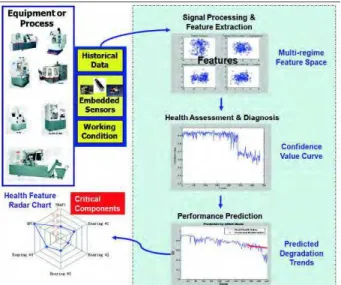
Potentially the interpretation of data into information is a very complex issue. One of many possible scenarios of conversion process of data obtained from different resources is shown in Fig. 2 (e.g. from the embedded sensors on the machines, from maintenance database, from manually input working conditions and experimental laboratory investigations into information [2]. Data is obtained from several resources and further transformed into multiple-regime features by selecting the appropriate computational tools for signal processing and feature extraction. In the feature space, indices are calculated by statistically detecting the deviation of the feature space from the baseline by choosing the appropriate computational tools for assessment / evaluation [3].
Figure 2. Data-to-information conversion process
In case of tribological investigations, conversion process is realised by data acquisition process whose block diagram is shown in Fig 3 [4]. Data acquisition system must convert real practice signals, such as amplitude, level, voltage, current intensity, temperature, pressure, weight, time period etc., which are not in a format acceptable for computer. It converts them into format understandable for computer, that is, into format that can be registered in databases. Data acquisition system of modern design consists of: analog - digital converter multiplexer, digital - analog transformer (D/A), sampling circuit (Sample/Hold), amplifier, timer (time circuits) and other specific circuits. One of the most important characteristics of the data acquisition system is that computer integrates them all into one compatible system. When appropriate software is added upon it, system is obtained that does not need detailed knowledge to use it. It is necessary to get acquainted with main problems in this area in order to make selection of such a system.
Analysis and manipulation Connecting module
Analog input
AD converter
Acquisition process control
LABTECH notebook
D
a
ta
re
c
o
rd
in
g
R
e
a
l
tim
e
p
ro
c
e
ss
Figure 3. Block diagram of data acquisition process
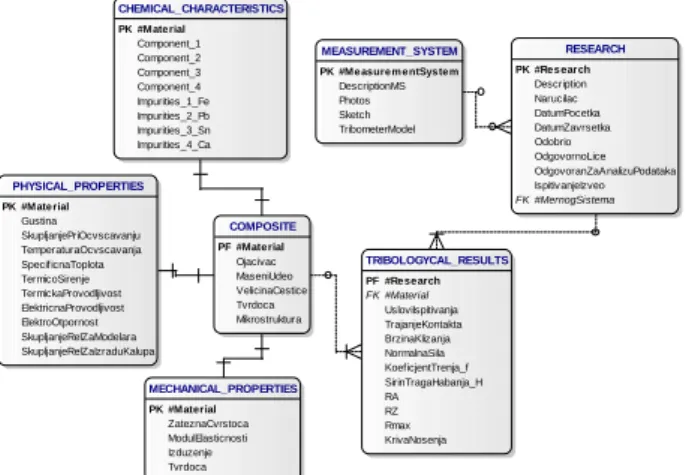
diagram. Software enables easy and simple work for a user in all database development phases: database creation, documenting, program code generation etc. [5].
By using DeZign for Databases, logical data model is created, in a form of a graphical diagram of entity relationships. Each entity has attributes that describe it and they are linked to each other by relationships. This software tool utilizes simple technique "show and click" to add entities into diagrams and to define their relationships. DeZign for Databases can automatically create schematic view of database from diagram of entity relationships, after they had been defined. The following database formats are supported: Oracle, InterBase, IBM DB2, MySQL, MaxDB, Paradox, MS SQL Server, MS Access, SQLAnywhere, Sybase, Informix, Pervasive, Advantage DB, DBISAM 3 i 4, FoxPro, PostgreSQL [6]. Databases are generated in MS SQL Serveru Express Edition, Microsoft development environment that enables very easy transfer to commercial versions. CHEMICAL_CHARACTERISTICS PK #Material Component_1 Component_2 Component_3 Component_4 Impurities_1_Fe Impurities_2_Pb Impurities_3_Sn Impurities_4_Ca PHYSICAL_PROPERTIES PK #Material Gustina SkupljanjePriOcvscavanju TemperaturaOcvscavanja Specif icnaToplota TermicoSirenje TermickaProvodljivost ElektricnaProvodljivost ElektroOtpornost SkupljanjeRelZaModelara SkupljanjeRelZaIzraduKalupa MEASUREMENT_SYSTEM PK #Measurem entSystem
DescriptionMS Photos Sketch TribometerModel RESEARCH PK #Research Description Narucilac DatumPocetka DatumZavrsetka Odobrio OdgovornoLice OdgovoranZaAnalizuPodataka IspitivanjeIzveo FK #MernogSistema MECHANICAL_PROPERTIES PK #Material ZateznaCvrstoca ModulElasticnosti Izduzenje Tvrdoca COMPOSITE PF #Material Ojacivac MaseniUdeo VelicinaCestice Tvrdoca Mikrostruktura TRIBOLOGYCAL_RESULTS PF #Research FK #Material UsloviIspitivanja TrajanjeKontakta BrzinaKlizanja NormalnaSila Koef icjentTrenja_f SirinTragaHabanja_H RA RZ Rmax KrivaNosenja
Figure 4. Relationship diagram
Database FIZICKE_OSOSBINE comprises data on tested materials such as: density (g/cm3) at 20oC, shrinkage during hardening (%), hardening temperature (oC), specific heat (J/kgK) at 24-92oC, thermal emission (m/mK) at 20-100oC, thermal conductivity (W/mK) at 24oC, electrical conductivity (%) IACS, electrical conductivity resistivity ( cm) at 20oC, shrinkage relevant for modeling (mm/m) and shrinkage relevant for die making (mm/m). This database enables comparison and comparative commenting on materials according to their physical properties. Database HEMIJSKE _KARAKTERISTIKE contains data on material chemical composition, mainly concerning alloys used in investigations, that is, percentage composition of aluminium, copper, zinc
and magnesium, as well as maximum share of impurities such as iron, cadmium, lead and tin.
Database MEHANIKCKE_OSOBINE contains data related to mechanical characteristics of used materials such as: tensile strength (MPa), elasticity modulus (GPa), elongation (%), hardness (HB). Database KOMPOZIT contains data related to type of reinforcements, mass share, particles size, hardness, as well as microstructure photograph. Databases MERNI_SISTEM and ISPITIVANJE contains basic data about created measurement system for investigations, its structure and elements, schema and photography of the measurement system; investigation description, client description, beginning date, and end date, who approved test, who performed test, who realised analysis, etc. These are all data related only to the investigation itself. Database REZULTATI_ TRIBOLOSKIH_ISPITIVANJA contains data about conditions and results of tribological investigations: test conditions (with or without lubrication), contact duration (min), sliding speed (m/s), normal force (daN), friction coefficient, width of the wear scar (mm), arithmetical mean roughness of a surface, Ra, mean asperities height, Rz, maximum asperities height, Rmax, bearing curve of a profile. Previously described databases with defined logical structure and interrelationships are suitable for analysis of tribological characteristics according to different criteria.
Figure 5. Access to OLAP Cube
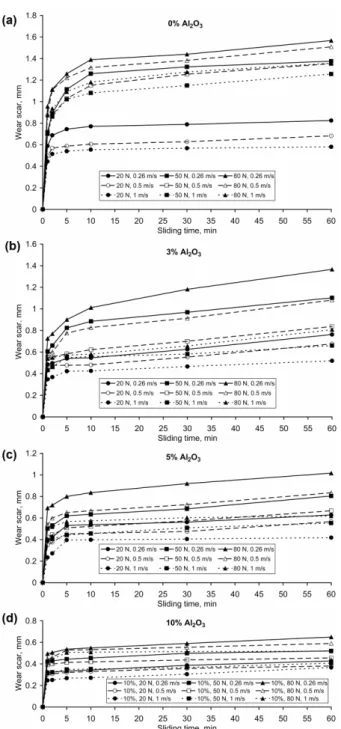
Figure 6. Wear curves of: (a) ZA-27 matrix alloy, (b) MMC 3% Al2O3 (c) MMC 5% Al2O3 (d) MMC
10% Al2O3
Analysis of data organized in OLAP cubes in
Excel and Statistica is done by creation of so
called pivot tables. MS Excel and Statistica
enable analysis by using additional tools which
are part of this software. User is provided with
the possibility to directly do report printing for
specified time interval, for selected level of
details and dimensions distribution.
Pivot table represents dynamic table with
integrated data from some database. It is used
for tabular representation of number of data
types/dimensions. It enables for resulting data
to be presented in any selected level of details.
Pivot Table Wizard in MS Excel and Statistica
is used to create pivot tables.
Reporting is the last and crucial step of long and
complex
process
of
collecting,
storing,
transforming and manipulating data. Report
creating represents presentational layer of
working with databases, a layer that leads to
generation of knowledge from data. Fig. 6. [4]
shows data on wear scar width in time (wear
curves) as diagrams, and comparative histogram
view of wear of tested materials, obtained from
database in MS Excel, is given in Fig. 7 [4]. By
using software tool Statistica, data from
databases is used for 3D view and determination
of analytical relations (using regression function)
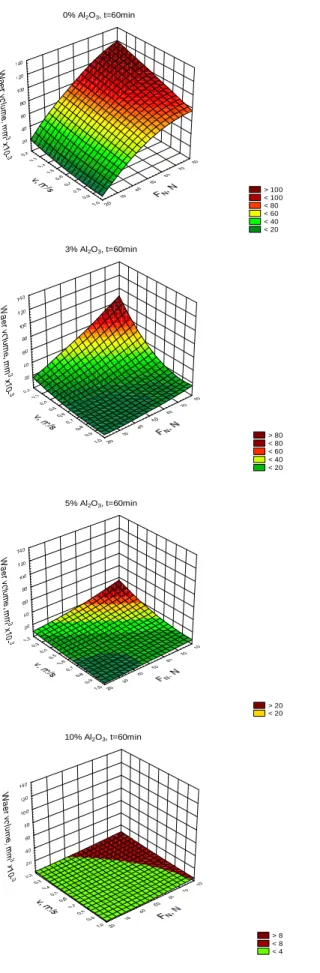
with high correlation factor. Fig. 8. [4] illustrates
report of tribological investigations realised in
Statistica, and it shows multidimensional
relationships between wear, mass weight of the
reinforcements, sliding speed, and normal load.
0% Al2O3, t=60min
> 100 < 100 < 80 < 60 < 40 < 20
3% Al2O3, t=60min
> 80 < 80 < 60 < 40 < 20
5% Al2O3, t=60min
> 20 < 20
10% Al2O3, t=60min
> 8 < 8 < 4
Figure 8. Relationships between wear scar width and normal load and sliding speed, for different
mass weight of the reinforcements
3.
CONCLUSION
Data structuring, finding adequate information and knowledge gaining are the pre-conditions to understanding and making appropriate and quality conclusions and decisions. During that, it is important that processing and analysis of information make constant process which is adapted to changes in time. New software technologies, such as open service architectures (SOA- Service Oriented Architecture), open data exchange standards (Open Standards for Data Exchange) and similar significantly influence data conversion into information to be introduced as a part of the scientific research work. For such a concept, Internet is especially important, as broad data resource and as a system for exchange of data that should be structured and exchanged in unique way.
Acknowledgment
This study was financed by Ministry of Science and Technological Development, Serbia, project No.35021.
REFERENCES
[1] Sydanmanaka P., An Intelligent Organization: Integrating performance, Competence and Knowledge Management, Capstone, Oxford, 2002.
[2] Jay Lee, Linxia Liao, Edzel Lapira, Jun Ni and Lin Li, Informatics Platform for Designing and Deploying e-Manufacturing Systems, Springer, 2009.
[3] Anthony Cleve, Jean Henrard and Jean-Luc Hainaut, Co-transformations in Information System Reengineering, Electronic Notes in Theoretical Computer Science 137, 2005.
[4] Mitrović S., Tribological characteristics of composites based on ZnAl alloys, PhD thesis (in Serbian), 2007.
[5] Jean-Marc Hick, Jean-Luc Hainaut, Database application evolution: A transformational approach, Data & Knowledge Engineering 59, 534–558, 2006.