CPD
11, 279–305, 2015Forcing of paleoclimate
H.-J. Lüdecke et al.
Title Page
Abstract Introduction
Conclusions References
Tables Figures
◭ ◮
◭ ◮
Back Close
Full Screen / Esc
Printer-friendly Version Interactive Discussion
Discussion
P
a
per
|
Discussion
P
a
per
|
Discussion
P
a
per
|
Discussion
P
a
per
|
Clim. Past Discuss., 11, 279–305, 2015 www.clim-past-discuss.net/11/279/2015/ doi:10.5194/cpd-11-279-2015
© Author(s) 2015. CC Attribution 3.0 License.
This discussion paper is/has been under review for the journal Climate of the Past (CP). Please refer to the corresponding final paper in CP if available.
Paleoclimate forcing by the solar
De Vries/Suess cycle
H.-J. Lüdecke1,*, C. O. Weiss2,*, and A. Hempelmann3
1
HTW, University of Applied Sciences, Saarbrücken, Germany 2
Physikalisch-Technische Bundesanstalt, Braunschweig, Germany 3
University of Hamburg, Hamburg Observatory, Hamburg, Germany *
retired
Received: 8 December 2014 – Accepted: 21 January 2015 – Published: 12 February 2015
Correspondence to: H.-J. Lüdecke ([email protected])
CPD
11, 279–305, 2015Forcing of paleoclimate
H.-J. Lüdecke et al.
Title Page
Abstract Introduction
Conclusions References
Tables Figures
◭ ◮
◭ ◮
Back Close
Full Screen / Esc
Printer-friendly Version Interactive Discussion
Discussion
P
a
per
|
Discussion
P
a
per
|
Discussion
P
a
per
|
Discussion
P
a
per
|
Abstract
A large number of investigations of paleoclimate have noted the influence of a ∼200 year oscillation which has been related to the De Vries/Suess cycle of solar activity. As such studies were concerned mostly with local climate, we have used extensive northern hemispheric proxy data sets of Büntgen and of
5
Christiansen/Ljungqvist together with a southern hemispheric tree-ring set, all with 1 year time resolution, to analyze the climate influence of the solar cycle. As there is increasing interest in temperature rise rates, as opposed to present absolute temperatures, we have analyzed temperature differences over 100 years to shed light on climate dynamics of at least the last 2500 years. Fourier- and Wavelet transforms as
10
well as nonlinear optimization to sine functions show the dominance of the∼200 year cycle. The sine wave character of the climate oscillations permits an approximate prediction of the near future climate.
1 Introduction
The search for cycles on nearly all time scales in time series of temperatures,
15
precipitations and droughts has a long tradition. The physical mechanisms of these cycles are mostly unknown. As hypotheses, solar modes, auto climate modes (episodic outbursts of big meltwater reservoirs, thermohaline circulation through a threshold response etc.), and cosmic modes governed by big planets are discussed, (Friis-Christensen and Lassen, 1991; Van Geel et al., 2003; Braun et al., 2005; Lohmann
20
and Schöne, 2013; Scafetta, 2012). In the present study we look for dominant climate cycles in the period regime of∼200 years and their influence on the recent and near future climate. We found no work on auto oscillations in this period range, by contrast, in all papers solar forcing is considered as the main cycle driver.
The studies begin with De Vries (1958) and Suess (1980) who found variations in
25
CPD
11, 279–305, 2015Forcing of paleoclimate
H.-J. Lüdecke et al.
Title Page
Abstract Introduction
Conclusions References
Tables Figures
◭ ◮
◭ ◮
Back Close
Full Screen / Esc
Printer-friendly Version Interactive Discussion
Discussion
P
a
per
|
Discussion
P
a
per
|
Discussion
P
a
per
|
Discussion
P
a
per
|
analyze terrestrial temperature proxies and the De Vries/Suess solar activity and find a good correlation, particularly when incorporating volcanic activity. Cliver et al. (1998) show a precise linear dependence of solar magnetic field (thus solar activity) and Earth temperature and estimate the influence of the Sun on the 20th century Earth climate change up to 100 %. Raspopov et al. (2008) find a clear∼200 year cycle and
5
relate it with the solar De Vries/Suess cycle. How closely the Earth temperature is related with the solar De Vries/Suess cycle becomes apparent in the study of Knudsen et al. (2011) who find the characteristic “burst” pattern (1000 years of oscillation, repeating every 2500 years) mirrored in the temperatures derived from stalagmites in subtropical caves of China, Turkey, USA. Novello et al. (2012) find the AMO plus
10
De Vries/Suess cycle the dominant contribution to the nordeast Brazilian climate for the last 3000 years, in correspondence with our results (Lüdecke, 2012). Wagner et al. (2001) demonstrate that the De Vries/Suess cycle of ∼205 years is present in 10Be data from the GRIP ice core during the last ice age, 20 to 50 kyr BP. Liu et al. (2011) find cycles of 1324, 800, 199, and 110 years in tree-rings of the Tibetan Plateau for
15
the past 2485 years and make a prediction that the temperatures will decrease in the future until ∼AD 2070 and then increase again. Steinhilber and Beer (2013) find in their analysis of solar isotope data the De Vries/Suess cycle as the strongest spectral component and, additionally, give a prediction of future climate for the next 500 years with cooling until∼AD 2080. Kern et al. (2012) find the influences of 80, 120, 208, 500,
20
1000 and 1500 year cycles and show that the De Vries/Suess cycle was a dominant factor for the Earth climate. Zhao and Feng (2015) find periodicities of 208, 521, and ∼1000 years in antarctic ice-core records. Evidences of the dominance of the De Vries/Suess cycle of solar activity on terrestrial climate are given in Seidenglanz et al. (2012); Leal-Silva and Herrera (2012); Costas et al. (2012), and Scafetta (2012) to
25
CPD
11, 279–305, 2015Forcing of paleoclimate
H.-J. Lüdecke et al.
Title Page
Abstract Introduction
Conclusions References
Tables Figures
◭ ◮
◭ ◮
Back Close
Full Screen / Esc
Printer-friendly Version Interactive Discussion
Discussion
P
a
per
|
Discussion
P
a
per
|
Discussion
P
a
per
|
Discussion
P
a
per
|
survey of papers investigating the influence of the Sun on terrestrial climate cycles is given in Lüning (2014). Dima and Lohmann (2008) and Huybers and Wunsch (2003) discuss a rectification hypothesis based on nonlinearity of the terrestrial system. In view of these various investigations of the influence of solar activity on local climate the question of the effects on the global scale arises.
5
2 Differences vs. absolute temperatures
There is interest in temperature rise rates besides the absolute temperatures, for instance applied in trend analysis (Lennartz and Bunde, 2011) or to detect Dansgaard– Oeschger events (Rahmstorf, 2003). Therefore, we looked in yearly records of 100 year temperature differences for cycles. For this purpose, from a yearly temperature time
10
seriesT(t1),. . .,T(tL) of theLyearst1,. . .,tLthe pertinent∆T(t) record of lengthL−100 is derived as follows:∆T(tj) is the backward temperature difference over 100 years by linear regressionR,
R[T(tj−99),. . .,T(tj)]=aj·t+cj (1)
which yields
15
∆T(tj)=aj·(tj−tj−99) (2)
Note that the∆T(t) record is 100 years shorter than theT(t) record because the first
∆T(t) value belongs tot100.
Differences by linear regression ∆T(t) are better suited to reveal temperature periodicities in a certain frequency range than temperaturesT(t) themselves, because
20
frequency components outside the range are weakened, the differencing acting as a spectral filter. The Fourier spectra of theT(t) and the∆T(t) records show the same frequencies but different peak powers. This is plausible since the derivative of a sine function has the same spectrum as the sine function itself, and the ∆T(t) data are rather similar to a sine function.
CPD
11, 279–305, 2015Forcing of paleoclimate
H.-J. Lüdecke et al.
Title Page
Abstract Introduction
Conclusions References
Tables Figures
◭ ◮
◭ ◮
Back Close
Full Screen / Esc
Printer-friendly Version Interactive Discussion
Discussion
P
a
per
|
Discussion
P
a
per
|
Discussion
P
a
per
|
Discussion
P
a
per
|
3 The data
For sufficient resolution in the Fourier analysis and to avoid possible distortions by interpolations,T(t) records of 1 year time resolution are desirable. A length of at least ∼2000 years is further desirable to avoid Fourier artifacts within the multi centennial region of interest. Recently two appropriate Northern Hemisphere temperature proxy
5
stacks are available extending back to a maximum of −2500 yr BP. One stack (0 to AD 1973) contains 91 temperature proxy series evaluated from tree rings, stalagmites, ice cores, sediments etc. (Christiansen and Ljungqvist, 2012). The other (−499 BP to AD 1993) was evaluated from 7284 tree ring samples, a total of 1546 ring width series, from high elevation conifers from the Austrian Alps (Büntgen et al., 2011). For
10
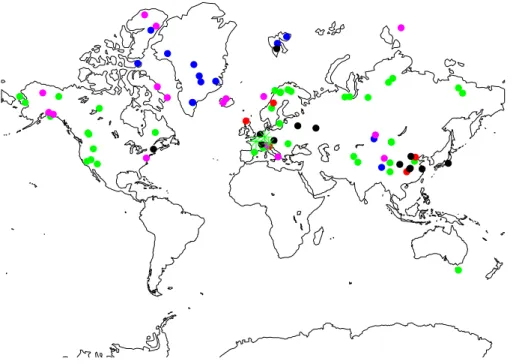
the Southern Hemisphere a Tasmanian tree ring record of 3592 years exists (Cook et al., 2000). Figure 1 shows the geographic locations of the proxies used in this study. Apart from these records no other publicly available data meet the requirements for the analysis. For a relation with solar activity, we analyzed the production rate record
P(t) of the solar isotope abundances of10Be and 14C (Steinhilber et al., 2012), which
15
has a time resolution of 22 years. ThisP(t) series extends back to−7404 BP. Fourier-and wavelet analyses were given (Steinhilber et al., 2012). Table 1 gives the main characteristics of the records used. Figure 2 shows the data together with their∆T(t) resp.∆P(t) graphs, constructed according to Eqs. (1) and (2). Since the P(t) record has 22 year time steps we have used 110 years instead of 100 years for the differences.
20
4 Spectral analysis
For the discrete Fourier transform (DFT) the records were padded with 25 000 zeros, yielding optimum interpolation of the DFT spectra. The data were converted to anomalies around the mean and normalized to the SD. The confidence curves with respect to background noise were generated by MC-simulation for which 10 000
25
CPD
11, 279–305, 2015Forcing of paleoclimate
H.-J. Lüdecke et al.
Title Page
Abstract Introduction
Conclusions References
Tables Figures
◭ ◮
◭ ◮
Back Close
Full Screen / Esc
Printer-friendly Version Interactive Discussion
Discussion
P
a
per
|
Discussion
P
a
per
|
Discussion
P
a
per
|
Discussion
P
a
per
|
pertinent records, in the form of anomalies and normalized to the SD. H was obtained by detrended fluctuation analysis (DFA) (Kantelhardt et al., 2001; Kantelhardt, 2004). With MC-simulation the calculation of the confidence curves is not restricted to red AR1 noise.
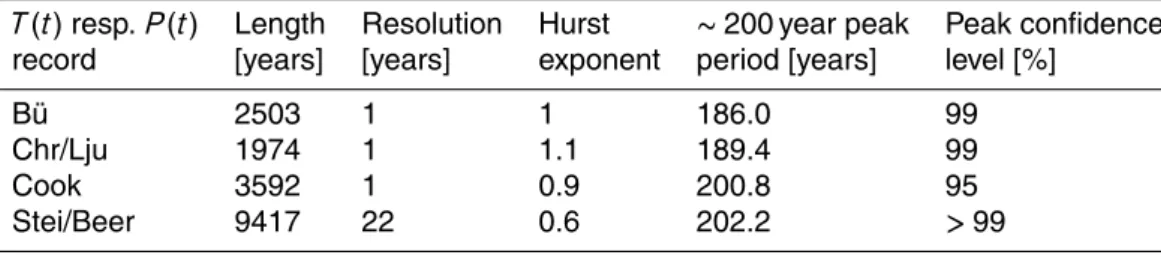
Table 2 gives the record lengths, record resolutions, Hurst exponents, DFT periods
5
for the strongest peak in the∼200 year period band, and confidence levels. Figure 3 shows the DFT spectra. The ∼200 year peaks in the NH series Bü and Chr/Lju, as well as the pertinent peak in the Stei/Beer isotope record have powers giving 99 % confidence level against noise, in the SH series of Cook only 95 %.
We note that the spectrum of theP(t) record shows 3 distinct peaks at∼200 years.
10
It would seem that this reflects the amplitude modulation AM of the De Vries oscillation (Knudsen et al., 2011) known as the “Suess bursts” (1000 years of strong oscillation amplitude followed by weaker oscillation, repeating every 2500 years. Spectrum of an AM being a central carrier with two sidebands).
Figure 4 shows the wavelet analysis (Torrence and Compo, 1998) of theT(t) resp.
15
P(t) records, Fig. 6 the cross wavelets (Grinsted et al., 2004). Because the Stei/Beer record with 22 year steps and its 1 year step interpolated version show no difference in DFT, the interpolated version was applied for the wavelet analysis. All wavelet spectra exhibit variations in power and frequency over the time. We mention that the NH records Bü and Chr/Lju have a disruption of the cycle regularity around the years
20
CPD
11, 279–305, 2015Forcing of paleoclimate
H.-J. Lüdecke et al.
Title Page
Abstract Introduction
Conclusions References
Tables Figures
◭ ◮
◭ ◮
Back Close
Full Screen / Esc
Printer-friendly Version Interactive Discussion
Discussion
P
a
per
|
Discussion
P
a
per
|
Discussion
P
a
per
|
Discussion
P
a
per
|
5 Sine wave fit by nonlinear optimization
The appearance of Fig. 2 suggests that the∆T(t) and∆P(t) records can be reasonably represented by single sine functions
∆Tsine(resp.∆Psine)=sin(2πν·t+ϕ) (3)
The parameters of the sine functionνandϕcould in principle be taken from the DFT.
5
However, DFT has uncertainty margins and treats the data as infinite recurrences, which is equivalent to compulsory boundary conditions
sin(2πν·tstart+ϕ)=sin(2πν·tend+ϕ) (4)
To avoid this restrictions and associated possible artifacts, the frequency ν and the phasesϕof the sine representations ∆Tsineand ∆Psinewere determined by nonlinear
10
optimization (Nelder and Mead, 1965). The objective functionF(ν,ϕ) to be minimized is the negative Pearson correlation betweenX = ∆TsineandY = ∆T(t) resp.X = ∆Psine
andY = ∆P(t)
F(ν,ϕ)=−ρXY=−
cov(X,Y)
σXσY (5)
As the result, we find nearly the same frequencies for all records as in DFT (see
15
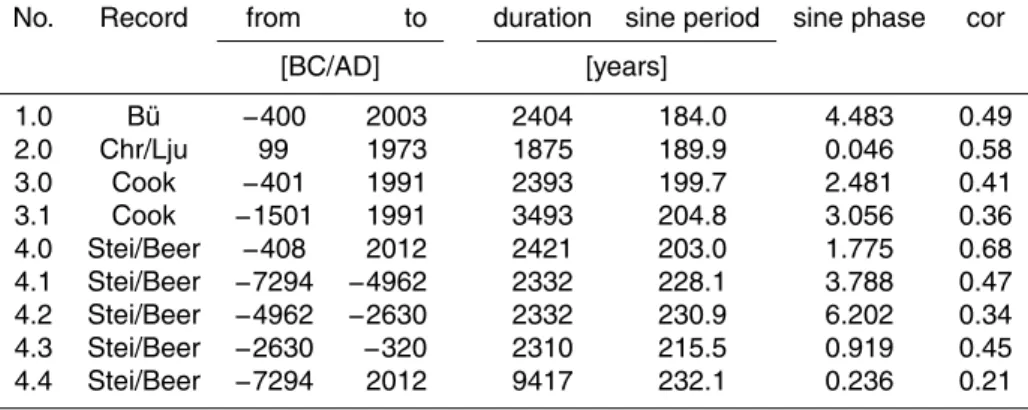
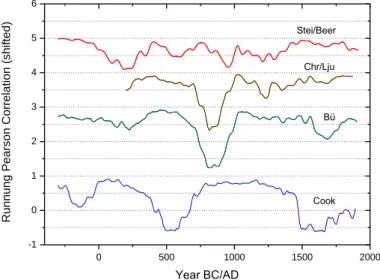
Table 2). Table 3 shows parameters and results of the nonlinear optimization. Figure 6 shows the difference records ∆T(t) and ∆P(t) together with the pertinent sine representations. The running correlations for a 200 year window are given in Fig. 7, showing a notable common gap of correlation around∼AD 700 for the Bü and Chr/Lju series. The disruption of the climate cycle which occurs for the two NH temperature
20
CPD
11, 279–305, 2015Forcing of paleoclimate
H.-J. Lüdecke et al.
Title Page
Abstract Introduction
Conclusions References
Tables Figures
◭ ◮
◭ ◮
Back Close
Full Screen / Esc
Printer-friendly Version Interactive Discussion
Discussion
P
a
per
|
Discussion
P
a
per
|
Discussion
P
a
per
|
Discussion
P
a
per
|
We note that the 20th century∆T(t) maximum is comparable in magnitude with the past maxima. Thus, the proxies used in this paper show that the warming rate during the 20th century lies within the natural rates of change.
The correlation of the ∆T(t) records Bü and Chr/Lju (AD 99–1973) is 0.45. The higher correlation of these records with sine functions∆Tsineindicates that the essential
5
content of the two records is their periodic character.
The sine representation over the 9307 years of the Stei/Beer difference record yields a correlation of only 0.21, apparently due to phase noise during the long time. For a test, we divided the record into subsections of ∼2330 years and find higher correlations with periods and phases given in the rows 4.0–4.3 of Table 3. According to this, the
10
∼200 year cycle varies between 185 and 230 years in period length. In a corresponding wavelet diagram (Knudsen et al., 2011) the period is found to shift up to∼240 years in 5000 yr BP, in agreement with our finding given in Table 3 and in the left upper panel of Fig. 4.
6 Phase noise of the climate cycle
15
To identify reasonably maxima and minima in Fig. 6 as real extrema, we must define an objective criterion. Since each record is represented by a single sine function, we define the following criterion for a cycle maximum: it must lie within less than half of the sine period to a sine maximum and exceed 1/2 of the data SD. If more than one maximum satisfies this condition, we choose the strongest one. Admissible maxima which only
20
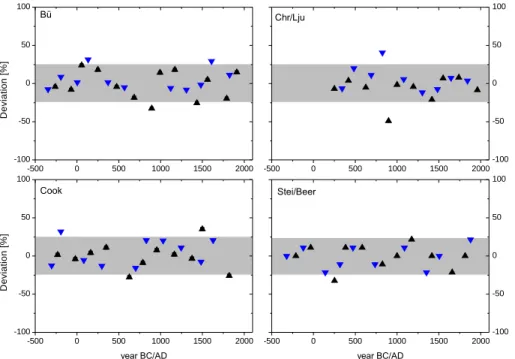
fail the “standard-deviation-condition” are still counted if the Pearson correlation of the data with the sine representation exceeds 0.4 during the time interval between two neighboring sine minima. The corresponding criterion applies with the minima. Figure 8 shows the time deviations of the maxima and minima from the sine wave extrema (Fig. 6) demonstrating a good cycle stability over the whole duration of∼2500 years.
CPD
11, 279–305, 2015Forcing of paleoclimate
H.-J. Lüdecke et al.
Title Page
Abstract Introduction
Conclusions References
Tables Figures
◭ ◮
◭ ◮
Back Close
Full Screen / Esc
Printer-friendly Version Interactive Discussion
Discussion
P
a
per
|
Discussion
P
a
per
|
Discussion
P
a
per
|
Discussion
P
a
per
|
7 Confidence levels
In order to ascertain a statistical confidence level of the correlation between the data and the sine-representations (see Fig. 6), we assumed the Null hypothesis that the correlation is caused by chance. We tested the Null hypothesis by Monte Carlo simulations, in each case with 10 000 random surrogate records of the same length and
5
the same Hurst exponent H as the pertinent time seriesT(t) resp.P(t) given in Table 2. The surrogate time series were converted into difference records ∆T(t) resp. ∆P(t) according to Eqs. (1) and (2). Next, the Pearson correlations of these surrogates with the pertinent sine representations∆Tsineresp.∆Psinegiven in Table 3 were calculated.
The following numbers of surrogates out of 10 000 had better or equal correlations
10
with the pertinent sines: 6 for Bü, 3 for Chr/Lju, 42 for Cook, and 0 for Stei/Beer. As a consequence, the Null hypothesis can be rejected with a confidence level of 99.9 % for Chr/Lju, Bü, and Stei/Beer and of 95 % for Cook.
Besides 100 year linear regression length, we tested also the lengths 50 and 150 years for all temperature records. However, the sine representation by nonlinear
15
optimization becomes more difficult for the 50 year length because the algorithm tends to be trapped in local minima. With 50 year length, the values of the correlations for all records are distinctly worse than for 100 year length. With 150 year length, again neither significant differences to 100 year length in the optimum period arise, however, the correlations with the pertinent sine representations become somewhat better. In
20
order to verify that in the period-phase plane no better correlations than those with the sine representations cited in Table 3 exist, we optimized the difference records through all sine periods from 50 years until 200 years in 0.1 year steps evaluating in every step only the sine phases by nonlinear optimization. As a result, no better correlations than those belonging to the “De Vries/Suess” periods, cited in Table 3, are found. Thus,
25
CPD
11, 279–305, 2015Forcing of paleoclimate
H.-J. Lüdecke et al.
Title Page
Abstract Introduction
Conclusions References
Tables Figures
◭ ◮
◭ ◮
Back Close
Full Screen / Esc
Printer-friendly Version Interactive Discussion
Discussion
P
a
per
|
Discussion
P
a
per
|
Discussion
P
a
per
|
Discussion
P
a
per
|
8 Tentative prediction of the climate future
The Earth’s climate shows a rather regular oscillation of∼200 year period during the last millennia. However, frequency, phase, and strength of the oscillation are found to vary in different time series of temperatures and for different times (see Figs. 4–6, and 8). Nonetheless, the relative historic stability of the cycle suggests that the periodic
5
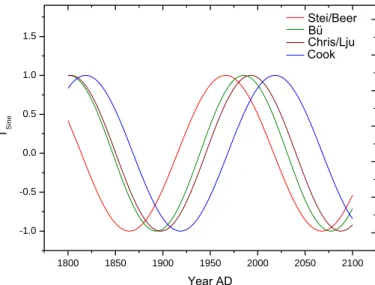
nature of the climate will persist also for the foreseeable future. Disregarding other conceivable forcings e.g. anthropogenic influences, an approximate prediction of the climate for the next 100 years suggests itself. Figure 9 shows theTsine representation
from AD 1800 to AD 2100 derived from the∆Tsine representation by aπ/2 phase shift.
It gives correctly the 1850–1900 temperature minimum and shows a temperature drop
10
from present to∼AD 2080, the latter comparable with the minimum of 1870, as already predicted in the studies (Steinhilber and Beer, 2013; Liu et al., 2011) on the grounds of solar activity data alone.
9 Summary and discussion
We have analyzed the differences of temperatures resp. isotope production rates
15
of the most extensive paleoclimate temperature proxy sets for the NH and the SH (Christiansen and Ljungqvist, 2012; Büntgen et al., 2011; Cook et al., 2000) and an isotopes production time series (Steinhilber and Beer, 2013). The methods are spectral, including wavelet analyses and nonlinear optimization fitting of single sine functions to the records. The global picture emerges of a ∼200 year period climate
20
oscillation which correlates highly with the De Vries/Suess oscillation of solar activity. This would indicate that the dominant forcing of the paleoclimate is the solar activity.
For different records and different times, however, we find frequencies differing slightly from the main ∼200 year periodicity. The solar influence is modified by the response of the Earth system and its inherent forcings such as volcanic activity. Such
25
time-CPD
11, 279–305, 2015Forcing of paleoclimate
H.-J. Lüdecke et al.
Title Page
Abstract Introduction
Conclusions References
Tables Figures
◭ ◮
◭ ◮
Back Close
Full Screen / Esc
Printer-friendly Version Interactive Discussion
Discussion
P
a
per
|
Discussion
P
a
per
|
Discussion
P
a
per
|
Discussion
P
a
per
|
series∆T(t) may be attributed. The terrestrial activities may dominate the solar activity temporarily, e.g. disrupting the sine-like oscillations. Such disruptions are clearly visible in Figs. 4–7. They can affect the oscillation amplitude as well as the phase. For longer term changes in phase and amplitude one may keep in mind a modulation of the higher frequency oscillations (e.g. the ∼200 year period De Vries/Suess cycle) by
5
lower frequency –, i. e. millennial period cycles. Zhao and Feng (2015) showed that the millennial cycles exhibit high phase stability compared to the centennial cycles. This could show such a modulation, which is by all means to be expected in view of the nonlinearities of the terrestrial system, and even for the sun system itself, as the different frequencies in the rows 4.0–4.4 of Table 3 show. By such modulation,
10
continuous phase changes over a long time can occur, equivalent to frequency shifts as mentioned above, such as we and also Zhao/Feng find them in different proxies and for different times. We observe that the unequal strength of the sidebands of the ∼200 year period oscillation of the solar activity (Fig. 3 left upper panel) is consistent with a simultaneous modulation of amplitude and phase. Evidently with the proxies
15
available of only 10 to 12 De Vries/Suess cycles such cross modulation between cycles cannot be unambiguously proven, but nonetheless is a possible explanation for the differing frequencies.
Acknowledgements. We thank Sebastian Lüning for helpful discussions and providing us with
additional references to the interdependence of solar activity and climate change. 20
References
Braun, H., Christl, M., Rahmstorf, S., Ganopolski, A., Mangini, A., Kubatzki, C., Roth, K., and Kromer, B.: Possible solar origin of the 1,470-year glacial climate cycle demonstrated in a coupled model, Nature, 438, 208–211, 2005. 280
Breitenmoser, P., Beer, J., Brönnimann, S., Frank, D., Steinhilber, F., and Wanner, H.: Solar 25
CPD
11, 279–305, 2015Forcing of paleoclimate
H.-J. Lüdecke et al.
Title Page
Abstract Introduction
Conclusions References
Tables Figures
◭ ◮
◭ ◮
Back Close
Full Screen / Esc
Printer-friendly Version Interactive Discussion
Discussion
P
a
per
|
Discussion
P
a
per
|
Discussion
P
a
per
|
Discussion
P
a
per
|
Büntgen, U., Tegel, W., Nicolussi, K., McCormick, M., Frank, D., Trouet, V., Kaplan, J. O., Herzig, F., Heussner, K.-U., Wanner, H., Luterbacher, J., and Esper, J.: 2500 years of European climate variability and human susceptibility, Science, 331, 578–582, doi:10.1126/science.1197175, 2011. 283, 288, 294, 297, 298, 299, 300
Christiansen, B. and Ljungqvist, F. C.: The extra-tropical Northern Hemisphere temperature in 5
the last two millennia: reconstructions of low-frequency variability, Clim. Past, 8, 765–786, doi:10.5194/cp-8-765-2012, 2012. 283, 288, 294, 297, 298, 299, 300
Cliver, E. W., Boriakoff, V., and Feynman, J.: Solar variability and climate change: geomagnetic aa index and global surface temperature, Geophys. Res. Lett., 25, 1035–1038, 1998. 281 Cook, E. R., Buckley, B. M., D’Arrigo, R. D., and Peterson, M. J.: Warm-season temperatures 10
since 1600 BC reconstructed from Tasmanian tree rings and their relationship to large-scale sea surface temperature anomalies, Clim. Dynam., 16, 79–91, 2000. 283, 288, 294, 297, 298, 299, 300
Costas, S., Jerez, S., Trigo, R. M., Goble, R., and Rebelo, L.: Sand invasion along the Portuguese coast forced by westerly shifts during cold climate events, Quaternary Sci. Rev., 15
42, 15–28, 2012. 281
De Vries, H.: Variation in concentration of radiocarbon with time and location on Earth, K. Ned. Akad. Van. Wet.-B, 61, 94–102, 1958. 280
Dima, M. and Lohmann, G.: Conceptual model for millenial climate variability: a possible combined solar-thermohaline circulation origin for the∼1,500-year cycle, Clim. Dynam., 32, 20
301–311, 2008. 282
Enghoff, M. B., Pedersen, J. O. P., Uggerhoj, U. I., and Paling, S. M.: Aerosol nucleation induced by a high energy particle beam, Geophys. Res. Lett., 38, L09805, doi:10.1029/2011GL047036, 2011. 281
Friis-Christensen, E. and Lassen, K.: Length of the solar cycle: an indicator of solar activity 25
closely associated with climate, Science, 254, 698–700, 1991. 280
Grinsted, A., Moore, J. C., and Jevrejeva, S.: Application of the cross wavelet transform and wavelet coherence to geophysical time series, Nonlin. Processes Geophys., 11, 561– 566, doi:10.5194/npg-11-561-2004, software available at: http://noc.ac.uk/using-science/ crosswavelet-wavelet-coherence (last access: February 2015), 2014. 284, 301
30
CPD
11, 279–305, 2015Forcing of paleoclimate
H.-J. Lüdecke et al.
Title Page
Abstract Introduction
Conclusions References
Tables Figures
◭ ◮
◭ ◮
Back Close
Full Screen / Esc
Printer-friendly Version Interactive Discussion
Discussion
P
a
per
|
Discussion
P
a
per
|
Discussion
P
a
per
|
Discussion
P
a
per
|
Kantelhardt, J. W.: Fluktuationen in komplexen Systemen, Habilitationsschrift, Universität Gießen, Germany, available at: http://www.physik.uni-halle.de/Fachgruppen/kantel/habil.pdf (last access: February 2015), 2004. 284
Kantelhardt, J. W., Koscielny-Bunde, E., Rego, H. H. A., Havlin, S., and Bunde, A.: Detecting long-range correlations with detrended fluctuation analysis, Physica A, 295, 441–454, 2001. 5
284
Kern, A. K., Harzhauser, M., Piller, W. E., Mandic, O., and Soliman, A.: Strong evidence for the influence of solar cycles on a Late Miocene lake system revealed by biotic and abiotic proxies, Palaeogeogr. Palaeocl., 329–330, 124–136, 2012. 281
Knudsen, M. F., Jacobsen, B. H., Riisager, P., Olsen, J., and Seidenkrantz, M.-S.: Evidence of 10
Suess solar-cycle bursts in subtropical Holocene speleothemδ18O records, Holocene, 22, 597–602, 2011. 281, 284, 286
Leal-Silva, M. C. and Velasco Herrera, V. M.: Solar forcing on the ice winter severity index in the western Baltic region, J. Atmos. Sol-Terr. Phy., 89, 98–109, 2012. 281
Lennartz, S. and Bunde, A.: Distribution of natural trends in long-term correlated records: 15
a scaling approach, Phys. Rev. E, 84, 021129, doi:10.1103/PhysRevE.84.021129, 2011. 282 Liu, Y., Cai, Q., Song, H., An, Z., and Linderholm, H. W.: Amplitudes, rates, periodicities and causes of temperature variations in the past 2485 years and future trends over the central-eastern Tibetan Plateau, Chinese Sci. Bull., 56, 2986–2994, doi:10.1007/s11434-011-4713-7, 2011. 281, 288
20
Lohmann, G. and Schöne, B. R.: Climate signatures on decadal to interdecadal time scales as obtained from mollusk shells (Arctica islandica) from Iceland, Palaeogeogr. Palaeocl., 373, 152–162, 2013. 280
Lüdecke, H.-J., Hempelmann, A., and Weiss, C. O.: Multi-periodic climate dynamics: spectral analysis of long-term instrumental and proxy temperature records, Clim. Past, 9, 447–452, 25
doi:10.5194/cp-9-447-2013, 2013. 281
Lüning, S.: Compilation of references of solar-climate cycles, available at: www. klimaargumente.de/#sonne (last access: February 2015), and chrono.qub.ac.uk/blaauw/cds. html (last access: February 2015), 2014. 282
Marsh, N. and Svensmark, H.: Low cloud properties influenced by cosmic rays, Phys. Rev. 30
Lett., 85, 5004–5007, 2000. 281
CPD
11, 279–305, 2015Forcing of paleoclimate
H.-J. Lüdecke et al.
Title Page
Abstract Introduction
Conclusions References
Tables Figures
◭ ◮
◭ ◮
Back Close
Full Screen / Esc
Printer-friendly Version Interactive Discussion
Discussion
P
a
per
|
Discussion
P
a
per
|
Discussion
P
a
per
|
Discussion
P
a
per
|
Novello, V. F., Cruz, F. W., Karmann, I., Burns, S. J., Strikis, N. M., Vuille, M., Cheng, H., Edwards, R. L., Santos, R. V., Frigo, E., and Barreto, E. A. S.: Multidecadal climate variability in Brazil’s Nordeste during the last 3000 years based on speleothem isotope records, Geophys. Res. Lett., 39, L23706, doi:10.1029/2012GL053936, 2012. 281
Rahmstorf, S.: Timing of abrupt climate change: a precise clock, Geophys. Res. Lett., 30, 1510, 5
doi:10.1029/2003GL017115, 2003. 282
Raspopov, O. M., Dergachev, V. R., Esper, J., Kozyreva, O. V., Frank, D., Ogurtsov, M., Kolström, T., and Shao, X.: The influence of the de Vries (∼200-year) solar cycle on climate variations: results from the Central Asian Mountains and their global link, Palaeogeogr. Palaeocl., 259, 6–16, 2008. 281
10
Scafetta, N.: Multi-scale harmonic model for solar and climate cyclical variation throughout the Holcene based on Jupiter-Saturn tidal frequencies plus the 11-year solar dynamo cycle, J. Atmos. Sol-Terr. Phy., 80, 296–311, 2012. 280, 281
Seidenglanz, A., Prange, M., Varma, V., and Schulz, M.: Ocean temperature response to idealized Gleissberg and de Vries solar cycles in a comprehensive climate model, Geophys. 15
Res. Lett., 39, L22602, doi:10.1029/2012GL053624, 2012. 281
Steinhilber, F. and Beer, J.: Prediction of solar activity for the next 500 years, J. Geophys. Res.-Space, 118, 1861–1867, 2013. 281, 288, 294, 298, 299, 300
Steinhilber, F., Abreu, J. A., Beer, J., Brunner, I., Christl, M., Fischer, H., Heikkilä, U., Kubik, P. W., Mann, M., McCracken, K. G., Miller, H., Miyahara, H., Oerter, H., and 20
Wilhelms, F.: 9,400 years of cosmic radiation and solar activity from ice cores and tree rings, P. Natl. Acad. Sci. USA, 109, 5967–5971, doi:10.1073/pnas.1118965109, 2012. 283 Suess, H. E.: The radiocarbon record in tree rings of the last 8000 years, Radiocarbon, 22,
200–209, 1980. 280
Svensmark, H.: Influence of cosmic rays on Earth’s climate, Phys. Rev. Lett., 81, 5027–5030, 25
1998 281
Svensmark, H., Bondo, T., and Svensmark, J.: Cosmic ray decreases affect atmospheric aerosols and clouds, Geophys. Res. Lett., 36, L15101, doi:10.1029/2009GL038429, 2009. 281
Torrence, C. and Compo, P.: A practical guide to wavelet analysis, Bulletin of the AMS, 79, 30
CPD
11, 279–305, 2015Forcing of paleoclimate
H.-J. Lüdecke et al.
Title Page
Abstract Introduction
Conclusions References
Tables Figures
◭ ◮
◭ ◮
Back Close
Full Screen / Esc
Printer-friendly Version Interactive Discussion
Discussion
P
a
per
|
Discussion
P
a
per
|
Discussion
P
a
per
|
Discussion
P
a
per
|
Van Geel, B., van der Plicht, J., and Renssen, H.: Major ∆14C excursions during the late glacial and early Holocene: changes in ocean ventilation or solar forcing of climate change?, Quatern. Int., 105, 71–76, 2003. 280
Wagner, G., Beer, J., Masarik, J., Muscheler, R., Mende, W., Kubik, P. W., Laj, C., Raisbeck, G. M., and Yiou, F.: Presence of the solar De Vries cycle (∼205 years) during 5
the last ice age, Geophys. Res. Lett., 28, 303–306, 2001. 281
CPD
11, 279–305, 2015Forcing of paleoclimate
H.-J. Lüdecke et al.
Title Page
Abstract Introduction
Conclusions References
Tables Figures
◭ ◮
◭ ◮
Back Close
Full Screen / Esc
Printer-friendly Version Interactive Discussion
Discussion
P
a
per
|
Discussion
P
a
per
|
Discussion
P
a
per
|
Discussion
P
a
per
|
Table 1.Characteristics of the records used: Bü (Büntgen et al., 2011), Chr/Lju (Christiansen and Ljungqvist, 2012), Cook (Cook et al., 2000), and Stei/Beer (Steinhilber and Beer, 2013).
Record Data Method Season Resolution Time span BC/AD
[years]
Bü proxy-temperatures tree rings summer 1 −499 until 2003
Chr/Lju proxy-temperatures multi all 1 0 until 1973
Cook proxy-temperatures tree rings summer 1 −1600 until 1991
CPD
11, 279–305, 2015Forcing of paleoclimate
H.-J. Lüdecke et al.
Title Page
Abstract Introduction
Conclusions References
Tables Figures
◭ ◮
◭ ◮
Back Close
Full Screen / Esc
Printer-friendly Version Interactive Discussion
Discussion
P
a
per
|
Discussion
P
a
per
|
Discussion
P
a
per
|
Discussion
P
a
per
|
Table 2.Parameters and results of DFT.
T(t) resp.P(t) Length Resolution Hurst ∼200 year peak Peak confidence record [years] [years] exponent period [years] level [%]
Bü 2503 1 1 186.0 99
Chr/Lju 1974 1 1.1 189.4 99
Cook 3592 1 0.9 200.8 95
CPD
11, 279–305, 2015Forcing of paleoclimate
H.-J. Lüdecke et al.
Title Page
Abstract Introduction
Conclusions References
Tables Figures
◭ ◮
◭ ◮
Back Close
Full Screen / Esc
Printer-friendly Version Interactive Discussion
Discussion
P
a
per
|
Discussion
P
a
per
|
Discussion
P
a
per
|
Discussion
P
a
per
|
Table 3.Single sine representations of the difference records∆T(t) resp.∆P(t) by nonlinear optimization (phases given in radians). The piecewise optimizations for the Steinhilber/Beer data (No. 4.1–4.3) and the total length optimizations for the records Stei/Beer (No. 4.4 compared with No. 4.0) and Cook (No. 3.0 compared with No. 3.1) demonstrate the variations of periods and phases over the time. We mention that the∆T(t) resp.∆P(t) records start 100 resp. 110 years later than theT(t) resp.P(t) records (see Table 1).
No. Record from to duration sine period sine phase cor
[BC/AD] [years]
1.0 Bü −400 2003 2404 184.0 4.483 0.49
2.0 Chr/Lju 99 1973 1875 189.9 0.046 0.58
3.0 Cook −401 1991 2393 199.7 2.481 0.41
3.1 Cook −1501 1991 3493 204.8 3.056 0.36
4.0 Stei/Beer −408 2012 2421 203.0 1.775 0.68
4.1 Stei/Beer −7294 −4962 2332 228.1 3.788 0.47
4.2 Stei/Beer −4962 −2630 2332 230.9 6.202 0.34
4.3 Stei/Beer −2630 −320 2310 215.5 0.919 0.45
CPD
11, 279–305, 2015Forcing of paleoclimate
H.-J. Lüdecke et al.
Title Page
Abstract Introduction
Conclusions References
Tables Figures
◭ ◮
◭ ◮
Back Close
Full Screen / Esc
Printer-friendly Version Interactive Discussion
Discussion
P
a
per
|
Discussion
P
a
per
|
Discussion
P
a
per
|
Discussion
P
a
per
|
CPD
11, 279–305, 2015Forcing of paleoclimate
H.-J. Lüdecke et al.
Title Page Abstract Introduction Conclusions References Tables Figures ◭ ◮ ◭ ◮ Back Close
Full Screen / Esc
Printer-friendly Version Interactive Discussion Discussion P a per | Discussion P a per | Discussion P a per | Discussion P a per |
-500 0 500 1000 1500 2000
-1.5 -1.0 -0.5 0.0 0.5 1.0 1.5 2.0 P A n o m a ly , ∆ P Stei/Beer
-500 0 500 1000 1500 2000
-2 0 2 4 T A n o m a ly , ∆ T Bü
0 500 1000 1500 2000
-2 -1 0 1 2 T A n o m a ly , ∆ T
Year BC/AD Chr/Lju
-1500 -1000 -500 0 500 1000 1500 2000
-1 0 1 2 T A n o m a ly , ∆ T
Year BC/AD Cook
Figure 2. (Color online) Proxy temperatures T(t) and cosmic isotopes rate P(t) (grey). Differences ∆T(t) (∆t=100 years) and ∆P(t) (∆t=110 years) by linear regression (Eqs. 1 and 2) (blue color). Left upper panel:P(t) and∆P(t) (Steinhilber and Beer, 2013) with a linear regression length of 110 years enforced by the 22 year steps of the originalP(t) record. Left lower panel: northern hemispheric T(t) and∆T(t) from stalagmites, tree rings, sediments, ice cores, pollen etc. (Christiansen and Ljungqvist, 2012). Right upper panel: northern hemispheric
T(t) and∆T(t) from tree rings (Büntgen et al., 2011). Right lower panel: southern hemispheric
CPD
11, 279–305, 2015Forcing of paleoclimate
H.-J. Lüdecke et al.
Title Page Abstract Introduction Conclusions References Tables Figures ◭ ◮ ◭ ◮ Back Close
Full Screen / Esc
Printer-friendly Version Interactive Discussion Discussion P a per | Discussion P a per | Discussion P a per | Discussion P a per |
0.000 0.002 0.004 0.006 0.008 0.010 0 10 20 30 40 50 60 70 80 P o w x 0 .0 1 Stei/Beer
202.2 yr
0.000 0.005 0.010 0.015 0.020 0.025 0 5 10 15 20 P o w x 0 .0 0 0 1 Bü
186 yr
0.000 0.005 0.010 0.015 0.020 0.025 0 5 10 15 20 25 30 P o w x 0 .0 0 0 1 1/yr Chr/Lju
189.4 yr
0.000 0.005 0.010 0.015 0.020 0.025 0 5 10 15 20 P o w x 0 .0 0 0 1 1/yr Cook
200.8 yr
Figure 3. (Color online) Fourier analysis (DFT) together with 99 % (red) and 95 % (green) confidence lines of the T(t) resp.P(t) time series. Left upper panel:P(t) record of Steinhilber and Beer (2013). Right upper panel:T(t) record of Büntgen et al. (2011). Left lower panel:
CPD
11, 279–305, 2015Forcing of paleoclimate
H.-J. Lüdecke et al.
Title Page
Abstract Introduction
Conclusions References
Tables Figures
◭ ◮
◭ ◮
Back Close
Full Screen / Esc
Printer-friendly Version Interactive Discussion
Discussion
P
a
per
|
Discussion
P
a
per
|
Discussion
P
a
per
|
Discussion
P
a
per
|
CPD
11, 279–305, 2015Forcing of paleoclimate
H.-J. Lüdecke et al.
Title Page
Abstract Introduction
Conclusions References
Tables Figures
◭ ◮
◭ ◮
Back Close
Full Screen / Esc
Printer-friendly Version Interactive Discussion
Discussion
P
a
per
|
Discussion
P
a
per
|
Discussion
P
a
per
|
Discussion
P
a
per
|
CPD
11, 279–305, 2015Forcing of paleoclimate
H.-J. Lüdecke et al.
Title Page
Abstract Introduction
Conclusions References
Tables Figures
◭ ◮
◭ ◮
Back Close
Full Screen / Esc
Printer-friendly Version Interactive Discussion
Discussion
P
a
per
|
Discussion
P
a
per
|
Discussion
P
a
per
|
Discussion
P
a
per
|
-500 0 500 1000 1500 2000
T
(t
)
re
s
p
.
P
(t
)
a
n
d
S
in
e
(
lin
e
a
r
s
c
a
le
)
Year BC/AD
Stei/ Beer
Bü
Chr/ Lju
Cook
CPD
11, 279–305, 2015Forcing of paleoclimate
H.-J. Lüdecke et al.
Title Page
Abstract Introduction
Conclusions References
Tables Figures
◭ ◮
◭ ◮
Back Close
Full Screen / Esc
Printer-friendly Version Interactive Discussion
Discussion
P
a
per
|
Discussion
P
a
per
|
Discussion
P
a
per
|
Discussion
P
a
per
|
0 500 1000 1500 2000
-1 0 1 2 3 4 5 6
R
u
n
n
u
n
g
P
e
a
rs
o
n
C
o
rr
e
la
ti
o
n
(
s
h
if
te
d
)
Year BC/AD
Stei/Beer
Bü Chr/Lju
Cook
Figure 7. (Color online) Running Pearson correlation of ∆T(t) with ∆Tsine resp. ∆P(t) with
CPD
11, 279–305, 2015Forcing of paleoclimate
H.-J. Lüdecke et al.
Title Page
Abstract Introduction
Conclusions References
Tables Figures
◭ ◮
◭ ◮
Back Close
Full Screen / Esc
Printer-friendly Version Interactive Discussion
Discussion
P
a
per
|
Discussion
P
a
per
|
Discussion
P
a
per
|
Discussion
P
a
per
|
-500 0 500 1000 1500 2000 -100
-50 0 50 100
D
e
v
ia
ti
o
n
[
%
]
Bü
-500 0 500 1000 1500 2000
Chr/Lju
-500 0 500 1000 1500 2000 -100
-50 0 50 100
D
e
v
ia
ti
o
n
[
%
]
year BC/AD Cook
-500 0 500 1000 1500 2000
year BC/AD Stei/Beer
-100 -50 0 50 100
-100 -50 0 50 100
CPD
11, 279–305, 2015Forcing of paleoclimate
H.-J. Lüdecke et al.
Title Page
Abstract Introduction
Conclusions References
Tables Figures
◭ ◮
◭ ◮
Back Close
Full Screen / Esc
Printer-friendly Version Interactive Discussion
Discussion
P
a
per
|
Discussion
P
a
per
|
Discussion
P
a
per
|
Discussion
P
a
per
|
1800 1850 1900 1950 2000 2050 2100
-1.0 -0.5 0.0 0.5 1.0 1.5
TS
in
e
Year AD
Stei/Beer Bü Chris/Lju Cook
Figure 9.(Color online) Sine representations of recent and future climateT(t) according to the
∼200 year period for the data sets of No. 1.0, 2.0, 3.0, and 4.0 of Table 3. Please note that this
is theTsine representation, which differs from the∆Tsinerepresentation shown in Fig. 6 only by