Ef f ect of Field Trip On St udent s’
Academic Perf ormance in Basic
Technology in Ilorin Met ropolis, Nigeria
Abdul Ganiyu Alasela Amosa [1], Oyeronke Olufunmilola Ogunlade [2], Adunni Suliat Atobatele [3]
Department of Educational
Technology,
University of Ilorin, Ilorin, Nigeria
Department of Educational
Technology,
University of Ilorin, Ilorin, Nigeria
Department of Educational
Technology,
University of Ilorin, Ilorin, Nigeria
ABSTRACT
The use of field trip in teaching and learning helps to bring about effective and efficient learning in Basic Technology. Field trip is a group excursion away from the normal education environment for firsthand experience of an historic site or place of special interest. This study therefore was geared toward finding out the effect of field trip on students’ academic performance in learning practical skills in Basic Technology in Ilorin, Nigeria. A pre‐test, post‐test and control group quasi‐experimental design was adopted for this study. Two sampled upper basic Schools were selected from Ilorin East Local Government Area of Kwara State using purposive sampling technique. The two sampled upper basic Schools comprised 50 students who were randomly assigned to treatment (25 students) and control (25 students) groups. Analysis of Co‐variance (ANCOVA) was used to analyze the data collected. The findings revealed that at significant level, the value produced F (2, 22) = 3.44 > 0.109 Therefore, hypothesis one was rejected. Also, at 0.05 significant level, the value produced F (2, 9) = 4.26 > 0.433. Therefore, hypothesis two was rejected. Based on the findings, it was recommended among others that; teachers should take students on field trip so as to promote and encourage active engagement in learning, self‐motivation, discovery learning and learning by experience..
Keywords:
INTRODUCTION
Technology in teaching and learning has contributed immensely to the existing body of knowledge
about process and tools to such trades as welding, carpentry and joinery, painting and decorating, mechanics,
electronics, and so on. These are skills which prepare beneficiaries for work that is largely manipulative to
tackle educational problems. Thus, the place of instructional materials in the successful implementation of
basic technology curriculum cannot be over‐emphasized. It serves as channel for disseminating information
or messages to learners (NERDC, 2007). Thus, the use of field trip in teaching basic technology can ensure
value and effectiveness in the teaching and learning process.
Technology in teaching and learning has contributed immensely to the existing body of knowledge
about process and tools in trades such as welding, carpentry and joinery, painting and decorating, mechanics,
electronics, and so on. Ajelabi (2005) defined technology as the application of science to make the world
more efficient. Technology can be viewed as one of the ways where a social group provide themselves with
the materials of civilization. Therefore, technology is a systematic approach in an integrated process toward
an end product. Basic Technology has the ability to communicate ideas and feelings in a way to improve
science and technology of every nation. It is used to describe the multidisciplinary forms or scientific
theoretical aspect. The contents under each theme were made to reflect the basic nature of technology (i.e.,
knowledge, skills, creativity and attitude).
The Basic Technology curriculum reports that real life experiences through community resources, field
trip, Information and Communications Technology (ICT), learning and instructional materials, and so forth,
should be used to facilitate teaching and learning. Meanwhile, schools lacking the basic equipment could be
engaged in industrial visitations through community resources and field trips (NERDC, 2007). The mission of
field trip is to enhance learning and academic success by providing activities and programs for the students
by allowing community resource persons to share their skills, knowledge and expertise. Field trip provides
learners the opportunity to be active learners instead of passive learners or mere recipients of knowledge
which have been the major hindrance to effective teaching and learning (Yusuf, 2006).
Field trip is a study trip taken outside the classroom to obtain direct experience from a natural setting.
It is organized to improve students’ interest in learning, for collecting data, materials or objects for classroom
lessons as well as to observe objects or phenomena not possible to bring within the classroom. Field trip is a
planned exercise taking place outside the four walls of the classroom. It offers opportunity for learners to get
firsthand information on people, places and things for the permanency of learning experiences (Instructional
Strategies Online, 2013). Field trip is a tour planned by teacher to benefit the student learning process. The
trip is planned for learners to experience theory in practice.
Using field trip in teaching and learning leads to teacher‐learner interaction outside the classroom.
These interactions take place in a new learning environment and result in a meaningful teaching and learning
process. Fakomogbon, Ibrahim, and Gegele (2007) noted that the basic technology curriculum requires child‐
centered and activity‐oriented teaching and learning processes. Nowadays it is imperative to use different
teaching methods and learning processes as well as strategies to ensure student understanding.
Since field trip is a method of teaching used to collect firsthand information in the course of
investigation, this will enable both teachers and students to create meaningful and productive learning both
on the field and in schools. Omosewo (2009) explained that field trip can be used as a chance to collect data
for later analysis, to generate artwork and stimulate discussions both on site and back at schools and
universities in tutorials, seminars and workshops.
The use of field trip as a method of teaching helps to bring about an effective learning of Basic
Technology. It is of enormous benefit because it enhances the observation of learning experiences in the field
of engineering works where engineering materials such as plastic, ceramics, rubber, wood and metals are
used. Field trips are an interactive method of teaching which give both male and female students equal
opportunity to widen their practical and cultural experience by varying their learning environments. Thus,
Amosa (2013) remarked that no evidence of superiority is expected to be noticed in the academic
performance based on gender, if both males and females students are exposed to learning experiences
equally.
Statement of the Problem
Learning basic technology is expected to be free from such problems as method of teaching,
inadequate infrastructure facilities, teacher attitudes to using innovative technology and lukewarm attitudes
of teachers towards using field trip. Student performance in basic technology has been substandard over the
years, specifically in the area of practical application. However, in the teaching and learning of Basic
Technology, the theory is minimal because it is a practically oriented subject. Yet teaching and learning of
Basic Technology is still beset with inadequacy in quality and quantity of learning and instructional materials
(Amosa, 2013). Many researchers have attempted to find out the factors militating against the teaching and
learning of basic technology.
For instance, Fakomogbon, Ibrahim, and Gegele (2007) observed that most of the imported equipment
for teaching and learning Basic Technology were not installed but rather were kept in stores or left outside.
The researchers stressed further that many equipment could not be operated without electricity supply,
which is lacking in most city and village schools. Olubusuyi (2009) reported that regardless of the intensive
efforts at ensuring effective implementation of the basic technology curriculum, monitoring the
federal government of Nigeria also recommends developing innovative materials in schools to enhance the
teaching and learning process (FRN, 2009).
Amosa (2013) investigated the effect of community resources on upper basic schools students’ Basic
Technology performance using mechanical workshop (metalwork tools) at a resource center in Ilorin, Kwara
State. The findings revealed that students taught using community resources performed better than their
counterparts exposed to the traditional expository method. Meanwhile, the teaching and learning of the
subject, which is practical oriented, is commonly taught verbally. Thus, the use of interactive video‐based
instruction ought to have been fully incorporated into the teaching and learning of Basic Technology.
Besides that, Amosa (2013) investigated the effect of community resources on Junior Secondary School
students’ performance in Basic Technology in Ilorin metropolis, Kwara state. The research revealed that
students taught using community resources performed better than students taught using the conventional
method. Yusuf (2006) studied the effect of field trip on Junior Secondary Schools students’ performance in
social studies in Ilorin metropolis. His findings revealed that students taught using field trip performed better
than their counterparts taught using the conventional method.
Although the learning of Basic Technology is not limited only to the classroom activities, not much is
researched in the areas regarding empirically documented works about the use of field trip to learn practical
skills in basic technology. In short, the use of field trip needs to be adopted at all topic levels of the teaching
and learning process. In addition, the present topic, effect of field trip on students’ academic performance in
learning practical skills in Basic Technology would go a long way to address the unawareness of both teachers
and learners on the use and importance of field trip in learning basic technology.
Purpose of the Study
The main purpose of this study is to investigate the effect of field trip on students’ academic
performance in learning practical skills in Basic Technology in Ilorin, Nigeria.
Specifically, the study aimed at the following:
1. Investigating the difference between students’ performance using field trip and students
taught using expository method.
2. Identifying the difference between male and female students’ performance taught using
field trip.
Research Questions
In this study, answers were sought for the following research questions.
1. What is the difference between students’ performance taught using expository and when taught using
field trip?
2. What is the difference between male and female students’ performance when taught using field trip?
Research Hypotheses
The following null hypotheses were tested:
: There is no significant difference in the performance of students taught using expository and their
counterparts taught using field trip.
: There is no significant difference in the performance of male and female students taught using
METHODOLOGY
All upper basic school students in Ilorin, Kwara State, constituted the population of the study. Fifty (50)
students from two intact classes were purposively selected from 2 upper basic schools namely: Imam Hamzat
Model College, Ilorin and Ajoshe Model College, Alagbado, Ilorin. Students from the two sampled schools
were randomly assigned to experimental (25 ‐ male and female students) and control groups (25 – male and
female students). Two instruments were used to gather the relevant data for this study: Instructional Strategy
on Practical Skills (Treatment) ISPS and Basic Technology Performance Test (BTPT).
The quasi‐experimental, non‐equivalent, non‐randomized, pre‐test, post‐test control group design
was adopted for the study. In the design, pre‐test served as a measure of students’ background knowledge.
The experimental and control groups were pre‐tested using a Basic Technology performance test prepared
by the researchers. The experimental group received the treatment using field trip while the control group
was taught using expository method. After the treatment, all the groups were post‐tested using same test
prepared for pre‐test, but in a re‐arranged form.
The lesson for the two groups lasted from the third to fifth week while the first and the last week (first
and sixth week) were used for the administration of pre‐test and post‐test respectively. The data obtained
from the instruments were analyzed using mean and standard deviation to answer the research questions.
In testing the hypotheses, Analysis of Covariance (ANCOVA) was used to ascertain whether any significant
difference existed at the : 0.05 level of significance.
RESULTS
This section presents the analysis and interpretation of data collected for this study. Data obtained in
respect to the research questions were analyzed using mean and standard deviation to answer the research
questions and analysis of co‐variance was used for the hypotheses.
Research Question 1: what is the difference between students’ performance taught using expository
and when taught using field trip?
Table 1: Mean and Standard Deviation on the difference between students’ performance taught using expository and when taught using field trip
Mean N Std. Deviation
ControlTreatment 35.24045.040 2525 4.476614.90985
As shown in Table 1, learning of Basic Technology using field trip has a positive influence on student
performance. The mean score (45.040) of the students taught using field trip was higher than the mean score
(35.240) of the students taught using expository method.
Research Question 2: what is the difference between male and female students’ performance when
taught using field trip?
Table 2: Mean and Standard Deviation on the difference between male and female students’ performance when taught using field trip
Gender N Mean Std. Deviation
Female 12 45.8333 3.85730
Male 13 44.3077 5.02302
As shown in Table 2, the performance of male and female students when they were taught using field
trip proved there was difference. The table revealed that male and female students had a range of (44.3077)
and (45.8333) respectively.
and the students taught using field trip.
Table 3: Analysis of Co‐variance on the performance of both experimental and control groups using post‐test
From Table 3, it is shown that at 0.05 significant levels, the value produced F = (2,22)3.440 >0.109.
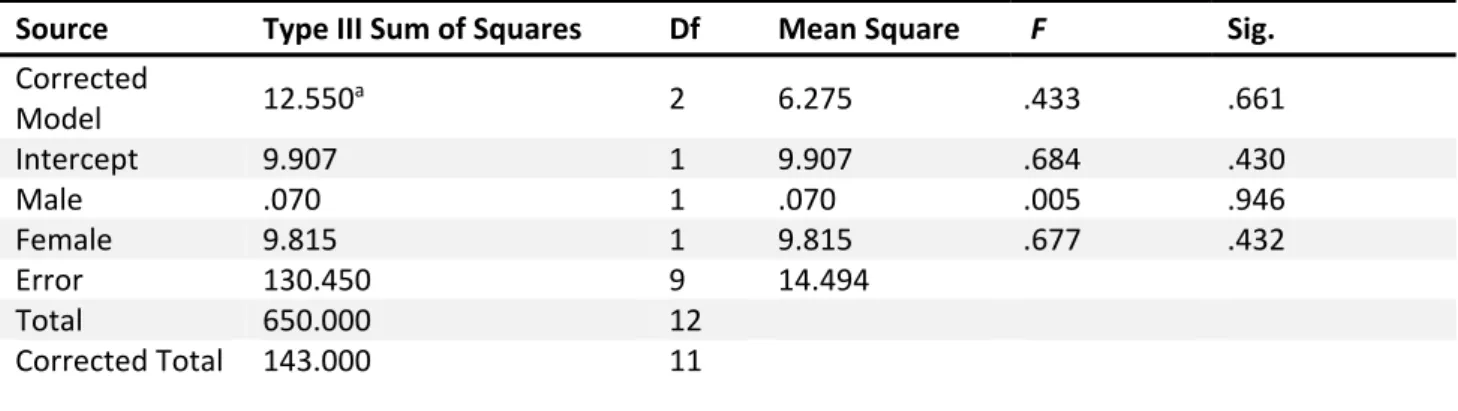
Hypothesis 2: There is no significant difference in the performance of male and female students using
post‐test of the experimental.
Table 4: Analysis of Co‐variance (ANCOVA) for post‐test scores of both male and female students taught using field trip
Source Type III Sum of Squares Df Mean Square F Sig.
Corrected
Model 12.550
a 2 6.275 .433 .661
Intercept 9.907 1 9.907 .684 .430
Male .070 1 .070 .005 .946
Female 9.815 1 9.815 .677 .432
Error 130.450 9 14.494
Total 650.000 12
Corrected Total 143.000 11
The analysis in Table 4 indicated that F (2, 9) = 4.26 > 0.433 at the .05 level of significance.
Summary of Findings
Based on the analysis of responses of the students, it was revealed that:
1. Those students using field trip performed significantly better than those taught using
expository method.
2. There was a significant difference in the performance of male and female students
using field trip in learning Basic Technology.
DISCUSSION
The findings indicate that the students using field trip performed better than students taught using
expository method. This finding corroborated the findings of Yusuf (2006) and Amosa (2013). However, Yusuf
(2006) noted that students taught using field trip performed better than the students taught using
conventional method in teaching and learning Social Studies. Also, Amosa (2013) affirmed that the gender of
the learners is not a factor in teaching and learning of Basic Technology; male students taught using
community resources did not perform better than female students who were also exposed to the community
resources.
Source Type III Sum
of Squares Df Mean Square F Sig.
Corrected Model 12.703a 2 6.352 .109 .898
Intercept 18.355 1 18.355 .314 .581
Experimental 2.271 1 2.271 .039 .846
Control 11.601 1 11.601 .198 .660
Error 1287.297 22 58.513
Total 5525.000 25
Corrected Total 1300.000 24
CONCLUSIONS
The classroom is a limited environment; the learning of Basic Technology must go beyond the four
walls of the classroom. The use of field trip guarantees teachers and students meet their responsibilities by
ensuring its utilization to facilitate the learning of practical skills. Field trip will also help learners to acquire,
retain and make abstract ideas concrete. Gender of learners is not a factor in teaching and learning of Basic
Technology; male students taught using field trip did not perform better than their female counterparts who
were also exposed to the same method.
RECOMMENDATIONS
The following recommendations were made based on the findings of this study:
1. Teachers should expose students to practical works through field trip as a method of teaching which will
promote and encourage social interaction, active engagement in learning, self‐motivation, discovery
learning, learning by doing and learning by experience.
2. Once gender is not a factor in students’ performance in Basic Technology, teachers should put in more
effort on equal distribution of attention to both male and female.
REFERENCES
Ajelabi, A. (2005). Essentials of Educational Technology. Lagos, Nigeria: Raytel Communications.
Amosa, A. A. (2013). Effect of community resources on Junior Secondary Schools’ Performance in Basic
Technology in Ilorin, Kwara State, Nigeria. Journal of Education in Developing Areas (JEDA), 21(1),
214‐221.
Fakomogbon, M. A, Ibrahim, A. I., & Gegele, W. B. (2007). An introduction to vocational method. Ilorin,
Nigeria: Onigba.
Federal Republic of Nigeria (FRN, 2009). National Policy on Education. Lagos, Nigeria: NERDC Press.
Instructional Strategies Online. (2013).What are Field trips? Retrieved from
olc.spsd.sk.ca/DE/PD/instr/strats/fieldtrips/index.html
Nigeria Educational Research and Development Council. (2007). A philosophy of Nigerian education: Report
on Basic Technology curriculum conference. Abuja, Nigeria: NERDC Press.
Olubusuyi, A. (2009). All‐Embracing 9‐year basic Education Curriculum uplifts UBE programme: Vanguard
29th March, 2009.
Omosewo, E. O. (2009). Formal Instructional Method (3): Laboratory, demonstration and field trip Methods
on instruction. Principle and practice of instruction. Ilorin, Nigeria: Bamitex.
Yusuf, A. (2006). Effect of field trip method of teaching on students’ performance in Social Studies. Ilorin
Journal of Education, 2, 7‐17.