Brazilian adaptation of the
Addenbrooke’s Cognitive
Examination-Revised (ACE-R)
Viviane Amaral Carvalho
1,2, Paulo Caramelli
1,2Abstract – The Addenbrooke’s Cognitive Examination-Revised (ACE-R) is a highly sensitive and specifi c tool for the detection of mild dementia. It is particularly useful in differentiating Alzheimer’s disease from frontotemporal dementia. While the fi rst version of the test battery has been adapted in many countries, its revised version has not, probably because it was published very recently. Objective: To translate and adapt the ACE-R for use in the Brazilian population. Methods: Two independent translations were made from English into Portuguese, followed by two independent back-translations. Few adaptations in accordance to the Brazilian culture and language were made and a fi rst version of the instrument produced. This former version of the ACE-R was administered to 21 cognitively healthy subjects aged 60 years or more, with different educational levels. Results: The mean age of the studied sample of healthy elderly was 75.4 years (ranging from 60 to 89 years). Small additional modifi cations were necessary after the evaluation of the fi rst ten subjects in order to improve comprehension of the test. The fi nal Portuguese version of the ACE-R was produced and was found to be well understood by the remaining 11 subjects, taking an average of 15 minutes to be administered. Conclusions: The Brazilian version of the ACE-R proved to be a promising cognitive instrument for testing both in research and clinical settings. With this regard, additional studies are currently being carried out in our unit in order to investigate the diagnostic properties of the ACE-R in our milieu.
Key words: dementia, diagnosis, cognitive evaluation, Addenbrooke’s Cognitive Examination-Revised, cultural adaptation, Brazil.
Adaptação brasileira do Exame Cognitivo de Addenbrooke-Revisado
Resumo – A Addenbrooke’s Cognitive Examination - Versão Revisada (ACE-R) é um instrumento com elevada sensibilidade e especifi cidade para detectar demência em estágio leve. Ela é particularmente útil para diferenciar a doença de Alzheimer da demência frontotemporal. Enquanto a primeira versão desta bateria foi adaptada em vários países, a versão revisada ainda não, provavelmente por ter sido publicada muito recentemente. Objetivo:
Traduzir e adaptar a ACE-R para uso na população brasileira. Métodos: Foram feitas duas traduções independen-tes do Inglês para o Português, seguidas de duas retro-traduções também independenindependen-tes. Algumas adaptações de acordo com a cultura brasileira e a língua portuguesa foram realizadas e a primeira versão brasileira do instru-mento produzida. Esta foi administrada a 21 sujeitos saudáveis com idades de 60 anos ou mais, com diferentes níveis de escolaridade. Resultados: A média de idade da amostra de idosos estudada foi de 75,4 anos (variando de 60 a 89 anos de idade). Após a avaliação dos dez primeiros indivíduos foi necessário realizar pequenas altera-ções com o objetivo de melhorar a compreensão do teste. A versão fi nal em Português da ACE-R foi produzida e se mostrou de fácil entendimento pelos onze participantes restantes, tendo tempo médio de aplicação de 15 minutos. Conclusões: A versão brasileira da ACE-R provou ser um instrumento promissor de avaliação cognitiva promissor para a pesquisa e para a prática clínica. Estudos adicionais estão sendo realizados em nossa unidade para investigar as propriedades diagnósticas da ACE-R em nosso meio.
Palavras-chave: demência, diagnóstico, avaliação cognitiva, Addenbrooke’s Cognitive Examination-Versão Re-visada, adaptação transcultural, Brasil.
1Post-graduate program in Neurology, University of Sao Paulo School of Medicine, São Paulo (SP), Brazil. 2Behavioral and Cognitive Neurology Unit,
Department of Internal Medicine, Faculty of Medicine of the Federal University of Minas Gerais, Belo Horizonte (MG), Brazil.
Cognitive evaluation is a mandatory step for the
di-agnosis of dementia, warranting more attention in Brazil.
There are still only a limited number of instruments that
present specifi c norms for use in our population, especially
regarding the variables age and education. In Brazil, the
available instruments for brief cognitive evaluation of
de-mentia, in particular for Alzheimer’s disease (AD) include:
1the Mini-mental State Examination (MMSE),
2-6the Test of
Information-Memory-Concentration (IMC) of Blessed,
7the CASI-S (Cognitive Abilities Screening Instrument -
Short Form),
8-10the Consortium to Establish a Registry for
Alzheimer’s Disease (CERAD),
11,12the Cambridge
Exami-nation for Mental Disorders of the Elderly (CAMDEX),
13,14the NEUROPSI
15,16and the Alzheimer’s Disease Assessment
Scale Cognition Component (ADAS-cog).
17,18Another tool
also used in our population is the Brief Cognitive
Screen-ing Battery (BCSB)
19-22that consists of the presentation of
a sheet of paper with 10 simple line drawings that evaluates
naming, recall and recognition aspects of memory, using
a semantic verbal fl uency test and the clock drawing test as
interference tasks.
23The Addenbrooke’s Cognitive Examination (ACE) is an
additional tool which has similar characteristics, although
has not been studied in our population to date. The ACE
is a brief and reliable test battery that provides detection
of early stages of dementia and is also effi cient in
differen-tiating its subtypes, such as AD, frontotemporal dementia
(FTD), progressive supranuclear palsy, and other forms
of dementia associated with parkinsonism.
24The test can
be administered in 15 to 20 minutes and, together with
the MMSE, provides a more thorough evaluation of six
cognitive domains (orientation, attention, memory,
ver-bal fluency, language and visuospatial ability). Each of
these domains can be individually evaluated. Moreover,
Mathuranath et al.
24developed a ratio (V+L) / (O+M),
called the
VLOM ratio
, after observing that AD patients
presented better performance in domains such as verbal
fl uency (V) and language (L) when compared to FTD
pa-tients. These fi ndings are similar to the
neuropsychologi-cal profi les of both diseases observed in other studies.
25-28However, patients with FTD presented better performance
in orientation tasks (O) and episodic memory (M),
com-pared to AD patients.
The Addenbrooke’s Cognitive Examination was
subse-quently revised and data on this new version has recently
been published by Mioshi et al.
25In this new version, called
ACE-R, the structure and the sequence of the tasks were
completely reworked in order to facilitate its use. The
content was also modifi ed to facilitate future translations,
allowing adaptations and use in other cultures, besides
slightly increasing the instrument’s sensitivity level.
Fur-thermore, the ACE-R now has three versions (A, B and
C). These versions differ between each other with regard
to the anterograde memory task, in which three different
stimuli are offered for the item “name and address”, in
or-der to prevent recalling information from previous
assess-ments. Another difference from the original version was
that instead of six, the ACE-R assesses only fi ve domains,
namely: orientation and attention (18 points), memory (26
points), verbal fl uency (14 points), language (26 points)
and visuospatial ability (16 points). The individual’s total
score is still obtained by the addition of all subtests’ scores,
ranging from 0 to 100.
The authors also developed a guide of instructions to
offer further information on how the scores should be
noted. This guide also presents examples of acceptable
answers, models of drawings, and explanations of how to
apply and correct the test. The idea is to create a pattern
when organizing all the answers in order to improve the
overall reliability of the test among examiners.
While the original version has previously been studied
in several countries, such as Germany,
29Argentina,
30Bel-gium,
31,32Spain,
33India
34and Israel,
35the ACE-R has not
yet been studied outside the UK. The present article has the
objective of presenting the adapted version of the ACE-R
for use in Brazil.
Methods
Methodology of adaptation / Portuguese version of ACE-R
The process of ACE-R adaptation was initiated by two
independent translations from English to Portuguese,
fol-lowed by two back-translations of these Portuguese versions
into English. The aim of this work was to reveal the possible
misunderstandings and ambiguities that the fi rst translated
version could have contained. Subsequently, we carried out
cross-cultural adaptation. The same method was used for
the Portuguese version of the Instructions guide.
In this adaptation of the battery we used the Brazilian
version of the MMSE proposed by Brucki et al.,
14as
recom-mended by the Department of Cognitive Neurology and
Aging of the Brazilian Academy of Neurology.
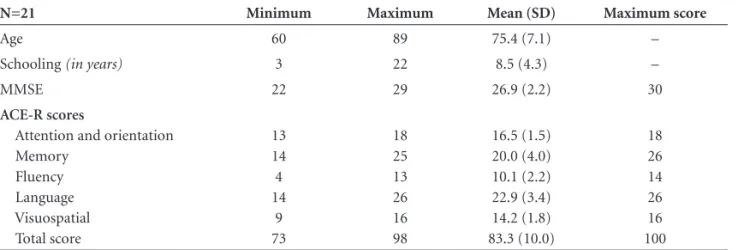
1The name
tions for the subtests of the battery, are shown in Table 1.
The instrument took 15 minutes on average to be
admin-istered. Overall, the comprehension of the different items
of the test was found to be good.
Discussion
In this study we have translated and adapted the revised
version of the ACE (ACE-R) to be used in Brazil. After its
application on half of the sample, some additional
modi-fi cations were made to make it easier to understand by the
low education level subjects. Obviously, these modifi
ca-tions did not interfere with the original aims of the battery
authors. The fi nal instrument proved to be easy to
admin-ister and was well understood by a group of healthy elderly
people with heterogeneous educational background.
Cognitive evaluation constitutes an important tool for
the assessment of cerebral functioning, being mandatory
for the differential diagnosis between normal aging, mild
cognitive impairment, dementia and its subtypes.
Sensitiv-ity and specifi cSensitiv-ity are essential aspects of a cognitive
inves-tigative instrument, but these also depend on knowledge of
the imperative diversities and infl uences between cultures,
gender, age and educational level.
As outlined previously, brief cognitive evaluation
in-struments validated in Brazil remain scarce. Moreover,
the differential diagnosis between AD and FTD represents
a challenge, especially in the early stages, and even fewer
tools are available in our milieu with this regard. Recently,
a Brazilian version of the Frontal Assessment Battery (FAB)
was published by Beato et al.
36This study represents an
important contribution for clinicians since it describes the
performance of a group of healthy elderly people in an
executive function brief evaluation tool. Previous studies
have shown good sensitivity of the FAB in detecting frontal
lobe dysfunction
37and also in differentiating AD from FTD
patients.
38-40However, the FAB assesses only some aspects of
execu-well known Brazilian ecosystem. In the Language-reading,
irregular words were chosen to have similar levels of
dif-fi culty in Portuguese and in English, such as “táxi, testa,
saxofone, fi xar and ballet” (cab, forehead, saxophone, to
fi x and ballet).
The ACE-R Brazilian version instrument took its fi nal
form after a pilot study test. In this study, 21 healthy
indi-viduals were tested, aged 60 years or more, with different
educational levels, but no illiterate subjects were included.
All participants had no history of neurologic or psychiatric
disease, as well as no history of cognitive decline. They were
all fully independent and performed above specifi c
edu-cation-adjusted cut-off scores in the MMSE as suggested
by Brucki et al.,
6namely:
≥
22 for subjects with 1-4 years,
≥
25 for 5-8 years and
≥
26 for those with 9 or more years
of schooling. Initially, ten subjects were submitted to the
Portuguese fi rst version and this experience highlighted
some additional modifi cations which were necessary.
Fol-lowing this, the fi nal Portuguese version of the ACE-R was
produced and then administered to the remaining 11
par-ticipants.
The study was approved by the Ethics Committee of
the Hospital das Clínicas of the University of São Paulo
School of Medicine and by the Ethics Committee of the
Federal University of Minas Gerais. All participants signed
the written informed consent.
Results
The 21 elderly subjects presented a mean age of 75.4±
7.1 years, ranging from 60 to 89 years. Seventeen (80.9%) of
the participants were female and four (19.1%), male. The
mean number of years of formal education was 8.5±4.3
(ranging from 3 to 22 years).
The lowest total score observed in the ACE-R was 73,
while the highest was 98. The mean total score in the
bat-tery was of 83.3±10.0 points. Minimum and maximum
total scores observed, as well as means and standard
devia-Table 1. Main demographic data of the sample and ACE-R scores
N=21 Minimum Maximum Mean (SD) Maximum score
Age 60 89 75.4 (7.1) –
Schooling (in years) 3 22 8.5 (4.3) –
MMSE 22 29 26.9 (2.2) 30
ACE-R scores
Attention and orientation Memory
Fluency Language Visuospatial Total score
13 14
4 14
9 73
18 25 13 26 16 98
16.5 (1.5) 20.0 (4.0) 10.1 (2.2) 22.9 (3.4) 14.2 (1.8) 83.3 (10.0)
tive functions, while the ACE-R includes the assessment
of different cognitive domains, such as orientation and
at-tention, memory, verbal fl uency, language and visuospatial
ability. The more comprehensive evaluation together with
the VLOM ratio analysis provided by the ACE and also by
the ACE-R offer more information on the patients’
neu-ropsychological profi les, which can be helpful to identify
specifi c dementia subtypes. In the original version (ACE),
patients with AD performed better on tests of verbal fl
u-ency and language (VL), whereas patients with FTD
pre-sented relatively better results on orientation and episodic
memory tasks (OM).
24,30,33Similar fi ndings were reported
using the revised version of ACE.
25Therefore, the
Brazil-ian version of the ACE-R seems to be a promising tool
for clinical use and therefore warrants validation in our
population. The Brazilian version of the ACE-R is available
through contact with the authors.
These are the preliminary results of a study that intends
to investigate the applicability of ACE-R as an instrument
of brief cognitive evaluation for healthy Brazilian subjects
and patients with suspected dementia, to determine the
sensitivity and specifi city of this tool in mild-AD patients
and to later assess its capacity to differentiate between AD
and FTD patients.
Acknowledgements –
We are grateful to Professor John
R. Hodges and to Mrs. Eneida Mioshi-Hornberger, from
the University of Cambridge (UK) for their support and
ongoing collaboration with our work.
References
1. Nitrini R, Caramelli P, Bottino CMC, Damasceno BP, Brucki SMD, Anghinah R. Diagnóstico de doença de Alzheimer no Brasil: avaliação cognitiva e funcional. Recomendações do Departamento Científi co de Neurologia Cognitiva e do Envelhecimento da Academia Brasileira de Neurologia. Arq Neuropsiquiatr 2005;63:720-727.
2. Nitrini R, Caramelli P, Bottino CMC, Damasceno BP, Brucki SMD, Anghinah R. Diagnóstico de doença de Alzheimer no Brasil: avaliação cognitiva e funcional. Recomendações do Departamento Científi co de Neurologia Cognitiva e do Envelhecimento da Academia Brasileira de Neurologia. Arq Neuropsiquiatr 2005;63:720-727.
3. Bertolucci PHF, Brucki SMD, Campacci S, Juliano Y. O Mini-Exame do Estado Mental em uma população geral. Impacto da escolaridade. Arq Neuropsiquiatr 1994;52:1-7.
4. Almeida O. Mini-Exame do Estado Mental e o diagnóstico de demência no Brasil. Arq Neuropsiquiatr 1998;56:605-612. 5. Caramelli P, Herrera Jr E, Nitrini R. O Mini-Exame do Estado
Mental no diagnóstico de demência em idosos analfabetos. Arq Neuropsiquiatr 1999;57:(Suppl 1):S7.
6. Laks J, Batista EMR, Guilherme ERL et al. O Mini Exame do Estado Mental em idosos de uma comunidade: dados parci-ais de Santo Antonio de Pádua, Rio de Janeiro. Arq Neurop-siquiatr 2003;61:782-785.
7. Brucki SMD, Nitrini R, Caramelli P, Bertolucci PHF, Okamoto IH. Sugestões para o uso do Mini-exame do estado mental no Brasil. Arq Neuropsiquiatr 2003;61:777-181.
8. Burns A, Lawlor B, Craig S. Blessed Dementia Scale (incor-porating the Information-Memory Concentration (ICM) Test and the Dementia Scale. Assessment Scales in Old Age Psychiatry. London: Martin Dunitz; 1999:40-41.
9. Burns A, Lawlor B, Craig S. Cognitive Abilities Screening In-strument (CASI). Assessment Scales in Old Age Psychiatry. London: Martin Dunitz;1999:63.
10. Ng RTY, Damasceno A, Delicio AM, et al. Validation of mini-test CASI-S in a sample of Brazilian population (Abstr.). J Int Neuropsychol Soc 2001;7:420.
11. Damasceno A, Mazo DFC, Ng RTY, et al. Validation of mini-test CASI-S in a sample of Brazilian population. Arq Neurop-siquiatr 2005;63:416-421.
12. Bertolucci PH, Okamoto IH, Brucki SM, Siviero MO, Toniolo J Neto, Ramos LR. Applicability of the CERAD neuropsy-chological battery to Brazilian elderly. Arq Neuropsiquiatr 2001;59:532-536.
13. Morris JC, Heyman A, Mohs RC, et al. The Consortium to Establish a Registry for Alzheimer’s disease (CERAD): Part 1. Clinical and neuropsychological assessment of Alzheimer’s disease. Neurology 1989;39:1159-1165.
14. Roth M, Tym E, Mountjoy CQ, et al. CAMDEX - A standard-ized instrument for the diagnosis of mental disorder in the elderly with special reference to the early detection of demen-tia. Br J Psychiatry 1986;149:698-709.
15. Bottino CMC, Stoppe Jr A, Scalco AZ, Ferreira RCR, Hototian SR, Scalco MZ. Validade e confi abilidade da versão brasileira do CAMDEX. Arq Neuropsiquiatr 2001;59(Suppl 3):S20. 16. Gomes JA. Avaliação neuropsicológica nas fases inicial e
mod-erada da demência do tipo Alzheimer. Dissertação. Escola Paulista de Medicina da Universidade Federal de São Paulo (UNIFESP), São Paulo; 1999.
17. Ostrosky-Solís F, Roselli MA. NEUROPSI: a brief neuropsy-chological test battery in Spanish with norms by age and edu-cational level. J Int Neuropsychol Soc 1999;5:413-433. 18. Rosen WG, Mohs RC, Davis KL. A new rating scale for
Al-zheimer’s disease. Am J Psychiatry 1984;141:1356-1364. 19. Schultz RR. Desempenho de uma população brasileira na
sub-escala cognitiva da Escala de Avaliação da Doença de Alzheimer (ADAS-Cog). Dissertação. Escola Paulista de Medicina da Uni-versidade Federal de São Paulo (UNIFESP), São Paulo;1999. 20. Nitrini R, Lefèvre BH, Mathias SC, et al. Testes
21. Nitrini R, Caramelli P, Herrera E Jr, et al. Performance of illit-erate and litillit-erate nondemented elderly subjects in two tests of long-term memory. J Int Neuropsychol Soc 2004;10:634-638. 22. Takada LT, Caramelli P, Fichman HC, et al. Comparison be-tween two tests of delayed recall for the diagnosis of demen-tia. Arq Neuropsiquiatr 2006;64:35-40.
23. Nitrini R, Caramelli P, Porto CS, et al. Brief cognitive battery in the diagnosis of mild Alzheimer’s disease in subjects with medium and high levels of education. Dementia & Neuropsy-chologia 2007;1:32-36.
24. Sunderland T, Hill JL, Mellow AM, et al. Clock drawing in Alzheimer’s disease:A novel measure of dementia severity. J Am Geriatr Soc 1989; 37:725-729.
25. Mathuranath OS, Nestor PJ, Berrios GE, Rakowicz W, Hodges JR. A brief cognitive test battery to differentiate Al-zheimer’s disease and frontotemporal dementia. Neurology 2000;55:1613-1620.
26. Mioshi E, Dawson K, Mitchell J, Arnold R, Hodges JR. The Addenbrooke’s Cognitive Examination Revised (ACE-R): a brief cognitive test battery for dementia screening. Int J Geri-atr PsychiGeri-atry 2006;21:1078-1085.
27. Gregory CA, Orrell M, Sahakian B, Hodges JR. Can fronto-temporal dementia and Alzheimer’s disease be differenti-ated using a brief battery of tests? Int J Geriatr Psychiatry 1997;12:375–383.
28. Hodges JR, Patterson K, Ward R, et al. The differentiation of semantic dementia and frontal lobe dementia (temporal and frontal variants of frontotemporal dementia) from early Alzheimer’s disease: a comparative neuropsychological study. Neuropsychology 1999;13:31–40.
29. Pachana NA, Boone KB, Miller BL, Cummings JL, Berman N. Comparison of neuropsychological functioning in Alzheim-er’s disease and frontotemporal dementia. J Int Neuropsychol Soc 1996;2:505–510.
30. Alexopoulos P, Greim B, Nadler K et al. Validation of the Addenbrooke’s cognitive examination for detecting early Al-zheimer’s disease and mild vascular dementia in a German population. Dement Geriatr Cogn Disord 2006;22:385-391. 31. Sarasola D, de Lujan-Calcagno M, Sabe L, et al. Validity of
the Spanish version of the Addenbrooke’s Cognitive
Exami-nation for the diagnosis of dementia and to differentiate Al-zheimer’s disease and frontotemporal dementia. Rev Neurol 2005;41:717-21.
32. Bier JC, Donckels V, Van Eyll E, et al. The French Adden-brooke’s cognitive examination is effective in detecting de-mentia in a French-speaking population. Dement Geriatr Cogn Disord. 2005;19:15-7.
33. Bier JC, Ventura M, Donckels V, et al.. Is the Addenbrooke’s cognitive examination effective to detect frontotemporal de-mentia? J Neurol 2004;251:428-31.
34. Garcia-Caballero A, Garcia-Lado I, Gonzalez-Hermida J, et al. Validation of the Spanish version of the Addenbrooke’s Cognitive Examination in a rural community in Spain. Int J Geriatr Psychiatr 2006;21:239-45.
35. Mathuranath PS, Hodges JR, Mathew R, Cherian PJ, George A, Bak TH. Adaptation of the ACE for a Malayalam speak-ing population in southern India. Int J Geriatr Psychiatry 2004;19:1188-94.
36. Newman JP. Brief assessment of cognitive mental status in Hebrew: Addenbrooke’s Cognitive Examination. Isr Med As-soc J 2005;7451-7.
37. Beato RG , Nitrini R, Formigoni AP, Caramelli P. Brazilian version of the frontal assessment battery (FAB): preliminary data on administration to healthy elderly. Dement Neuropsy-chol 2007;1:59-65.
38. Dubois B, Slachevsky A, Litvan I, Pillon B. The FAB: a Fron-tal Assessment Battery at bedside. Neurology 2000;55:1621-1626.
39. Slachevsky A, Villalpando JM, Sarazin M, Hahn-Barma V, Pil-lon B, Dubois B. Frontal assessment battery and differential diagnosis of frontotemporal dementia and Alzheimer disease. Arch Neurol 2004;61:1104-1107.
40. Iavarone A, Ronga B, Pellegrino L et al. The Frontal Assess-ment Battery (FAB): normative data from an Italian sample and performances of patients with Alzheimer’s disease and frontotemporal dementia. Funct Neurol 2004;19:191-5. 41. Nakaaki S, Murata Y, Sato J et al. Reliability and validity of the