IN SITU
DEGRADABILITY OF CORN STOVER
AND ELEPHANT-GRASS HARVESTED AT FOUR
STAGES OF MATURITY
Luis Felipe Prada e Silva1; Laerte Dagher Cassoli2; Luiz Carlos Roma Júnior3; Ana Carolina de Oliveira Rodrigues3; Paulo Fernando Machado2*
1
USP/FMVZ - Depto. de Nutrição e Produção Animal, Av. Duque de Caxias Norte, 225 - 13635-900 - Pirassununga, SP - Brasil.
2
USP/ESALQ - Depto. de Zootecnia - Clínica do Leite - C.P. 09 - 13418-900 - Piracicaba, SP - Brasil. 3
USP/ESALQ - Programa de Pós-Graduação em Ciência Animal e Pastagem. *Corresponding author <[email protected]>
ABSTRACT: Among tropical forages, corn silage is largely used by farmers trying to explore the maximum genetic potential from the animals. However, other tropical forages, such as elephant-grass (Pennisetum purpureum), are more productive and therefore cheaper to use than corn silage. Our objective was to compare the in situ degradability of elephant-grass with that from corn hybrids, all harvested at four stages of maturity. The experimental design followed a randomized block design with nested subplots. Two corn hybrids: AG5011, ZN8392 were harvested with 25, 30, 35, and 40% dry matter (DM) in the whole plant, and separated in stem + leaf sheath + leaf blade (stover), and cobs. Elephant-grass was harvested with 30, 40, 50 and 60 days after a leveling cut. Dried and ground samples were incubated in nylon bags inside the rumen for 0, 6, 12, 24, 48 and 72 h to estimate the kinetics of ruminal DM and neutral detergent fiber (NDF) degradation. The advance of maturity increased the NDF and acid detergent fiber (ADF) content in elephant-grass, and reduced its DM degradability. However, maturity had little or no effect on fiber content and DM degradability of corn stover. Elephant-grass had a higher NDF degradability than corn stover, and there was no effect of maturity on NDF degradability of either grass or corn stover. Fiber degradability of elephant-grass was not worse than that of corn stover, and therefore the choice of forage should be made on economical analysis rather than assuming an intrinsic low production potential for elephant-grass based diets.
Key words:Pennisetum purpureum, corn silage, digestibility, rumen, tropical grass
DEGRADABILIDADE
IN SITU
DE HÍBRIDOS DE MILHO
E DE CAPIM-ELEFANTE COLHIDOS EM QUATRO
ESTÁDIOS DE MATURIDADE
INTRODUCTION
Forages are the basis for ruminant nutrition and cell-wall digestibility is a major limiting factor of forages nutritive value (Wattiaux et al., 1991). Among available tropical forages corn silage is widely used on dairy farms with high production per cow and is fre-quently taken as the one with the highest nutritive value (Nussio et al., 2003). The higher nutritive value of corn silage is dependent on the percentage of grain in the total mass (Schmid et al., 1976; Lauer et al., 2001).
However, Deinum & Bakker (1981) and Coors & Lauer (2000) have demonstrated that as grain percentage in-creases, stover digestibility dein-creases, so that there is no strong relationship between grain percentage and total forage dry matter digestibility. Even more impor-tant for the definition of corn silage quality is the ob-servation that milk production in intensified system is usually limited by fiber digestibility, due to the fill ef-fect in the digestive tract (Mertens, 1983). Corn si-lage with higher fiber digestibility has a higher poten-tial for feed intake and energy concentration, allowing better animal production (Allen, 1996).
Another advantage of corn silage is that it maintains the nutritive value for long period of time (Bal et al., 1997). This occurs because the
percent-age of grain in the total mass increases to counteract the decline in stover nutritional quality (Silva et al., 2000; Nussio et al., 2001). When plant dry matter (DM) concentration increased from 32% to 40% DM digestibility of the whole plant was unchanged, but the stover digestibility decreased from 62% to 54% (Daynard & Hunter, 1975).
Other tropical grasses, such as elephant-grass (Pennisetum purpureum), have a greater yield
poten-tial in comparison to corn silage, but their nutritional value declines rapidly with advance of maturity (Deschamps, 1999). Since fiber degradability is usu-ally the most important limitation for animal perfor-mance in the tropics (Wattiaux et al., 1991), it poten-tially could be used as an indicator of nutritive value when selecting forages. Therefore, it was our objec-tive to compare the DM and neutral detergent fiber (NDF) in situ degradability of corn stover and
el-ephant-grass, harvested at four stages of maturity.
MATERIAL AND METHODS
Forage production and harvest
Corn - On September 8th, 1997, 2 corn hybrids: AG
5011 (Agroceres, SP, Brazil) and ZN 8392 (Zeneca, SP, Brazil) were sown in a commercial field in Assis-SP-Brazil (22º38’S, 50º27’W). The row spacing was
0.9 m and the calculated final sowing density was 6 seeds per linear meter. Fertilizer was applied at 105 kg ha–1 N, 70 kg ha–1 P
2O5 and 110 kg ha –1 K
2O.
In-side each corn field, three experimental blocks were arranged with six rows of corn by 10 m in length. Within each block, areas were assigned randomly to four sampling times, based on plant dry matter con-centration. Field DM was monitored twice a week by collecting plant samples and drying them for 4 h at 105ºC in a forced ventilation oven. Twelve corn plants were sampled at random from each block when the field had reached DM concentration of 25, 30, 35 and 40%. The corncobs with the husks were removed from the rest of the plant (stover) and the two fractions were weighed, chopped and frozen in plastic bags at -20ºC.
Elephant-grass - An elephant-grass (Pennisetum
purpureum cv. Napier) production field located at São
Pedro, SP, Brazil (22º60’S, 47º88’W) was chosen. Af-ter a first leveling cut at approximately 10 cm from the ground, 100 kg ha–1 N was applied and three blocks
of 6 m × 10 m were arranged. Within each block ar-eas were assigned randomly to four sampling times: 30, 40, 50 and 60 days after the first cut. Approxi-mately 10 kg of fresh material was collected at each sampling time by clipping the plants 10 cm above the soil level. The plants were chopped and the samples frozen in plastic bags at -20ºC.
Chemical analyses
The samples were dried in a forced ventilation oven for 72 h at 60ºC or until constant weight. For-age samples were analyzed for neutral detergent fiber (NDF), acid detergent fiber (ADF) and lignin accord-ing to Goeraccord-ing & Soest (1970). Total N and mineral matter (MM) were determined according to AOAC (1990).
Ruminal degradability
A mature ruminally cannulated Holstein dry dairy cow was used to determine in situ degradation
characteristics. The animal was kept in a free stall and received a corn silage based total mixed ration (TMR)
ad libitum 14 days before and during the in situ
incu-bation, and had free access to water and trace miner-alized salt. The TMR contained 67% DM, 35.4% NDF, 21.6% ADF and 17% crude protein (CP) and the ani-mal was fed twice daily. Dacron bags (13 cm × 7 cm; 50 mm pore size) were filled with 3 g of dried ground sample giving a sample:surface area ratio of 16.5 mg cm–2. Forage samples from each block were incubated
All bags were soaked in warm water for 10 min-utes to remove water-soluble components and hasten microbial colonization. Triplicates bags for each rough-age and strough-age of maturity for each time, excepted 0, were suspended in the rumen attached to a lead weight, just prior to feeding (07h30 a.m.), and incubated for 6, 12, 24, 48 or 72 h. Two empty bags and two bags taining a standard oat hay sample were included as con-trols. After the incubation period the bags were imme-diately placed in ice water to stop the fermentation pro-cess. The bags were washed in a washing machine with constant water flux for approximately 15 min until the point of clear water. The bags were dried for 48 h at 60ºC in a forced-air oven. After drying the bags were weighed and analyzed for residual NDF.
Calculations of kinetics of ruminal DM and NDF degradation were obtained with McDonald’s equation (1981): D = A + [B × (1-e–kd × T)] when T >
Lag or D = A when T ≤ Lag; where D = degradability at time T, A = soluble fraction (%, wash value at 0h), B = insoluble potentially digestible fraction (%), kd = fractional rate of degradation (% h–1), T = time of
in-cubation and Lag = discrete lag time. The procedure NLIN of SAS® (2000) was used to fit the model to
the data using the Marquardt Method. Initial estimates of the model parameters were based on data set vi-sual appraisal.
Statistical analyses
This experiment followed a randomized block design with sub-sampling. Analysis was done using the GLM procedure of SAS® (2000) considering the fixed
effects of grass specie (corn or elephant-grass), block within specie, maturity and the interaction species ´ maturity. When a significant species × maturity inter-action was apparent, the option SLICE was used to test for maturity effect within each grass species.
Data from in situ degradability was analyzed
as a split-plot design, where the experimental periods were the blocks, the incubation times were the plots and the grass species were the sub-plots.
RESULTS AND DISCUSSION
Chemical composition
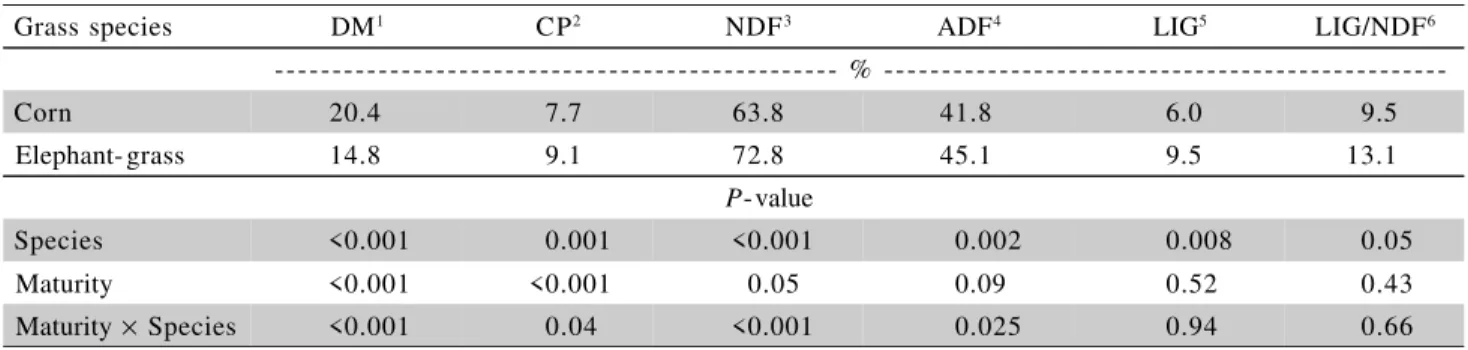
The chemical composition of corn stover and elephant grass was different for all variables analyzed (Table 1). On average, elephant-grass had lower DM content, and higher NDF, ADF and lignin content (Table 1). There was a significant maturity × grass ef-fect for CP, NDF and ADF content (p < 0.05, Table
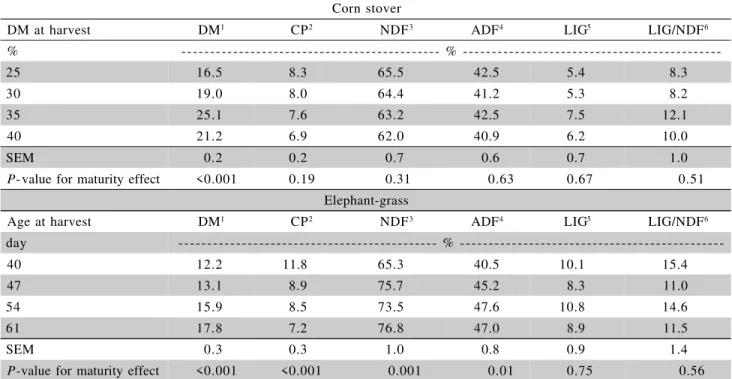
1). Maturity had no effect on the CP, NDF and ADF content of corn stover, but reduced CP, and increased NDF and ADF content in elephant-grass (Table 2).
The NDF content of forages increases with ad-vance in maturity (Soest, 1994). However, in corn si-lage, the NDF content usually decreases with advanced maturity, mainly because of increased starch accumu-lation in the grain fraction (Filya, 2004). In our study, the lack of increase in NDF content of corn stover with advanced maturity was unexpected. Working in Mexico, Estrada-Flores et al. (2006) observed an in-crease from 58% to 64% in the NDF content of corn stem when harvested at three stages of maturity. Darby & Lauer (2002) also reported a linear increase in the NDF content of corn stover harvested at six stages of maturity.
One explanation for these contrasting results is the range of maturity that the hybrids were har-vested. In our study, the DM content of corn stover increased from 16.5 to 25%, while in the Estrada-Flores et al. (2006) study, the plants were harvested with a DM content of the stems varying from 22% to 66%. In the Darby & Lauer (2002) study, there was no difference in the NDF or ADF content of corn stover for the first three stages of maturity, both in-creasing linearly after the fourth harvest date. Zeoula et al. (2003) reported a cubic effect of maturity on NDF content of corn stems. It would be advanta-geous to the farmer to use corn hybrids with a slow increase in fiber content of corn stover with advanced maturity, which would permit a larger flexibility on the harvest date.
Table 1 - Average chemical composition of corn stover and elephant-grass harvested at four stages of maturity.
1DM = dry matter; 2CP = crude protein; 3NDF = neutral detergent fiber; 4ADF = acid detergent fiber; 5LIG = lignin; 6LIG/NDF = lignin/
neutral detergent fiber
Grass species DM1 CP2 NDF3 ADF4 LIG5 LIG/NDF6
%
---Corn 20.4 7.7 63.8 41.8 6.0 9.5
Elephant- grass 14.8 9.1 72.8 45.1 9.5 13.1
P-value
Species <0.001 0.001 <0.001 0.002 0.008 0.05
Maturity <0.001 <0.001 0.05 0.09 0.52 0.43
Dry matter degradability
There was effect of maturity on in situ DM
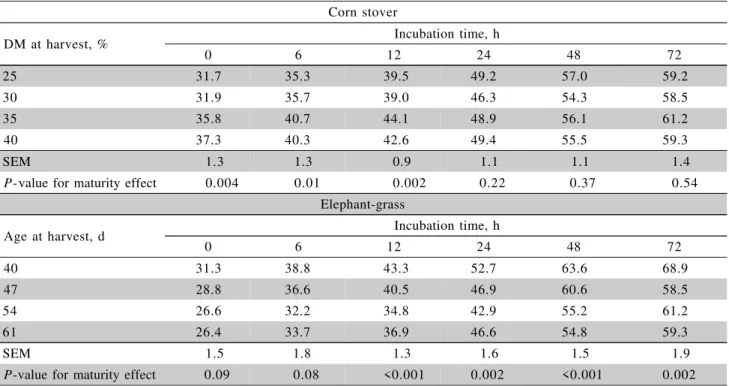
degradability at 24, 48 and 72 h of rumen incubation in both grass species (Table 3), and there was also a difference in DM degradability between grass species at most time points (Table 3). Corn stover had higher DM degradability in the shorter incubation points (0, 6 and 12 h), while elephant-grass had higher DM degradability after 48 and 72 h of rumen incubation (Table 3). The maturity × species interaction was sig-nificant for all time points (Table 3).
Advanced maturity reduced DM degradability of elephant-grass after 12, 24, 48 and 72 h of rumen incubation (Table 4) while maturity did reduce DM degradability of corn stover, and in fact, DM degradability of corn stover was increased with ad-vanced maturity after 0, 6 and 12 h of rumen incuba-tion (Table 4).
Maturity has a dramatic effect on DM degradability of elephant-grass (Brito et al., 1999 and Soares et al., 2004). The reduction in DM degradability with advanced maturity has been appointed as the main factor restricting elephant-grass utilization in diets of high producing animals (Salerno et al., 1990).
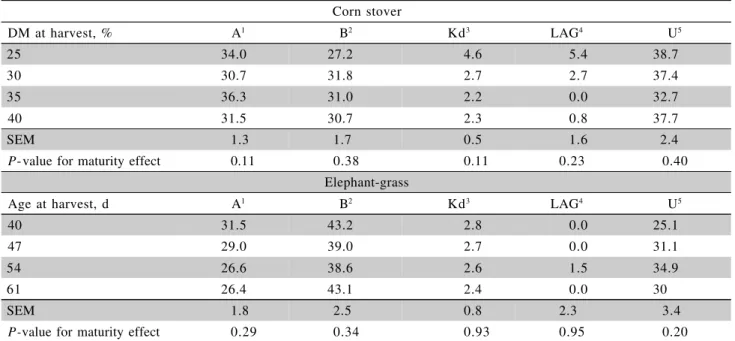
After calculating the parameters for the kinet-ics of rumen DM degradability no difference was ob-served in the rate of DM degradability between el-ephant-grass and corn stover (Table 5). Corn stover had higher soluble fraction (A) and lower potentially degradable fraction (B) than elephant-grass (p < 0.05,
Table 5). There was no significant maturity × species interaction. The higher A fraction of corn stover re-flects the higher DM degradability after short rumen incubation, and the lower B fraction reflects the lower DM degradability with longer rumen incubations (Table 3).
Corn stover
DM at harvest DM1 CP2 NDF3 ADF4 LIG5 LIG/NDF6
% %
---25 16.5 8.3 65.5 42.5 5.4 8.3
30 19.0 8.0 64.4 41.2 5.3 8.2
35 25.1 7.6 63.2 42.5 7.5 12.1
40 21.2 6.9 62.0 40.9 6.2 10.0
SEM 0.2 0.2 0.7 0.6 0.7 1.0
P-value for maturity effect <0.001 0.19 0.31 0.63 0.67 0.51 Elephant-grass
Age at harvest DM1 CP2 NDF3 ADF4 LIG5 LIG/NDF6
day --- %
---40 12.2 11.8 65.3 40.5 10.1 15.4
47 13.1 8.9 75.7 45.2 8.3 11.0
54 15.9 8.5 73.5 47.6 10.8 14.6
61 17.8 7.2 76.8 47.0 8.9 11.5
SEM 0.3 0.3 1.0 0.8 0.9 1.4
P-value for maturity effect <0.001 <0.001 0.001 0.01 0.75 0.56
Table 2 - Chemical composition of corn stover and elephant-grass harvested at four stages of maturity.
1DM = dry matter; 2CP = crude protein; 3NDF = neutral detergent fiber; 4ADF = acid detergent fiber; 5LIG = lignin; 6LIG/NDF = lignin/
neutral detergent fiber
Table 3 - Average in situ dry matter degradability of corn stover and elephant-grass harvested at four stages of maturity.
Grass species Incubation time, h
0 6 12 24 48 72
Corn 34.2 38.0 41.3 48.4 55.7 59.5
Elephant- grass 28.3 35.3 38.9 47.3 58.6 62.0
P-value
Maturity 0.70 0.92 0.55 0.007 0.003 0.03
Species <0.001 0.026 0.007 0.26 0.006 0.05
The highest A fraction of corn stover could be explained by the lower NDF content across maturities. The highest B fraction for elephant-grass could be an indicator of higher potentially degradable fiber, which is usually negatively correlated with lignin/NDF (Traxler et al., 1998). However, in this study, the lignin/NDF con-tent of elephant-grass was higher than in corn stover (Table 1). Although elephant-grass had higher lignin/NDF content than corn stover, the NDF degradability of el-ephant-grass was higher than the NDF degradability of corn stover in all time points, except 0 h of rumen in-cubation (Table 7) this agrees with the higher B frac-tion observed for the kinetics of DM degradability.
The advance in maturity did not alter the ki-netics parameters of in situ DM degradability for both
grasses (Table 6). When working with tropical forages Paciullo et al. (2002) did not also find any difference in the rate of DM digestion for the stem of young or
old plants. In contrast a decrease in DM degradability of corn stover has been demonstrated by others (Darby & Lauer, 2002; Lewis et al., 2004). Lewis et al. (2004) reported a significant maturity × hybrid interaction for stover DM degradability when working with three corn hybrids.
Neutral detergent fiber degradability
A grass effect for NDF degradability was ob-served (Table 7). Elephant-grass had higher in situ NDF
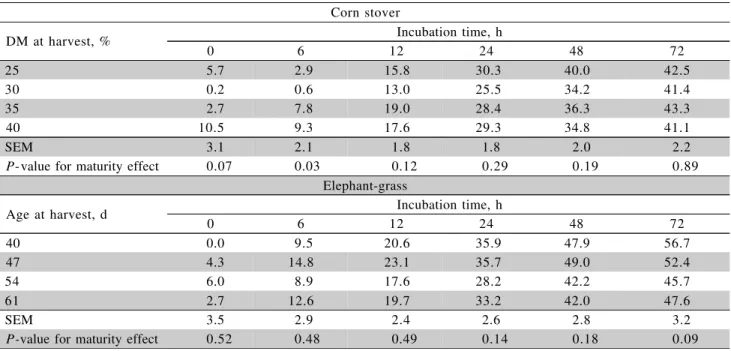
degradability than corn stover (Table 7). The maturity × grass interaction was not significant (Table 7). Overall, maturity had little effect on NDF degradability on both grass species. With advance in maturity there was an increase in NDF degradability of corn stover only after 6 h of rumen incubation, while in elephant-grass there was a tendency for lower NDF degradability after 72 h of rumen incubation (Table 8).
Table 5 - Average kinetics parameters of in situ dry matter degradability of corn stover and elephant-grass harvested at four
stages of maturity.
¹A = soluble fraction (%), 2B = insoluble potentially degradable fraction (%), 3kd = rate of degradation (% h-1), 4Lag = discrete lag time
(h), 5U = indigestible fraction
Grass species A1 B2 Kd3 LAG4 U5
Corn 33.1 30.2 3.0 2.2 36.6
Elephant- grass 28.4 39.2 2.9 0.4 32.5
P-value
Maturity 0.22 0.76 0.39 0.69 0.39
Species 0.01 0.004 0.86 0.26 0.11
Maturity ´ Species 0.18 0.19 0.33 0.45 0.17
Corn stover
DM at harvest, % Incubation time, h
0 6 12 24 48 72
25 31.7 35.3 39.5 49.2 57.0 59.2
30 31.9 35.7 39.0 46.3 54.3 58.5
35 35.8 40.7 44.1 48.9 56.1 61.2
40 37.3 40.3 42.6 49.4 55.5 59.3
SEM 1.3 1.3 0.9 1.1 1.1 1.4
P-value for maturity effect 0.004 0.01 0.002 0 .22 0.37 0.54
Elephant-grass
Age at harvest, d Incubation time, h
0 6 12 24 48 72
40 31.3 38.8 43.3 52.7 63.6 68.9
47 28.8 36.6 40.5 46.9 60.6 58.5
54 26.6 32.2 34.8 42.9 55.2 61.2
61 26.4 33.7 36.9 46.6 54.8 59.3
SEM 1.5 1.8 1.3 1.6 1.5 1.9
P-value for maturity effect 0.09 0.08 <0.001 0.002 <0.001 0.002
Corn stover
DM at harvest, % A1 B2 Kd3 LAG4 U5
25 34.0 27.2 4.6 5.4 38.7
30 30.7 31.8 2.7 2.7 37.4
35 36.3 31.0 2.2 0.0 32.7
40 31.5 30.7 2.3 0.8 37.7
SEM 1.3 1.7 0.5 1.6 2.4
P-value for maturity effect 0.11 0.38 0.11 0.23 0.40
Elephant-grass
Age at harvest, d A1 B2 Kd3 LAG4 U5
40 31.5 43.2 2.8 0.0 25.1
47 29.0 39.0 2.7 0.0 31.1
54 26.6 38.6 2.6 1.5 34.9
61 26.4 43.1 2.4 0.0 30
SEM 1.8 2.5 0.8 2.3 3.4
P-value for maturity effect 0.29 0.34 0.93 0.95 0.20
Table 6 - Kinetics parameters for in situ dry matter degradability of corn stover and elephant-grass harvested at four stages
of maturity.
¹A = soluble fraction (%), 2B = insoluble potentially degradable fraction (%), 3kd = rate of degradation (% h-1), 4Lag = discrete lag time
(h), 5U=indigestible fraction
Grass species Incubation time, h
0 6 12 24 48 72
Corn 4.8 5.1 16.4 28.4 36.3 42.1
Elephant- grass 2.9 11.5 20.2 33.3 45.3 50.6
P-value
Maturity 0.47 0.34 0.99 0.22 0.13 0.21
Species 0.42 0.003 0.02 0.004 <0.001 <0.001
Maturity ´ Species 0.14 0.10 0.08 0.16 0.28 0.18
Table 7 - Average in situ NDF degradability of corn stover and elephant-grass harvested at four stages of maturity.
When looking at the kinetics parameters there was a significant grass effect for the B fraction lag-time and a tendency for a difference in the U fraction (Table 9). Elephant-grass had a higher potentially de-gradable NDF fraction, shorter lag-time and smaller in-digestible NDF fraction (Table 9). The rate of NDF degradability was the same (Table 9). Advance in ma-turity had no effect on the kinetics of NDF degradability for either corn-stover or elephant-grass (Table 10). In contrast to our results, Estrada-Flores et al. (2006), Browne et al. (2005) have reported a marked decrease in NDF degradability of corn hybrids with advance in maturity.
When evaluating five corn hybrids in Brazil, Zeoula et al. (2003) also did not observe a clear ef-fect of maturity on in vitro DM and NDF degradability
of corn stem. There was a great variability among the five hybrids, and the authors attributed this behavior
to the process of nutrient translocation between the stem and the grains, that can be greatly altered by en-vironmental conditions (Zeoula et al., 2003).
The observation that the NDF of elephant-grass had a greater degradability than the NDF from corn stover was unexpected. Elephant-grass is a tropical forage capable of annual DM yield about 3 to 4 times higher than the DM yields obtained with corn silage (Minson et al. 1993). However, although in the trop-ics corn for silage has a much lower productivity than elephant-grass, it is usually considered the best qual-ity forage available for ruminants, and is allocated to the higher performing animals in a property (Nussio et al., 2003).
Table 8 - In situ NDF degradability of corn stover and elephant-grass harvested at four stages of maturity. Corn stover
DM at harvest, % Incubation time, h
0 6 12 24 48 72
25 5.7 2.9 15.8 30.3 40.0 42.5
30 0.2 0.6 13.0 25.5 34.2 41.4
35 2.7 7.8 19.0 28.4 36.3 43.3
40 10.5 9.3 17.6 29.3 34.8 41.1
SEM 3.1 2.1 1.8 1.8 2.0 2.2
P-value for maturity effect 0.07 0.03 0.12 0.29 0.19 0.89
Elephant-grass
Age at harvest, d Incubation time, h
0 6 12 24 48 72
40 0.0 9.5 20.6 35.9 47.9 56.7
47 4.3 14.8 23.1 35.7 49.0 52.4
54 6.0 8.9 17.6 28.2 42.2 45.7
61 2.7 12.6 19.7 33.2 42.0 47.6
SEM 3.5 2.9 2.4 2.6 2.8 3.2
P-value for maturity effect 0.52 0.48 0.49 0.14 0.18 0.09
Table 9 - Average kinetics parameters of in situ NDF degradability of corn stover and elephant-grass harvested at four
stages of maturity.
¹A = soluble fraction (%), 2B = insoluble potentially degradable fraction (%), 3kd = rate of degradation (%/h), 4Lag = discrete lag time (h), 5U = indigestible fraction
Grass species A1 B2 K d3 LAG4 U5
Corn 5.8 37.2 5.0 5.5 56.9
Elephant-grass 3.3 50.3 4.0 1.7 46.5
P- value
Maturity 0.82 0.19 0.49 0.82 0.89
Species 0.48 0.006 0.19 0.009 0.10
Maturity ´ Species 0.71 0.20 0.41 0.07 0.82
Table 10 - Kinetics parameters for in situ NDF degradability of corn stover and elephant-grass harvested at four stages of
maturity.
¹A = soluble fraction (%), 2B = insoluble potentially degradable fraction (%), 3kd = rate of degradation (% h-1), 4Lag = discrete lag time
(h), 5U = indigestible fraction
Corn stover
DM at harvest, % A1 B2 Kd3 LAG4 U5
25 4.5 38.0 6.9 7.1 57.4
30 4.8 37.9 4.4 6.8 57.2
35 3.4 40.6 4.4 2.5 55.9
40 10.4 32.3 4.2 5.7 57.2
SEM 3.7 2.8 0.7 0.9 5.7
P-value for maturity effect 0.60 0.34 0.14 0.07 0.99
Elephant-grass
Age at harvest, d A1 B2 Kd3 LAG4 U5
40 0.0 59.6 3.9 1.2 40.4
47 4.3 51.3 4.1 0.7 44.4
54 6.0 43.5 3.8 4.1 50.5
61 2.8 46.7 4.2 0.7 50.6
SEM 5.3 4.0 1.0 1.3 8.0
where intake is usually limited by the fill effect of for-ages (Oba & Allen, 1999). Digestibility of the cell-wall has been appointed as the major limiting factor of the nutritive value of forages (Wattiaux et al., 1991). Based on this concept, temperate countries have used cell-wall digestibility as the target in corn breeding pro-grams aiming silage production (Dolstra et al., 1993; Argillier et al., 2000). There is great variability in cell-wall degradability of corn stover grown in Brazil (Silva et al., 1999), and given its lower NDF degradability as compared to elephant-grass, it would be important to incorporate this parameter into corn breeding pro-grams.
In conclusion, maturity decreased DM degradability of elephant-grass more dramatically than in corn stover. However, NDF degradability was greater for elephant-grass than corn stover. The choice of forage should be made on economical analysis rather than assuming an intrinsic low production po-tential for elephant-grass based diets.
ACKNOWLEDGEMENTS
To FAPESP, for the funding, and the Usina Nova America for all their collaboration during this ex-periment.
REFERENCES
ALLEN, M.S. Physical constraints on voluntary intake of forages by ruminants. Journal of Animal Science, v.74, p.3063-75, 1996.
ASSOCIATION OF OFFICIAL ANALYTICAL CHEMISTS -AOAC. Official methods of analysis of the AOAC. 15 Ed. Arlington: AOAC, 1990. 1298p.
ARGILLIER, O.; MECHIN, V.; BARRIERE, Y. Inbred line evaluation and breeding for digestibility-related traits in forage maize. Crop Science, v.40, p.1596-1600, 2000.
BAL, M.A.; COORS, J.G.; SHAVER, R.D. Impact of the maturity of corn for use as silage in the diets of dairy cows on intake, digestion, and milk production. Journal of Dairy Science, v.80, p.2497-503, 1997.
BRITO, C.J.F.A.; RODELLA, R.A.; DESCHAMPS, F.C.; ALQUINI, Y. Anatomia quantitativa e degradação in vitro de tecidos em cultivares de capim-elefante (Pennisetum purpureum Schumach.). Brazilian Journal of Animal Science, v.28, p.223-229, 1999.
BROWNE, E.M.; JUNIPER, D.T.; BRYANT, M.J.; BEEVER, D.E. Apparent digestibility and nitrogen utilization of diets based on maize silage harvested at three stages of maturity and fed to steers. Grass and Forage Science, v.60, p.274-282, 2005.
COORS, J.G.; LAUER, J.G. Silage corn. In: HALLAUER, A.R. (Ed.) Specialty corns. Boca Raton: CRC Press, 2000. p.347-392.
DARBY, H.M.; LAUER, J.G. Harvest date and hybrid influence on corn forage yield, quality, and preservation. Agronomy Journal, v.94, p.559-566, 2002.
DAYNARD, T.B.; HUNTER, R.B. Relationships among whole-plant moisture, grain moisture, dry-matter yield, and quality of whole-plant corn-silage. Canadian Journal of Plant Science, v.55, p.77-84, 1975.
DEINUM, B.; BAKKER, J.J. Genetic-differences in digestibility of forage maize hybrids. Netherlands Journal of Agricultural Science, v.29, p.93-98, 1981.
DESCHAMPS, F.C. Effects of growing periods on digestion and chemical composition of Elephant Grass cultivars tissues. Brazilian Journal of Animal Science, v.28, p.1358-1369, 1999.
DOLSTRA, O.; J.H. MEDEMA; A.W. DE JONG. Genetic improvement of cell-wall digestibility in forage maize (Zea mays L.). I. Performance of inbred lines and related and related hybrids. Euphytica, v.65, p.187-194, 1993.
ESTRADA-FLORES, J.G.; GONZÁLEZ-RONQUILLO, M.; MOULD, F.L.; ARRIAGA-JORDÁN, C.M.; CASTELÁN-ORTEGA, O.A. Chemical composition and fermentation characteristics of grain and different parts of the stover from maize land races harvested at different growing periods in two zones of central Mexico. Animal Science, v.82, p.845-852, 2006.
FILYA, I. Nutritive value and aerobic stability of whole crop maize silage harvested at four stages of maturity. Animal Feed Science and Technology, v.116, p.141-150, 2004.
GOERING, H.K.; SOEST, P.J. van Forage fiber analysis: apparatus reagents, procedures and some applications. Washington, DC: USDA/ARS, 1970. 20p. (Agricultural Handbook, 379).
LAUER, J.G.; COORS, J.G.; FLANNERY, P.J. Forage yield and quality of corn cultivars developed in different areas. Crop Science, v.41, p.1449-1455, 2001.
LEWIS, A.L.; COX, W.J.; CHERNEY, J.H. Hybrid, maturity, and cutting height interactions on corn forage yield and quality. Agronomy Journal, v.96, p.267-274, 2004.
McDONALD, I. A revised model for the estimation of protein degradability in the rumen. Journal of Agricultural Science, v.96, p.251-252, 1981.
MERTENS, D.R. Using neutral detergent fiber to formulate dairy rations and estimate the net energy content of feeds. In: CORNELL NUTRITION CONFERENCE, Ithaca, 1983. Proceedings. Ithaca: Cornell University, 1983. p.60-68. MINSON, D.J.; COWAN, T.; HAVILAH, E. Northern dairy feedbase
2001. 1. Summer pasture and crops. Tropical Grasslands, v.27, p.131-149, 1993.
NUSSIO, L.G.; CAMPOS, F.P.; DIAS, F.N. Importância da qualidade da porção vegetativa no valor alimentício da silagem de milho. In: JOBIM, C.C.; CECATO, U.; DAMASCENO, J.C.; DOS SANTOS, G.T (Ed.) Simpósio Sobre Produção e Utilização de Forragens Conservadas, Maringá: UEM/CCA/DZO, 2001. p.127-145.
NUSSIO, L.G.; ROMANELLI, T.L.; ZOPOLLATTO, M. Tomada de decisão na escolha de volumosos suplementares para bovinos de corte em confinamento. In: SIMPÓSIO GOIANO SOBRE MANEJO E NUTRIÇÃO DE BOVINOS DE CORTE E LEITE, 5., Goiânia, 2003. Campinas: CBNA, 2003. p.1-14.
OBA, M.; ALLEN, M.S. Evaluation of the importance of the digestibility of neutral detergent fiber from forage: effects on dry matter intake and milk yield of dairy cows. Journal of Dairy Science, v.82, p.589-595, 1999.
PACIULLO, D.S.C.; GOMIDE, J.A.; DA SILVA, E.A.M.; QUEIROZ, D.S.; GOMIDE, C.A.M. In vitro digestion of leaf blade and stem tissues of tropical forage grasses according to stages of development. Brazilian Journal of Animal Science, v.31, p.900-907, 2002.
SALERNO, A.R.; VETTERLE, C.P.; DESCHAMPS, F.C.; FREITAS, E.A.G. Gramíneas forrageiras estivais perenes no Baixo Vale do Itajaí. Florianópolis: EMPASC, 1990, 99p. (EMPASC Boletim Técnico, 49).
SAS INSTITUTE. SAS user’s guide: version 8.0. Cary: SAS Institute, 2000. 1042p.
SILVA, L.F.P.; MACHADO, P.F.; FRANCISCO JR, J.C.; DONIZETTI, M.T. Características agronômicas e digestibilidade “in situ” da fração volumosa de híbridos de milho para silagem. Scientia Agricola, v.56, p.171-184, 1999.
SILVA, L.F.P.; MACHADO, P.F.; FRANCISCO JÚNIOR, J.C.; DONIZETTI, M.T.; PEREIRA, A.R. Relação entre características agronômicas e composição química e digestibilidade da porção volumosa de híbridos de milho. Revista Brasileira de Zootecnia, v.29, p.288-294, 2000.
SOARES, J.P.G.; BERCHIELLI, T.T.; AROEIRA, L.J.M.; DERESZ, F.; VERNEQUE, R.S. Chromium oxide technique for intake estimates of chopped elephantgrass (Pennisetum purpureum Schum.) using lactating cows. Revista Brasileira de Zootecnia, v.33, p.811-820, 2004.
SOEST, P.J. van. Nutritional Ecology of the Ruminant. Ithaca: Cornell University Press, 1994. 476p.
TRAXLER, M.J.; FOX, D.G.; SOEST, P.J. van; PELL, A.N.; LASCANO, C.E.; LANNA, D.P.D.; MOORE, J.E.; LANA, R.P.; VÉLEZ, M.; FLORES, A. Predicting forage indigestible NDF from lignin concentration. Journal of Animal Science, v.76, p.1469-1480, 1998.
WATTIAUX, M.A.; MERTENS, D.R.; SATTER, L.D. Effect of source and amount of fiber on kinetics of digestion and specific gravity of forage particles in the rumen. Journal of Dairy Science, v.74, p.3872-83, 1991.
ZEOULA, L.M.; BELEZE, J.R.F.; CECATO, U.; JOBIM, C.C.; GERON, J.V.; PRADO, O.P.P.; FALCÃO, A.J.S. Avaliação de cinco híbridos de milho (Zea mays, L.) em diferentes estádios de maturação. 4. Digestibilidade da matéria seca, matéria orgânica e fibra em detergente neutro da porção vegetativa e planta inteira. Revista Brasileira de Zootecnia, v.32, p.567-575, 2003.