Hydro lysis o f xylans by e nzym e
syste m s fro m so lid culture s o f
Tricho d e rm a harz ianum
strains
1Laboratório de Enzimologia, Departamento de Biologia Celular,
Universidade de Brasília, Brasília, DF, Brasil
2Departamento de Biotecnologia, Faculdade de Engenharia Q uímica de Lorena, Lorena, SP, Brasil
3Institut für Holzchemie, Hamburg, Germany F.Q .P. Silveira1,
F.A. Ximenes1, A.O .G. Cacais1, A.M.F. Milagres2, C.L. Medeiros2, J. Puls3 and E.X.F. Filho1
Abstract
Xylanase activity was isolated from crude extracts of Trichoderma harzianum strains C and 4 grown at 28o
C in a solid medium containing wheat bran as the carbon source. Enzyme activity was demonstrable in the permeate after ultrafiltration of the crude extracts using an Amicon system. The hydrolysis patterns of different xylans and paper pulps by xylanase activity ranged from xylose, xylobiose and xylotriose to higher xylooligosaccharides. A purified ß-xylosidase from the Tricho-derma harzianum strain released xylose, xylobiose and xylotriose
from seaweed, deacetylated, oat spelt and birchwood xylans. The purified enzyme was not active against acetylated xylan and catalyzed the hydrolysis of xylooligosaccharides, including xylotriose, xylotet-raose and xylopentaose. However, the enzyme was not able to degrade xylohexaose. Xylanase pretreatment was effective for hardwood kraft pulp bleaching. Hardwood kraft pulp bleached in the XEOP sequence had its kappa number reduced from 13.2 to 8.9 and a viscosity of 20.45 cp. The efficiency of delignification was 33%.
Co rre spo nde nce
Edivaldo X. Ferreira Filho Laboratório de Enzimologia Departamento de Biologia Celular Universidade de Brasília 70910-900 Brasília, DF Brasil
Research supported by the International Foundation for Science (IFS, Sweden), FAPDF and PADCT III (CNPq). Publication supported by FAPESP.
Received December 11, 1998 Accepted May 11, 1999
Ke y wo rds
·Trichoderm a
·Xylan
·Xylanase
Xylan, the most abundant of the hemicel-luloses in plant cell walls, has a linear back-bone structure consisting of ß-1,4-linked xylosyl residues that, depending on its ori-gin, may contain branches of L-arabinofura-nosyl, acetyl, glucuronosyl and 4-O-methylglucuronosyl residues (1-4). Xylanase (1,4-ß-xylan xylanohydrolase; EC 3.2.1.8) and xylosidase (1,4-ß-xylan xylohydrolase; EC 3.2.1.37) are main-chain hemicellulases that catalyze hydrolysis of xylans from dif-ferent sources (1,2,5). Most of the ß-xylanases hydrolyze glycosidic linkages along the xy-lan backbone in a random cleavage
mech-anism, while ß-xylosidases release D-xylose from short-chain xylooligomers (1).
Many microorganisms produce xylan-degrading enzyme activities. Among fungi, strains of Trichoderma spp have attracted considerable attention as rich sources of xylanolytic enzymes (5). Attempts to use xylanases as processing aids in the pulp and paper industry have the advantage of elimi-nating the use of chlorine in bleaching and decreasing the concentration of chlorinated organic compounds in the effluent (6).
xy-lan-degrading enzymes (7). According to Considine and Coughlan (7), some advan-tages of the use of solid cultivation over liquid procedure are: lower costs, improved enzyme stability, mimicking to some extent the natural habit of the fungus, production of enzymes with higher specific activities, gen-eration of a protein-enriched byproduct, and easier downstream processing of the enzymes produced. In this paper, we report on the enzyme-catalyzed hydrolysis of various xy-lans and pulps by some xylan-degrading ac-tivities from solid cultures of T. harzianum
strains C and 4. We also describe some hydrolytic activities of a purified ß-xylosidase from T. harzianum strain C against xylans and xylooligomers.
Kraft and sulfite pulps for the experi-ments concerning hydrolysis products were from Modobirch (Hussum, Sweden) and Zellstoffabrik Rosenthal (Blankenstein, Ger-many), respectively. Oat spelt and birchwood xylans were from The Carl Roth Co. (Karlsruhe, Germany). Deacetylated and acetylated xylans were obtained by dimeth-ylsulfoxide (DMSO) extraction of beech-wood and wheat straw holocelluloses, re-spectively (3). Xylan (commonly called dilisk or dulse), extracted by HCl from the sea-weed Palmaria palmata, was a gift from Maria G. Tuohy (University College, Galway, Ireland). Xylooligosaccharides were prepared as described before (8). Unbleached hard-wood kraft pulp was provided by Bahia Sul Co. (Brasil). All other chemicals were ana-lytical grade or equivalent. The experiments described below were carried out in tripli-cate.
The aerobic mesophilic T. harzianum
strains C and 4 (CNP 17) were kindly pro-vided by Cirano J. Ulhoa (Universidade Fed-eral de Goiás, Brazil) and Itamar S. de Melo (CNPMA, Embrapa, Jaquariúna, Brazil), re-spectively. For production of xylan-degrad-ing enzyme activities, the fungi were cul-tured at 28o
C for 7 days in a solid medium containing wheat bran (9-11). Aliquots of
the crude extracts of T. harzianum strains C and 4 were concentrated by ultrafiltration in an Amicon system using a membrane cutoff size of 10 kDa. The purification of ß-xylosidase activity was described in a previ-ous publication (11).
Protein concentrations were determined by the method of Bradford (12) using bovine serum albumin as a standard. Assays meas-uring the release of reducing sugar from xylan (1%, w/v) were performed as described in previous papers (11,13).
The reaction mixtures containing 100 µl of enzyme solution (3.73 µg of protein from the ultrafiltrate of T. harzianum strain C or 1.6 µg of protein from the ultrafiltrate of T. harzianum strain 4) and 500 µl of 0.2% xylan in distilled water were incubated for 16 h at 28o
C with shaking at 100 rev/min. Kraft and sulfite pulps were hydrolyzed with 186.5 µg of protein from the ultrafiltrate of
T. harzianum strain C or 80 µg of protein from the ultrafiltrate of T. harzianum strain 4 and 1.0 g of pulp in distilled water, in a reaction mixture of 5.0 ml at 40o
C with shaking for 18 h at 80 rev/min. The reaction was stopped by heating in boiling water and the preparations were centrifuged at 3,000 g
for 5 and 10 min, respectively. The hydroly-sis products were determined by high perfor-mance anion exchange chromatography coupled with pulsed amperometric detection (Dionex Corp., Sunnyvale, CA, USA), as described previously (3,14,15). The hydroly-sis products of xylans and xylooligomers with 8.85 µg of purified ß-xylosidase were analyzed as described above. However, the hydrolysis of xylooligomers was determined after 1 to 2 h of incubation at 40o
C.
Pulp properties were analyzed according to the standard methods of the Technical Association of the Pulp and Paper Industry (TAPPI, Atlanta, GA, USA). Kappa number was determined by TAPPI test method T-236 os-76. The kappa number is defined as the amount (ml) of a 0.1 N KMnO4 solution
under standard conditions. The viscosity of the pulp was determined by dissolving delignified pulp in cupriethylenediamine and measuring the viscosity of a 0.5% solution at 25oC in a capillary viscometer (TAPPI
T-230 su-63). The efficiency of delignification (ED) is given by the following equation: ED (%) = unbleached kappa number - kappa number after treatment x 100/initial kappa number.
Selectivity is defined as the relation be-tween efficiency of delignification and % reduction in pulp viscosity.
A dried unbleached hardwood kraft pulp produced in an industrial pulp mill had an initial kappa number, consistency and vis-cosity of 13.2, 36% and 31.0 cp, respec-tively. Each gram of pulp was treated with 2 IU of xylanase in a double-layer polyester bag for 3 h in 50 mM sodium acetate buffer, pH 5.0-6.0, at 50o
C at a consistency of 10% (10 g dry mass pulp/100 ml water). After the enzyme treatment (X), the pulp samples were washed with distilled water and used in the following treatment sequence: E-O-P. The pulp (20 g dry weight) was subjected to alkali treatment (E) at 10% consistency with 1.8 g NaOH/100 g, and 0.1 M magnesium sulfate was added. Oxygen delignification of the pulp (O) was carried out in the pulp mill at 6 kgf/cm2 oxygen pressure and 100oC, pH
11, for 1 h. The pulp was then treated with 0.5% hydrogen peroxide (P) under the same conditions as described above. After comple-tion of the bleaching sequence, the pulp was thoroughly washed with distilled water. Again, the pulp in the control sequence was submitted to the same treatment with no enzyme added.
Screening of nine Trichoderma har-zianum strains grown by solid-state fermen-tation on media containing wheat bran as the carbon source showed that the best balance of xylan-degrading enzyme activity was ob-tained from cultures of strain 4 (9). The hydrolysis products of xylans and paper pulps by xylan-degrading enzyme activities from
the ultrafiltrates of T. harzianum strains C and 4 were determined by high performance liquid chromatography (Figure 1). Neither of these enzyme samples was able to degrade cellulose, indicating a possible application in biobleaching processes. A comparison was made of the enzymatic hydrolysis of oat spelt, birchwood, seaweed, acetylated and deacetylated xylans and sulfite and Kraft pulps. The two enzyme samples showed some differences in the range and amounts of xy-lose and intermediate products (xylobiose, xylotriose, xylotetraose, xylopentaose and xylohexaose) released from the substrates (Figure 1). The enzyme sample from T. har-zianum strain C showed low activity against oat spelt, birchwood, seaweed and acety-lated xylans. Xylotriose and xylohexaose were the main products. The behavior of this xylanase activity on different xylans as sub-strate resembles that of an endoenzyme mech-anism. On the other hand, the hydrolysis of sulfite and kraft pulps was followed by re-lease of high amounts of xylose, indicating that this enzyme activity switched from an endo- to an exo-mode of action. However, we cannot discard the hypothesis that the large amounts of xylooligosaccharide accu-mulation could lead to their breakdown to the end products of digestion, probably xy-lose and xylobiose. Xylotetraose and xylo-hexaose were the major products generated from deacetylated xylan by xylanase activity from T. harzianum strain C. On the other hand, the small amount of hydrolysis prod-ucts (xylotriose and xylohexaose) released from acetylated xylan suggests that the pres-ence of acetyl residues as side chains limited the action of xylanase activity (4,10). Small amounts of xylopentose were liberated from oat spelt, birchwood, seaweed and acety-lated xylans by xylanase activity from T.
released xylooligosaccharides to their limit products. The predominant product from deacetylated xylan hydrolysis was xylotetra-ose. The xylanase activity yielded mainly xylose, xylobiose and xylotriose from birchwood xylan. The major hydrolysis prod-ucts of kraft and sulfite pulps were xylose and xylobiose.
A purified ß-xylosidase activity from T.
harzianum strain C (11) was also tested against various xylans (data not shown). The enzyme showed little activity against xylans. It produced xylose exclusively from oat spelt and seaweed xylans. No arabinose was de-tected among the hydrolysis products of oat spelt xylan. ß-Xylosidase had no action against acetylated xylan, suggesting the pres-ence of steric hindrance. The addition of an acetyl xylan esterase activity would be cru-cial for the efficient hydrolysis of this sub-strate (1,4,13). When a mixture containing acetylated xylan fragments from the steam-ing extract of birchwood, xylanase and xylosidase activities was supplemented with acetyl xylan esterase, it enhanced xylose production (1). In contrast to acetylated xy-lan, hydrolysis of deacetylated xylan was accompanied by the release of xylose and xylobiose. Hydrolysis products released by purified ß-xylosidase from birchwood xylan breakdown were xylose, xylobiose and xylotriose. The mode of action against unsubstituted xylooligomers was also ana-lyzed by HPLC. ß-Xylosidase was not able to degrade xylohexaose. The hydrolytic ca-pacity of ß-xylosidase activity is generally reported to decrease towards longer xylooli-gomers (2,4). The hydrolysis of xylotriose during different periods of incubation pro-duced exclusively xylobiose. This result sug-gests that xylobiose was produced by a transglycosidase mechanism. The enzyme also showed transferase activity with xylo-tetraose and xylopentaose as substrates. Transferase activity has been described for xylan-degrading enzymes of fungi (2,13,15). The hydrolysis pattern of xylotetraose was
X1 X2 X3 X4 X5 X6 60
40
20
0
H
y
d
ro
ly
s
is
p
ro
d
u
c
ts
(
µ
g
/m
l)
OSX BX SX AX DAX KP SP
Substrates
X1 X2 X3 X4 X5 X6 160
H
y
d
ro
ly
s
is
p
ro
d
u
c
ts
(
µ
g
/m
l)120
80
40
0
OSX BX SX AX DAX KP SP
Substrates
A Strain C
Strain 4 B
quite similar during 1- and 2-h incubation. Xylotetraose was split into xylose, xylotriose and xylopentaose. Xylobiose and xylo-hexaose were the only hydrolysis products of xylopentaose after 1-h incubation, whereas xylose was also produced after a 2-h period of incubation.
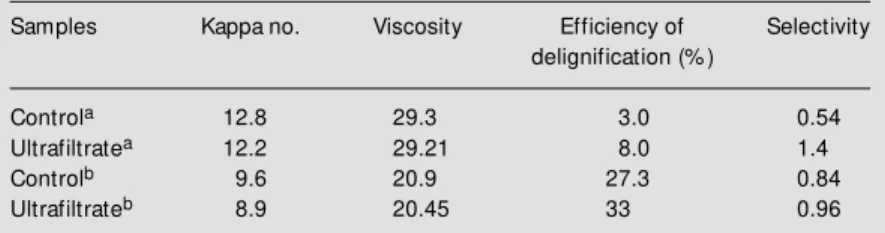
The effect of xylanase activity from a cellulase-free ultrafiltrate sample of T. har-zianum strain 4 on unbleached hardwood kraft pulp is described in Table 1. A reduc-tion in hardwood kraft pulp kappa number after xylanase treatment was larger com-pared to the control sequence (without the enzyme stage). When xylanase treatment was applied, a moderate viscosity drop was ob-tained, indicating that there was little or no cellulose depolymerization and a selective removal of xylan (16-18). The enzyme sample improved the delignification of unbleached hardwood kraft pulp, thus reducing the amount of active chlorine required to obtain a given pulp brightness effect (6,16). The process of lignin release by xylan removal and the further increased swelling of the fiber walls could explain this effect (6,16). In comparison to a thermostable xylanase from Thermomonospora fusca KW 3 (19), xylanase activity from T. harzianum strain
4produced a more extensive delignification of the pulp.
In conclusion, the xylan-degrading en-zymes from T. harzianum strains 4 and C act mainly on ß-1,4 xylosidic linkages. The pres-ence of substituents limits the access of these enzymes to the main chain of xylan. The puri-fied ß-xylosidase activity has transferase as well as hydrolase activities. The introduction of a xylanase preparation from T. harzianum
strain 4 as one bleaching stage facilitated the subsequent bleaching of hardwood kraft pulp.
Ackno wle dgm e nts
The technical assistance of Mrs. Annegret Borchmann is gratefully acknowledged.
Table 1 - Effect of T. harzianum strain 4 xylanase activity on pulp bleaching.
The unbleached pulp had kappa number of 13.2 and viscosity of 31.0 cp before treatment. aPulp prebleaching. bPulp bleaching follow ed by alkaline, oxygen and hydrogen peroxide treatments.
Samples Kappa no. Viscosity Efficiency of Selectivity
delignification (% )
Controla 12.8 29.3 3.0 0.54
Ultrafiltratea 12.2 29.21 8.0 1.4
Controlb 9.6 20.9 27.3 0.84
Ultrafiltrateb 8.9 20.45 33 0.96
Re fe re nce s
1. Puls J & Poutanen K (1989). M echanisms of enzymic hydrolysis of hemicelluloses (xylans) and procedures for determination of the enzymic activities involved. In: Coughlan M P (Editor), Enzyme System for Lignocellulose Degradation. Elsevier Applied Science, London, 151-165. 2. Coughlan M P, Tuohy M G, Filho EXF, Puls
J, Clayessens M , Vrsanská M & Hughes M M (1993). Enzymological aspects of mi-crobial hemicellulases w ith emphasis on f ungal syst em s. In: Coughlan M P & Hazlew ood GP (Editors), Hemicellulose and Hemicellulases. Portland Press, Lon-don, 53-84.
3. Puls J & Schuseil J (1993). Chemistry of hem icelluloses: relat ionship bet w een hemicellulose structure and enzymes re-quired for hydrolysis. In: Coughlan M P &
Hazlew ood GP (Editors), Hemicellulose and Hemicellulases. Portland Press, Lon-don, 1-27.
4. Filho EXF (1994). The xylan-degrading en-zyme system. Brazilian Journal of M edical and Biological Research, 27: 1093-1109. 5. Wong KKY & Saddler JN (1992).
Tricho-derma xylanases, their properties and ap-plicat ions. In: Visser J, Beldm an G, Kusters-van Someren M A & Voragen AGJ (Editors), Xylans and Xylanases. Elsevier, Amsterdam, 171-186.
6. Filho EXF (1998). Hemicellulases and bio-technology. In: Pandalai SG (Editor), Re-cent Research Developments in M icrobi-ology. Research Signpost, India, 165-176. 7. Considine PJ & Coughlan M P (1989). Pro-duction of carbohydrate-hydrolysing en-zyme blends by solid-state fermentation.
In: Coughlan M P (Editor), Enzyme System for Lignocellulose Degradation. Elsevier Applied Science, London, 273-281. 8. Puls J, Borchmann A, Gottschalk D &
Wiegel J (1988). Xylose and xylooligo-mers. M ethods in Enzymology, 160: 528-536.
9. Silveira FQP, M elo IS & Filho EXF (1997). Carbohydrate-hydrolysing enzyme activity production by solid-state cultures of Tri-choderma harzianum strains. Revista de M icrobiologia, 28: 152-156.
10. Filho EXF (1996). Purification and charac-terization of a ß-glucosidase from solid-state cultures of Humicola grisea var.
thermoidea. Canadian Journal of M icrobi-ology, 42: 1-5.
by Trichoderma harzianum strains. Cur-rent M icrobiology, 33: 71-77.
12. Bradford M M (1976). A rapid and sensi-tive method for the quantitation of micro-gram quantities of protein utilizing the principle of protein dye binding. Analytical Biochemistry, 72: 248-254.
13. Filho EXF, Puls J & Coughlan M P (1993). Biochemical characteristics of tw o endo-ß-1,4-xylanases produced by Penicillium capsulatum. Journal of Industrial M icrobi-ology, 11: 171-180.
14. Puls J, Tenkanen M , Korte HE & Poutanen K (1991). Products of beechw ood acetyl-4-O-methylglucuronoxylan hydrolysis by a
xylanase and an acetylxylanesterase. En-zyme and M icrobial Technology, 13: 483-486.
15. Tenkanen M , Puls J & Poutanen K (1992). Tw o m ajor xylanases of Trichoderm a reesei. Enzyme and M icrobial Technology, 14: 566-574.
16. Tremblay L & Archibald F (1993). Produc-tion of a cloned xylanase in Bacillus cereus
and its performance in kraft pulp pre-bleaching. Canadian Journal of M icrobiol-ogy, 39: 853-860.
17. Bajpai P (1997). M icrobial xylanolytic en-zyme system: properties and applications.
Advances in Applied M icrobiology, 43:
141-194.
18. Ragauskas AJ, Poll KM & Cesterino AJ (1994). Effects of xylanase pretreatment procedures on nonchlorine bleaching. En-zyme and M icrobial Technology, 16: 492-495.
19. Davis S, Gysin B, Casimir J & Zimmer-mann W (1992). Thermostable xylanases from actinomycetes for pulp bleaching. In: Visser J, Beldman G, Kusters-van Someren M A & Voragen AGJ (Editors),