HIGH LEVEL OF COPPER APPLICATION TO SOIL AND
LEAVES REDUCE THE GROWTH AND YIELD OF
TOMATO PLANTS
Sahriye Sonmez1*; Mustafa Kaplan1; Namik Kemal Sonmez2; Harun Kaya3; Ilker Uz4
1
Akdeniz University - Faculty of Agriculture - Department of Soil Science & Plant Nutrition, Antalya, Turkey. 2
Akdeniz University - Remote Sensing Research & Application Center. Turkey. 3
Bati Akdeniz Agricultural Research Institute, Antalya, Turkey. 4
University of Florida - Soil & Water Science Dept., Gainesville, Florida, USA. *Corresponding author <[email protected]>
ABSTRACT: Copper-containing fertilizers, fungicides and bactericides are extensively used in greenhouses in Turkey. Informations on effects of these applications to plants are scarce. The aim of the present study was to investigate effects of Cu application to a calcareous soil and to leaves on the yield and growth of tomato plants. Cu was first applied to soil as CuSO4.5H2O in three different levels (0, 1000, and 2000 mg Cu kg-1
) and then to leaves in three different frequencies (no application, biweekly and weekly) using two cupric fungicides (Cu oxychloride, and Cu salts of fatty and rosin acids) in pot experiments carried out in a computer-controlled greenhouse. Total yield, fruit number, dry root weight and plant height decreased with increasing Cu application to soil. Increasing levels of Cu applied to soil and leaves resulted in decreasing final fruit number, dry root weight and plant height in 4th, 5th and 6th weeks. Combined applications of Cu to soil and leaves could be more deleterious to plants than when Cu is applied only to soil or leaves. Key words: dry root weight, fruit number, fungicides, plant height, greenhouse
ALTOS NÍVEIS DE COBRE NO SOLO E NAS FOLHAS REDUZ
CRESCIMENTO E PRODUTIVIDADE DE TOMATEIROS
RESUMO: Fertilizantes, fungicidas e bactericidas cúpricos são usados em larga escala em casas de vegetação na Turquia. Informações sobre os efeitos das aplicações destes produtos sobre as plantas são escassas. Este trabalho investiga os efeitos da aplicação de Cu na forma de CuSO4.5H2O a um solo calcário (0, 1000 e 2000 mg Cu kg-1) e em cobertura (controle, semanal e duas vezes por semana), nas formas de oxicloreto de cobre ou calda bordalesa na produção total, número de frutas, peso seco da raiz e altura de tomateiros cultivados em casa de vegetação. Produtividade total, número de frutas por planta, peso seco da raiz e altura das plantas foram reduzidas pelo aumento da quantidade de Cu aplicado ao solo. O aumento da concentração de CU no solo e folhas diminuiu número final de frutos por planta, peso seco da raiz e altura da planta na quarta, quinta e sexta semanas. A aplicação combinada de Cu ao solo e em cobertura pode ser mais deletéria às plantas que a aplicação de Cu somente ao solo ou em cobertura.
Palavras-chave: peso seco da raiz, número de futas, fungicidas, altura da planta, casas de vegetação
INTRODUCTION
Copper contents of the majority of plant spe-cies varies between 20 and 30 mg kg-1 dry weight. The critical copper deficiency level in vegetative plant parts is generally 3 to 5 mg kg-1 dry weight (Robson & Reuther, 1981); in young grain plants it was reported to be 1.5 mg kg-1
dry weight (Robson et al., 1984).
Copper is an essential element for various metabolic processes. Because it is required only in trace amounts, Cu becomes toxic at high concentra-tions (Delas, 1963; Alva & Chen, 1995). In non-toler-ant plnon-toler-ants, inhibition of root elongation and damage
of root cell membranes are the immediate responses to high Cu levels (Wainwright & Woolhouse, 1977). Changes in root morphology, such as inhibited elon-gation and enhanced lateral root formation (Savage et al., 1981), might be related to the sharp decrease in Indol Acetic Acid oxidase activity in roots exposed to high Cu concentrations (Coombs et al., 1976). Zheng et al. (2004) reported that excessive copper reduced plant root length, root dry weight, total dry weight, root to shoot ratio, leaf area and specific leaf area in three ornamental crops (Dendronthema × grandiflorum L.
Copper-containing fertilizers, fungicides and bactericides have been used extensively in the green-houses in Antalya, Turkey. Kaplan (1999) reported that circa 8% of soils in Antalya contained DTPA-extract-able Cu greater than the critical toxicity level (20 mg kg-1), and the Cu concentration in leaf samples was very high as a result of the intensive use of foliar ap-plied Cu- containing chemicals.
Application of copper containing fertilizers, pesticides and fungicides to leaf or soil has increased gradually over the years in Mediterranean regions where soils are calcareous with neutral or alkaline pH. It is known that Cu solubility decreases as soil pH in-creases. Therefore, it is thought that levels of bio-avail-able Cu in the Mediterranean region are low. There are no previous reports on the effects of high levels of Cu-containing fungicides on yield and growth of tomato plants in the Mediterranean region. The effects of Cu toxicity on yield and growth of tomato plants, under high levels of Cu applications were evaluated in this study.
MATERIAL AND METHODS
Pot experiments were conducted in a com-puter-controlled greenhouse located in Antalya, Tur-key (30°58’44"E, 36°55’49"N, altitude 41 m). Pots were filled with a Xerorthent soil (Entisol) with the following chemical and physical properties: clayey tex-tured (530.4 g kg-1 clay, 367.2 g kg-1 silt, and 102.4 g kg-1 sand); pH 6.5 (1:2.5 soil-water ratio); 26.0 g kg-1 organic matter (Walkley-Black method); total carbon-ates equivalent to 44.0 g kg-1; total N 0.18%; extract-able P 110.80 mg kg-1; extractable K 241.8 mg kg-1; extractable Ca 2750 mg kg-1; extractable Mg 541.2 mg kg-1
; extractable Fe 92.35 mg kg-1
; extractable Zn 14.80 mg kg-1
; and extractable Cu 15.30 mg kg-1
. Total car-bonates were determined according to the calcimeter method of Nelson (1982). Potassium, Ca and Mg were extracted with NH4-Ac and determined by atomic ab-sorption spectrophotometry (AAS) (Kacar, 1995). Soil Fe, Mn, Zn and Cu were extracted with DTPA (Lind-say & Norvell, 1978) and then determined by AAS.
Two separate experiments were carried out, each using different cupric fungicide: Cu oxychloride or copper salts of fatty and rosin acids. The former con-tains 25% Cu oxychloride and is sold as a powder. The latter is a liquid fungicide containing 58% copper salts of fatty and rosin acids (CAS # 61789-22-8), equiva-lent to 51.4 mg L-1 metallic Cu.
Experimental Design
Twenty kg of air-dried soil were passed through a 4 mm mesh sieve and mixed with 5 kg of
a 75% turf: 25% perlyte mixture, and distributed in 25-L pots, fertilized with mono ammonium phosphate and potassium sulphate (36 kg N ha-1
, 80 kg P ha-1
and 112 kg K ha-1). Copper was applied to soil at three dif-ferent rates [0 (Cu1), 1000 (Cu2) and 2000 mg kg-1 (Cu3)] as CuSO4.5H2O. One seedling of tomato (Lycopersicon esculentum (L.) Mill. Cv. F144) was planted per pot. Fungicides were applied at three dif-ferent frequencies [control, no application (L1), bi-weekly (L2) and bi-weekly (L3)]. The treatments were set up based on Kaplan (1999). Trials were set up in a com-pletely randomized factorial design with nine treatments: three levels of Cu application to soil and three frequen-cies of fungicide application to leaves, in all possible combinations, (n = 4).
Processes During and at the End of the Experiment Period
Pots were incubated for two weeks after addition of copper and before planting. Copper application to leaves started at four weeks after planting. All pots were fertilized once a week with mono ammonium phosphate, potassium nitrate, ammonium nitrate, and magnesium sulfate. Total amounts of nutrients provided to each pot were: 195 kg N ha-1, 62 kg P ha-1, 177 kg K ha-1, and 16 kg Mg ha-1
. Pots also received 3.0 kg Fe ha-1
, 3.0 kg Mn ha-1, 1.13 kg Zn ha-1, 0.38 kg B ha-1 and 0.08 kg Mo ha-1.
Plant height was measured weekly from the 4th week after planting. Fruit numbers per plant were re-corded and harvested fruits were weighed. At the end of the experiment, plant roots were washed to detach soil particles, dried in a forced-air oven (65o
C; 72 h), and weighed.
Statistical Analysis
Statistical analysis was carried out using the MSTAT-C software. Means were compared by analy-sis of variance (ANOVA) and the LSD test (α = 0.05). A factorial analysis was used to determine interaction effects of copper application to soil and leaves on yield and growth of tomato plants.
RESULTS
Experiment I (Cu Oxy Chloride Fungicide)
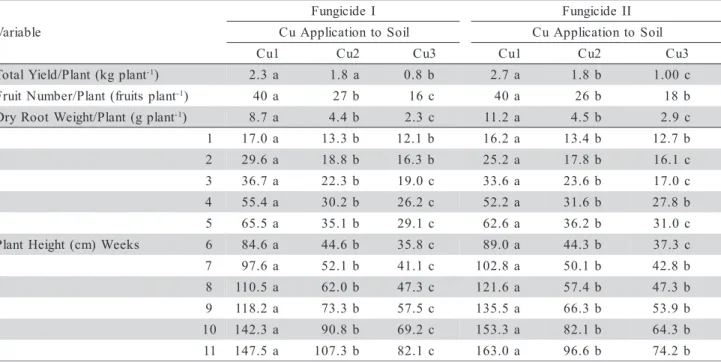
Copper application to soil affected total yield, fruit number, dry root weight, and plant height (P < 0.01). The greatest total yield, fruit number, and dry root weight were obtained when no copper was applied to soil (Cu1); performance traits decreased from treat-ment Cu1 to Cu3 (Table 1).
heights during the 11 weeks were observed when no copper was applied. On average, Cu application to soil resulted in 39% and 50% reductions in plant height in Cu2 and Cu3, respectively, in comparison with treat-ment Cu1.
Increasing levels of Cu application to leaves affected dry root weight and plant height after the 5th
week. The smallest dry root weight was observed in L3. Similarly, after the 5th week, the smallest plant heights were registered for L3 (Table 2). Cu applica-tion to leaves did not affect plant height during the first four weeks. After the 5th week, however, plant height decreased as a result of increasing levels of Cu appli-cation. e l b a i r a V I e d i c i g n u
F FungicideII
l i o S o t n o i t a c i l p p A u
C CuApplicationtoSoil
1 u
C Cu2 Cu3 Cu1 Cu2 Cu3
t n a l p g k ( t n a l P / d l e i Y l a t o
T -1) 2.3a 1.8a 0.8b 2.7a 1.8 b 1.00c
t n a l p s t i u r f ( t n a l P / r e b m u N t i u r
F -1) 40a 27b 16c 40a 26 b 18 b
t n a l p g ( t n a l P / t h g i e W t o o R y r
D -1) 8.7a 4.4b 2.3c 11.2a 4.5 b 2.9c
1 17.0a 13.3b 12.1b 16.2a 13.4 b 12.7 b
2 29.6a 18.8b 16.3b 25.2a 17.8 b 16.1c
3 36.7a 22.3b 19.0c 33.6a 23.6 b 17.0c
4 55.4a 30.2b 26.2c 52.2a 31.6 b 27.8 b
5 65.5a 35.1b 29.1c 62.6a 36.2 b 31.0c
s k e e W ) m c ( t h g i e H t n a l
P 6 84.6a 44.6b 35.8c 89.0a 44.3 b 37.3c
7 97.6a 52.1b 41.1c 102.8a 50.1 b 42.8 b
8 110.5a 62.0b 47.3c 121.6a 57.4 b 47.3 b
9 118.2a 73.3b 57.5c 135.5a 66.3 b 53.9 b
0
1 142.3a 90.8b 69.2c 153.3a 82.1 b 64.3 b
1
1 147.5a 107.3b 82.1c 163.0a 96.6 b 74.2 b
Table 1 - The Effects of Cu Application to Soil on Total Yield, Fruit Number, Dry Root Weight and Plant Height.
Means in the same row followed by the same letter are not significantly different. Fungicide I: Cu oxychloride fungicide. Fungicide II: Copper salts of fatty and rosin acids fungicide.
Table 2 - The Effects of Cu Application to Leaves on Total Yield, Fruit Number, Dry Root Weight and Plant Height.
Means in the same row followed by the same letter are not significantly different (LSD; P > 0.05). Fungicide I: Cu oxychloride Fungicide. Fungicide II: Copper salts of fatty and rosin acids Fungicide.
e l b a i r a V I e d i c i g n u
F FungicideII
s e v a e L o t n o i t a c i l p p A u
C CuApplicationto Leaves
1
L L2 L3 L1 L2 L3
t n a l p g k ( t n a l P / d l e i Y l a t o
T -1) 2.0 a 1.5a 1.5a 2.1a 1.6a 1.7a
t n a l p s t i u r f ( t n a l P / r e b m u N t i u r
F -1) 29 a 26a 28a 29a 26a 28a
t n a l p g ( t n a l P / t h g i e W t o o R y r
D -1) 5.8 a 6.1a 3.5b 7.5a 5.6b 5.4b
1 13.7 a 14.9a 13.8a 14.9a 14.2a 13.3a
2 21.8 a 20.3a 19.7a 20.8a 19.4a 18.9a
3 26.4 a 26.4a 25.2a 26.2a 24.6a 25.4a
4 38.5 a 37.7a 35.6a 39.5a 35.9a 36.1a
5 46.2 a 43.3ab 40.8b 45.5a 42.0a 42.3a
s k e e W ) m c ( t h g i e H t n a l
P 6 59.7 a 55.4a 49.8b 61.3a 54.5a 54.8a
7 71.8 a 64.7b 54.3c 71.6a 62.8a 61.3a
8 83.1 a 75.3a 61.4b 84.1a 71.2a 71.0a
9 96.0 a 85.1a 67.9b 98.0a 85.1a 84.9a
0
1 115.67a 102.42ab 84.25b 113.33a 91.75a 94.67a
1
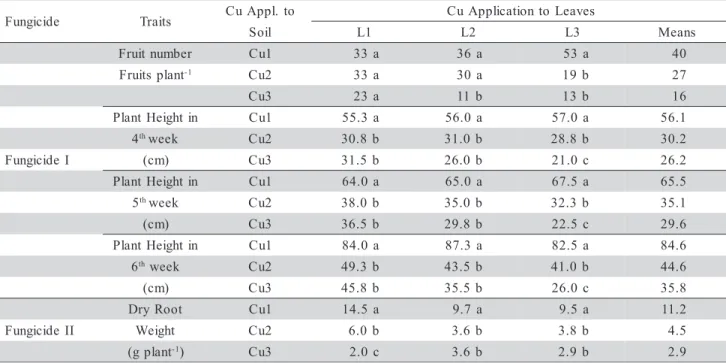
The interaction between Cu application to soil and leaves was significant for fruit number and plant height in the 4th, 5th and 6th week (Table 3). In treat-ment L1, in which no copper was applied to leaves, Cu application to soil did not change fruit number per plant, whereas in the treatments L2 and L3, fruit num-ber decreased with increasing level of Cu application to soil. While the smallest fruit number in treatment L2 (11 fruits, 69.4% decrease in comparison to the con-trol) was recorded for treatment Cu3, the smallest fruit number in treatment L3 was obtained recorded for both treatments Cu2 and Cu3 (64.2% and 75.5% decrease, respectively) (Table 3). Plant height in the 4th, 5th and 6th weeks decreased from Cu1 to Cu2 when no fungi-cide was applied or when it was applied biweekly, while the weekly application of fungicide led to a further decrease in plant height from Cu2 to Cu3 (Table 3).
Experiment II (Copper Salts of Fatty and Rosin Acids Containing Fungicide)
Total yield, fruit number, dry root weight and plant height were affected by the level of Cu applica-tion to soil (P < 0.01). The greatest total yield, fruit number and dry root weight were obtained when no copper was applied (Table 1). As compared with treat-ment Cu1; total yield, fruit number and dry root weight decreased in the treatment Cu2 (33.5%, 35.0% and 60.3%, respectively) and Cu3 (63.9%, 55.0% and 74.5%, respectively). The greatest plant heights
dur-ing the experiment were also obtained when no cop-per was applied to soil (Table 1). On average, increas-ing the level of Cu application to soil resulted in a 40.9% and 50.4% reduction in plant height in ments Cu2 and Cu3, respectively, as compared to treat-ment Cu1.
Cu application to leaves resulted in a decrease in dry root weight. The greatest dry root weight was obtained in treatment L1 (Table 2). The interaction be-tween Cu application to soil and leaves was signifi-cant only for dry root weight (P < 0.01). Copper ap-plication to soil and leaves led to a sharper decrease in dry root weight than when copper was only applied to soil (Table 3).
DISCUSSION
Successful tomato production is ordinarily as-sociated with healthy vegetative top and root growth throughout the growing season. High levels of Cu ap-plication to soil and leaves seriously disrupted normal plant growth. There was an increasing reduction total yield, fruit number, dry root weight and plant height with increasing levels of Cu application to soil and leaves. Copper is a transition metal that participates in redox reactions. When in excess, Cu causes over-pro-duction of oxy radicals, which is believed to be its pri-mary toxic effect in plant cells. Furthermore, Cu-in-duced cell disturbances have consequences on main physiological processes, and impair growth
e d i c i g n u
F Traits CuAppl. to CuApplicationtoLeaves
l i o
S L1 L2 L3 Means
r e b m u n t i u r
F Cu1 33a 36a 53a 40
t n a l p s t i u r
F -1 Cu2 33a 30a 19b 27
3 u
C 23a 11b 13b 16
n i t h g i e H t n a l
P Cu1 55.3a 56.0a 57.0a 56.1
4thweek Cu2 30.8b 31.0b 28.8b 30.2
I e d i c i g n u
F (cm) Cu3 31.5b 26.0b 21.0c 26.2
n i t h g i e H t n a l
P Cu1 64.0a 65.0a 67.5a 65.5
5thweek Cu2 38.0b 35.0b 32.3b 35.1
) m c
( Cu3 36.5b 29.8b 22.5c 29.6
n i t h g i e H t n a l
P Cu1 84.0a 87.3a 82.5a 84.6
6thweek Cu2 49.3b 43.5b 41.0b 44.6
) m c
( Cu3 45.8b 35.5b 26.0c 35.8
t o o R y r
D Cu1 14.5a 9.7a 9.5a 11.2
I I e d i c i g n u
F Weight Cu2 6.0b 3.6b 3.8b 4.5
t n a l p g
( -1) Cu3 2.0c 3.6b 2.9b 2.9
Table 3 - Significant Interactions Between Cu Application to Soil and Leaves.
(Marschner, 1986). Application of high levels of Cu usually inhibits root growth before affecting shoot pro-duction. However, this does not necessarily mean that roots are more sensitive to high copper concentrations, but probably, derives from the fact that roots are in an environment where copper is in excess (Lexmond & Vorm, 1981).
Copper application to soil decreased total yield, fruit number, dry root weight and plant height in both experiments (Table 1). Karataglis & Babalonas (1985) reported that plant height, shoot and root bio-mass, flower and fruit production decreased with in-creasing Cu concentration. Hunter (1981) reported that root growth was almost completely inhibited by Cu treatment in maize. Alva et al. (2000) reported 20% reduction in root weight for 62 and 271 mg kg-1
Cu in the roots of citrus seedlings grown in soils with pH 5.7 and 6.5, respectively. Mazhoudi et al. (1997) reported a decline in the growth rate of tomato plants after ad-dition of 50 µM Cu to a nutrient medium. Lidon &
Henriques (1992) reported that Cu toxicity, as ex-pressed by reduced root length, appeared to be a di-rect result of the accumulation of excess Cu in tissues. Similarly, Rhoads et al. (1992) found that plant dry weight decreased with increasing Cu level in ‘Florida 502’ oats. Lombardini & Sebastiani (2005) registered that Prunus cerasifera plantlets grown in vitro had smaller growth rate (for both fresh and dry weight) at 100 mµM of copper.
Cu application to leaves affected dry weight of roots in both experiments. Plant height after the 5th week was also affected by foliar application of the Cu oxy chloride fungicide, but not by the copper salts of fatty and rosin acids fungicide (Table 2). Reasons for these differences are unknown. However, there are other reports of excessive Cu+2 depressing root (Hill et al., 2000; Lidon & Henriques, 1992; Ouzounidou, 1994) and shoot growth in other plants (Lin et al., 2003; Maksymiec & Baszynski, 1996).
While the interaction between Cu application to soil and leaves was found to be significant for fruit number and plant height in the 4th, 5th and 6th week, when Cu oxychloride-containing fungicide was used, it was significant only for dry root weight when cop-per salts of fatty and rosin acids-containing fungicide was used (Table 3). Copper application to soil and leaves resulted in a sharper decrease in dry root weight, fruit number, and plant height in the 4th
, 5th
and 6th
week than when copper was only applied to soil. High levels of Cu application to soil and leaves to control plant diseases, can negatively affect yield and growth of tomato plants. The combined application of Cu to soil and leaves could be more deleterious to plants than when Cu is applied only to soil or leaves.
ACKNOWLEDGEMENTS
The Scientific Studies Management Unit of Akdeniz University provided financial support for this project. Authors also would like to acknowledge The Batý Akdeniz Agricultural Research Institute in Antalya for its contribution.
REFERENCES
ALVA, A.K.; CHEN, Q. Effects of external copper concentrations on uptake of trace elements by citrus seedlings. Soil Science, v.159, p.59-64, 1995.
ALVA, A.K.; HUANG, B.; PARAMASTUAM, S. Soil pH affects copper fractionation and phytotoxicity. Soil Science Society of America Journal, v.64, p.955-962, 2000.
COOMBS, A.J.; LEEP, N.W.; PHIPPS, D.A. The effects of copper on IAA-Oxidase activity in root tissue of barley (Hordeum vulgare, cv. Zephyr). Zeitschrift fur Pflanzenphysiologie, v.80, p.236-242, 1976. DELAS, J. The toxicity of copper accumulated in soils. Agrochemica,
v.7, p.258-288, 1963.
HILL, S.S.; MIYASAKA, S.C.; YOST, R.S. Taro responses to excess copper in solution culture. Hortscience, v.35, p.863-867, 2000. HUNTER, R.B. A reversible phase of copper toxicity in maize roots.
Journal of Plant Nutrition, v.3, p.375-386, 1981.
KACAR, B. Chemical analyses of plant and soil. III. Soil analyses. Ankara: Ankara University Press, Agriculture Faculty, 1995. p.255-307.
KAPLAN, M. Accumulation of copper in soils and leaves of tomato plants in greenhouses in Turkey. Journal of Plant Nutrition, v.22, p.237-244, 1999.
KARATAGLIS, S.; BABALONAS, D. The toxic effects of copper on the growth of Solanum lycopersicum L. collected from Zn and Pb-soil. Angewandte Botanik, v.59, p.45-52, 1985.
LIDON, F.C.; HENRIQUES, F.S. Copper toxicity in rice: Diagnostic criteria and effect on tissue Mn and Fe. Soil Science, v.154, p.130-135, 1992.
LIN, L.X.; LIANG, W.S.; LIU, D.H. Accumulation of copper by roots, hypocotyls, cotyledons and leaves of sunflower (Helianthus annuus L.). Bioresource Technology, v.86, p.151-155, 2003.
LINDSAY, W.L.; NORVELL, W.A. Development of DTPA soil test for zinc, iron, manganese and copper. Soil Science Society of America Proceedings, v.42, p.421-428, 1978.
LEXMOND, T.M.; VORM, P.D.J.VAN DER. The effect of pH on copper toxicity to hydroponically grown maize. Netherlands Journal of Agricultural Science, v.29, p.217-238, 1981.
LOMBARDINI, L.; SEBASTIANI, L. Copper toxicity in Prunus cerasifera: growth and antioxidant enzymes responses of in vitro grown plants. Plant Science, v.168, p.797-802, 2005.
MARSCHNER, H. Mineral nutrition in higher plants. Orlando: Academic Press, 1986. p.287-300.
MAKSYMIEC, W.; BASZYNSKI, T. Different susceptibility of runner bean plants to excess copper as a function of the growth stages of primary leaves. Journal of Plant Physiology, v.149, p.217-221, 1996. MAZHOUDI, S.; CHAOUI, A.; GHORBAL, N.H.; EL-FERJANI, E. Response of antioxidant enzymes to excess copper in tomato (Lycorpersicon esculentum, Mill.). Plant Science Limerick, v.127, p.129-137, 1997.
NELSON, R.E. Carbonate and gypsum. In: PAGE, A.L.; MILLER, R.H.; KEENEY, D.R. (Ed.). Methods of soil analysis. Madison: SSSA, 1982. p.181-197.
OUZOUNIDOU, G. Root growth and pigment composition in relationship to element uptake in Silene compacta plants treated with copper. Journal of Plant Nutrition, v.17, p.933-943, 1994. RHOADS, F.M.; BARNET, R.D.; OLSON, S.M. Copper toxicity and
ROBSON, A.D.; REUTHER, D.J. Diagnosis of copper deficiency and toxicity. In: LONERAGAN, J.F.; ROBSON, A.D.; GRAHAM, R.D. (Ed.). Copper in soils and plants. Orlando: Academic Press, 1981. p.287-312.
ROBSON, A.D.; LONERAGAN, J.F.; GARTRELL, J.W.; NOWBALL, K. Diagnosis of copper deficiency in wheat (Triticum aestivum
cultivar Gamenya) by plant analysis. Australian Journal of Agricultural Research, v.35, p.347–358, 1984.
SAVAGE, W.; BERRY, W.L.; REED, C.A. Effects of trace element stress on the morphology of developing seedlings of lettuce (Lactuca sativa
L. Grand Rapids) as shown by scanning electron microscopy. Journal of Plant Nutrition, v.3, p.129-138, 1981.
WAINWRIGHT, S.J.; WOOLHOUSE, H.W. Some physiological aspects of copper and zinc tolerance in Agrostis tenuis Sibth: Cell elongation and membrane damage. Journal of Experimental Botany, v.28, p.1029-1036, 1977.
ZHENG, Y.B.; WANG, L.P.; DIXON, M.A. Response to copper toxicity for three ornamental crops in solution culture. Hortscience, v.39, p.1116-1120, 2004.