ISSN 1517-7076 artigo 11547, pp.197-203, 2014
Autor Responsável: UMER, Assim. Data de envio: 24/01/2014 Data de aceite: 19/08/2014
A green method for the synthesis of Copper
Nanoparticles using L-ascorbic acid
Asim Umer1, Shahid Naveed2, Naveed Ramzan3, Muhammad Shahid Rafique4, Muhammad Imran5
1,2,3 Department of Chemical Engineering, University of Engineering and Technology, Lahore.
e-mail: [email protected]; [email protected]; [email protected]
4Department of Physics, University of Engineering and Technology, Lahore.
e-mail: [email protected]
5College of Science and Technology, Model Town, Lahore.
e-mail: [email protected]
ABSTRACT
Chemical Reduction technique was employed to prepared highly stable and dispersed Copper nanoparticles using L-Ascorbic Acid (Vitamin C) as reducing as well as capping agent. In this technique, cupric chloride was used as precursor. The effects of different molar ratios of L-Ascorbic Acid on the concentration and size of copper nanoparticles were studied. The Copper nanoparticles were characterized by X-Ray Diffraction, Atomic Absorption Spectrometry, and Fourier Transform Infrared Spectrometry. The results show that with the increase in the molar ratio of L-ascorbic acid the concentration of Copper nanoparticles were also increased. The average particles size of copper nanoparticle was found in the range of 50-60 nm. The product was kept in ambient conditions for three month but no sedimentation or separation was observed. The use of ascorbic acid makes the process a non-toxic, cost effective and environmental friendly green method.
Keywords: Copper nanoparticles, ascorbic acid, copper salt, XRD, FTIR
1. 1 INTRODUCTION
Copper nanoparticles (Cu NP) are very attractive due to their heat transfer properties such as high thermal conductivity. Cu NP also have high surface area to volume ratio, low production cost, antibacterial potency, catalytic activity, optical and magnetic properties as compared to precision metals such as gold, silver or palladium. The main difficulty lies in their preparation and preservation as they oxidized immediately when exposed in air. Scientists are using different inert media such as Argon, Nitrogen [1-3] to overcome this oxidation problem also using reducing, capping or protecting agents for the reduction of copper salt used. Some reducing and capping agents are very expensive and also have toxic effects.
Physical and chemical methods are two basic techniques for the synthesis of Cu NP. Pulsed laser ablation [4], vacuum vapor deposition [5], pulsed wire discharge [6] and mechanical milling [7] are physical techniques while Chemical reduction [8], Microemulsion techniques [9], sonochemical reduction [10], Electrochemical [11], Microwave assisted [12], and hydrothermal [13] are chemical approaches for the synthesis of nanoparticles. Biological or biosynthesis [14] techniques are also considered as chemical methods. Cu NP has high thermal conductivity [15] and also the production cost is very low as compare to noble metals. Cu NP production using chemical reduction method gives good results but use of hazardous reducing and costly and protecting agent [16-22] makes the process toxic in some cases. To avoid the toxicity and to prepare Cu NP in green environment, we have used ascorbic acid in our chemical reduction process. Ascorbic acid works both as reducing and protecting agent, which makes the process economical, nontoxic and environment friendly [15]. The raw materials are the same as Jing Xiong [23]; however, the synthesis route and the equipments have been changed, which resulted in the size variation of NP in this work.
2. 2 EXPERIMENTAL
198
Copper (II) Chloride CuCl2.2H2O (98 % Pure) from Riedel-de Haen, Germany, L-Ascorbic Acid (99 % pure) from Merck, Germany, of analytical grade, were purchased and used without further chemical treatment and purification. L-Ascorbic acid was used as reducing as well as capping agent. De-ionized water was obtained from Institute of Environmental Engineering and Research, University of Engineering and Technology, La-hore, Punjab, Pakistan. (S.G 2000 Water Germany now owned by Siemens USA.)
2.2 Synthesis of Copper nanoparticles
A 500 mL of 0.01 molar Copper (II) Chloride (CuCl2.2H2O) solution was prepared by dissolving that copper salt in ionized water. Solutions of 0.25M, 0.5M, 0.75M and 1.0M L-Ascorbic Acid were prepared in de-ionized water. Four air tight flasks, each having 50 mL of CuCl2.2H2O solution were heated continuously at 90oC in water bath shaker (electrical/mechanical heated).
Figure 1: Synthesis steps of Cu NP.
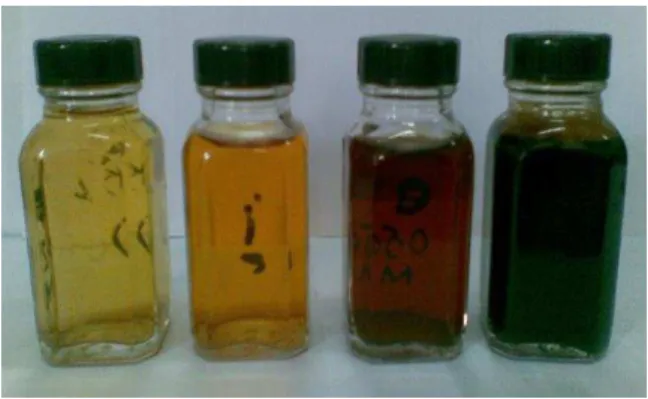
The solution of 0.25M, 0.5M, 0.75M and 1.0M L-Ascorbic Acid were added drop wise to each flask respectively. The heating and mixing continued till the color changed from no color to yellow, orange, brown and finally dark brown-black as shown in Figure 1. The whole process was completed within 17 hours. The product was kept for 12 weeks, no sedimentation or dispersion was observed with no magnification.
2.2 Characterization
The concentration of synthesized Cu NP was evaluated using Atomic Absorption Spectrometer (AA6800, Shimadzu, Japan). FT-IR spectrum were accomplished and recorded with Fourier-Transform infrared spec-trophotometer (Bruker , Alpha ATR) between 4000 and 375 cm-1, with resolution of 4 cm-1. The morphology and size of produced nanoparticles were characterized by X-Ray Diffraction (XRD), PANalytical, X'Pert PRO XRD system.
3. 3 RESULTS AND DISCUSSION
3.1 Atomic Absorption Spectrometry
A sample of 0.1 mL prepared Cu NPs solution from each flask was obtained and diluted to 100 mL by adding de-ionized water. Standard copper solutions (0.5ppm, 1.0ppm, 2.0ppm and 5.0 ppm) were prepared as refer-ence. By adjusting the wavelength of Atomic Absorption Spectrometer at 324 nm, the samples were ana-lyzed.
The concentration-Absorption graph confirms the presence of copper and the Beer-Lambert’s laws
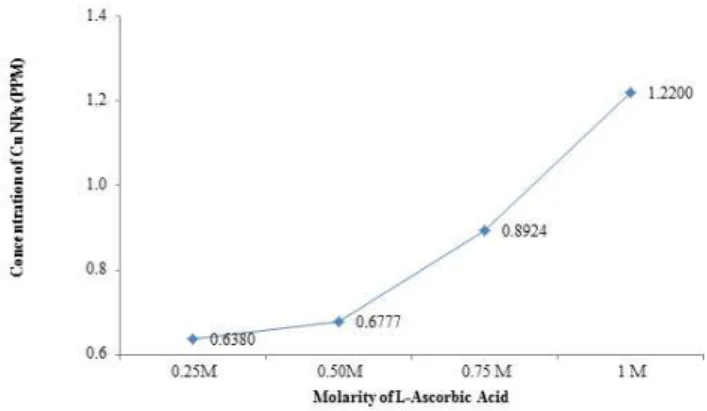
(the proportional relationship between the concentration and absorption) proving that the concentration of Cu NPs increased in different prepared samples. It also revealed that the concentration of Cu NPs increased rapidly when the concentration of L-Ascorbic acid was increased gradually whereas the concentration of copper chloride was kept constant as shown in Figure 2.
199 Figure 2: Effect of the L-Ascorbic Acid concentration on the synthesis of Cu NPs.
Figure 3: Relation of Cu NPs concentration and Absorption.
3.2 Fourier Transform-Infra Red (FT-IR) Spectrometry
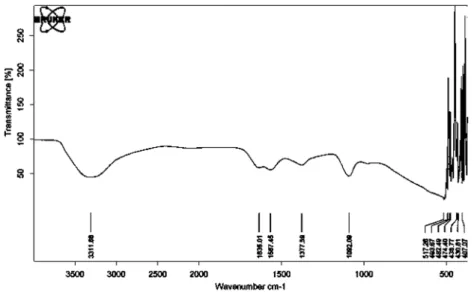
The interaction of L-Ascorbic Acid and Cu nanoparticles and the mixture composition changes were studied by FT-IR spectrometry. The IR spectra of pure L-Ascorbic Acid is represented in Figure 4. The spectrum of pure L-Ascorbic Acid revealed that the stretching vibration of C-C double bond and the peak of enol-hydroxyl were observed at 1674 cm-1 and 1322 cm-1, respectively. These were replaced after the reaction with new peaks 3311.88 cm-1, 1635.01 cm-1,1567.45 cm-1 and 1377.59 cm-1 (Figure 5). These peaks corre-spond to hydroxyl, band due to scissor bending vibration of molecular water, acidic asymmetric stretch and C-H deformations of –CH2 or –CH3 groups (lignin) in aliphatic respectively.
200 Figure 5: IR spectra of Cu NPs produced by L-Ascorbic Acid.
3.3 X-Ray Diffraction (XRD)
The crystal structure and average particle size of the Cu nanoparticles were analyzed by PANalytical, X'Pert PRO XRD system. The pattern of the prepared Cu nanoparticles is shown in Figure 6. It is observed that there are much broader and less intense peaks in the XRD spectrum. XRD pattern of obtained Cu Nano-partcles sample is made up of very small crystallites. The broadness of the peak can be used to calculate the
average crystalline size of the Cu NPs using the Scherer’s formula [24], (D = ), where 0.90 is a constant value known as shape factor, is the wavelength of the X-rays and taken as 0.1541Å, is the FWHM (full Width at half maximum) of the diffraction peaks and is the diffraction angle. The Experi-mental and Standard diffraction angles [25] of Cu NP obtained by XRD are mentioned in Table-1.
201 Table 1. Experimental and Standard diffraction angles of Copper nanoparticles.
Experimental diff. angle [2θ in degree]
Standard diff.
angle [2θ in degree]
JCPDS copper:
04-0836 [24,25]
Hkl (Planes)
41.075 43.297 (111)
48.129 50.433 (200)
69.178 74.130 (220)
The XRD pattern of the as prepared Cu nanoparticles is presented in Figure 6 and in good agreement with the reported XRD pattern of Cu nanoparticles [25]. The average crystalline size of the Cu nanoparticles for 0.5M L-ascorbic acid was calculated using the Scherrer’s formula for the Cu sample is in the range of 50 -60 nm. The values at peaks mentioned in the Table-1 are in good agreement with the spherical Cu phase and correspond to lattice planes of standard crystalline Cu, respectively [26].
4. 4 STABILITY OF CU NANOPARTICLES
The main factors that affect the use of Cu NP are the stability in the dispersion. Many capping agents such as Polyvinyl Pyrrolidone (PVP) and Polyethylene glycol are used to prevent agglomeration. L-Ascorbic acid was used as reducing as well as capping agent in this work to avoid contamination of other organic com-pounds.
The prepared Cu NP suspensions were placed without any further mixing or treatment for 12 weeks, no sedimentation was seen till that period. This indicates that the L-Ascorbic Acid highly stabilized the Cu nanoparticles due to its high capping power.
5. CONCLUSIONS
The L-ascorbic acid (Vitamin C) protected Cu NP prepared using chemical reduction of cupric chloride. The product is of uniform size 50-60 nm and has uniform distribution curve. It is noted that by increasing the concentration of L-ascorbic acid the concentration of nanoparticles is increased at constant concentration of cupric chloride, which is confirmed by Atomic Absorption spectrometry. The produced Cu NP are of high stability than ever reported. The stability period is 3 months, which has been observed with no suspension or sedimentation. This is a simple, economical and green method for the synthesis of Cu NP with no toxic and hazardous effect.
6. ACKNOWLEDGEMENT
The authors express immense thanks to the Department of Chemical Engineering, Department of Physics and IEER, University of Engineering and Technology, Lahore and also thankful to Mr. Shahid Rehman Khan (SOS) of PCSIR, Lahore for providing test facilities. The financial support from the UET, Lahore-Pakistan is also gratefully acknowledged.
7. REFERENCES
[1] FELDHEIM, D.L., FOSS JR, C.A., Metal Nanoparticles; Synthesis, Characterization, and Applications, New York, USA, Marcel Dekker Incorporated, 2002.
[2] SIEGEL, R. W., HU, E., ROCO, M. C., Nanostructure Science and Technology: R & D Status and Trends in Nanoparticles, Nanostructured Materials, and Nano-devices, 1 ed., In: WTEC Panel Report, Kluwer Academic Press, Dordrecht, Netherland, 1999.
[3] JANA, N. R., WANG, Z. L., SAU, T. K., et al., “Seed-mediated growth method to prepare cubic Copper
202
[4] YEH, M. S., YANG, Y.-S., LEE, Y.-P., et al.,“Formation and Characteristics of Cu Colloids from CuO Powder by Laser Irradiation in 2-Propanol”, Journal of Physical Chemistry-B, v.103, n.33, pp.6851-7, Aug. 1999.
[5] LIU, Z., BANDO, Y. “A Novel Method for Preparing Copper Nanorods and Nanowires”, Advanced Materials, v. 15, n. 4, pp.303-305, Feb. 2003.
[6] YATSUI, K., GRIGORIU, C., KUBO, H., et al., “Synthesis of nano size powders of alumina by ablation
plasma produced by intense pulsed light-ion beam”, Applied Physics Letters, v. 67, n. 9, pp.1214–1216, Aug. 1995.
[7] OLESZAKA, D., SHINGU, P.H., “Nanocrystalline metals prepared by low energy ball milling”, Journal of Applied Physics, v. 79, n. 6, Mar. 1996.
[8] WANG, Y., CHEN, P., LIU, M., “Synthesis of Well-Defined Copper Nanocubes by a One-Pot Solution
Process”, Nanotechnology, n. 17, n.24, pp.6000-6006, 2006
[9] PILENI, M. P., “Reverse Micelles as Microreactors”, The Journal of Physical Chemistry, v. 97, n.27, pp.6961-6973, Jul. 1993.
[10] KUMAR, R. V., MASTAI, Y., DIAMANT, Y., et al., “Sonochemical Synthesis of Amorphous Cu and Nanocrystalline Cu2O Embedded in a Polyaniline Matrix”, Journal of Materials Chemistry, v.11, n.4, pp.1209-1213, Feb. 2001.
[11] MOLARES, MET., BUSCHMANN, V, DOBREV, D, et al., “Single-crystalline copper nanowires
pro-duced by electrochemical deposition in polymeric ion track membranes”, Advanced Materials, v.13, n.1, pp.62-65, Jan. 2001.
[12] TAKAYAMA, S., LINK, G., SATO, M.., et al., Microwave and Radio Frequency Applications, In: Proceedings of the Fourth World Congress on Microwave and Radio Frequency Applications, pp.311-318, Austin, Texas, USA, Nov. 2004.
[13] CHU, LY., ZHUO, Y., DONG, L., et al., “Controlled synthesis of various hollow Cu nano/microstructures via a novel reduction route”, Advanced Functional Materials, v. 17, n.6, pp.933-938, Feb. 2007.
[14] BALI, R., RAZAK, N., LUMB, A., et al., “The synthesis of metal nanoparticles inside live plants”, In:
International Conference on Nanoscience and Nanotechnology, pp.224-227, Jul. 2006.
[15] UMER, A., NAVEED, S., RAMZAN, N., et al., “Selection of a suitable method for the synthesis of
Copper nanoparticles”, NANO: Brief Reports and Reviews, World Scientist Publishing Company, v. 7, n. 5, Nov. 2012.
[16] BONET, F., DELMAS, V., GRUGEON, S., et al., “Synthesis of Monodisperse Au, Pt, Pd, Ru and Ir
Nanoparticles in Ethylene Glycol,” Nano Structured Materials, v. 11, n. 8, pp.1277-1284, Nov. 1999. [17] MURPHY, C. J., SAN, T. K., GOLE, A. M., et al., “Anisotropic Metal Nanoparticles: Synthesis, A
s-sembly, and Optical Applications”, Journal of Physical Chemistry B, v. 109, n. 29, pp.13857-13870, Jun. 2005.
[18] SANTOS, I. PASTORIZA.,LIZ-MARZAN, L. M., “Formation and stabilization of silver nanoparticles through reduction by N, N-dimethylformamide”, Langmuir, v. 15, n. 4, pp.948-951, Jan. 1999.
[19] TAN, Y. W., DAI, X. H., Li, Y. F., “Preparation of Gold, Platinum, Palladium and Silver Nano
-particles”, Journal of Materials Chemistry, v. 13, n. 5, pp. 1069-1075, Mar. 2003
[20] CHOU, K. S., REN, C. Y., “Synthesis of nanosized silver particles by chemical reduction method”,
Materials Chemistry and Physics, v. 64, pp.241–246, May 2000.
[21] LEE, Y., CHOI, J.R., LEE, K. J., et al., “Large-scale synthesis of copper nanoparticles by chemically controlled reduction for applications of inkjet-printed electronics”, Nanotechnology, v. 19, n. 41, Sep. 2008.
[22] LEOPOLD, N., LENDL, B., “A New Method for Fast Preparation of Highly Surface-Enhanced Raman Scattering (SERS) Active Silver Colloids at Room Temperature by Reduction of Silver Nitrate with
Hy-droxylamine Hydrochloride”, In: Journal of Physical Chemistry B, v. 107, n. 24, 5723–5727, May 2003. [23] XIONG, JING., WANG, YE., XUE, QUNJI, et al., “Synthesis of highly stable dispersions of nanosized
203
[24] SCHERRER, P., “Nachrichten von der Gesellschaft der Wissenschaften zu Gittingen, Mathematisch-Physikalische Klasse, v. 26, n. 1, pp. 98-100, Jul. 1918.
[25] MDI (material data) Jade Software, Version-6.5, XRD data processing Card # 04-0836.
[26] ZHOU,RUIMIN., WU, XINFENG., HAO, XUFENG, et al., “Influences of surfactants on the prepar