Femtosecond Lasers for Processing Glassy and Polymeric Materials
A. J. G. Otukaa, J. M. P. Almeidaa, V. Tribuzia, M. R Cardosoa,
A. C. Hernandesa, D. S. Correab, C. R. Mendonçaa*
aDepartamento de Física e Ciência dos Materiais, Instituto de Física de São Carlos, Universidade de São Paulo – USP, CP 369, CEP 13560-970 São Carlos, SP, Brazil bLaboratório Nacional de Nanotecnologia para o Agronegócio – LNNA, Embrapa Instrumentação,
Rua XV de Novembro, 1452, CP 741, CEP 13560-970, São Carlos, SP, Brazil
Received: April 2, 2013; Revised: August 13, 2013
Novel materials have been developed to meet the increasing mechanical, electrical and optical
properties required for technological applications in different ields of sciences. Among the methods
available for modifying and improving materials properties, femtosecond laser processing is a potential
approach. Owing to its precise ablation and modiication capability, femtosecond laser processing has
already been employed in a broad range of materials, including glasses and polymers. When ultrashort laser pulses are focused into a transparent material, the intensity at the focus can become high enough
to induce nonlinear optical processes. Here, we report on femtosecond (fs) laser microfabrication in special glasses and polymers. Initially, we describe fs-laser micromachining on the surface of copper doped borate and borosilicate glasses. Subsequently, we present results on two-photon induced polymerization to fabricate microstructures containing luorescent dyes for manufacturing optical microcavities. Both approaches are promising for designing optical and photonics micro/nanodevices.
Keywords: femtosecond pulses, laser micromachining, microfabrication, glass, polymer
1. Introduction
In the last decades, laser has become an important
tool for material processing at the industry, being mainly
used for welding, cutting and drilling. However, the need
for producing more compact equipment has motivated
researchers to develop new techniques for material processing at micro/nano scale1-4. Ultrashort lasers pulses have some unique features that provide advances to
accomplish this task. For instance, in femtosecond laser micromachining, a focused fs-laser beam is used to induce
permanent changes on the surface or in the bulk of materials
to produce 3D microstructures. Because of the nonlinear nature of the process, the material’s modiication occurs where the light intensity is high enough, i.e., only in the focal volume. Thus, by moving the sample with respect
to the laser focus, it is possible to change the material properties, such as the refractive index, nonlinear optical
susceptibility, crystalline structure and morphology, with
high spatial precision5,6. Different classes of materials, from semiconductors to organic compounds have been
investigated in order to develop all-optical devices. In this paper we show some recent results we obtained on the use of fs-laser to micromachine doped glasses and to microfabricate 3D polymeric structures, which are potential materials for photonics applications.
1.1.
Femtosecond laser micromachining in
glasses: ablation
Glass materials can be made up with a wide range of compositions, which enables tuning their properties aiming at speciic applications. Optical glasses are highly transparent in the visible and near-infrared region, presenting
also good chemical and mechanical stability7,8. Hence, glasses are considered attractive candidates for waveguides, all-optical switches and stimulated Raman ampliiers9. Fs-laser micromachining has been used to fabricate
photonic structures in glass, because ultrashort laser pulses
can produce change of the refractive index, modiication
of the local composition5,6, photoreduction of some ions and even to induce growth of metallic nanoparticles10. To achieve each speciic type of material modiication, however,
distinct experimental parameters, such as the numerical
aperture (NA) of the lens used for micromachining, the
pulse duration and the pulse energy need to be adjusted5. In general, two main classes of optical breakdown that results in material’s modiication are found. Considering the pulse energy (E), a refractive index change is observed when the E value is close to the material’s damage threshold. On the other hand, increasing E beyond the threshold may
lead to ablation5. Although recent advances have been achieved in the understanding of ultrashort laser pulses
commercial glasses, despite their technologic relevance. In this direction, we present here results on the use of fs-laser
to micromachine copper doped borate11 and borosilicate10 glasses, where the damage threshold energy and ablation processes have been studied. It has been shown that these
glasses can be used to generate metallic copper nanoparticles
by fs-laser irradiation, which is important for all-optical technologies.
1.2.
Femtosecond laser microfabrication
in polymers: two-photon absorption
polymerization
Polymeric microstructures have been widely studied to
develop many technological applications12-15. Two-photon
absorption polymerization (2PP) has emerged as a promising
technique for fabricating polymeric microdevices due to the advantages it provides16,17; (i) resolution below the diffraction limit because of the quadratic dependence on
the intensity, (ii) no restrictions regarding the shape the 3D fabricated structures and (iii) the capability of producing components with moving parts. In the last few years, the
2PP fabrication of microstructures containing compounds
of interest, such as luorescent dyes and nanoparticles, has
been demonstrated in polymeric structures18-21, as well as
in hybrid organic-inorganic materials22, with interesting prospects for the development of devices14,23. These structures can be specially designed to meet the desired application24. Furthermore, the use of picosecond pulses and
cw laser for microfabrication have also been demonstrated, opening new possibilities in this ield25,26. Here we present some results regarding the fabrication and characterization
of doped microstructures, produced by 2PP, with potential application for optical microcavities.
2. Experimental
2.1.
Femtosecond laser micromachining in
glasses
The 0.1CuO doped borate (53B2O3 -14MgO-13ZnO-6.5SiO2-4PbO-1.5Al2O3-0.5Nb2O5-2.5Na2O-4.5K2 O-0.5Sb2O3) and borosilicate (50SiO2-17B2O3
-11.5MgO-10Na2O-11.5Al2O3 mol%) glasses were prepared by
conventional melting-quenching technique, using platinum crucible and melting temperature above 1200 °C. Both samples were annealed at 450 °C for 12h in order to minimize the mechanical stress.
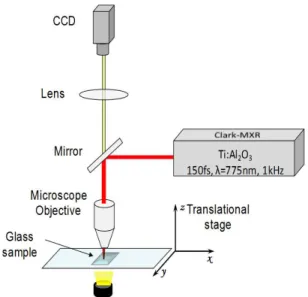
The samples were micromachined using 150 fs, 775 nm laser pulses from a Ti:sapphire ampliied system (Clark-MXR CPA-2001), operating at a 1 kHz repetition rate. The beam was focused on the sample surface through microscope objectives with NA of 0.25 and 0.65. The sample was translated with respect to the laser beam at different constant speeds (50 - 1000 µm/s), using a computer-controlled xyz stage (Thorlabs Z825B). The pulse energy was measured before the microscope objective, which value was corrected by the corresponding objective’s transmittance (63 and 23 % for the objectives with NA of 0.25 and 0.65, respectively). The experimental setup used for the micromachining is
displayed in Figure 1, in which a CCD camera was coupled to the optical system to watch sample fabrication in real time.
The micromachined samples were analyzed by optical (LSM 700 - Carl Zeiss) and scanning electron microscopies (SEM) (Hitachi - TM3000). The samples absorption spectra and glass transition temperature (Tg) were obtained in a Shimadzu UV-1800 spectrometer and a Netzsch STA 409C
calorimeter, using Al2O3 pans and heating rate of 10 °C/min, respectively.
2.2.
Femtosecond laser microfabrication
in polymers: two-photon absorption
polymerization
The polymeric resins employed in this work consist of two three-acrylate monomers (liquid form). The irst monomer is the tris(2-hydroxyethyl)isocyanurate triacrylate (SR 368), that is responsible for giving hardness to the inal structure, while the second monomer, the ethoxylated(6) trimethyl-lolpropane triacrylate (SR 499), reduces the
shrinkage tensions upon polymerization27,28. The monomers were used in a ratio of 50 wt %. To the monomers mixture was added the photoinitiator ethyl-2,4,6-trimethylbenz oylphenylphosphinate (Lucirin TPO-L)27,28, and mixed it for 1 hour to obtain a homogeneous solution. Besides Lucirin TPO-L, other photoinitiators as well as resin with no-photoinitiator can also be used, allowing producing,
for instance, transparent optical devices or developing biomedical applications29-31. We dissolved the luorescent dyes in ethanol, added it to the resin and left it mix for 1 extra
hour. Afterwards, the mixtures were left resting for solvent evaporation. In this work, we fabricated microstructures doped with Rhodamine B32,33 and Stilbene 42034.
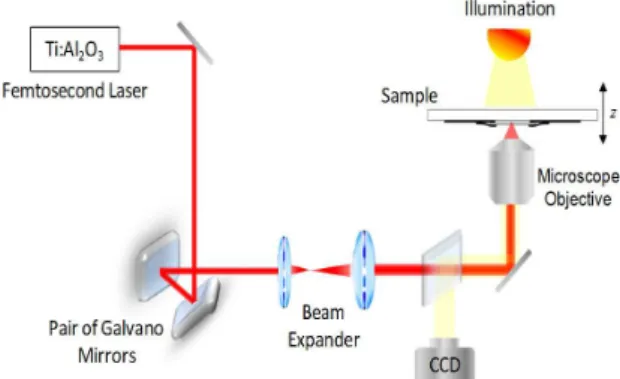
To fabricate polymeric microstructures, a Ti: sapphire (KMLabs, 86 MHz, 780 nm, 100 fs) laser oscillator was employed. The laser beam was focused onto the sample with a 0.85-NA microscope objective. The sample is prepared by
Figure 1. Schematic diagram of the experimental setup used for
placing a drop of resin mixture on a glass substrate, which lies on a glass slide. The resin is placed inside a spacer and enclosed by a cover slip. The sample is positioned in the z direction using a motorized stage, while the laser is scanned
across the sample in the xy plane using a pair of galvano
mirrors (Cambridge Technology) operating with a scanning
speed of 20 µm/s. In this condition the sample is subjected to 4 × 10⁶ pulses/spot. For the undoped microstructure we used an average power of 26 mW (0.30 nJ/pulse) that corresponds to an intensity of 0.11 GW/cm2, determined after the microscopy objective . The microstructures doped with Stilbene 420 were fabricated using an average power of 36 mW (0.42 nJ/pulse), which corresponds to an intensity of 0.15 GW/cm2. For more details about calculations of pulse overlap and energy dose refer to Reference35. Our system allows real time visualization of microfabrication, due to the difference
Figure 2. Experimental setup employed for microfabrication using
two-photon absorption polymerization.
Figure 3. Absorption spectra of the copper doped borate (solid)
and borosilicate (dash) glasses.
Table 1. Glass transition temperature (Tg), cutoff wavelength (λcutof), threshold pulse energy (Eth) threshold intensity (Ith) to damage the
sample surface.
Glass sample Tg(°C) λcutoff (nm) th (µJ) I th (TW/cm
2)
NA = 0.25 NA = 0.65 NA = 0.25 NA = 0.65
Borate 511 ± 2 346 ± 2 0.46 ± 0.07 0.30 ± 0.02 86 140
Borosilicate 500 ± 2 329 ± 2 0.38 ± 0.03 0.07 ± 0.01 45 20
in index of refraction between the liquid resin and the polymerized one. An illustration of this experimental setup is show in Figure 2. After fabricating the microstructures by
2PP, the sample is immersed in ethanol for approximately
15 minutes to remove the unpolymerized resin.
The fabricated microstructures were characterized by optical (LSM 700 – Carl Zeiss) and scanning electron microscopies (SEM) (Hitachi – TM3000). The emission spectra of doped microstructures were obtained using a spectrometer coupled to an optical microscope. As the excitation source for luorescence we used a He-Cd laser operating at 325nm.
3. Results and Discussion
3.1.
Femtosecond laser micromachining in
glasses
The glass transition temperatures obtained from the DSC curves are shown in Table 1. Figure 3 shows the absorption spectra of the copper doped borate (solid line) and borosilicate (dashed line) glasses. Both samples present a wide absorption band in the range of 550-1000 nm, which is related to Cu+2 ions, and yields the bluish color to the glass. The absorption band around 800 nm is attributed to
the superposition of 2B 1g→
2A 1g and
2B 1g→
2B
2g electronic transitions10. The spectra shown in Figure 3 are quite similar,
in which small differences are observed for the absorption band intensity at visible region and in the cutoff wavelength, presented in Table 1. Such differences are related to the distinct compositions of the glass matrix.
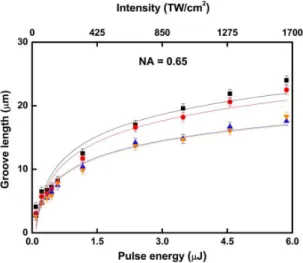
Figure 4 illustrates the dependence of the groove width, produced by fs-laser micromachining, on the pulse energy
for the copper doped borosilicate glass irradiated at 50, 100, 500 and 1000 µm/s, using a microscope objective with NA = 0.65. It is possible to observe a logarithmic behavior of the groove width on the pulse energy. For the micromachining using NA=0.25 and considering the same
experimental conditions for borate glass, a similar behavior
was observed. Although the optical breakdown induced by ultra-short laser pulses is a complex process, a simple model
has been proposed in the literature5:
(
)
1ln
a th
L≈ α− F F (1)
where L is the ablation width/depth, α–1 is the optical
penetration depth and Fa and Fth are the absorbed and
speeds analyzed we found the same value for Eth, considering
the error bar. Thus, the threshold energy of each sample (presented in Table 1) seems to be independent of the laser scan speed.
The morphology of the grooves was analyzed by SEM images. The top view of the borate and borosilicate glass grooves are shown in Figure 5 for slow and fast scan speeds. We can split the proile observed in two parts: (i) a central region where the ablation process is dominant and (ii) a peripheral region in which micromachining is distinct for the slow and fast scan speeds. For the slow scan speed, a
structural pattern is formed at the external region of the
groove. Similar morphologies have already been observed
in semiconductor materials36. Such kind of process is called LIPSS - laser induced periodic surface structures, and results from the interference between the incident laser beam and
the scattered light by imperfection on the sample surface36.
3.2.
Microstructures fabricated using two-photon
absorption polymerization (2PP)
In Figure 6 we show SEM micrographs of structures produced by the 2PP technique, using a laser power of 26 mW (0.11 GW/cm2) and a scanning speed of 20 µm/s. The fabricated microstructures present their structural characteristics unchanged after the washing process. In Figure 6a we show microstructures with different sizes and heights, demonstrating the eficacy of the technique to fabricate miniaturized devices for several applications. The detached microstructure displayed in Figure 6 was
Figure 4. Groove width as a function of the pulse energy for the borosilicate glass (NA = 0.65). The symbols represent the experimental results for four scan speeds: ( ) 50, ( ) 100, ( ) 500 and ( ) 1000 μm/s. Solid lines are the itting obtained with Equation 1.
Figure 5. Scanning electron microscopy images of borate and borosilicate glass for scan speeds of 50 and 1000 µm/s (NA = 0.65 and
E = 3.5µJ). For 50 µm/s the sample is subjected to 40 pulses/spot (~2 µm) and each spot experiences a luence of 4.5 kJ/cm2, while
unintentionally obtained during the washing process. Such detachment can be prevented by covering the glass substrate with a coating layer that facilitates adhesion of
the polymerized structure to the glass surface, such as, for
instance, acryloxy-propyl-trimethoxy silane. Figure 6b shows a cylindrical (open) microstructure, whose details will be discussed latter. For real optical device applications smother microstructures would be necessary, which can be
obtained by using a higher voxel overlap14,23,37.
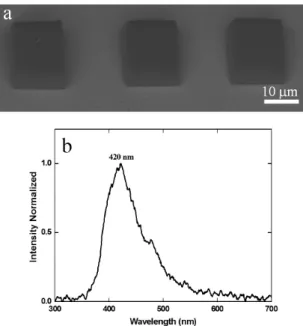
Figure 7a shows a SEM image of microstructures containing Stilbene 420. Such structures were produced with a laser power of 36 mW (0.15 GW/cm2) and scanning speed of 20 µm/s. The luorescence spectrum of these microstructures, displayed in Figure 7b, shows that the emission peak is located at 420 nm, which is in good agreement with the ones reported in the literature for Stilbene
in several solvents34. Our results indicate that the luorescent
dye was not degraded during the microfabrication process, and that it is retained in the microstructures after the washing process. Such features are appreciable for fabricating optical devices.
To demonstrate the viability of using 2PP for producing optical devices, as a proof of principle, we fabricated a microstructure composed of two concentric cylindrical shells, being the inner one doped with Rhodamine B while the outer one is constituted only of the pure (undoped) resin. To microfabricate the structure doped with Rhodamine B, we used an average power of 26 mW ( 0.30 nJ/pulse and an intensity of 0.11 GW/cm2), Such type of structure is fabricated in two steps; i) irstly, the doped part of the
microstructure is fabricated using the doped resin and
ii) subsequently, after washing the unpolymerized resin,
the second part of the fabrication is carried out using
the undoped resin. In Figure 8a we show a top view image (SEM), in detail, of the interface between the two polymerized cylindrical shells.
Figure 8b presents an optical microscopy image of the cylindrical microstructure, where distinct parts of the structure can be visualized; the center with air, the inner cylinder containing Rhodamine B and the external portion with pure resin. Such microstructure was excited, under the microscope, using an LED centered at 450 nm. In Figure 8c we see the intense luorescence of the microstructure portion containing Rhodamine B. It can be seen that most of the emitted light is conined to the inner cylinder (doped), and only a small scattering is observed in the undoped region. Therefore, we fabricated a microstructure that is able to provide light coninement in a given region, which could be used for fabricating optical microcavities. To obtain smoother microstructures aiming at micro-optical devices,
a higher voxel overlap has to be used, as demonstrated for instance in Reference14,23,37.
4. Conclusion
We have presented some results on the use of fs-laser to
micromachine cooper doped glasses and to microfabricate
polymeric -structures containing fluorescent dyes. We have obtained the experimental conditions (pulse energy and scan speed) to micromachine copper doped borate and borosilicate glasses. Laser induced periodic structures were observed on the sample surface, with features in the nanometric scale. In addition, by using 2PP we were able to produce 3D polymeric microstructures with high deinition and structural integrity. Fluorescent microstructures were
Figure 6. SEM images of microstructures with different sizes and
heights (a) and of an open cylindrical microstructure (b).
Figure 7. (a) SEM image of structures doped with Stilbene 420.
(b) Emission spectrum of microstructures doped with Stilbene 420.
produced by doping the basic acrylic resin with luorescent
dyes, indicating such approach for the development of
micro-optical devices. In general, the results obtained show that fs-laser micromachining and microfabrication
are promising techniques to engineer novel materials for
diverse technological applications.
Acknowledgments
We thank inancial support from the Brazilian agencies FAPESP, CNPq and CAPES. Technical assistance from André L. S. Romero, the support and interaction with
previous students and collaborators are also gratefully
acknowledged.
References
1. Eliajh Kannatey-Asibu J. Principles of laser materials
p ro c e s s i n g . N e w J e r s e y : J o h n W i l e y & S o n s ,
Inc.; 2009. 819 p. http://dx.doi.org/10.1002/9780470459300 2. Cheng JY, Wei CW, Hsu KH and Young TH. Direct-write
laser micromachining and universal surface modification
of PMMA for device development. Sensors and Actuators
B-Chemical. 2004; 99(1):186-196. http://dx.doi.org/10.1016/j.
snb.2003.10.022
3. Cristea D, Obreja P, Kusko M, Manea E, Rebigan R and European Materials Research Society. Polymer
micromachining for micro- and nanophotonics. Materials
Science & Engineering C-Biomimetic and Supramolecular Systems. 2006; 26(5-7):1049-1055. http://dx.doi.org/10.1016/j.
msec.2005.09.010
4. Farson DF, Choi HW, Lu C and Lee LJ. Femtosecond
laser bulk micromachining of microfluid channels in
p o l y ( m e t h y l m e t h a c r y l a t e ) . J o u r n a l o f L a s e r A p p l i c a t i o n s. 2006; 18(3):210-215. http://dx.doi. org/10.2351/1.2227015
5. Gattass RR and Mazur E. Femtosecond laser micromachining in transparent materials. Nature Photonics. 2008; 2(4):219-225.
http://dx.doi.org/10.1038/nphoton.2008.47
6. Krol DM. Femtosecond laser modiication of glass. Journal of
Non-Crystalline Solids. 2008; 354(2-9):416-424.
7. Gan F and Xu L. Photonic Glass. Singapore: World
Scientiic; 2006.
8. Hirao K, Mitsuyu T, Si J and Qiu J, editors. Active glass for photonic devices: photoinduced structures and their
application. New York: Springer; 2001. 234 p. http://dx.doi. org/10.1007/978-3-662-04603-6
9. Pan ZD, Morgan SH and Long BH. Raman-scattering cross-section and nonlinear-optical response of lead borate glasses.
Journal of Non-Crystalline Solids. 1995; 185(1-2):127-134.
http://dx.doi.org/10.1016/0022-3093(94)00650-4
10. Almeida JMP, De Boni L, Avansi W, Ribeiro C, Longo E, Hernandes AC et al. Generation of copper nanoparticles induced by fs-laser irradiation in borosilicate glass. Optics Express. 2012; 20(14):15106-15113. PMid:22772208. http://
dx.doi.org/10.1364/OE.20.015106
11. Teng Y, Qian B, Jiang N, Liu Y, Luo F, Ye S et al. Light and heat driven precipitation of copper nanoparticles inside Cu2+
-doped borate glasses. Chemical Physics Letters. 2010;
485(1-3):91-94. http://dx.doi.org/10.1016/j.cplett.2009.12.010 12. Lee KS, Kim RH, Yang DY and Park SH. Advances
in 3D nano/microfabrication using two-photon initiated
polymerization. Progress in Polymer Science. 2008;
33(6):631-681. http://dx.doi.org/10.1016/j.progpolymsci.2008.01.001 13. Drakakis TS, Papadakis G, Sambani K, Filippidis G, Georgiou
S, Gizeli E et al. Construction of three-dimensional biomolecule
structures employing femtosecond lasers. Applied Physics
Letters. 2006; 89(14). http://dx.doi.org/10.1063/1.2359533
14. Kawata S, Sun HB, Tanaka T and Takada K. Finer features for functional microdevices - Micromachines can be created with higher resolution using two-photon absorption.
Nature. 2001; 412(6848):697-698. PMid:11507627. http://
dx.doi.org/10.1038/35089130
15. Doraiswamy A, Jin C, Narayan RJ, Mageswaran P, Mente P, Modi R et al. Two photon induced polymerization of organic-inorganic hybrid biomaterials for microstructured
medical devices. Acta Biomaterialia. 2006;
2(3):267-275. PMid:16701886. http://dx.doi.org/10.1016/j. actbio.2006.01.004
16. M a r u o S , N a k a m u r a O a n d K a w a t a S . T h r e e -dimensional microfabrication with two-photon-absorbed
photopolymerization. Optics Letters. 1997; 22(2):132-134.
http://dx.doi.org/10.1364/OL.22.000132
17. Marder SR, Bredas JL and Perry JW. Materials for multiphoton 3D microfabrication. Mrs Bulletin. 2007; 32(7):561-565. http://
dx.doi.org/10.1557/mrs2007.107
18. Correa DS, Tribuzi V, Cardoso MR, Misoguti L and Mendonca CR. Selective excitation through tapered silica fibers of
fluorescent two-photon polymerized structures. Applied
Physics a-Materials Science & Processing. 2011; 102(2):435-439. http://dx.doi.org/10.1007/s00339-010-6165-3
19. Wang J, Xia H, Xu BB, Niu LG, Wu D, Chen QD et al.
Remote manipulation of micronanomachines containing
magnetic nanoparticles. Optics Letters. 2009; 34(5):581-583.
PMid:19252558. http://dx.doi.org/10.1364/OL.34.000581 20. Tribuzi V, Corrêa DS, Avansi W, Ribeiro C, Longo E and
Mendonça CR. Indirect doping of microstructures fabricated
by two-photon polymerization with gold nanoparticles. Optics
Express. 2012; 20(19):21107-21113. PMid:23037234. http:// dx.doi.org/10.1364/OE.20.021107
21. Otuka AJG, Tribuzi V, Corrêa DS and Mendonça CR. Emission features of microstructures fabricated by
two-photon polymerization containing three organic dyes. Optical
Materials Express. 2012; 2(12):1803-1808. http://dx.doi. org/10.1364/OME.2.001803
22. Zukauskas A, Malinauskas M, Kontenis L, Purlys V, Paipulas D, Vengris M et al. Organic Dye Doped Microstructures for Optically Active Functional Devices Fabricated via
Two-Photon Polymerization Technique. Lithuanian Journal
of Physics. 2010; 50(1):55-61. http://dx.doi.org/10.3952/
lithjphys.50112
23. LaFratta CN, Fourkas JT, Baldacchini T and Farrer RA.
Multiphoton fabrication. Angewandte Chemie-International
Edition. 2007; 46(33):6238-6258. PMid:17654468. http:// dx.doi.org/10.1002/anie.200603995
24. Farsari M, Ovsianikov A, Vamvakaki M, Sakellari I, Gray D, Chichkov BN et al. Fabrication of three-dimensional
photonic crystal structures containing an active nonlinear
optical chromophore. Applied Physics a-Materials Science
& Processing. 2008; 93(1):11-15. http://dx.doi.org/10.1007/
25. Malinauskas M, Danilevicius P and Juodkazis S. Three-dimensional micro-/nano-structuring via direct write
polymerization with picosecond laser pulses. Optics
Express. 2011; 19(6):5602-5610. PMid:21445200. http:// dx.doi.org/10.1364/OE.19.005602
26. Thiel M, Fischer J, Von Freymann G and Wegener M et al. Direct laser writing of three-dimensional submicron structures
using a continuous-wave laser at 532 nm. Applied Physics
Letters. 2010; 97(22). http://dx.doi.org/10.1063/1.3521464
27. Baldacchini T, LaFratta CN, Farrer RA, Teich MC, Saleh BEA, Naughton MJ et al. Acrylic-based resin with favorable properties for three-dimensional two-photon polymerization.
Journal of Applied Physics. 2004; 95(11):6072-6076. http://
dx.doi.org/10.1063/1.1728296
28. Mendonca CR, Correa DS, Baldacchini T, Tayalia P, Mazur E. Two-photon absorption spectrum of the photoinitiator
Lucirin TPO-L. Applied Physics a-Materials Science &
Processing. 2008; 90(4):633-636. http://dx.doi.org/10.1007/ s00339-007-4367-0
29. Malinauskas M, Zukauskas A, Bickauskaite G, Gadonas R and Juodkazis S. Mechanisms of three-dimensional structuring of photo-polymers by tightly focussed femtosecond laser pulses.
Optics Express. 2010; 18(10):10209-10221. PMid:20588875.
http://dx.doi.org/10.1364/OE.18.010209
30. Malinauskas M, Zukauskas A, Belazaras K, Tikuišis K, Purlys V, Gadonas R et al. Laser fabrication of various polymer
microoptical components. European Physical
Journal-Applied Physics. 2012; 58(2). http://dx.doi.org/10.1051/
epjap/2012110475
31. Malinauskas M, Baltriukiene D, Kraniauskas A, Danilevicius P, Jarasiene R, Sirmenis R et al. In vitro and in vivo biocompatibility
study on laser 3D microstructurable polymers. Applied Physics
a-Materials Science & Processing. 2012; 108(3):751-759. http://dx.doi.org/10.1007/s00339-012-6965-8
32. Kubin RF and Fletcher AN. Fluorescence quantum yields of some
rhodamine dyes. Journal of Luminescence. 1982;
27(4):455-462. http://dx.doi.org/10.1016/0022-2313(82)90045-X 33. Ali MA, Moghaddasi J and Ahmed SA. Optical-properties of
cooled Rhodamine-B in ethanol. Journal of the Optical Society
of America B-Optical Physics. 1991; 8(9):1807-1810. http://
dx.doi.org/10.1364/JOSAB.8.001807
34. Sharma AK, Ahlawat DS, Mohan D, Singh RD. Concentration-dependent energy transfer studies in ternary dye mixture of Stilbene-420, Coumarin-540 and Nile Blue.
Spectrochimica Acta Part a-Molecular and Biomolecular Spectroscopy. 2009; 71(5):1631-1633. PMid:18930436. http:// dx.doi.org/10.1016/j.saa.2007.05.067
35. Danilevicius P, Rekstyte S, Balciunas E, Kraniauskas A, Jarasiene R, Sirmenis R et al. Micro-structured polymer scaffolds fabricated by direct laser writing for tissue
engineering. Journal of Biomedical Optics. 2012; 17(8).
PMid:23224166. http://dx.doi.org/10.1117/1.JBO.17.8.081405 36. Bonse J, Baudach S, Krüger J, Kautek W and Lenzner M.
Femtosecond laser ablation of silicon-modiication thresholds
and morphology. Applied Physics a-Materials Science &
Processing. 2002; 74(1):19-25. http://dx.doi.org/10.1007/ s003390100893
37. Malinauskas M, Gilbergs H, Zukauskas A, Purlys V, Paipulas D and Gadonas R. A femtosecond laser-induced two-photon photopolymerization technique for structuring microlenses.