Enteric viruses in HIV-1 seropositive and HIV-1
seronegative children with diarrheal diseases
in Brazil
Silvana Augusta Rodrigues Portes1☯*, Filipe Anibal Carvalho-Costa1,2☯, Monica
Simões Rocha1, Tulio Machado Fumian1, Adriana Gonc¸alves Maranhão1, Rosane Maria de Assis1, Maria da Penha Trindade Pinheiro Xavier1, Myrna Santos Rocha3, Marize
Pereira Miagostovich1, Jose´ Paulo Gagliardi Leite1, Eduardo de Mello Volotão1
1Laboratory of Comparative and Environmental Virology, Oswaldo Cruz Institute, Oswaldo Cruz Foundation, Rio de Janeiro, Rio de Janeiro, Brazil,2Escrito´rio Regional Fiocruz Piauı´, Teresina, Piauı´, Brazil,3Hospital Municipal Jesus, Rio de Janeiro, Brazil
☯These authors contributed equally to this work. *[email protected]
Abstract
Diarrheal diseases (DD) have distinct etiological profiles in deficient and immune-competent patients. This study compares detection rates, genotype distribution and viral loads of different enteric viral agents in HIV-1 seropositive (n = 200) and HIV-1 seronegative (n = 125) children hospitalized with DD in Rio de Janeiro, Brazil. Except for group A rotavirus (RVA), which were detected through enzyme immunoassay, the other enteric viruses (noro-virus [NoV], astro(noro-virus [HAstV], adeno(noro-virus [HAdV] and boca(noro-virus [HBoV]) were detected through PCR or RT-PCR. A quantitative PCR was performed for RVA, NoV, HAstV, HAdV and HBoV. Infections with NoV (19% vs. 9.6%; p<0.001), HBoV (14% vs. 7.2%; p = 0.042) and HAdV (30.5% vs. 14.4%; p<0.001) were significantly more frequent among HIV-1 sero-positive children. RVA was significantly less frequent among HIV-1 serosero-positive patients (6.5% vs. 20%; p<0.001). Similarly, frequency of infection with HAstV was lower among HIV-1 seropositive children (5.5% vs. 12.8%; p = 0.018). Among HIV-1 seropositive children 33 (16.5%) had co-infections, including three enteric viruses, such as NoV, HBoV and HAdV (n = 2) and NoV, HAstV and HAdV (n = 2). The frequency of infection with more than one virus was 17 (13.6%) in the HIV-1 negative group, triple infection (NoV + HAstV + HBoV) being observed in only one patient. The median viral load of HAstV in feces was sig-nificantly higher among HIV-1 positive children compared to HIV-1 negative children. Con-cerning children infected with RVA, NoV, HBoV and HAdV, no statistically significant differences were observed in the medians of viral loads in feces, comparing HIV-1 seroposi-tive and HIV-1 seronegaseroposi-tive children. Similar detection rates were observed for RVA, HAstV and HAdV, whilst NoV and HBoV were significantly more prevalent among children with CD4+T lymphocyte count below 200 cells/mm3. Enteric viruses should be considered an important cause of DD in HIV-1 seropositive children, along with pathogens more classically associated with intestinal infections in immunocompromised hosts.
a1111111111 a1111111111 a1111111111 a1111111111 a1111111111
OPEN ACCESS
Citation:Portes SAR, Carvalho-Costa FA, Rocha MS, Fumian TM, Maranhão AG, de Assis RM, et al. (2017) Enteric viruses in HIV-1 seropositive and HIV-1 seronegative children with diarrheal diseases in Brazil. PLoS ONE 12(8): e0183196.https://doi. org/10.1371/journal.pone.0183196
Editor:Oliver Schildgen, Kliniken der Stadt Ko¨ln gGmbH, GERMANY
Received:May 30, 2017
Accepted:July 31, 2017
Published:August 30, 2017
Copyright:©2017 Portes et al. This is an open access article distributed under the terms of the
Creative Commons Attribution License, which permits unrestricted use, distribution, and reproduction in any medium, provided the original author and source are credited.
Data Availability Statement:All sequence files are available from the GenBank database (accession numbers KY611586-KY611611; MF150192-MF150203; KY882298 - KY882312; KY910901-KY910941; KY753477-753502; MF034109-MF034119; MF034120-MF034125; MF156863-MF156875; MF156863-MF156866; MF156867-MF156875).
Introduction
Diarrheal diseases (DD) represent one of the leading causes of mortality in children, account-ing for almost 10% of deaths in this age group [1]. Viruses are among the most frequently enteric pathogens identified in children with DD worldwide [2]. Classic viral enteropathogens include group A rotaviruses (RVA), noroviruses (NoV), astrovirus (HAstV) and enteric ade-novirus (HAdV-F). More recently, emerging agents such as bocavirus (HBoV) and Aichi virus (AiV) have been considered as potential etiological agents of DD [3–5].
RVA (Reoviridae family) are the major etiological agents associated with severe DD in chil-dren younger than 5 years of age in developed and developing countries [6]. RVA have been classified into 27 G genotypes and 37 P genotypes based on the nucleotide sequences of the VP7 (G-type) and VP4 (P-type) encoded genes. Combinations of G1, G2, G3, G4, G9, and G12 with P[4], P[6] and P[8] have been the most frequently detected in humans [7].
NoV (Caliciviridae family) are responsible for outbreaks and sporadic cases of DD in all age groups, accounting for 50% of all cases and more than 90% nonbacterial DD outbreaks [8]. NoV were classified into seven genogroups (GI to GVII) [9,10]. NoV GI, GII and GIV infect humans, with at least 36 genotypes described so far [8,11,12]. The NoV GII is the most fre-quently detected worldwide, with GII.4 being the most prevalent in DD [10].
HAstV are considered important etiological agents associated with DD in children under 5 years [13]. They belong to family Astroviridae and genusMamastrovirus(MAstV 1- classical human astrovirus 1–8) and are often detected in children with DD, with HAstV-1 being most commonly detected [14].
HAdV are frequently detected in outbreaks and sporadic DD in children under 5 years [15,16]. HAdV belong to Adenoridae family,Mastadenovirusgenus and are classified into seven species of HAdV (HAdV-A to -G) with a total of 78 types of HAdV reported. HAdV are associated with different syndromes such as respiratory infections, conjunctivitis and DD. Enteric HAdV-F40 and F41 (species F) are the third most common cause of non-bacte-rial diarrhea among children. Other species such as A, B, C, G and D have also been detected in DD [17].
Among emerging viral enteric pathogens, HBoV (Parvoviridaefamily) is a small non-envel-oped single-stranded DNA virus identified in 2005 and proposed initially as a putative agent of acute respiratory tract infections [18]. HBoV has also been identified in human stool samples [19] and, in patients with DD, usually present in co-infections with other viral pathogens such as RVA, NoV, and HAstV [20,21]. Four genotypes have been described: HBoV1 in respiratory samples and HBoV2, HBoV3 and HBoV4 in fecal samples [4,19,22].
DD is a very frequent clinical complication and a common cause of hospitalization and death among human immunodeficiency virus 1 (HIV-1) seropositive children [23,24,25]. Concerning enteric viruses, different agents have been identified in association with DD in HIV-1 seropositive patients [26,27,28,29]. The positivity for at least one viral agent in HIV-1 seropositive subjects with DD ranges between 6.4% and 52% in distinct surveys carried out in the United States and South America [23,30,31,32].
DD has distinct etiological profiles in immune-deficient and immune-competent patients. In this context it was observed that the detection rate of RVA in children with DD is higher in HIV negative than in HIV positive children in Tanzania [33]. This contrasts with a higher pos-itivity for caliciviruses among HIV-1 positive children when compared to HIV-1 negative chil-dren, as described in Venezuela [34].
In HIV-1 positive adults with DD in Brazil, agents such as herpes simplex virus 1 and 2 (HSV-1/2), cytomegalovirus (CVM), HAdV and emerging viruses such as HBoV have been identified; these viruses frequently co-infect patients harboring parasites, includingIsospora VI/Fiocruz-CNPq-407566), PAEF/Fiocruz
(IOC008-FIO-15-71), Coordination for Improvement of Higher Level Personnel (CAPES) and Carlos Chagas Filho Foundation for Research Support of the State of Rio de Janeiro (FAPERJ- E-26/ 202.968/2015). The funders had no role in study design, data collection and analysis, decision to publish, or preparation of the manuscript.
belli,Giardia duodenalis,Strongyloides stercoralisandEntamoeba histolytica/Entamoeba dispar [35].
The objective of this study was to compare detection rates, genotype distribution and viral load of different enteric viral agents in HIV-1 seropositive and HIV-1 seronegative children hospitalized with DD in Rio de Janeiro, Brazil.
Materials and methods
Ethical statement
This study was approved by the Ethics Committee of the Oswaldo Cruz Foundation (CEP No. 311/06) and is part of an official surveillance of the Brazilian Ministry of Health (MS, Portu-guese acronym for Ministe´rio da Sau´de) of enteric pathogens to investigate the viral etiology of DD. This surveillance is performed through a hierarchical network in which the samples are provided by medical request in hospitals and health centers, monitored by Unified Health Sys-tem (SUS, Portuguese acronym for SisSys-tema U´ nico de Sau´de). Fecal samples were sent to the Laboratory of Comparative and Environmental Virology (LVCA) of the Oswaldo Cruz Insti-tute (Fiocruz/MS). Records containing epidemiological and clinical data followed each fecal sample. Data are maintained anonymously and securely.
Setting
The study was performed in Rio de Janeiro, Brazil (population = 6,300,000 inhabitants). The incidence rate of HIV-1 infection is 41.1 new cases/100,000 inhabitants/year; one of the highest in the country. In Brazil, AIDS incidence in children has reduced substantially following implementation of HIV-1 testing during pregnancy, rapid anti-HIV-1 testing in maternity hospitals and the universal access of exposed newborns to antiretroviral prophylaxis. Children were recruited in two public pediatric hospitals: i) Hospital Municipal Jesus (HMJ), a tertiary pediatric center providing specialized medical care and ii) Hospital Municipal Salles Netto (HMSN), a pediatric general hospital. These hospitals are situated downtown in Rio de Janeiro, 6km distant from each other, providing medical care for children from low and middle socio-economic status. Identification of enteric viruses was carried out at the LVCA (Fiocruz), 10km from both hospitals.
Study design, case definition and collection of fecal samples
Children recruited were participants in a project of DD etiological monitoring conducted in both hospitals during the study period. DD was defined by liquid or semi-liquid stools (with or without fever, vomiting, and abdominal pain) associated with dehydration and the necessity of intravenous fluid replacement. Liquid or semiliquid fecal samples were collected in plastic bottles by health personnel during hospitalization, and stored briefly in the hospital at 4˚C until transport to the LVCA, where they were transferred to freezers at -20˚C for viral identification.
Statistical analysis
The positivity rates for distinct enteric viruses in HIV-1 seropositive and HIV-1 seronegative children were compared through the Fisher’s exact test (two-tailed). Viral loads among HIV-1 seropositive and HIV-1 seronegative patients, as well as among HIV-1 seropositive children with CD4+T lymphocyte count below and above 200 cells/mm3were compared with the Krus-kal-Wallis test. Statistical significance was established at p<0.05.
Nucleic acid purification, detection and characterization of enteric
viruses
Viral nucleic acids were purified from stool samples stored at –20˚C. 140μL fecal suspen-sions (10%v/v) were prepared in Tris-calcium buffer (Tris/HCl/Ca2+, pH 7.2). The extrac-tion of viral DNA and RNA was performed using the methodology of the QIAamp Viral RNA Mini Kit (QIAGEN1, Valencia, CA, USA). RNA was transcribed to complementary DNA (cDNA) using the High Capacity cDNA Reverse Transcription kit (Applied Biosys-tems, Foster City, CA, USA) according to the manufacturer’s instructions. Aliquots were immediately stored at -80˚C. In each extraction procedure RNAse/DNAse-free water was used as negative control.
Except for RVA, which were detected through enzyme immunoassay kits (EIARA1
, Bio-manguinhos, Rio de Janeiro, Rio de Janeiro, Brazil; Premier Rotaclone1, Meridian Biosci-ence Inc, Cincinatti, Ohio, USA or Ridascreen Rotavirus1
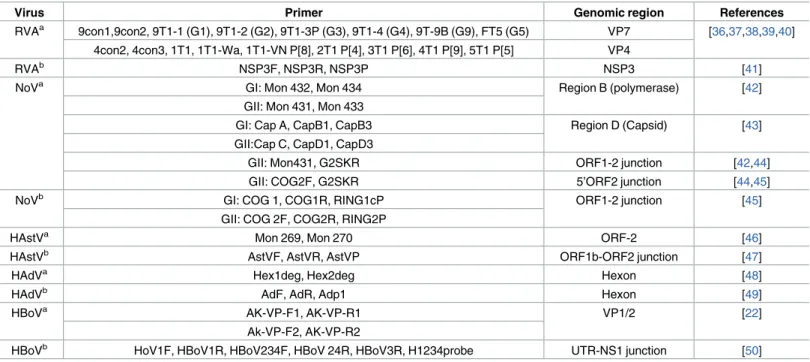
, R-Biopharm, Darmstadt, Hesse, Germany) and polyacrylamide gel electrophoresis (PAGE) [36], and genotyped by semi-nested multiplex reverse transcription polymerase chain reaction (RT-PCR), the other enteric viruses (NoV, HAstV, HAdV and HBoV) were detected though PCR or RT-PCR with sets of primers that amplify specific regions used for viral detection and characterization (Table 1). PCR amplicons were purified using QIAquick Gel Extraction Kit and PCR Purifi-cation Kit (Qiagen, Inc., Valencia, CA, USA) following the manufacturer’s recommenda-tions. The purified DNA amplicons were sequenced using the BigDye1Terminator v3.1 Cycle Sequencing Kit and ABI Prism 3100 Genetic Analyser sequencer (both from Applied Biosystems, Foster City, CA, USA). Sequences were edited and aligned using BioEdit Sequence Alignment Editor Program (Hall, 1999) and subsequently compared to those available in GenBank database using the Basic Local Alignment Search Tool (BLAST). For NoV, genotyping was assigned using an online genotyping tool (http://www.rivm.nl/mpf/ norovirus/typingtool) and the strains were named, with the genotype of the polymerase indi-cated with an uppercase letter p [11,12].
The nucleotide sequences obtained in this study were submitted to the NCBI (GenBank,
Quantification of viral loads
A quantitative PCR (qPCR) was performed for detection and quantification of RVA, NoV, HAstV, HAdV and HBoV according to previously described protocols (Table 1). All qPCR reactions were carried out in an ABI PRISM 75001Real-Time System v2.0 (Applied Biosys-tems, Foster City, CA). All assays were performed with TaqMan universal master mix1
(Applied Biosystems, Foster City, CA). Undiluted and 10-fold dilutions of the nucleic acid and cDNA were analyzed in duplicated and concentrations were estimated as the mean of data obtained, correcting for the dilution analyzed. Amplifications were performed in a thermocy-cler programmed as follows: incubation at 50˚C for 2 min to activate UNG, initial denatur-ation at 95˚C for 10 min, followed by 45 cycles at 95˚C for 15s and 60˚C for 1min. The negative control used was a PCR TaqMan master mix without DNA.
Results
Detection rates of enteric viruses and genotype distribution in HIV-1
seropositive and HIV-1 seronegative patients
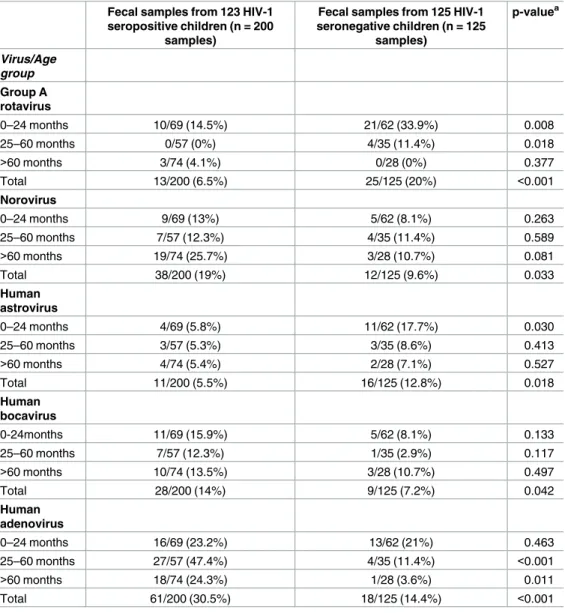
Among HIV-1 seropositive children, 148/200 (74%) were infected with at least one virus, ver-sus 80/125 (64%) among HIV-1 seronegative children. As presented inTable 2, infections with NoV (19% vs. 9.6%; p<0.001), HBoV (14% vs. 7.2%; p = 0.042) and HAdV (30.5% vs. 14.4%;
p<0.001) were significantly more frequent among HIV-1 seropositive children. On the other
hand, RVA was significantly less frequent among HIV-1 seropositive patients with DD (6.5% vs. 20%; p<0.001). Similarly, frequency of infection with HAstV was lower among
HIV-sero-positive children (5.5% vs. 12.8%; p = 0.018).
Table 1. Oligonucleotide primers and probes used for viral detection, quantification and molecular characterization.
Virus Primer Genomic region References
RVAa 9con1,9con2, 9T1-1 (G1), 9T1-2 (G2), 9T1-3P (G3), 9T1-4 (G4), 9T-9B (G9), FT5 (G5) VP7 [36,37,38,39,40] 4con2, 4con3, 1T1, 1T1-Wa, 1T1-VN P[8], 2T1 P[4], 3T1 P[6], 4T1 P[9], 5T1 P[5] VP4
RVAb NSP3F, NSP3R, NSP3P NSP3 [41]
NoVa GI: Mon 432, Mon 434 Region B (polymerase) [42]
GII: Mon 431, Mon 433
GI: Cap A, CapB1, CapB3 Region D (Capsid) [43]
GII:Cap C, CapD1, CapD3
GII: Mon431, G2SKR ORF1-2 junction [42,44]
GII: COG2F, G2SKR 5’ORF2 junction [44,45]
NoVb GI: COG 1, COG1R, RING1cP ORF1-2 junction [45]
GII: COG 2F, COG2R, RING2P
HAstVa Mon 269, Mon 270 ORF-2 [46]
HAstVb AstVF, AstVR, AstVP ORF1b-ORF2 junction [47]
HAdVa Hex1deg, Hex2deg Hexon [48]
HAdVb AdF, AdR, Adp1 Hexon [49]
HBoVa AK-VP-F1, AK-VP-R1 VP1/2 [22]
Ak-VP-F2, AK-VP-R2
HBoVb HoV1F, HBoV1R, HBoV234F, HBoV 24R, HBoV3R, H1234probe UTR-NS1 junction [50]
A rotavirus (RVA), norovirus (NoV), human adenovirus (HAdV), human astrovirus (HAstV) and human bocavirus (HBoV).
a
Primes used for molecular detection and characterization.
b
Primes and probes used for detection and quantification (qPCR).
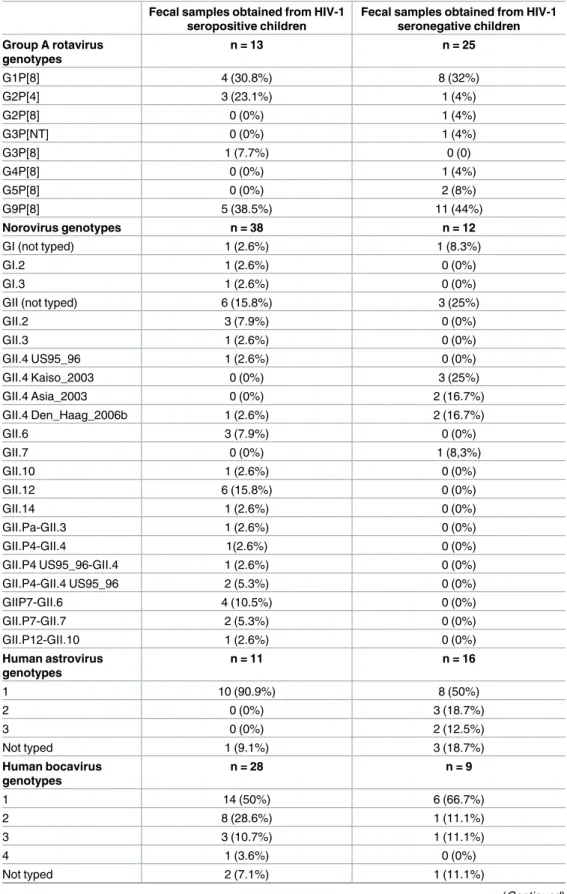
Table 3presents genotype distribution of different enteric viruses in HIV-1 seropositive and HIV-1 seronegative patients. It was observed that, among children infected with RVA, G1, G2, G3 and G9 genotypes were detected in HIV-1 seropositive, while G1, G2, G3, G4, G5 and G9 genotypes were in HIV-1 seronegative children. The P[4] and P[8] genotypes were detected in HIV-1 seropositive and seronegative subjects. The combinations G1P[8] and G9P[8] pre-dominated in both groups. Among children in whom NoV was detected, a great diversity of genotypes was observed. Genogroup II was the most frequently identified both in HIV-1 sero-positive and HIV-1 seronegative patients, with a predominance of GII.4 and GII.12 in HIV-1 seropositive and GII.4 in HIV-1 seronegative children. GII.4 variants detected were Den Haag_2006b and US95_96 among HIV-1 seropositive children whereas among HIV-1 sero-negative children were Kaiso_2003, Asia_2003 and Den Haag_2006b. NoV recombinant geno-types GII.Pa-GII.3, GII.P12-GII10 and GII.P7-GII.6 were detected among HIV-1 seropositive
Table 2. Enteric virus detection in HIV-1 seropositive children and HIV-1 seronegative children hospi-talized with diarrheal diseases by age group in Rio de Janeiro, Brazil.
Fecal samples from 123 HIV-1 seropositive children (n = 200
samples)
Fecal samples from 125 HIV-1 seronegative children (n = 125
samples)
p-valuea
Virus/Age group
Group A rotavirus
0–24 months 10/69 (14.5%) 21/62 (33.9%) 0.008
25–60 months 0/57 (0%) 4/35 (11.4%) 0.018
>60 months 3/74 (4.1%) 0/28 (0%) 0.377
Total 13/200 (6.5%) 25/125 (20%) <0.001
Norovirus
0–24 months 9/69 (13%) 5/62 (8.1%) 0.263
25–60 months 7/57 (12.3%) 4/35 (11.4%) 0.589
>60 months 19/74 (25.7%) 3/28 (10.7%) 0.081
Total 38/200 (19%) 12/125 (9.6%) 0.033
Human astrovirus
0–24 months 4/69 (5.8%) 11/62 (17.7%) 0.030
25–60 months 3/57 (5.3%) 3/35 (8.6%) 0.413
>60 months 4/74 (5.4%) 2/28 (7.1%) 0.527
Total 11/200 (5.5%) 16/125 (12.8%) 0.018
Human bocavirus
0-24months 11/69 (15.9%) 5/62 (8.1%) 0.133
25–60 months 7/57 (12.3%) 1/35 (2.9%) 0.117
>60 months 10/74 (13.5%) 3/28 (10.7%) 0.497
Total 28/200 (14%) 9/125 (7.2%) 0.042
Human adenovirus
0–24 months 16/69 (23.2%) 13/62 (21%) 0.463
25–60 months 27/57 (47.4%) 4/35 (11.4%) <0.001
>60 months 18/74 (24.3%) 1/28 (3.6%) 0.011
Total 61/200 (30.5%) 18/125 (14.4%) <0.001
aFisher‘s exact test.
Table 3. Genotype distribution of different enteric viruses in fecal samples obtained from 123 HIV-1 seropositive children (n = 200 fecal samples) and 125 HIV-1 seronegative children ((n = 125 fecal sam-ples) hospitalized with diarrheal diseases in Rio de Janeiro, Brazil.
Fecal samples obtained from HIV-1 seropositive children
Fecal samples obtained from HIV-1 seronegative children Group A rotavirus
genotypes
n = 13 n = 25
G1P[8] 4 (30.8%) 8 (32%)
G2P[4] 3 (23.1%) 1 (4%)
G2P[8] 0 (0%) 1 (4%)
G3P[NT] 0 (0%) 1 (4%)
G3P[8] 1 (7.7%) 0 (0)
G4P[8] 0 (0%) 1 (4%)
G5P[8] 0 (0%) 2 (8%)
G9P[8] 5 (38.5%) 11 (44%)
Norovirus genotypes n = 38 n = 12
GI (not typed) 1 (2.6%) 1 (8.3%)
GI.2 1 (2.6%) 0 (0%)
GI.3 1 (2.6%) 0 (0%)
GII (not typed) 6 (15.8%) 3 (25%)
GII.2 3 (7.9%) 0 (0%)
GII.3 1 (2.6%) 0 (0%)
GII.4 US95_96 1 (2.6%) 0 (0%)
GII.4 Kaiso_2003 0 (0%) 3 (25%)
GII.4 Asia_2003 0 (0%) 2 (16.7%)
GII.4 Den_Haag_2006b 1 (2.6%) 2 (16.7%)
GII.6 3 (7.9%) 0 (0%)
GII.7 0 (0%) 1 (8,3%)
GII.10 1 (2.6%) 0 (0%)
GII.12 6 (15.8%) 0 (0%)
GII.14 1 (2.6%) 0 (0%)
GII.Pa-GII.3 1 (2.6%) 0 (0%)
GII.P4-GII.4 1(2.6%) 0 (0%)
GII.P4 US95_96-GII.4 1 (2.6%) 0 (0%)
GII.P4-GII.4 US95_96 2 (5.3%) 0 (0%)
GIIP7-GII.6 4 (10.5%) 0 (0%)
GII.P7-GII.7 2 (5.3%) 0 (0%)
GII.P12-GII.10 1 (2.6%) 0 (0%)
Human astrovirus genotypes
n = 11 n = 16
1 10 (90.9%) 8 (50%)
2 0 (0%) 3 (18.7%)
3 0 (0%) 2 (12.5%)
Not typed 1 (9.1%) 3 (18.7%)
Human bocavirus genotypes
n = 28 n = 9
1 14 (50%) 6 (66.7%)
2 8 (28.6%) 1 (11.1%)
3 3 (10.7%) 1 (11.1%)
4 1 (3.6%) 0 (0%)
Not typed 2 (7.1%) 1 (11.1%)
children, with GII.P7-GII.6 being the most detected. HAstV genotype 1 was the most frequent both in HIV-1 seropositive and HIV-1 seronegative subjects. In HIV-1 seronegative patients, HAstV 2 was the second most detected virus followed by HAstV3. HBoV genotype 1 was the most prevalent in both groups and genotype 2 the second most detected in HIV-1 seropositive children. Among HAdV positive patients, non-enteric species (A, B, C or D) were detected fre-quently in diarrheic feces from HIV-1 seropositive (25/61 [41%]) and HIV-1-seronegative (9/18 [50%]) children. HAdV D was the second most detected among HIV-1 seropositive chil-dren losing only to HAdV- F40. Concerning enteric HAdV types, F40 was detected more fre-quently than F41 in both groups. All not typed samples presented low viral load by qPCR and failed to attempt genotyping by PCR.
Multiple viral agents infecting HIV-1 seropositive and HIV-1 seronegative
children
As presented inTable 4, 33/200 (16.5%) HIV-1 seropositive patients were excreting more than one enteric virus in fecal samples. In this group, co-infections with three enteric viruses, such as NoV, HBoV and HAdV (n = 2) and NoV, HAstV and HAdV (n = 2) were identified. The rate of infection with more than one virus was 17/125 (13.6%) in the HIV-1 seronegative group, triple infection (NoV + HAstV + HBoV) being observed in only one patient.
Viral load of enteric viruses in HIV-1 seropositive and HIV-1
seronegative children
As demonstrated inFig 1, the median viral load of HAstV in feces was significantly higher among HIV-1 seropositive children compared to HIV-1 seronegative children (p = 0.012). Concerning children infected with RVA, NoV, HBoV and HAdV, no statistically significant differences were observed in the medians of viral loads in feces when comparing HIV-1 seropositive and HIV-1 seronegative children. Comparing viral loads of distinct enteric viruses in HIV-1 seronegative patients, it was observed that RVA presented the higher median (5.81 [IQR = 5.53–6.62] log10 copies/g). In this group, median viral load in feces for NoV, HAstV, HBoV and HAdV reached 2.72 (IQR = 0.69–3.51), 1.29 (IQR = 1.17–4.99), 4.72
Table 3. (Continued)
Fecal samples obtained from HIV-1 seropositive children
Fecal samples obtained from HIV-1 seronegative children Human adenovı´rus
genotypes
n = 61 n = 18
A-12 3 (4,9%) 1 (5,6%)
A-31 0 (0%) 1 (5,6%)
B-3 2 (3,3%) 0 (0%)
B-7 1 (1,6%) 2 (11,1%)
C-1 2 (3,3%) 0 (0%)
C-2 6 (9,8%) 3 (16,7%)
C-6 1 (1,6%) 0 (0%)
D 10 (16,4%) 2 (11,1%)
F-40 30 (49,2%) 7 (38,9%)
F-41 6 (9,8%) 2 (11,1%)
(IQR = 3.07–4.72), and 3.23 (IQR = 2.27–3.90) log10 copies/g, respectively. RVA also pre-sented the higher median viral load among HIV-1 seropositive children: 6.08 (IQR = 3.36– 7.17) log10 copies/g. Among HIV-1 seropositive patients, viral loads in feces were as follows: NoV, 3.36 (IQR = 2.54–4.99), HAstV, 5.26 (4.18–7.43), HBoV, 3.09 (2–4.31), HAdV, 3.63 (2.27–4.72) log10 copies/g. In HIV-1-seropositive patients, median viral loads of enteric (types F-40 and F-41) and non-enteric (types A-12, A-31, B-3, B-7, C-1, C-2, C-6, and D) HAdV were similar (3.63 [IQR = 2.73–4.53) vs. 3.24 [IQR = 2–5.28], p = 0.210) (not shown).
Table 4. Detection of multiple enteric viruses in fecal samples from 123 HIV-1 seropositive children (n = 200 fecal samples) and 125 HIV-1 seroneg-ative children ((n = 125 fecal samples) hospitalized with diarrheal diseases in Rio de Janeiro, Brazil.
No. of viruses
Virus combination in fecal samples
Fecal samples from 123 HIV-1 seropositive children
(n = 200 samples)
Fecal samples from 125 HIV-1 seronegative children
(n = 125 samples)
Two HAstV + HBoV 1 (0.5%) 1 (0.8%)
HAstV + HAdV 4 (2%) 3 (2.4%)
HBoV + HAdV 6 (3%) 0 (0%)
NoV + HAstV 0 (0%) 1 (0.8%)
NoV + HBoV 5 (2.5%) 1 (0.8%)
NoV + HAdV 6 (3%) 2 (1.6%)
RVA + HAstV 0 (0%) 4 (3.2%)
RVA + HBoV 3 (1.5%) 1 (0.8%)
RVA + HAdV 1 (0.5%) 2 (1.6%)
RVA + NoV 2 (1%) 1 (0.8%)
Total no. of double infections (%) 28 (14%) 16 (12.8%)
Three
HAstV + HBoV + HAdV 1 (0.5%) 0 (0%)
NoV + HAstV + HBoV 0 (0%) 1 (0.8%)
NoV + HAstV + HAdV 2 (1%) 0 (0%)
NoV + HBoV + HAdV 2 (1%) 0 (0%)
Total no. of triple infections (%) 5 (2,5%) 1 (0.8%)
Rotavirus A (RVA), norovirus (NoV), human adenovirus (HAdV), human astrovirus (HAstV) and human bocavirus (HBoV);
https://doi.org/10.1371/journal.pone.0183196.t004
Fig 1. Fecal viral loads of enteric viruses in HIV-1 seropositive and seronegative children hospitalizaded with diarrheal diseases in Rio de Janeiro, Brazil.
Frequency of infection with enteric viruses and viral loads by level of
CD4
+T lymphocyte count
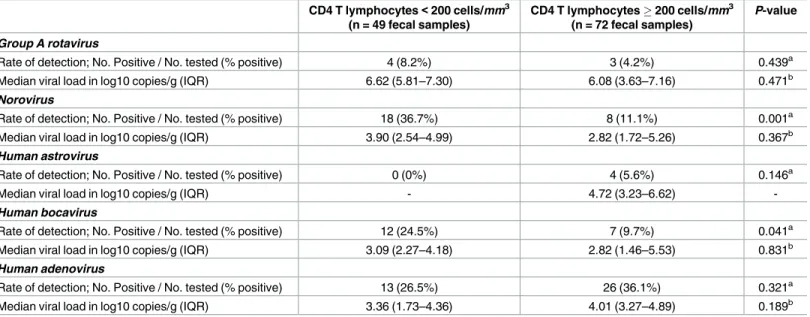
From 200 HIV-1 seropositive, DD-related hospitalizations, we could assess CD4+T lympho-cyte count in 121 children. From these, 49 had<200 cells/mm3and 72 presented a count
200 cells/mm3. It was examined whether among HIV-1 seropositive children, those with a CD4+T lymphocyte count below 200 cells/mm3had a different enteric virus profile than chil-dren with a count above 200 cells/mm3. Similar detection rates were observed for RVA, HAstV and HAdV, whilst NoV and HBoV were significantly more frequent among children exhibiting a CD4+T lymphocyte count below 200 cells/mm3.
Differences in viral loads in both groups were not statically significant for distinct viruses (Table 5).
Discussion
The present study explores the diversity of viral agents in HIV-1 seropositive patients hospital-ized with DD, comparing their etiological profile with a group of HIV-1 seronegative children. In this sense, the initial findings were significantly higher NoV, HBoV and HAdV detection rates in the HIV-1 seropositive group. RVA and HAstV were more frequent among HIV-1 seronegative children. In the present study, the opportunistic character of NoV may be evi-denced by the fact that, among HIV-1 seropositive children, its positivity rate was more than 3 times higher among patients with CD4 T lymphocyte counts<200 cells/mm3. Despite viral
loads being higher among HIV-1 seropositive children, and particularly among those more severely immunocompromised, differences were not statistically significant. In Brazil, NoV has been associated with DD in HIV-1 positive patients [29].
Our results confirm the detection of different genotypes in this group as well as demon-strating the high genetic diversity among HIV-1 seropositive children. Recombinant NoV
Table 5. Rate of detection and fecal viral load of different enteric virus in fecal samples obtained from HIV-1 seropositive children by level of CD4+ T lymphocyte count in Rio de Janeiro, Brazil.
CD4 T lymphocytes<200 cells/mm3 (n = 49 fecal samples)
CD4 T lymphocytes200 cells/mm3 (n = 72 fecal samples)
P-value
Group A rotavirus
Rate of detection; No. Positive / No. tested (% positive) 4 (8.2%) 3 (4.2%) 0.439a
Median viral load in log10 copies/g (IQR) 6.62 (5.81–7.30) 6.08 (3.63–7.16) 0.471b
Norovirus
Rate of detection; No. Positive / No. tested (% positive) 18 (36.7%) 8 (11.1%) 0.001a
Median viral load in log10 copies/g (IQR) 3.90 (2.54–4.99) 2.82 (1.72–5.26) 0.367b
Human astrovirus
Rate of detection; No. Positive / No. tested (% positive) 0 (0%) 4 (5.6%) 0.146a
Median viral load in log10 copies/g (IQR) - 4.72 (3.23–6.62)
-Human bocavirus
Rate of detection; No. Positive / No. tested (% positive) 12 (24.5%) 7 (9.7%) 0.041a
Median viral load in log10 copies/g (IQR) 3.09 (2.27–4.18) 2.82 (1.46–5.53) 0.831b
Human adenovirus
Rate of detection; No. Positive / No. tested (% positive) 13 (26.5%) 26 (36.1%) 0.321a
Median viral load in log10 copies/g (IQR) 3.36 (1.73–4.36) 4.01 (3.27–4.89) 0.189b
aFisher‘s exact test bKruskal-Wallis test
circulation has been observed when the combined characterization of both regions of the poly-merase and capsid are used. Using both regions we characterized recombinant strains (GII.Pa-GII.3, GII.P12-GII10 and GII.P7-GII.6) for the first time in HIV-1 seropositive children in Brazil. The high genetic diversity of NoV has been described among HIV-1 seronegative indi-viduals [51]. Our data reaffirm that NoV is an important agent of DD in HIV-1 seropositive children in Brazil. NoV has been associated with DD in HIV positive patients, and in some studies it has been detected more frequently in this group, as demonstrated in Tanzania [52]. The importance of NoV as a cause of hospitalization and DD-associated death in HIV-1 sero-positive children was also demonstrated in South Africa [53]. In Venezuela it was observed that NoV excretion is significantly more frequent in HIV-1 seropositive children, regardless of whether or not they are suffering from DD [34]. Frequent NoV infection in HIV-1 seroposi-tive children with and without DD has also been reported in Kenya in a study that points to the high genetic diversity of NoV in HIV-1 seropositive children [54].
The present study suggests that HBoV is excreted more frequently in HIV-1 seropositive children than in HIV-1 seronegative children. Cases of HBoV co-infections with other enteric viral agents were common and the most frequent HBoV genotypes identified were 1, 2 and 3. Interestingly, among HIV-1 seropositive children HBoV, like NoV, was significantly more fre-quent in the group with CD4 T lymphocyte counts<200 cells/mm3.HBoV is an emerging
pathogen, considered as a potential DD agent. Its clinical and epidemiological importance as a DD agent has not yet been fully clarified. HBoV has been identified in respiratory secretion of HIV-1 seropositive and HIV-1 seronegative patients with acute respiratory infections [55,56] and in the feces of HIV-1 seropositive patients in Brazil [35,57]. Additional studies should be performed to more accurately characterize the role of HBoV as an opportunistic agent in immunocompromised children.
This study demonstrated that HAdV is detected more frequently in HIV-1 seropositive than in HIV-1 seronegative patients and therefore presents an opportunistic behavior. Studies from Brazil report HAdV excretion by HIV-1 seropositive children with and without DD [58]. HAdV is a common cause of pediatric DD, also causing respiratory infections. In immuno-compromised patients, other infections, especially CMV, may coexist with HAdV. HAdV associated colitis is a clinical entity characterized by persistent diarrhea described in HIV-1 seropositive patients in the pre-HAART era [26,27,59]. For the first time in Brazil, we are reporting enteric HAdV in HIV-1 seropositive patients. In this study, the enteric HAdV type F-40 was detected in almost one-half of HAdV-1 positive fecal samples. However, a great diversity of types was observed, some not commonly associated with DD. Similar viral loads of enteric and non-enteric HAdV were observed, suggesting comparable replication intensity in the digestive tract. Among HIV-1 seropositive children, HAdV was detected with similar fre-quency and viral load among patients with CD4+T lymphocyte counts bellow and above<200
cells/mm3.
rotavirus vaccine. The monovalent rotavirus vaccine is not indicated for immunocompro-mised HIV-1 seropositive children (CD4+T lymphocyte counts<200 cells/mm3). From 2006
to 2010, vaccine coverage ranged from 70% a 90% in Rio de Janeiro, for the cohort of children born after March 2006.
HAstV was also more frequent among HIV-1 seronegative children. Despite this, viral load was significantly higher among HIV-1 seropositive children when infected by HAstV, regard-less of CD4+T lymphocyte count. HAstV has been detected in HIV-1 seropositive children [31], but its importance as a DD agent in this group has not been established.
Data from this study demonstrate that viral agents are often found in HIV-1 seropositive children hospitalized with DD. As a limitation of this study we highlight the fact of having ana-lyzed children with severe forms of DD, which motivated the hospitalizations, providing an etiological profile of the viral agents in this segment of patients. However, the circulation of enteric viruses in asymptomatic children has been reported, which is important to the DD dynamic of transmission. Thus, enteric viruses should be considered an important cause of DD in this group, along with pathogens more classically associated with intestinal infections in immunocompromised hosts. Management of hospitalized HIV-1 seropositive children with DD should consider enteric viral agents.
Author Contributions
Conceptualization:Silvana Augusta Rodrigues Portes, Filipe Anibal Carvalho-Costa, Marize Pereira Miagostovich, Jose´ Paulo Gagliardi Leite, Eduardo de Mello Volotão.
Data curation:Silvana Augusta Rodrigues Portes, Filipe Anibal Carvalho-Costa, Monica Simões Rocha, Eduardo de Mello Volotão.
Formal analysis:Silvana Augusta Rodrigues Portes, Filipe Anibal Carvalho-Costa.
Funding acquisition:Marize Pereira Miagostovich, Jose´ Paulo Gagliardi Leite, Eduardo de Mello Volotão.
Investigation:Silvana Augusta Rodrigues Portes, Filipe Anibal Carvalho-Costa, Monica Simões Rocha, Tulio Machado Fumian, Adriana Gonc¸alves Maranhão, Rosane Maria de Assis, Maria da Penha Trindade Pinheiro Xavier, Eduardo de Mello Volotão.
Methodology:Silvana Augusta Rodrigues Portes, Filipe Anibal Carvalho-Costa, Monica Simões Rocha, Marize Pereira Miagostovich, Jose´ Paulo Gagliardi Leite, Eduardo de Mello Volotão.
Project administration:Eduardo de Mello Volotão.
Resources:Silvana Augusta Rodrigues Portes, Filipe Anibal Carvalho-Costa, Myrna Santos Rocha, Marize Pereira Miagostovich, Jose´ Paulo Gagliardi Leite, Eduardo de Mello Volotão.
Supervision:Filipe Anibal Carvalho-Costa, Eduardo de Mello Volotão.
Validation:Silvana Augusta Rodrigues Portes, Monica Simões Rocha.
Visualization:Silvana Augusta Rodrigues Portes, Filipe Anibal Carvalho-Costa, Marize Per-eira Miagostovich, Eduardo de Mello Volotão.
Writing – original draft:Silvana Augusta Rodrigues Portes.
References
1. Black RE, Cousens S, Johnson HL, Lawn JE, Rudan I, Bassani DG, et al. Global, regional, and national causes of child mortality in 2008: a systematic analysis. Lancet 2010; 375: 969–1987.
2. Liu L, Oza S, Hogan D, Perin J, Rudan I, Lawn JE, et al. Global, regional, and national causes of child mortality in 2000–13, with projections to inform post-2015 priorities: an updated systematic analysis. Lancet. 2015; 385(9966):430–440.https://doi.org/10.1016/S0140-6736(14)61698-6PMID:25280870
3. Clark B, McKendrick M. 2004. A review of viral gastroenteritis. Curr Opin Infect Dis 17(5):461–469. PMID:15353966
4. Arthur JL, Higgins GD, Davidson GP, Givney RC, Ratcliff RM. A novel bocavirus associated with acute gastroenteritis in Australian children. PLoS Pathog. 2009; 5:e1000391.https://doi.org/10.1371/journal. ppat.1000391PMID:19381259
5. Drexler JF, Baumgarte S, de Souza Luna LK, Eschbach-Bludau M, Lukashev AN, Drosten C. Aichi virus shedding in high concentrations in patients with acute diarrhea. Emerg Infect Dis 2011; 17: 1544– 48.https://doi.org/10.3201/eid1708.101556PMID:21801647
6. Tate JE, Burton AH, Boschi-Pinto C, Parashar UD; World Health Organization—Coordinated Global Rotavirus Surveillance Network. Global, Regional, and National Estimates of Rotavirus Mortality in Chil-dren<5 Years of Age, 2000–2013. Clin Infect Dis. 2016; 62 Suppl 2:S96–S105.
7. WHO (World Health Organization). Global rotavirus information and surveillance bulletin. Reporting period: January through December 2010. Vol.4. Geneva, Switzerland. 2011.
8. Mesquita JR, Barclay L, Nascimento MS, Vinje J. Novel norovirus in dogs with diarrhea. EmergInfect Dis. 2010; 16:980–82.
9. Tse H, Lau SK, Chan WM, Choi GK, Woo PC, Yuen KY. Complete genome sequences of novel canine noroviruses in Hong Kong. J Virol. 2012; 86:9531–32.https://doi.org/10.1128/JVI.01312-12PMID: 22879606
10. Vinje´ J. Advances in laboratory methods for detection and typing of norovirus. J Clin Microbiol. 2015; 53(2):373–81.https://doi.org/10.1128/JCM.01535-14PMID:24989606
11. Kroneman A, Vennema H, Deforche K, Avoort HV, Peñaranda S, Oberste MS, et al. An automated
gen-otyping tool for enteroviruses and noroviruses. J Clin Virol.2011; 51:121–125.https://doi.org/10.1016/j. jcv.2011.03.006PMID:21514213
12. Kroneman A, Vega E, Vennema H, Vinje´ J, White PA, Hansman G, et al. Proposal for a unified norovi-rus nomenclature and genotyping. Arch Virol. 2013; 158:2059–68. https://doi.org/10.1007/s00705-013-1708-5PMID:23615870
13. Bosch A, Pinto´ RM, Guix S. Human astroviruses. Clin Microbiol Rev. 2014 27(4):1048–74.https://doi. org/10.1128/CMR.00013-14PMID:25278582
14. Vu DL, Bosch A, Pinto´ RM, Guix S. Epidemiology of Classic and Novel Human Astrovirus: Gastroenteri-tis and Beyond. Viruses. 2017; 9(2).
15. Moyo SJ, Hanevik K, Blomberg B, Kommedal O, NordbøSA, Maselle S, Langeland N. Prevalence and molecular characterisation of human adenovirus in diarrhoeic children in Tanzania; a case control study. BMC Infect Dis. 2014 12; 14:666.https://doi.org/10.1186/s12879-014-0666-1PMID:25495029
16. La Rosa G, Della Libera S, Petricca S, Iaconelli M, Donia D, Saccucci P, et al. Genetic Diversity of Human Adenovirus in Children with Acute Gastroenteritis, Albania, 2013–2015. Biomed Res Int. 2015; 2015:142912.https://doi.org/10.1155/2015/142912PMID:26339589
17. Ghebremedhin B. Human adenovirus: Viral pathogen with increasing importance. Eur J Microbiol Immunol (Bp). 2014; 4(1):26–33.
18. Allander T, Tammi MT, Eriksson M, Bjerkner A, Tiveljung-Lindell A, Andersson B. Cloning of a human parvovirus by molecular screening of respiratory tract samples. Proc Natl Acad Sci USA. 2005; 102:12891–96https://doi.org/10.1073/pnas.0504666102PMID:16118271
19. Kapoor A, Slikas E, Simmonds P, Chieochansin T, Naeem A, Shaukat S, et al. A newly identified boca-virus species in human stool. J Infect Dis. 2009; 199:196–200.https://doi.org/10.1086/595831PMID: 19072716
20. Lau SK, Yip CC, Que TL, Lee RA, Au-Yeung RK, Zhou B, et al. Clinical and molecular epidemiology of human bocavirus in respiratory and fecal samples from children in Hong Kong. J Infect Dis. 2007; 196:986–93.https://doi.org/10.1086/521310PMID:17763318
21. Campe H, Hartberger C, Sing A. Role of Human Bocavirus infections in outbreaks of gastroenteritis. J Clin Virol. 2008; 43:340–42https://doi.org/10.1016/j.jcv.2008.07.014PMID:18835213
23. Grohmann GS, Glass RI, Pereira HG, Monroe SS, Hightower AW, Weber R, et al. Enteric viruses and diarrhea in HIV-infected patients. N Engl J Med. 1993; 329(1): 14–20.https://doi.org/10.1056/ NEJM199307013290103PMID:8099429
24. Arvelo W, Kim A, Creek T, Legwaila K, Puhr N, Johnston S, et al. Case-control study to determinerisk factors for diarrhea among persons during a large outbreak in a country with a high prevalence of HIV infection. Int J Infect Dis 2010; 14: e1002–07.https://doi.org/10.1016/j.ijid.2010.06.014PMID: 20932791
25. Groome MJ, Madhi SA. Five-year cohort study on the burden of hospitalisation for acute diarrhoeal dis-ease in African HIV-infected and HIV-uninfected children: potential benefits of rotavirus vaccine. Vac-cine 2012; 30 Suppl 1:A173–8.
26. Thomas PD, Pollok RC, Gazzard BG. Enteric viral infections as a cause of diarrhoea in the acquired immunodeficiency syndrome. HIV Med 1999; 1(1):19–24. PMID:11737325
27. Pollok RC. Viruses causing diarrhoea in AIDS. Novartis Found Symp. 2001; 238:276–83; discussion 283–8. PMID:11444032
28. Rossit ARB, Gonc¸alves ACM, Franco C, Machado RLD. Etiological agents of diarrhea in patients infected by the human immunodeficiency virus-1: A review. Rev Inst Med Trop São Paulo 2009; 51 (2):59–65. PMID:19390732
29. Gonc¸alves AC, Gabbay YB, Mascarenhas JD, Yassaka MB, Moran LC, Fraga VD, et al. Calicivirus and Giardia lamblia are associated with diarrhea in human immunodeficiency virus-seroposiive patients from southeast Brasil. Am J Trop Med Hyg 2009; 81: 463–66. PMID:19706916
30. Gonza´lez GG, Pujol FH, Liprandi F, Deibis L, Ludert JE. Prevalence of enteric viruses in human immu-nodeficiency virus seropositive patients in Venezuela. J med Virol 1998; 55: 288–292. PMID:9661837
31. Giordano MO, Martinez LC, Rinaldi D, Espul C, Martinez N, Isa MB, et al. Diarrhea and enteric emerg-ing viruses in HIV-infected patients. AIDS Res. hum. Retroviruses. 1999; 15: 1427–1432.https://doi. org/10.1089/088922299309937PMID:10555105
32. Liste MB, Natera I, Suarez JA, Pujol FH, Liprandi F, Ludert JE. Enteric virus infections and diarrhea in healthy and human immunodeficiency virus infected children. J clin Microbiol 2000; 38: 2873–2877. PMID:10921942
33. Moyo SJ, Blomberg B, Hanevik K, Kommedal O, Vainio K, Maselle SY, et al. Genetic diversity of circu-lating rotavirus strains in Tanzania prior to the introduction of vaccination. PLoS One 2014; 20; 9(5): e97562.https://doi.org/10.1371/journal.pone.0097562PMID:24844631
34. Rodrı´guez-Guille´n L, Vizzi E, Alcala´ AC, Pujol FH, Liprandi F, Ludert JE. Calicivirus infection in human immunodeficiency virus seropositive children and adults. J Clin Virol. 2005; 33(2):104–9.https://doi. org/10.1016/j.jcv.2004.09.031PMID:15911425
35. Silva RC, Benati FJ, Pena GP, Santos N. Molecular characterization of viruses associated with gastro-intestinal infection in HIV-positive patients. Braz J Infect Dis. 2010; 14(6):549–52. PMID:21340293
36. World Health Organization. Manual of rotavirus detection and characterization methods. 2009.http:// apps.who.int/iris/bitstream/10665/70122/1/WHO_IVB_08.17_eng.pdf. Acessed April 15th 2016.
37. Gentsch JR, Glass RI, Woods P, Gouvea V, Gorziglia M, Flores J, et al. Identification of group A rotavi-rus gene 4 types by polymerase chain reaction. J Clin Microbiol. 1992; 30: 1365–1373. PMID:1320625
38. Gouvea V, Santos N, Timenetsky MC. Identification of bovine and porcine rotavirus G types by PCR. J Clin Microbiol. 1994; 32(5): 1338–40. PMID:8051263
39. Das BK, Gentsch JR, Cicirello HG, Woods PA, Gupta A, Ramachandran M, et al. Characterization of rotavirus strains from newborns in New Delhi, India. J Clin Microbiol. 1994; 32: 1820–1822. PMID: 7929782
40. Fischer TK, Steinsland H, Molbak K, Ca R, Gentsch JR, Valentiner-Branth P, et al. Genotype profiles of rotavirus strains from children in a suburban community in Guinea-Bissau, Western Africa. J Clin Micro-biol. 2000; 38(1):264–7. PMID:10618098
41. Zeng SQ, Halkosalo A, Salminen M, Szakal ED, Puustinen L, Vesikari T. One-step quantitative RT-PCR for the detection of rotavirus in acute gastroenteritis. J Virol Methods. 2008; 153(2):238–40. https://doi.org/10.1016/j.jviromet.2008.08.004PMID:18765254
42. Beuret C, Kohler D, Baumgartner A, Lu¨thi TM. Norwalk-like virus sequences in mineral waters: one-year monitoring of three brands. Appl Environ Microbiol. 2002; 68(4):1925–31.https://doi.org/10.1128/ AEM.68.4.1925-1931.2002PMID:11916714
43. Vinje´ J, Hamidjaja RA, Sobsey MD. Development and application of a capsid VP1 (region D) based reverse transcription PCR assay for genotyping of genogroup I and II noroviruses. J Virol Methods. 2004; 116(2):109–17. PMID:14738976
45. Kageyama T, Kojima S, Shinohara M, Uchida K, Fukushi S, Hoshino FB, et al. 2003. Broadly reactive and higly sensitive assay for Norwalk-like viruses based on real-time quantitative reverse transcription-PCR. J Clin Microbiol 41(4):1548–1557.https://doi.org/10.1128/JCM.41.4.1548-1557.2003PMID: 12682144
46. Noel JS, Lee TW, Kurtz JB, Glass RI, Monroe SS. Typing of human astroviruses from clinical isolates by enzyme immunoassay and nucleotide sequencing. J Clin Microbiol. 1995; 33(4):797–801. PMID: 7790440
47. Dai YC, Xu QH, Wu XB, Hu GF, Tang YL, Li JD, et al. Development of real-time and nested RT-PCR to detect astrovirus and one-year survey of astrovirus in Jiangmen City, China. Arch Virol. 2010; 155 (6):977–82.https://doi.org/10.1007/s00705-010-0664-6PMID:20376681
48. Allard A, Albinsson B, Wadell G. Rapid typing of human adenoviruses by a general PCR combined with restriction endonuclease analysis. J Clin Microbiol 2001; 39: 498–505.https://doi.org/10.1128/JCM.39. 2.498-505.2001PMID:11158096
49. Hernroth BE, Conden-Hansson AC, Rehnstam-Holm AS, Girones R, Allard AK. Environmental factors influencing human viral pathogens and their potential indicator organisms in the blue mussel, Mytilus edulis: the first Scandinavian report. Appl Environ Microbiol. 2002; 68(9):4523–33.https://doi.org/10. 1128/AEM.68.9.4523-4533.2002PMID:12200309
50. Kantola K, Sadeghi M, Antikainen J, Kirveskari J, Delwart E, Hedman K,et al. Real-time quantitative PCR detection of four human bocaviruses. J Clin Microbiol 2010; 48(11):4044–50.https://doi.org/10. 1128/JCM.00686-10PMID:20844210
51. Fumian TM, da Silva Ribeiro de Andrade J, Leite JP, Miagostovich MP. Norovirus Recombinant Strains Isolated from Gastroenteritis Outbreaks in Southern Brazil, 2004–2011. PLoS One. 2016; 11(4): e0145391.https://doi.org/10.1371/journal.pone.0145391eCollection 2016. PMID:27116353
52. Moyo S, Hanevik K, Blomberg B, Kommedal O, Vainio K, Maselle S, et al. Genetic diversity of norovirus in hospitalised diarrhoeic children and asymptomatic controls in Dar es Salaam, Tanzania. Infect Genet Evol. 2014; 26:340–7.https://doi.org/10.1016/j.meegid.2014.06.013PMID:24960396
53. Page NA, Groome MJ, Nadan S, Netshikweta R, Keddy KH, Poonsamy B, et al. Norovirus epidemiology in South African children<5 years hospitalised for diarrhoeal illness between 2009 and 2013. Epidemiol Infect. 2017; 10: 1–11.
54. Mans J, Murray TY, Kiulia NM, Mwenda JM, Musoke RN, Taylor MB. Human caliciviruses detected in HIV-seropositive children in Kenya. J Med Virol. 2014; 86(1):75–81.https://doi.org/10.1002/jmv.23784 PMID:24123054
55. Nunes MC, Kuschner Z, Rabede Z, Madimabe R, Van Niekerk N, Moloi J, et al. Clinical epidemiology of bocavirus, rhinovirus, two polyomaviruses and four coronaviruses in HIV-infected and HIV-uninfected South African children. PLoS One. 2014; 9(2):e86448.https://doi.org/10.1371/journal.pone.0086448 PMID:24498274
56. Garbino J, Inoubli S, Mossdorf E, Weber R, Tamm M, Soccal P, et al.; Swiss HIV Cohort Study. Respi-ratory viruses in HIV-infected patients with suspected respiRespi-ratory opportunistic infection. AIDS. 2008; 22(6):701–5.https://doi.org/10.1097/QAD.0b013e3282f470acPMID:18356599
57. Santos N, Peret TC, Humphrey CD, Albuquerque MC, Silva RC, Benati FJ, et al. Human bocavirus spe-cies 2 and 3 in Brazil. J Clin Virol. 2010; 48(2):127–30.https://doi.org/10.1016/j.jcv.2010.03.014PMID: 20382557
58. Morillo SG, Luchs A, Cilli A, Carmona RC, Neme SN, Timenetsky MC. Rotavirus genotype G4P[8] and enteric adenovirus in HIV-positive patients with and without diarrhoea in São Paulo State, Brazil. Trans R Soc Trop Med Hyg. 2010; 104(2):165–7.https://doi.org/10.1016/j.trstmh.2009.07.023PMID: 19729177