RESEARCH-ACTION IN THE PERSPECTIVE OF NURSING IN ENVIRONMENTAL
EDUCATION: FROM THEORY TO PRACTICE
PESQUISA-AÇÃO NA PERSPECTIVA DA ENFERMAGEM EM EDUCAÇÃO AMBIENTAL: DA
TEORIA À PRÁTICA
INVESTIGACIÓN-ACCIÓN EN LA PERSPECTIVA DE LA ENFERMERÍA EN EDUCACIÓN AMBIENTAL: DE LA TEORÍA A LA PRÁCTICA
Antonio Dean Barbosa Marques1, July Grassiely de Oliveira Branco2, Juliana Brito Cavalcante3, Livia Maria Damasceno dos Santos4, Ana Maria Fontenelle Catrib5, Rosendo Freitas de Amorim6
ABSTRACT
Objective: to report environmental education experiences held with children of an elementary school developed by undergraduate nursing students. Method: descriptive study of the type case report that used the research-action technique with undergraduate nursing students of a private univerdity and students of the 5th grade of elementary school in the countryside of Ceará. The theoretical framework of Paulo Freire was adopted and data were produced through participant observation. Results: data were selected and coded into five generating themes: Environmental pollution, Global warming, Conscious water consumption, Preservation of nature and Recycling. Each generator theme was initiated always with a problematical situation and motivating discussions. Conclusion: the practice of nursing in environmental education is strongly related to the constructs of Public Health, recognizing determinant and conditioning factors involved in the health-disease process. Descriptors: Environmental education; Nursing; Health Education.
RESUMO
Objetivo: relatar as experiências de educação ambiental com crianças de uma escola de ensino fundamental, desenvolvidas por estudantes do curso de graduação de enfermagem. Método: estudo descritivo, do tipo relato de experiência, que utilizou a técnica da pesquisa-ação, com alunos do curso de graduação em Enfermagem de uma faculdade privada e alunos do 5º ano do ensino fundamental do interior do Ceará. Adotou-se o arcabouço teórico de Paulo Freire e os dados foram produzidos através da observação participante. Resultados: os dados foram selecionados e codificados em cinco temas geradores: Poluição ambiental, Efeito estufa, Consumo racional da água, Preservação da natureza e Reciclagem. Cada tema gerador iniciava-se sempre com uma situação problematizadora e motivadora de discussões. Conclusão: a prática da enfermagem na educação ambiental encontra-se fortemente relacionada com os constructos da Saúde Coletiva, reconhecendo os fatores determinantes e condicionantes envolvidos no processo saúde-doença. Descritores: Educação Ambiental; Enfermagem; Educação em Saúde.
RESUMEN
Objetivo: relatar las experiencias de educación ambiental con niños de una escuela de enseñanza básica, desarrolladas por estudiantes del curso de graduación de enfermería. Método: estudio descriptivo, del tipo relato de experiencia, que utilizo la técnica da investigación-acción, con alumnos del curso de graduación en Enfermería de una facultad privada y alumnos de 5º año de enseñanza primaria del interior de Ceará. Se adoptó la base teórica de Paulo Freire y los datos fueron producidos a través de la observación participante. Resultados: los datos fueron seleccionados y codificados en cinco temas generadores: Polución ambiental, Efecto estufa, Consumo racional del agua, Preservación de la naturaleza y Reciclaje. Cada tema generador se iniciaba siempre con una situación problematizadora y motivadora de discusiones. Conclusión: la práctica de la enfermería en la educación ambiental se encuentra fuertemente relacionada con los constructos de la Salud Colectiva, reconociendo los factores determinantes y condicionantes envueltos en el proceso salud-enfermedad. Descriptores: Educación Ambiental; Enfermería; Educación en Salud.
1Nurse, Master Student, Graduate Program in Public Health/PPGSC, University of Fortaleza/UNIFOR. Professor, Technological Education Center Institute/ CENTEC, Professor, School Princess of the West/FPO. Fortaleza (CE), Brazil. Email: [email protected]; 2Nurse, Master student, Graduate Program in Public Health/PPGSC, University of Fortaleza/UNIFOR. Scholarship awarded of the Cearense Foundation for Support to Scientific and Technological Development/FUNCAP. Fortaleza (CE), Brazil. Email: [email protected]; 3Juliana Brito Cavalcante. Psicologist, Master student, Graduate Program in Public Health/PPGSC, University of Fortaleza/UNIFOR. Mobile Service and Emergency/SAMU. Coordinator, Social Assistance Reference Center/CRAS. Fortaleza (CE), Brazil. E-mail:
[email protected]; 4Nurse, Master Student, Graduate Nursing Program, Federal University of Ceará/UFC. Fortaleza (CE), Brazil. Email: [email protected]; 5Pedagogue, Professor Post-doctor, Graduation in Nursing/Post Graduate Program in Public Health, GEnf/PPGSC, University of Fortaleza/UNIFOR. Fortaleza (CE). Brazil. Email: [email protected]; 6Philosopher, Professor Post-doctor, Graduate Program in Public Health/PPGSC, University of Fortaleza/UNIFOR. Assessor Technical Secretariat of the State of Ceara Education/SEDUC/CE. Fortaleza (CE). Brazil. Email: [email protected]
Environmental changes result from the influence of human activities and bring as direct consequence many problems for the quality of life of the population. In this context, it is necessary to promote continuous
discussion on environmental issues,
environmental risks and their effects on health among various social actors and sectors, once that negative effects become a problem of public health. The intrinsic relationship between health and environment requires an interdisciplinary approach that prioritizes the development of environmental education in primary health care. The nurse is among the responsibles for conducting education on health issues related to the environment with individuals and human communities.1
The role of the nursing professional toward environmental education is founded in actions of Promotion of Health. This can empower the individual and the community to reflect critically for a change of behavior, fostering commitment with environmental health as well as can identify health problems related to determinants of health and disease.2
The effects of chemical pollutants on health show that the environmental issue should be of key importance in the practice of health professionals because healthy life is inherent to a healthy environment. The
engagement of these professionals to
incorporate healthy policies, especially in developing countries, has been recommended by International Conferences on Health
Promotion, that have discussed the
importance of social determinants of health in the health-disease process of populations.3
The Letter of Ottawa, a document
produced by the First International
Conference on Health Promotion, held in Ottawa, Canada, in November 1986, that directed the operational bases of Health Promotion and said that the conditions and
requirements for health are: peace,
education, housing, social justice, but also a stable ecosystem, sustainable resources, social justice and equity.4
The axes of Health Promotion are closely
related to environmental health,
characterized by promoting the development of personal skills to propel people to fight for better conditions, serving as a pillar for strengthening of communal action. Also, the importance of creating environments that favor health stands out as an axis, considering that this is a constant struggle, once the
environmental and human damage may unbalance the ecosystem.2
The discussion of essential elements promotes the creation of new guiding assumptions of health practice, then realizing the pursuit of establishing an interface with environmental issues and appreciation of its importance to health, from the demarcation of a priority area related to creating healthy environments.5
The Federal Constitution of 1988
introduced, for the first time in the history of the country, a specific chapter about environment, the Article 225, "Everyone has right to an ecologically balanced environment a wealth of common use and essential to a
healthy quality of life, imposing on
government and society the duty to defend it and preserve it for present and future generations. " In the Article 200, lines II and VIII attribute to the Unified Health System (SUS), among others, the task of implementing sanitary and epidemiological surveillance, as well as promoting health of the worker and cooperating to protect the environment,
including work.6
SUS (Law 8080/90) understands the concept of health as a result of feeding, housing, education, income, environment, labor, transportation, employment, leisure, freedom, access and land tenure and access to healthcare services. It is, thus, first of all, the result of the forms of social organization of production, which can generate large inequalities in living standards.7
In this context, the approval of Law nº 9.795, of April 27, 1999 and its regulations, Decree nº 4281 of June 25, 2002, establishing
the National Policy on Environmental
Education (NPEE), brought great hope, especially for educators, environmentalists
and teachers, because environmental
education was being carried out, regardless of the existence of a legal framework. The NPEE
defines the need for inclusion of
environmental education at all levels and types of education, using the Parameters and the National Curriculum Guidelines. There is a cross-sectional, continuous and permanent integration between environmental education and other disciplines, and adequacy of already existing programs of continuing training of
educators. It also establishes that
environmental education programs must be
created, maintained, implemented and
integrated between themselves, and there must be training processes of professionals promoted by public and private institutions.8
Environmental education is the problematization of the reality, of our values, attitudes and behaviors in dialogic practices. According to Paulo Freire,9 on "awareness":
mutual learning process for dialogue,
reflection and action in the world. It is a collective movement to expand the knowledge of the relationships that constitute reality, reading of the world, knowing it to transform it, to transforming it to know it. School dynamic that recognizes the specificities of
teachers, parents, students and other
members of the school community, but that do not think of access to information and to culture as dissociated of the contextualization of practice and the recreation of culture itself.
Based on the above mentioned, it is evident the seriousness of environmental issues and the need for intervention that results in the awakening of environmental awareness and transformation of reality.
Faced with this problem, this study aims to report environmental education experiences with children of an elementary school, developed by undergraduate nursing students.
This study was taken from the Final Report of the Scientific Initiation Research Project of the Faculty Princess of the West (FPO) <<
Intervention Plan on Environmental Education
>>, effective from August to December 2014.
The intervention plan had as main objective to promote a critical and reflective space about nursing practice in environmental education with students from a public school. Activities were performed within the course entitled "Environmental Education" in the fourth semester of the nursing course, promoting the teaching and learning process grounded in three pillars: teaching, research and outreach activities.
The methodology was based in the exploratory descriptive interface with a
qualitative approach, which used the
research-action technique, developed through a case report of an educational intervention with undergraduate nursing students from a private college in the interior of Ceará and elementary school students of the public network, and the theoretical framework of Paulo Freire9.
Descriptive research aims primarily at
description of certain population
characteristics or phenomenon or an
establishment of relationships between
variables.10
Qualitative research aim at understanding
the universe of meanings, reasons,
aspirations, beliefs, values and subjective attitudes that can be observed in the speech of individuals.11
The research-action is designed and carried out in close association with an action or solving a collective problem, in which researchers and where both researches and participants of the situation or problem are involved in a cooperative and participatory way.12
Research-action promotes organization of self-formation and emancipation of the subjects involved in the action, the creation of commitment with the creation and development of critical-reflective procedures about reality.13
The framework of Paulo Freire on awareness education was adopted in this study because it promotes the development of the man as a whole, making him the agents of
its own transformation. Thus, Freire14
eliminates the traditional conception of education from its pedagogy, which are methods centered in the authority of the educator, who holds the knowledge. He proposes an awareness education that comes from the experience and perception of the student, who takes place in the so-called circle of Culture, formed by a group of people coming together to learn to read and write, or to discuss their work at local or national reality. So instead of the school, we say "Culture Circle". Instead of teacher, the "coordinator of debate." Instead student, "group participant." Instead of points and alienated programs, the "compact and coded programation" in learning units.
The intervention was carried out with 43 students of the 5th year, between 10 and 13 years old, of a public school in the city of Crateús, Ceará. The school environment is a mediating element in the processes of teaching and learning, in which most children spend their time, developing, producing and socializing knowledge. It is considered the
suitable space for the reflection of
environmental awareness.
The intervention was conducted during the months of August to December 2014. Data
were collected through participant’s
observation technique. This technique is defined as a process by which a researcher stands as an observer of a social situation, in order to carry out a scientific research using as observation work tool the field diary.11
In order to analyze the data from this study, we used the assumptions of thematic
analysis proposed by Paulo Freire9. This method is active, promoting dialogue and criticism and seeking to know how children perceive the environmental reality, creating awareness, that is, creators of culture. It fosters the construction of transforming education, having as transformed element the researcher dialogue with participants in horizontal level.
The practical development of this method occurred in two stages. The first stage, Survey of the thematic universe consists of five phases (Phase I: Survey of generating themes, phase II: organization of materials for data collection, phase III: selection and coding of words and phrases recorded during participant observation, phase IV: summary of selected words and sentence and phase V: order of generating themes). The second stage, research-action: educational activity.
The choice of generating themes occurred through observation of a science lesson that lasted two hours on the theme: Environmental changes occurring today.
The content registered through participant observation was interpreted and core issues
were it selected. According Freire's
suggestion,9 words and phrases most
frequently registered and susceptible to be worked by nurses in the educational activity were chosen.
Without pre-established order, the phrases
recorded during participants’ observation
were selected and coded, and a synthesis of words and phrases was extracted, giving raise to generating themes. Thus, for example, students complained of strong heat, emerging
the the code: Greenhouse effect. Students reported water waste, code: Conscious consumption of water. Deforestation and environmental pollution, emerging codes: Preservation of Nature and Environmental Pollution. Accumulation of garbage in the streets, with the code: Recycling.
The generative themes were listed
according to the interest of students, taking into account environmental needs of the population at the present time, according to
the following order of discussion:
Environmental Pollution, Greenhouse effect, Conscious water consumption, Preservation of nature and Recycling.
With listed materials in hands, the education plan drawn up for each theme generator was initiated, always beginning with a problem-solving situation and motivating discussions, seeking to understand and appreciate the students' prior knowledge. Strategies calling attention and awaken greater interest of students were used, such as plays, puppet theater, conversation
round-tables and storytelling and recycling
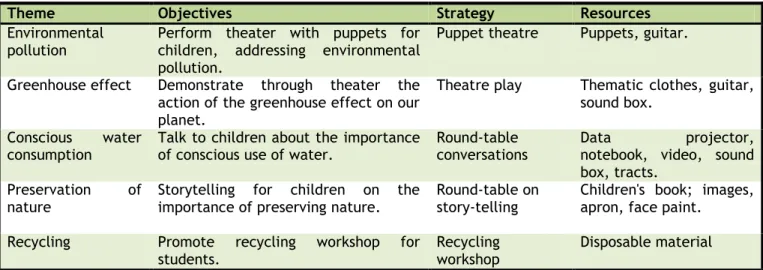
workshop. Afterwards, students would draw the key-points that were discussed and analyzed by them and by the researcher. Table 1 shows how the themes were discussed.
According to Freire,9 this phase is the development of an education plan to assist the coordinator of the debate in his educational work, but this must be a aid and never a rigid prescription that must be strictly followed.
Theme Objectives Strategy Resources
Environmental pollution
Perform theater with puppets for children, addressing environmental pollution.
Puppet theatre Puppets, guitar.
Greenhouse effect Demonstrate through theater the action of the greenhouse effect on our planet.
Theatre play Thematic clothes, guitar, sound box.
Conscious water consumption
Talk to children about the importance of conscious use of water.
Round-table conversations
Data projector, notebook, video, sound box, tracts.
Preservation of nature
Storytelling for children on the importance of preserving nature.
Round-table on story-telling
Children's book; images, apron, face paint.
Recycling Promote recycling workshop for students.
Recycling workshop
Disposable material
Figure 1. Teaching plan according to the theme discussed, objectives, strategy, resources used in the educational process, Crateús 2014.
Theme I: Environmental pollution
The educational process with the theme environmental pollution started with the presentation of puppet theaters, as this is a
recreational resource for awakening the importance of environmental issues.
The piece presented to group participants told the story of a group of marine animals
that lived in the sea and few had their space invaded by garbage dumped into the ocean. The animals got together and developed strategies to combat pollution such as educational campaigns and recycling of waste. When asked what the final for the garbage, group participants showed they did not know the actual final destination of the waste produced. They also mentioned that the garbage piled up on city streets causing dirt and disease.
The activity obtained excellent class participation. The puppet theater provided a good integration of children involved, who remained attentive and interested during the process. The theater is set up as an important resource for transmission of the theme, as well as a good form of interaction, entertainment and fun way of learning.
The puppet theater and other theaters are being used in education as a teaching methodology and its use goes beyond the field
of environmental education, becoming
present in several contents of the school curriculum. The puppets perform a fascinating magic not only with students but also with adults during presentations, allowing the
transmission of environmental content,
generating feelings of solidarity and
awareness to change behaviors and
attitudes.15
Theme II: Greenhouse effect
To address this issue we used the theater. The group made up of students from the nursing program used thematic clothes. One of the students narrated in a simple way how global warming happens and how the planet was affected by this problem.
At the end of the presentation, questions were made to children regarding greenhouse effect. Students expressed their knowledge of the main causes of global warming and its effects on the planet and human health. This showed that children have a satisfactory knowledge of the subject.
The main environmental actions to reduce global warming and how we can intervene to slow this process were discussed.
The theater plays an important role in the lives of students, provided it is well used, assisting in the development of children and adolescents, enhancing the teaching and learning processes. The theater promotes a kind of unrest based on a philosophical perspective, promoting rethink, fostering the desire to change the reality.16
Theme
III:
Conscious
water
consumption
The discussion was initiated by the participants themselves. They shared opinions on the difficulties experienced in their daily lives due to a strong water crisis plaguing the municipality of Crateús. Some children reported lack of water in their homes and that they were suffering because of this. Many families had to buy water from water trucks.
Scholars presented posters and pictures and explained that the lack of water is a result of climate change caused by man and by the irresponsible unrestrained use of this vital resource in everyday activities.
The importance of all was highlighted for engagement of rational use of water and individual and family participation in the adoption of simple measures to face the collapse was encouraged. The creation of collaborative-critical contexts in "Round-table conversations" is an aid in promoting changes in the modes of action of students and in researchers themselves. The expansion of development and possibilities of action in the context itself are highlighted.17
The round-table conversation is a
constructive tool that enables interactions between children and teachers, enabling a
better understanding of the child,
contributing to the incorporation of situations outside of school into the discussion.18
Theme IV: Preservation of nature
The debate on conservation of the nature was started on a round-table of storytelling where nursing students narrated the story "The transforming tree". The book was produced by the team and talked about the life of a large fruit tree that was overthrown and transformed into a table.
Students understood the impacts caused by deforestation and highlighted the importance of trees to the ecological balance, providing food and oxygen, and as an essential component for our survival.
The use of stories promotes reflection and exemplifies situations experienced in the day-to-day of the student. This made it easier students to recognize themselves within the reality of the characters. The story-telling
represents an important tool in the
socialization process, reducing negative
aspects and promoting greater respect for differences.19
Theme V: Recycling
segregate waste for recycling and the time nature takes to break down each type of material.
The students used four cardboards with different colors representing the material to be recycled. An A4 paper sheet was handed to students and they were asked to draw any kind of recycled material and then classify the material according to its respective color.
The students had a good knowledge of the subject and noted that the school had specific
bins according to the material, and
encouraged the segregation of waste
produced. Despite the effort, there is the need for training of cleaning professionals, because we observed that these professionals gathered all waste segregated into a single garbage bag. There is, thus, a need to instruct all school staff, considering that the city has selective collection as well as an association for recycled material.
Recycling workshops emerge as the solution strategy and reducing waste contributing to the reduction of pollution and contamination, a promoting the economy of natural resources and adopting positive habits and attitudes that promote a better quality of life.
Environmental education should be
developed according to the different levels of education. It is important to emphasize awareness with perception, interaction, care and respect of children toward nature and culture, highlighting the diversity of this relationship, as early as in kindergarten and elementary school. The final years of elementary school should develop critical, prospective and interpretive reasoning on environmental issues as well as environmental citizenship.20
The Health education is an important tool for the promotion of health, because it provides the autonomy and civic education of the individual, and make them participate in the construction of knowledge on health.21
The practice of nursing in environmental education is strongly related to the constructs of Public Health, recognizing the determinant and conditioning factors involved in the health-disease process and the importance of the involvement of social actors of this process.
The study allows us to see and believe that education developed with application of a conscientizing methodology among children, in the face of environmental issues, provided
reflection and understanding of basic
elements as to the environmental reality. The
method of research-action presupposes a
relationship of participation between
participants and researchers who, together, reflect and seek to clarify the issues.
The nurse in this scenario acts promoting
community empowerment through
contextualized discussion of reality and encouraging reflection.
The needs regarding environmental
education must rethink the teaching practice through the problematization of reality and the complexity of environmental issues involving the school environment for a paradigm shift, continuous and effective action to reach students and affect directly the communities where students live.
In recent years, environmental issues have become a key issue and represent a great challenge of global spectrum. Such problems have gained huge public visibility and increasingly attention in the news, in studies and election debates. However, we cannot stay in the field of discussion; we have to
start concrete actions, enabling the
transformation of this sad reality.
1. Santos DAS, Silva MS. Atuação do
enfermeiro na educação ambiental e a relação com a sua formação acadêmica. Rev Eletrônica Mestr Educ Ambient [Internet]. 2014 [cited 2015 May 08];31(2):127-39.
Available from:
http://www.seer.furg.br/remea/article/down load/4647/3097
2. Beserra EP, Alves MDS, Pinheiro PNC,
Vieira NFC. Educação ambiental e
enfermagem: uma integração necessária. Rev Bras Enferm [Internet]. 2010 [cited 2015 May
08];63(5):848-52. Available from:
http://www.scielo.br/scielo.php?pid=S0034-71672010000500026&script=sci_arttext
3. Vargas LA, Oliveira TFV. Saúde, meio
ambiente e risco ambiental: um desafio para a prática profissional do enfermeiro. Revista de Enfermagem UERJ [Internet]. 2007 [cited 2015
May 08];15(3):451-456. Available from:
http://www.portalbvsenf.eerp.usp.br/scielo. php?script=sci_arttext&pid=S0104-
35522007000300021&lng=pt&nrm=iso
4. Brasil. Ministério da Saúde. As Cartas da Promoção da Saúde. Secretaria de Políticas de Saúde. Projeto Promoção da Saúde [Internet]. 2002 [cited 2015 May 08]. Available from: http://bvsms.saude.gov.br/bvs/publicacoes/c artas_promocao.pdf
5. Camponogara S. Saúde e meio ambiente
na contemporaneidade: o necessário resgate do legado de Florence Nightingale. Esc. Anna Nery [Internet]. 2012 Jan/Mar [cited 2015 May
REFERENCES
08];16(1):178-84. Available from: http://www.scielo.br/scielo.php?pid=S1414-81452012000100024&script=sci_arttext
6. Brasil. Constituição (1988). Constituição da República Federativa do Brasil. 1988.
Available from:
http://www.planalto.gov.br/ccivil_03/Constit uicao/Constituicao.htm
7. Brasil. Lei nº 8080, de 19 de setembro de
1990. Dispõe sobre a Organização do Sistema Nacional de Saúde. Diário Oficial da União. Brasília: Congresso Nacional. 1990. Available from:
http://www.planalto.gov.br/ccivil_03/Leis/L 8080.htm
8. Decreto nº 4.281 de 25 de junho de 2001.
Regulamenta a Lei n. 9.795, de 27 de abril de 1999, que instituí a Política Nacional de Educação Ambiental – PNSA, e dá outras
providências. 2001. Available from:
http://www.planalto.gov.br/ccivil_03/decret o/2002/d4281.htm
9. Freire P. Educação como prática da
liberdade. 23ª ed. Rio de Janeiro: Paz e Terra; 1999.
10. Gil AC. Como Elaborar Projetos de
Pesquisa. 5ª ed. São Paulo: Atlas; 2010.
11. Minayo MCS. Pesquisa social: teoria,
método e criatividade. 29ª ed. Rio de Janeiro: Vozes; 2010.
12. Thiollent M. Metodologia da Pesquisa-ação. 14th ed. São Paulo: Editora Cortez; 2005.
13. Franco MAS. Pedagogia da pesquisa-ação. Educ Pesq [Internet]. 2005 Dec/Sept [cited 2015 May 08];31(3):483-502. Available from: http://www.scielo.br/pdf/ep/v31n3/a11v31n 3.pdf
14. Freire P. Pedagogia do Oprimido. 42ª ed. Rio de Janeiro: Paz e Terra; 2005.
15. Guerra RAT, Gusmão CRC, Sibrão
ER. Teatro de fantoches: uma estratégia em educação ambiental. Universidade Federal da
Paraíba, Depto. de Sistemática e
Ecologia[Internet]. 2004 [cited 2015 June 10].
Available from:
http://www.dse.ufpb.br/ea/Masters/Artigo_4 .pdf
16. Miranda JL, Elias RC, Faria, RM, Silva VL, Felício WAS. Teatro e a escola: funções, importâncias e práticas. Revista CEPPG
[Internet]. 2009 [cited 2015 May
08];20(1):172-81. Available from:
http://www.portalcatalao.com/painel_cliente s/cesuc/painel/arquivos/upload/temp/a11292 37b55edac1c4426c248a834be2.pdf
17. Ryckebusch CG. A Roda de Conversa na Educação Infantil: uma abordagem crítico-colaborativa na produção de conhecimento [Tese]. São Paulo (SP): Programa de
Pós-Graduação em Linguística Aplicada e Estudos da Linguagem, Universidade Católica de São Paulo; 2011.
18. Leite ESM. O diálogo com as culturas de infância para o presente: um princípio da Educação Ambiental na escola [Dissertação]. Rio Grande: Programa de Pós-Graduação em Educação Ambiental, Fundação Universidade Federal do Rio Grande; 2004.
19. Santos RM. A contação de histórias como instrumento de socialização na educação infantil [Monografia]. Rio Grande do Sul: Curso
de Licenciatura Plena em Pedagogia,
Universidade Federal do Rio Grande do Sul; 2011.
20. Lipai EM, Layrargues PP, Pedro VV.
Educação ambiental na escola: tá na lei... In: Vamos Cuidar do Brasil: conceitos e práticas em educação ambiental na escola. Brasília: Ministério da Educação [Internet]. 2007 [cited
2015 May 08]. Available from:
http://portal.mec.gov.br/dmdocuments/publi cacao3.pdf
21. Araújo MG, Cassiano AN , Holanda CSM, Moreira PVSQ, Giovannini PE. Educação em saúde no ensino infantil: metodologias ativas na abordagem da ação extensionista. J Nurs UFPE on line [Internet]. 2013 Jan [cited 2015
May 08];7(1):306-13. Available from:
file:///C:/Users/Netbook/Downloads/3470-35480-1-PB.pdf
Submission: 2015/11/17 Accepted: 2016/02/01 Publishing: 2016/03/01
Corresponding Address
Antonio Dean Barbosa Marques
Programa de Pós-graduação em Saúde Coletiva Centro de Ciências da Saúde
Universidade de Fortaleza
Av. Washington Soares, 1321 / Bloco S / Sala 1 Bairro Edson Queiroz