Prevalence of and variables related to smoking among medical
students at a university in the city of Passo Fundo, Brazil*
Prevalência e fatores associados ao tabagismo em estudantes de medicina de uma universidade em Passo Fundo (RS)
Leandro Mazzoleni Stramari, Munique Kurtz, Luiz Carlos Corrêa da Silva
Abstract
Objective: To determine the prevalence of and factors associated with smoking among medical students, as well
as to evaluate the profile of this group. Methods: A total of 316 medical students (98.7% of the total) at the University of Passo Fundo, in the city of Passo Fundo, Brazil, completed a self-report questionnaire with questions on tobacco intake and on attitudes related to smoking. In accordance with the World Health Organization guide-lines, the students were classified as daily smokers, occasional smokers, former smokers or nonsmokers, those in the two first categories being considered active smokers. Results: We found that 16.5% of the students were active smokers (daily smokers, 5.4%; occasional smokers, 11.1%) and that 3.5% were former smokers. The mean age was 22.2 ± 2.4 years. Factors significantly associated with the smoking habit (p < 0.05) were male gender, paternal smoking, regular alcohol consumption and use of antidepressants or anxiolytics. For the majority (69.2%) of the smokers, the age at smoking onset was 15-19 years of age, and the main motivations to start smoking were self-initiative and influence of friends. The conceptualization of smoking as an illness was significantly higher among the nonsmokers. In 70.6% of the smokers, tobacco intake was 1-10 cigarettes a day. Among the smokers, 92.3% agreed that smoking is harmful to health, 67.3% had tried to quit smoking, 96.0% believed themselves able to do so, and 87.2% intended to quit smoking. Conclusions: The prevalence of smoking remains significant among medical students. Therefore, it is fundamental that we develop more effective strategies for smoking prevention and cessation in order to reduce the number of smokers among future doctors.
Keywords: Smoking; Prevalence; Students, medical; Behavior.
Resumo
Objetivo: Verificar a prevalência e fatores associados ao tabagismo entre os acadêmicos de medicina e avaliar o
perfil desse grupo. Métodos: Responderam a um questionário autoaplicável, contendo perguntas sobre consumo e atitudes relacionadas ao tabagismo, 316 acadêmicos de medicina (98,7% do total) da Universidade de Passo Fundo. Segundo recomendações da Organização Mundial da Saúde, os estudantes foram classificados em fumantes diários, fumantes ocasionais, ex-fumantes ou não-fumantes, sendo considerados fumantes ativos os nas duas primeiras categorias. Resultados: Observou-se que 16,5% dos acadêmicos eram fumantes ativos (5,4% diários e 11,1% ocasionais) e 3,5% eram ex-fumantes. A média de idade foi 22,2 ± 2,4 anos. Os fatores significativamente associados ao tabagismo (p < 0,05) foram sexo masculino, pai fumante, uso regular de bebidas alcoólicas e uso de antidepressivos ou ansiolíticos. Verificou-se que 69,2% dos fumantes iniciaram o tabagismo entre 15 e 19 anos, tendo como principais motivações a vontade própria e/ou a influência de amigos. A conceituação do tabagismo como doença foi significativamente maior entre os não-fumantes. Quanto à carga tabágica, 70,6% dos fumantes consumiam 1-10 cigarros por dia. Entre os fumantes, 67,3% já tentaram parar de fumar, 96,0% acreditam serem capazes de fazê-lo e 87,2% pretendem deixar de fumar, ao passo que 92,3% admitiram que o cigarro faz mal à saúde. Conclusões: A prevalência do tabagismo ainda é significativa entre os acadêmicos de medicina, sendo fundamental estabelecer estratégias preventivas e de cessação mais efetivas a fim de se tentar reduzir o número de fumantes entre os futuros médicos.
Descritores: Tabagismo; Prevalência; Estudantes de medicina; Comportamento.
* Study carried out at the Universidade de Passo Fundo – UPF, University of Passo Fundo – School of Medicine, Passo Fundo, Brazil.
Correspondence to: Leandro Mazzoleni Stramari. Rua Teixeira de Freitas, 231, CEP 99025-140, Passo Fundo, RS, Brasil. Tel 55 54 3312-1926. E-mail: [email protected]
Financial support: None.
analyze factors associated with smoking and to study the profile of these smokers.
Methods
A cross-sectional study involving medical students at the UPF was carried out in 2007. After the objective of the study had been briefly explained and written informed consent had been obtained, the researchers administered questionnaires in the classrooms. There was no personal identification on the questionnaires, which were collected separately and were not attached to the informed consent forms. The researchers remained in the classrooms during the completion of the questionnaires in order to answer any questions that might arise. The sixth-year students were visited during their medical internship activities in the hospital so that they could complete the questionnaire.
The questionnaires, developed specifically for the present study, contained questions about biological data, demographic data, current resi-dence, parental marital status, parental smoking, alcohol consumption, physical exercises, diag-nosis of depression, use of antidepressants/ anxiolytics, academic performance, passive smoking and conceptualization of smoking, as well as questions related to addressing the topic of smoking during medical appointments with patients.
In accordance with the WHO guidelines,(11)
the students were categorized as daily smokers, occasional smokers, former smokers or nonsmokers. Daily smokers were defined as those who smoked at least one cigarette per day for at least one month before completing the questionnaire; occasional smokers were defined as those who did not smoke daily; former smokers were defined as those who, after having been smokers, had quit smoking at least one month prior; and nonsmokers were defined as those who had never smoked or who had been smoking for less than one month.
The participants who were categorized as current smokers (daily smokers and occasional smokers) also completed the second part of the questionnaire, which included data on the type of cigarette smoked, age at smoking onset, reasons to start smoking, family attitude toward smoking, time to the first cigarette after waking, number of cigarettes smoked per day and conceptualization of smoking as a disease.
Introduction
Worldwide, smoking is considered the leading avoidable cause of death,(1,2) especially
death due to cancer, lung disease and cardiovas-cular disease, as well as being a risk factor for other diseases.(3) The World Health Organization
(WHO) estimates that smokers account for one third of the world adult population, that is, 1.2 billion people.(1)
According to the WHO, the total annual number of tobacco-related deaths is 5 million. If the current tendency toward an expansion of the tobacco epidemic is maintained, in 2030, this number will increase to 10 million, and 70% of these deaths will occur in developing coun-tries.(1,4)
In this era of prevention and health promo-tion, the health-related behavior of health professionals has drawn considerable attention and has been a common object of study.(5) Since
physicians serve as role models for their patients and for the general population, as well as playing a key advisory role in smoking prevention and cessation, they constitute a primary target of the anti-smoking campaign recommended by the WHO.(2)
It might seem paradoxical that, despite the large amount of information about the hazardous effects of smoking received during medical school, tobacco use continues to be common among medical students.(6)
In a review of the literature, in which studies on the prevalence of smoking among medical students published in the past 30 years were analyzed, significant variations were found among countries, with prevalence rates ranging from 3% in the USA to 58% in Japan.(6) Studies
conducted in Brazil have revealed a tendency toward a decrease in the prevalence of smoking among medical students.(7,8)
Although tobacco use among medical students has decreased in the past 50 years, it continues to be a worrisome disease due to the role that these future physicians will play in the community. Smokers are unlikely to be convinced to quit smoking if their advisor, the physician, is a smoker.(9,10)
Commercial cigarettes were used by 98.2% of the current smokers. For the majority (69.2%) of the smokers, the age at smoking onset was 15-19 years of age, and the principal reasons to start smoking were personal choice and peer pressure. In 70.6% of the smokers, tobacco intake was 1-10 cigarettes per day, and 41.1% smoked their first cigarette within the first hour after waking (Table 4).
Among the smokers, 92.3% acknowledged that smoking is harmful to health, 67.3% had tried to quit smoking, 96.0% believed them-selves able to quit smoking, and 87.2% intended to quit smoking.
When the students were asked whether they avoided environments where there were people smoking, 76.3% of the nonsmokers stated that they did, compared with only 36.4% of the former smokers (p = 0.007).
There were no significant differences among the different medical school years in terms of the frequency of smokers.
Discussion
The prevalence of smoking found at the UPF School of Medicine (16.5%) was found to be lower than that in the Brazilian popula-tion (22.4%),(12) which is in accordance with the
literature. In the present study, the prevalence The questionnaires were reviewed and entered
into a database constructed using the program Statistical Package for the Social Sciences, version 15.0 (SPSS Inc., Chicago, IL, USA), which was used to perform the statistical analysis. The chi-square test was used to evaluate associations among the variables, considering a confidence interval of 95% (p < 0.05).
The study project was approved by the UPF Research Ethics Committee.
Results
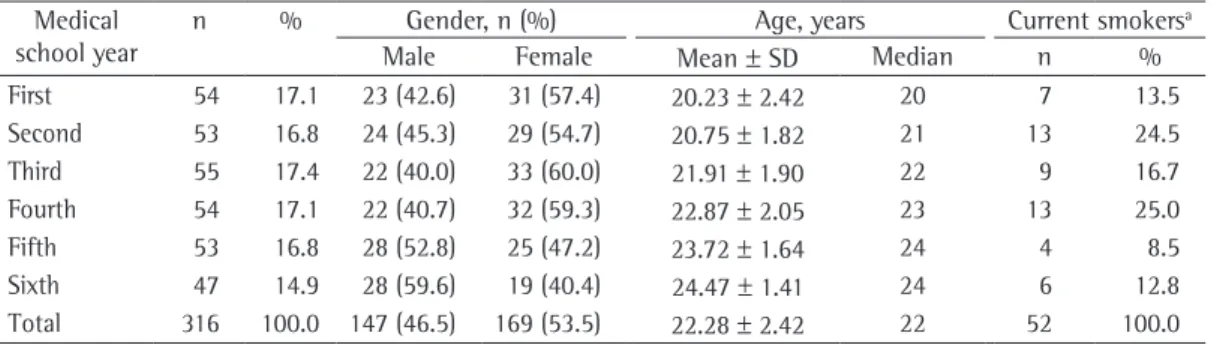
Of the 320 students enrolled in the UPF School of Medicine in 2007, 316 (98.75%) completed the questionnaire. Of those 316, 147 (46.5%) were male and 169 (53.5%) were female. The mean age was 22.28 ± 2.42 years (Table 1). A total of 97.8% of the participants described themselves as White.
We found that 16.5% of the students were smokers, 5.4% being daily smokers and 11.1% being occasional smokers, and that 3.5% were former smokers (Table 2).
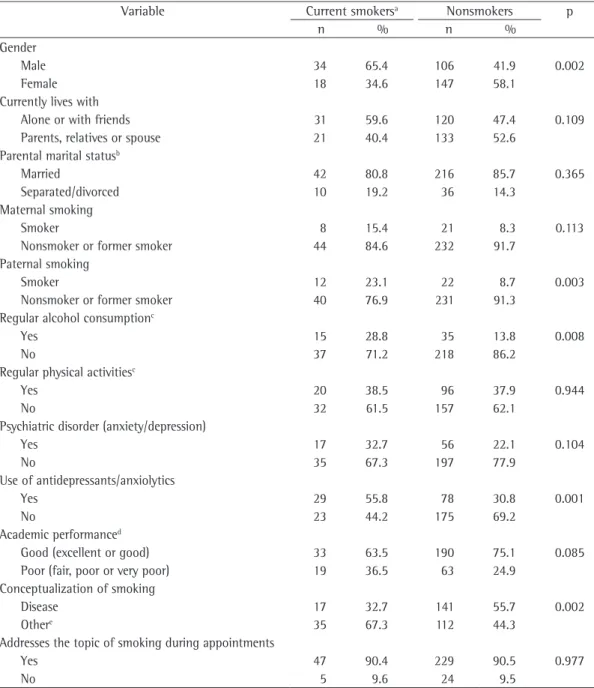
Factors significantly associated with the smoking habit were male gender, paternal smoking, regular alcohol consumption and use of antidepressants or anxiolytics. The conceptuali-zation of smoking as a disease was significantly higher among the nonsmokers (Table 3).
Table 1 - Characteristics of the population studied, correlating medical school year with gender, age and number of current smokers.
Medical school year
n % Gender, n (%) Age, years Current smokersa
Male Female Mean ± SD Median n % First 54 17.1 23 (42.6) 31 (57.4) 20.23 ± 2.42 20 7 13.5 Second 53 16.8 24 (45.3) 29 (54.7) 20.75 ± 1.82 21 13 24.5 Third 55 17.4 22 (40.0) 33 (60.0) 21.91 ± 1.90 22 9 16.7 Fourth 54 17.1 22 (40.7) 32 (59.3) 22.87 ± 2.05 23 13 25.0 Fifth 53 16.8 28 (52.8) 25 (47.2) 23.72 ± 1.64 24 4 8.5 Sixth 47 14.9 28 (59.6) 19 (40.4) 24.47 ± 1.41 24 6 12.8 Total 316 100.0 147 (46.5) 169 (53.5) 22.28 ± 2.42 22 52 100.0
aDaily smokers + occasional smokers.
Table 2 - Categorization of the interviewees by gender.
Gender Daily smoker
Occasional smoker
Former s moker
Nonsmoker Current smokera
n % n % n % n % n %
Male 10 58.8 24 68.6 7 63.6 106 41.9 34 65.4 Female 7 41.2 11 31.4 4 36.4 147 58.1 18 34.6 Totalb 17 5.4 35 11.1 11 3.5 253 80.1 52 16.5
most studies, the subjects are categorized as smokers or nonsmokers, whereas others include the category of occasional tobacco use.(6,14) The
Centers for Disease Control and Prevention and the WHO define (young) current smokers as individuals who smoked for at least one day in the past 30 days,(15) therefore including
occasional smokers in this category. In a popu-of smoking at the UPF was found to be higher
that the rates reported in similar studies carried out at other medical schools in Brazil: 14% at the University of Brasília in 2003(13); 5.6% at the
University of São Paulo in 1996(7); and 10.1% at
the University of Pelotas in 2002.(8)
An important confounding factor among the studies is the definition of smoking. In
Table 3 - Personal factors that might or might not be associated with the smoking habit, with the conceptualization
of smoking and with whether or not the subject is addressed during medical appointments.
Variable Current smokersa Nonsmokers p
n % n %
Gender
Male 34 65.4 106 41.9 0.002
Female 18 34.6 147 58.1
Currently lives with
Alone or with friends 31 59.6 120 47.4 0.109 Parents, relatives or spouse 21 40.4 133 52.6
Parental marital statusb
Married 42 80.8 216 85.7 0.365
Separated/divorced 10 19.2 36 14.3 Maternal smoking
Smoker 8 15.4 21 8.3 0.113
Nonsmoker or former smoker 44 84.6 232 91.7 Paternal smoking
Smoker 12 23.1 22 8.7 0.003
Nonsmoker or former smoker 40 76.9 231 91.3 Regular alcohol consumptionc
Yes 15 28.8 35 13.8 0.008
No 37 71.2 218 86.2
Regular physical activitiesc
Yes 20 38.5 96 37.9 0.944
No 32 61.5 157 62.1
Psychiatric disorder (anxiety/depression)
Yes 17 32.7 56 22.1 0.104
No 35 67.3 197 77.9
Use of antidepressants/anxiolytics
Yes 29 55.8 78 30.8 0.001
No 23 44.2 175 69.2
Academic performanced
Good (excellent or good) 33 63.5 190 75.1 0.085 Poor (fair, poor or very poor) 19 36.5 63 24.9
Conceptualization of smoking
Disease 17 32.7 141 55.7 0.002
Othere 35 67.3 112 44.3
Addresses the topic of smoking during appointments
Yes 47 90.4 229 90.5 0.977
No 5 9.6 24 9.5
Former smokers (n = 11) were excluded from this analysis. aDaily smokers + occasional smokers. bUnknown in one case. cTwo or more times a week. dResponse to the question “How would you rate your academic performance?” eInterviewees
lation-based study carried out in Brazil at two different time points, only daily smokers were considered smokers in 1989, whereas, in 2003, occasional smokers were included in the cate-gory “smokers”.(12)
The importance of including occasional smokers in the studies is due to the fact that, whereas daily smokers should be the target of measures directed at smoking cessation, young occasional smokers should be the target of preventive measures.(15) Occasional smoking also
constitutes a major risk factor for tobacco-re-lated diseases, which is why occasional smokers are included in the same category as daily smokers.(16)
Although the prevalence of smoking was lower among medical students than in the general population, this finding should be inter-preted with caution, due to the influence that future physicians will have on the community. Therefore, even a small number of smokers, in a population that serves as a role model, can have a negative effect on smoking control programs, especially on strategies for prevention and smoking cessation.
In addition, most studies involving the general population,(12) as well as most of those
involving health professionals,(6,14) report that
tobacco consumption is more common in males. Even though the prevalence of smoking has been decreasing in men and increasing in women, it remains significantly higher in males.(12)
The significant association between regular alcohol consumption and smoking again confirms what has been found in other groups of medical students and in the general popula-tion.(17) The greater, regular alcohol consumption
among smokers suggests that these individuals are more likely to use drugs other than tobacco, thereby increasing the smoking-related risks considerably.
There is evidence of comorbidity between smoking and depressive disorders, as well as of an association between smoking and anxiety.(17)
In the present study, current or previous use of antidepressants or anxiolytics was found to be positively associated with smoking. However, smoking was not found to present a similar association with physician-diagnosed anxiety or depression. Since these variables were self-reported by the students, and no specific questionnaire was used to evaluate their
psycho-Table 4 - Characteristics of the medical students who
were smokers.
Variable Current smokers (daily + occasional)
n %
Age at smoking onset
6 to 9 years 1 1.9 10 to 14 years 14 26.9 15 to 19 years 36 69.2 20 to 24 years 1 1.9 Number of cigarettes smoked
per daya
1 to 5 5 29.4
6 to 10 7 41.2
11 to 15 3 17.6
16 to 20 2 11.8
Time to first cigarette after waking?a
Less than 30 min 4 23.5 30 to 60 min 3 17.6
1 to 2 h 2 11.8
More than 2 h 8 47.1 At smoking onset, had friends
who smoke?
Yes 49 94.2
No 3 5.8
Family attitude
Unaware of the student’s smoking
19 36.5
Indifferent 6 11.5 Unfavorable 27 51.9 Response to the question “Is
smoking harmful to health?”
Yes 48 92.3
No 4 7.7
Response to the question “Do you believe yourself able to quit smoking?”b
Yes 49 96.0
No 2 4.0
Has already tried to quit smoking
Yes 35 67.3
No 17 32.7
Intends to quit smokingc
Yes 41 87.2
No 6 12.8
Reason to start smokingd
Personal choice 36 69.2 Peer pressure 22 42.3 Passing fancy 9 17.3 Influence of parents 3 5.8 Influence of advertising 3 5.8
Other 3 5.8
aValid only for daily smokers (n = 17). bUnknown in 1 case.
cUnknown in 5 cases. dParticipants were allowed to select
Although addressing the topic of smoking during medical appointments in the various fields of medicine is considered routine prac-tice in the anamnesis, it requires that health professionals be adequately trained. Studies have shown that a brief intervention during medical appointments leads to cessation rates ranging from 5% to 10% in one year, whereas more intensive interventions, with behav-ioral counseling and drugs, result in cessation rates ranging from 20% to 25% in one year.(20)
Among the students at the UPF, 90.5% reported addressing the subject during appointments with patients, which demonstrates the aware-ness of most students regarding the importance of this disease as a public health problem.
Many pioneering studies have been conducted and many important political deci-sions on smoking control have been made by physicians, professionals who enjoy a unique position of power and influence in the fight against smoking, principally because they know diseases in detail, they are respected in society and they are the principal advisors to patients on health-related subjects.(2,21)
Physicians should serve as role models in society, especially regarding the use of a drug that is widely disseminated in the population and is recognized as a major risk factor for numerous diseases.
In conclusion, the high prevalence of smokers among the medical students at the UPF shows the need for the implementation of a more effective smoking control program in this population. The higher frequency of occasional smokers suggests the need for promoting smoking prevention campaigns, since these students are likely to be less nicotine dependent due to their lower daily tobacco intake. Preventing this popula-tion from increasing their tobacco intake, which increases the risk of becoming more dependent and the risk of developing diseases, should be the primary target of such campaigns.
References
1. World Health Organization. Tobacco Free Initiative [homepage on the Internet]. Geneva: WHO; c2008 [cited 2008 Oct 23]. Available from: http://www.who. int/tobacco/en/
2. World Health Organization. The role of health professionals in tobacco control. Geneva: WHO; 2005. 3. Villanova CA. Tabagismo como fator de risco. In: Silva
LC, editor. Condutas em Pneumologia. Rio de Janeiro: Revinter; 2001. p.210-3.
logical profile, such diseases might have been underdiagnosed in this population.
The age at smoking onset was found to be higher among the medical students than in the general population. Studies have shown that individuals with higher level of education typi-cally start smoking later (> 17 years of age).(18)
This might reflect a difference in the availability of educational support regarding smoking in this population.
Personal choice was the principal reason given for starting smoking, followed by peer pressure, which was corroborated by the fact that, at smoking onset, 94.2% of the students had close friends who smoked. This shows that, in addition to personal choice, the influence of people with whom the youths most often interact is a determining factor for the develop-ment of the disease.
The conceptualization of smoking as a disease is well established in, and incorporated into, the body of medical knowledge.(2) Among medical
students, who study and are exposed to the various smoking-related diseases, this concep-tualization is expected to be consolidated. Our study showed that, among the smokers, only 32.7% considered smoking a disease, whereas the majority (55.8%) considered it a choice. The most surprising fact, however, is that, among the nonsmokers, only 55.7% considered smoking a disease. These numbers show that, regardless of whether or not students smoke, the concept of smoking as a disease remains poorly understood by most of them. This can influence the atti-tude of satti-tudents and future physicians toward patients who smoke. Since these students and physicians view smoking only as a choice and do not consider such patients to be ill, they are less likely to approach the problem with the same propriety as that employed when attempting to treat and advise patients who have other diseases.
The percentage of nonsmoking students who avoided passive smoking (76.3%) can be considered low, since involuntary smoking is increasingly recognized as a cause of disease in nonsmokers.(3,19) Among the former smokers,
13. Andrade AP, Bernardo AC, Viegas CA, Ferreira DB, Gomes TC, Sales MR. Prevalence and characteristics of smoking among youth attending the University of Brasília in Brazil. J Bras Pneumol. 2006;32(1):23-28. 14. Smith DR, Leggat PA. An international review of tobacco
smoking in the medical profession: 1974-2004. BMC Public Health. 2007;7:115.
15. Ministério da Saúde. Instituto Nacional do Câncer. Coordenação de Prevenção e Vigilância. Prevalência de Tabagismo no Brasil: Dados dos inquéritos epidemiológicos em capitais brasileiras. Rio de Janeiro: Coordenação de Prevenção e Vigilância/INCA/MS; 2004.
16. World Health Organization. WHO Statistical Information System (WHOSIS) [homepage on the Internet]. Geneva: World Health Organization. [cited 2008 Jan 10]. Available from: http://www.who.int/whosis/en/ 17. Rondina RC, Gorayeb R, Botelho C. Psychological
characteristics associated with tobacco smoking behavior. J Bras Pneumol. 2007;33(5):592-601 18. Palombini BC. Educação e descontinuação do tabagismo.
In: Silva LC, editor. Condutas em Pneumologia. Rio de Janeiro: Revinter; 2001. p.209-10.
19. World Health Organization. Protection from exposure to second-hand tobacco smoke: Policy recommendations. Geneva: WHO; 2007.
20. U.S. Department of Health and Human Services. Public Health Service. Treating tobacco use and dependence: 2008 update. Rockville (MD): U.S. Department of Health and Human Services, Public Health Service; 2008. 21. Simpson D. Doctors and Tobacco: Medicine´s big
challenge. London: Tobacco Control Resource Center; 2000.
4. International Consultation on Tobacco and Youth. International Consultation on Tobacco and Youth: What in the world works? 28-30 September 1999, Singapore : final conference report. Geneva: WHO; 2000.
5. Mangus RS, Hawkins CE, Miller MJ. Tobacco and alcohol use among 1996 medical school graduates. JAMA. 1998;280(13):1192-3, 1195.
6. Smith DR, Leggat PA. An international review of tobacco smoking among medical students. J Postgrad Med. 2007;53(1):55-62.
7. Ribeiro SA, Jardim JR, Laranjeira AK, Alves F, Kesselring L, Fleissig MZ, et al. Prevalência de tabagismo na Universidade Federal de São Paulo, 1996 - dados preliminares de um programa institucional. Rev Ass Med Brasil. 1999;45(1):39-44.
8. Menezes AM, Hallal PC, Silva F, Souza M, Paiva L, D´ávila A, et al. Smoking among medical students: temporal trends and related variables. J Bras Pneumol. 2004;30(3):223-8.
9. Halty LS, Hüttner MD, Oliveira Netto I, Fenker T, Pasqualini T, Lempek B, et al. Pesquisa sobre tabagismo entre médicos de Rio Grande, RS: prevalência e perfil do fumante. J Pneumol. 2002;28(2):77-83.
10. Guazzelli AC, Terra Filho M, Fiss E. Smoking among physicians in a specific region of the greater metropolitan area of São Paulo. J Bras Pneumol. 2005;(31)6:516-22. 11. World Health Organization. Tobacco country profiles.
2nd ed. Proceedings of the 12th World Conference on Tobacco or Health; 2003 Aug 3-9; Helsinki, Finalnd: WHO; 2003.
12. Monteiro CA, Cavalcante TM, Moura EC, Claro RM, Szwarcwald CL. Population-based evidence of a strong decline in the prevalence of smokers in Brazil (1989-2003). Bull World Health Organ. 2007;85(7):527-34.
About the authors
Leandro Mazzoleni Stramari
Medical Student. Universidade de Passo Fundo – UPF, University of Passo Fundo – School of Medicine, Passo Fundo, Brazil.
Munique Kurtz
Medical Student. Universidade de Passo Fundo – UPF, University of Passo Fundo – School of Medicine, Passo Fundo, Brazil.
Luiz Carlos Corrêa da Silva