Fisioter. Mov., Curitiba, v. , n. , p. - , Jan./Mar. Licenciado sob uma Licença Creative Commons DO): http://dx.doi.org/ . / - . . .AR
[T]
The respiratory physiotherapy causes pain in newborns?
A systematic review
A i sioterapia respiratória causa dor em
neonatos? Uma revisão sistemática
Camila Ferreira Zanelat[a], Flávia Rodrigues Rocha[a], Gabriela Menezes Lopes[a],
Juliana Rodrigues Ferreira[a], Letícia Silva Gabriel[b], Trícia Guerra e Oliveira[b]*
[a] Universidade Vila Velha UVV , Vila Velha, ES, Brazil
[b] Universidade Federal de Minas Gerais UFMG , Belo (orizonte, MG, Brazil
Abstract
Introduction: Neonatal respiratory physicaltherapy plays an important role in prevention and treatment of
respiratory pathologies. )n preterm neonates, immaturity of respiratory system can let development of vari-ous respiratory diseases. Meanwhile, it is discussed if respiratory physiotherapy can cause pain. Objective:
)nvestigate presence of pain in neonates undergone to respiratory physiotherapy by a systematic review.
Methods:Scienti ic search in electronic databases: Medline, Lilacs, Bireme, PEDro, Pubmed, Scielo and
Capes thesis and dissertations base. Portuguese, English and Spanish, publication year from to .
Results:Thriteen studies were included, but one of them was excluded due to fulltext unavaiable. Therefore,
twelve articles were included, nine , % con irm pain in newborn NB , from these, in eight , % intervention was suction and in only one vibrocompression. Four articles studied term and premature new-borns. Mechanical ventilatory assistance was used in seven of the studies analyzed. Conclusion:Results
suggest that suction and vibrocompression were pain causers in NB. (owever, evidenced the necessity of well delineated methods to evaluate if physicaltherapy techniques can cause pain in neonates.
Keywords: Physical Therapy Modalities. Pain. Pain Measurement. Newborn. Neonatal )ntensive Care.
Resumo
Introdução: A ϔisioterapia respiratória neonatal representa um papel importante na prevenção e tratamento das patologias de origem respiratória. Em neonatos pré-termos, a imaturidade do sistema respiratório pode levar ao desenvolvimento de várias doenças respiratórias. Porém, é discutido se a ϔisioterapia respiratória possa causar dor. Objetivo: Investigar a presença de dor em neonatos submetidos à ϔisioterapia respiratória por meio de uma revisão sistemática. Métodos: Busca cientíϔica nas bases eletrônicas de dados: Medline, Lilacs, Bireme, PEDro, Scielo e base de teses e dissertações da Capes, nas línguas portuguesa, inglesa e espanhola, ano de publicação de 2000 a 2012. Resultados: Treze estudos foram considerados elegíveis, porém um dos estudos foi excluído devido a indisponibilidade do texto na íntegra. Dos 12 trabalhos incluídos, nove (81,8%) comprova-ram presença de dor em recém-nascidos (RN), destes, em oito (72,7%) a intervenção realizada foi a aspiração e, em apenas um, a vibrocompressão. Quatro artigos estudaram neonatos a termo e pretermo. A assistência ventilatória mecânica foi utilizada em sete dos estudos analisados. Conclusão: Os resultados sugerem que a aspiração e a vibrocompressão são causas de dor em RN. Entretanto, evidenciou a necessidade de métodos bem delineados para avaliar se as técnicas de ϔisioterapia podem causar dor em neonatos.
Palavras-chave: Modalidades de Fisioterapia. Dor. Medição da Dor. Recém-Nascido. Terapia Intensiva neonatal.
Introduction
World (ealth Organization revels that in every year about million babies were born premature-ly in the world. The increase in premature births in developing countries is related to the number of pregnant women with more advanced age and higher frequency of fertility medicines. Meanwhile in under developing countries, mean cause include higher adolescent pregnancy taxes, malaria, ()V and infections .
Brazil appears in th position in absolute
numbers, with . thousand of premature births
per year. The information system of living births S)SNAC showed that the percentage of premature
living births in was . %, which corresponds
to . living births . )n preterm neonates,
there is immaturity of respiratory system which can favour development of various respiratory patholo-gies, resulting in increased occupied beds in neona-tal intensive care and multidisciplinary treatment, including physiotherapy .
Physiotherapeutic approach in face of these dis-eases represents an important role in prevention and treatment, acting in ambulatory, hospital and in-tensive care. The aims reached by physiotherapeutic procedures prioritizes pulmonary volumes and ca-pacities normalized, increment in oxygenation and
gas changes, mobilization and elimination of pulmo-nary secretions, respiratory work reduction, increase of respiratory muscle endurance and strength and then, promote function respiratory independency, beyond preventing complications and motivate pa-tient recovery , .
Among most used techniques in respiratory physiotherapy we can quote thoracic vibration, vi-brocompression, forced expiratory low technique
FEF , bag-squeezing, postural drainage PD , suc-tion, diaphragmatic stimulasuc-tion, Rhinopharyngeal Retrograde Clearance RRC , prolonged slow
expira-tory PSE and tapping , , , , , , , , , .
)t is discussed if these techniques can or cannot cause pain, considering that neonatal pain deserves differential attention, thus these patients do not ver-bally express and its manifestations are distinct in other age bands. Until th decade suspected that newborns were not able to experience pain, be-cause of lack of central nervous system mieliniza-tion. Actually it is known that premature newborns
present nociceptive neurophysiological paths . )n
pain stimulus presence despites chemical, thermic or mechanical occurred algiogenic substances releases such as bradicinines, acetylcoline, serotonine, hista-mine and prostaglandines. Such substances unleash process that results in reduction of action potential
179
To evaluate studies methodological quality PEDro scale that is based in Delphi list was used. Delphi list originated from Delphi system that consisted
in items associated to studies quality. These
items were reduced to nine by Delphi consensus technique. PEDro scale is composed by criterion, only criterions more than Delphi list criterions
and and inal score is generated by the sum of
ten of eleven criterions , , , . This score
is realized for two independent evaluators, and in case of disagreement in any of the criterion, a third evaluator analyzed and decide the inal score. Quality score range from to points. This scale
is appropriated to physiotherapy studies , .
The following aspects are evaluated: inclusion criterion speci ication; study groups randomiza-tion; true randomizarandomiza-tion; groups homogene-ity; double blind; independent evaluator for results; measurement of at least a key result in more than % of subjects initially distributed among groups; intention to treat analysis; re-sults description of comparison between groups;
presentation of variability measurements and
point estimative for primary variable , , .
Were considered of lower methodological expressiv-ity articles that scored four or less Category and those that scored ive or more, higher
methodologi-cal expressiveness Category .
Kappa analysis was used to calculate inter ex-aminer agreement, comparing results of evaluations
that used PEDro scale . The concordance
mea-sured by Kappa is interpreted in this way: Kappa val-ues < , - absence concordance; from , to , low; from , to , discreet; from , to , moderate; , to , substantial and , perfect
concordance . Mann Whitney test was used for
medians of evaluators scores comparison, consid-ered as signi icance level p < , . Statistical pack-age Social Package for Social Science SPSS version
. and the program of Statistics and Epidemiology
laboratory were used , .
Results
After analysis of scienti ic articles, thirteen stud-ies were eligible, but one of the studstud-ies was unavail-able and was excluded. Figure presents selection of included studies luxograme.
)nternational association for pain study de ines painful sensation as a sensorial emotional disgust-ing experience, associated to potential and or real
tecidual lesion, being always subjective , . )t is
important to analyze if chest physiotherapy causes pain in neonates, once pain in luences directly in stabilization and clinical evolution, having long term repercussions in family interactions, cognition and learning . Because of this subjective and newborn preverbal characteristics, speci ic methods to evalu-ate were creevalu-ated.
Among utilized methods showed up pain scales: behavioral pain scale, Neonatal )nfant Pain Scale – N)PS, Neonatal Facial Coding System – NFCS, Premature )nfant Pain Pro ile – P)PP, among
oth-ers . These for this time, evaluate behavioral
parameters N)PS and NFCS , and its association to physiological parameters as heart rate and oxygen
saturation P)PP , , , , , , , .
The practical dearth of this type of evaluation for physiotherapy team, added to reduced number of studies that evaluated pain in neonates during physiotherapeutic procedures justifying the aim to investigate if respiratory physiotherapy causes pain in neonates by a systematic review.
Methods
Scienti ic articles search strategy includes:
a electronic data base: Medline, Lilacs, Bireme,
Pubmed, PEDro, Scielo and Capes thesis and dis-sertations base; b selection of key words utilized in review process through health science descriptors B)REME DeCS in Spanish, English and Portuguese languages: physical therapy modalities, pain, pain measurement, suction, neonate/newborn, neona-tal intensive care; c publication year from
to ; d types of study: clinical trial,
random-ized clinical trial, controlled clinical trial and meta-analysis.
)nitial search was made by four of the researchers CFZ, FRR, GML, JRF , then, it was realized again by three researchers FRR, GML, LG , in independently
and blinded way . After title and abstract
Figure 1 - Flowchart of selected studies.
From twelve selected articles, nine observed pain unleashed by procedures in neonates, in eight the
intervention was suction , , , , , , .
Thoracic vibrocompression technique was described
as potentially painful in another study , while
techniques as vibration, diaphragmatic stimulation, postural drainage associated to others techniques, passive respiratory exercises associated to neonate positioning, bag-squeezing, forced expiratory low and thoracic physiotherapy do not resulted in pain
in six analyzed studies , , , , .
Pain measurements included behavioral and or physiological evaluation scales. Behavioral scales used were Neonatal infant pain scale N)PS , neo-natal facial coding system NFCS , premature infant pain pro ile P)PP . Six articles used some of these scales and physiological parameters, four utilized
N)PS scale , , and two NFCS , .
Another study applied P)PP scale and two only
N)PS , , .Beyond this, two pain scales were
used together, N)PS and NFCS, as described in one
article .
)n two articles only the following physiological parameters were evaluated: heart rate (R , respira-tory rate r , oxygen peripheral saturation SpO
and pulse frequency P , . Two articles
in-vestigated only (R and SpO , , four articles
beyond these parameters observed respiratory rate
, , . While two articles, beyond (R, r and
SpO evaluated P , .
)nvestigation of (R and P is considered equal parameters, but according to literature, there is dif-ference among their values.
181
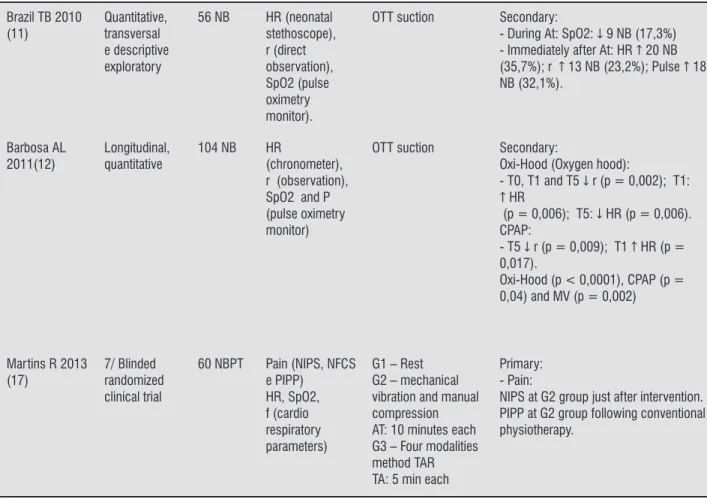
Table 1 - Main data from selected studies
AUTHOR/ YEAR PEDro MEDIA/ TYPE OF STUDY SAMPLE ANALYZED VARIABLES (EVALUATION INSTRUMENTS)
INTERVENTION MAIN OUTCOMES
Falcão LFM 2007 (14)
Transversal and prospective
60 NB Pain (NIPS and
NFCS)
Diaphragmatic stimulation oral or manual vibrocompression TA: 3 times of 5 s each
Primary:
- Pain (NIPS > 3): 53% (p = 0,0199) during thoracic vibrocompression
Falcão FRC 2008 (21)
7/ Randomized clinical trial
13 NB Pain (NFCS)
HR and SpO2
Tracheal suction with or without contention TA: 10 s
Primary:
-23% contentend patients felt pain; - 92% non contented patients felt pain (p = 0,0015). Nicolau CM 2008 (5) Longitudinal prospective of case series
30 NBPT Pain (NIPS) Vibration; postural
drainage; passive respiratory exercise; SAW and ETT suction.
Primary:
- Pain before physiotherapy: 19,1%; - Pain after suction: 71,6% (p < 0,001).
Nicolau CM 2008 (32)
Longitudinal prospective of case series
50 NBPT Pain (NIPS);
r (chronometer), HR and SpO2 (pulse oximetry)
Endotracheal suction Primary:
- Pain at T1: 52%;
- Pain at T5: 40% (p < 0,05) Secundary:
- SpO2 < 90%: 20% NB.
Moran CA 2009 (18)
4/ Double blind clinical trial
06 NBPT Pain (NIPS) - Vibration; FEF;
- ETT and SAW suction; -Tatil stimulation;
Primary:
- T and T1 without pain (p = 0,312).
Castro ACL 2010 (19) Observational quantitative and transversal cohort
09 NBPT Pain (NIPS);
r; HR, SpO2 (monitor)
Endotracheal suction Primary:
- Pain: 25% (p = 0,00) Secondary:
- ↑ HR (p = 0,01); ↑ r (p = 0,32); ↓ SpO2 (p = 0,83);
Lanza FC 2010 (22)
Transversal NBPT Pain (NFCS), HR,
SpO2, r
Vibration TA: 20 min
Vibration: no pain neither physiological parameters changes (p < 0,05).
Araújo MC 2010 (10)
Exploratory
fi eld research, observational and non-participative
10 NBPT Pain (PIPP) Tracheal cannula
suction
Primary:
- Pain during suction: 70% NBPT
Leal SS 2010 (20)
Analytical, observational transversal cohort
60 NBPT Pain (NIPS); HR,
SpO2 (monitor) and r .
Vibrocompression; - Bag-squeezing; - FEF;
- OTT suction. TA: 3 min each technique
Primary: Pain:
- Before: 9 NBPT; - During: 38 NBPT;
- After: 14 NBPT (p = 0,05); Secondary:
↑ HR (p < 0,05).
Studied population constitute of premature new-borns interned in N)CU in seven articles , , , ,
, , . Four articles studied term and preterm
newborns , , . Mechanical assisted ventilation
MAV was used in seven studies, in three of them they
do not speci ied the MVA type , , .Two forms
of mechanical ventilation invasive and non-invasive
were described in two studies , .
Articles media score that were analyzed for two evaluators by PEDro scale is included in box ). Articles score was divided in two categories. Based in this divi-sion, it was possible classi ied four articles in category
and seven articles in category , with agreement inter both examiners.
Concordance analysis inter examiners showed
per-fect concordance Kappa = , ; p = , according to
Table 1 - Main data from selected studies
Brazil TB 2010 (11)
Quantitative, transversal e descriptive exploratory
56 NB HR (neonatal
stethoscope), r (direct observation), SpO2 (pulse oximetry monitor).
OTT suction Secondary:
- During At: SpO2: ↓ 9 NB (17,3%) - Immediately after At: HR ↑ 20 NB (35,7%); r ↑ 13 NB (23,2%); Pulse ↑ 18 NB (32,1%).
Barbosa AL 2011(12)
Longitudinal, quantitative
104 NB HR
(chronometer), r (observation), SpO2 and P (pulse oximetry monitor)
OTT suction Secondary:
Oxi-Hood (Oxygen hood):
- T0, T1 and T5 ↓ r (p = 0,002); T1: ↑ HR
(p = 0,006); T5: ↓ HR (p = 0,006). CPAP:
- T5 ↓ r (p = 0,009); T1 ↑ HR (p = 0,017).
Oxi-Hood (p < 0,0001), CPAP (p = 0,04) and MV (p = 0,002)
Martins R 2013 (17)
7/ Blinded randomized clinical trial
60 NBPT Pain (NIPS, NFCS
e PIPP) HR, SpO2, f (cardio respiratory parameters)
G1 – Rest G2 – mechanical vibration and manual compression AT: 10 minutes each G3 – Four modalities method TAR TA: 5 min each
Primary: - Pain:
NIPS at G2 group just after intervention. PIPP at G2 group following conventional physiotherapy.
Note: NB: Newborn; NBPT: newborn preterm; NIPS: Neonatal Infant Pain Score; NFCS: Neonatal Facial Coding System; PIPP: Premature Infant Pain Profi le; OTT: or tracheal tube; SAW: superior airways; HR: heart rate; r: respiratory rate; SpO2: oxygen peripheral saturation; P: pulse frequency; T: before procedure; T0: during procedure; T1: immediately after procedure; T5: fi ve minutes after procedure; At: tracheal suction; MV: mechanical ventilation; FEF: forced expiratory fl ow; G1: control group; G2: conventional physiotherapy; G3: thoracoabdominal rebalance (TRA); TA: application time.
(Conclusion)
Table . Medians distribution of examiners scores do
not differed signi icantly p = , .
Table 2 - Concordance analysis inter examiners
Kappa value 1.0
p value 0,0010
95% Confi dence interval 1.0 - 0,49
Discussion
183
hygiene, indicated when physiological response for se-cretion removal do not act adequately. )t is potentially painful because it is an aggressive procedure that causes
discomfort and anxiety . Beyond, suction can
pro-mote reduction of volume, pulmonary ventilation and oxygen saturation by hemoglobin in children submit-ted to mechanical ventilation, due to suction catheter introduction, interruption in oxygen supply and gas removal due to negative pressure application, Nicolau et al. veri ied that suction adverse effects can overcome
bene its effects , .
Vibrocompression is a technique that imposes high-er thoracic pressure added to a vibration stimulus, pro-viding a higher stress stimulus to neonates, which could explain the higher presence of pain during and after this
procedure according to Falcão et al. .
Others techniques such as vibration, diaphragmatic pressure, postural drainage associated to others tech-niques, passive respiratory exercises associated to neo-nate positioning, bag-squeezing and FEF do not resulted in pain in the analyzed studies. These indings are suit-able to Selestrin et al.´s results, that veri ied neonatal respiratory physiotherapy do not cause physiological repercussions in the population studied. Emphasized that bronchial hygiene maneuvers are contraindicate
in preterm neonates with weight lower than . g in
the irst three days of life due to higher instability and intracranial hemorrhage possibility. )n this population, it is viable positioning with the aim to improve thora-coabdominal biomechanics and respiratory function
without risks of hemorrhages .
Painful stimulus or distress presence instable the neonate considering cardiovascular, respiratory and
metabolic components , . This fact can be
ob-served in mechanical ventilated NBE which is also a stress and pain factor unchained. )ndependently of others invasive procedures, mechanical ventilation unleashes stress hormone discharge. Among them fea-tures: adrenaline, noradrenaline, cortisol, aldosterone, glucagon, growth hormone and insulin production sup-pression, with substrate mobilization as protein, lipid and carbohydrates. (ormone biochemical dose can be a method used to pain evaluation in this population . )n the present work, premature neonates consti-tute the frequently studied population among analyzed articles. This fact can be explained due to an extensive internment period in which the referred population is submitted, constantly exposed to potentially painful procedures and its hurtful effects .
Actually it is known that nociception neurophysi-ological ways A-delta and C ibers are present in pre-mature, but until third gestational trimesters, ibers C synaptic connections are immature. Therefore, central nervous system uses temporally A-beta ibers to
pain-ful stimulus transmission , , , , . Receptors
low activity and inhibitory synaptic neurotransmissions reduced levels turn pain perception in neonates more intense than older children and adults, resulted of pain
control inhibitory immature mechanisms .
Pain expression in neonates is a nonverbal language, turning necessary interpretation. Cry is a neonatal com-munication when there is distress. Nevertheless, it is only useful for pain measurement when associated to others parameters. Facial mimic is an important pa-rameter, in pain presence, occur more expressive fa-cial movements. These two behavioral parameters are considered the main parameters during pain analysis
, .
Based on this, emerge the need of multidimensional scales implementation as a routine procedure in neo-nate pain evaluation. Falcão et al. veri ied the impor-tance of multidimensional method described and vali-dated for pain characterization. N)PS is useful for term and preterm pain evaluation, distinguishing painful and non-painful by six pain indicators, ive behavioral and one physiological. )n this review, the method frequently used for pain evaluation was N)PS in . % of the stud-ies. )t was used as a single measurement method or as-sociated to others scales and physiological parameters
, , .
Painful stimulus modify behavioral parameters and a series of physiological parameters in neonates such as (R, SpO and r. There are controversy in the literature about changes in these parameters after respiratory physiotherapy techniques application, whereas varia-tion in these parameters can occur due to hungry, cry, distress, anxiety and installed pathology, besides pain
. Antunes et al.compared effects of conventional
respiratory physiotherapy versus forced expiratory low, observing increases in (R, SpO and r remains
unchangeable . Counterpart, Selestrin et al.
evalu-ated physiological parameters in mechanical ventilevalu-ated preterm neonates after neonatal physiotherapy proce-dures, they found (R and f reduction .
. Abreu LC, Pereira VX, Valenti VE, Panzarin SA, Moura Filho OF. Uma visão da prática da isioterapia respira-tória: ausência de evidencia não e evidencia de ausência: Artigo de Revisão. Arq Med ABC. ; Supl. :S - . . Nicolau CM, Pigo JDC, Bueno M, Falcão MC. Avaliação
da dor em recém-nascidos prematuros durante a i-sioterapia respiratória.Rev Bras Saude Mater )nfant.
; : - .
. Antunes LCO, Silva EG, Bocardo P, Daher DR, Faggiotto RD, Rugolo LMSS. Efeitos da isioterapia respiratória convencional versus aumento do luxo expiratório na saturação de o , frequência cardíaca e frequência respi-ratória, em prematuros no período pós-extubação. Rev Bras Fisioter. ; : - .
. Ribeiro )F, Melo APL, Davidson J. Fisioterapia em recém-nascidos com persistência do canal arterial e complica-ções pulmonares. Rev Paul Pediatr. ; : - . . )ke D, Lorenzo VAPD, Costa D, Jamami M. Drenagem
Pos-tural: prática e evidência. Fisioter Mov. ; : - . . Farias GM, Freire )LS, Ramos CS. Aspiração endotraqueal: estudo em pacientes de uma unidade de urgência e te-rapia intensiva de um hospital da região metropolitana de natal – RN. Rev Eletronica Enferm. ; : - . . Araujo MC, Nascimento MAL, Christoffel MM, Antunes
JCP, Gomes AVO. Aspiração traqueal e dor: reações do recém-nascido pré-termo durante o cuidado. Cienc Cuid Saude. ; : - .
. Brasil TB, Barbosa AL, Cardoso MVLML. Aspiração orotraqueal em bebês: implicações nos parâmetros isiológicos e intervenções de enfermagem. Rev Bras Enferm. ; : - .
. Barbosa AL, Cardoso MVLML, Brasil TB, Scochi CGS. As-piração do tubo orotraqueal e de vias aéreas superiores: alterações nos parâmetros isiológicos em recém-nasci-dos.Rev Latino-Am Enfermagem. ; :[ telas]. . Falcão LFM, Ribeiro )F, Chermont AG, Guimarães
AGM. Avaliação da dor em recém-nascidos com distúr-bios respiratórios submetidos a procedimentos isioter-apêuticos de rotina. Rev Paul Pediatr. ; : - . . Sousa BBB, Santos M(, Sousa FGM, Gonçalves APF, Paiva
SS. Avaliação da dor como instrumento para o cuidar de recém-nascidos pré-termo. Texto Contexto Enferm.
; spe : - .
This research had some limitations: lack of studies that related respiratory physiotherapy and pain,
dif-iculty in study this population due to ethical reasons and pain subjectivity. Other limitations were the lack of reports about airway clearance such as RRC, PSE and tapping, but are largely used in clinical practice. )t shows need of scienti ic evidence correlating these techniques with neonatal pain. Besides, PEDro scale allow evaluate randomized clinical trials. )n this review, from twelve
analyzed studies, only three , , were classi ied
as randomized clinical trial reinforcing lack of studies about this topic. PEDro scale evaluation pointed to exi-guity of scores in criterions , , and , respectively related to group randomization, blind of subjects, thera-pist and examiners. This fact corroborate to ethics limi-tations and peculiarities in studying neonates showing the need of higher methodological studies.
Conclusion
)n front of the exposed, we conclude that suction and vibrocompression were the techniques pain causers in the studied population, evidencing necessity of other studies, with well delineated methods that evaluate relation of these techniques and pain aiming stablish neonatal physiotherapy risk bene it in premature due to fragility of this population.
References
. Brasil. Ministério da Saúde. Rede cegonha busca reduzir índice de nascimentos prematuros. [cited Oct ]. Available from: http://tinyurl.com/h c oga. . Selestrin CC, Oliveira AG, Ferreira C, Siqueira AAF, Abreu
LC, Murad N. Avaliação dos parâmetros isiológicos em recém nascidos pré-termo em ventilação mecânica após procedimentos de isioterapia neonatal. Rev Bras Cres-cimento Desenvolv (um. ; : - .
. Abreu LC, Angheben JMM, Braz PF, Oliveira AG, Fal-cão MC, Saldiva P(N. Efeitos da isioterapia neonatal sobre a frequência cardíaca em recém-nascidos pré-termo com doença pulmonar das membranas hialinas pós-reposição de surfactante exógeno. Arq Med ABC.
185 . Dias RC, Dias JMD.Prática baseada em evidências: uma
metodologia para a boa prática isioterapêutica. Fisioter Mov. ; : - .
. Shiwa SR. Prática baseada em evidências: a base de da-dos PEDro, reprodutibilidade da escala de qualidade PEDro em português e a in luência do idioma de publica-ção na qualidade dos estudos controlados aleatorizados [master´s thesis]. São Paulo: Universidade Cidade de São Paulo; . Portuguese.
. Cipolat S, Pereira BB, Ferreira FV. Fisioterapia em Pa-cientes com Leucemia: Revisão Sistemática. Rev Bras Cancerol. ; : - .
. Siegel S, Castellan NJJ. Estatística não paramétrica para Ciências do Comportamento. nd ed. Porto Alegre Bra-zil : Artmed; . p. - .
. Campos MR, Leal MC, Souza PR, Cunha CB. Consistência entre fontes de dados e con iabilidade interobservador do Estudo da Morbi-mortalidade e Atenção Peri e Neo-natal no Município do Rio de Janeiro.Cad Saude Publica.
; Suppl :S -S .
. Laboratório de Epidemiologia e Estatítisca. Análise de Concordância – Kappa. [cited Oct ]. Avail-able from: http://tinyurl.com/jyjeph .
. Nicolau CM, Modesto K, Nunes P, Araújo K, Amaral (, Falcão MC. Avaliação da dor no recém-nascido prema-turo: parâmetros isiológicos versus comportamentais. Arq Bras Cien Saude. ; : - .
. Johnston C, Zanetti NM, Comaru T, Ribeiro SNS, Andrade LB, Santos SLL. ) Recomendação brasileira de isioterapia respiratória em unidade de terapia intensiva pediátrica e neonatal. Rev Bras Ter )ntensiva. ; : - . . Nicolau CM, Lahóz AL. Fisioterapia respiratória em
tera-pia intensiva pediátrica e neonatal: uma revisão baseada em evidências. Pediatria. ; : - .
. Castro MCFZ, Guinsburg R, Almeida MFB, Peres CA, Yanaguibashi G, Kopelman B). Per il da indicação de analgésicos opióides em recém-nascidos em ventilação pulmonar mecânica. J Pediatr. ; : - . . Santos LM, Pereira MP, Santos LFN, Santana RCB.
Avalia-ção da dor no recém-nascido prematuro em Unidade de Terapia )ntensiva. Rev Bras Enferm. ; : - . . Abu-Saad ((, Bours GJJW, Stevens B, (amers JP(.
Assessment of Pain in the Neonate. Semin Perinatol.
; : - .
. Rocha APC, Kraychete DC, Lemonica L, Carvalho LR, Barros GAM, Garcia JBS, et al. Dor: Aspectos Atuais da Sensibilização Periférica e Central. Rev Bras Anestesiol.
; : - .
. Diament A, Cypel S. Neurologia infantil. th ed. São Paulo: Atheneu; . Portuguese.
. Martins R, Silva MEM, (onório GJS, Paulin E, Schivin-ski C)S. Técnicas de isioterapia respiratória: efeito nos parâmetros cardiorrespiratórios e na dor do neo-nato estável em UT)N. Rev Bras Saude Mater )nfant.
; : - .
. Moran CA, Serra NL, Negrão AS, Oliveira CS. Estimu-lação tátil e dor em recém-nascido pré-termo sub-metido à ventilação mecânica: estudo piloto. Ter Man.
; : - .
. Castro ACL, Fonseca ALL, Carreiro DL, Coutinho LTM, Coutinho WLM. Avaliação da dor em recém-nascidos prematuros submetidos à higiene de vias aéreas supe-riores. R Min Educ Fis. ; : - .
. Leal SS, Xavier CL, Sousa ECM, Sousa CC, Rocha GM, Sou-za APS, et al. Avaliação da dor durante a aspiração endo-traqueal pós- isioterapia respiratória em recém-nascido pré-termo. ConScientiae Saude. ; : - . . Falcão FRC, Silva MAB. Contenção durante a
aspira-ção traqueal em recém-nascidos. Rev Cien Med Biol. ; : - .
. Lanza FC, Kim A(K, Silva JL, Vasconcelos A, Tsopano-glou SP. A vibração torácica na isioterapia respira-tória de recém-nascidos causa dor? Rev Paul Pediatr.
; : - .
. Sampaio RF, Mancini MC. Estudos de revisão sistemática: um guia para síntese criteriosa da evidência cientí ica. Rev Bras Fisioter. ; : - .
. PEDro: Physiotherapy Evidence Database. Camperdown, Sydney Australia : The George )nstitute for Global (ealth; [cited Sep ]. Available from: http:// tinyurl.com/ dar.
. Gaspardo CM. Dor em neonatos pré-termo em unidade de terapia intensiva neonatal: avaliação e intervenção com sacarose [master´s thesis]. Ribeirão Preto Brazil : Faculdade de Medicina de Ribeirão Preto da Universi-dade de São Paulo; . Portuguese.
. Silva YP, Gomez RA, Máximo TA, Silva ACS. Avalia-ção da Dor em Neonatologia. Rev Bras Anestesiol.
; : - .
. Guinsburg R. Avaliação e tratamento da dor no recém-nascido. J Pediatr Rio J . ; : - .
. Falcão ACMP, Sousa ALS, Stival MM, Lima LR. Abor-dagem terapêutica da dor em neonatos sob cuidados intensivos: uma Breve revisão. R Enferm Cent O Min.
; : - .
Received in / /
Recebido em / /
Approved in / /