Fisioter. Mov., Curitiba, v. , n. , p. - , set./dez. Licenciado sob uma Licença Creative Commons
[T]
Locomotor training with partial body weight support in
spinal cord injury rehabilitation: literature review
[)]
Treino locomotor com suporte parcial de peso corporal em
reabilitação de lesão medular: revisão de literatura
[A]
Cristina Maria Rocha Dutra[a], Cynthia Maria Rocha Dutra[b], Auristela Duarte de Lima Moser[c], Elisangela Ferretti Manffra[c]
[a] Master in Technology in (ealth at Pontifícia Universidade Católica do Paraná PUCPR , Curitiba, PR - Brazil, e-mail:
cristinadutra @hotmail.com
[b] Master in Physical Therapy, professor at Universidade Tuiuti do Paraná UTP , Curitiba, PR - Brazil, e-mail:
[c] Ph.D in Physical Therapy, professor at PUCPR, Curitiba, PR – Brazil, e-mail: [email protected] [d] Ph.D in Physical Therapy, professor at PUCPR, Curitiba, PR – Brazil, e-mail: [email protected]
[R] Abstract
Introduction: The locomotor training with bodyweight support LTBWS has been used for approximately
twenty years in the field of rehabilitation in patients who suffer from neurological pathologies. The LTBWS fa-vors these improvements muscle, cardiovascular and osteo-psychological, because maximum residual potential develops the body, providing reintegration into the familial, social and professional. Objective: )dentify the main
methods of assessment and their parameters LTBWS with the purpose of contributing to the establishment of reliable evidence for the rehabilitation practice of people with spinal cord. Materials and methods: Original
ar-ticles were analyzed, published between and , involving gait training after spinal cord, with or without partial body weight support, and training assistance technologies such as functional electrical stimulation and biofeedback among others. Results: The majority of the participants of the studies was male; injury levels ranged
from C to L , AS)A had scores from A to D; injury times ranged from . months years. Also it was noted that there is no consensus regarding LTBWS Protocol. Conclusion: The locomotor training with bodyweight support
908
cord, regardless of training protocol used the benefits relating to increases in muscular strength, maintaining or increasing bone density, decreased heart rate, increase in physical conditioning are present.
[P]
Keywords: Weight-bearing. Gait. Spinal cord injury.
[B] Resumo
Introdução: O treino locomotor com suporte de peso corporal (TLSP) é utilizado há aproximadamente 20 anos no campo da reabilitação em pacientes que sofrem de patologias neurológicas. O TLSP favorece melhoras osteomuscu-lares, cardiovasculares e psicológicas, pois desenvolve ao máximo o potencial residual do organismo, proporcionando a reintegração na convivência familiar, profissional e social. Objetivo: Identificar as principais modalidades de TLSP e seus parâmetros de avaliação com a finalidade de contribuir com o estabelecimento de evidências confiáveis para as práticas reabilitativas de pessoas com lesão medular. Materiais e métodos: Foram analisados artigos originais, publicados entre 2000 e 2011, que envolvessem treino de marcha após a lesão medular, com ou sem suporte parcial de peso corporal, e tecnologias na assistência do treino, como biofeedback e estimulação elétrica funcional, entre outras. Resultados: A maioria dos participantes dos estudos era do sexo masculino; os níveis de lesão variavam de C3 a L3; ASIA teve pontuações de A a D; os tempos de lesão variaram entre 0,3 meses a 33 anos. Também se verificou que não há consenso em relação ao protocolo de TLSP. Conclusão: O treino locomotor com suporte de peso corpo-ral mostra-se viável na reabilitação de pacientes que sofrem de uma patologia neurológica como a lesão medular. Independentemente do protocolo de treino utilizado, os benefícios referentes ao aumento da força muscular, ma-nutenção ou aumento da densidade óssea, diminuição da frequência cardíaca e aumento do condicionamento físico estão presentes.
[K]
Palavras-chave: Suporte de carga. Marcha. Lesão medular.
Introduction
Locomotor training with body weight support LTBWS has been proposed as an alternative option for the rehabilitation of people with spinal cord injury SC) , in order to develop at most the body’s residual potential and assist in the individual’s reintegration into family, professional, and social daily life.
The early works in LTBWS were carried out by Lois Finch and (ugues Barbeau and the Canadian resear-cher (ugues Barbeau pioneered the use of LTBWS. The theoretical grounding for developing LTBWS comes from studies which studied the recovery of locomotion in cats with SC) , . Adult cats with a complete SC) and unable to move their hind legs after the injury, when put on the treadmill and encouraged to walk with a weight bearing, were able to take some steps with their hind legs after months practicing LTBWS.
A feasible neurophysiological explanation for these motor responses may be that the continuous movement of the treadmill and the repetition of steps could stimulate neural circuits of locomotion control, which makes up the so-called central pattern gene-rator CPG at the spinal level , .
CPG is responsible for producing the cyclic gait pattern, even after SC), as it is in the spinal cord , . CPG activation during training on the treadmill could favor the neural plasticity processes by regulating the interaction between CPG and peripheral reflex activity. Training stimulates neuronal activity and it produces a better activation of the spinal centers of locomotion control. Thus, synaptic and cell responses of the control circuits CPG may be more flexible or more appropriately modulated on the treadmill than on the floor .
LTBWS in patients with incomplete SC) may be an important ally in motor rehabilitation, especially through neural plasticity , something which allows learning a new gait pattern. This learning depends on specific sensory inputs associated to the fulfillment of a
motor task and the repetitive practice of this task .
Motor learning brings improvements to the bio-mechanics of the lower limbs, such as the pelvis and ankle, by means of an increased range of motion of the joints involved and the strength of the lower
lim-bs, ensuring greater stability during gait . These
peripheral changes contribute to improve motor con-trol, something which is reflected on an increased
909
Besides motor gains, many studies point out the potential of LTBWS to provide an aerobic capacity
gain , reducing the risk of cardiovascular
disea-ses , improving self-image, self-esteem, and life
satisfaction , and maintenance of bone mineral
density due to the mechanical effect of muscle
con-traction , , , something which contributes
to increase strength in the lower limbs . Also
stand out the maintenance and increase in the
re-sistance for practicing physical activity . )t has
been observed that the regular use of LTBWS brings benefits to the cardiovascular status, both central
heart and in the peripheral temperature
ves-sels , reducing the risk factors for cardiovascular
diseases , increasing the regulation of heart rate
and blood pressure , , in addition to quality
and functional independence . LTBWS in patients
with incomplete SC) is critical to physical recovery, especially through neural plasticity and by using
stem cells .
Despite the implementation of LTBWS for rehabilitation of SC) has been proposed and stu-died for over years, there is still no consensus with regard to the parameters for its application and all the effects it can produce. )ndeed, there are methodological differences in the application of training and in the analyses carried out. For instance, passive movements required by LTBWS may be performed by a technician or robotically
assisted by a robotic orthosis . LTBWS may
be associated to techniques such as virtual reality
or functional electrical stimulation , .
The protocols use different speeds, weight bea-ring ranges, and times, such as the speed of . km/h, % of body weight discharge, training
time of minutes , or the speed of . km/h,
% of body weight discharge, and minutes
of training time .
Some authors devote themselves to study motor learning, i.e. they try to understand the way how pe-ople acquire motor skills. )n contrast, other authors study the physical gains after training.
Due to the potential that LTBWS conventionally shows in the rehabilitation of SC) or even as an aid in stem cell therapy, we regard a literature review as relevant to constitute an overview on the effects of training observed in the literature and its associa-tion to the protocols used. This review article aims, therefore, to identify the main modalities of LTBWS and its evaluation parameters for the purpose of
contributing to the establishment of reliable evidence for the rehabilitation practices of people with SC).
Methods
The search for information was made on the bases Wiley Online Library, Science Direct, SciELO, BioMed Central, MedLine, L)LACS, and Google Scholar. The se-lected languages were Portuguese and English, with the keywords: body weight-supported, treadmill
trai-ning, spinal cord injury, gait traitrai-ning, robotic-assisted,
treino locomotor, suporte parcial de peso, lesão medu-lar, treino de marcha, and terapia robótica assistida.
We reviewed only original articles involving gait training after SC), with or without partial body wei-ght support, and training improvement technologies, such as biofeedback and functional electrical stimu-lation, among others.
We excluded the papers which aimed at locomo-tor training in pathologies which did not derived from spinal cord injury and articles which did not indicate the kind of evaluation. The time window searched was
within and . After conducting the search in
the databases, the abstracts were read and duplications were eliminated. We extracted from selected studies information about the following topics: locomotor trai-ning with partial body weight support, gait traitrai-ning, electromyography, and spinal cord injury.
Results
Our synthesis was based on references, used to prepare the tables addressing protocols with LTBWS. The total number of items used in the study was
dis-tributed over the years, and and had the
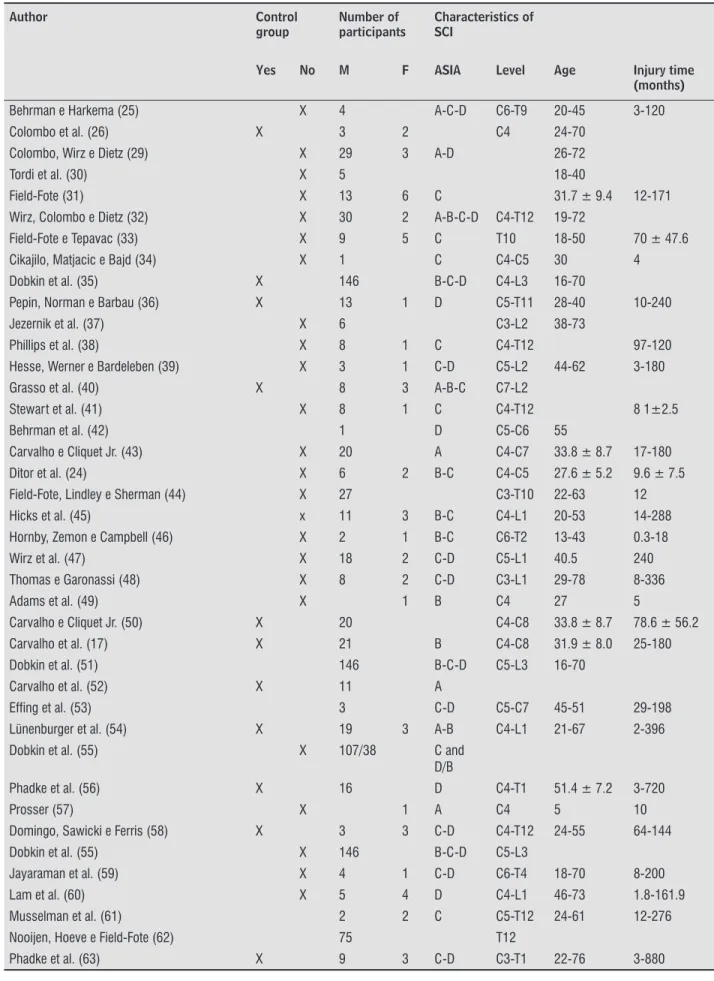
hi-ghest number of selected publications articles each . Table shows characteristics related to the sample and whether there was a control group. We divided the table according to the number of participants in each research, differing by sex, and data regarding the SC), such as the classification by the American Spinal )njury Association AS)A , level, and injury time.
910
Table 1 - Sample and sampling classification used in researches on LTBWS
Author Control group
Number of participants
Characteristics of SCI
Yes No M F ASIA Level Age Injury time
(months)
Behrman e Harkema (25) X 4 A-C-D C6-T9 20-45 3-120
Colombo et al. (26) X 3 2 C4 24-70
Colombo, Wirz e Dietz (29) X 29 3 A-D 26-72
Tordi et al. (30) X 5 18-40
Field-Fote (31) X 13 6 C 31.7 ± 9.4 12-171
Wirz, Colombo e Dietz (32) X 30 2 A-B-C-D C4-T12 19-72
Field-Fote e Tepavac (33) X 9 5 C T10 18-50 70 ± 47.6
Cikajilo, Matjacic e Bajd (34) X 1 C C4-C5 30 4
Dobkin et al. (35) X 146 B-C-D C4-L3 16-70
Pepin, Norman e Barbau (36) X 13 1 D C5-T11 28-40 10-240
Jezernik et al. (37) X 6 C3-L2 38-73
Phillips et al. (38) X 8 1 C C4-T12 97-120
Hesse, Werner e Bardeleben (39) X 3 1 C-D C5-L2 44-62 3-180
Grasso et al. (40) X 8 3 A-B-C C7-L2
Stewart et al. (41) X 8 1 C C4-T12 8 1±2.5
Behrman et al. (42) 1 D C5-C6 55
Carvalho e Cliquet Jr. (43) X 20 A C4-C7 33.8 ± 8.7 17-180
Ditor et al. (24) X 6 2 B-C C4-C5 27.6 ± 5.2 9.6 ± 7.5
Field-Fote, Lindley e Sherman (44) X 27 C3-T10 22-63 12
Hicks et al. (45) x 11 3 B-C C4-L1 20-53 14-288
Hornby, Zemon e Campbell (46) X 2 1 B-C C6-T2 13-43 0.3-18
Wirz et al. (47) X 18 2 C-D C5-L1 40.5 240
Thomas e Garonassi (48) X 8 2 C-D C3-L1 29-78 8-336
Adams et al. (49) X 1 B C4 27 5
Carvalho e Cliquet Jr. (50) X 20 C4-C8 33.8 ± 8.7 78.6 ± 56.2
Carvalho et al. (17) X 21 B C4-C8 31.9 ± 8.0 25-180
Dobkin et al. (51) 146 B-C-D C5-L3 16-70
Carvalho et al. (52) X 11 A
Effing et al. (53) 3 C-D C5-C7 45-51 29-198
Lünenburger et al. (54) X 19 3 A-B C4-L1 21-67 2-396
Dobkin et al. (55) X 107/38 C and
D/B
Phadke et al. (56) X 16 D C4-T1 51.4 ± 7.2 3-720
Prosser (57) X 1 A C4 5 10
Domingo, Sawicki e Ferris (58) X 3 3 C-D C4-T12 24-55 64-144
Dobkin et al. (55) X 146 B-C-D C5-L3
Jayaraman et al. (59) X 4 1 C-D C6-T4 18-70 8-200
Lam et al. (60) X 5 4 D C4-L1 46-73 1.8-161.9
Musselman et al. (61) 2 2 C C5-T12 24-61 12-276
Nooijen, Hoeve e Field-Fote (62) 75 T12
Phadke et al. (63) X 9 3 C-D C3-T1 22-76 3-880
911
SC)s; the injury times ranged from . months to
years months .
)t was observed that the experimental design, with a longitudinal nature the collections are made over a long period , had a frequency eight times greater than cross-sectional studies, where data is collected within a given period of time, i.e. they are short-term studies.
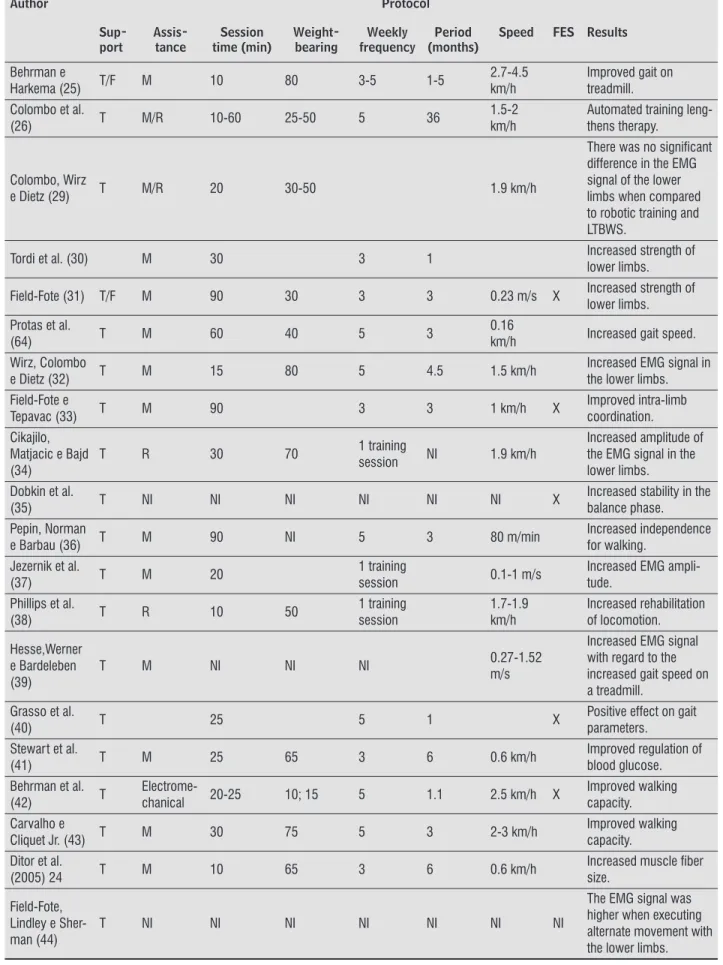
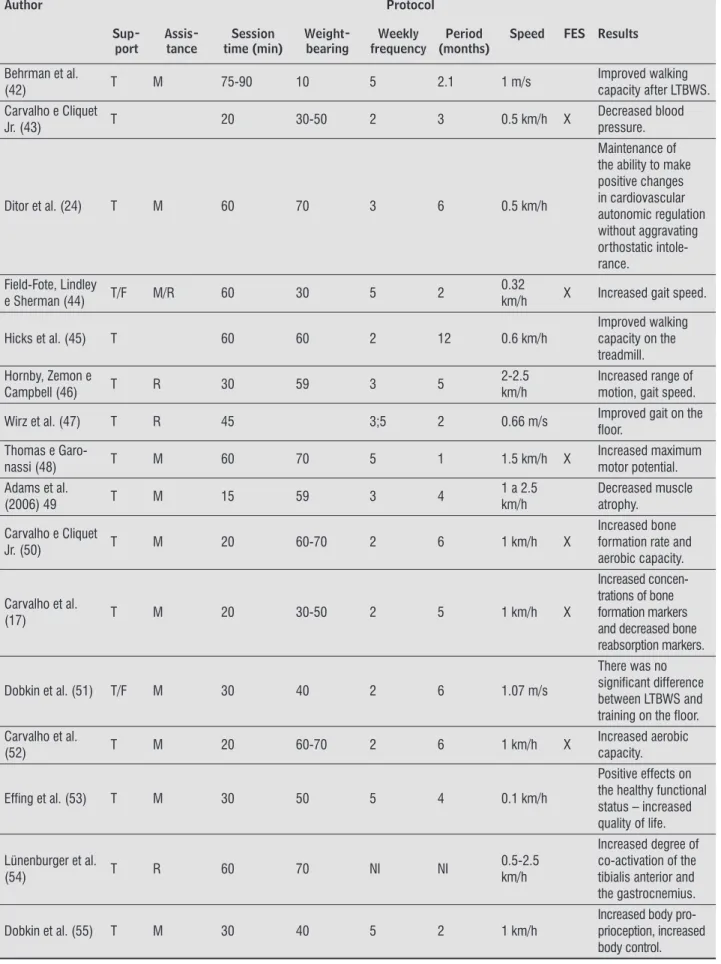
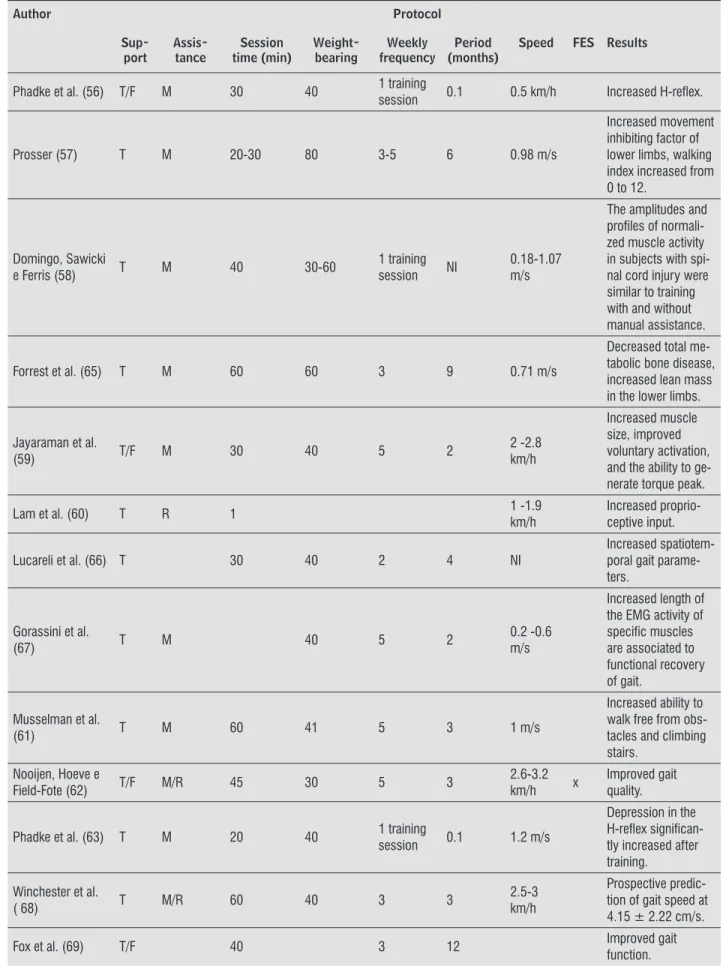
Table shows the parameters used in LTBWS in the last years, highlighting the methodological differences in the implementation of training and in the analyses carried out.
We checked the weight percentage that each vo-lunteer supported during gait training, noticing that a burden of % of body weight was the most
fre-quently used. Most protocols % were based on
a training time of minutes; the remainder %
varied training time between and minutes. The resources for the conducting locomotor trai-ning were using a treadmill, floor traditional gait training , or a mixture of both. The number of pro-tocols which used the treadmill was around times greater than the protocols using treadmill/ground.
Some authors among did not report the type
of training used, and they do not define whether trai-ning was performed only on the floor or otherwise. )n addition to the total training period applied to participants by means of the protocols, they were subdivided into weekly sessions, and the highest
in-cidence . % of sessions was times per week.
LTBWS is put into practice through participants’ gait movements, and these movements may be performed in an active way by the participant her/himself wi-thout external assistance , assisted active partially assisted by external mechanisms , and passive en-tirely performed with external assistance . Since the passive motion may be done either in a manual way
a technician performs the impaired function , in a ro-botized way an electromechanical orthosis performs the movement , using LTBWS with manual assistance was observed in . % of the studies analyzed.
Discussion
Sampling characteristics
This article aimed at identifying the main modalities of LTBWS and its evaluation parameters for the purpose of contributing to the establishment of reliable evidence for rehabilitative practices of people with SC)s. Thus, we found out that LTBWS may be an important ally in the motor rehabilitation of SC), something which allows us to know a new gait pattern, especially through neural plasticity . Such learning depends on specific sensory inputs, associated to the performance of a motor task
and the repetitive practice of this task . The medulla
integrates to the afferent supraspinal information and, with repetitive practice, it can improve the motor ou-tput. Therefore, activities specifically based on therapy provide an activation of the neuromuscular system be-low the lesion level, with the purpose to retrain the
nervous system and resume specific motor tasks .
Based on the results, it was found out that the po-pulation of studies had an average injury time of . months, and the age group with the highest incidence was between and years, characterizing a popu-lation with age classification within the aging phase. )n addition, there was a prevalence of participation of men in all these studies and, despite a study claimed that the distribution of gender is . men per woman , corroborating the results, the findings regarding age at the time the injury occurred and the average age
Table 1 - Sample and sampling classification used in researches on LTBWS
Author Control group
Number of participants
Characteristics of SCI
Yes No M F ASIA Level Age Injury time
(months)
Turiel et al. (22) X 10 4 50.6 ± 17.7
Protas et al. (64) X 3 C-D T8-T12 34-48 24-156
Legend: M = male; F = female; ASIA = functional classification of sensorimotor changes deriving from spinal cord injury, ranging from A (greater impairment) to E (normal).
912
Table 2- LTBWS protocols and their respective results
Author Protocol
Sup-port
Assis-tance
Session time (min)
Weight-bearing
Weekly frequency
Period (months)
Speed FES Results
Behrman e
Harkema (25) T/F M 10 80 3-5 1-5
2.7-4.5 km/h
Improved gait on treadmill. Colombo et al.
(26) T M/R 10-60 25-50 5 36
1.5-2 km/h
Automated training leng-thens therapy.
Colombo, Wirz
e Dietz (29) T M/R 20 30-50 1.9 km/h
There was no significant difference in the EMG signal of the lower limbs when compared to robotic training and LTBWS.
Tordi et al. (30) M 30 3 1 Increased strength of
lower limbs.
Field-Fote (31) T/F M 90 30 3 3 0.23 m/s X Increased strength of
lower limbs. Protas et al.
(64) T M 60 40 5 3
0.16
km/h Increased gait speed.
Wirz, Colombo
e Dietz (32) T M 15 80 5 4.5 1.5 km/h
Increased EMG signal in the lower limbs. Field-Fote e
Tepavac (33) T M 90 3 3 1 km/h X
Improved intra-limb coordination. Cikajilo,
Matjacic e Bajd (34)
T R 30 70 1 training
session NI 1.9 km/h
Increased amplitude of the EMG signal in the lower limbs. Dobkin et al.
(35) T NI NI NI NI NI NI X
Increased stability in the balance phase. Pepin, Norman
e Barbau (36) T M 90 NI 5 3 80 m/min
Increased independence for walking.
Jezernik et al.
(37) T M 20
1 training
session 0.1-1 m/s
Increased EMG ampli-tude.
Phillips et al.
(38) T R 10 50
1 training session
1.7-1.9 km/h
Increased rehabilitation of locomotion.
Hesse,Werner e Bardeleben (39)
T M NI NI NI 0.27-1.52
m/s
Increased EMG signal with regard to the increased gait speed on a treadmill.
Grasso et al.
(40) T 25 5 1 X
Positive effect on gait parameters.
Stewart et al.
(41) T M 25 65 3 6 0.6 km/h
Improved regulation of blood glucose. Behrman et al.
(42) T
Electrome-chanical 20-25 10; 15 5 1.1 2.5 km/h X
Improved walking capacity. Carvalho e
Cliquet Jr. (43) T M 30 75 5 3 2-3 km/h
Improved walking capacity. Ditor et al.
(2005) 24 T M 10 65 3 6 0.6 km/h
Increased muscle fiber size.
Field-Fote, Lindley e Sher-man (44)
T NI NI NI NI NI NI NI
The EMG signal was higher when executing alternate movement with the lower limbs.
913 Table 2- LTBWS protocols and their respective results
Author Protocol
Sup-port
Assis-tance
Session time (min)
Weight-bearing
Weekly frequency
Period (months)
Speed FES Results
Behrman et al.
(42) T M 75-90 10 5 2.1 1 m/s
Improved walking capacity after LTBWS. Carvalho e Cliquet
Jr. (43) T 20 30-50 2 3 0.5 km/h X
Decreased blood pressure.
Ditor et al. (24) T M 60 70 3 6 0.5 km/h
Maintenance of the ability to make positive changes in cardiovascular autonomic regulation without aggravating orthostatic intole-rance.
Field-Fote, Lindley
e Sherman (44) T/F M/R 60 30 5 2
0.32
km/h X Increased gait speed.
Hicks et al. (45) T 60 60 2 12 0.6 km/h
Improved walking capacity on the treadmill. Hornby, Zemon e
Campbell (46) T R 30 59 3 5
2-2.5 km/h
Increased range of motion, gait speed.
Wirz et al. (47) T R 45 3;5 2 0.66 m/s Improved gait on the
floor. Thomas e
Garo-nassi (48) T M 60 70 5 1 1.5 km/h X
Increased maximum motor potential. Adams et al.
(2006) 49 T M 15 59 3 4
1 a 2.5 km/h
Decreased muscle atrophy.
Carvalho e Cliquet
Jr. (50) T M 20 60-70 2 6 1 km/h X
Increased bone formation rate and aerobic capacity.
Carvalho et al.
(17) T M 20 30-50 2 5 1 km/h X
Increased concen-trations of bone formation markers and decreased bone reabsorption markers.
Dobkin et al. (51) T/F M 30 40 2 6 1.07 m/s
There was no significant difference between LTBWS and training on the floor. Carvalho et al.
(52) T M 20 60-70 2 6 1 km/h X
Increased aerobic capacity.
Effing et al. (53) T M 30 50 5 4 0.1 km/h
Positive effects on the healthy functional status – increased quality of life.
Lünenburger et al.
(54) T R 60 70 NI NI
0.5-2.5 km/h
Increased degree of co-activation of the tibialis anterior and the gastrocnemius.
Dobkin et al. (55) T M 30 40 5 2 1 km/h
914
Table 2- LTBWS protocols and their respective results
Author Protocol
Sup-port
Assis-tance
Session time (min)
Weight-bearing
Weekly frequency
Period (months)
Speed FES Results
Phadke et al. (56) T/F M 30 40 1 training
session 0.1 0.5 km/h Increased H-reflex.
Prosser (57) T M 20-30 80 3-5 6 0.98 m/s
Increased movement inhibiting factor of lower limbs, walking index increased from 0 to 12.
Domingo, Sawicki
e Ferris (58) T M 40 30-60
1 training
session NI
0.18-1.07 m/s
The amplitudes and profiles of normali-zed muscle activity in subjects with spi-nal cord injury were similar to training with and without manual assistance.
Forrest et al. (65) T M 60 60 3 9 0.71 m/s
Decreased total me-tabolic bone disease, increased lean mass in the lower limbs.
Jayaraman et al.
(59) T/F M 30 40 5 2
2 -2.8 km/h
Increased muscle size, improved voluntary activation, and the ability to ge-nerate torque peak.
Lam et al. (60) T R 1 1 -1.9
km/h
Increased proprio-ceptive input.
Lucareli et al. (66) T 30 40 2 4 NI
Increased spatiotem-poral gait parame-ters.
Gorassini et al.
(67) T M 40 5 2
0.2 -0.6 m/s
Increased length of the EMG activity of specific muscles are associated to functional recovery of gait.
Musselman et al.
(61) T M 60 41 5 3 1 m/s
Increased ability to walk free from obs-tacles and climbing stairs.
Nooijen, Hoeve e
Field-Fote (62) T/F M/R 45 30 5 3
2.6-3.2
km/h x
Improved gait quality.
Phadke et al. (63) T M 20 40 1 training
session 0.1 1.2 m/s
Depression in the H-reflex significan-tly increased after training.
Winchester et al.
( 68) T M/R 60 40 3 3
2.5-3 km/h
Prospective predic-tion of gait speed at 4.15 ± 2.22 cm/s.
Fox et al. (69) T/F 40 3 12 Improved gait
915
of patients with spinal cord injury were years, con-tradicting the results obtained in this literature review.
Protocols and results
Based on this literature review, it was found out that LTBWS is a technique which benefits patients with SC)s, regardless of age and injury time.
LTBWS can change the ankle biomechanics, es-pecially in the plantiflexors, influencing gait. A study
carried out tests with healthy volunteers n = , and
the measures were taken by means of
electromyogra-phy of leg muscles and kinematic analysis . During
LTBWS, there was no change in muscle activity at any speed applied . m/s to . m/s , with levels of body weight support, %, %, and %. The loss of kinematics of the plantiflexors at high speeds sup-porting % of body weight can compromise motor re-learning in healthy volunteers. These results agree those from another study, which recommends that LTBWS is performed with the minimum percentage of support, generating a gait similar to the healthy
pattern . These studies showed negative results
for the percentage of %, however, the results were negative for healthy volunteers, without confirmation of the same event for volunteers with SC).
The application period of the LTBWS protocol more frequently adopted was over months, ho-wever, studies did not report the period of the protocol application. Variability in the duration of training was relatively large from to months , something which shows the absence of consensus with regard to the time of locomotor training proto-col application. Perhaps, the -month period is the most used to minimize sampling losses, since long--term studies have limitations regarding such losses,
and this fact is routine . Also with regard to the
training period, an important issue to be taken into account is the weekly frequency, due to the partici-pants’ physical fitness their muscle fatigue; in this article, we found out that most researchers opted for the frequency of times per week, and there was no report of muscle fatigue.
Recovering gait is a difficult and costly task, pa-tients are often unable to produce the muscle streng-th required to keep posture and walk . Resuming the ability to walk requires various techniques and it usually demands considerable assistance from the physiotherapist to hold the patient’s weight and increase her/his balance. )n conventional gait trai-ning, often the result does not satisfy the patient, with asymmetrical patterns of movement and, es-pecially, undergoing difficulty to walk through greater
Table 2- LTBWS protocols and their respective results
Author Protocol
Sup-port
Assis-tance
Session time (min)
Weight-bearing
Weekly frequency
Period (months)
Speed FES Results
Turiel et al. (22)
T R 60 30-50 5 1.2 2 - 2 . 5
km/h
Improved sensori-motor and diastolic left ventricular functions.
Protas et al. (64)
T M 20 40 5 3 0.16 km/h Improved gait in
individuals with incomplete spinal cord injury.
Cotie et al. (23)
T R 60 60 3 1 0.6 km/h LTBWS increased
skin temperature, but there was no significant difference in blood flow of the lower limbs.
Legend: T/F = treadmill or floor; M/R = manual or robotized assistance; T = session time, in minutes; % SP = percentage of partial body weight support by the individual; WF = weekly frequency; S = speed; FES = functional electrical stimulation; NI = not informed.
916
distances . LTBWS on a treadmill is more effective
for training gait skills when compared to locomotor
training on the floor . A study investigated the
effect of LTBWS, and that of the locomotor training on the floor, on the modulation of (-reflex in the so-leus muscle of individuals with SC), finding out that LTBWS helps normalizing the (-reflex, when com-pared to training on the floor, pointing out that the average amplitude of the (-reflex in the soleus muscle male/female ratio was % lower in the supporting phase and % lower in the balancing phase during gait on a treadmill, and the male/female ratio was sig-nificantly higher in the support and balancing phases
p = . and p = . , respectively , when
com-pared to healthy individuals . )n contrast, there
was a study which found out no conclusion when comparing LTBWS and exercises on the floor with
regard to improvement in the functional gait .
)n the articles analyzed, manual assistance for conducting locomotor training was the most fre-quently used. A study evaluated LTBWS with tradi-tional gait training for weeks in patients with SC)
n = . The tests were carried out with
speed, walking distance, and the
indepen-dence measure for locomotion F)M-L . The results showed no significant difference between the kinds of training, denoting that all of them have the same results with regard to gait improvements in patients with SC). The results of another study denote the effectiveness of manual assistance, indicating a high incidence of studies which applied manual assistance . An advantage of this assistance is enabling the gait of people with SC) at higher speeds, something which they cannot fulfill without manual assistance
, . Conversely, coach’s effort is great, thus,
robo-tized locomotor training has been proposed, because
with this kind of assistance the coach works less ,
but there is a limitation with regard to the range of motion during the execution of robotized gait, since the orthoses stems are fixed.
)t has also been found out that LTBWS constitutes a feasible alternative option for the rehabilitation of patients who underwent stem cell application, due to the neural remodeling caused by repetitive stimu-lation deriving from locomotor training; however, further research is needed.
LTBWS also shows results going beyond motor mobility, such as those of a study with patients with incomplete SC)s AS)A C , which evidenced that after months of treatment sessions/week there was
an improvement in the lipid profile with decreased low-density lipoprotein LDL , increased area of mus-cle fiber type ) and ))a, but it showed no change in
body fat mass . )n patients with incomplete SC),
improved regulation of blood glucose glucose tole-rance and increased insulin sensitivity have been
observed .
Although a study claims that LTBWS does not seem to prevent bone density loss both in the acute
and chronic phases of SC) , the results Table
of this article contradict this assertion, i.e. LTBWS
prevents bone density loss in SC) , .
LTBWS also showed decreased energy expenditu-re, expressed by means of oxygen consumption, from
. to . mL/kg m- , and a decreased heart
rate after training, from to beats/min .
This leads to less chance of a traumatic event, such as cardiac arrest or shortness of breath during training,
as well as less fatigue during and after training .
)n addition to the traditional benefits, such as musculoskeletal, kinematics, psychological, and cardiorespiratory improvements, LTBWS leads to improved sensory system sensory and propriocep-tive , which works by coordinating motor control,
lipid profile, decreased heart rate after training ,
besides improved blood flow in the legs, preventing
pressure ulcers .
Conclusion
LTBWS leads shown to be feasible for the reha-bilitation of patients suffering from a neurological pathology, such as SC); regardless of the training protocol adopted, the benefits related to increased muscle strength, sustained or increased bone density, decreased heart rate, and increased physical fitness are observed.
References
. Finch L, Barbeau (, Arsenault B. )nfluence of body weight support on normal human gait: de-velopment of a gait retraining strategy. Phys Ther.
; : - .
917
. Threlkeld AJ, Cooper LD, Monger BP, Craven AN, (aupt (G. Temporospatial and kinematic gait alterations during treadmill walking with body weight suspension. Gait Posture. Jun; : - .
. Dietz V, (arkema SJ. Locomotor activity in spinal cord-injured persons. J Appl Physiol . May; : - .
. Capaday, C. The special nature of human walking and its neural control. Trends Neurosci. Jul; : - .
. Miyai ), Fujimoto Y, Ueda Y, Yamamoto (, Nozaki S, Saito T, et al. Treadmill training with body weight support: )ts effect on Parkinson’s disease. Arch Phys Med Rehabil. Jul; : - .
. Rossignol S, Schwab M., Schwartz M, Fehlings MG. Spinal cord injury: time to move? J Neurosci. Oct ; : - .
. Mackay-lyons, M. Central pattern generation of lo-comotion: a review of the evidence. Phys Ther. Jan; : - .
. Jakeman LB, (oschouer EL, Basso DM. )njured mice at the gym: review, results and considerations for combining chondroitinase and locomotor exercise to enhance recovery after spinal cord injury. Brain Res Bull. Mar ; - : - .
. Edgerton VR, Leon, RD, (arkema SJ, (odgson JA, Lon-don N, Reinkensmeyer DJ, et al. Retraining the injured spinal cord. J Physiol. May ; Pt : - . . Mulroy SJ, Klassen T, Gronley JAK, Eberly VJ, Brown DA, Sullivan KJ. Gait parameters associated with responsi-veness to treadmill training with body-weight support after stroke: an exploratory study. Phys Ther. Feb; :
-. Walker, ML, Ringleb S), Maihafer GC, Walker R, Crouch JR, van Lunen B, et al. Virtual reality-enhanced partial body weight-supported treadmill training poststroke: feasibility and effectiveness in subjects. Arch Phys Med Rehabil. Jan; : - .
. Ada L, Dean CM, Morris ME, Simpson JM, Katrak, P. Randomized trial of treadmill walking with body wei-ght support to establish walking in subacute stroke: the MOB)L)SE trial. Stroke. Jun; : -. Bhambhani Y-. Physiology of wheelchair racing
in athletes with spinal cord injury. Sports Med. ; : - .
. Slater, D, Meade MA. Participation in recreation and sports for persons with spinal cord injury: re-view and recommendations. NeuroRehabilitation.
; : - .
. Tasiemski T, Bergström, Savic G, Gardner BP. Sports, recreation and employment following spinal cord in-jury: a pilot study. Spinal Cord. ; : - . . Carvalho DCL, Martins CL, Cardoso SD, Cliquet A
Ju-nior. )mprovement of metabolic and cardiorespira-tory responses through treadmill gait training with neuromuscular electrical stimulation in quadriplegic subjects. Artif Organs. Jan; : - . . Sabo D, Blaich S, Wenz W, (ohmann M, Loew M,
Ger-ner (J. Osteoporosis in patients with paralysis after spinal cord injury: a cross sectional study in male patients with dual-energy X-ray absorptiometry. Arch Orthop Trauma Surg. ; - : - .
. Dutra CMR. Respostas fisiológicas ao treino locomotor com suporte parcial de peso na lesão medular [dis-sertação]. Curitiba: Pontifícia Universidade Católica do Paraná; .
. (icks AL, Ginis KAM. Treadmill training after spinal cord injury: it’s not just about the walking. J Rehabil Res Dev. ; : - .
. Timaud D, Calmels P, Devillard X. Réentra nement a l’effort chez le blesse médullaire. Ann Readapt Med Phys. ; : - .
. Turiel M, Sitia S, Cicala S, Magagnin V, Bo ), Porta A, et al. Robotic treadmill training improves cardiovascular function in spinal cord injury patients. )nt J Cardiol.
Jun ; :
-. Cotie LM, Geurts CLM, Adams MME, Macdonald MJ-. Leg skin temperature with body-weight-supported treadmill and tilt-table standing training after spinal cord injury. Spinal Cord. Jan; : -. Ditor DS, Kamath MV, Macdonald MJ, Bugaresti J,
Mc-cartney NE, (icks AL. Effects of body weight-suppor-ted treadmill training on heart rate variability and blood pressure variability in individuals with spinal cord injury. J Appl Physiol. Apr; : - . Behrman AL, (arkema SJ. Locomotor training after human spinal cord injury: a series of case studies. Phys Ther. Jul; : - .
918
. Borggraefe ), Schaefer JS, Klaiber M, Dabrowski E, Ammann-Reiffer C, Knecht B, Berweck S, et al. Ro-botic-assisted treadmill therapy improves walking and standing performance in children and adoles-cents with cerebral palsy. Eur J Paediatr Neurol. Nov; : - .
. Ditunno JE, Scivoletto G. Clinical relevance of gait re-search applied to clinical trials in spinal cord injury. Brain Res Bull. Jan ; :
-. Colombo G, Wirz M, Dietz V-. Driven gait orthosis for improvement of locomotor training in paraplegic pa-tients. Spinal Cord. May; : - .
. Tordi N, Dugue B, Klupzinski D, Rasseneur L, Rou-illon JD, Lonsdorfer J. )nterval training program on a wheelchair ergometer for paraplegic subjects. Spinal Cord. Oct; : - .
. Field-Fote EC. Combined use of body weight support, functional electric stimulation, and treadmill training to improve walking ability in individuals with chronic incomplete spinal cord injury. Arch Phys Med Rehabil.
Jun; : - .
. Wirz M, Colombo G, Dietz V. Long Term effects of loco-motor training in spinal humans. J Neurol Neurosurg Psychiatry. Jul; : - .
. Field-Fote EC, Tepavac D. )mproved intralimb coordi-nation in people with incomplete spinal Cord injury following training with body weight support and elec-trical stimulation. Phys Ther. Jul; : - . . Cikajilo ), Matjacic Z, Bajd T. Developement of a gait
re-education system in incomplete spinal Cord in-jury. J Rehabil Med. Sep; : - .
. Dobkin B(, Apple D, Barbeau (, Basso M, Behrman A, Deforge D, et al. Methods for a randomized trial of weight-supported treadmill training versus conven-tional training for walking during inpatient rehabili-tation after incomplete traumatic spinal cord injury. Neurorehabil Neural Repair. Sep; : - . . Pépin A, Norman KE, Barbeau (. Treadmill walking in incomplete spinal-cord-injured subjects: . Adaptation to changes in speed. Spinal Cord. May; : - .
. Jezernik S, Scharer R, Colombo G, Morari M. Adap-tative robotic rehabilitation of locomotion:a clinical study in spinally injured individual. Spinal Cord. Dec; : - .
. Phillips SM, Stewart BG, Mahoney DJ, (icks AL, Mc-cartney N, Tang JE, et al. Body-weight support tread-mill trainning improves blood glucose regulation in persons with incomplete spinal cord injury. J Appl Physiol. Aug; : - .
. (esse S, Werner C, Bardeleben A. Electromechanical gait trainning with functional electrical stimulation: case studies in spinal cord injury. Spinal Cord. Jun; : - .
. Grasso R, )vanenko YP, Zago M, Molinari M, Scivoletto G, Castellano V, et al. Distributed plasticity of locomotor pattern generators in spinal cord injured patients. Brain. May; Pt : - .
. Stewart BG, Tarnapolsky MA, (icks AL, Mccartney N, Mahoney DJ, Staron RS, et al. Treadmill training-indu-ced adaptations in muscle phenotype in persons with incomplete spinal cord injury. Muscle Nerve. Jul; : - .
. Behrman AL, Lawless-Dixon AR, Davis SB, Bowden MG, Nair P, Phadke C, et al. Locomotor training progres-sion and outcomes after incomplete spinal cord injury. Phys Ther. Dec; : - .
. Carvalho DC, Cliquet A Junior. Response of the ar-terial blood pressure of quadriplegic patients to treadmill gait training. Braz J Med Biol Res. Sep; : - .
. Field-Fote EC, Lindley SD, Sherman AL. Locomotor training approaches for individuals with spinal cord injury: a preliminary report of walking-related ou-tcomes. J Neurol Phys Ther. Sep; : - . . (icks AL, Adams MM, Martin Ginis K, Giangregorio L, Latimer A, Phillips SM, et al. Long-term body-weight--supported treadmill training and subsequent follow--up in persons with chronic SC): effects on functional walking ability and measures of subjective well-being. Spinal Cord. May; : - .
. (ornby TG, Zemon D(, Campbell D. Robotic-assisted, body-weight-supported treadmill training in indivi-duals following motor incomplete spinal cord injury. Phys Ther. Jan; : - .
919
. Thomas SL, Gorassini MA )ncreases in corticos-pinal tract function by treadmill training after in-complete spinal cord injury. J Neurophysiol. Oct; : - .
. Adams MM, Ditor DS, Tarnopolsky MA, Phillips SM, McCartney N, (icks AL. The effect of body weight--supported treadmill training on muscle morpho-logy in an individual with chronic, motor- complete spinal cord injury: a case study. J Spinal Cord Med.
; : - .
. Carvalho DCL, Cliquet A Junior. )nvestigation of oste-ometabolic and cardio-respiratory changes occuring after gait training under neuromuscular electric sti-mulation in quadriplegic patients. Acta Ortopédica.
; : - .
. Dobkin B, Apple D, Barbeau (, Basso M, Behrman A, Deforge D, et al.; Spinal Cord )njury Locomotor Trial Group. Weight-supported treadmill vs over-ground training for walking after acute incomplete SC). Neu-rology. Feb ; : - .
. Carvalho DC, Garlipp CR, Bottini PV, Afaz S(, Moda MA, Cliquet A Junior. Effect of treadmill gait on bone ma-rkers and bone mineral density of quadriplegic sub-jects. Braz J Med Biol Res. Oct; : - . . Effing TW, van Meeteren NL, van Asbeck FW, Prevo AJ. Body weight-supported treadmill training in chronic incomplete spinal cord injury: a pilot study evaluating functional health status and quality of life. Spinal Cord.
May; : - .
. L“nenburger L, Bolliger M, Czell D, M“ller R, Dietz V. Modulation of locomotor activity in complete spinal cord injury. Exp Brain Res. Oct; : - . . Dobkin B, Barbeau (, Deforge D, Ditunno J, Elashoff R,
Apple D, et al.; Spinal Cord )njury Locomotor Trial Group. Traumatic spinal cord injury: the multicenter randomized spinal cord injury locomotor trial the evo-lution of walking-related outcomes over the first weeks of rehabilitation for incomplete. Neurorehabil Neural Repair. Jan-Feb; : - .
. Phadke CP, Wu SS, Thompson FJ, Behrman AL. Com-parison of Soleus (-reflex modulation after incom-plete spinal cord injury in walking environments: treadmill with body weight support and overground. Arch Phys Med Rehabil. Dec; : - . . Prosser LA. Locomotor training within an inpatient
rehabilitation program after pediatric incomplete spi-nal cord injury. Phys Ther. Sep; : - .
. Domingo A, Sawicki G, Ferris DP. Kinematics and muscle activity of individuals with incomplete spi-nal cord injury during treadmill stepping with and without manual assistance. J Neuroeng Rehabil. Aug ; : .
. Jayaraman A, Shah P, Gregory C, Bowden M, Stevens J, Bishop M, et al. Locomotor training and muscle function after incomplete spinal cord injury: case series. J Spinal Cord Med. ; : - . . Lam T, Wirz M, Lunenburger L, Dietz V. Swing phase
re-sistance enhances flexor muscle activity during tread-mill locomotion in incomplete spinal cord injury. Neu-rorehabil Neural Repair. Sep-Oct; : - . . Musselman KE, Fouad K, Misiaszek JE, Yang JF.
Trai-ning of walking skills overground and on the tread-mill: case series on individuals with incomplete spinal cord injury. Phys Ther. Jun; : - . Nooijen CF, Ter (hoeve N, Field-Fote EC. Gait
quali-ty is improved by locomotor training in individuals with SC) regardless of training approach. J Neuroeng Rehabil. Oct ; :
. Phadke CP, Flynn SM, Thompson FJ, Behrman AL, Trimble M(, Kukulka CG. Comparison of single bout effects of bicycle training versus locomotor training on paired reflex depression of the soleus h-reflex after motor incomplete spinal cord injury. Arch Phys Med Rehabil. Jul; : -
. Protas, EJ, (olmes S, Qureshy (, Johnson A, Lee, DE, Sherwood AM. Supported treadmill ambulation trai-ning after spinal cord injury: a pilot study. Arch Phys Med Rehabil. Jun; : - .
. Forrest GF, Sisto SA, Barbeau (, Kirshblum SC, Wilen J, Bond Q, et al. Neuromotor and musculoskeletal res-ponses to locomotor training for an individual with chronic motor complete A)S-B spinal cord injury. J Spi-nal Cord Med. ; : - .
. Lucareli PRG, Limac MO, Limac FPS, Garbelotti AS Ju-nior, Gimenesa RO, Almeidab JBG, et al. Análisis de la marcha y evaluación de la calidad de vida después del entrenamiento de la marcha en pacientes con lesión medular. Rev Neurol. ; : - .
-920
. Winchester P, Smith P, Foreman N, Mosby JM, Pacheco F, Querry R, et al. A prediction model for determining over ground walking speed after locomotor training in persons with motor incomplete spinal cord in-jury. J Spinal Cord Med. ; : - .
. Fox EJ, Tester NJ, Phadke CP, Nair PM, Senesac CR, (owland DR, et al. Ongoing walking recovery ye-ars after locomotor training in a child with seve-re incomplete spinal cord injury. Phys Ther. May; : - .
. Behrman AL, (arkema SJ, Physical rehabilitation as an agent for recovery after spinal cord injury. Phys Med Rehabil Clin N Am. May; :
-. Wyndaele M, Wyndaele JJ-. )ncidence, prevalence and epidemiology of spinal cord injury: what learns a worldwide literature survey? Spinal Cord. Sep; : - .
. Lewek MD The influence of body weight support on ankle mechanics during treadmill walking. J Biomech.
Jan ; :
-. (aupenthal A, Schutz GR, Souza PV, Roesler (-. Análise do suporte de peso corporal para o treino de marcha. Fisioter Mov. ; : - .
. Andrade MJ, Gonçalves S. Lesão medular traumática: recuperação neurológica e funcional. Acta Med Port.
; : - ,
. Coelho JL, Abrahão F, Mattioli R. Aumento do torque muscular após tratamento em esteira com suporte parcial de peso em pacientes com hemiparesia crô-nica. Rev Bras Fisioter. ; : - .
. Dobkin B, Apple D, Barbeau (, Basso M, Behrman A, Deforge D, et al. Weight-supported treadmill vs over--ground training for walking after acute incomplete SC). Neurology. Feb ; : - .
. Giangregorio LM, Webber CE, Phillips SM, (icks AL, Craven BC, Bugaresti JM, et al. Can body weight su-pported treadmill training increase bone mass and reverse muscle atrophy in individuals with chronic incom plete spinal cord injury? Appl Physiol Nutr Me-tab. Jun; : - .
Received: / /
Recebido: / /
Approved: / /