www.rbo.org.br
0102-3616/$–see front matter © 2013 Sociedade Brasileira de Ortopedia e Traumatologia. Publicado pela Elsevier Editora Ltda. Todos os direitos reservados. Work performed in the Department of Orthopedics and Traumatology, Irmandade da Santa Casa de Misericórdia de São Paulo, São Paulo, SP, Brazil
*Corresponding author at: Fortunato, 252, apto 62, Vila Buarque, São Paulo, SP, Brazil. CEP: 01224-030. E-mail: [email protected] (T.R. Roessle).
Original Article
Tertiary assessment of trauma patients in a hospital in the
city of São Paulo: a question of necessity
Thiago Ricardo Roessle,
a,* Claudia Diniz Freitas,
bHerman Fabian Moscovici,
bCaio Zamboni,
cJosé Octávio Soares Hungria,
dRalph Walter Christian,
eand Marcelo Tomanik Mercadante
faTrainee in Orthopedics and Traumatology at Santa Casa de Misericórdia de São Paulo, São Paulo, SP, Brazil bResident in Orthopedics and Traumatology at Santa Casa de Misericórdia de São Paulo, São Paulo, SP, Brazil cAttending Physician in the Trauma Group, Santa Casa de Misericórdia de São Paulo, São Paulo, SP, Brazil
dMSc; Head of Emergency Orthopedic and Traumatological Services, Santa Casa de Misericórdia de São Paulo, São Paulo, SP, Brazil ePhD; Professor and Head of the Trauma Group, Santa Casa de Misericórdia de São Paulo, São Paulo, SP, Brazil
fPhD; Professor and Attending Physician in the Trauma Group, Santa Casa de Misericórdia de São Paulo, São Paulo, SP, Brazil
doi:
a b s t r a c t
Objective: To minimize the occurrence of missed injuries, the tertiary evaluation was introduced consisting of reassessment of the patient, 24 hours after admission, with: complete history, physical examination, review of exams and diagnostic testing if necessary. Methods: Observational study evaluating trauma patients admitted to a teaching hospital in São Paulo, according to a protocol for tertiary evaluation. Results:
Between February and May 2012, for 12 weeks, 182 patients were submitted to tertiary evaluation, 100 (55%) polytraumatized and 82 (45%) were victims of low-energy trauma. Neglected lesions were observed in 21 (11.5%) patients, who had 28 missed injuries. Of these 28 lesions, seven (25%) required surgical treatment. Conclusion: Strategies including formal tertiary evaluation, the protocol applied for assessing trauma victims, seem to be beneficial in these patients, regardless of the mechanism of trauma. The method is easily applied, effective and has low cost in identifying missed injuries in the victims of trauma.
© 2013 Sociedade Brasileira de Ortopedia e Traumatologia. Published by Elsevier Editora Ltda. All rights reserved.
A RT I C L E I N F O
Article history:
Received on July 10, 2012 Accepted on August 20, 2012
Keywords:
Avaliação terciária em pacientes traumatizados em hospital na cidade de São Paulo: uma questão de necessidade
Introduction
In attending trauma patients, regardless of whether a high or low-energy mechanism was involved, the initial approach can follow the steps recommended in the Advanced Trauma Life Support (ATLS) protocol, which was drawn up by the American College of Surgeons. This covers both primary and secondary assessments.1,2
However, another group of patients who are brought to emergency services end up undergoing physical examination guided only by their own complaints. The initial attendance may neglect secondary information that patients themselves describe or possibly fail to comment about. Thus, injuries may go unnoticed and aggregate morbidity that determines these patients’ prognosis.
With the aim of minimizing the occurrences of these unnoticed injuries, tertiary assessment was introduced.3 This consists
of reassessing the patient, 24 hours after hospitalization, with the following purposes: taking a complete history, performing a detailed physical examination, reviewing the subsidiary tests and doing additional diagnostic testing, if necessary. Thus, the attendance for trauma victims reaches a higher level of complexity, such that the initial phase consists of primary assessment in either a pre-hospital or a hospital environment, the secondary assessment is in the emergency room and the tertiary assessment takes place with the patient hospitalized in the ward. Because of the impossibility of obtaining data of greater precision regarding the conditions and other situations at the time of the trauma and the impossibility of achieving greater collaboration from the patient in the initial assessment that would enable complete diagnosis of traumatic injuries, we proposed to use a protocol for tertiary assessment based on detailed history-taking and complete physical examination, following the logical sequence. This proposal for tertiary assessment improves patients’ prognoses through identifying visceral, neurological and tendon injuries, fractures and bruising that remain unnoticed in the primary and/or secondary assessments.
Methods
An observational study assessing trauma patients in a teaching hospital in the city of São Paulo, 24 hours after hospitalization, was conducted in accordance with the protocol proposed for tertiary assessment. Patients who were unconscious or under sedation were reassessed after regaining consciousness.
Over the 12-week period between February and May 2012, 182 patients hospitalized in the Central Hospital with a diagnosis of at least injury to the musculoskeletal system requiring surgical treatment were evaluated. Individuals with pathological factures of any etiology were excluded, and it was stipulated that the patients needed to have been hospitalized for less than 24 hours.
The assessments were made by one of the three third-year resident physicians under training at the service, who are authors of this study. The resident physician indicated had not participated in the initial assessment and/or the secondary assessment at the time of the patient’s hospitalization. The protocol devised for carrying out the study (Annex 1) included obtaining identification data, history-taking, standardized and systematized physical examination, the date and time of the reassessment and the need for complementary examinations and additional clinical evaluations, in cases of unconscious or intubated patients. Seeking reasons for possible diagnostic failures was mandatory.
Upon applying the protocol, we also obtained the following parameters: sex, age, schooling level, body mass index, trauma mechanism, time of hospital admission, initial diagnosis and the date and time of reassessment. After diagnosing any injuries that had been ignored, the need for additional intervention was assessed and the reasons why the injury had been neglected were identified.
The categorical variables were expressed as absolute and percentage values, and the continuous variable were expressed as means and standard deviations.
informações sobre o artigo
Histórico do artigo:
Recebido em 10 de julho de 2012 Aceito em 20 de agosto de 2012
Palavras-chave:
Avaliação
Índices de gravidade do trauma Traumatismo múltiplo
r e s u m o
Objetivo: Com o intuito de minimizar a ocorrência de lesões despercebidas, foi introduzida a avaliação terciária, que consiste na reavaliação do paciente, 24 horas após sua internação, com: anamnese completa, exame físico detalhado, revisão dos exames subsidiários e complementação diagnóstica se houver necessidade. Métodos: Estudo observacional que avaliou pacientes vítimas de trauma internados em hospital escola na cidade de São Paulo, guiado por protocolo para avaliação terciária. Resultados: Entre fevereiro e maio de 2012, durante 12 semanas, foram submetidos à avaliação terciária 182 pacientes vítimas de trauma, 100 (55%) politraumatizados e 82 (45%) vítimas de trauma de baixa energia. As lesões negligenciadas foram observadas em 21 (11,5%) pacientes, que apresentavam 28 lesões despercebidas. Dessas 28 lesões, sete (25%) necessitaram de tratamento cirúrgico.
Conclusão: Estratégias que incluem avaliação terciária formal, aplicada nas vítimas de trauma, sugerem ser benéficas aos pacientes, independentemente do mecanismo de trauma. É método de execução fácil, custo financeiro barato e efetivo na identificação de lesões negligenciadas nas vítimas de trauma.
Results
Over the 12-week period between February and May 2012, 182 consecutive trauma patients underwent tertiary assessment, among whom 100 (55%) had suffered multiple trauma and 82 (45%) were victims of trauma that was considered to be low-energy. For 51 patients (30.2%), an emergency surgical approach was needed; 64 (35.2%) presented associated head-brain trauma; and one (0.5%) died.
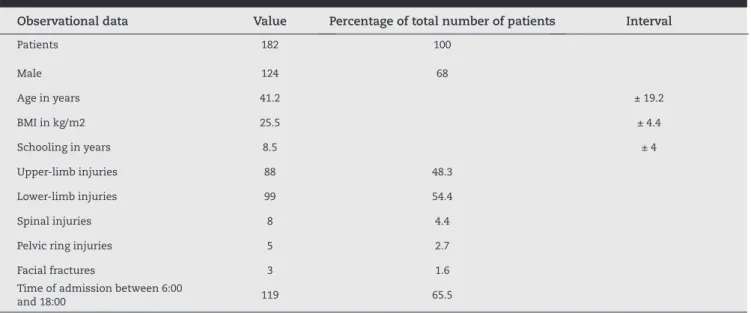
The patients baseline demographic characteristics are expressed in Table 1. Among the patients studied, 124 (68.1%) were male; the mean age was 41.2 ± 19.2 years; 86 (48.3%) were of mixed skin color, 69 (38%) were white, 24 (13.2%) were black and three (1.6%) were oriental; the mean body mass index (BMI) was 25.5 ± 4.4 kg/m2; the mean number of years of schooling was 8.5 ± 4 years; 88
patients (48.4%) presented upper-limb injuries; 99 (54.4%) presented lower-limb injuries); three (1.6%) had facial fractures; eight (4.4%) had spinal fractures; five (2.7%) had pelvic ring fractures; and 109 patients (65.5%) were admitted between the hours of 6:00 and 18:00, and were thus considered to be daytime patients. The unconscious or sedated patients were reassessed after they regained consciousness. All the patients were hospitalized under the care of the orthopedics team alone or in conjunction with other teams of the hospital.
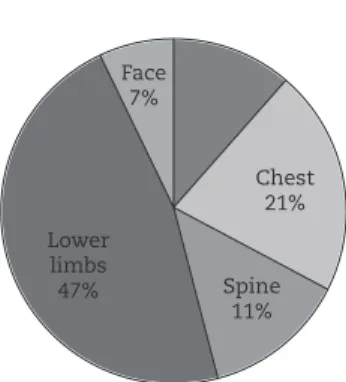
Neglected injuries were observed in 21 patients (11.5%), who presented 28 unnoticed injuries, as described in Table 2 and identified in the protocol. Upper-limb neglected injuries (Fig. 1) were identified in three patients (14.3%) patients, which corresponded to four injuries (14.3%). Eight patients (38.1%) presented lower-limb injuries corresponding to 14 injuries (50%). Six patients (28.6%) had chest injuries, two (9.5%) had facial injuries and three (14.3%) had spinal injuries. Among these 28 injuries, seven patients (25%) received nonsurgical
Observational data Value Percentage of total number of patients Interval
Patients 182 100
Male 124 68
Age in years 41.2 ± 19.2
BMI in kg/m2 25.5 ± 4.4
Schooling in years 8.5 ± 4
Upper-limb injuries 88 48.3
Lower-limb injuries 99 54.4
Spinal injuries 8 4.4
Pelvic ring injuries 5 2.7
Facial fractures 3 1.6
Time of admission between 6:00
and 18:00 119 65.5
BMI, body mass index; kg, kilogram; m2, square meter, min, minutes; n, number of patients studied. Table 1 - Demographic characteristics of the patients hospitalized.
Segment Patients = 21 Injuries = 28
Upper limbs 3 4 – acromioclavicular dislocation Clavicle fracture (2)
Fracture of distal third of radius Lower limbs 8 13 – Fracture of femoral condyle 4 fractures of right metatarsal and 5 fractures of left toes Fracture of fibular neck (2) Fracture of lateral tibial plateau Knee instability (2)
Fracture of calcaneus (2) Fracture of intermediate wedge Injury of common fibular nerve Fracture of ischiopubic ramus Chest 5 6 – Fractures of costal arches
Face 2 2 – Fracture of mandible
Fracture of orbit
Spine 3 3 – Fracture of L2, L4 and L5 Frat, fratura; L2, segunda vértebra lombar; L4, quarta vértebra lombar; L5, quinta vértebra lombar; LAC, luxação acromioclavicular; MMII, membros inferiores; MMSS, membros superiores; MTTD, metatarso direito; n, nervo; PDE, pododáctilo esquerdo.
Table 2 - Distribution of undiagnosed injuries according to body segment.
treatment consisting of immobilization, oral medication for the symptoms and local care.
Discussion
This assessment method was shown to be safe and effective for aiding in diagnosing neglected injuries. In addition, evidence suggests that in centers characterized by high demand from trauma patients, this action would minimize the negative impact caused by injuries that remain undiagnosed when attending to these patients.4 Undiagnosed injuries that are
clinically significant may culminate in complications, increased morbidity and even death.
Studies on undiagnosed injuries have reported incidences of between 0.6% and 65%, depending on the method used.5,6
The lack of standardized prospective studies makes it difficult to identify the real incidence of these lesions in trauma patients.7 We observed that the neglected injuries included
diagnoses that were missed both in clinical examinations and in radiographic imaging. This observation suggests that the practice of tertiary assessment is valuable for achieving early diagnosis of neglected injuries. This makes it possible to infer that improvement of the quality of clinical examinations in the assessments that these patients undergo and evaluation of the imaging examinations by specialists would give rise to a higher rate of clinical suspicion of neglected injuries.
Our study demonstrated that undiagnosed injuries occurred in patients who were victims of both high and low-energy trauma, i.e. going from those who suffered twisted ankle injuries to those who suffered motorcycle accidents. Although such injuries occurred in greater numbers in patients presenting higher-energy mechanisms, the results were not statistically significant. In our sample, victims of high-energy accidents predominated, which was coherent with the data in the literature researched.2-9 We can affirm that the
relevance of our results lies in the number of neglected injuries encountered, of which one third required surgical treatment.
The initial attendance, through the primary assessment (either before hospitalization or at the hospital) and the secondary assessment, has the fundamental aim of treating injuries that threaten the patient’s life. In seeking to make a complete clinical assessment in order to establish the
diagnoses for trauma victims, it needs to be borne in mind that systematical reviews for these patients will be required, and that the first appropriate time for this to take place is during the hospitalization. The importance of searching for neglected injuries at services attending trauma patients needs to be highlighted.
It has been suggested that, regardless of the trauma mechanism, such patients would benefit from strategies that include formal tertiary assessment applied to trauma victims, with standardized and systematized clinical examinations and reviewing of the subsidiary tests.3-5,8 In our sample, we
were able to diagnose neglected injuries in 21 patients (11.5%), without added morbidity. This is an easily applied, inexpensive and effective method. It was not possible to define the degree of accuracy of the method.
Limitations of the study
This study had the following limitations: its observational nature; the small number of patients included; the fact that it was conducted in a single center; and the lack of patient follow-up later on, when it would have been possible to check on whether any injuries had been neglected in the tertiary assessment.
Conclusions
The protocol for tertiary assessment was shown to be effective for identifying neglected injuries among trauma victims. Figure 1 - Graphical expression of the undiagnosed injuries
according to body segment (UL, upper limbs; LL, lower limbs).
Undiagnosed injuries
Chest 21% Lower
limbs 47%
Face 7%
Spine 11%
Protocol Nº. ______________Att: ______________ Reg: _________________________
Name: _________________________________
Age: ___________________ Sex: ( ) M ( ) F Profession: ____________________
Highest schooling level: ________________________
Skin color: ( ) Black ( ) White ( ) Oriental ( ) ______________________ Fluent Portuguese ( ) Y ( ) N Nationality: ____________________ Personal history: ( ) stroke ( ) visual deiciency ( ) hearing deiciency
Weight (kg): _____ Height (m): ______ BMI = weight (kg)/height (m)2 Obesity (BMI > 30): ( ) Yes ( ) No
Mechanism:
( ) fall from standing position ( ) car accident ( ) sports activity
( ) fall from height ( ) motorcycle accident ( ) ight or brawl
( ) gunshot wound ( ) run over ( ) __________________
Means of arrival at hospital: ( ) own means ( ) rescue/ambulance
Trauma: ____/_______/ _______ Attendance: ____/ ____/_____ Time of attendance: ____:_____ hours
Initial diagnoses, whether orthopedic or not: Operated?
1 - ) _____________________________________________________________________________________( ) Y ( ) N 2 - ) _____________________________________________________________________________________( ) Y ( ) N 3 - ) ____________________________________________________________________________________( ) Y ( ) N 4 - ) ____________________________________________________________________________________( ) Y ( ) N 5 - ) ____________________________________________________________________________________( ) Y ( ) N
Date of surgery (1): ___/ ___/ ___ Time of surgery (1): ____:____ hours
Length of time between admission and irst surgery: ______ days _____ hours _____ minutes ISS: _______ Glasgow: ______ Frankel: ________ Orotracheal intubation: ( ) Y ( ) N
Checklist – Reevaluation
Head: ( ) unremarkable _____ ( ) __________________________________________________
Face: ( ) unremarkable _____ ( ) __________________________________________________
Neck: ( ) unremarkable _____ ( ) __________________________________________________
Shoulder: ( ) unremarkable _____ ( ) __________________________________________________
Upper arm: ( ) unremarkable _____ ( ) __________________________________________________
Elbow: ( ) unremarkable _____ ( ) __________________________________________________
Forearm: ( ) unremarkable _____ ( ) __________________________________________________
Wrist: ( ) unremarkable _____ ( ) __________________________________________________
Hand: ( ) unremarkable _____ ( ) __________________________________________________
Chest: ( ) unremarkable _____ ( ) __________________________________________________
Abdomen: ( ) unremarkable _____ ( ) __________________________________________________
Total spine: ( ) unremarkable _____ ( ) __________________________________________________
Perineum: ( ) unremarkable _____ ( ) __________________________________________________
Pelvis: ( ) unremarkable _____ ( ) __________________________________________________
Hip: ( ) unremarkable _____ ( ) __________________________________________________
Thigh: ( ) unremarkable _____ ( ) __________________________________________________
Knee: ( ) unremarkable _____ ( ) __________________________________________________
Lower leg: ( ) unremarkable _____ ( ) __________________________________________________
Ankle: ( ) unremarkable _____ ( ) __________________________________________________
Conflicts of interest
The authors declare no conflicts of interest.
R E F E R E N C E S
1. Alexander RH, Proctor HJ. Advanced trauma life support student manual. Chicago: American College of Surgeons; 1993.
2. Soundappan SV, Holland AJ, Cass DT. Role of an extended tertiary survey in detecting missed injuries in children. J Trauma. 2004;57(1):114-8.
3. Enderson BL, Reath DB, Meadors J, Dallas W, DeBoo JM, Maull KI. The tertiary trauma survey: a prospective study of missed injury. J Trauma. 1990;30(6):666-9.
4. Hodgson NF, Stewart TC, Girotti MJ. Autopsies and death certification in deaths due to blunt trauma: what are we missing? Can J Surg. 2000;43(2):130-6.
5. Janjua KJ, Sugrue M, Deane SA. Prospective evaluation of early missed injuries and the role of tertiary trauma survey. J Trauma. 1998;44(6):1000-6.
6. Kremli MK. Missed musculoskeletal injuries in a University Hospital in Riyadh: types of missed injuries and responsible factors. Injury. 1996;27(7):503-6.
7. Buduhan G, McRitchie DI. Missed injuries in patients with multiple trauma. J Trauma 2000;49:600-5.
8. Houshian S, Larsen MS, Holm C. Missed injuries in a level I trauma center. J Trauma. 2002;52(4):715-9.
9. Vles WJ, Veen EJ, Roukema JA, Meeuwis JD, Leenen LP. Consequences of delayed diagnoses in trauma patients: a prospective study. J Am Coll Surg. 2003;197(4):596-602. ORTHOPEDICS
Date of reassessment (1): ___/ ___/___ Time of reassessment (1): ___:____ hours ____ hours
New radiographies ( ) Y ( ) N New diagnoses ( ) Y ( ) N
If yes, what?
Date of reassessment (2): ___/ ___/___ Time of reassessment (2): ___:____ hours ____ hours
New radiographies ( ) Y ( ) N New diagnoses ( ) Y ( ) N
If yes, what?
Date of reassessment (3): ___/ ___/___ Time of reassessment (3): ___:____ hours ____ hours
New radiographies ( ) Y ( ) N New diagnoses ( ) Y ( ) N
If yes, what?
Date of reassessment (4): ___/ ___/___ Time of reassessment (4): ___:____ hours ____ hours
New radiographies ( ) Y ( ) N New diagnoses ( ) Y ( ) N
If yes, what?
OTHER CLINICS
1) Has a (re)assessment been requested from another clinic? ( ) Yes ( ) No What?________ Date and time requested: ___/ ___/ ___ ___:___ hours Attended: ___/ ___/ ___ ___:___ hours Diagnosis: _______________________________________________________________________________
2) Has a (re)assessment been requested from another clinic? ( ) Yes ( ) No What? _________ Date and time requested: ___/ ___/ ___ ___:___ hours Attended: ___/ ___/ ___ ___:___ hours Diagnosis: _______________________________________________________________________________
New diagnosis:
( ) Review of radiographs or new views ( ) Abnormalities noted while still in hospital ( ) Complaint by patient while still in hospital ( ) Abnormalities noted after discharge ( ) Complaint by patient after discharge
Reasons for diagnostic failure:
( ) Lack of orthopedic assessment on admission
( ) Lack of assessment from other clinic on admission ______________________ ( ) Respiratory or hemodynamic instability
( ) Alteration of level of consciousness ( ) Alcoholism/drugs
( ) Sedation ( ) Neurological lesion ( ) Life-threatening injuries, operated as emergencies
( ) Initial clinical assessment was insuficient
( ) Poor quality examinations ( ) Wrongly requested
( ) Lesion not shown up on examination, even after reviewing ( ) Poor technical quality of examination
( ) Wrongly interpreted
( ) Communication problems (foreigner, stroke sequelae or hearing deiciencies) ( ) _______________________________________