The International Liaison Committee on Resuscitation (ILCOR). Roll in
Guidelines 2005-2010 for Cardiopulmonary Resuscitation and
Emergency Cardiovascular Care
Sergio Timerman, Maria Margarita Castro Gonzalez, Evandro Tinoco Mesquita, Flavio Rocha Brito Marques, José
Antônio Franchini Ramires, Ana Paula Quilici, Ari Timerman
Comitê Científico da Fundação Interamericana do Coração, São Paulo, SP, Brazil
Mailing Address: sergio timerman •
Rua Pará, 270/13 - 01243-020 – São Paulo, SP, Brazil
Key words
Resuscitation, sudden cardiac, emergency cardiovascular care.
in January 2005. The proceedings of this meeting provided material for regional consensus organizations to write their own resuscitation guidelines.
The creation of ILCOR established a unique opportunity for international collaboration in the development of guidelines and training programs on resuscitation over the past fifteen years. A short summary of the important aspects and the progress of the organization, which has become the authoritative voice on the scientific consensus behind national and international resuscitation guidelines, is presented below.
ILCOR History
1990 – In June, members of the American Heart Association (AHA), European Resuscitation Council (ERC), Heart and Stroke Foundation of Canada (HSFC), and Australian Resuscitation Council (ARC) attended a meeting organized by the Laerdal Foundation and held at the Utstein Abbey on the remote island of Mosteroy, in Norway. The objective of that meeting was to discuss problems with resuscitation terminology and the lack of standardized nomenclature for the reporting of out-of-hospital cardiac arrests in adults. This was the first significant collaborative event assembling Resuscitation Councils from all over the world. In December 1990, a second meeting took place in Surrey, England, when the “Utstein-style” (Utstein template) was adopted for uniform reporting of out-of-hospital cardiac arrest data1. Since that landmark meeting held at the
Utstein Abbey, many other statements have been published adding to the Utstein-style international consensus statements, including the uniform reporting of advanced life support for newborn2 and pediatric patients3, laboratory CPR research4,
in-hospital resuscitation5, and CPR records6.
1992 – The Fifth National Conference on Cardiopulmonary Resuscitation (CPR) and Emergency Cardiac Care (ECC) was held in Dallas, Texas, United States, in February 1992. Thanks to the generosity of the AHA, more than 25% of the delegates The International Liaison Committee on Resuscitation
(ILCOR) was chartered in 1992 aiming to provide a forum for the main resuscitation organizations in the world. Although criteria for participation were not yet strictly defined then, member organizations were expected to play an active part in the development of guidelines for cardiopulmonary resuscitation (CPR), preferably multidisciplinary and suitable for more than one country. Currently, ILCOR members include the American Heart Association (AHA), European Resuscitation Council (ERC), Heart and Stroke Foundation of Canada (HSFC), Australian and New Zealand Committee on Resuscitation, Resuscitation Councils of Southern Africa (RCSA) and InterAmerican Heart Foundation (IAHF).
ILCOR objectives are:
• Provide a forum for the worldwide discussion and coordination of all aspects of cardiopulmonary and cerebral resuscitation, cerebrovascular accidents, and acute coronary syndromes.
• Foster scientific research in the field of resuscitation wherever there is controversy or lack of sufficient data.
• Disseminate information on education and training in resuscitation methods.
• Provide a mechanism for collecting, reviewing, and sharing international scientific data on resuscitation.
• Produce appropriate statements that reflect international
consensus on resuscitation-specific issues.
substantiation for most of the international organizations to use in their own meetings and deliberations: AHA, Canadian Heart and Stroke Foundation, European Resuscitation Council, associations or societies in Latin America, Australia, Africa and Asia, and all countries or multinational organizations that wish to participate. The proposed changes would be analyzed by these organizations. If science remained indisputable, the modifications would probably be adopted with or without alterations, taking into consideration local needs and realities.
Such a plan for international cooperation would translate into great advantages over the current arrangements in that: 1) the main experts would enjoy helpful communication and cooperation; 2) the development of guidelines would probably suffer less interference of habits, traditions or daily pressures; 3) the guidelines developed in this way would be widely accepted by existing organizations; 4) a higher level of similarity (or even identity) among the different guidelines would probably be reached, without the fear of one group subverting another; 5) there would be potential for the development of universal guidelines; 6) existing organizations would not feel threatened as to their independence or autonomy”.
The “Resuscitation 92” event held in Brighton, England, in November 1992, was the first international conference organized by the European group. At the end of the came from outside the United States, representing more than
25 countries and 53 international organizations. It was just the right time to discuss international topics, based on the cooperation reached during the first meeting in Utstein. The conference focused on three issues: 1) the need to obtain international support in order to enable countries to develop an effective Emergency Cardiac Care program; 2) the creation of a permanent infrastructure for international cooperation; 3) the need for common international guidelines and an international conference on CPR and ECC. Richard Cummins and Douglas Chamberlain co-chaired a discussion panel on CPR and ECC that included lecturers from the United States, Canada, Europe, Australia, and South Africa. Its final report stated:
The Conference recommended that most organizations responsible for the guidelines on CPR and ECC should try to synchronize their guideline reviews, aiming at publishing the updates within the same year. Such a schedule would allow organizations to create international task forces and assemble a worldwide team of the main experts in their respective areas. These groups would be responsible for reviewing international literature on resuscitation and, based on shared scientific knowledge and experiences, would recommend changes in the guidelines. The proposed modifications, along with the scientific rationale behind them, would be provided as
# International event Associated date Organizer Venue
1 Resuscitation ‘92 Congress November 1992 ERC Brighton, UK 2 Sudden Cardiac Death Congress March 1993 ERC Vienna, Austria 3 AHA Scientific Sessions November 1993 AHA Dallas, USA 4 CPR & ECC Update ‘94 Congress May 1994 AHA Richmond, USA 5 Resuscitation ‘94 Congress October 1994 ERC Mainz, Germany 6 In-Hospital Utstein Consensus June 1995 ERC Mosteroy, Norway 7 ASA Congress October 1995 AHA Atlanta, USA 8 CPR & ECC Update ‘96 Congress May 1996 HSFC Montreal, Canada 9 AHA Scientific Sessions November 1996 AHA Dallas, USA 10 CPR ’97 Congress April 1997 ERC Brighton, UK 11 CPR & ECC Update 98 Congress May 1998 AHA Orlando, USA 12 AHA Meetings March 1999 AHA Dallas, USA 13 Resuscitation 2000 Congress June 2000 ERC Antwerp, Belgium 14 Education Utstein Consensus June 2001 ERC Mosteroy, Norway 15 Spark of Life 2002 Congress April 2002 ARC Melbourne, Australia 16 Resuscitation 2002 Congress October 2002 ERC Florence, Italy 17 AHA Meetings April 2003 AHA Dallas, USA 18 IAHF Meetings September 2003 IAHF Recife, Brazil 19 AHA Meetings March 2004 AHA Dallas, USA 20 Resuscitation 2004 Congress September 2004 ERC Budapest, Hungary 21 CoSTR Congress January 2005 AHA Dallas, USA 22 CoSTR Editorial Board April 2005 AHA Jersey City, USA
International Liaison Committee never had to ask for a vote on any issue.”
1996 – At the suggestion of Walter Kloeck, from South Africa, the name International Liaison Committee on Resuscitation (ILCOR) was formally approved in May 1996. It was an intentional play on words related to the development of guidelines for the treatment of an “ill cor”! The preparation of an “Advisory Statement” was considered highly necessary and each working group was in charge of presenting updated consensus statements.
1997 - In 1997, the Consejo Latino–Americano de Resucitación (CLAR), representing Latin American countries, officially became the seventh ILCOR member organization. The ILCOR Advisory Statement on Basic Life Support for only one rescuer, a universal Advanced Life Support Algorithm (ALS)8, Early Defibrillation9, Pediatric Life Support (PLS)10,
and Special Resuscitation Situations11 were published
worldwide.
1998 – The New Zealand Resuscitation Council and the Australian Resuscitation Council convened to form a multinational resuscitation entity. Petter Steen, from ERC, was assigned to co-chair ILCOR, along with Richard Cummins, after Douglas Chamberlain, the president-founder, left. It was decided that the development of guidelines would no longer be based on experts’ opinions and consensus discussions, but would be based on a much more explicit evidence-based process using “evidence levels” and “classes of recommendations.”
1999 - Representatives from China, Taiwan, Thailand, Japan, and Malaysia participated as observers at the ILCOR meetings. It was decided that ILCOR’s administrative secretariat would be assigned to the Australian and New Zealand Council on Resuscitation (ANZCOR). ILCOR published an Advisory Statement on Neonatal Resuscitation2, and determined that
in September 1999 there would be a Conference on Evidence Evaluation preceding the “Guidelines 2000” Conference in Dallas.
2000 – The 2000 Guidelines Conference, held in Dallas in February 2000, was the first international conference organized specifically to produce international guidelines for resuscitation12. Bill Montgomery (AHA) and Petter Steen (ERC)
were designated co-chairmen of ILCOR.
2001 – The first ILCOR Education on Resuscitation symposium took place at the Utstein Abbey (Figure 1) in June 200113, with the support of the Laerdal Foundation. During the
meeting, a formal constitution for ILCOR was drafted. 2002 - ILCOR organized a meeting in Melbourne, Australia, to update and simplify the Utstein templates for reporting out-of-hospital and in-hospital cardiac arrests, and to develop recommendations for resuscitation registries. Jerry Nolan (ERC) was elected co-president of ILCOR along with Bill Montgomery (AHA). It was agreed that ILCOR would be an advisory group for the Cochrane Heart Group, and Ian Jacobs was designated official coordinator. A Neonatal Task Force and an Interdisciplinary Work Force were created to handle issues such as epidemiology, education, and ethics in resuscitation.
2003 - ILCOR published the Advisory Statement for the conference, representatives of the organizations that developed
the guidelines, the European Resuscitation Council, American Heart Association, Heart and Stroke Foundation of Canada, Australian Resuscitation Council, and Resuscitation Council of Southern Africa, conducted the first ILCOR (International Liaison Committee) gathering . Chaired by Douglas Chamberlain, the meeting proposed continuous international cooperation through a permanent liaison committee comprised of well established active organizations that were currently developing guidelines and that were, in general, naturally multinational or multidisciplinary.
1993 – In March 1993, during the Update in Sudden Cardiac Death Congress in Vienna, Austria, the newly created ILCOR held its second meeting during which a formal Mission Statement was adopted:
Establish a consensus mechanism through which international science and relevant knowledge about emergency cardiac care may be identified and reviewed. This consensus mechanism will be used to develop consistent international emergency cardiac care guidelines for Basic Life Support (BLS), Pediatric Life Support (PLS), and Advanced Life Support (ALF). Although the focus is on treatment guidelines, the committee will also emphasize the effectiveness of education, training approaches, and topics relative to the organization and implementation of Emergency Cardiac Care programs. The Committee will also encourage several national resuscitation councils to synchronize dates for guideline development and conferences. These international guidelines aim to create a community centered on BLS, PLS, and ALF science.
It was agreed that, whenever possible, the meetings would take place alongside international resuscitation events in order to warrant better cost/benefit results, and provide an opportunity for leaders in the field of resuscitation to find and share information and know-how on a regular basis with a wide multinational and multidisciplinary audience (Table I). In the third meeting, co-chaired by Douglas Chamberlain and Richard Cummins, formal BLS, ALS, and PLS workgroups were formed with the responsibility of reviewing scientific data in their respective fields.
1994 – When the ERC (European Resuscitation Council) published their resuscitation guidelines, its president, Peter Baskett, reported that “ERC did not work on its own, but rather enjoyed a pleasant, friendly and productive cooperation with the AHA Emergency Cardiac Care, Australian Resuscitation Council, Heart and Stroke Foundation of Canada, South Africa Resuscitation Council, and many other Resuscitation Councils and authorities in Europe. Our goal for the future is to cooperate with our colleagues in the development of guidelines that are accepted worldwide. There is now an International Liaison Committee seeking to reach this objective so we can enter the 21st Century with a consensus.”
1995 – John Kattwinkel, from the American Academy of Pediatrics, proposed the creation of a Neonatal Pediatrics Subgroup within the Pediatrics Working Group. A consensus was reached as to the guidelines recommended for review, reports, and research on in-hospital resuscitation5. A
Following is a summary of the conclusions
and recommendations of the evidence
evaluation process
The goal of any resuscitation organization or expert is to prevent premature death due to cardiovascular diseases. In cardiac arrests or any life-threatening emergency a rapid and skilful response can mean the difference between life and death, between a survival with or without sequelae. This document summarizes current evidence for the prompt identification and response to life-threatening events, mainly sudden death in victims at any age. The ample series and number of topics reviewed and the unavoidable limitations of space in the journal require that science statements be concise and, wherever needed, that treatment recommendations be brief. This is not a comprehensive review of all aspects of resuscitation medicine; some topics were omitted when there was no evidence or new information.
The evidence evaluation process
In order to begin the current evidence evaluation process, ILCOR representatives established six task forces: basic life support, advanced life support, acute coronary syndromes, pediatric life support, neonatal life support, and an interdisciplinary task force for the analysis of overlapping topics such as education-related themes. Each task force identified topics that needed to be assessed as to evidence and indicated internationally recognized experts to review them. To warrant a consistent and in-depth approach, a spreadsheet with step-by-step instructions was created to help experts record their literature reviews, evaluation studies, determine evidence levels, and develop treatment recommendations. Whenever possible, two experts were chosen to head up the independent evaluation of each topic. Additionally, two evidence evaluation experts reviewed all the spreadsheets and helped reviewers by ensuring that they maintained consistent high-standards. All these procedures were described in detail in an attached editorial 17. Two
further task forces were created by AHA to be in charge of reviewing evidence related to cerebrovascular accidents and first aid. Although not a part of the ILCOR process, these topics were included in the 2005 International Consensus Conference and summarized in this document.
Two hundred and eighty-one experts filled out 403 spreadsheets on 276 topics. Two hundred, forty-nine spreadsheet authors (141 from the USA and 108 from 17 other countries) attended the 2005 International Consensus Conference. In December 2004, the review of evidence and parts of the summarized evidence evaluation spreadsheets, as well as the disclosure of conflict of interests signed by the author of the spreadsheet, were made available on the (http://www.C2005.org) website. Newspaper ads and e-mails invited public comments on the subject. People who sent comments were asked to indicate their potential conflicts of interests. These comments were forwarded to the president of the appropriate ILCOR task force, and to the author of the spreadsheet for consideration.
In an effort to guarantee a wide dissemination of the scientific reviews performed for the 2005 Consensus Uniform Reporting of Data for Drowning14, Therapeutic
Hypothermia after Cardiac Arrest15, and the use of AEDs
(Automatic External Defibrillators) in children16. The
InterAmerican Heart Foundation (IAHF) replaced CLAR as an official member organization representing countries in Central and South America. Intense planning began for the 2005 Resuscitation Science Consensus in an ILCOR meeting to be held in Brazil and chaired by Dr. Sergio Timerman.
2004 – Updated Utstein-style tables for research on resuscitation, which were first developed by representatives of International Resuscitation Councils in 1990, were published under the auspices of ILCOR6. An official logo for ILCOR was
approved and adopted (Figure 2), and all the procedures were carried out for ILCOR to be formally established as a Non-Profit Association. During the Dallas and Budapest meetings arrangements continued for the 2005 publication of the updated scientific consensus on resuscitation, using systematic tools for evidence evaluation.
Fig. 1 - ILCOR Utstein.
Fig. 2 - ILCOR logo.
Conference, the spreadsheets prepared for the conference were attached to the electronic version of this document. Every one of the 380 participants of the conference received a CD-ROM containing all spreadsheets. Access to the Internet was available to all participants during the event to facilitate real time consultation of relevant literature. During poster sessions, expert reviewers presented topics simultaneously. Lecturers and participants then discussed evidence, conclusions, and an outline of the statement summary. The most controversial topics discussed on the previous day, identified by the president of each task force, were presented and discussed in one or more additional sessions.
ILCOR task forces met daily during the conference to discuss the recommendations made by the experts, as well as prepare temporary statements about the scientific consensus. Each scientific statement summarized the expert’s interpretation of all the relevant data on a specific topic. When a consensus was reached, outlines of treatment recommendations were added. The final wording of the scientific statement and treatment recommendations was completed after being reviewed by ILCOR member organizations and the international editorial panel. This design warrants that the final document represents a truly international consensus process.
When it was submitted, the document represented the scientific state-of-the-art in resuscitation medicine. With the approval of relevant newspapers editors, several articles that were accepted for publication in medical journals before de 2005 Consensus Conference but had not been published, circulated among ILCOR task forces and contributed to the consensus statements.
This manuscript was approved by all ILCOR member organizations and by an international editorial team as well (referred to on the first page of this supplement). AHA’s Advisory Scientific Committee and the editor of the Circulation journal submitted this document for preliminary reviews before it was accepted for publication. The document is being published simultaneously in the Circulation and Resuscitation journals, although the Resuscitation version does not include the CVA and first aid sections.
Conlict of interest management
Chief world authorities in scientific resuscitation assumed responsibility for and published information on their research and the corresponding project reports (e.g., presentations of research summaries and participation in scientific conferences). This can potentially create financial and intellectual conflicts of interest (COI) for the expert 18,19. Financial conflicts of interest
may arise from subsidies and other types of support received for scientific research, or as lecturers’ fees. Non-financial conflicts of interest include support in cash, intellectual collaboration, or intellectual investment on one’s own ideas and long-term research agendas to which researchers have dedicated a significant period of time. A policy was developed to ensure the complete disclosure of potential conflicts of interest and to protect the objectivity and credibility of the evidence evaluation and development of the consensus process. All 380 participants were asked to fill out forms to document their potential conflicts of interest. Forms for those participants not included in the above-mentioned conditions
were completed at AHA.
Applying science to improve survival
From scientific consensus to guidelines20
This document presents scientific international consensus statements on resuscitation and, whenever feasible, treatment recommendations. ILCOR member organizations will subsequently publish resuscitation guidelines that are scientifically consistent with the science of this document. Nevertheless, geographical, economic, and method differences as to practice and availability of medical equipment and professionals will be taken into account too. All ILCOR member organizations endeavor to reduce differences among countries in resuscitation practices, and optimize the effectiveness of instruction methods by teaching first-aid measures and training networks.
The recommendations made by the 2005 Consensus Conference corroborate the safety and effectiveness of current approaches, recognize other approaches as being ineffective, and offer new treatment recommendations resulting from the evidence-based evaluation. New and reviewed treatment recommendations do not mean that the clinical care involved in using the former guidelines is unsafe or ineffective. ILCOR scientists and member organizations consider these new recommendations more effective and the interventions more easily learned than those based on current knowledge, research, and experiences. In the development of treatment recommendations, the implications for education and retention were also taken into consideration.
Ischemic heart disease is the leading cause of death in the world21. Sudden death accounts for more than 60% of
the estimated 335 thousand annual deaths due to coronary diseases in the United States21,22. Most victims die out of
the hospital without receiving the intervention described in this publication. The actions that enhance survival chances of sudden death victims are known as the Adult Chain of Survival. Links in this Adult Chain of Survival (Figure 3) are an immediate recognition of the emergency and activation of EMC, immediate application of CPR, immediate defibrillation and immediate advanced life support. The links in Infant and Child Chain of Survival are the prevention of conditions that lead to cardiorespiratory arrest, immediate application of CPR, immediate activation of the emergency systems, and immediate advanced life support (Figure 3).
The most important determinant of survival from sudden death is the presence of a trained lay rescuer who is readily available, willing, qualified, and equipped to act. Although some advanced life support techniques enhance survival23,
these improvements are generally less significant than the higher survival rates observed in CPR and automatic external defibrillation programs in the community24,25. Therefore, our
greatest challenge is the education of lay rescuers. We need to increase the effectiveness and efficiency of their training, improve their retention of skills, and reduce barriers for actions by providers both of basic life support and advanced life support26,27. The importance of education in resuscitation
The universal algorithm for cardiac arrest
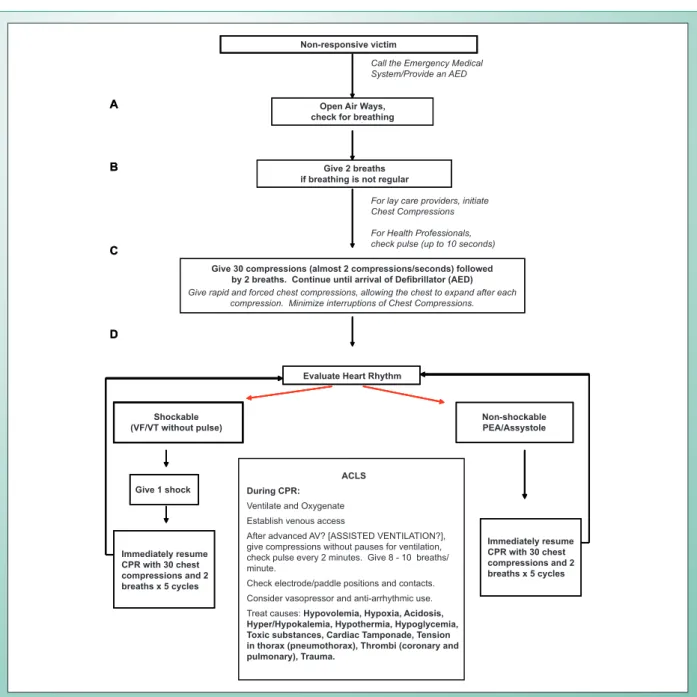
Many of the new treatment recommendations are included in the ILCOR Universal Algorithm for Cardiac Arrest (Figure 4). The objective of the algorithm is to put into practice and simplify the cardiopulmonary resuscitation maneuvers for infant, child, and adult victims of cardiac arrest (excluding newborns). All efforts were made to keep this algorithm as simple as possible and make it applicable to cardiac arrest victims of all ages, under all circumstances. Inevitably, some situations will require modifications. Each resuscitation organization will base its guidelines on this ILCOR algorithm, although there could be slight regional modifications.
Lay rescuers should start CPR if the victim is unconscious or unresponsive, not moving and not breathing. A
compression-Fig. 3 - Adult Chain of Survival (above) and Infant and Child Chain of Survival (below).
Fig. 4 - Universal algorithm for cardiorespiratory arrest management.
Vítima não responsiva
Abrir as Vias Aéreas, checar respiração
Forneça 2 ventilações se não há respiração regular
Forneça 30 compressões (quase 2 compressões/segundos) seguidas de 2 ventilações. Continue até chegar DEA/Desfibrilador
Fazer compressões Torácicas rápidas e forçadas permitindo que o tórax retorne, após cada compressão. Minimize as interrupções das Compressões Torácicas.
Ligue para o Sistema Médico de Emergência/Providencie um DEA
Para socorristas leigos iniciar Compressões Torácicas
Para Profissionais de saúde checar pulso( até 10 segundos)
A
B
C
D
Vítima não responsiva
Abrir as Vias Aéreas, checar respiração
Forneça 2 ventilações se não há respiração regular
Forneça 30 compressões (quase 2 compressões/segundos) seguidas de 2 ventilações. Continue até chegar DEA/Desfibrilador
Fazer compressões Torácicas rápidas e forçadas permitindo que o tórax retorne, após cada compressão. Minimize as interrupções das Compressões Torácicas.
Ligue para o Sistema Médico de Emergência/Providencie um DEA
Para socorristas leigos iniciar Compressões Torácicas
Para Profissionais de saúde checar pulso( até 10 segundos)
A
B
C
D
Avalie Ritmo Cardíaco
Chocável (FV/TV sem pulso)
Não Chocável AESP/Assistolia Fornecer 1 Choque Imediatamente reiniciar RCP:30 compressões torácicas e 2 ventilações X 5 ciclos
Imediatamente reiniciar RCP:30 compressões torácicas e 2 ventilações X 5 ciclos ACLS
Durante a RCP
Ventilar e Oxigenar
Obter acesso venoso
Após VA avançada, fornecer compressões sem pausas para a ventilação, cheque pulso cada 2 min. Administre de 8 a 10 ventilações/min
Verificar posição e contato de eletrodos/pás
Considerar vasopressores e antiarrítmicos
Tratar causas:Hipovolemia, Hipóxia, Acidose, Hiper/hipocalemia, Hipotermia, Hipoglicemia, Tóxicos, Tamponamento Cardíaco, Tensão no tórax(pneumotórax), Trombose(coronária e pulmonar), Trauma
Avalie Ritmo Cardíaco
Chocável (FV/TV sem pulso)
Não Chocável AESP/Assistolia Fornecer 1 Choque Imediatamente reiniciar RCP:30 compressões torácicas e 2 ventilações X 5 ciclos
Imediatamente reiniciar RCP:30 compressões torácicas e 2 ventilações X 5 ciclos ACLS
Durante a RCP
Ventilar e Oxigenar
Obter acesso venoso
Após VA avançada, fornecer compressões sem pausas para a ventilação, cheque pulso cada 2 min. Administre de 8 a 10 ventilações/min
Verificar posição e contato de eletrodos/pás
Considerar vasopressores e antiarrítmicos
Tratar causas:Hipovolemia, Hipóxia, Acidose, Hiper/hipocalemia, Hipotermia, Hipoglicemia, Tóxicos, Tamponamento Cardíaco, Tensão no tórax(pneumotórax), Trombose(coronária e pulmonar), Trauma
Avalie Ritmo Cardíaco
Chocável (FV/TV sem pulso)
Não Chocável AESP/Assistolia Fornecer 1 Choque Imediatamente reiniciar RCP:30 compressões torácicas e 2 ventilações X 5 ciclos
Imediatamente reiniciar RCP:30 compressões torácicas e 2 ventilações X 5 ciclos ACLS
Durante a RCP
Ventilar e Oxigenar
Obter acesso venoso
Após VA avançada, fornecer compressões sem pausas para a ventilação, cheque pulso cada 2 min. Administre de 8 a 10 ventilações/min
Verificar posição e contato de eletrodos/pás
Considerar vasopressores e antiarrítmicos
Tratar causas:Hipovolemia, Hipóxia, Acidose, Hiper/hipocalemia, Hipotermia, Hipoglicemia, Tóxicos, Tamponamento Cardíaco, Tensão no tórax(pneumotórax), Trombose(coronária e pulmonar), Trauma
Non-responsive victim
Call the Emergency Medical System/Provide an AED
Open Air Ways, check for breathing
Give 2 breaths if breathing is not regular
For lay care providers, initiate Chest Compressions For Health Professionals, check pulse (up to 10 seconds)
Give 30 compressions (almost 2 compressions/seconds) followed
by 2 breaths. Continue until arrival of Deibrillator (AED)
Give rapid and forced chest compressions, allowing the chest to expand after each compression. Minimize interruptions of Chest Compressions.
Evaluate Heart Rhythm
Non-shockable PEA/Assystole Shockable
(VF/VT without pulse)
Give 1 shock
Immediately resume CPR with 30 chest compressions and 2 breaths x 5 cycles
Immediately resume CPR with 30 chest compressions and 2 breaths x 5 cycles ACLS
During CPR:
Ventilate and Oxygenate
Establish venous access
After advanced AV? [ASSISTED VENTILATION?], give compressions without pauses for ventilation, check pulse every 2 minutes. Give 8 - 10 breaths/ minute.
Check electrode/paddle positions and contacts.
Consider vasopressor and anti-arrhythmic use.
ventilation ratio of 30:2 should be used for an infant, child, or adult victim (excluding newborns). This ratio is recommended for the lay rescuer and for CPR in adults. This single ratio was conceived in order to simplify CPR teaching, promote skill retention, increase the number of chest compressions delivered, and decrease interruptions in delivering compressions.
Once the defibrillator is attached, if a shockable rhythm is confirmed, a single shock is delivered. Irrespective of the resulting rhythm, chest compressions and ventilation (5 cycles of 30:2 – for approximately two minutes) are resumed in order to minimize the “no flow” time (e.g., time during in which compression maneuvers are interrupted to assess rhythm). Advanced life support interventions are outlined in a box at the center of the algorithm. Once an advanced airway (tracheal tube, laryngeal mask airway [LMA] or esophageal-tracheal combitube) has been inserted, the lay rescuer should perform eight to ten ventilations per minute during CPR for infants (except newborns), children, and adults, with no pauses for
chest compressions.
The theme of minimal interruption of chest compressions is emphasized in the consensus, and recent evidence indicates that these interruptions take place frequently, both out-of-hospital and in-hospital28,29. The “hands-off” time
(interruptions in chest compressions) during CPR must be minimized.
Future perspectives
The science of resuscitation is rapidly evolving. It would not be in the best interest of patients if we had to wait five or more years to inform health care professionals of the advances in this field. ILCOR members will continue to review new sciences and, when necessary, will publish interim advisory statements in order to update treatment guidelines so that physicians may always practice “state-of-the-art” medicine. The gaps in our knowledge will only be filled by continuous high-quality research on all aspect of CPR.
1. Cummins RO, Chamberlain DA, Abramson NS, Allen M, Baskett PJ, Becker L, et al. Recommended guidelines for uniform reporting of data from out-of-hospital cardiac arrest: the Utstein Style. A statement for health professionals from a task force of the American Heart Association, the European Resuscitation Council, the Heart and Stroke Foundation of Canada, and the Australian Resuscitation Council. Circulation. 1991; 84: 960-75.
2. Kattwinkel J, Niermeyer S, Nadkarni V, Tibballs J, Phillips B, Zideman D, et al. Resuscitation of the newly born infant: an advisory statement from the Pediatric Working Group of the International Liaison Committee on Resuscitation. Resuscitation. 1999; 40: 71-88.
3. Zaritsky A, Nadkarni V, Hazinski MF, Foltin G, Quan L, Wright J, et al. Recommended guidelines for uniform reporting of pediatric advanced life support: the Pediatric Utstein Style. A statement for healthcare professionals from a task force of the American Academy of Pediatrics, the American Heart Association, and the European Resuscitation Council. Resuscitation. 1995; 30: 95-115.
4. Idris AH, Becker LB, Ornato JP, Hedges JR, Bircher NG, Chandra NC, et al. Utstein-style guidelines for uniform reporting of laboratory CPR research. A statement for healthcare professionals from a Task Force of the American Heart Association, the American College of Emergency Physicians, the American College of Cardiology, the European Resuscitation Council, the Heart and Stroke Foundation of Canada, the Institute of Critical Care Medicine, the Safar Center for Resuscitation Research, and the Society for Academic Emergency Medicine. Resuscitation. 1996; 33: 69-84.
5. Cummins RO, Chamberlain D, Hazinski MF, Nadkarni V, Kloeck W, Kramer E, et al. Recommended guidelines for reviewing, reporting, and conducting research on in-hospital resuscitation: the in-hospital ‘Utstein style’. A statement for healthcare professionals from the American Heart Association, the European Resuscitation Council, the Heart and Stroke Foundation of Canada, the Australian Resuscitation Council, and the Resuscitation Councils of Southern Africa. Resuscitation. 1997; 34: 151-83.
6. Jacobs I, Nadkarni V, Bahr J, Berg RA, Billi JE, Bossaert L, et al. International Liason Committee on Resusitation.Cardiac arrest and cardiopulmonary resuscitation outcome reports: update and simplification of the Utstein templates for resuscitation registries. A statement for healthcare professionals from a task force of the international liaison committee on resuscitation (American Heart Association, European Resuscitation Council, Australian Resuscitation Council, New Zealand Resuscitation Council, Heart and Stroke Foundation of Canada, InterAmerican Heart Foundation, Resuscitation Council of Southern Africa). Resuscitation. 2004; 63: 233-49.
7. Handley AJ, Becker LB, Allen M, van Drenth A, Kramer EB, Montgomery WH. Single-rescuer adult basic life support: an advisory statement from the Basic Life Support Working Group of the International Liaison Committee
on Resuscitation. Circulation. 1997; 95: 2174-9.
8. Kloeck W, Cummins RO, Chamberlain D, Bossaert L, Callanan V, Carli P, et al. The universal advanced life support algorithm: an advisory statement from the Advanced Life Support Working Group of the International Liaison Committee on Resuscitation. Circulation. 1997; 95: 2180-2.
9. Bossaert L, Callanan V, Cummins RO. Early defibrillation. An advisory statement by the Advanced Life Support Working Group of the International Liaison Committee on Resuscitation. Resuscitation. 1997; 34: 113-4.
10. Nadkarni V, Hazinski MF, Zideman D, Kattwinkel J, Quan L, Bingham R, et al. Pediatric resuscitation: an advisory statement from the Pediatric Working Group of the International Liaison Committee on Resuscitation. Circulation. 1997; 95: 2185-95.
11. Kloeck W, Cummins RO, Chamberlain D, Bossaert L, Callanan V, Carli P, et al. Special resuscitation situations: an advisory statement from the International Liaison Committee on Resuscitation. Circulation. 1997; 95: 2196-210.
12. Guidelines 2000 for cardiopulmonary resuscitation and emergency cardiovascular care-an international consensus on science. The American Heart association in collaboration with the international Liaison Committee on resuscitation. Circulation. 2000; 46: 1-446.
13. Chamberlain DA, Hazinski MF; European Resuscitation Council; American Heart Association; Heart and Stroke Foundation of Canada; Resuscitation Council of Southern Africa; Australia and New Zealand Resuscitation Council; Consejo Latino-Americano de Resusucitacion. Education in resuscitation: an ILCOR symposium: Utstein Abbey: Stavanger, Norway: June 22-24, 2001. Circulation. 2003; 108: 2575-94.
14. Idris AH, Berg RA, Bierens J, Bossaert L, Branche CM, Gabrielli A, et al; American Heart Association. Recommended guidelines for uniform reporting of data from drowning: the “Utstein style”. Circulation. 2003; 108: 2565-74.
15. Nolan JP, Morley PT, Hoek TL, Hickey RW; Advancement Life support Task Force of the International Liaison committee on ResuscitationTherapeutic hypothermia after cardiac arrest. An advisory statement by the Advancement Life support Task Force of the International Liaison committee on Resuscitation. Resuscitation. 2003; 57: 231-5.
16. Samson RA, Berg RA, Bingham R, Biarent D, Coovadia A, Hazinski MF, et al. Use of automated external defibrillators for children: an update: an advisory statement from the pediatric advanced life support task force, International Liaison Committee on Resuscitation. Circulation. 2003; 107: 3250-5.
emergency cardiovascular care science with treatment recommendations. Resuscitation. 2005; 67: 167-70.
18. Davidoff F, DeAngelis CD, Drazen JM, Hoey J, Hojgaard L, Horton R, et al. Sponsorship, authorship, and accountability. Lancet. 2001; 358: 854-6.
19. Choudhry NK, Stelfox HT, Detsky AS. Relationships between authors of clinical practice guidelines and the pharmaceutical industry. JAMA. 2002; 287: 612-7.
20. Billi JE, Eigel B, Montgomery WH, Nadkarni VM, Hazinski MF. Management of conflict of interest issues in the activities of the American Heart Association Emergency Cardiovascular Care Committee, 2000-2005. Circulation. 2005; 112: IV204-5.
21. Murray CJ, Lopez AD. Mortality by cause for eight regions of the world: Global Burden of Disease Study. Lancet. 1997; 349: 1269-76.
22. Zheng ZJ, Croft JB, Giles WH, Mensah GA. Sudden cardiac death in the United States, 1989 to 1998. Circulation. 2001; 104: 2158-63.
23. Hypothermia after Cardiac Arrest Study Group. Mild therapeutic hypothermia to improve the neurologic outcome after cardiac arrest. N Engl J Med. 2002; 346: 549-56.
24. Holmberg M, Holmberg S, Herlitz J. Effect of bystander cardiopulmonary resuscitation in out-of-hospital cardiac arrest patients in Sweden. Resuscitation. 2000; 47: 59-70.
25. Valenzuela TD, Roe DJ, Nichol G, Clark LL, Spaite DW, Hardman RG. Outcomes of rapid defibrillation by security officers after cardiac arrest in casinos. N Engl J Med. 2000; 343: 1206-9.
26. Chamberlain DA, Hazinski MF; European Resuscitation Council; American Heart Association; Heart and Stroke Foundation of Canada; Resuscitation Council of Southern Africa; Australia and New Zealand Resuscitation Council; Consejo Latino-Americano de Resusucitacion. Education in resuscitation: an ILCOR symposium: Utstein Abbey: Stavanger, Norway: June 22-24, 2001. Circulation. 2003; 108: 2575-94.
27. Jacobs I, Nadkarni V, Bahr J, Berg RA, Billi JE, Bossaert L, et al; International Liason Committee on Resusitation. Cardiac arrest and cardiopulmonary resuscitation outcome reports: update and simplification of the Utstein templates for resuscitation registries. A statement for healthcare professionals from a task force of the international liaison committee on resuscitation (American Heart Association, European Resuscitation Council, Australian Resuscitation Council, New Zealand Resuscitation Council, Heart and Stroke Foundation of Canada, InterAmerican Heart Foundation, Resuscitation Council of Southern Africa). Resuscitation. 2004; 63: 233-49.
28. Wik L, Kramer-Johansen J, Myklebust H, Sorebo H, Svensson L, Fellows B, et al. Quality of cardiopulmonary resuscitation during out-of-hospital cardiac arrest. JAMA. 2005; 293: 299-304.