Universidade do Algarve
Faculdade de Ciências e Tecnologia
Sperm motility in Solea senegalensis:
effect of temperature, salinity, pH and
ovarian fluid
Patrícia Alexandra Cavaleiro Diogo
Dissertação apresentada para a obtenção do grau de Mestre em
Aquacultura e Pescas com especialização em Aquacultura
Sob a supervisão de:
Prof. Doutora Maria Teresa Dinis
Doutora Elsa Cabrita
Doutora Florbela Soares
(…) O sonho é ver as formas invisíveis
Da distância imprecisa, e, com sensíveis
Movimentos da esp'rança e da vontade,
Buscar na linha fria do horizonte
A árvore, a praia, a flor, a ave, a fonte -
Os beijos merecidos da Verdade. (…)
(…) Deus quere, o homem sonha, a obra nasce. (…)
vii
Agradecimentos
Durante a aventura que foi o desenvolvimento deste projecto, tive a felicidade de contar com o apoio incondicional e a ajuda de várias pessoas, sem as quais esta tese não seria possível. Não posso portanto deixar passar a oportunidade de expressar os meus sinceros agradecimentos.
Em primeiro lugar quero agradecer às minhas orientadoras Prof. Doutora Maria Teresa Dinis, Doutora Elsa Cabrita e Doutora Florbela Soares, minhas mães na ciência, não só pela oportunidade, confiança e apoio no desenvolvimento desta tese, mas também por todas as oportunidades profissionais que me proporcionaram.
Quero também agradecer à Prof. Margarida Castro pelo aconselhamento sobre estatística e aos voluntários de BMP que me ajudaram entusiasticamente nas amostragens no Ramalhete.
É essencial agradecer a todos os meus colegas do laboratório de aquacultura pela infinita paciência com o meu nível de stress e por me ouvirem sempre que quis dar largas ao mau génio!
Quero agradecer pelo apoio, críticas e correcções deste trabalho à Elisabete (e ao seu ombro amigo), José Beirão, Sónia Martinez-Páramo, Ana Ramos e ao meu irmão Hugo Diogo, o responsável por eu me ter tornado uma bióloga e que, apesar de estar longe, para mim está sempre perto.
Aos nada’ver que são os meus amigos de sempre e para sempre por toda a força e amizade, Rita, Ana, Manel e Ricardo…e ao Fred a bolinha antistress!
Quero agradecer ao meu Pai, à minha mãe, à minha avó e ao Ed, que são a pedra basilar sem a qual eu desabo e por todo o apoio incondicional sem o qual não era possível ter chegado a este ponto da carreira e da minha vida.
viii
This work was supported by FISHWEL Project (DGP, MARE-AQUICULTURA: Nº22.04.06.IFP.0015) and CRYOSPERM Project (FCT, PTDC ⁄ MAR ⁄ 64533 ⁄ 2006)ix
List of Abbreviations
µl - Microlitre
ALH - Amplitude of lateral displacement BCF - Beat cross frequency
E25 - Artificial sea water diluted with 25% of Epinephelus marginatus ovarian fluid E50 - Artificial sea water diluted with 50% of Epinephelus marginatus ovarian fluid Kg - Kilogram g - Gram L - Litre h - Hour LIN - Linearity m - Meter ml - Millilitre mm - Millimetre OF - Ovarian fluid PM - Progressive motility s- Second
S25 - Artificial sea water diluted with 25% of Solea senegaslensis ovarian fluid S50 - Artificial sea water diluted with 50% of Solea senegaslensis ovarian fluid SP - Subpopulation
STR - Straightness TM -Total motility
VCL - Curvilinear velocity VSL - Straight line velocity WOB - Wobble
xiii
INDEX
Agradecimentos ... vii
List of Abbreviations ... ix
List of Tables
... xv
List of Figures ... xvi
Resumo ... 3
Abstract
... 4
1. Introduction ... 7
1.1 Fish sperm quality ... 8
1.2 Factors affecting sperm quality
... 8
1.3 Sperm quality evaluation ... 9
1.4 Sperm motility activation mechanisms ... 10
1.5 Factors affecting sperm motility: environmental and biological cues
... 11
1.5.1 Environmental cues ... 11
1.5.2 Biological cues ... 12
1.6 Methods for sperm motility analysis
... 13
1.7 Applications of sperm motility assays ... 14
1.8 Solea senegalensis reproduction ... 15
2.
Objectives ... 19
3. Material and Methods ... 23
3.1 Broodstock husbandry conditions ... 23
3.2 Sperm collection
... 24
3.3 Ovarian fluid collection ... 25
3.4 CASA system and parameters analysed ... 26
3.5 Experimental design:
... 26
3.5.1 Effect of temperature, salinity and pH on sperm motility activation ... 26
3.5.2 Effect of homologous and heterelogous ovarian fluid concentration on motility
activation
... 27
3.5.3 Effect of S. senegalensis ovarian fluid on individual male sperm motility
activation ... 28
3.6 Data analysis and statistics
... 28
4.
Results ... 31
xiv
4.1.1 Effect of temperature on sperm motility ... 32
4.1.2 Effect of salinity on sperm motility ... 34
4.1.3 Effect of pH on sperm motility
... 35
4.2 Ovarian fluid influence on Solea senegalensis sperm motility ... 37
4.2.1 Effect of homologous and heterelogous ovarian fluid concentration on motility
activation
... 37
4.2.2 Effect of S. senegalensis ovarian fluid on individual male sperm motility
activation ... 39
4.3 Sperm subpopulation analysis ... 42
4.3.1. Sperm subpopulation analysis on sperm motility with different temperature,
salinity and pH of the activation solution
... 42
4.3.2 Sperm subpopulation analysis on sperm motility with ovarian fluid activation
solutions ... 46
5. Discussion
... 51
5.1 Effect of temperature, salinity and pH on sperm motility activation ... 51
5.2 Ovarian fluid influence on Solea senegalensis sperm motility
... 53
5.2.1 Effect of homologous and heterologous ovarian fluid concentration on sperm
motility activation
... 53
5.2.2 Effect of S. senegalensis ovarian fluid on individual male sperm motility
activation
... 55
5.3 Sperm subpopulation analysis
... 56
6. Conclusions ... 63
7.
References ... 65
xv
List of Tables
Table 1 - Osmolarity and pH of activation solutions used in the sperm motility analysis. SW- seawater; OF- ovarian fluid. ... 27 Table 2 - Statistical differences for temperature, salinity and pH for total motility (TM),
progressive motility (PM), curvilinear velocity (VCL), straight line velocity (VSL) and linearity (LIN) on S. senegalensis spermatozoa at 15, 30, 45 and 60 s post-activation, sustained by mean values of 7 males. The effect of the three tested conditions on motility parameters was detected by a three-way ANOVA (p < 0.05), significant differences are highlighted in bold... 32 Table 3 - Characterization of sperm subpopulations of sperm motility activated in different
temperatures, salinities and pH treatments. ... 43 Table 4 - Statistical differences between the percentage of cells in each subpopulation obtained
for temperature, salinity and pH treatments, sustained by mean values of 7 males. Statistical differences (multivariate three way ANOVA, p ≤ 0.05) are highlighted in bold. SP1 - Subpopulation 1, SP2 - Subpopulation 2, SP3 - Subpopulation 3, SP4 - Subpopulation 4. ... 45 Table 5 - Characterization of sperm subpopulations of sperm motility activated with ovarian
xvi
List of Figures
Figure 1 - S. senegalensis broodstock tank. ... 23
Figure 2 - Temperature and salinity fluctuations throughout the year at Ramalhete aquaculture station. ... 24
Figure 3 - A) S. senegalensis anaesthesia, B) sperm collection. ... 25
Figure 4 - Ovarian fluid collection using a 50 µm mesh. ... 25
Figure 5 - Experimental design for each post-activation time. ... 27
Figure 6 - Effect of temperature (16 ºC and 20 ºC) in S. senegalensis sperm motility at 15, 30, 45 and 60 s post-activation. Statistical differences (p < 0.05) between temperatures in each post-activation time are represented with letters. ... 33
Figure 7 - Effect of salinity (25 ‰, 30 ‰ and 35 ‰) in S. senegalensis sperm motility at 15, 30, 45 and 60 s post-activation. Statistical differences (p < 0.05) between temperatures in each post-activation time are represented with letters. ... 35
Figure 8 - Effect of pH (6, 7.4 and 9) in S. senegalensis sperm motility at 15, 30, 45 and 60 s post-activation. Statistical differences (p < 0.05) between temperatures in each post-activation time are represented with letters. ... 36
Figure 9 - Effect of homologous and heterelogous ovarian fluid concentration in motility activation parameters represented by data sustained by 8 males. Samples were activated with 100% seawater (Control), 25% of homologous ovarian fluid solution (S25), 50% of homologous ovarian fluid solution (S50), 25% of heterelogous ovarian fluid solution (E25) and 50% of heterelogous ovarian fluid solution (E50). Data were registered in intervals of 15 s during 1 min. Columns represent means, bars indicate standard deviation. Significant differences (p < 0.05) between treatments are represented with letters within each post-activation time... 38
Figure 10 - Effect of S. senegalensis ovarian fluid on individual male motility activation registered in the 8 males (M1-M8). Motility parameters were registered in intervals of 15 s during 1 min for control (C; 100% seawater) and 25% of homologous ovarian fluid (OF, n = 2). Significant differences (Independent Student’s t-test p < 0.05) between treatments (Control and OF) for each male are represented with (*). Columns represent means, bars indicate standard deviation. ... 41
Figure 11 - Effect of temperature, salinity and pH in the percentage of cells in each subpopulation 15 s (A), 30 s (B), 45 s (C) and 60 s post-activation (D). SP1 - Subpopulation 1, SP2 - Subpopulation 2, SP3 - Subpopulation 3, SP4 - Subpopulation 4. Statistical differences (p < 0.05) between the percentage of cells in each subpopulation are represented with uppercase letters (salinity), lowercase letters (pH) and (*) (temperature). ... 44
Figure 12 - Effect of ovarian fluid in the percentage of cells in each subpopulation 15 s (A), 30 s (B), 45 s (C), 60 s (D). Statistical differences of the percentage of cells in each subpopulation (SP) in sperm motility activated in the presence of sea water (control), 25% homologous ovarian fluid (S25) and 50% (S50), and 25% heterelogous ovarian fluid (E25) and 50% (E50). The differences between the percentage of cells in each subpopulation for all treatments are represented with letters. Significant differences (p < 0.05) were detected by one-way ANOVA... 48
3
Resumo
A análise da mobilidade seminal é uma ferramenta importante para reprodução em aquacultura. Esta é uma técnica in vitro que auxilia a estabulação, manutenção e selecção de lotes de reprodutores. A análise de mobilidade seminal pode tornar-se potencialmente uma ferramenta para o melhoramento das condições do ambiente de fertilização. A utilização do software CASA (Computer Assisted Sperm Analysis) revolucionou a descrição e quantificação específica da mobilidade seminal. A maioria da informação recolhida sobre mobilidade de sémen de peixes baseia-se em espécies de água doce, pelo que é crucial conhecer as condições óptimas de activação da mobilidade de espermatozóides para novas espécies de de água salgada de interesse em aquacultura tal como Solea senegalensis. A optimização das condições de fertilização desta espécie é particularmente importante já que os lotes de reprodutores em cativeiro podem desenvolver disfunções reprodutoras. Este trabalho teve como objectivo realizar a avaliação das condições óptimas de activação da mobilidade do sémen em S. senegalensis em termos de temperatura, salinidade e pH. O segundo objectivo foi realizar a avaliação da influência de fluido ovárico homólogo (S. senegalensis) e heterólogo (Epinephelus marginatus) na mobilidade seminal de S. senegalensis. Deste modo foram realizados dois conjuntos de experiências: 1) mobilidade de sémen de 7 machos analisado através do CASA em diferentes temperaturas, salinidades e pH, 2) mobilidade de sémen de 8 machos activados na presença de diferentes concentrações de fluido ovárico. Os parâmetros do CASA foram registados e posteriormente analisados através de médias e cluster analysis. Concluiu-se que temperaturas mais elevadas (20 ºC) e baixas salinidades (25 ‰ e 30 ‰) da solução de activação ocorre um melhoramento das características de mobilidade seminal, tal como a velocidade. A presença de fluido ovárico em baixas concentrações melhora as características da mobilidade seminal assim como a longevidade dos espermatozóides. O fluido ovárico é consequentemente um factor que estimula a mobilidade seminal que tem sido negligenciado em estudos anteriores. Este estudo demonstrou que durante a época de reprodução a temperatura da água (20 ºC) e a salinidade (25 ‰ e 30 ‰) no tanque são os principais factores que melhoram a activação da mobilidade do sémen, sendo consequentemente uma contribuição importante para compreender a dinâmica do processo de fertilização em S. senegalensis.
Palavras-chave: mobilidade, Solea senegalensis, “Computer Assisted Sperm Analysis” (CASA), qualidade seminal, fluido ovárico, subpopulações espermáticas
4
Abstract
The analysis of fish sperm motility is an important functional tool to assist reproduction in aquaculture. It is an in vitro technique that has an important role in broodstock selection, management and establishment as well to potentially improve fertilization environmental conditions. The use of CASA (Computer Assisted Sperm Analysis) systems revolutionized motility quantification and description to a scientific level. Most of the knowledge collected about fish sperm motility is based on fresh water species, but it is crucial to assess spermatozoa optimal activation conditions for new species, such as Solea senegalensis. The optimization of the fertilization conditions of this species is particularly important since broodstocks maintained in captivity developed several reproductive dysfunctions. This work aimed to perform an assessment of the optimal motility activation conditions in S. senegalensis sperm, in terms of temperature, salinity and pH. The second objective was to assess the influence of homologous (S. senegalensis) and heterologous (Epinephelus marginatus) ovarian fluid on Solea senegalensis sperm motility solution. For those reasons two sets of experiments were performed: 1) sperm motility from 7 males was analysed with CASA in different temperature, salinity and pH conditions, 2) sperm motility from 8 males in the presence of different ovarian fluid concentrations. CASA parameters were recorded and analysed afterwards by mean values and cluster analysis. Higher temperatures (20 ºC) and low salinities (25 ‰ and 30 ‰) of the activation solution improved sperm motility characteristics such as velocity. The presence of ovarian fluid in low concentrations improved sperm motility characteristics and sperm longevity. The ovarian fluid can be thus an important factor that stimulates sperm motility which has been neglected in previous studies. This study demonstrated that during the breeding season water temperature (20 ºC) and salinity (ranging between 25 ‰ and 30 ‰) in the tank are the main factors improving the activation of sperm motility, being therefore an important contribution to understand the fertilization dynamics in S. senegalensis.
Keywords: motility, Solea senegalensis, Computer Assisted Sperm Analysis (CASA), sperm quality, ovarian fluid, sperm subpopulations
7
1. Introduction
During the past years the overexploitation of fisheries resulted in an increase of aquaculture production to fulfil the market demands on marine products of a global exponentially growing human population. However, the domestication of cultured species requires an intense scientific and technological effort. One of the most sensitive stages of the fish life cycle is the reproduction period, which in many species has several constraints. The optimization of reproductive performance on husbandry broodstock is essential to obtain high quality fry, which is imperative to allow the aquaculture industry to produce high quality fish. Fish aquaculture production, as fish recruitment in the wild, depends directly on the quality and quantity of eggs available during the reproductive season (Lahnsteiner et al., 2009). Egg quality is determined by intrinsic and extrinsic factors, including the fertilization and incubation environment (Brooks et al., 1997). As in other vertebrates, embryos result from the fusion between oocyte and sperm, however traditional quality studies focused only on egg quality, since it was attributed to the female the responsibility to produce the egg substances necessary for normal larval development (Lahnsteiner et al., 2009). In the last years the quality of gametes of both female and male parents were admitted to be a contributing factor for fry viability, although in different ontogeny times and ways. The importance of male gamete quality in terms of undamaged genome, the male genetic compatibility with the female and the recent discover of specific mRNAs present in spermatozoa are important factors that contribute to the knowledge that sperm plays a crucial role in fertilization and embryo development (Cabrita et al. 2009; Miller et al., 2005; Simmons, 2005). Until recently, spermatozoa contribution to fertilization process relied only on the fact that sperm needs to reach the oocytes and deliver the genomic content, which must be maintained undamaged to avoid abortions or embryonic malformations. The recent discover of specific mRNAs in mammalian sperm proposed that these transcripts might play an important role in genomic imprinting, conditioning sperm quality and even participating in the zygote development (Miller et al., 2005). Another issue is the genetic compatibility that may be involved in fertilization selection. Stickleback females (Gasterosteus aculeatus) choose males that complement their own alleles, producing offspring with an optimal number of alleles (Aeschlimann et al., 2003; Reusch et al., 2001). It is then clear the importance of the spermatozoa genetic heritage or “male genetic factor” on egg quality, as well as male and sperm quality on reproductive performance.
Sperm quality has been a focus of research since it can be used as a biomarker of the male status (Cabrita et al., 2009; Chauvaud et al., 1995). As in eggs, there is no consensus about the most suited sperm quality assessment technique. Nevertheless, several sperm parameters have been used to determine sperm quality with indubitable value for male characterization and broodstock selection, enabling the improvement of the quality of male broodstock as a mean to increase reproduction success. The study of sperm quality is essential
8
to understand the overall dynamic of fertilization process in fish. This will allow for an improvement of the fertilization conditions, aiming for higher fertilization and hatching rates as well as reliable fry production being an important tool to apply in hatcheries and research.1.1 Fish sperm quality
The use of high quality sperm is imperative for aquaculture purposes to ensure viable offspring when in contact with good quality eggs and appropriate environment (Kjørsvik et al., 1990). Cabrita et al. (2009) described the requirements for high sperm quality as the ability of the spermatozoa to reach the egg and the capacity to cross the egg envelopes or enter through the micropyle. It is also the ability to recognize the oolema and the fusion of both plasma membranes, the capacity to perform correct activation of the egg metabolic pathways and finally, sperm must have an undamaged genome with genetic compatibility with the egg genome (Simmons, 2005). The studies describing milt characteristics revealed high individual variability variations in different parameters (Dreanno et al., 1998). Consequently, as the definition of high quality sperm relies on its overall “fitness” and not on individual traits, an objective quality biomarker is difficult to institute (Cabrita et al., 2009).
The use of high quality sperm in fish farms is beneficial to increase the effectiveness of artificial fertilization, since low quality samples can be discarded. Also, the frequent sperm analysis of the male broodstock enables the identification of males with better reproductive traits, which in conjunction with genetic analysis allows for the selection of good breeders. Furthermore, it facilitates the storage of sperm, through short or long term storage improving the management of sperm in aquafarms (Cabrita et al., 2009; Rurangwa et al., 2004).
1.2 Factors affecting sperm quality
High quality sperm is primarily dependent of factors such as the paternal genetic heritage (Simmons, 2005), the spermiation period and sperm storage conditions in the testes, as well as the favourable environmental conditions during motility activation (Billard, 1986). Cultured species are very susceptible to husbandry management conditions, stress, disease, nutrition disorders, water quality and exposure to pollutants, which may impair spermiation and sperm quality. Sperm quality in many species changes along the reproductive season, such as in European sea bass (Dicentrarchus labrax), where two weeks after the beginning of spermiation period the sperm concentration decreased (Dreanno et al., 1999b). Morphological, biochemical and sperm motility traits changed at the end of the reproductive season in Pagrus pagrus, Dicentrarchus labrax, Hippoglossus hippoglossus and in some freshwater species (Billard et al., 1993; Dreanno et al., 1999b; Mylonas et al., 2003). In Solea senegalensis this variation was not so evident, but during female spawning season sperm quality was improved
9
(Cabrita et al., 2006). The stripping frequency also affects sperm quality if a recovery period is not respected, which is different between species (Cabrita et al., 2009).The quality of sperm can be affected by the environmental conditions which males are exposed to. Due to the reproductive dysfunctions occurring in the F1 generation in some species, aquaculture breeders are sometimes collected from the wild. As a consequence their background is unknown, including their life-history with possible exposure to toxics that may affect their reproductive performance (Van der Oost et al., 2003). The male exposure to contaminants (heavy metals, organochlorides, carbamates, tributyltine) may cause hazardous effects on gonadal development, maturation and spermiation. In terms of sperm quality, the main effects are loss of sperm motility, velocity, viability, fertility and metabolic activity (Kime et al., 1996; Rurangwa et al., 2002). In fresh water species such as rainbow trout (Oncorhynchus mykiss) a shift from warm to cold water improved sperm quality (Labbé et al., 2001). However, in Senegalese sole (Solea senegalensis) an increase of water temperature during summer period resulted in a sperm volume decrease (Cabrita et al., 2009). Fish nutrition is known to affect the composition of seminal plasma and spermatozoa, such as plasma membrane phospholipids and cholesterol levels and distribution. For example, S. senegalensis males fed with mussels had higher cholesterol in spermatozoa plasma membrane than fish fed with polychaete (Cabrita et al., unpublished data). The same findings were reported in rainbow trout (Labbé et al., 1995).
Sperm handling is another factor that may affect sperm quality. In hatcheries that perform artificial fertilization it is a common procedure to maintain sperm in short or long term storage to optimize gametes management. These techniques can decrease sperm quality (Suquet et al., 2000) due to the negative effects of some procedures such as cooling, freezing or thawing, which may affect spermatozoa membrane integrity and fertilizing capacity (Parks and Graham, 2003). Consequently it is important to ensure the proper functioning of cell metabolism and maintenance of cell function through the development of adequate protocols and extenders, which can be monitored by sperm quality techniques.
1.3 Sperm quality evaluation
A quality assessment must be reliable and fast to be useful in commercial aquaculture (Cabrita et al., 2009). The most common milt quality biomarkers, such as spermatocrit, sperm density, osmolarity and pH of the seminal plasma, chemical composition of the seminal plasma, enzymatic activity, ATP concentration, motility, as well as fertilizing ability have been determined in several species (Billard et al., 1995a,b; Billard and Cosson, 1992; Ciereszko and Dabrowski, 1993, 1994; Chowdhury and Joy, 2001; Fauvel et al., 1998; Geffen and Evans, 2000; Lahnsteiner et al., 1996, 1998; Rurangwa et al., 2004). For a more exhaustive analysis, the evaluation of other cell functions should be assessed. However when whole-milt quality is
10
assessed it disregards the individual spermatozoa status, which can be disadvantageous when sperm from multiple males is mixed. Individual spermatozoa-based measurements are more discriminatory techniques to analyse membrane integrity, sperm morphology, ultrastructure, and sperm motility characteristics (Rurangwa et al., 2004). Cell viability is another assay that measures spermatozoa individual status and usually is related with plasma membrane integrity and resistance. The level of DNA fragmentation in nucleus can be used to assess the status of the DNA integrity. Single cell gel electrophoresis or comet assay is one of the methods used to perform this analysis (Lee and Steinert, 2003). Mitochondria function can be determined by measuring membrane potential, enzymatic activity or ATP levels. Their impairment can be responsible for the presence of non motile spermatozoa (Ogier et al., 1997). Fluorescent probes such as rodamine 123 or JC1 have been used to assay changes in mitochondria membrane potential in rainbow trout (Ogier et al., 1997), and in gilthead seabream (Cabrita et al., 2005).Sperm motility is the most studied parameter of sperm quality assessment in fish due to its correlation with fertility (Rurangwa et al., 2001). Although it is an incomplete physiological analysis and needs other quality assays to guarantee the status of spermatozoa, it may reveal the probability of fertility success and is useful to analyse the effects of different treatments (Kime et al., 2001).
Sperm motility studies are adequate for sperm quality assessment purposes in aquaculture, since fish sperm has several characteristics which facilitate this type of analysis. Fish are generally external fertilizers that possess immotile spermatozoa in the seminal fluid, consequently it is easy to trigger its motility with a competent medium (Cosson et al., 2008a,b). All these facts support that sperm motility analysis is an advantageous technique for fish sperm quality assessment (Cosson et al., 2008a,b).
1.4 Sperm motility activation mechanisms
Spermatozoa from teleost fish are flagellated single cells adapted to external fertilization that undergo a long period of spermatogenesis in a safe environment, surrounded by seminal plasma and sertoli cells in the testes, with physicochemical conditions similar to the body environment (Billard, 1986; Schulz et al., 2002). Under these conditions, spermatozoa are immotile in the testes and only acquire motility when in contact with the external medium.
In marine fish, when sperm is delivered into the seawater, during the fertilization process, along with eggs, cells make contact with an extremely hazardous medium. Sperm motility is then trigged by hyperosmotic shock combined with ionic exchange with the environment, causing a severe change in the sperm membrane potential (Morisawa et al., 1983). The change in the membrane potential promotes a rise in the intracellular ionic concentration, especially Ca2+ ions, and a pH rise resulting in flagellar beating, thus promoting motility activation (Cosson et al., 2008a,b). Once the movement is started, the cells have only few seconds or minutes to
11
reach the oocytes and penetrate the micropyle before it closes up or the few mitochondrial ATP reserves in sperm get fully exhausted (Rurangwa et al., 2004). In Sparus aurata (Cabrita et al., 2006), S. senegalensis (Cabrita et al., 2007; Martínez-Pastor et al., 2008) and flounder (Oda et al., 1998), sperm motility is trigged by hyperosmotic solutions of sugar or other non-ionic compounds, revealing that motility is probably mediated by osmotic pressure receptors in the membrane (Cabrita et al., 2009). Also, it is known that the activation occurs when sodium ions of seawater are substituted by choline chloride (Cosson et al., 2008a). It is assumed that sperm motility activation in marine species occurs through a positive osmolarity gradient between the outside and the inside of the cells. This process was also proved to be reversible in a triggering/inactivation mechanism (Cosson et al., 2008a). In freshwater species, sperm motility is activated when in contact with the hypotonic external environment. Krasznai et al. (2000) proposed for carp semen a cell signalling cascade to promote sperm motility activation, where the hyposmotic shock causes the opening of K+ channels due to the low ionic concentration in the environment, promoting an efflux of K+ from the cell that hyperpolarizes the plasma membrane. This mechanism is followed by a plasma membrane depolarization and consequently an influx of Ca2+, promoting flagellar beating.In euryhaline, as in most species, osmolarity is considered to be the most important feature to trigger sperm motility. The sperm motility activation depends on the period of fish adaptation to the environment. Individuals adapted to freshwater environmental, hypotonicity is the triggering factor promoting motility activation, whether individuals adapted to saline conditions, motility is trigged by hypertonicity (Morita et al., 2003).
1.5 Factors affecting sperm motility: environmental and biological cues
Immediately after activation fish spermatozoa reveal the highest motility efficiency, declining progressively motility parameters throughout time. Initially all the ATP mitochondrial reserves are fully available but in fact the energy management throughout time and its expenditure can be modulated by the characteristics of the motility activation media (Cosson et al., 2008a,b).There are several factors that affect sperm motility in fish which can be considered as environmental and biological factors.
1.5.1 Environmental cues
The temperature of the activation solutions is known to affect spermatozoa since it increases cell metabolism, causing an increase in velocity with quicker depletion of the scarce energetic resources, promoting an earlier motility cessation. On the other hand, lower temperature results in a prolongation of sperm motility with reduction in velocity and flagellar beating frequency, (reviewed in Cosson et al., 1985). The temperature affects differently the beating frequency of spermatozoa flagella, which is more or less physiological related to the adaptation of each species to natural environment conditions (Alavi and Cosson, 2005).
12
Osmolarity seems to be one of the most relevant factors in motility activation in several species. As mentioned previously, the hypertonicity of the environment triggers motility activation on marine fish sperm, while the opposite triggers motility in most freshwater species. This fact is widely reported for species such as Atlantic cod (Gadus morhua) (Westin and Nissling, 1991), European sea bass (Dicentrarchus labrax) (Dreanno et al., 1999b) and gilthead seabream (Billard, 1978). The salinity is not usually considered by itself an independent factor in sperm motility triggering because is associated with ionic composition such as Ca2+, K+, Mg2+, Na+.The effect of pH from the activation solution is considered to have a low interference in sperm motility activation (Cosson, 2004). However it is known that the internal pH of the cell is a key factor for motility initiation. Gatti et al. (1990) reported that rainbow trout sperm plasma membrane potential is sensitive to external pH, consequently improving membrane hyperpolarization. Miura et al. (1992) demonstrated that a rise of external pH was associated with an increase of cAMP levels in masou salmon (Onchorynchus masou), promoting sperm motility activation. Nevertheless in species such as sea bass (Dicentrarchus labrax) (Billard et al., 1977), turbot (Chauvaud et al., 1995) and halibut (Billard et al., 1993) spermatozoa achieved motility activation in a wide range of pH with optimal motility values in a specific pH for each species, although with a tendency for slightly alkaline solutions.
1.5.2 Biological cues
The presence of ovarian fluid in the activation solution improves sperm longevity in freshwater species (Lahnsteiner et al., 1995; Turner and Montgomerie, 2002; Urbach et al., 2005; Wojtczak et al., 2007; Dietrich et al., 2008) and may enhance sperm motility characteristics such as speed, trajectory and motility pattern (Lahnsteiner et al., 1996). The same findings were observed by Litvak and Trippel (1998) in Atlantic cod (Gadus morhua). These facts imply an important female role in the fertilization process and in the characterization of sperm motility, being the ovarian fluid one of the main biological factors that may modulate sperm motility.
The mechanism through which ovarian fluid may affect sperm motility is not known, but may be related with its physico-chemical composition. Ovarian fluid composition is highly variable among species, but also between individuals, due to differences in females such as physiological status, maturation grade and egg quality (Lahnsteiner, 2002). It has several hormones, nutrients and metabolites that spermatozoa may metabolize (Lahnsteiner et al., 1996), thus also working as a substrate for spermatozoa physiological functions. Wojtczak et al. (2007) showed that in rainbow trout (Oncorhynchus mykiss), ovarian fluid pH improved sperm motility. Its characteristics may also modify the osmolarity of the fertilization microenvironment, affecting the duration of sperm motility (Lahnsteiner et al., 1995; Westin and Nissling, 1991;
13
Wojtczak et al., 2007). However these facts are related to the triggering of sperm motility and the real mechanism behind the influence of ovarian fluid is still unknown.The role of ovarian fluid on sperm motility in some species might also be related to the presence of chemoatractants released by the eggs (Urbach et al., 1995). Chemotaxis is the modulation of the direction of movement of motile cells in response to a chemical gradient stimulus, resulting in approach to an attractant or retreat from a repellent. In species like herring the chemotaxis physiological role of ovarian fluid/egg is to attract as many spermatozoa as possible towards the egg in response to its chemoatractive factors (Yanagimachi et al., 1992). There are still few studies about chemoatractants composition and it is quite variable among species, but in herring (Ohtake, 2003) and corals (Coll et al., 1994) they were found to be low molecular weight proteins.
1.6 Methods for sperm motility analysis
Sperm motility can be determined using two assessment methods: subjective analysis and quantitative computer assisted methods. During subjective analysis of motility, an estimation of motile cells and velocity is made by an observer scoring the results in an arbitrary scale of criteria from 0 (immotile) to 5 (all spermatozoa highly motile) (Billard et al., 1995). This method is usually used in fishfarms and in order to guarantee some accuracy of results, the observations should be performed by the same observer. One of the main problems in these nonlinear arbitrary scales is that data cannot be statistically analysed (Rurangwa et al., 2004). To reduce the subjectivity of the tests, recorded images of activated samples and further videotape analysis was performed by multiple observers to determine sperm motility, but this procedure expended too much time and was not practical (Kime et al., 2001). Sperm motility became easily verified and quantifiable especially since quantitative computer assisted methods were developed. Sperm motility analysis software such as Computer Assisted Sperm Analysis (CASA) software was developed for human tests and later for other mammalian species (Vantman et al., 1989; Farrell et al., 1998; Hirano et al., 2001). The first sperm motility study in fish was conducted by Cosson et al. (1985) using video recording with stroboscopic illumination. In the last years CASA systems were adapted to sperm motility in fish, thus allowing a more practical scientifically accurate assessment of motility parameters (Kime et al., 2001). The delay in the implementation of CASA analysis in fish sperm was due to its biological differences compared to mammalian sperm, since it has a short lifespan and high flagellar beating frequency after activation (Billard and Cosson, 1992). However, the use of this software has not yet been widely adopted by the Aquaculture industry, since although it is a very simple and practical analysis, it requires some investment.
CASA can generate several parameters related with spermatozoa type of movement, trajectory and velocity. In fish, the percentage of motile cell, progressive spermatozoa, straight
14
line velocity (VSL), curvilinear velocity (VCL), and linearity are the most common parameters analysed to characterize a sperm sample. Computer sperm analysis generates thousands of data since it registers individual spermatozoa characteristics. Consequently, several authors have been studying the best method to interpret results. Mean values have been used to characterize samples, but due to the high heterogeneity of sperm samples, some characteristics may be hidden, overlooking the useful information of the individual variability. Due to this heterogeneity and the identification of different characteristics within an ejaculate, the possibility of using subpopulations in the interpretation of results has gained more value. The study of sperm subpopulations started originally on mammalian species such as gazelle (Abaigar et al., 2001), stallion (Quintero-Moreno et al., 2003) and red deer (Martínez-Pastor et al., 2005), among others. Nowadays, the presence of distinct sperm subpopulations within a sample is generally accepted (Martínez-Pastor et al., 2005, 2006). Although it is potentially a powerful tool, the use of sperm subpopulations analysis is still unusual in fish sperm motility studies, although several reports have characterized sperm subpopulations in gilthead seabream and Senegalese sole (Beirão et al., in press; Martínez-Pastor et al., 2008). The mechanism of sperm subpopulations formation in the testes is still unknown as well as its physiological role (Martínez-Pastor et al., 2005, 2008). The analysis performed with CASA software has the ability to typify the individual motility of each spermatozoon, thus allowing a characterization and inclusion in a group or subpopulation with common characteristics, identified by means of cluster analysis. Subpopulation analysis has the potential to locate significant differences between treatments in the same sample that would otherwise be shadowed since, unlike mean values, it considers the heterogeneity of the sample. Furthermore, several studies showed correlations not only between subpopulations and fertilization ability but also sperm quality, physiology, behaviour and genetics (Petrunkina and Topfer-Petersen, 2000; Thurston et al., 1999).1.7 Applications of sperm motility assays
Fish sperm motility analysis has been used in numerous ecotoxicological studies since it is a good biomarker of contaminants exposure. The organs and tissues located in the abdominal cavity concentrate preferably the toxics absorbed in food and environment and the reproductive system is known to be vulnerable to contaminants toxic levels (Xing et al., 2008). The use of motility assays as indicators of pollutant effects has been used in several fish species such as flounder (Chauvaud et al., 1995) and African catfish (Rurangwa et al., 2002). Furthermore, it is advantageous to use sperm motility analysis for ecotoxicological studies since no fish slaughter is needed and individual fish monitoring can be achieved (Kime et al., 1996).
Sperm short and long term storage is another procedure that may require the analysis of motility either at fish farms or for research purposes. It is a common procedure in hatcheries to store sperm in order to optimize gametes management (Suquet et al., 2000). In
15
cryopreservation studies, motility analysis is fundamental to select the best protocols for sperm storage and to identify damage occurring during this process. Motility analysis was a useful tool to assess the effect of different diluents in sperm cryopreservation in trout (Oncorhynchus mykiss) (Cabrita et al., 2001), in turbot (Dreanno et al., 1997), African catfish (Viveiros and Komen, 2000) and common carp (Linhart et al., 2000), among others. Also sperm motility is used to optimize not only the extenders but also the cryopreservation techniques for non-studied species, since to control sperm quality after the use of this technique several parameters must be tested, such as freezing and thawing velocities, extender and cryoprotectant type and concentration (Dreanno et al., 1997; Rurangwa et al., 2004).When controlled maturation and spawning is obtained by hormonal treatments and applied in industrial hatcheries, sperm motility analysis is the most practical technique to use as a tool for male broodstock selection but also to check individual samples for artificial fertilization (Devauchelle et al., 1988). The use of this method for the optimization of fertilization conditions is highly suitable, since it is an in vitro test that can be extrapolated to in vivo conditions.
1.8 Solea senegalensis reproduction
Solea senegalensis (Order Pleuronectiformes, Family Soleidae) is a marine teleost widely distributed from the Mediterranean to the Atlantic Ocean. The southern limit of distribution is Senegal, which lent the name to this species. It presents a benthic behaviour, living on sandy or muddy bottoms usually in coastal waters and estuaries. This species tolerates substantial changes in the environment, such as temperature and salinity, with high stress resistance. This species is gonochoric, with females reaching the maturation at age 3+. In the Portuguese coasts it has two reproduction periods per year, being the first one during the spring (March/April-June) and the second one during the autumn (September) (Dinis et al., 1999).
Although many achievements in S. senegalensis production have been accomplished in the past years, some production restrictions remain unsolved, mainly related with reproduction control. Some of the main bottlenecks in this species reproduction are variable egg production and quality, low fertilization rates and the dependence on wild broodstock. For these reasons the selection of good breeders that produce quality gametes is essential to overcome the reproductive dysfunctions and the low fertility rates obtained. In this species low fertility rates are observed not only due to variable egg quality, but also to the high variability in sperm quality within males (Cabrita et al., 2006).
The first attempts to induce spawning hormonally resulted in the production of eggs that either are not fertilized, fail to hatch or abort (Dinis et al., 1999). The fluent males can produce motile sperm all year around during spermiation cycles (Cabrita et al., 2006). High spermiation
16
periods are registered in mid March, May and during the second spawning period in October, coinciding with the female reproduction cycle (Anguis and Cañavate, 2005; Cabrita et al., 2006; Dinis et al., 1999; García-López et al., 2005, 2006), although it was observed in captivity that not all males revealed a peak of spermiation during this period. S. senegalensis sperm production is very low compared to other flatfish species and ranges from 50 to 110×106 spermatozoa in high spermiation periods to less than 20×106 spermatozoa, due to the low sperm volume (less than 80 µl individually) and concentration (Cabrita et al., 2006).Like most marine teleost fish species with external fertilization S. senegalensis spermatozoa remain immotile until the contact with seawater. The spermatozoa lifespan of this species ranges from 1 to 1.5 minutes (Cabrita et al., 2006). Sperm motility in S. senegalensis is higher within the spermiation period that coincides with the females’ reproductive cycle. During this period, Cabrita et al. (2006) registered 80% of spermatozoa showing progressive movement. Their results also showed that high temperatures during August seem to inhibit sperm motility by 50%.
In this species different sperm subpopulations could be identified in the same ejaculate according to motility and resistance to osmotic shock criteria. The variability of spermatozoa quality within the same ejaculate has been attributed to top cell aging (Martínez-Pastor et al., 2008). Beirão et al. (2008) identified some discrepancy in the maturation state among the males which can represent a problem in this species since during the female spawning season some males have highly variable sperm quality, especially in terms of cell damage. All studies in this species revealed a high level of spermatozoa sensitivity to the external environment; however the most adequate environmental conditions to spermatozoa were not studied yet. There is a lack of information about the factors that affect sperm motility in S. senegalensis. The modulation of the sperm motility activation solution can infer the reproductive natural conditions of this species, but most especially it can give indications about the proper husbandry conditions during the reproductive season to enhance the male potential to fertilization for aquaculture purposes.
19
2. Objectives
The first objective was to perform an assessment of the optimal conditions, in terms of temperature, salinity and pH, for S. senegalensis sperm motility activation. This work aimed to reach some conclusions about the husbandry conditions that favour an improvement and prolongation on sperm motility in this species. A comparative analysis between multivariate cluster analysis and mean values with this data was performed in order to conclude which analytical tool is more suited to S. senegalensis sperm motility analysis.
The second objective of this work was to assess the influence of homologous and heterologous ovarian fluid on Solea senegalensis sperm motility. Additionally, ovarian fluid specificity has been evaluated as well as the effect of concentration on the electiveness of the activation solution.
23
3. Material and Methods
3.1 Broodstock husbandry conditions
The experiments were carried out at the Ramalhete aquaculture station (Faro, Portugal) using Solea senegalensis males (1,144.6 ± 709.9 g) from an originally wild-captured broodstock established in captivity 3 years before the onset of experiments. The fish (n = 50, 25 females and 25 males) were kept in 4 round fiberglass tanks (3,000 L) with sand subtract in a semi-closed system with 500 L/h of water flow with aeration (Figure 1). The individuals were subjected to a natural photoperiod and the temperature and salinity fluctuated according to Ria Formosa’s natural patterns (37º00´N, 7º56´W) (Figure 2). The tanks were indoors with overhead fluorescent daylight lamps (58 watts) with 200 Lux at water surface. Breeders were maintained at a density of 5 Kg/m3 with a sex ratio of 1:2 (female:male). The fish were fed with 3% of biomass every day, alternating between frozen mussel and squid. Each individual was tagged with a PIT Tag (Trovan, NL) for individual monitoring. Experiments were performed during the reproductive season lasting from March to June.
24
Figure 2 - Temperature and salinity fluctuations throughout the year at Ramalhete aquaculturestation.
3.2 Sperm collection
The males were anaesthetized with 2-phenoxyethanol (300 ppm) in seawater (Figure 3 A) and the sperm was collected by testes pressure in the ventral side (blind side) of the fish. The urogenital pore was carefully cleaned to remove seawater, mucus and faeces that might contaminate the sample; afterwards the sperm was collected with a syringe (Figure 3 B). Also it was important to verify that no urine contaminated the sample, which is particularly difficult in this species due to low sperm volume. Thus all contaminated samples (more transparent and diluted) were discarded. The samples were maintained in microtubes at 7 ºC until analyse. This procedure was performed to all males, however after sperm motility analysis, 7 samples were selected for temperature, salinity and pH effect on sperm motility activation; and 8 samples were selected for ovarian fluid effect on sperm motility activation.
0 5 10 15 20 25 30 34 34.5 35 35.5 36 36.5 37 37.5
Jan Feb Mar Apr May Jun Jul Ago Sep Oct Nov Dec
T e m p e ra tu re ( ºC ) S al in it y (‰) Months
25
Figure 3 - A) S. senegalensis anaesthesia, B) sperm collection.3.3 Ovarian fluid collection
The ovarian fluid was collected from two senegalense sole females (homologous ovarian fluid) and two dusky grouper (Epinephelus marginatus) females (heterologous ovarian fluid). Females of S. senegalensis were slaughtered using a lethal dose of 2-phenoxyethanol (3,500 ppm), and the gonads were excised. The gonad was pressed through a 50 µm mesh to separate the eggs from the fluid (Figure 4). The fluid was centrifuged (10 000 g, 20 min, 4 ºC) to eliminate the debris and was immediately stored at -80ºC. Grouper (E. marginatus) ovarian fluid was tested to check for species specificity during motility activation and fluid was collect from fish stripping.
Figure 4 - Ovarian fluid collection using a 50 µm mesh.
26
3.4 CASA system and parameters analysed
The spermatozoa were analysed with the software CASA (Computer Assisted Sperm Analysis) which consists in a image capture software (ISAS, Proiser, Valencia, Spain), connected with a firewire to a digital recording camera (Basler 312fc/c, Basler Vision Technologies, Ahrensburg, Germany), which in turn is attached to a optical phase-contrast microscope (Nikon E200, Tokyo, Japan). The image capture was performed with a 10x negative phase contrast objective. Sperm was activated in a Makler chamber covered with a special cover slip to capture only one field of cells. Image sequences were saved at 15, 30, 45 and 60 s post-activation and analysed afterwards.
CASA software settings were previously adjusted for analyzing fish spermatozoa namely: 30 frames/s for acquisition for 1 s acquisition time; 10–80 mm2
for head area (this wide range was necessary for acquiring all spermatozoa). The parameters analysed for each spermatozoa where defined by Boyers et al. (1989) as VCL (curvilinear velocity, according to the actual path; µm/s), VSL (straight line velocity, according to the straight path; µm/s), VAP (velocity according to the smoothed path; µm/s), LIN (Linearity, VSL/VCLx100; %), STR (straightness, VSL/VAPx100; %), WOB (wobble, VAP/VCLx100; %), ALH (amplitude of lateral displacement of sperm head; µm), and BCF (beat-cross frequency; Hz). Furthermore, the percentage of total motility (TM; %) and progressive motility (PM; %) were assessed by mean values of all spermatozoa in each analysis.
3.5 Experimental design:
3.5.1 Effect of temperature, salinity and pH on sperm motility activation
Sperm (n = 7) was extracted from males using the methods previously described. Sperm was previously diluted with 300 mOsm/Kg sucrose solution (1:5) and activated with artificial seawater (1.5:5) in a Makler chamber in the microscope. The activation was performed with artificial seawater set at two temperatures (16 and 20 ºC), three salinities (25, 30 and 35 ‰) and three pH conditions (6, 7.4, and 9) (Figure 5). Motility parameters described previously, were recorded individually at 15, 30, 45 and 60 seconds after activation, and three replicates were done for each sample.
27
Figure 5 - Experimental design for each post-activation time.3.5.2 Effect of homologous and heterelogous ovarian fluid concentration on motility activation
To study the influence of ovarian fluid in the activation of sperm motility in S. senegalensis, several concentrations of homologous ovarian fluid (S. senegalensis) and heterelogous (E. marginatus) ovarian fluid were tested. The ovarian fluid was collected as previously described and tested in the activation of sperm from 8 males. Previously, the ovarian fluid osmolarity was analysed with a cryo-osmometer (OSMOMAT 030, Gonotec); samples from S. senegalensis had 490 and 495 mOsm/Kg and samples from E. marginatus had 360 and 357 mOsm/Kg. For solutions preparation, artificial seawater was diluted with ovarian fluid in the following concentrations (v:v): 0:100, 25:75 50:50, 75:25, and 100:0 (seawater control). The osmolarity and pH of the several tested activation solutions are shown in Table 1. For motility activation, sperm was previously diluted with 300 mOsm/Kg sucrose solution (1:5) and activated with artificial seawater (1.5:5) as described previously. The spermatozoa were analysed with the software CASA and the described motility parameters were recorded individually at 15, 30, 45 and 60 seconds after activation.
Table 1 - Osmolarity and pH of activation solutions used in the sperm motility analysis. SW- seawater; OF- ovarian fluid.
OF:SW dilution
Ovarian Fluid Osmolarity/pH 0:100 100:0 25:75 50:50 75:25
Homologous OF1 mOsm/Kg 1072 471 988 889 693
pH 8.33 6.70 6.56 6.53 6.59
Homologous OF2 mOsm/Kg 514 1000 852 723
pH 6.46 6.68 6.46 6.41
Heterelogous OF1 mOsm/Kg 383 906 737 550
pH 8.07 8.32 8.15 8.23
Heterelogous OF2 mOsm/Kg 359 913 764 557
pH 8.44 8.41 8.39 8.44
16ºC
25‰
pH 6
pH 7.4
pH 9
30‰
pH 6
pH 7.4
pH 9
35‰
pH 6
pH 7.4
pH 9
20ºC
25‰
pH 6
pH 7.4
pH 9
30‰
pH 6
pH 7.4
pH 9
35‰
pH 6
pH 7.4
pH 9
28
3.5.3 Effect of S. senegalensis ovarian fluid on individual male sperm motility activationThe effect of ovarian fluid on the activation of sperm was analysed. For that purpose, sperm from 8 males was activated with 25% of homologous ovarian fluid and with 100% seawater as described before. CASA parameters were recorded as previously described.
3.6 Data analysis and statistics
To perform mean values analysis for each frame, the individual spermatozoa data was extracted from the software to excel format and a macro was programmed to generate mean values for TM, PM, VCL, VSL and LIN. Whenever necessary the data was normalized and the adequate statistical analysis was performed. The effect of temperature, salinity and pH in sperm motility, in both mean values and subpopulation analysis, was submitted to three-way ANOVA multivariate statistical analysis (SNK p < 0.05). The effect of ovarian fluid in sperm motility, in both mean values and subpopulation analysis was submitted to one-way ANOVA. However the effect of ovarian fluid on individual male samples was submitted to independent samples Student’s t-test analysis.
To perform subpopulation analysis, a k-means cluster analysis was performed generating clusters that characterized different sperm subpopulations. Each spermatozoon was labelled within its subpopulation and the number of spermatozoa subpopulations for each treatment was identified. To establish subpopulations a two step cluster analysis with log likelihood distances and Schwarz´s Bayesian criterion (BIC) was performed to all CASA parameters to 80 033 spermatozoa in the first experiment and to 23 855 spermatozoa in the second one. The percentage of spermatozoa in each subpopulation was assessed for all treatments. All data (mean values and cluster analysis) were submitted to ANOVA multivariate statistical analysis (SNK p < 0.05) (SPSS 17.0).
31
4. Results
4.1 Effect of temperature, salinity and pH on sperm motility activation
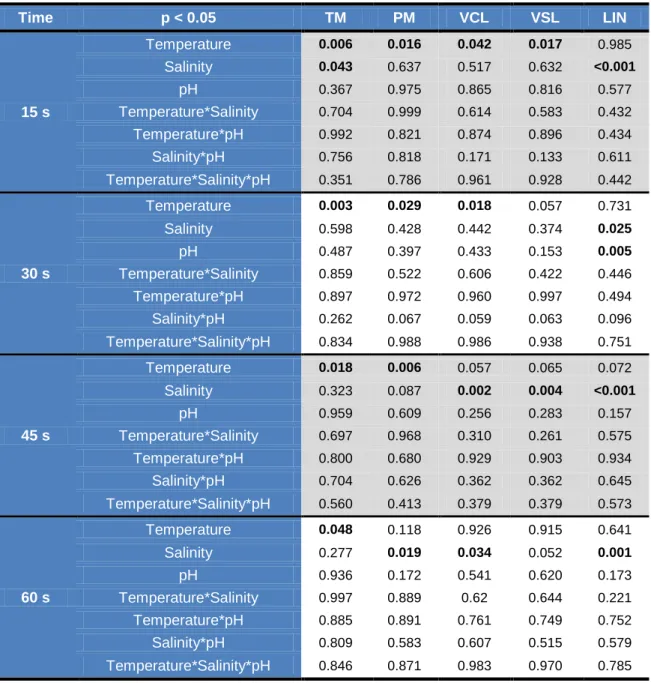
The results gathered from the motility data of all spermatozoa parameters for each treatment and sampling time, resulted in mean values for the 7 selected male samples. The parameters described here are the most relevant descriptors for fish sperm motility analysis, namely TM, PM, VCL, VSL and LIN. A three-way ANOVA was performed for each post activation time for all parameters to analyse if there are interactions between the effects of temperature, salinity and pH. Since there were no interactions between the parameters analysed (Table 2) each factor could be analysed independently.
Temperature affected significantly all parameters except linearity (Figure 6 E) at 15 s post-activation. Its effect decreased in the following times affecting significantly TM (p = 0.003), PM (p = 0.029) and VCL (p = 0.018) at 30 s post-activation, TM (p = 0.018) and PM (p = 0.006) at 45 s post-activation and TM (p = 0.048) at 60 s post-activation.
Salinity affected significantly TM (p = 0.043) and LIN (p < 0.001) at 15 s post-activation and LIN (p = 0.025) at 30 s post-activation, however the effect of salinity was more pronounced in the last post-activation times. At 45 s post-activation, VCL (p = 0.002), VSL (p = 0.004) and LIN (p < 0.001) had significant differences among salinity treatments, as well as at 60 s post-activation (PM (p = 0.019), VCL (p = 0.034) and LIN (p = 0.001)).
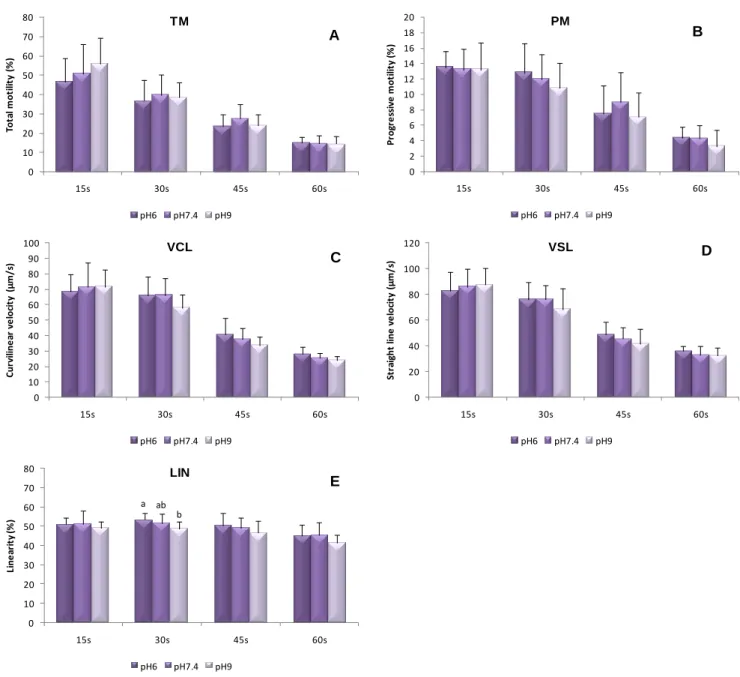
The effect of pH was the less evident since only one significant different was observed for linearity (p = 0.005) at 30 s post-activation.
32
Table 2 - Statistical differences for temperature, salinity and pH for total motility (TM), progressive motility (PM), curvilinear velocity (VCL), straight line velocity (VSL) and linearity (LIN) onS. senegalensis spermatozoa at 15, 30, 45 and 60 s post-activation, sustained by mean values of 7
males. The effect of the three tested conditions on motility parameters was detected by a three-way ANOVA (p < 0.05), significant differences are highlighted in bold.
Time p < 0.05 TM PM VCL VSL LIN 15 s Temperature 0.006 0.016 0.042 0.017 0.985 Salinity 0.043 0.637 0.517 0.632 <0.001 pH 0.367 0.975 0.865 0.816 0.577 Temperature*Salinity 0.704 0.999 0.614 0.583 0.432 Temperature*pH 0.992 0.821 0.874 0.896 0.434 Salinity*pH 0.756 0.818 0.171 0.133 0.611 Temperature*Salinity*pH 0.351 0.786 0.961 0.928 0.442 30 s Temperature 0.003 0.029 0.018 0.057 0.731 Salinity 0.598 0.428 0.442 0.374 0.025 pH 0.487 0.397 0.433 0.153 0.005 Temperature*Salinity 0.859 0.522 0.606 0.422 0.446 Temperature*pH 0.897 0.972 0.960 0.997 0.494 Salinity*pH 0.262 0.067 0.059 0.063 0.096 Temperature*Salinity*pH 0.834 0.988 0.986 0.938 0.751 45 s Temperature 0.018 0.006 0.057 0.065 0.072 Salinity 0.323 0.087 0.002 0.004 <0.001 pH 0.959 0.609 0.256 0.283 0.157 Temperature*Salinity 0.697 0.968 0.310 0.261 0.575 Temperature*pH 0.800 0.680 0.929 0.903 0.934 Salinity*pH 0.704 0.626 0.362 0.362 0.645 Temperature*Salinity*pH 0.560 0.413 0.379 0.379 0.573 60 s Temperature 0.048 0.118 0.926 0.915 0.641 Salinity 0.277 0.019 0.034 0.052 0.001 pH 0.936 0.172 0.541 0.620 0.173 Temperature*Salinity 0.997 0.889 0.62 0.644 0.221 Temperature*pH 0.885 0.891 0.761 0.749 0.752 Salinity*pH 0.809 0.583 0.607 0.515 0.579 Temperature*Salinity*pH 0.846 0.871 0.983 0.970 0.785
4.1.1 Effect of temperature on sperm motility
The effect of temperature on S. senegalensis sperm motility was significantly different for total motility (TM) and progressive motility (PM) and both velocities analysed (VSL and VCL). No significant differences were observed in linearity of spermatozoa trajectory between 16 ºC and 20 ºC.
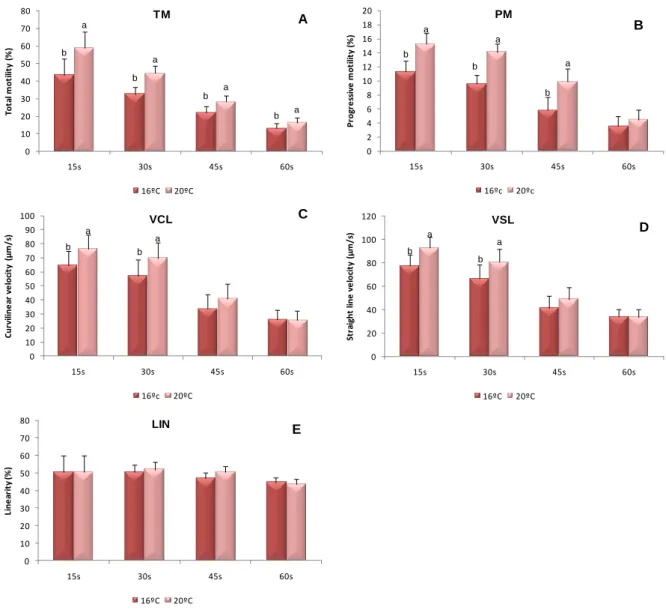
During the motile period total motility was always significantly higher for 20 ºC (58.8%, 44.6%, 28.4%, and 16.6%, respectively) than for 16 ºC (43.6%, 32.5%, 22.2%, and 13.1%, respectively (Figure 6 A). Similarly, progressive motility was significantly improved with 20 ºC
33
solutions (15.2%, 14.1%, and 9.9% respectively) than with 16 ºC solutions (11.3%, 9.6%, and 5.9% respectively) except at 60 s post-activation (Figure 6 B). Both sperm velocities were significantly improved by 20 ºC solution at 15 s (VCL - 76.2, VSL - 92.9 µm/s) and 30 s post-activation (VCL - 69.4%, VSL - 80.7%, compared with 16 ºC solution (VCL - 64.8%, VSL - 77.8% at 15 s post-activation and VCL - 57.3%, VSL - 66.9% 30 s post-activation) (Figure 6 C, D).In all post-activation times it became evident that higher temperature improved significantly sperm motility. This improvement was not at the expense of premature motility loss. The results also show that it improved preferably parameters such as TM (p = 0.006), PM (p = 0.016), VCL (p = 0.042) and VSL (p = 0.017) (Table 2). Moreover, the effect of temperature seemed to improve significantly more parameters in the first recorded post-activation periods (such as TM, PM, VCL and VSL) than at the end of motility (such as TM and PM).
Figure 6 - Effect of temperature (16 ºC and 20 ºC) in S. senegalensis sperm motility at 15, 30, 45 and 60 s post-activation. Statistical differences (p < 0.05) between temperatures in each post-activation time are represented with letters. A - Total motility, B - Progressive motility, C- curvilinear velocity, D - straight line velocity, E - linearity.
b b b b a a a a 0 10 20 30 40 50 60 70 80 15s 30s 45s 60s To ta l m o ti lit y (% ) TM 16ºC 20ºC A b b b a a a 0 2 4 6 8 10 12 14 16 18 20 15s 30s 45s 60s P rog re ss iv e m ot ili ty (% ) PM 16ºc 20ºc B b b a a 0 10 20 30 40 50 60 70 80 90 100 15s 30s 45s 60s C ur vi line ar v e loc it y (µ m /s ) VCL 16ºc 20ºC 0 10 20 30 40 50 60 70 80 15s 30s 45s 60s Li ne ar it y (% ) LIN 16ºC 20ºC E b b a a 0 20 40 60 80 100 120 15s 30s 45s 60s St ra ig h t lin e v e lo ci ty ( µ m /s ) VSL 16ºC 20ºC D C
34
4.1.2 Effect of salinity on sperm motility
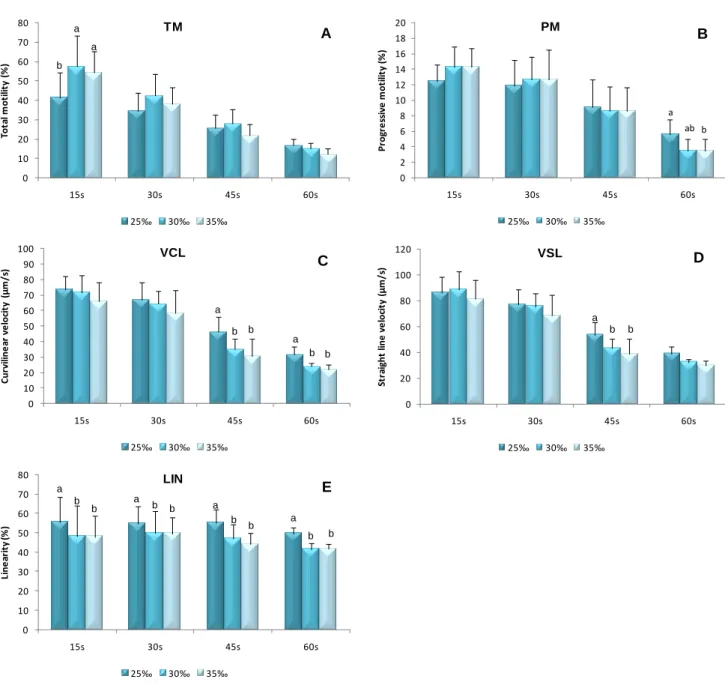
The effect of salinity on S. senegalensis sperm motility could be observed in all the parameters analysed. In most of all parameters lower salinity improved sperm motility except for total motility where 30 ‰ (57.5%) and 35 ‰ (54.5%) were significantly higher than 25 ‰ (41.7%) at 15 s post-activation (Figure 7 A).
Progressive motility and both velocities (VCL, VSL) were improved with 25 ‰ solution in the last periods of motility. Progressive motility was significantly higher with 25 ‰ solution (5.6%) than 35 ‰ (2.9%) at 60 s post-activation although no differences were observed from 30 ‰ solution (3.5%) Figure 7 B). VCL and VSL at 45 s (VCL - 46.3 µm/s, VSL - 53.7 µm/s) post-activation were significantly higher comparing with 30 ‰ (VCL - 35.2 µm/s, VSL - 43.4 µm/s) and 35 ‰ (VCL - 30.6 µm/s, VSL - 38.9 µm/s). Curvilinear velocity had also significantly higher values with 25 ‰ (31.7 µm/s) than 30 ‰ (23.9 µm/s) and 35 ‰ (22.1 µm/s) at 60 s post-activation
(Figure 7 C, D).
The lowest salinity improved sperm linearity throughout the post-activation time (15 s – 55.4%, 30 s – 54.5%, 45 s – 55.0%, 60 s – 49.7%) comparing with 30 ‰ (15 s – 48.1%, 30 s – 49.7%, 45 s – 47.0%, 60 s – 41.4%) and 35 ‰ (15 s – 47.9%, 30 s – 49.5%, 45 s – 44.0%, 60 s – 41.5%) (Figure 7 E).
The use of low salinity (25 ‰) in the activation solution proved to enhance significantly parameters of sperm motility mainly linked with spermatozoa trajectories, such as LIN, throughout the motile period. Salinity was one of the important parameters tested for sperm motility, improving most of the motility parameters.