Introduction
Resistance training (RT) has been recognized as an effective intervention for improving skeletal muscle strength and overall healthy1. The primary aim of strength gains optimization research has been to understand how the manipulation of the training variables, mainly intensity and volume, can affect the strength development. Training intensity refers to the amount of effort that an individual exerts during a given exercise, and it can be manipulated by rest interval, time under tension, and external load. RT-related training intensity it is generally presented as a weight/load based on (1) the percentage of one repetition maximum (1RM) (e.g., 80% of 1RM), (2) a targeted repetition number (e.g., 10 repetitions), or (3) a specific repetitions zone (e.g., 8-12 repetitions)1. Training volume refers to the total number of repetitions performed in each exercise (e.g., 3 sets of 12 repetition; total: 36 repetitions) or during an entire training session (e.g., total repetitions x load)1,2.
Several previous studies with previously untrained young individuals have compared the effects of low- and high-volume training (single vs. multiple sets), indicating that high-volume training results in greater gains in strength than low-volume training3-5. In contrast, other studies have not found any differences on strength gains between low- and high-volume training6-8. These inconsistencies may be associated with the
studied muscle groups because different strength gains have been observed in lower- and upper-body muscles in response to training volume3,5,9,10. In a specific analysis for lower-body
muscles (e.g., knee extensor muscles), some studies have reported greater strength gains with high-volume training than low-volume (3 sets vs.1 set)3,5,11, whereas others reported similar results6,9,12-14.
Therefore, there is a still controversy as to whether multiple sets protocols are more effective than single set protocols for increasing lower-body muscle strength.
This discrepancy may be due to the large difference in study designs (e.g., number and type of exercises, intensity and frequency of training, resting periods between sets and exercises, and washout period) and studied populations (e.g., trained or untrained, and young or old). Moreover, the majority of previous studies have used different groups of subjects to compare the effects of training volume on muscle strength. However, this type of methodological approach does not provide sufficient control over differences and individual behaviors (e.g., genetic, food intake, motivation, training level, and life style) during the intervention period, and may therefore influence the result of the study. Therefore, further studies using well-controlled designs that consider individual variability could bring new insights into the question of training volume on muscle strength.
The purpose of this study was to investigate the effects of training volume on muscular strength in previously untrained Original Article (short paper)
Effects of training volume on lower-body muscle strength in untrained young
men: a contralateral control study
Marcio A. Rinaldo1, Jeferson L. Jacinto1, Francis L. Pacagnelli3, Leonardo Shigaki1, Alex S. Ribeiro1, Mario C. W. Balvedi1, Leandro R. Altimari2, Douglas K. da Silva1, Walquíria B. de Andrade1,
Rubens A. da Silva4, Andreo F. Aguiar1
1Universidade Norte do Paraná, UNOPAR, Center of Research in Health Sciences, Londrina, PR, Brazil;
2Universidade Estadual de Londrina, UEL, Department of Physical Education, Centre for Physical Education and Sports,
Londrina, PR, Brazil;
3Universidade do Oeste Paulista, UNOESTE, Department of Physiotherapy, Presidente Prudente, SP, Brazil;
4Département des Sciences de la Santé, Programme de physiothérapie de l’université McGill offert en extension à l’Université du Québec à Chicoutimi (UQAC), 555 boul. de l’Université, ville du Saguenay, Québec, Canada
Abstract — Aims: The purpose of this study was to examine the effects of training volume (1 vs. 3 sets) on lower-body muscle strength in untrained young men. Methodsː Eighteen untrained young men were recruited and their legs were trained with 1 or 3 sets (in a contralateral design) for 6 weeks, using a knee extension machine. Isokinetic peak torque and one repetition maximum (1RM) were assessed at pre- and post-training. Resultsː There was a similar improvement in the 1RM strength (1SET: +14.8% vs. 3SET: 16.3%, P > 0.05) and peak torque (1SET: +8.1% vs. 3SET: 9.3%, P > 0.05) for both conditions from pre- to post-training. The effect size (ES) for the change in 1RM was moderate for both conditions (1SET: 1.39 vs. 3SET: 1.41), and peak torque was trivial and small for 1SET (0.47) and 3SET (0.55), respectively. Additionally, there were no significant (P > 0.05) differences in the dietary intakes from pre- to post-training. Conclusionsː Our results indicate that 1 set is as effective as 3 sets for increasing lower-body muscle strength after a short-term RT period (6 weeks) in untrained young men.
young men. We used a contralateral control design to compare the effects of 1 or 3 set of RT on lower-body muscular strength. With this experimental design both legs of the same individual are used to perform different exercise interventions (1 or 3 sets), eliminating any confounding factors associated with inter-subject variability (e.g., genetic, food intake, motivation, training level, and life style). We hypothesized that low-volume training (1 set) would be as effective as high-volume training (3 sets) to promote increase in lower-body muscle strength in untrained young men.
Methods
Experimental approach
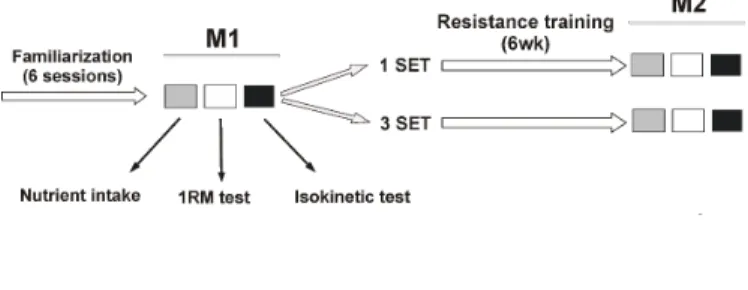
A contralateral control design was used to examine the effects of training volume (1 vs. 3 set) on lower-body muscular strength in previously untrained young men (Fig. 1). With this experimental approach both legs of the same individual were randomly assigned to train with 1 or 3 sets, eliminating any confounding factors associated with inter-subject variability. All subjects performed unilateral 1RM (see maximal isoinertial strength measurement) and isokinetic strength (see isokinetic strength measurement) tests on 2 separate occasions [before (M1) and after (M2) a 6-week RT program] following a 2-week familiarization period (6 non-consecutive sessions) with the unilateral knee extension exercise and 1RM tests to minimize potential learning effects (Fig. 1). The training period was set at 6 weeks because it has been shown to be sufficient to promote significant increase in muscle strength in young subjects2,15. In order to monitor any influence of diet on
strength, the subjects completed 3-day dietary intake records (see nutrient intake) before (M1) and after (M2) the intervention period.
Figure 1. Experimental design.
Participants
Twenty previously untrained young men volunteered for the study. Two subjects dropped out during the study because they underestimated the time required to participate. Descriptive characteristics of the participants are presented in Table I. An a priori power analysis was conducted (G*Power v. 3.0.1) for an F test (repeated measures, within factors for two time points).
On the basis of a statistical power (1 – β) of 0.90, a small effect size (0.5), and an overall level of significance of 0.05, least 14 subjects were required for this study. Eligibility criteria consisted of following: (1) to be between 18 and 30 years of age, (2) not to be vegetarian (3) not to be smokers or alcoholics, (4) to have not ingested any ergogenic supplement or anabolic steroids 6 months prior to the start of study, (5) to have not ingested any medication that could affect muscle growth or the ability to train intensely during the study, (6) have no experience with strength training program prior to the start of study, (7) to have a detailed description of their lifestyle and daily food intake, and (8) to have medical approval for the practice of physical exercise. All subjects were carefully informed of the purpose, procedures, benefits, risks and discomfort of the investigation and signed an informed consent document approved by the Institutional Review Board of the North University of Paraná (protocol no: 846.393). This study meets the ethical standards of research with human subject16, and all procedures were performed according to the principles outlined in the 1964 Declaration of Helsinki.
Table 1. Physical characteristics of the subjects (N = 18).
Age (y) Body mass (kg) Height (cm) BMI (kg/m2)
24.6 ± 4.1 78.0 ± 12.4 177.7 ± 8.2 24.5 ± 3.4 Values are mean ± SD.
BMI: body mass index
Familiarization
All subjects completed a 2-week orientation program (6 non-consecutive sessions) before M1 for familiarization with the knee extension exercise and 1RM tests to minimize any potential learning effects and establish the reliability of the testing protocols. The sessions consisted of repeated performance of knee extension exercise (3 sets of 8–12 repetitions) (days 1, 2, and 3), and tests of 1RM (days 4, 5, and 6). Maximal effort in each test was requested during the sessions to reduce any learning effects and to make the data consistent. The intraclass correlation coefficient was > 0.97 for 1RM tests, indicating the elimination of the learning curve for the subjects. All familiarization sessions and physical tests were performed at the same location, between 7 and 9 pm.
Nutrient intake
Training protocol
Participants underwent a 6-wk RT program (2 days•wk−1; 1 or 3 sets of 8–12 repetitions at 80% of 1RM) designed to promote increase in muscle strength1. The training program focused on quadriceps muscle using a commercial knee extension machine (Nakagym equipment, São Paulo, Brazil), in which both legs of the same individual were trained with 1 or 3 sets, alternating the leg that started the training at each session. A 2-minute rest was taken between the 2 protocols and between the sets (3SET condition). The velocity/cadence of muscle action was 30 repetitions per minute (1 s concentric: 1 s eccentric), which was controlled with a metronome. Each training session began with general (stretching and moderate walking on treadmill for 10 min) and specific (1 set of 12 repetitions with a self-selected load) warm-up exercises for quadriceps muscle. Qualified personnel (with more than 5 years of practical in resistance exercise) supervised individually each participant during every workout. The training load was adjusted every 15 days according to a 1RM test. At the end of each session, stretching exercise was performed just to relax the exercised muscle. The total time of one training session for each participant was approximately 30 min. The sessions were performed between 7 and 9 pm.
Maximum isoinertial strength
Maximal isoinertial strength was assessed using a 1RM standard testing protocol as previously documented elsewhere15.
1RM tests were carried out on both legs on the same day, with a 5-min rest between measuring the 2 legs. The 1RM test was preceded by a set of warm-up exercise (5–10 repetitions) at approximately 50 % of the load to be used in the first attempt of the 1RM test. After 2 min of rest, the 1RM attempts were performed with a progressively increasing load for each attempt and were separated by 3- to 5-min rest intervals. The subjects were permitted 3–4 attempts to determine the 1RM value. 1RM was defined as the greatest load lifted through a full range of motion before 2 failed attempts at a given load. Verbal encouragement was provided during all 1RM attempts. The exercise execution technique was standardized and continuously monitored in an attempt to assure the quality of the data. Test-retest reliability of the strength measures was determined on 8 subjects, 2 weeks apart. The coefficient of variation (CV) was 2.6 % for 1RM measures.
Isokinetic peak torque
Unilateral knee extension torque peak was assessed before (M1) and after (M2) the 6-wk training program using a Biodex System 3 Isokinetic Dynamometer (Biodex, Inc., Shirley, NY). Isokinetic strength tests were carried out on both legs on the same day, with a 5-min rest between measuring the 2 legs. The subjects had not been engaged in any strenuous activity 2 days prior to the test. The test protocol consisted of 3 sets of 8 repetitions at 60°/s,
with 1-min rest between sets, and a range of motion at the knee joint was 90°–10° of knee flexion (0° = full knee extension). Prior to the isokinetic test, the subjects performed a specific warm-up that consisted of 8 submaximal repetitions at 60°/s, during which the subjects were advised to avoid using maximal effort. The subjects were set up on the dynamometer in a comfortable, upright, seated position. Straps with Velcro were used to stabilize the thigh, pelvis, and trunk to prevent extraneous body movement. The axis of the dynamometer was aligned with the axis of the rotation of the right knee joint, according to the body dimensions of each subject. The subjects’ arms were placed across their chest with their hands grasping the straps. These settings were identical in each subject. Qualified personnel individually supervised each participant during every test. The subjects were given verbal encouragement in an attempt to achieve maximal effort in each set, and they were instructed to exhale during the contractions. Calibration of the Biodex dynamometer was performed according to the specifications of the manufacturer before each test. The validity coefficient of this equipment is 0.9917, and the test–retest
reliability for measuring the peak torque during knee extension is high (ICC: 0.98) in young subjects9.
Statistical analyses
Data are expressed as means ± SD. The normality and homogeneity for outcome measures were tested using the Shapiro– Wilk’s and Levene’s tests, respectively. Nutritional intake at pre- and post-training was compared using a paired t-test. Two way (group x time) ANOVA with repeated measures was used to evaluate the data of the 1RM and peak torque. All analyses were done on the raw data. When significant differences were confirmed with ANOVA, multiple comparisons testing were performed using Bonferroni post hoc analysis to identify these differences. The significance level was set at P ≤ 0.05. Statistical analyses were performed using SPSS statistical analysis software (SPSS version 20.0; Chicago, IL, USA). The effect size (ES) was calculated according to the following equation: ES=Posttest mean-Pretest mean /Pretest SD, considering an ES < 0.5 as trivial, 0.50-1.25 as small, 1.25-1.9 as moderate and ≥ 2.0 as large18.
Results
Participant characteristics and training volume
The physical characteristics and macronutrients intake of the participants are presented in Table I and II, respectively. There were no significant (P > 0.05) differences in the daily dietary intakes from
condition during the training program.
Table 2. Dietary analyses.
Pre Post
Carbohydrate, g/kg/d 3.7 ± 1.4 3.5 ± 1.2
Protein, g/kg/d 1.6 ± 0.9 1.7 ± 0.8
Fat, g/kg/d 1.2 ± 0.6 1.4 ± 1.0
Values are mean ± SD. There were no differences among pre- and post-train-ing.
Maximal isoinertial strength
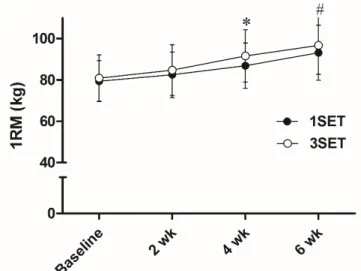
The 1RM data are shown in Figure 2. There was no group-by-time interaction or main effect for group. A significant (P < 0.05) main effect
for time demonstrated similar improvement in the 1RM strength for both conditions (1SET: +14.8% vs. 3SET: +16.3%, P > 0.05) from
pre- to post-training. According to the scale proposed by Rhea18, the ES for the change in 1RM was moderate for both conditions (1SET: 1.39 vs. 3SET: 1.41).
Figure 2. Maximal isoinertial strength (1RM) along the 6-wk resis-tance training program.
Data are mean ± SD. *P < 0.05 compared to baseline and 2 wk for both
protocols. #P < 0.05 compared to 4 wk for both protocols.
Isokinetic peak torque
The isokinetic peak torque data are shown in Figure 3. There was no group-by-time interaction or main effect for group. A significant
(P < 0.05) main effect for time demonstrated similar improvement in
the peak torque for both conditions (1SET: +8.1% vs. 3SET: +9.3%,
P > 0.05) from pre- to post-training. According to the scale proposed
by Rhea18, the ES for the change in peak torque was trivial (0.47) for 1SET and small (0.55) for 3SET.
Figure 3. Isokinetic peak torque before and after the 6-wk resistance training program.
*P < 0.05 compared to corresponding pre-training values.
Discussion
The purpose of this study was to investigate the effects of training volume (1 vs. 3 sets) on lower-body muscle strength in previously untrained young men. We used a contralateral control design (crossover-like) to investigate the effects of training volume on lower-body muscle strength. With this experimental approach both legs of the same individual were randomly assigned to train with 1 or 3 sets, eliminating any inter-subject variability (e.g., genetic, food intake, motivation, training level, and life style) that could influence the results. Moreover, we evaluated the macronutrients intake before and after the 6-wk intervention period to control any influence of diet on muscle strength gains. Expectedly, the participants had a sufficient CHO (> 1.2 g/kg/d) and proteins (> 3 g/ kg/d) intake according to the recommendations proposed by American College of Sports Medicine19, indicating that any
effect of training was not influenced by macronutrient intake. With these variables controlled, our results indicated that 1 set is as effective as 3 sets to promote increases on 1RM (1SET: +14.8% vs. 3SET: +16.3%, P > 0.05) and peak torque (1SET: +8.1% vs. 3SET: +9.3%, P > 0.05), despite of a small superiority of the 3 sets in the ES. Previous studies have shown different strength gains in lower- and upper-body muscles in response to training volume3,5,9,10, indicating that a non-dissimilar analysis of limbs may complicate the understanding of this variable. Therefore, to avoid these confounding factors we conducted a comparative analysis only with training volume-studies that included lower-body muscles data.
untrained subjects6,9,12-14. For example, Hass, Garzarella, de
Hoyos, Pollock6 showed a similar increase in leg extension 1RM for 1 (+13.6%) and 3 sets (+12.8%) after a 13-wk RT program (8-12 repetitions to volitional fatigue at 75% of 1RM) in previously trained subjects. Mitchell et al.12 also showed
similar knee extension 1RM gains for 1 and 3 sets (~25%) after a 10-wk RT program (repetitions to voluntary failure at 80% of 1RM) in previously untrained subjects. Similar results have also been shown in elderly subjects after 6 weeks of RT (knee extension 1RM gains, 1 set: +16.1% vs. 3 sets: %21.7%, P > 0.05)13. Our findings, together with these above-mentioned
studies6,12,13 show that 1 set is as effective as 3sets to promote
increased maximal dynamic strength in lower-body muscles during short- and long-term RT period (range: 6 – 13 weeks) in young and elderly subjects. Therefore, it seems plausible that a threshold for sets in untrained individuals can be achieved with 1 set, making the higher volume (i.e., 3 sets) irrelevant in terms of muscular strength gains.
In contrast to our results, previous studies have reported greater 1RM gains with high-volume training (3 sets) than low-volume (1 set) in young and elderly subjects3,5,10,11. A
possible explanation for discrepancy with the aforementioned studies may be the training intensity. The short- and long-term studies3,5,10 that reported superior effects for 3 sets in
young subjects used a higher training intensity (load for 7RM in each set that which corresponds to an intensity >80% of 1RM, and 3 exercises for quadriceps muscle) compared to our study and others6,12 that used a load range between 8-12RM
(75-80% of 1RM, and 1-2 exercises for quadriceps muscle). Curiously, similar responses have been observed in elderly subjects: additional effects on knee extension 1RM gains was reported when a higher training volume (3 sets) was associated with moderate (10-15RM)11, but not low- (15-20RM)13 or predominantly low-intensity (80% of training period with 15-20RM)20. Thus, it is possible that 3 sets are more effective than
1 set for increased lower-body muscles 1RM strength when higher intensity are used in young (e.g., > 80% of 1RM) and elderly (e.g., > 70% of 1RM) subjects. Opposite to intensity, training volume does not seem to explain the difference in strength gains during the early phases of training (up to 6 weeks), because even with a lower training volume (~ 2500 kg) compared to our study (~ 2700kg) and others10, Rønestad, Egeland, Kvamme, Refsnes, Kadi, Raastad5 found higher 1RM strength gains with 3 sets compared to 1 set. Nevertheless, it is noteworthy that the training period was higher (11 weeks) in the study from Rønestad, Egeland, Kvamme, Refsnes, Kadi, Raastad5, indicating that the duration of the training program may be more important than the training volume to discriminate differences in gains between 3 and 1 set.
A confounding issue when analyzing muscular strength is the lack of familiarization of the participants with the exercises used, where current literature indicates that several test sessions are beneficial in achieving accurate maximal strength baseline scores21. The absence of familiarization,
principally in untrained subject, may result in learning-related
gains of strength, obscuring the effects of training volume during experimental period. A strong point of our study is that a 2-wk familiarization period (6 sessions) was provided before strength tests, in order to reduce any potential learning effects and make the data consistent.
Measurements of muscular strength during a RT program are generally determined by both 1RM and peak torque. To determine the peak torque is used an isokinetic dynamometer, which is a high-tech equipment and high internal validation, but its use is expensive and has limited practical application. On the other hand, 1RM test have less financial cost and high applicability in the practical field. The advantage of our study compared to previous studies in this area is that we used both measures to investigate the effects of training volume on muscular strength of the knee extension muscles. In this sense, it is important to note in our study that strength gains were lower in isokinetic peak torque compared to 1RM for both 1 (peak torque: +8.1 vs. 1RM: +14.8%) and 3 sets (peak torque: +9.3 vs. 1RM: +16.3%), indicating that dynamic isokinetic strength test may underestimate the strength gains after a dynamic/ isoinertial RT program. This result may be attributed to the specificity of training and suggest that maximal isoinertial strength (1RM) test seems to be more suitable to strength evaluate when a dynamic/isoinertial RT program is applied. Moreover, a direct comparison between the results of studies that analyzed the isokinetic and 1RM strength gains after a dynamic/isoinertial RT program may confuse the interpretation of the training effects. To avoid this bias, our results of isokinetic (peak torque) strength were compared only with studies5,9 that
also performed isokinetic strength test in lower-body muscles after a dynamic/isotonic RT program. In contrast to our results, Rønnestad, Egeland, Kvamme, Refsnes, Kadi, Raastad5 showed
that 3 sets (+16%) were superior to 1 set (+8%) to promote increase in peak torque in the knee extensions muscles after a 11-wk RT program in young men. These differences in the results among studies may be due to intensity, frequency and/ or duration of training program. Rønnestad Egeland, Kvamme, Refsnes, Kadi, Raastad5 used three exercises for quadriceps
muscle (i.e., leg press, knee extension, and leg curl) in a frequency of 3 times/week for 11 weeks, and our study used only one exercise (i.e., knee extension) in a frequency of 2 times/week for 6 weeks. Moreover, when a training protocol similar to study our (1 vs. 3 sets for one exercise, 2 times/ week) was used over a longer training period (12 weeks)9, it
was showed that only the 3 sets protocol promoted significant peak torque gains (3 sets: +10.9%, P < 0.05, and 1 set: +5.1%, P > 0.05) in knee extensors muscles. Therefore, it seems that training duration and/or exercises number may to be important to reveal significant differences in dynamic isokinetic strength gains between 3 and 1 set in untrained young subjects.
possibility that some strength from the leg 3 sets was transferred to the leg 1 set due to a cross-educational effect22, which could
reduce differences in strength gains between the 2 protocols. Another limitation was that we used only 3 sets (vs. 1 set) to investigate the effects of training volume on strength gains. Our results cannot confirm whether a higher training volume (i.e., ≥ 4 sets) could be superior to 1 set to promote additional gains on muscle strength. Finally, we used only 1 leg exercise during the RT program, in which it may underestimate the amount of exercise (e.g., ≥ 2 exercises) regularly used in practical routine of novice and intermediate practitioners. Our results cannot confirm whether 1 set is as effective as 3 sets when a larger number of exercises are incorporated into the training routine. Further studies are required to address these issues.
Conclusion
In conclusion, the results of the present study demonstrate that 1 set is as effective as 3 sets to increase the lower-body muscle strength during the first 6 weeks of isoinertial strength training in previously untrained young men. In addition, our data show that increase in muscular strength during isoinertial strength training may be underestimated in dynamic isokinetic strength test, compared to 1RM test. This result may be attributed to the specificity of training and suggest that 1RM test seems to be more suitable to strength evaluate when an isoinertial strength training program is applied.
References
1. American College of Sports Medicine. American College of Sports Medicine position stand. Progression models in resistance training for healthy adults. Med Sci Sports Exerc. 2009;41:687-708.
2. Robbins DW, Marshall PW, McEwen M. The effect of training volume on lower-body strength. J Strength Cond Res. 2012;26:34-9.
3. Hanssen KE, Kvamme NH, Nilsen TS, Rønnestad B, Ambjørnsen IK, Norheim F, et al. The effect of strength training volume on satellite cells, myogenic regulatory factors, and growth factors. Scand J Med Sci Sports. 2013;23:728-39.
4. Munn J, Herbert RD, Hancock MJ, Gandevia SC. Resistance training for strength: effect of number of sets and contraction speed. Med Sci Sports Exerc. 2005;37:1622-6. 5. Rønnestad BR, Egeland W, Kvamme NH, Refsnes PE,
Kadi F, Raastad T. Dissimilar effects of one- and three-set strength training on strength and muscle mass gains in upper and lower body in untrained subjects. J Strength Cond Res. 2007;21:157-63.
6. Hass CJ, Garzarella L, de Hoyos D, Pollock ML. Single versus multiple sets in long-term recreational weightlifters. Med Sci Sports Exerc. 2000;32:235-42.
7. Sooneste H, Tanimoto M, Kakigi R, Saga N, Katamoto S. Effects of training volume on strength and hypertrophy in young men. J Strength Cond Res. 2013;27:8-13.
8. Wolfe BL, LeMura LM, Cole PJ. Quantitative analysis of single- vs. multiple-set programs in resistance training. J Strength Cond Res. 2004;18:35-47.
9. Bottaro M, Veloso J, Wagner D, Gentil P. Resistance training for strength and muscle thickness: Effect of number of sets and muscle group trained. Sci Sport. 2011;26:259-64. 10. Paulsen G, Myklestad D, Raastad T. The influence of
volume of exercise on early adaptations to strength training. J Strength Cond Res. 2003;17:115-20.
11. Ribeiro AS, Schoenfeld BJ, Pina FLC, Souza MF, Nascimento MA, Dos Santos L, et al. Resistance training in older women: comparison of single vs. multiple sets on muscle strength and body composition. Isokinet Exerc Sci. 2015;23:53-60.
12. Mitchell CJ, Churchward-Venne TA, West DW, Burd NA, Breen L, Baker SK, et al. Resistance exercise load does not determine training-mediated hypertrophic gains in young men. J Appl Physiol. 2012;113:71-7.
13. Radaelli R, Wilhelm EN, Botton CE, Rech A, Bottaro M, Brown LE, et al. Effects of single vs. multiple-set short-term strength training in elderly women. Age (Dordr). 2014;36:9720.
14. Starkey DB, Pollock ML, Ishida Y, Welsch MA, Brechue WF, Graves JE, et al. Effect of resistance training volume on strength and muscle thickness. Med Sci Sports Exerc. 1996;28:1311-20.
15. Aguiar AF, Buzzachera CF, Pereira RM, Sanches VC, Januário RB, da Silva RA, et al. A single set of exhaustive exercise before resistance training improves muscular performance in young men. Eur J Appl Physiol. 2015;115:1589-99.
16. Harriss DJ, Atkinson G. Ethical Standards in Sport and Exercise Science Research: 2016 Update. Int J Sports Med. 2015;36:1121-4.
17. Drouin JM, Valovich-mcLeod TC, Shultz SJ, Gansneder BM, Perrin DH. Reliability and validity of the Biodex system 3 pro isokinetic dynamometer velocity, torque and position measurements. Eur J Appl Physiol. 2004;91:22-9. 18. Rhea MR. Determining the magnitude of treatment effects
in strength training research through the use of the effect size. J Strength Cond Res. 2004;18:918-20.
19. Thomas DT, Erdman KA, Burke LM. American College of Sports Medicine Joint Position Statement. Nutrition and Athletic Performance. Med Sci Sports Exerc. 2016;48:543-68.
20. Radaelli R, Botton CE, Wilhelm EN, Bottaro M, Lacerda F, Gaya A, et al. Low- and high-volume strength training induces similar neuromuscular improvements in muscle quality in elderly women. Exp Gerontol. 2013;48:710-6. 21. Soares-Caldeira LF, Ritti-Dias RM, Okuno NM, Cyrino ES,
22. Lee M, Carroll TJ. Cross education: possible mechanisms for the contralateral effects of unilateral resistance training. Sports Med. 2007;37:1-14.
Corresponding author
Andreo F. Aguiar
Center of Research in Health Sciences, North University of Paraná (UNOPAR), Avenue Paris, 675, Jardim Piza, CEP: 86041-120, Londrina, Paraná, Brazil. Email: [email protected]
Manuscript received on May 2, 2018 Manuscript accepted on June 16, 2018