Floristic and structure of the arboreal community of an Ombrophilous Dense Forest
at 800 m above sea level, in Ubatuba/SP, Brazil
Ana Cláudia Oliveira de Souza1* , Luís Benacci2 & Carlos Alfredo Joly3
1Universidade Estadual Paulista Júlio de Mesquita Filho, Departamento de Botânica, Campus de Rio Claro,
Av. 24 A, 1515, 13506-900, Rio Claro, SP, Brasil 2Instituto Agronômico, 13020-902, Campinas, SP, Brasil
3Universidade de Campinas, Instituto de Biologia, Campinas, SP, Brasil
*Corresponding author: Ana Cláudia Oliveira de Souza, e-mail: [email protected]
SOUZA, A. C. O., BENACCI, L., JOLY, C. A. Floristic and structure of the arboreal community of an Ombrophilous Dense Forest at 800 m above sea level, in Ubatuba/SP, Brazil. Biota Neotropica. 18(4): e20180590. http://dx.doi.org/10.1590/1676-0611-BN-2018-0590
Abstract: Undoubtedly, the publication of floristic lists and phytosociological studies are important tools for metadata generation, quantification and characterization of the megadiversity of Brazilian forests. In this sense, this work had the objective of describing the composition and the structure of the tree community of one hectare of Dense Atlantic Rainforest, at an altitude of 800 m. All individuals, including trees, palm trees, arborescent ferns and dead and standing stems, with a diameter at breast height (DBH) of ≥ 4.8 cm were sampled. After the identification of the botanical material, we proceeded to calculate the usual phytosociological parameters, besides the Shannon diversity index (H’) and Pielou equability index (J). A total of 1.791 individuals were sampled, of which 1.729 were alive, belonging to 185 species, 100 genera and 46 families. The results obtained showed a strong similarity of structure and floristic composition with plots of both Montana and Sub Montana Ombrophilous Dense Forest studied in the same region. This reinforces the hypothesis that the transition between the phytophysiognomies of the Atlantic Ombrophylous Dense Forest is gradual, and that the boundaries between them cannot be clearly established. Keywords: Biodiversity conservation, Megadiversity, Atlantic forest, Serra do Mar State Park, PELD/ILTER FGAF Site.
Florística e estrutura da comunidade arbórea de uma Floresta Ombrófila Densa a 800
m acima do nível do mar, em Ubatuba/SP, Brasil
Resumo: Indiscutivelmente a publicação de listas florísticas e estudos fitossociológicos são importantes ferramentas para a geração de metadados, quantificação e caracterização da megadiversidade das florestas brasileiras. Neste sentido, o presente trabalho teve por objetivo descrever a composição e a estrutura da comunidade arbórea de um hectare de Floresta Ombrófila Densa Atlântica, na cota dos 800 m de altitude. Para tanto foram estabelecidas 100 subparcelas de 10 x 10 m, distribuídas em quatro blocos amostrais de 0,25 ha, onde foram amostrados todos os indivíduos arbóreos, incluindo palmeiras, fetos arborescentes e indivíduos mortos e em pé, com DAP (diâmetro à altura do peito) ≥ 4,8 cm. Após a identificação do material botânico e do cálculo dos parâmetros fitossociológicos usuais, foram calculados os índices de diversidade de Shannon (H’) e de eqüabilidade de Pielou (J). Foram amostrados 1.791 indivíduos arbóreos, sendo 1.729 vivos pertencentes a 185 espécies, 100 gêneros e 46 famílias. Os resultados obtidos mostram forte similaridade de estrutura e composição florística com parcelas tanto de Floresta Ombrófila Densa Montana como Floresta Ombrófila Densa Submontana estudadas na mesma região, reforçando a hipótese que a transição entre as fitofisionomias da Floresta Ombrófila Densa Atlântica é gradual e que os limites entre elas não podem ser claramente estabelecidos.
Palavras-chave: Conservação da biodiversidade, Megadiversidade, Floresta Atlântica, Parque Estadual da Serra do Mar, Sítio PELD/ILTER FGAF.
Introduction
The Atlantic Forest, classified by Myers et al. (2000) among the five most threatened hotspots in the world, originally covered about 82% of the state of São Paulo (Joly et al. 1999), especially due to the coffee economic cycle, was reduced to about 5% of its original area (Kronka et al. 2005). This biome, which is classified as the second largest tropical rainforest on the American continent (Morellato & Haddad 2000), is composed of a mosaic of ecosystems with specific ecological processes (Campanili & Schaffer 2010).
The well-preserved stretches, which harbour great floristic diversity, are located mainly in the Serra do Mar region (SOS Mata Atlântica & INPE 2014), a set of scalloped escarpments that extend from
Rio de Janeiro to Santa Catarina (Almeida & Carneiro 1998). The largest continuous well-preserved stretch is protected by the Serra do Mar State Park (PESM).
During the last decade, the lack of large and intensive studies in the region of the north coast of São Paulo was greatly improved by work in the Picinguaba and Santa Virgínia Nucleus of the Serra do Mar State Park (Joly et al. 2012). However, between the elevations of 400 and 1000 m altitude, a large information gap persisted, because there was no floristic or phytosociological study with expressive representativeness of the arboreal vegetation in these intermediate levels.
Therefore, this work had the objective to describe the composition and structure of the tree community of one hectare of Montana Ombrophilous Dense Forest in the altitude of 800 m, an intermediate level between the altitudes of 400 and 1000 m. This proposal are of extreme importance for the generation of data that allow a better understanding of the full extent of the megadiversity of the forests that cover the Serra do Mar.
Material and Methods
1. Location and characterization of the study area
The Serra do Mar State Park (PESM) is about 332,000 ha, is predominantly covered by Ombrophilous Dense Forest (Veloso et al. 2012) and extends through 25 municipalities of São Paulo from sea level to around 1600 m altitude, including coastal plains, scarps and plateaus (Mattoso 2006). In the northern coastal region, in the plains area, the lowland forest presents a tropical climate without a dry season, with an average annual rainfall of 2200 mm, and even in the driest months (June to August) it is less than 60 mm (Setzer 1966, Rosado et al. 2012). However, the temperate tropical climate is present in the plateau, in the montane forest, with an average annual precipitation near 2000 mm and frequent occurrence of fogs that cover large areas
of this forest (Rosado et al. 2010).
In the region, soils low in basic cations and rich in aluminum predominate in comparison to other tropical forests (Martins 2010, Joly et al. 2012). The study area (23º 21 ‘34-40 “S, 45º 06’ 31-40” W) is located in the cliffs of the Serra do Mar, presenting relief with strong slopes (Forest Institute 2010) and is within the PELD/ILTER Functional Gradient of Atlantic Forest/FGAF site, established in 2010 ( http://peld-biotagradiente.net/). This was the portion denominated as P, following
the sequence of areas previously studied. Although the area studied was administratively part of Picinguaba Nucleus, due to its proximity and logistics, the Santa Virgínia Nucleus was used as an operational base.
2. Establishment of permanent plots and survey of vegetation
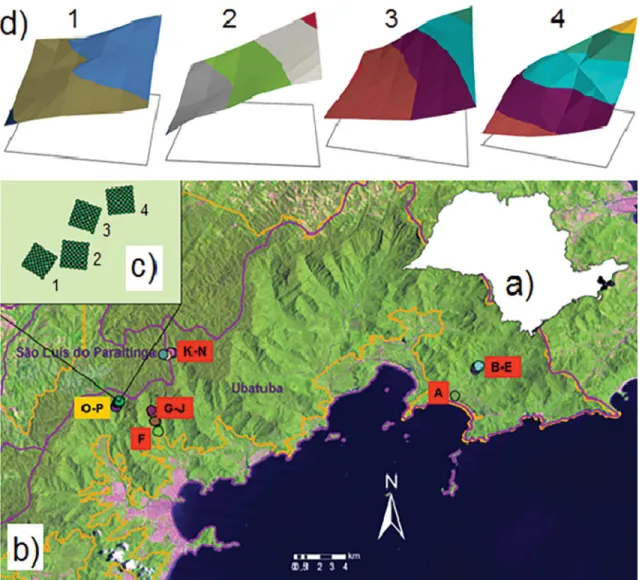
In the studied area, 100 subplots of 10 x 10 m were established, distributed in four sample blocks of 0.25 ha (50 x 50 m) and a maximum distance between the blocks of around 40 m (Figure 1), between altitudes of 758 to 866 m (quota of 800 m). The allocation of subplots, georeferenced and delimited with PVC pipes of 1.5 m height and 5” diameter at the external vertices and 3/4” in the others, in order to allow long term studies and continuous monitoring in these areas was done by a team specialized in topography, as proposed by Joly et al. (2012).
The floristic survey was carried out from the collection of botanical material of the arboreal individuals, including palm trees, arborescent ferns and dead and standing individuals, with a diameter at breast height (DBH) of ≥ 4.8 cm. The collection trips were carried out from January 2011 to January 2012. The identifications were made with the aid of relevant literature and expert consultations, as well as comparisons with the IAC, UEC and HRCB herbarium collections. The species were grouped by families according to the classification system of Angiosperm Phylogeny Group (APG IV 2016) with indication of subfamilies in Fabaceae, according to the consensual proposal discussed by LPWG (2013). For the arborescent ferns, phylogenetic order was also followed (Christenhusz et al. 2011).
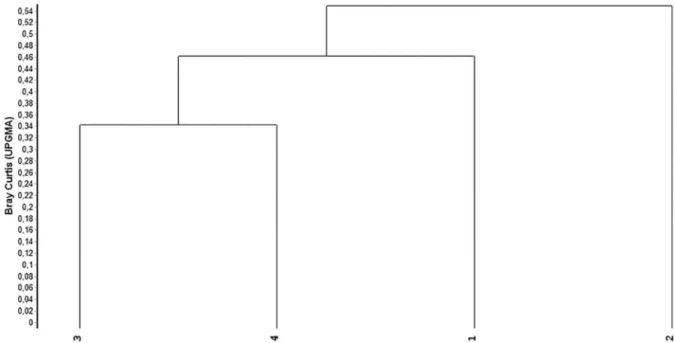
For the phytosociological analyses, the following parameters were represented: number of individuals; absolute frequency; absolute dominance and importance value, and the Shannon (H’) diversity indexes, using the natural basis, and Pielou (J) equation (Brower & Zar 1984) were calculated. In the multivariate analyses, the FITOPAC 2.1 program (Shepherd 2010) was used, from a quantitative matrix (absolute density of all morphospecies, identified at least up to the family level), and a dendrogram was constructed using the UPGMA method, using the coefficient of Bray Curtis, to verify the similarity among the four sample blocks.
Results
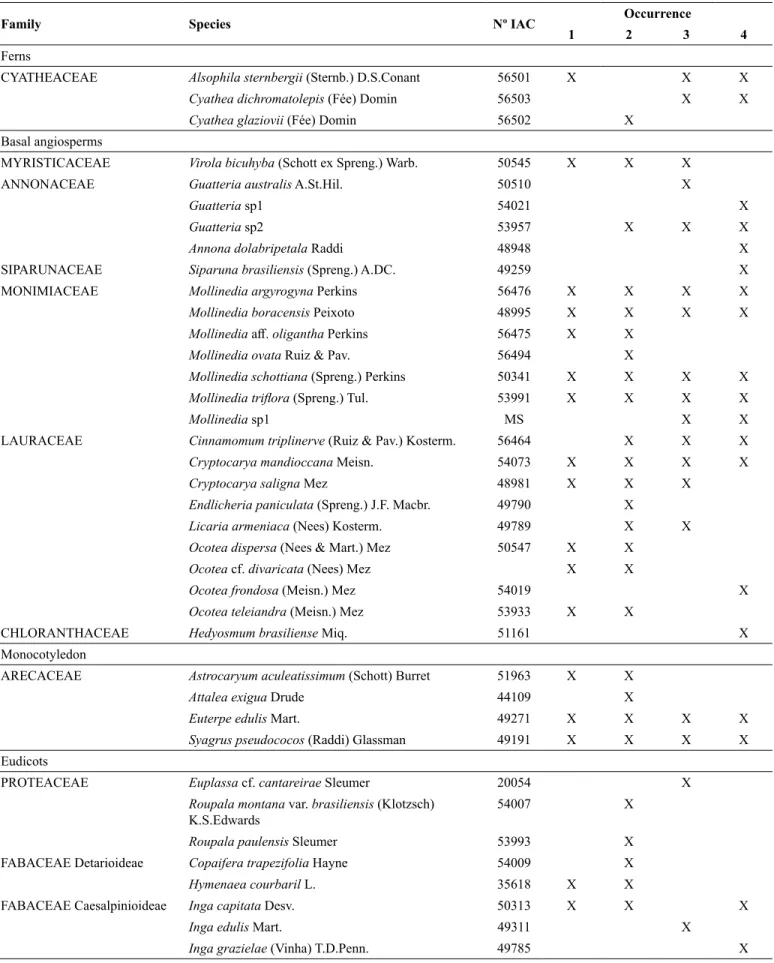
In the total area, 1.791 individuals were demarcated, of which 1.729 were alive, including 1610 trees (89.8% of individuals), 112 palm trees (6.2%) and 7 arborescent ferns (0.4%) belonging to 185 species, 100 genera and 46 families. Two individuals remained undetermined, not having been collected, due to the absence of branches and high height (Table 1). The individuals still dead and standing (62) represented 3.57% of the sample.
Myrtaceae was the richest family (48 species, 25.9%), followed by Rubiaceae (16 species, 8.6%), Fabaceae (11 species, 5.9% - being six Caesalpinioideae, three Faboideae and two Detarioideae), Lauraceae (9 species, 4.9%), Melastomataceae (8 species, 4.3%), Monimiaceae and Sapotaceae (7 species, 3.8% each), which together comprised 57.2% of the species found in the area. Four of these families were also among the most abundant: Rubiaceae (540 individuals.ha-1, 31.3% of live trees), followed by Myrtaceae (233, 13.5%), Monimiaceae (122, 7.1%) and Melastomataceae (111, 6.4% – fifth position), together with Arecaceae (112, 6.5% – fourth position) and Nyctaginaceae (94, 5.4% – sixth position) added up to 70.2% of the live trees.
Figure 1. Location of the region and area of study. a) Núcleos Picinguaba and Santa Virgínia (PESM), in the region of the north coast
(São Paulo - Brazil); b) Distribution of plots (1 ha each) with studies already carried out (A–J, 0–400 m; K–N 1000 m); c) Spatial
arrangement of sample blocks of plot P (800 m); d) Topographic scheme in each sample block, where equal colour bands correspond
to the same altitude (ranging from 758 m – block 1, to 866 m – block 4).
value of importance (60.9% of importance value index – IVI), followed by Myrtaceae (42.4%) and Monimiaceae (23.4%). In relation to genus, Eugenia (Myrtaceae) was the richest with 21 species (11.4% of the
total), followed by Mollinedia (Monimiaceae) (seven species, 3.8%), Marlierea and Myrcia (Myrtaceae) and Inga (Fabaceae) (six species, 3.2% each), which added up to 24.8% of the species.
The estimated diversity of the community was H’ = 4.3 and the
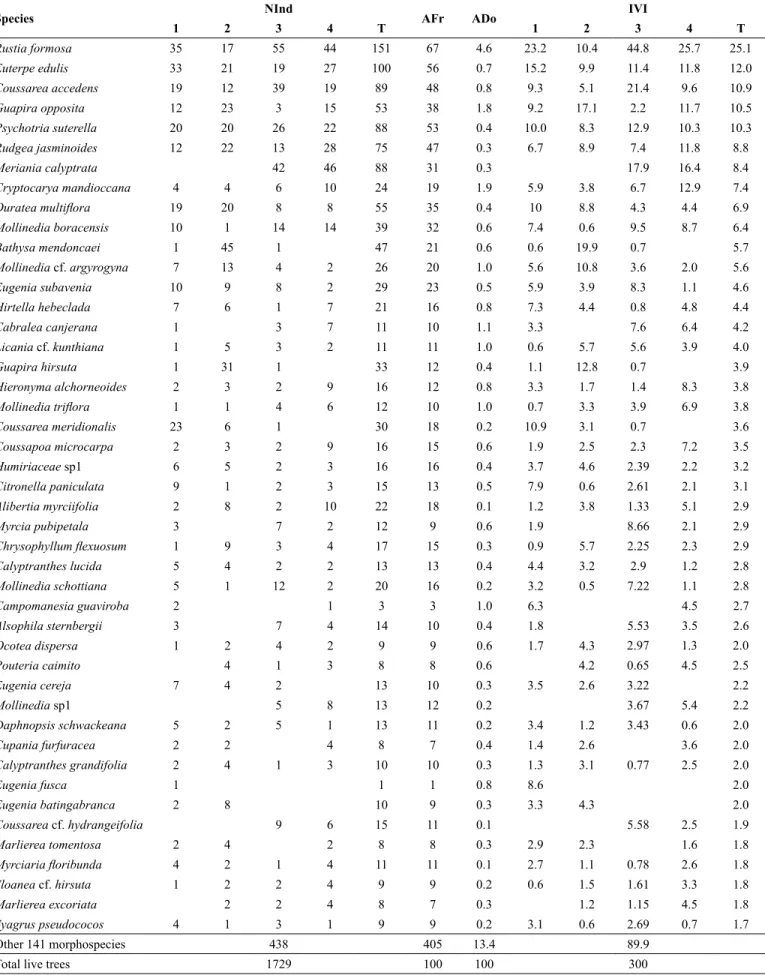
equability was 0.82. Rustia formosa (151 individuals.ha-1, 8.7% of live
trees), Euterpe edulis (100, 5.8%), Coussarea accedens (89, 5.2%), Psychotria suterella and Meriania calyptrata (88, 5.1% each one of them), Rudgea jasminoides (75, 4.3%), Ouratea multiflora (55, 3.2%)
and Guapira opposita (53, 3.1%) were the most abundant species (Table 2), accounting for 40.5% of living individuals.
With some variation of position, the eight most abundant species in the area were among the ten species with the highest IVI, standing
out due to abundance and frequency. Cryptocarya mandioccana (24
individuals.ha-1, 1.4% live individuals – eighth position) and Mollinedia boracensis (39, 2.3% – tenth position) completed the list of the ten species with the highest IVI, standing out due to dominance.
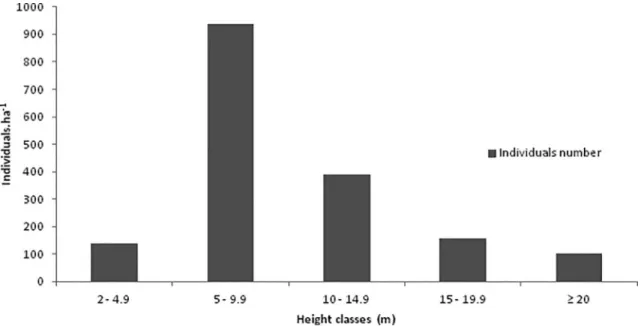
The majority (about 54.4%) of live trees (Figure 2) were 5-10 m in height. Emerging trees (≥ 20 m), which surpassed the regular forest canopy, included several species, such as Copaifera trapezifolia,
Syagrus pseudococos and Cryptocarya mandioccana. Regarding the
diameters, the majority of the individuals belonged to the class of 4.8 to 9.9 cm (Figure 3). The estimated basal area was 41.9 m2 ha-1.
The similarity analysis (Figure 4) that the floristic composition was similar between the blocks, with showed a high co-optic correlation (0.85) and grouped blocks 3 and 4 as the most similar (distance of 0.34). However, when we consider only the five species of the highest importance value per block (Figure 5), some differences between them
stand out.
Rustia formosa (which had the highest IVI in the quota of 800 m) was the only species among the five species with the highest IVI in the four blocks. Other species that presented high IVI in more than one block were Euterpe edulis (blocks 1, 3 and 4), Psychotria suterella (blocks 1 and 3) and Meriania calyptrata (blocks 3 and 4). The other species stood out in only one of the blocks. Coussarea meridionalis,
Table 1. Trees (in phylogenetic order by families and subfamilies and alphabetical by species) sampled in 1 ha of Montana Ombrophilous Dense Forest, at 800
m elevation, Serra do Mar State Park, Ubatuba – SP. Nº IAC = reference material in the herbarium of the Agronomic Institute; ①, ②, ③, ④ = sample blocks; X =
occurrence of the species in the block and MS= material with specialist.
Family Species Nº IAC Occurrence
1 2 3 4
Ferns
CYATHEACEAE Alsophila sternbergii (Sternb.) D.S.Conant 56501 X X X
Cyathea dichromatolepis (Fée) Domin 56503 X X
Cyathea glaziovii (Fée) Domin 56502 X
Basal angiosperms
MYRISTICACEAE Virola bicuhyba (Schott ex Spreng.) Warb. 50545 X X X
ANNONACEAE Guatteria australis A.St.Hil. 50510 X
Guatteria sp1 54021 X
Guatteria sp2 53957 X X X
Annona dolabripetala Raddi 48948 X
SIPARUNACEAE Siparuna brasiliensis (Spreng.) A.DC. 49259 X
MONIMIACEAE Mollinedia argyrogyna Perkins 56476 X X X X
Mollinedia boracensis Peixoto 48995 X X X X
Mollinedia aff. oligantha Perkins 56475 X X
Mollinedia ovata Ruiz & Pav. 56494 X
Mollinedia schottiana (Spreng.) Perkins 50341 X X X X
Mollinedia triflora (Spreng.) Tul. 53991 X X X X
Mollinedia sp1 MS X X
LAURACEAE Cinnamomum triplinerve (Ruiz & Pav.) Kosterm. 56464 X X X
Cryptocarya mandioccana Meisn. 54073 X X X X
Cryptocarya saligna Mez 48981 X X X
Endlicheria paniculata (Spreng.) J.F. Macbr. 49790 X
Licaria armeniaca (Nees) Kosterm. 49789 X X
Ocotea dispersa (Nees & Mart.) Mez 50547 X X
Ocotea cf. divaricata (Nees) Mez X X
Ocotea frondosa (Meisn.) Mez 54019 X
Ocotea teleiandra (Meisn.) Mez 53933 X X
CHLORANTHACEAE Hedyosmum brasiliense Miq. 51161 X
Monocotyledon
ARECACEAE Astrocaryum aculeatissimum (Schott) Burret 51963 X X
Attalea exigua Drude 44109 X
Euterpe edulis Mart. 49271 X X X X
Syagrus pseudococos (Raddi) Glassman 49191 X X X X
Eudicots
PROTEACEAE Euplassa cf. cantareirae Sleumer 20054 X
Roupala montana var. brasiliensis (Klotzsch)
K.S.Edwards 54007 X
Roupala paulensis Sleumer 53993 X
FABACEAE Detarioideae Copaifera trapezifolia Hayne 54009 X
Hymenaea courbaril L. 35618 X X
FABACEAE Caesalpinioideae Inga capitata Desv. 50313 X X X
Inga edulis Mart. 49311 X
Continuation Table 1.
Inga marginata Willd. 49339 X X
Inga schinifolia Benth. 54029 X X
Inga sessilis (Vell.) Mart. 48242 X
FABACEAE Faboideae Dahlstedtia pinnata (Benth.) Malme 54033 X X X
Zollernia ilicifolia (Brongn.) Vogel 49308 X X X
Fabaceae-Faboideae sp1 54006 X X
ROSACEAE Prunus myrtifolia (L.) Urb. 49007 X
MORACEAE Brosimum guianense (Aubl.) Huber 56499 X
URTICACEAE Cecropia glaziovi Snethl. 49016 X X
Coussapoa microcarpa (Schott) Rizzini 49017 X X X X
CELASTRACEAE Maytenus sp1 53958 X X
Maytenus sp2 56500 X
ELAEOCARPACEAE Sloanea guianensis (Aubl.) Benth. 49778 X
Sloanea cf. hirsuta (Schott) Planch. ex Benth. 51299 X X X X
ERYTHROXYLACEAE Erythroxylum cf. cuspidifolium Mart. 54081 X
OCHNACEAE Ouratea multiflora (Pohl) Engl. 53932 X X X X
Quiina aff. magalano-gomesi Schwacke 56468 X X X X
CLUSIACEAE Garcinia gardneriana (Planch. & Triana) Zappi 49777 X X X X
MALPIGHIACEAE Bunchosia maritima (Vell.) J.F.Macbr. 54028 X
CHRYSOBALANACEAE Couepia venosa Prance 50297 X X
Hirtella hebeclada Moric. ex DC. 50298 X X X
Licania cf. hoehnei Pilg. 56471 X X
Licania cf. kunthiana Hook.f. 56470 X X X X
Parinari excelsa Sabine 56469 X X
HUMIRIACEAE Vantanea sp1 54027 X X X
Humiriaceae sp1 56493 X X X X
SALICACEAE Casearia decandra Jacq. 33938 X X
Casearia sylvestris Sw. 42118 X
EUPHORBIACEAE Alchornea glandulosa Poepp. & Endl. 49226 X X
Alchornea triplinervia (Spreng.) Müll.Arg. 48965 X X
Sapium glandulosum (L.) Morong 48967 X X
Sebastiania sp1 54031 X
PHYLLANTHACEAE Hieronyma alchorneoides Allemão 54012 X X X X
MYRTACEAE Calyptranthes grandifolia O.Berg 56483 X
Calyptranthes lucida Mart. ex DC. 49145 X X
Calyptranthes rufa O.Berg 49047 X X
Calyptranthes strigipes O.Berg 49877 X X X
Campomanesia guaviroba (DC.) Kiaersk. 50617 X X
Campomanesia phaea (O.Berg) Landrum 43144 X
Eugenia acutata Miq. 49854 X X X
Eugenia batingabranca Sobral 49866 X X
Eugenia burkartiana (D.Legrand) D.Legrand 56675 X
Eugenia cerasiflora Miq. 49865 X
Eugenia cereja D.Legrand 56481 X X X
Eugenia copacabanensis Kiaersk. 45956 X X
Continuation Table 1.
MYRTACEAE Eugenia dodonaeifolia Cambess. 51320 X
Eugenia flamingensis O.Berg 56489 X
Eugenia fusca O.Berg 50367 X
Eugenia involucrata DC. 50365 X
Eugenia melanogyna (D.Legrand) Sobral 50366 X X
Eugenia multicostata D.Legrand 56482 X X X
Eugenia neoverrucosa Sobral 49164 X
Eugenia oblongata O.Berg 53944 X X
Eugenia plicata Nied. 54004 X X X
Eugenia pruinosa D.Legrand 37912 X
Eugenia pruniformis Cambess. 49057 X X
Eugenia subavenia O.Berg 49058 X X
Eugenia verticillata (Vell.) Angely 56487 X X X
Eugenia sp1 MS X
Marlierea excoriata Mart. 46874 X X X
Marlierea glazioviana Kiaersk. 50371 X
Marlierea obscura O.Berg 54000 X X
Marlierea racemosa (Vell.) Kiaersk. 54070 X X X
Marlierea suaveolens Cambess. 56488 X X
Marlierea tomentosa Cambess. 49887 X X X
Myrceugenia cf. campestris (DC.) D.Legrand &
Kausel 53947 X
Myrceugenia glaucescens (Cambess.) D.Legrand &
Kausel 56477 X X
Myrceugenia cf. kleinii D.Legrand & Kausel 53930 X
Myrceugenia myrcioides (Cambess.) O.Berg 55770 X X X
Myrceugenia sp1 MS X X
Myrcia neoblanchetiana E.Lucas & Sobral MS X
Myrcia pubipetala Miq. 50374 X X X
Myrcia spectabilis DC. 53208 X X
Myrcia tenuivenosa Kiaersk. 56485 X
Myrcia tijucensis Kiaersk. 54458 X
Myrcia ubatubana Mazine & Sobral 53476 X X
Myrciaria floribunda (H.West ex Willd.) O.Berg 50377 X X X X
Myrciaria cf. pallida O.Berg 56498 X X
Neomitranthes glomerata (D.Legrand) D.Legrand 50515 X X
MELASTOMATACEAE Henriettea glabra (Vell.) Penneys, F.A. Michelangeli,
Judd et Almeda 50383 X X
Leandra acutiflora (Naudin) Cogn. 54077 X
Meriania calyptrata (Naudin) Triana 53959 X X
Miconia atlantica Caddah & R. Goldenb. 54041 X X
Miconia calvescens DC. 54040 X
Miconia latecrenata (DC.) Naudin 54076 X X X
Miconia tristis Spring 56480 X
Continuation Table 1.
PICRAMNIACEAE Picramnia ciliata Mart. 50401 X X
BURSERACEAE Protium sp1 54001 X
ANACARDIACEAE Tapirira guianensis Aubl. 37240 X X
SAPINDACEAE Allophylus edulis (A.St.-Hil. et al.) Hieron. ex
Niederl.
56486 X
Allophylus cf. membranifolius Radlk. 56465 X X
Allophylus petiolulatus Radlk. 56467 X X X X
Cupania furfuracea Radlk. 54071 X X X
Cupania oblongifolia Mart. 50208 X
Matayba juglandifolia (Cambess.) Radlk. 50438 X
MELIACEAE Cabralea canjerana (Vell.) Mart. 48992 X X X
Guarea cf. guidonia (L.) Sleumer 49486 X X X
Guarea macrophylla Vahl 54035 X
Trichilia elegans A.Juss. subsp.elegans 48052 X
Trichilia silvatica C.DC. 56490 X X
THYMELAEACEAE Daphnopsis schwackeana Taub. 54075 X X X X
OLACACEAE Heisteria silvianii Schwacke 50396 X X
Tetrastylidium grandifolium (Baill.) Sleumer 54013 X X
OPILIACEAE Agonandra excelsa Griseb. 56496 X
NYCTAGINACEAE Guapira hirsuta (Choisy) Lundell 49894 X X X
Guapira nitida (Mart. ex J.A.Schmidt) Lundell 49002 X X
Guapira opposita (Vell.) Reitz 56479 X X X X
Guapira venosa (Choisy) Lundell 56484 X X X
SAPOTACEAE Chrysophyllum flexuosum Mart. 50440 X X X X
Chrysophyllum viride Mart. & Eichler 56474 X
Micropholis crassipedicellata (Mart. & Eichler)
Pierre 55752 X X
Pouteria caimito (Ruiz & Pav.) Radlk. 49927 X X X
Pouteria psammophila (Mart.) Radlk. 56473 X
Pouteria venosa (Mart.) Baehni 50450 X X
Sapotaceae sp1 54079 X
PRIMULACEAE Ardisia martiana Miq. 53956 X X X X
RUBIACEAE Alibertia myrciifolia Spruce ex K.Schum. 54030 X X X X Amaioua intermedia Mart. ex Schult. & Schult.f. 51892 X
Bathysa mendoncaei K.Schum. 54037 X X X
Bathysa stipulata (Vell.) C.Presl 54076 X
Choemelia cf. pedunculosa Benth. 56472 X
Coussarea accedens Müll.Arg. 56495 X X X X
Coussarea cf. hydrangeifolia (Benth.) Müll.Arg. 54026 X X
Coussarea meridionalis (Vell.) M.Gomes 49942 X X X
Faramea hyacinthina Mart. 43943 X
Posoqueria latifolia (Rudge) Schult. 49907 X X X X
Psychotria leitana C.M.Taylor 50414 X
Psychotria pubigera Schltdl. 54038 X
Continuation Table 1.
Randia armata (Sw.) DC. 54645 X
Rudgea jasminoides (Cham.) Müll. Arg. 54024 X X X X
Rustia formosa (Cham. & Schltdl. ex DC.) Klotzsch 56478 X X X X
APOCYNACEAE Tabernaemontana cf. laeta Mart. 53734 X X
BORAGINACEAE Cordia sellowiana Cham. 54084 X
Cordia trichoclada DC. 50682 X
SOLANACEAE Cestrum schlechtendahlii G.Don 54083 X
Solanum pseudoquina A.St.-Hil. 48202 X
Solanum rufescens Sendtn. 54072 X X X
LAMIACEAE Aegiphila integrifolia (Jacq.) Moldenke 54036 X X
CARDIOPTERIDACEAE Citronella paniculata (Mart.) R.A.Howard 53934 X X X X
AQUIFOLIACEAE Ilex theezans Mart. ex Reissek 56497 X
ARALIACEAE Dendropanax denticulatus Fiaschi 54025 X X X
Dendropanax sp1 53992 X X
Schefflera calva (Cham.) Frodin & Fiaschi 48950 X X
Undetermined Undetermined sp1 X
Undetermined sp2 X
not among the 10 species with the highest IVI for the quota of 800 m,
while M. boracensis was the only one among the 10 largest species with an IVI in the quota of 800 m that was not among the five species with the highest IVI per block (Figure 5).
Discussion
Most of the families that excelled in the richness and abundance parameters were eudicotiledonous; however, we also found representatives of magnoliids (Monimiaceae and Lauraceae) and monocotyledons (Arecaceae). Sequentially, the three richest families at 800 m (Myrtaceae, Rubiaceae and Fabaceae) were the same as those observed by Ramos et al. (2011) and Gomes et al. (2011) in stretches of Sub Montana Ombrophilous Dense Forest, respective to those of 200 and 350 m of altitude, located in the same region. However, in another area of the same region (350 m of altitude), Lauraceae occupied the second position among the richest families (Rochelle et al. 2011), as in the Montana Ombrophilous Dense (Montane) Forest (Padgurschi et al. 2011 - 1000 m altitude).
In terms of families higher values of importance (IVI), the first two sites (Rubiaceae and Myrtaceae) are usually cited in works from the north coast of São Paulo (Gomes et al. 2011, Rochelle et al. 2011, Joly et al. 2012). However, we highlight the importance of the Monimiaceae (third major VI) in the altitudinal range that corresponds to the Montane stretch of this forest, a pattern already observed by Padgurschi et al. (2011) in an area denominated plot K in the altitudinal elevation of 1000 m.
At the gender level, although Eugenia (21 species at 800 m) was the richest in all altitudinal heights, with no evidence of strong anthropic impact, it presented greater wealth in Sub Montana Ombrophilous Dense (Submontane) Forest (from 19 to 28 species – Rochelle et al. 2011, Gomes et al. 2011), than in the Montane FOD (12 species - Padgurschi
et al. 2011).
Among the species with the highest IVI in the 800 m, Euterpe edulis,
“palmito-jussara” (second position) was considered a characteristic species and the only one with importance in other studies carried out in Submontane and Montane Forests (Scudeller et al. 2001).
Rustia formosa (first position of IVI) occupies intermediate positions of importance in the Submontane Forests in the region (Gomes et al. 2011, Campos 2008, Lacerda 2001) and in an area in the municipality of Imbé in the north of Rio de Janeiro (Moreno et al. 2003), representing between 0.26 (Ramos et al. 2011) and 19.0% (Gomes et al. 2011) of the IVI, but it was not observed in the Montane Forest (Padgurschi et al. 2011). While Coussarea accedens (third position) occurs, it does
not present significant importance (between 0.7 and 1.1% of IVI), in the Submontane Forests and was not founded in the Montane Forest.
The high percentage of species represented by only one individual, as in this study, has already been observed in other studies carried out in Atlantic forests in southeastern Brazil (Melo & Mantovani 1993, Guedes-Bruni & Mantovani 1999, Gomes et al. 2011, Rochelle et al. 2011, Padgurschi et al. 2011). Thus, the present work contributed to increase the knowledge of this parameter, being that the great percentage of species represented by a single individual is considered a standard for to the Atlantic Forest (Martins 1991, Valencia et al. 1994).
The present work contributed to the publication of a newly described
species, Myrcia ubatubana Mazine & Sobral, for which the holotype was represented by one of our herbarium collections (A.C.O. Souza et al. s/no., IAC 53476), reinforcing that the Atlantic Forest is one of the largest centers of biodiversity in the world (Campanili & Prochnow 2006, Tabarelli et al. 2010), with new species still being recognized
and described in the present.
The values of the Shannon diversity index and Pielou equability index reflect the high diversity and equitability of the area, being among the richest in the region. The greatest diversity value found in one hectare
continues was 4.48 (Rochelle et al. 2011) and, in general for this region,
Table 2. Number of individuals (NInd) and importance value index (IVI) of the species that comprise 70% of the IVI by sampling area (1–4) and total (T), and absolute frequency (AFr) and dominance (ADo) in decreasing order of the total IVI, sampled in 1 ha of Montana Ombrophilous Dense Forest, at an altitude of
800 m, Serra do Mar State Park, Ubatuba – SP.
Species NInd AFr ADo IVI
1 2 3 4 T 1 2 3 4 T
Rustia formosa 35 17 55 44 151 67 4.6 23.2 10.4 44.8 25.7 25.1
Euterpe edulis 33 21 19 27 100 56 0.7 15.2 9.9 11.4 11.8 12.0
Coussarea accedens 19 12 39 19 89 48 0.8 9.3 5.1 21.4 9.6 10.9
Guapira opposita 12 23 3 15 53 38 1.8 9.2 17.1 2.2 11.7 10.5
Psychotria suterella 20 20 26 22 88 53 0.4 10.0 8.3 12.9 10.3 10.3
Rudgea jasminoides 12 22 13 28 75 47 0.3 6.7 8.9 7.4 11.8 8.8
Meriania calyptrata 42 46 88 31 0.3 17.9 16.4 8.4
Cryptocarya mandioccana 4 4 6 10 24 19 1.9 5.9 3.8 6.7 12.9 7.4
Ouratea multiflora 19 20 8 8 55 35 0.4 10 8.8 4.3 4.4 6.9
Mollinedia boracensis 10 1 14 14 39 32 0.6 7.4 0.6 9.5 8.7 6.4
Bathysa mendoncaei 1 45 1 47 21 0.6 0.6 19.9 0.7 5.7
Mollinedia cf. argyrogyna 7 13 4 2 26 20 1.0 5.6 10.8 3.6 2.0 5.6
Eugenia subavenia 10 9 8 2 29 23 0.5 5.9 3.9 8.3 1.1 4.6
Hirtella hebeclada 7 6 1 7 21 16 0.8 7.3 4.4 0.8 4.8 4.4
Cabralea canjerana 1 3 7 11 10 1.1 3.3 7.6 6.4 4.2
Licania cf. kunthiana 1 5 3 2 11 11 1.0 0.6 5.7 5.6 3.9 4.0
Guapira hirsuta 1 31 1 33 12 0.4 1.1 12.8 0.7 3.9
Hieronyma alchorneoides 2 3 2 9 16 12 0.8 3.3 1.7 1.4 8.3 3.8
Mollinedia triflora 1 1 4 6 12 10 1.0 0.7 3.3 3.9 6.9 3.8
Coussarea meridionalis 23 6 1 30 18 0.2 10.9 3.1 0.7 3.6
Coussapoa microcarpa 2 3 2 9 16 15 0.6 1.9 2.5 2.3 7.2 3.5
Humiriaceae sp1 6 5 2 3 16 16 0.4 3.7 4.6 2.39 2.2 3.2
Citronella paniculata 9 1 2 3 15 13 0.5 7.9 0.6 2.61 2.1 3.1
Alibertia myrciifolia 2 8 2 10 22 18 0.1 1.2 3.8 1.33 5.1 2.9
Myrcia pubipetala 3 7 2 12 9 0.6 1.9 8.66 2.1 2.9
Chrysophyllum flexuosum 1 9 3 4 17 15 0.3 0.9 5.7 2.25 2.3 2.9
Calyptranthes lucida 5 4 2 2 13 13 0.4 4.4 3.2 2.9 1.2 2.8
Mollinedia schottiana 5 1 12 2 20 16 0.2 3.2 0.5 7.22 1.1 2.8
Campomanesia guaviroba 2 1 3 3 1.0 6.3 4.5 2.7
Alsophila sternbergii 3 7 4 14 10 0.4 1.8 5.53 3.5 2.6
Ocotea dispersa 1 2 4 2 9 9 0.6 1.7 4.3 2.97 1.3 2.0
Pouteria caimito 4 1 3 8 8 0.6 4.2 0.65 4.5 2.5
Eugenia cereja 7 4 2 13 10 0.3 3.5 2.6 3.22 2.2
Mollinedia sp1 5 8 13 12 0.2 3.67 5.4 2.2
Daphnopsis schwackeana 5 2 5 1 13 11 0.2 3.4 1.2 3.43 0.6 2.0
Cupania furfuracea 2 2 4 8 7 0.4 1.4 2.6 3.6 2.0
Calyptranthes grandifolia 2 4 1 3 10 10 0.3 1.3 3.1 0.77 2.5 2.0
Eugenia fusca 1 1 1 0.8 8.6 2.0
Eugenia batingabranca 2 8 10 9 0.3 3.3 4.3 2.0
Coussarea cf. hydrangeifolia 9 6 15 11 0.1 5.58 2.5 1.9
Marlierea tomentosa 2 4 2 8 8 0.3 2.9 2.3 1.6 1.8
Myrciaria floribunda 4 2 1 4 11 11 0.1 2.7 1.1 0.78 2.6 1.8
Sloanea cf. hirsuta 1 2 2 4 9 9 0.2 0.6 1.5 1.61 3.3 1.8
Marlierea excoriata 2 2 4 8 7 0.3 1.2 1.15 4.5 1.8
Syagrus pseudococos 4 1 3 1 9 9 0.2 3.1 0.6 2.69 0.7 1.7
Other 141 morphospecies 438 405 13.4 89.9
Figure 2. Distribution of the height classes of the tree component in 1 ha of the Ombrophilous Dense Montane Forest, at an altitude
of 800 m, State Park of Serra do Mar, Ubatuba – SP.
Figure 3. Distribution of the diameter classes of the tree component in 1 ha of Ombrophilous Dense Montane Forest, at an altitude of
800 m, State Park of Serra do Mar, Ubatuba – SP.
2008, Gomes et al. 2011, Padgurschi et al. 2011). With insufficient numbers of protected areas allied with other aggravating factors, the conservation of the Atlantic Forest is still insufficient (Tabarelli et al. 2005) and studies like this are fundamental to reinforce the need to preserve this biome and its valuable biodiversity.
It is widely known the proposed division of the Ombrophylous Dense Forest into phytophysiognomies that reflect the ecotypic variations of the altimetric bands and geomorphological situations (Veloso et al. 2012) however, recent studies have also highlighted the importance of local abiotic factors for floristic composition and structure of the vegetation (Joly et al. 2012). So although the proposed environmental continuum (Gleason 1926, Whittaker 1967) could
consider this forest type as the only formation, there are peculiarities among the phytophysiognomies in the altitudinal gradient which are relevant and occur gradually.
Figure 4. Dendrogram of similarity between the four sample blocks in 1 ha of Ombriphilous Dense Montane Forest, at 800 m elevation, Serra
do Mar State Park, Ubatuba – SP.
Figure 5. The five species that obtained the highest importance values per sampling area in 1 ha of Ombrophilous Dense Montane Forest, at an
In this way, these data corroborates with previous work which indicate that events of lower geographic scale, mainly related to the combination of relief and microclimate, could result in the phytophysiognomies stratification with smooth transitions (Scaramuzza et al. 2011, Joly et al. 2012). There are few vegetation studies developed in the Serra do Mar area at 800 m elevation, and therefore, the objective of describing the floristic composition and structure of this arborea community was essential to understanding the transition
of this altitudinal gradient in the area, and new studies are desirable at
the same quota altitudinal.
Acknowledgments
This research was co-supported by the Brazilian National Research Council/CNPq (PELD Process 403710/2012-0), by the British Natural Environment Research Council/NERC and by the State of São Paulo Research Foundation/FAPESP as part of the projects PELD/BIOTA and ECOFOR (Processes 2012/51509-8 e 2012/51872- 5, within the BIOTA/ FAPESP Program - The Biodiversity Virtual Institute (www.biota.org.br). COTEC/IF 002.766/2013 and 010.631/2013 permits. We are also grateful to CAPES for granting a scholarship to the first author. We also thank IAC colleagues who assisted in fieldwork and laboratory work, and Dr. Renato Veiga for kindly releasing postgraduate students and employees.
Author Contributions
Ana Cláudia Oliveira de Souza: Contribution to data collection, data analysis and interpretation. Contribution to manuscript preparation.
Luís Benacci: Substantial contribution in the concept and design
of the study. Contribution to data collection, data analysis and
interpretation. Contribution to manuscript preparation.
Carlos Alfredo Joly: Substantial contribution in the concept and
design of the study. Contribution to manuscript preparation.
Conflicts of interest
The authors declare that they have no conflict of interest related to the publication of this manuscript.
References
ALMEIDA, F.F.M. & CARNEIRO, C.D.R. 1998. Origem e evolução da Serra do Mar. Revista Brasileira de Geociências. 28(2): 135-150.
ANGIOSPERM PHYLOGENY GROUP (APG). 2016. An update of the Angiosperm Phylogeny Group classification for the orders and families of flowering plants: APG IV. Botanical Journal of the Linnean Societ. 181: 1-20. BROWER, J.E. & ZAR, J.H. 1977. Field and laboratory methods for general
ecology. W. C. Brown Company Publishers, Iowa.
CAMPANILI, M. & SCHAFFER, W.B. (Org.) 2010. Mata Atlântica: patrimônio nacional dos brasileiros. MMA, Brasília.
CAMPANILI, M., PROCHNOW, M. (Org). 2006. Rede de ONGs da Mata Atlântica. Mata Atlântica: uma rede pela floresta. RMA, Brasília. CAMPOS, M.C.R. 2008. Relação da composição e estrutura do componente
arbóreo com variáveis microtopográficas e edáficas da Floresta Ombrófila Densa do Núcleo Picinguaba/PESM, Ubatuba/SP. Dissertação de mestrado, Universidade de Campinas, Campinas.
CHRISTENHUSZ, M.J.M., ZHANG, X.C. & SCHNEIDER, H. 2011. A linear sequence of extant families and genera of lycophytes and ferns. Phytotaxa. 19: 7–54.
GENTRY, A.H. & TERBORGH, J. 1990. Composition and dynamics of the Cocha Cashu mature floodplain forest. In Four Neotropical rainforests (A.H. Gentry, ed.). Yale University Press, New Haven, p.542-564.
GLEASON, H.A. 1926. The individualistic concept of the plant association. Bull. Torrey Bot. Club, 3: 7-26.
GOMES, J.A.M.A., BERNACCI, L.C. & JOLY, C.A. 2011. Diferenças florísticas e estruturais entre duas cotas altitudinais da Floresta Ombrófila Densa Submontana Atlântica, do Parque Estadual da Serra do Mar, município de Ubatuba/SP, Brasil. Biota Neotropica. 11(2): http://www. biotaneotropica. org.br/v11n2/pt/abstract?article+bn02611022011 (last access on 20/11/217). GUEDES-BRUNI, R.R. & MANTOVANI, W. 1999. Espécies arbóreas raras em dossel de seis unidades fisionômicas de Mata Atlântica no Rio de Janeiro: uma abordagem preliminar. In: Anais do 50º Congresso Nacional de Botânica. Blumenau, p.264-265.
INSTITUTO FLORESTAL. 2010. Unidades de Conservação do Estado de São Paulo. Instituto Florestal, São Paulo http://www.iflorestal. sp.gov.br/ unidades_conservacao/index.asp (last access on 14/06/17).
JOLY, C.A., AIDAR, M.P.M., KLINK, C.A., MCGRATH, D.G., MOREIRA, A.G., MOUTINHO, P., NEPSTAD, D.C., OLIVEIRA, A.A., POTT, A.,RODAL, M.J.N. & SAMPAIO, E.V.S.B. 1999. Evolution of the Brazilian phytogeography classification systems: implications for biodiversity conservation. Cien. Cult. 51(5-6):331-348.
JOLY, C.A.; ASSIS, M.A.; BERNACCI, l.C.; TAMASHIRO, J.Y.; CAMPOS, M.C.R. de; GOMES, J.A.M.A LACERDA, M.S.; SANTOS, F.A.M. dos; PEDRONI, F.; PEREIRA, L. DE S.; PADGURSCHI, M. de C.G.; PRATA, E.M.B.; RAMOS, E.; TORRES, R.B.; ROCHELLE, A.; MARTINS, F.R; ALVES, L.F; VIEIRA, S.A.; MARTINELLI, L.A.; CAMARGO, P.B. de; AIDAR, M.P.M.; EISENLOHR, P.V.; SIMÕES, E.; VILLANI, J.P.;BELINELLO, R. 2012. Florística e fitossociologia em parcelas permanentes da Mata Atlântica do sudeste do Brasil ao longo de um gradiente altitudinal. Biota Neotropica. 12(1): 123-145 http://www.biotaneotropica. org.br/v12n1/pt/fullpaper?bn01812012012 (last access on 10/02/2018). KRONKA, F.J.N., NALON, M.A., MATSUKUMA, C.K., PAVÃO, M.,YWANE,
M.S.S., KANASHIRO, M.M., LIMA, L.M.P.R., PIRES,A.S., SHIDA, C.N., FUKUDA, J.C., GUILLAUMON, J.R., BARBOSA, O., BARRADAS, A.M.F., BORGO, S.C., MONTEIRO, C.H.B.,PONTINHAS, A.A.S., ANDRADE, G.G., JOLY, C.A., COUTO, H.T.Z.& BAITELLO, J.B. 2005. Inventário florestal da vegetação nativa do Estado de São Paulo. Secretaria do Meio Ambiente, São Paulo.
LACERDA, M.S. 2001. Composição Florística e Estrutura da Comunidade Arbórea num gradiente altitudinal da Mata Atlântica. Tese de Doutorado, Universidade Estadual de Campinas, Campinas.
MARTINS, F.R. 1991. Estrutura de uma floresta mesófila. Universidade Estadual de Campinas, Campinas.
MATTOSO, A.Q. (Coord.) 2006. Plano de Manejo e Gestão do Parque Estadual da Serra do Mar. http://iflorestal.sp.gov.br/institutoflorestal/files/2013/03/ Plano_de_Manejo_Pe_Serra_do_Mar.pdf (last access on 14/02/2018).
MELO, M.R.F. & MANTOVANI, W. 1994. Composição florística e estrutura fitossociológica da mata atlântica de encosta na Ilha do Cardoso (Cananéia,
Brasil). Bol. Inst. Bot. 9:107-158.
MORENO, M.R., NASCIMENTO, M.T., KUTRZ, B.C. 2003. Structure and floristic composition of tree communities in two altitudinal zones in Atlantic Forest in the Imbe Region, RJ, Brazil. Acta Bot Bras., 17(3): 371-386. MORELLATO, L.P.C. & HADDAD, C.F.B. 2000. Introduction: The Brazilian
Atlantic Forest. Biotropica 32: 786-792.
PADGURSCHI, M.C.G., PEREIRA, L.P., TAMASHIRO, J.Y. & JOLY, C.A. 2011. Composição e similaridade florística entre duas áreas de Floresta Atlântica Montana, São Paulo, Brasil. Biota Neotropica. 11(2): http:// www.biotaneotropica.org.br/v11n2/pt/abstract?article+bn02811022011
(last access on 20/01/18.
ROCHELLE, A.L.C., CIELO-FILHO, R. & MARTINS, F.R. 2011. Florística e estrutura da comunidade arbórea de um trecho de Floresta Ombrófila Densa Atlântica Submontana no Parque Estadual da Serra do Mar, em Ubatuba/SP, Brasil. Biota Neotropica. 11(2): http://www.biotaneotropica.org.br/v11n2/ pt/abstract?inventory+bn02711022011 (last Access on 20/12/17). ROSADO, B.H.P, OLIVEIRA, R.S, JOLY, C.A, AIDAR, M.P.M. & BURGESS,
S.S.O. 2012. Diversity in nighttime transpiration behavior of woody species of the Atlantic Rain Forest, Brazil. Agricultural Forest Meteorology .158-159: 13-20.
SCARAMUZZA, C.A.M., SIMÕES, L.L., RODRIGUES, S.T., ACCACIO, G.M., HERCOWITZ, M., ROSA, M.R., GOULART, W., PINAGÉ, E.R. & SOARES, M.S. 2011. Visão de Biodiversidade da Ecorregião Serra do Mar. WWF- Brasil. http://www.wwf.org. br/?28724/Visao-da-Biodiversidade--da-Ecorregiao-Serra-do-Mar (last access on 15/12/2017).
SCUDELLER, V.V., MARTINS, F.R. & SHEPHERD, G.J. 2001. Distribution and abundance of arboreal species in the atlantic ombrophilous dense forest in Southeastern Brazil. PlantE. 152: 185-199.
SETZER, J. 1966. Atlas climatológico do estado de São Paulo. Comissão Interestadual da Bacia do Paraná-Paraguai. CESP, São Paulo.
SHEPHERD, G.J. 2010. Fitopac 2.1: manual do usuário. Departamento de Botânica/UNICAMP, Campinas.
SOS MATA ATLÂNTICA & INPE 2014. Atlas dos remanescentes florestais da Mata Atlântica período 2012-2013. Relatório Técnico, São Paulo. https://www.sosma.org.br/wp-content/uploads/2014/05/atlas_2012-2013_
relatorio_tecnico_20141.pdf (last access on10/01/18).
TABARELLI, M., AGUIAR, A.V., RIBEIRO, M.C., METZGER, J.P. & AND PERES, C.A. 2010. Prospects for biodiversity conservation in the Atlantic Forest: lessons from aging human-modified landscapes. Biological Conservation. 143: 2328-2340.
TABARELLI, M., PINTO, L.P., SILVA, J.M.C., HIROTA, M.M. & BEDÊ, L.C. 2005. Desafios e oportunidades para a conservação da biodiversidade na Mata Atlântica brasileira. Megadiversidade 1(1): 132-138.
TABARELLI, M. & MANTOVANI, W. 1999. A regeneração de uma floresta tropical montana após corte e queima (São Paulo-Brasil). Revista Brasileira de Biologia. 59(2): 239-250.
VALENCIA, R., BALSLEV, H. & PAZ Y MIÑO, G. 1994. High tree alpha diversity in Amazonian Ecuador. Biodivers. Conserv. 3:21-28. http://dx.doi.
org/10.1007/BF00115330 (last access on 20/01/2018).
VELOSO, H.P., RANGEL-FILHO, A.L.R. & LIMA, J.C.A. 2012. Classificação da Vegetação Brasileira, Adaptada a um Sistema Universal. Manual Técnico da Vegetação Brasileira. IBGE, Rio de Janeiro, Brasil.
WHITTAKER, R.H. 1967. Gradient analysis of vegetation. Biol. Rev., Cambridge, 42: 207-264.