Characterization and selection of ornamental pineapple
hybrids with emphasis on sinuous stems and black fruits
1Orjana Santos Lima2, Everton Hilo de Souza2,
Lucas Ezequiel da Costa Dias2, Cintia Paula Feitosa Souza2, Fernanda Vidigal Duarte Souza3
INTRODUCTION
The market for flowers and ornamental plants is dynamic, and there is a constant search for
novelty. Tropical flowering plants have been gaining
increasing space in this segment, both in Brazil and internationally, due not only to the exuberance and
diversity of their flowers, but also because of their
uniqueness and durability.
In this context, fruits traditionally cultivated for nutritional purposes are an alternative for ornamental use and can offer a wide range of products, including varieties for potted plants, living fences and landscaping, as well as for the production
ABSTRACT
RESUMO
of cut flowers and mini fruits (Souza et al. 2012a and 2014).
The use of fruit-bearing plants for ornamental purposes in Brazil is still incipient, being mainly
restricted to private gardens. However, efforts have
been made in recent years to change this situation, with the emergence of genetic breeding programs aiming to develop ornamental varieties of fruit
species, such as pineapple (Souza et al. 2009, 2012a and 2014, Costa Junior et al. 2016), banana (Santos-Serejo et al. 2007 and 2012, Souza et al. 2012b) and citrus (Santos et al. 2015 and 2016). Many of these efforts have been carried out by the Embrapa Mandioca e Fruticultura. This research follows the
1. Manuscript received in Mar./2017 and accepted for publication in Jun./2017 (http://dx.doi.org/10.1590/1983-40632016v4746163).
2. Universidade Federal do Recôncavo da Bahia, Cruz das Almas, BA, Brazil. E-mails: [email protected],
[email protected], [email protected], [email protected].
3. Empresa Brasileira de Pesquisa Agropecuária (Embrapa Mandioca e Fruticultura), Cruz das Almas, BA, Brazil. Ornamental fruit plants have a good potential for
the development of innovative products for the floriculture
segment, and the ornamental pineapple has attracted a strong interest in this segment. This study aimed at characterizing and selecting new ornamental pineapple hybrids for the production
of cut flowers, with emphasis on stem sinuosity and a nearly
black color for fruits. Twenty-three morphological descriptors
were studied in 26 hybrids developed from six progenies, involving different botanical varieties. These descriptors are among those published by the Brazilian Ministry of Agriculture for protection of cultivars. The 26 hybrids evaluated fitted in different use categories: 5 for the production of cut flowers, 11 as potted plants, 6 for the production of mini fruits, 6 for foliage and 26 for landscaping. One hybrid with sinuous stems to produce cut flowers and 12 hybrids bearing nearly black
fruits for ornamental use were selected as a novelty for the
flower market.
KEYWORDS:Ananas comosus; cut flower; ornamental fruit
plants; floriculture.
Caracterização e seleção de híbridos de abacaxizeiro ornamental com ênfase em hastes sinuosas e frutos negros
A fruticultura ornamental tem grande potencial na
geração de produtos inovadores para o segmento de floricultura,
e o abacaxi ornamental vem se consolidando nesse segmento. Objetivou-se caracterizar e selecionar novos híbridos de abacaxizeiro ornamental para uso como flor de corte, com ênfase na sinuosidade da haste e na coloração quase negra dos
frutos. Foram aplicados 23 descritores morfológicos em 26
híbridos provenientes de seis progênies, envolvendo diferentes variedades botânicas. Os descritores morfológicos utilizados
foram publicados pelo Ministério da Agricultura, Pecuária e Abastecimento para a proteção de cultivares. Os 26 híbridos avaliados se enquadraram em diferentes categorias de uso: 5 para corte, 11 para vaso, 6 para minifrutos, 6 para folhagem e 26 para paisagismo. Um híbrido com hastes sinuosas para uso como flor de
corte e 12 híbridos com frutos quase negros para uso ornamental
foram selecionados como novidade para o mercado de flores.
PALAVRAS-CHAVE:Ananas comosus; flor de corte; fruticultura
hybrids and improvement of these same three species
(Häkkinen & Sharrock 2001, Del Bosco 2003, Stokes 2004, Sanewski 2009).
Cross-breeding to develop superior ornamental
pineapple genotypes began in 2003, and various
hybrids have been selected for the production of
cut flowers, mini fruits and ornamental foliage, as
well as for use as potted plants and in landscaping.
Two hybrids (BRS Anauê and BRS Boyrá) were commercially launched in 2016, after agronomic
validation, and are now sold in the market as ornamental plants, mainly in Europe. This work has involved the prospection of ornamental genotypes in germplasm banks and directed hybridization, in search
of new varieties with traits of interest in the flower and
ornamental plant market, in various niches. Among
these are the traditional ones of cut flowers, potted
plants and landscaping, as well as the development of a totally new product line of ornamental plants bearing
mini fruits (Souza et al. 2009, 2012a, 2012b and 2014, Santos et al. 2015 and 2016). A new selection process
to develop pineapple genotypes bearing nearly black
fruits and/or sinuous stems may open new market
perspectives in Brazil and abroad.
Among the characteristics traditionally demanded in the European market are straight stems,
with average length of 40 cm and no deformation (Souza et al. 2014). However, recent observations and
surveys at international trade fairs and other events indicate that there is a good acceptance and even a
preference among professionals (floral designers and landscapers), as well as consumers, for curvy stems. Sinuous stems lend a sense of movement to floral
arrangements, a feature that is important to these
professionals for purposes of artistic differentiation (Souza et al. 2015). Another trait that can be an
attractive novelty is the fruit coloration. In previous selections, the aim has been to achieve pink or red
coloration. However, fruits with dark blue/purple or
nearly black color have stood out in some progenies
maintained in the field (Lima et al. 2015).
Therefore, this study aimed at selecting
pineapple plants with sinuous stems and/or black
fruits as candidates for novel products in the
floriculture market, both domestic and foreign. These
new genetic materials present broad aptitude for use as potted plants or for landscaping, as well as to
produce cut flowers.
The study was carried out in Cruz das Almas, Bahia state, Brazil, where the climate, according to the Köppen scale, ranges from Am to Aw. The crop treatment and phytotechnical management of the progenies followed recommendations by Cunha et
al. (1999).
Twenty-six hybrids, still in the sexual cycle, were
obtained from 6 progenies involving crosses between 10 accessions, from the pineapple active germplasm bank of the Embrapa Mandioca e Fruticultura, of four different botanical varieties: Ananas comosus var.
ananassoides, A. comosus var. erectifolius, A. comosus
var. comosus and A. comosus var. bracteatus. Twenty-three morphological descriptors were applied, being 11 quantitative and 12 qualitative, as published by the
Brazilian Ministry of Agriculture, according to the
standards and indications of the National Service to Protect Cultivars applicable to ornamental pineapple
varieties (Brasil 2013).
The 11 quantitative descriptors were: plant height (cm); leaf “D” length (cm); leaf “D” width (cm); peduncle length after closure of the last flower (cm); peduncle diameter after closure of the last flower (cm); number of peduncle curves; syncarp length after closure of the last flower (cm); syncarp diameter after closure of the last flower (cm); crown length after closure of the last flower (cm); crown diameter after closure of the last flower (cm); and crown/syncarp ratio. In turn, the following descriptors were applied to the qualitative traits: plant habit; presence/absence of leaf variegation; distribution of leaf variegation; presence/absence of anthocyanin
in leaves; peduncle shape; syncarp shape; syncarp color; bract apex shape; bract shape at crown base; overlap of bracts in relation to fruitlet; number of crown colors; and crown apex shape. The colors were
identified using the table of the Royal Horticulture
Society Colour Chart, adopted for protection of ornamental plants by the International Union for the Protection of New Varieties of Plants.
After these evaluations, the hybrids were grouped in use categories and selected according to
239
Characterization and selection of ornamental pineapple hybrids with emphasis on sinuous stems and black fruits b) Cut flowers with sinuous peduncle: syncarp
length smaller than 8.00 cm, syncarp diameter smaller than 6.00 cm, peduncle length greater than 50.00 cm considering sinuosity/number of curves, peduncle diameter smaller than 1.50 cm and crown length smaller than 7.00 cm;
c) Potted plants: plant height smaller than 65.00 cm, crown diameter smaller than 80.00 cm, leaf length smaller than 60.00 cm, crown/syncarp ratio near 1, syncarp length smaller than 5.00 cm, syncarp diameter smaller than 3.00 cm, crown length smaller than 5.00 cm, peduncle length smaller than 30.00 cm and absence of thorns;
d) Landscaping: a broad category that may include any use category, except (in the case of pineapple) for genotypes that produce concealed fruits (inserted in the foliar rosette and covered by the leaves);
e) Mini fruits: syncarp length smaller than 5.00 cm, crown/syncarp ratio near 1 and crown length smaller than 4.50 cm;
f) Foliage: leaf length greater than 80.00 cm, leaf width greater than 4.00 cm, intense color and
absence of thorns.
The new trait evaluated (stem sinuosity) is not
found in any of the categories described by Souza
et al. (2012a), but was included as a new product characteristic in the cut flower category, requiring
its own description for selection.
The following descriptive parameters were
calculated, using the SAS statistical software (SAS Institute 2010): average, minimum and maximum values and coefficient of variation. The qualitative
and quantitative data were used for analysis of genetic
distance, based on the Gower (1971) algorithm.
The hierarchical groupings were obtained by the
Unweighted Pair Group Method with Arithmetic Mean (UPGMA), employing the mean Euclidian
distance between the clones and parents. The groupings were represented in a dendrogram and
validated by the cophenetic correlation coefficient (r) (Sokal & Rohlf 1962).
RESULTS AND DISCUSSION
A good diversity of colors and morphologies was observed, confirming the great variability between the hybrids and the crosses evaluated. The average, minimum and maximum values, standard
deviation and coefficient of variation (CV%) for all
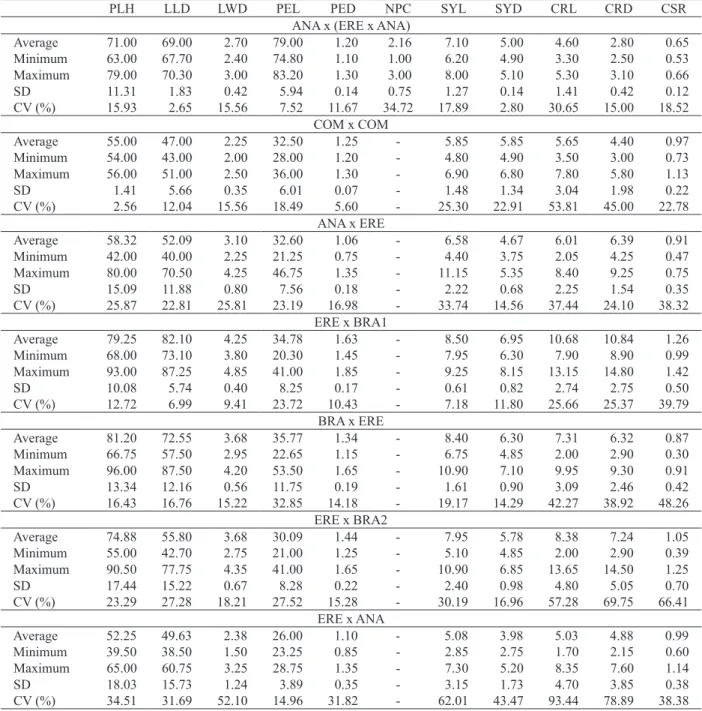
the quantitative traits of the 26 hybrids evaluated in the different crosses are presented in Table 1.
The descriptive statistics demonstrated a wide variation between progenies for all the traits evaluated. The smallest plants were obtained from the ERE x ANA cross, while the largest plants were obtained from the ERE x BRA1 and BRA x ERE
crosses (Tables 1 to 3). Plant height is an important
characteristic, mainly in the selection of varieties for use as potted plants, since tall plants are not
suitable in this category (Souza et al. 2012a). Potted
plants need to be compact, as tall plants require very complicated adjustments in their production system to make their size compact.
Peduncle length was another trait that presented
a wide variation, with average values from 26 cm for the ERE x ANA cross to 79 cm for the ANAx
(ERE x ANA) triple cross (Tables 1 to 3), where
sinuous stem was selected. These plants presented peduncle with one to three curves, indicating a lack of standardization for this trait.
The peduncle diameter varied from 0.75 cm to 1.85 cm among the hybrids evaluated. This trait is directly related to the final weight of the plant,
which is relevant for transportation, particularly in the case of exportation. Very thick peduncles weigh more, making shipment more expensive. Small peduncle length and diameter are also more suitable for potted plants.
The syncarp and crown measurements were
also highly variable among the crosses, influencing the crown/syncarp ratio. Characteristics related to the fruit (syncarp + crown) are important to determine a good balance between them, with a crown/syncarp
ratio near 1 being considered ideal by Souza et
al. (2012a). Crowns that are much larger than the syncarp (ratio higher than 1) may cause the stem to
break at the point of joining the peduncle, and very small crowns can compromise the esthetics of the fruit. In this study, the hybrids from the triple cross
ANA x (EREx ANA) presented the lowest crown/ syncarp ratio, with an average of 0.65.
For selection of potted plants, the hybrids from the ERE x ANA cross had the best values, according
to the description by Souza et al. (2012a). This cross had the smallest plant height (52.25 cm), leaf length (49.63 cm) and peduncle length (26.00 cm),
meaning they are small and compact, with better potential to adapt to a production system in pots
be modified by the production system to better fit
as potted plants.
The potted plants market has been growing
faster than that for cut flowers. Consumers have a perception of a better cost x benefit relation due to the longevity of living plants x cut flowers (Sebrae 2015).
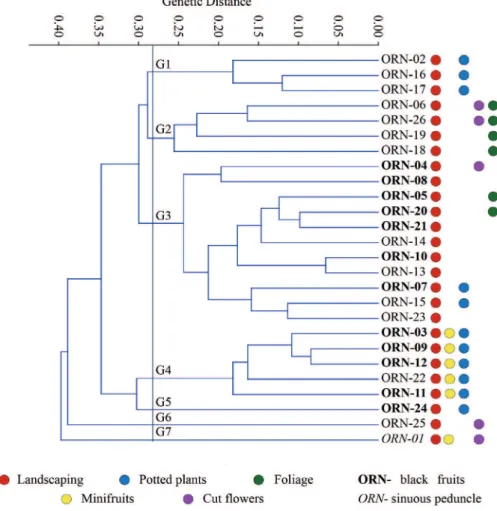
descriptors (qualitative and quantitative) are presented in Figure 1. This figure also shows how the hybrids were classified in the different use categories recommended by Souza et al. (2012a).
The cophenetic correlation coefficient of
the dendrogram (r = 0.77, p < 0.0001, 10,000
SD: standard deviation; CV (%): coefficient of variation; PLH: plant height (cm); LLD: leaf “D” length (cm); LWD: leaf “D” width (cm); PEL: peduncle length after closure of the last flower (cm); PED: peduncle diameter after closure of the last flower (cm); NPC: number of peduncle curves; SYL: syncarp length after closure of the last flower (cm); SYD: syncarp diameter after closure of the last flower (cm); CRL: crown length after closure of the last flower (cm); CRD: crown diameter after closure of the last flower (cm); CSR: crown/syncarp ratio.
PLH LLD LWD PEL PED NPC SYL SYD CRL CRD CSR
ANA x (EREx ANA)
Average 71.00 69.00 2.70 79.00 1.20 2.16 7.10 5.00 4.60 2.80 0.65
Minimum 63.00 67.70 2.40 74.80 1.10 1.00 6.20 4.90 3.30 2.50 0.53 Maximum 79.00 70.30 3.00 83.20 1.30 3.00 8.00 5.10 5.30 3.10 0.66
SD 11.31 1.83 0.42 5.94 0.14 0.75 1.27 0.14 1.41 0.42 0.12
CV (%) 15.93 2.65 15.56 7.52 11.67 34.72 17.89 2.80 30.65 15.00 18.52
COMx COM
Average 55.00 47.00 2.25 32.50 1.25 - 5.85 5.85 5.65 4.40 0.97
Minimum 54.00 43.00 2.00 28.00 1.20 - 4.80 4.90 3.50 3.00 0.73
Maximum 56.00 51.00 2.50 36.00 1.30 - 6.90 6.80 7.80 5.80 1.13
SD 1.41 5.66 0.35 6.01 0.07 - 1.48 1.34 3.04 1.98 0.22
CV (%) 2.56 12.04 15.56 18.49 5.60 - 25.30 22.91 53.81 45.00 22.78
ANA x ERE
Average 58.32 52.09 3.10 32.60 1.06 - 6.58 4.67 6.01 6.39 0.91
Minimum 42.00 40.00 2.25 21.25 0.75 - 4.40 3.75 2.05 4.25 0.47
Maximum 80.00 70.50 4.25 46.75 1.35 - 11.15 5.35 8.40 9.25 0.75
SD 15.09 11.88 0.80 7.56 0.18 - 2.22 0.68 2.25 1.54 0.35
CV (%) 25.87 22.81 25.81 23.19 16.98 - 33.74 14.56 37.44 24.10 38.32
ERE x BRA1
Average 79.25 82.10 4.25 34.78 1.63 - 8.50 6.95 10.68 10.84 1.26
Minimum 68.00 73.10 3.80 20.30 1.45 - 7.95 6.30 7.90 8.90 0.99
Maximum 93.00 87.25 4.85 41.00 1.85 - 9.25 8.15 13.15 14.80 1.42
SD 10.08 5.74 0.40 8.25 0.17 - 0.61 0.82 2.74 2.75 0.50
CV (%) 12.72 6.99 9.41 23.72 10.43 - 7.18 11.80 25.66 25.37 39.79
BRA x ERE
Average 81.20 72.55 3.68 35.77 1.34 - 8.40 6.30 7.31 6.32 0.87
Minimum 66.75 57.50 2.95 22.65 1.15 - 6.75 4.85 2.00 2.90 0.30
Maximum 96.00 87.50 4.20 53.50 1.65 - 10.90 7.10 9.95 9.30 0.91
SD 13.34 12.16 0.56 11.75 0.19 - 1.61 0.90 3.09 2.46 0.42
CV (%) 16.43 16.76 15.22 32.85 14.18 - 19.17 14.29 42.27 38.92 48.26
ERE x BRA2
Average 74.88 55.80 3.68 30.09 1.44 - 7.95 5.78 8.38 7.24 1.05
Minimum 55.00 42.70 2.75 21.00 1.25 - 5.10 4.85 2.00 2.90 0.39
Maximum 90.50 77.75 4.35 41.00 1.65 - 10.90 6.85 13.65 14.50 1.25
SD 17.44 15.22 0.67 8.28 0.22 - 2.40 0.98 4.80 5.05 0.70
CV (%) 23.29 27.28 18.21 27.52 15.28 - 30.19 16.96 57.28 69.75 66.41
ERE x ANA
Average 52.25 49.63 2.38 26.00 1.10 - 5.08 3.98 5.03 4.88 0.99
Minimum 39.50 38.50 1.50 23.25 0.85 - 2.85 2.75 1.70 2.15 0.60
Maximum 65.00 60.75 3.25 28.75 1.35 - 7.30 5.20 8.35 7.60 1.14
SD 18.03 15.73 1.24 3.89 0.35 - 3.15 1.73 4.70 3.85 0.38
CV (%) 34.51 31.69 52.10 14.96 31.82 - 62.01 43.47 93.44 78.89 38.38
241
Characterization and selection of ornamental pineapple hybrids with emphasis on sinuous stems and black fruits permutations) showed a good fit between the
graphical representation of the distances and the
original distance matrix (Rohlf & Fisher 1968). Multivariate analysis of the 26 hybrids allowed the formation of 7 groups (Figure 1) by the UPGMA
based on the mean Euclidian distance between the
hybrids, using a genetic dissimilarity cutoff (D dg) of 0.28. Based on the particularities of each hybrid,
it was possible to include them in use categories. The distribution was highly variable and some showed aptitude for inclusion in more than one category.
Group G1 is composed of the ORN-02, ORN-16 and ORN-17 hybrids, coming from two crosses: COM x COM and ERE x BRA2
(Figure 1).These three hybrids are suitable for two
use categories: landscaping and potted plants. The
landscaping use involves great plasticity, and all the
hybrids fit in this category. The use of a particular
hybrid for this purpose depends more on the skill of the landscaper than on the particular traits of the plant
variety. The only situation where a variety would not be suitable for landscaping is when the fruit is hidden by leaves, as described in the methodology section.
In turn, potted plants demand specific characteristics,
mainly small size, short stems and preferably open or decumbent habit.
Group G2 contains the ORN-26, ORN-18 and ORN-19 hybrids, of which the first two are suitable for landscaping, cut flowers and foliage, and the last
two for landscaping and foliage. The hybrids of this group come from two distinct crosses, although both
share a common parent: A. comosus var. erectifolius. The inclusion in the foliage category was mainly due to the large length and width of leaves, greater than
80 cm and 4 cm, respectively. This was expected
based on the traits of the parents. A. comosus var.
erectifolius has long and narrow leaves without thorns, while A. comosus var. bracteatus has long and
broad leaves with thorns (Souza et al. 2012a). The
plants in this group presented similar characteristics,
shape.
Groups G3 and G4 contain 16 hybrids resulting from five crosses (Figure 1). These groups contain
the majority of the genotypes bearing black fruits
(69 %) selected in this study (Figure 2a-d). The
denomination black pineapple used here is due to the high concentration of anthocyanin in the syncarp. Anthocyanin confers fruits a dark appearance, even when the bracts of the fruitlet are reddish. This
two accessions of A. comosus var. erectifolius used in all the crosses.
The black color is rare in nature and also
in the flower growing segment, where novelty
typically brings added value due to rarity and exoticism. Other examples are black tulip and rose
(Carlson 1980), iris (Al-Khassawneh et al. 2006) and lisianthus (Markham et al. 2004). In the case
of pineapple, only the syncarp approaches a black
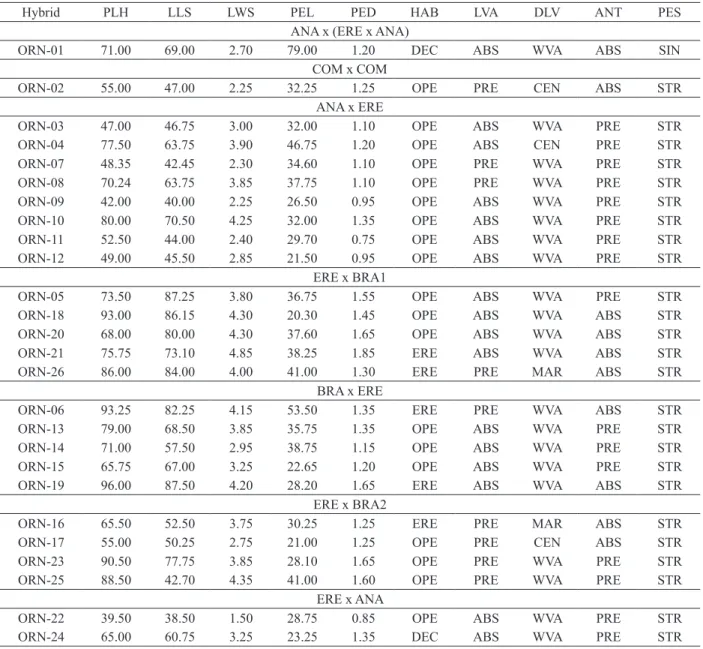
PLH: plant height (cm); LLD: leaf “D” length (cm); LWD: leaf “D” width (cm); PEL: peduncle length after closure of the last flower (cm); PED: peduncle diameter after closure of the last flower (cm); HAB: plant habit; LVA: presence/absence of leaf variegation; DLV: distribution of leaf variegation; ANT: presence/absence of anthocyanin in leaves; PES: peduncle shape; ERE: erect; OPE: open; DEC: decumbent; ABS: absent; PRE: present; WVA: without variegation; CEN: central; MAR: marginal; SIN: sinuous; STR: straight.
Hybrid PLH LLS LWS PEL PED HAB LVA DLV ANT PES
ANA x (EREx ANA)
ORN-01 71.00 69.00 2.70 79.00 1.20 DEC ABS WVA ABS SIN
COMx COM
ORN-02 55.00 47.00 2.25 32.25 1.25 OPE PRE CEN ABS STR
ANA x ERE
ORN-03 47.00 46.75 3.00 32.00 1.10 OPE ABS WVA PRE STR
ORN-04 77.50 63.75 3.90 46.75 1.20 OPE ABS CEN PRE STR
ORN-07 48.35 42.45 2.30 34.60 1.10 OPE PRE WVA PRE STR
ORN-08 70.24 63.75 3.85 37.75 1.10 OPE PRE WVA PRE STR
ORN-09 42.00 40.00 2.25 26.50 0.95 OPE ABS WVA PRE STR
ORN-10 80.00 70.50 4.25 32.00 1.35 OPE ABS WVA PRE STR
ORN-11 52.50 44.00 2.40 29.70 0.75 OPE ABS WVA PRE STR
ORN-12 49.00 45.50 2.85 21.50 0.95 OPE ABS WVA PRE STR
ERE x BRA1
ORN-05 73.50 87.25 3.80 36.75 1.55 OPE ABS WVA PRE STR
ORN-18 93.00 86.15 4.30 20.30 1.45 OPE ABS WVA ABS STR
ORN-20 68.00 80.00 4.30 37.60 1.65 OPE ABS WVA ABS STR
ORN-21 75.75 73.10 4.85 38.25 1.85 ERE ABS WVA ABS STR
ORN-26 86.00 84.00 4.00 41.00 1.30 ERE PRE MAR ABS STR
BRA x ERE
ORN-06 93.25 82.25 4.15 53.50 1.35 ERE PRE WVA ABS STR
ORN-13 79.00 68.50 3.85 35.75 1.35 OPE ABS WVA PRE STR
ORN-14 71.00 57.50 2.95 38.75 1.15 OPE ABS WVA PRE STR
ORN-15 65.75 67.00 3.25 22.65 1.20 OPE ABS WVA PRE STR
ORN-19 96.00 87.50 4.20 28.20 1.65 ERE ABS WVA ABS STR
ERE x BRA2
ORN-16 65.50 52.50 3.75 30.25 1.25 ERE PRE MAR ABS STR
ORN-17 55.00 50.25 2.75 21.00 1.25 OPE PRE CEN ABS STR
ORN-23 90.50 77.75 3.85 28.10 1.65 OPE PRE WVA PRE STR
ORN-25 88.50 42.70 4.35 41.00 1.60 OPE PRE WVA PRE STR
ERE x ANA
ORN-22 39.50 38.50 1.50 28.75 0.85 OPE ABS WVA PRE STR
ORN-24 65.00 60.75 3.25 23.25 1.35 DEC ABS WVA PRE STR
243
Characterization and selection of ornamental pineapple hybrids with emphasis on sinuous stems and black fruits
color, which is accompanied by reddish bracts,
giving the plant a singular appearance (Figure 2c-d).
Group G4 also contains hybrids suitable for
landscaping, mini fruits and potted plants, sharing
as common parent accessions of A. comosus var.
ananassoides, which has small size and fruits. The
ORN-24, ORN-25 and ORN-01 hybrids formed three distinct groups (G5, G6 and G7, respectively), originating from different crosses (Tables 2 and 3). The ORN-24 hybrid was classified as suitable for landscaping and potted plants, while ORN-25 is suitable for landscaping and cut flowers.
The ORN-01 hybrid was selected for cut flowers, mini fruits and landscaping, presenting a peduncle length of 79 cm and diameter of 1.2 cm.
These measures are outside the normal pattern for the stem length preferred in the current market. The shape of the peduncle was sinuous, with one to three curves,
making the plants a novelty for the floriculture segment (Figure 2e). This trait of long and sinuous peduncle is related to the parent (A. comosus var. ananassoides).
Overall, the results found in this study increase the range of traits for tropical floriculture, with
potential as varieties with new features for the flower
and ornamental plant market.
ORN in boldface denotes plants that produce black fruits; SYL: syncarp length after closure of the last flower (cm); SYD: syncarp diameter after closure of the last flower (cm); CRL: crown length after closure of the last flower (cm); CRD: crown diameter after closure of the last flower (cm); CSR: crown/syncarp ratio; SYS: syncarp shape; SYC: syncarp color; BAS: bract apex shape; BSC: bract shape at crown base; BFO: overlap of bracts in relation to fruitlet; NCC: number of crown colors; CAS: crown apex shape; COC: conical/cylindrical; GLO: globular; CYL: cylindrical; CON: conical; ELL: elliptical; BLK: black; PIN: pink; ACU: acute; PAR: partial; TOT: total; ABS: absent; PRE: present; CR1: color; CR2: colors; MAC: moderately acute; TAP: tapering.
Hybrid SYL SYD CRL CRD CSR SYS SYC BAS BSC BFO NCC CAS
ANA x (EREx ANA)
ORN-01 7.10 5.00 4.60 2.80 0.65 COC PIN ACU PAR ABS CRS MAC
COMx COM
ORN-02 5.85 5.85 5.65 4.40 0.97 GLO PIN ACU PAR ABS CRS MAC
ANA x ERE
ORN-03 5.10 4.45 4.45 4.75 0.87 CYL BLK ACU PAR ABS CR1 MAC
ORN-04 11.15 5.15 7.75 6.55 0.70 CON BLK ACU PAR ABS CR2 MAC ORN-07 6.85 5.35 8.00 9.25 1.17 COC BLK ACU TOT ABS CR2 MAC ORN-08 7.10 5.30 5.70 6.80 0.80 COC BLK ACU PAR ABS CR1 MAC ORN-09 4.40 3.95 7.35 7.15 1.67 CYL BLK ACU PAR ABS CR2 MAC ORN-10 8.20 5.30 8.40 6.60 1.02 CON BLK ACU TOT ABS CR1 MAC
ORN-11 4.65 4.10 4.35 4.25 0.94 CON BLK ACU PAR ABS CR1 MAC ORN-12 5.20 3.75 2.05 5.80 0.39 ELL BLK ACU PAR ABS CR2 MAC
ERE x BRA1
ORN-05 8.75 8.15 12.90 14.80 1.47 ELL BLK ACU TOT ABS CR2 MAC
ORN-18 8.05 6.75 8.75 9.05 1.09 CON PIN ACU TOT ABS CR2 TAP
ORN-20 9.25 6.30 7.90 8.90 0.85 CYL BLK ACU TOT ABS CR2 MAC ORN-21 7.95 6.60 13.15 10.60 1.65 COC BLK ACU TOT ABS CR2 MAC
ORN-26 6.20 5.50 5.70 4.90 0.92 COC PIN ACU PAR ABS CR2 MAC
BRA x ERE
ORN-06 8.80 7.10 7.85 5.25 0.89 COC PIN ACU TOT ABS CR2 MAC
ORN-13 8.25 6.80 9.95 9.30 1.21 COC PIN ACU TOT ABS CR1 MAC
ORN-14 6.75 6.70 8.80 7.90 1.30 CYL PIN ACU TOT ABS CR2 MAC
ORN-15 7.30 6.05 7.95 6.25 1.09 CYL PIN ACU TOT ABS CR2 MAC
ORN-19 10.90 4.85 2.00 2.90 0.18 COC PIN ACU TOT ABS CR2 MAC
ERE x BRA2
ORN-16 5.10 5.05 8.85 6.35 1.74 CYL PIN ACU TOT PRE CR2 MAC
ORN-17 10.90 4.85 2.00 2.90 0.18 COC PIN ACU TOT PRE CR2 MAC
ORN-23 8.40 6.35 9.00 5.20 1.07 COC PIN ACU TOT ABS CR2 MAC
ORN-25 7.40 6.85 13.65 14.50 1.84 CYL PIN ACU TOT ABS CR1 MAC
ERE x ANA
ORN-22 2.85 2.75 1.70 2.15 0.60 CYL PIN ACU PAR ABS CR2 MAC
ORN-24 7.30 5.20 8.35 7.60 1.14 CYL BLK ACU PAR PRE CR1 MAC
CONCLUSIONS
1. Among the 26 hybrids evaluated, 5 were selected for cut flowers, 11 for potted plants, 6 for mini fruits and 6 for foliage;
2. Twelve hybrids produced black flowers;
3. One hybrid (ORN-01) was selected for having
a sinuous stem and being suitable for producing
cut flowers;
4. The hybrid with sinuous stem and those bearing
black fruits are innovations that may be successful
either in the cut flowers market or as ornamental
plants.
ACKNOWLEDGMENTS
We acknowledge the financial support from
the Conselho Nacional de Desenvolvimento
Científico e Tecnológico (CNPq) and Coordenação
de Aperfeiçoamento de Pessoal de Nível Superior
(Capes - Embrapa no 15/2014 and PROCAD-2013).
REFERENCES
AL-KHASSAWNEH, N. M.; KARAM, N. S.; SHIBLI, R. A. Growth and flowering of black iris (Iris nigricans
Dinsm.) following treatment with plant growth Figure 2. Ornamental pineapple hybrids selected with black fruits (a, c), reddish bracts (b-d) and sinuous stems (e), developed by the genetic improvement program of the Embrapa Mandioca e Fruticultura. a and c: ORN-04; b and d: ORN-21; e: ORN-01.
245
Characterization and selection of ornamental pineapple hybrids with emphasis on sinuous stems and black fruits
regulators. Scientia Horticulturae, v. 107, n. 2, p.
187-193, 2006.
BRASIL. Ato nº 2, de 2 de janeiro de 2013. Diário Oficial da República Federativa do Brasil. Brasília, DF, 03 jan.
2013. Seção1, p. 4.
CARLSON, P. S. Blue roses and black tulips: is the new plant genetics only ornamental? In: STAPLES, R. C.; KUHR, R. J. (Eds.). Linking research to crop production. Boston: Springer, 1980. p. 63-77.
COSTA JUNIOR, D. S. et al. Clonal evaluation of new ornamental pineapple hybrids to use as cut flowers. Acta Scientiarum: Agronomy, v. 38, n. 4, p. 475-483, 2016.
CUNHA, G. A. P.; CABRAL, J. R. S.; SOUZA, L. F. O abacaxizeiro: cultivo, agroindústria e economia. Brasília, DF:
Embrapa Comunicação e Transferência de Tecnologia, 1999. DEL BOSCO, S. F. The use for ornamental purposes of an ancient Citrus genotype. Acta Horticulturae, v. 589,
n. 1, p. 65-67, 2003.
GOWER, J. C. A general coefficient of similarity and some of its properties. Biometrics, v. 27, n. 4, p. 857-874, 1971.
HÄKKINEN, M.; SHARROCK, S. Diversity in the genus
Musa: focus on Rhodochlamys. In: INSTITUTE FOR
THE IMPROVEMENT OF BANANA AND PLANTAIN (INIBAP). Annual report. Montpellier: INIBAP, 2001.
p. 16-23.
LIMA, O. S. et al. Seleção de híbridos negros e hastes sinuosas de abacaxizeiros. In: JORNADA CIENTÍFICA DA EMBRAPA MANDIOCA E FRUTICULTURA, 9., 2015, Cruz das Almas. Anais... Cruz das Almas: Embrapa
Mandioca e Fruticultura, 2015. p. 154-154.
MARKHAM, K. R. et al. Black flower coloration in wild Lisianthiusnigrescens: its chemistry and ecological
consequences. Zeitschrift für Naturforschung C, v. 59,
n. 9-10, p. 625-630, 2004.
ROHLF, F. J.; FISHER, D. R. Tests for hierarchical structure in random data sets. Systematic Biology, v. 17,
n. 4, p. 407-412, 1968.
SANEWSKI, G. M. Breeding Ananas for the cut-flower
and garden markets. Acta Horticulturae, v. 822, n. 1,
p. 71-78, 2009.
SANTOS, A. R. A. et al. Genetic variation of Citrus and related genera with ornamental potential. Euphytica, v. 205, n. 2, p. 503-520, 2015.
SANTOS, A. R. A. et al. Selection of CTV-tolerant citrus hybrids for ornamental use. Fruits, v. 71, n. 6, p. 389-398,
2016.
SANTOS-SEREJO, J. A. et al. Caracterização morfológica de bananeiras ornamentais. Magistra, v. 19, n. 4, p.
326-332, 2007.
SANTOS-SEREJO, J. A. et al. Selection and use recommendation in hybrids of ornamental banana. Crop Science, v. 52, n. 2, p. 560-567, 2012.
SAS INSTITUTE INC. SAS/STAT 9.2user’s guide. Cary:
SAS Institute Inc., 2010.
SERVIÇO BRASILEIRO DE APOIO ÀS MICRO E PEQUENAS EMPRESAS (Sebrae). Flores e plantas ornamentais do Brasil. 2015. Available at: <http://
www.hortica.com.br/artigos/2015/FPO_BR_Estudos_ Mercadologicos_2015_Vol1.pdf>. Access on: 14 Nov., 2016.
SOKAL, R. R.; ROHLF, F. J. The comparison of dendrograms by objective methods. Taxon, v. 11, n. 2, p. 33-40, 1962.
SOUZA, E. H. et al. Genetic variability of banana with ornamental potential. Euphytica,v. 184, n. 3, p. 355-367, 2012b.
SOUZA, E. H. et al. Genetic variation of the Ananas genus with ornamental potential. Genetic Resources and Crop Evolution,v. 59, n. 7, p. 1357-1376, 2012a.
SOUZA, E. H. et al. Seletion and use recommendation in hybrids of ornamental pineapple. Revista Ciências Agronômicas, v. 45, n. 2, p. 409-416, 2014.
SOUZA, E. H.; LIMA, O. S.; SOUZA, F. V. Hastes sinuosas de abacaxi ornamental como inovação para o mercado de flor de corte. In: CONGRESSO BRASILEIRO DE FLORICULTURA E PLANTAS ORNAMENTAIS, 20.; CONGRESSO BRASILEIRO DE CULTURA DE TECIDOS DE PLANTAS, 7., 2015, Piracicaba. Anais....
Piracicaba: Esalq, 2015. p. 432-432.
SOUZA, F. V. D. et al. Evaluation of F1 hybrids between
Ananas comosus var. ananassoides and Ananas comosus
var. erectifolius. Acta Horticulturae, v. 822, n. 1, p.
79-84, 2009.