Quality of aged shoulder from lambs fed with different oldman saltbush hay levels
(
Atriplex nummularia
)
Qualidade da paleta maturada de cordeiros alimentados com diferentes níveis de feno de erva-sal (Atriplex nummularia)
Tharcilla Isabella Rodrigues Costa AlvarengaI Hirasilva BorbaII Greicy Mitzi Bezerra MorenoIII Gherman Garcia Leal de AraújoIV Juliana Lolli Malagoli de MelloII Rita de Cássia DouradoII
José Carlos BarbosaV Pedro Alves de SouzaII
ISSN 0103-8478
ABSTRACT
This study assessed the effects of different levels of oldman saltbush hay and ageing time on the physical characteristics of Santa Inês lamb meat. Sixty shoulders from 32 male lambs fed with 30, 40, 50 or 60% oldman saltbush hay for 60 days were vacuum-packaged and stored in a refrigerator at 0 ± 1°C for 0, 7 or 14 days of ageing. The shear force, cooking loss and water holding capacity were 3.06kgf cm-2, 37.28% and 76.71%,
respectively, and there were no signifi cant changed by studied
factors (P>0.05).
Key words: cooking loss, tenderness, ageing, sheep.
RESUMO
Objetivou-se com este trabalho avaliar o efeito da inclusão de diferentes níveis de feno de erva-sal e tempo de maturação sobre as características físicas da carne de cordeiros Santa Inês. Sessenta paletas apartir de 32 cordeiros machos, alimentados com 30, 40, 50 e 60% de feno de erva-sal por 60 dias foram embaladas a vácuo e mantidas sob refrigeração a 0±1oC por 0, 7 e 14 dias de maturação. A força de cisalhamento, perda por
cocção e capacidade de retenção de água não foram infl uenciados
(P>0,05) pelos fatores estudados, apresentando valores médios de 3,06kgf cm-2, 37,28% e 76,71%, respectivamente.
Palavras-chave: perda por cocção, maciez, maturação, ovinos.
INTRODUCTION
The concept of meat quality is dynamic and evolves with consumer preferences. Meat quality
also involves many characteristics that are strongly linked to regional traditions and cultures, thus making impossible to create a universally accepted defi nition. A quality product should meet the expectations of consumers, i.e., a healthy, nutritious and tasty food product (ROTA et al., 2004). To meet the requirements of the consumer market, the production sector must study the factors that infl uence the physical and chemical characteristics of the meat because these characteristics determine its quality and acceptability (MARTÍNEZ-CEREZO et al., 2005).
Using alternative foods for sheep fi nishing can minimize animal production costs and improve producer profi ts, which help to sustain animal production systems (MORENO et al., 2010). Due to its potential as feed, resistance to diseases, resistance to pests and ease propagation, oldman saltbush (Atriplex nummularia Lindl.) has been used in various regions as a major feed source. Atriplex is well adapted to salt and drought stress (ABOU EL NASR et al., 1996) and high levels of protein in A. nummularia hay (20.2%) (MENESES et al., 2012) and crude fi ber (22.2%) (ABU-ZANAT, 2005) may be found.
One of the best traits of saltbush is its capacity to grow and produce biomass in arid, salty environments. Once established the plant is resistant and can remain productive for several decades. High levels of protein, vitamin E and sulfur in oldman
IDepartamento de Zootecnia, Universidade Federal de Lavras (UFLA), 37200-000, Lavras, MG, Brasil. E-mail: [email protected].
Autor para correspondência.
IIDepartamento de Tecnologia, Universidade Estadual Paulista “Júlio de Mesquita Filho” (UNESP), Jaboticabal, SP, Brasil. IIIColegiado de Zootecnia, Universidade Federal de Alagoas (UFAL), Arapiraca, AL, Brasil.
saltbush plants supplement old and low-quality pastures. The main limitations of saltbush are its high salt and oxalate levels in addition to its moderate energy values and low biomass production levels. Adding saltbush to complimentary plants, such as cactus forage, is a viable solution for improving animal performance, but this solution assumes that the additional plants can grow in salty soil or be established with saltbush, which is not true. The presence of vitamin E, minerals and antioxidants can also help to improve meat quality (BEN SALEM et al., 2010).
Ageing is a meat tenderizing technique that is widely used because it is simple and effi cient. In addition, meat tenderizing is a natural process driven by the enzymes in the meat and does not require the use of chemicals. Therefore, this study evaluated the physical characteristics of shoulder meat aged for 0, 7 or 14 days from male lambs that were fed with diets containing 30, 40, 50 or 60% saltbush hay.
MATERIALS AND METHODS
Sixty shoulders were used from 32 uncastrated male Santa Inês sheep raised in feedlot and fed with 30, 40, 50 or 60% of oldman saltbush combined with concentrate feed at different hay:concentrate ratios. The animals were kept under experimental conditions for 60 days, which was preceded by 20 days of diet and care adaptation. Diets were formulated using the requirements recommended by the NATIONAL RESEARCH COUNCIL (2006) to achieve the nutritional requirements of lambs with 20kg of body weight and a daily weight gain of 200g animal-1. Diet and mineral supplementation were
provided ad libitum. The diet contained 89% DM,
12% CP and 4Mcal kg-1 crude energy.
After 60 days of feedlot and average 10 months of age, the animals were weighed to obtain the fi nal body weight. The average fi nal weights of lambs fed with 30, 40, 50 or 60% saltbush hay were 36.31±3.41, 34.88±5.07, 32.75±4.24 and 31.06±4.40kg, respectively. The animals were held in fasting for 18 hours and slaughtered by electric stunning (330V about 12 seconds) followed by bleeding. The carcasses were refrigerated at 5±2°C for 24 hours. At 24 hours post mortem, the shoulder
muscles were collected using a scalpel, labeled, vacuum-packed and stored in refrigeration at 0±1°C for 7 and 14 days. For day 0 (without ageing), the shoulders were frozen at -18°C immediately after obtaining the meat cuts.
After ageing the shoulder muscles, pH was measured using a digital pH meter connected
to a penetrating probe. Color was measured using a Minolta CR-300 colorimeter (diffuse illumination/0° viewing angle, specular component included) and the CIELAB system (L*, lightness; a*, redness; and b*,
yellowness) calibrated to a white standard.
Water-holding capacity was calculated using the method described by HAMM (1961) with slight modifi cations. Meat samples weighing 500±20mg were placed on fi lter paper between two acrylic plates, and a 10kg weight was placed on top of the plates for 5 minutes. The results are expressed as percentages compared to initial weight as follows: WHC=100-((Wi-Wf)/Wi*100), where WHC is the water-holding capacity, Wi is the initial weight, and Wf is the fi nal weight.
To measure cooking loss, the samples were weighed and cooked in an industrial oven preheated to 175°C until the internal temperature of the samples reached 72°C. The samples were then removed from the oven, cooled at room temperature and weighed again. Cooking loss was calculated by the difference between the initial weight and fi nal weight of the cooked samples. Subsequently, subsamples were taken from the cooked samples parallel to the muscular fi bers while avoided connective tissue and fat. Samples were cut perpendicular to the muscular fi bers. The heights and widths of the subsamples were measured to calculate the area in cm2, and the
shear forces of the subsamples were measured using a TA-TX2 Texture Analyzer connected to a Warner-Bratzler device. The data were expressed in kgf cm-2.
Data were analysed using the AGROESTAT program (BARBOSA & MALDONADO JR, 2010). The experimental design was a 3×4 factorial design (three ageing times and four levels of saltbush hay), with four shoulders per treatment to SF and CL and fi ve shoulders per treatment to pH, WHC and colour measurements. Analysis of variance and comparisons of the averages using Tukey’s test at a 5% probability level. Polynomial regression analysis was used to evaluate the effect of the saltbush hay levels.
RESULTS AND DISCUSSION
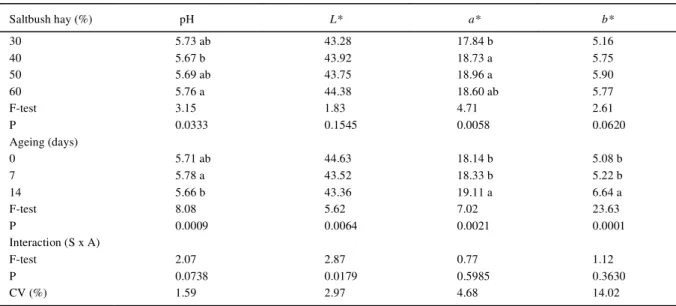
There was no interaction between the saltbush hay level and ageing (P>0.05) for pH, a* and b* values (Table 1). Shoulders aged for 14 days had
ranging from 5.5 to 5.8 are normal 24 hours after slaughter. In this study, the pH values of the shoulder muscles were within this range GONÇALVES et al. (2004) also found effect in pH under ageing effect and related this with the glycolysis and accumulation of lactic acid after animal slaughter. There was an interaction (P<0.05) between saltbush hay level and ageing for lightness value (L*) (Table 2). Meat
from the lambs fed with 60% saltbush hay had a higher lightness (P<0.05) when the shoulders were aged for 14 days than shoulders aged for 7 days. Differences in the lightness values were not detected for the other levels of saltbush hay. Shoulders aged for 14 days from lambs fed with 60% saltbush hay showed the lightness values higher than 30 and 50% saltbush hay but were similar to the 40% saltbush hay. PEARCE et al. (2005) found increase from 2.4 to 6.3mg kg-1 LL muscle alpha-tocopherol among
lambs fed with control and saltbush diet, respectively. The *L values is a positive effect and the plausible
explanation is due to the saltbush increase in the vitamin E levels on muscle, which improve the color stability (PEARCE et al., 2010).The lightness is an objective analysis that may be used to predict fi nal meat quality when evaluated together with other parameters. BONAGURIO et al. (2003) reported that meat lightness decreases when the slaughter weight of sheep increases. Similar to this study, the lightest animals were from feeding with 60% saltbush hay and had the highest lightness values when the meat was aged for 14 days. MORENO et al. (2010)
showed that the effect of including saltbush hay in the slaughter weight decreased when the saltbush hay level was increased in diet of the animals in the present study (36.31±3.41, 34.88±5.07, 32.75±4.24 and 31.06±4.40kg of the slaughter weight for 30, 40, 50 and 60% saltbush hay, respectively). ZEOLA et al. (2007) reported that the ageing infl uences (P<0.05) the lightness and redness values but does not affect yellowness values.
Shoulders aged for 14 days had higher (P<0.05) redness values (a*) than those aged for 7
days and unaged. The average redness values (a*) for
the 40 and 50% saltbush hay samples differed (P<0.05) from the 30% saltbush samples but were similar to the redness values of the 60% saltbush samples. The higher redness level in meat is considered a positive effect for the consumers. The yellowness values (b*)
did not differ (P>0.05) among the saltbush hay levels but was different among ageing time. Shoulders aged for 14 days had higher (6.64) yellowness value (b*)
than those aged for 7 days (5.22) and unaged(5.08). PEARCE et al. (2005) identifi ed a behavior that was similar to these parameters when they evaluated meat from lambs fed with saltbush pasture. In addition, these authors concluded that consumers prefer redder meat and that increased yellowness (b*) of meat
may reduce its acceptance by consumers. Including saltbush hay improved meat color by making it redder without altering the yellowness, which suggests that saltbush hay is a good option for producing meat that meets consumer acceptance standards.
Table 1 - pH, lightness (L*), redness (a*) and yellowness (b*) values of aged shoulders from lambs fed with different saltbush hay levels.
Saltbush hay (%) pH L* a* b*
30 5.73 ab 43.28 17.84 b 5.16
40 5.67 b 43.92 18.73 a 5.75
50 5.69 ab 43.75 18.96 a 5.90
60 5.76 a 44.38 18.60 ab 5.77
F-test 3.15 1.83 4.71 2.61
P 0.0333 0.1545 0.0058 0.0620
Ageing (days)
0 5.71 ab 44.63 18.14 b 5.08 b
7 5.78 a 43.52 18.33 b 5.22 b
14 5.66 b 43.36 19.11 a 6.64 a
F-test 8.08 5.62 7.02 23.63
P 0.0009 0.0064 0.0021 0.0001
Interaction (S x A)
F-test 2.07 2.87 0.77 1.12
P 0.0738 0.0179 0.5985 0.3630
CV (%) 1.59 2.97 4.68 14.02
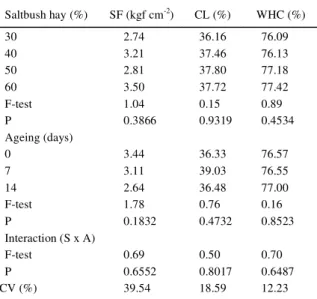
There was no signifi cant interaction (P>0.05) among ageing and saltbush hay levels for shear force (SF), cooking loss (CL) and water holding capacity (WHC) of the lamb shoulder (Table 3). These variables were not infl uenced (P>0.05) by saltbush hay level or ageing time, with average values of 3.06kgf cm-2, 37.28% and 76.71% for SF, CL and WHC,
respectively. GONÇALVES et al. (2004) also did not fi nd a signifi cant difference in CL and SF for 1, 3, 7 and 14 days of ageing at 2ºC for the lamb longissimus
muscle, and they explained that the decrease in SF may not have been observed because the SF results on the fi rst day post mortem were already suffi ciently
low (3.78kgf). The results reported by GONÇALVES et al. (2004) were consistent with the results identifi ed in this study which the average values for SF were 3.44, 3.11 and 2.64kgf cm-2 for 0, 7 and 14 days of
ageing, respectively. WHEELER & KOOHMARAIE (1999) found slightly lower reduction in shear force from 1 to 10d and assign this due to the fact that the control psoas major muscle was already so tender that there was little room for improvement.
ZEOLA et al. (2007) analyzed the effects of different ageing times and calcium chloride injection on the color, WHC and tenderness of lamb biceps
femoris, longissimus and triceps brachii muscles.
They found that ageing affects the reduction of WHC of the triceps brachiimuscles but not of the biceps
femoris and longissimus muscles, even though the SF
values of the biceps femoris and longissimus muscles
are affected by ageing. Although in this study there was not effect of the saltbush in WHC, PEARCE et al. (2010) affi rm that the high level of salt in saltbush may be responsible for the increase in hydration status observed in sheep fed with saltbush and high vitamin E concentrations in muscle may aid in the retention of water, but further research are necessary to explain this effect.
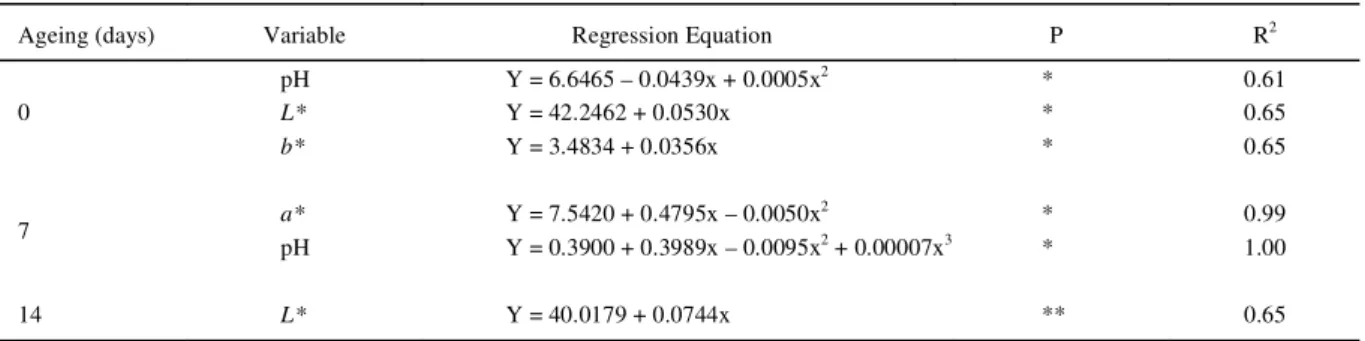
Table 4 shows the regression equation for the effects of 30, 40, 50 and 60% saltbush hay in lamb diets. Shoulders unaged had a linear (P<0.05) increase in the results for lightness (L*) and yellowness (b*),
with slopes of 0.0530 and 0.0356, respectively. A quadratic behavior was observed for pH, with a minimum value at 43.9% saltbush hay in unaged meat. Shoulders aged for 7 days had a quadratic behavior for redness (a*), with a maximum at 47.95%
of saltbush hay. A cubic effect (P<0.05) was observed for the pH, tenderness and overall quality of the product, with estimated maximums at 36, 55 and 54% saltbush hay, respectively, and minimums at 51, 39 and 38% saltbush hay, respectively. Shoulders aged for 14 days had a positive linear effect (P=0.0063) on lightness (L*), with a slope of 0.0744.
CONCLUSION
There were no detrimental effects of increasing saltbush hay until 60% level in the diet of Table 3 - Shear force (SF), cooking loss (CL) and water-holding
capacity (WHC) of aged shoulders from lambs fed with different saltbush hay levels.
Saltbush hay (%) SF (kgf cm-2) CL (%) WHC (%)
30 2.74 36.16 76.09
40 3.21 37.46 76.13
50 2.81 37.80 77.18
60 3.50 37.72 77.42
F-test 1.04 0.15 0.89
P 0.3866 0.9319 0.4534
Ageing (days)
0 3.44 36.33 76.57
7 3.11 39.03 76.55
14 2.64 36.48 77.00
F-test 1.78 0.76 0.16
P 0.1832 0.4732 0.8523
Interaction (S x A)
F-test 0.69 0.50 0.70
P 0.6552 0.8017 0.6487
CV (%) 39.54 18.59 12.23
P=probability. CV=coefficient of variation.
Table 2 - Interaction among saltbush hay level and ageing time for lightness in meat lamb.
---Saltbush hay (%)---Ageing (days)
30 40 50 60 F-test P
0 43.50 A a 45.05 A a 44.50 A a 45.45 A a 2.11 0.1107
7 43.85 A a 43.61 A a 44.03 A a 42.58 A b 1.24 0.3042
14 42.50 B a 43.11 AB a 42.72 B a 45.12 A a 4.22 0.0100
F-test 1.44 3.00 2.51 7.30
P 0.2477 0.0592 0.0922 0.0017
lambs, and there was improvement in the lightness with 60% saltbush hay level in meat aged for 14 days.
ACKNOWLEDGEMENTS
This work was fi nancially supported by ‘Fundação de
Amparo à Pesquisa do Estado de São Paulo’ (FAPESP) and ‘Banco Nacional do Desenvolvimento’ (BNDES).
COMITÊ DE ÉTICA E BIOSSEGURANÇA
Protocolo da aprovação do trabalho pelo Comitê de Ética é: 008403-08.
REFERENCES
ABOU EL NASR, H.M. et al. Value of processed saltbush and acacia shrubs as sheep fodders under the arid conditions of Egypt. Small Ruminant Research, v.24, p.15-20, 1996. Available from: <http://www.sciencedirect.com/science/article/pii/ S0921448896009327>. Accessed: Mar. 22, 2014. doi: 10.1016/ S0921-4488(96)00932-7.
ABU-ZANAT, M.M.W. Voluntary intake and digestibility of saltbush by sheep. Asian-Australian Journal Animal Science, v.18, n.2, p.214-220, 2005. Available from: <http:// www2.ju.edu.jo/sites/Academic/mahfouz/Lists/Published%20 Research/Attachments/4/Voluntary%20Intake%20and%20 Digestibility2005.pdf>. Accessed: Mar. 22, 2014.
BARBOSA, J.C.; MALDONADO JR, W. AgroEstat. Sistema para análises estatísticas de ensaios agronômicos. Versao 1.0. Universidade Estadual Paulista “Júlio de Mesquita Filho” – Faculdade de Ciências Agrárias e Veterinárias, Jaboticabal, Brasil, 2010.
BEN SALEM, H. et al. Potential use of oldman saltbush (Atriplex nummularia Lindl.) in sheep and goat feeding. Small Ruminant Research, v.91, p.13-28, 2010. Available from: <http://www. sciencedirect.com/science/article/pii/S0921448810000246>. Accessed: Out. 15, 2011. doi: 10.1016/j.smallrumres.2009.10.017.
BONAGURIO, S. et al. Qualidade da carne de cordeiros Santa Ines puros e mesticos com Texel abatidos com diferentes pesos.
Revista Brasileira de Zootecnia, v.32, n.6, p.1981-1991, 2003. Available from: <http://www.scielo.br/pdf/rbz/v32n6s2/20971. pdf>. Accessed: Dec. 08, 2011. doi: 10.1590/S1516-35982003000800023.
GONÇALVES, L.A.G. et al. Efeitos do sexo e do tempo de maturação sobre a qualidade da carne ovina. Ciência e Tecnologia de Alimentos, v.24, n.3, p.459-467, 2004. Available from: <http:// www.scielo.br/pdf/cta/v24n3/21943.pdf>. Accessed: Jan. 15, 2012. doi: 10.1590/S0101-20612004000300027.
HAMM, R. Biochemistry of meat hydration. Advanceds in Food Research, v.10, p.335-443, 1961. Available from: <http://www. sciencedirect.com/science/article/pii/S006526280860141X>. Accessed: Jan. 10, 2012. doi: 10.1016/S0065-2628 (08) 60141-X.
MARTÍNEZ-CEREZO, S. et al. Breed, slaughter weight and ageing time effects on consumer appraisal of three muscles of lamb.
Meat Science, v.69, p.795-805, 2005. Available from: <http:// www.sciencedirect.com/science/article/pii/S0309174004002955>. Accessed: Feb. 05, 2012. doi: 10.1016/j.meatsci.2004.11.013.
MENESES, R. et al. Evaluating the use of Atriplex nummularia
hay on feed intake, growth, and carcass characteristics of creole kids.
Chilean Journal of Agricultural Research, v.72, n.1, p.74-79, 2012. Available from: <http://www.scielo.cl/scielo.php?script=sci_ arttext&pid=S0718-58392012000100012>. Accessed: Mar. 22, 2014. doi: 10.4067/S0718-58392012000100012.
MORENO, G.M.B. et al. Desempenho de cordeiros Santa Inês alimentados com níveis de feno de erva-sal e concentrado. In: Reunião Anual da Sociedade Brasileira de Zootecnia, 47., 2010, Salvador, BA. Anais… Salvador: Sociedade Brasileira de Zootecnia, 2010. (CD-ROM).
NATIONAL RESEARCH COUNCIL (NRC). Nutrient requirement of small ruminants. Washington, DC, 2006. 362p.
PARDI, M.C. et al. Ciência, higiene e tecnologia da carne. 2.ed. Goiânia: UFG, 2001. 623p.
PEARCE, K.L. et al. Plasma and tissue α-tocopherol
concentrations and meat colour stability in sheep grazing saltbush (Atriplexspp.). Australian Journal of Agricultural Research,
v.56, p.663-672, 2005. Available from: <http://www.publish.csiro. au/paper/AR05001.htm>. Accessed: Mar. 15, 2012. doi: 10.1071/ AR05001.
PEARCE, K.L. et al. The role of saltbush-based pasture systems for the production of high quality sheep and goat meat. Small Ruminant Research, v.91, p.29-38, 2010. Available from: <http://www.sciencedirect.com/science/ article/pii/S0921448810000258#>. Accessed: Feb. 20, 2014. doi:10.1016/j.smallrumres.2009.10.018.
Table 4 - Regression analysis of the variables revealed significant effects as a function of the saltbush hay levels (30, 40, 50 and 60%).
Ageing (days) Variable Regression Equation P R2
pH Y = 6.6465 – 0.0439x + 0.0005x2 * 0.61
L* Y = 42.2462 + 0.0530x * 0.65
0
b* Y = 3.4834 + 0.0356x * 0.65
a* Y = 7.5420 + 0.4795x – 0.0050x2 * 0.99
7
pH Y = 0.3900 + 0.3989x – 0.0095x2 + 0.00007x3 * 1.00
14 L* Y = 40.0179 + 0.0744x ** 0.65
ROTA, E.L. et al. Efeitos do cruzamento de carneiros da raça Texel com ovelhas Corriedale e Ideal sobre a qualidade da carne.
Revista brasileira de Agrociência, v.10, n.4, p.487-491, 2004. Available from: <http://www.ufpel.tche.br/faem/agrociencia/ v10n4/artigo14.pdf>. Accessed: Oct. 15, 2011.
WHEELER. T.L.; KOOHMARAIE, M. The extent of proteolysis is independent of sarcomere length in lamb longissimus and psoas major. Journal of Animal Science, v.77, p.2444-2451,
1999. Available from: <http://www.journalofanimalscience.org/ content/77/9/2444.full.pdf>. Accessed: Mar. 22, 2014.
ZEOLA, N.M.B. et al. Capacidade de retenção de agua e maciez da carne de cordeiro maturada e injetada com cloreto de calcio.