Vol. 44, N. 2 : pp. 129 – 134, June, 2001
ISSN 1516-8913 Printed in Brazil BRAZILIAN ARCHIVES OF BIOLOGY AND TECHNOLOGY
A N I N T E R N A T I O N A L J O U R N A L
Influence of Temperature and Diet on the Development of
Ulomoides dermestoides
(Fairmaire, 1893) (Coleoptera,
Tenebrionidae, Diaperinae)
Renato C. Marinoni
*and Cibele S. Ribeiro-Costa
Departamento de Zoologia, Universidade Federal do Paraná. Caixa Postal, 19020. Centro Politécnico, 81531-990, Curitiba - PR, Brazil
ABSTRACT
Ulomoides dermestoides (Fairmaire, 1893) develops in stored food products (peanuts, maize, oats, rice, sorghum, etc.) and breeds successfully in the laboratory. To determine the best conditions for development, experiments were
set up in different temperatures and diets, similar to storage conditions of peanuts (Arachis hypogaea L.). The
higher viability of individuals and the shorter developmental time were observed in the diet composed of hulls and
seeds of fruits at 21 and 24ºC.
Key words: Coleoptera, Ulomoides dermestoides, peanuts, diet, temperature, moisture
* Author for correspondence
INTRODUCTION
Ulomoides dermestoides (Fairmaire, 1893) is a
euryphagous and cosmopolitan species, considered as a restorative on the southeast coast of China, and then as a panacea around the world, purporting to cure any illness (Yoshida, 1974; Chua & Chandrapal, 1978; Dacanay & Cervancia, 1989). It is a species that develops in stored food products, and has been used in laboratory experiments because it is easy to breed. The purposes of this work was to improve the knowledge of the effects of different physical and biological parameters on the development of stored food insects; and analyze the influence of different temperatures and storage conditions of peanuts (Arachis hypogaea L.) in order to develop
for better rearing conditions for Ulomoides dermestoides.
MATERIALS AND METHODS
The development of Ulomoides dermestoides was
tested in three different conditions of peanut storage in four chambers with controlled temperatures (18, 21, 24 and 27º C), 12 hours photophase and moisture at 65 ± 5%. For each diet, in each temperature, two replications were established. The diets were: only grains (diet “A”); open fruits (hulls + seeds) (diet “B”); complete fruits (diet “C”).
The receptacles, with adults and food, were examined daily after the first emergence of pupa (first generation). Each pupa detected was sorted by sex and transferred to another receptacle with the same conditions of food and temperature. The number of individuals and the duration of development (days) were noted. The date of first pupal emergence from the second receptacle (second generation) was considered the last day of the first generation and, at this time, the replication was concluded.
As the experiments started in the pupal stage, the period for the appearance of first pupae of the first generation was considered as being the duration of the life cycle. The mean time of the life cycle was the result of the average time (days) of the development of individuals, during the interval defined by the period of emergence of all pupae of the first generation until the emergence of the first pupae of the second generation.
The number of individuals and days of development obtained for males and females, diets “A” and “B”, were not significantly different (P > 0.90), so the values were treated together. Statistical analyses were performed based on X2
test to evaluate differences in data of viability between diets and the F test to evaluate the differences of developmental time, considering the diets and the four temperatures.
The voucher material has been deposited in the
Museu de Entomologia Pe. Jesus S. Moure, Departamento de Zoologia, Universidade Federal do Paraná.
RESULTS AND DISCUSSION
Ulomoides dermestoides developed in the diets
“A” and “B” but not in the diet “C”.
Viability
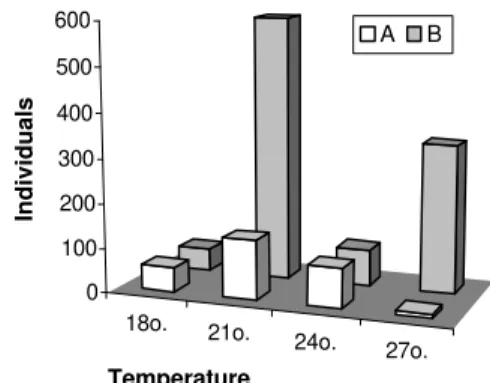
(Table 1, Figure 1).
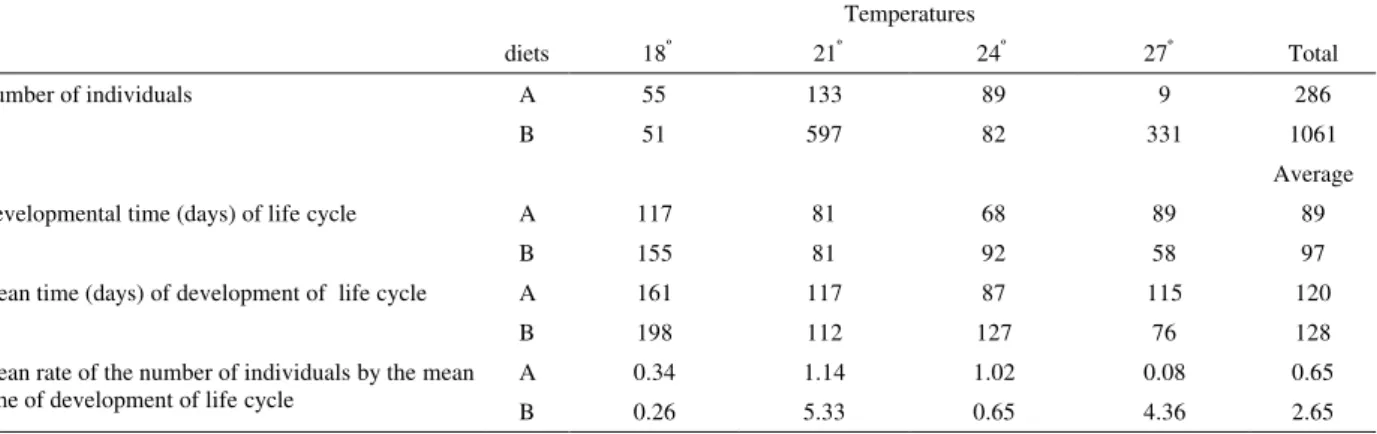
The diet "B" (open fruits = hulls + seeds) was favorable to the development of a higher number of individuals compared with diet "A" (only seeds) (1061:286; X2 = 230.83, P<0.0001 ). The most extremelydifferent values where those observed in the experiment at 27º C, as there were 331
individuals in the diet "B" and only nine in diet "A".
Extensive data are available quoting a trend of better development in higher temperatures (Hafez & El-Ziady, 1952; Ray, 1960; Atwal & Sethi,
1977; Kasten Junior & Parra, 1984; Almeida & Marinoni, 1986), until the upper limit of the optimal range of temperature was reached (Chapman, 1982). In the experiment with
Ulomoides dermestoides, however, more
individuals were observed in the intermediate temperatures (21 and 24º C), on both diets, except
in the experiment at 27o C, on diet "B" .
Because our results showed that intermediate temperatures were more favorable for the species viability, two points must be discussed: 1) at 21º
C, the number of individuals on diet “B” was four times higher than that observed on diet “A”; 2) at 27º C on diet “B”, the number of individuals was
30 times higher than on diet “A”. In the former, the results appeared to be influenced by a combination of two factors: temperature and the physical environment of diet “B”. In the latter, the expected results at 27ºC would be a lesser number
of individuals than that at 24oC, following the
tendency observed on diet “A”. The changing of the tendency could be explained by the different condition provided by diet “B”, probably increasing the moisture.
18o. 21o.
24o. 27o.
0 100 200 300 400 500 600
Individuals
Temperature
A B
Figure 1 - Ulomoides dermestoides. Number of
individuals reared in peanuts, diets “A” and “B”, at different temperatures.
Atwal & Sethi (1977) reported the influence of moisture on the viability of Epilachna
vigintioctopunctata Fabricius (Coleoptera,
Coccinellidae); the results showed that higher moisture (40-70%) determine an increase, almost proportional, of the percentage of surviving larvae (58.2-82.2%). Butler (1949), observed that the highest moisture was favorable to larvae survival
of Palorus ratzeburgi Wissman (Tenebrionidae,
When Chua & Chandrapal (1978) compared their fecundity data on U. dermestoides with those of
Yoshida (1974) experiments, they stated that the observed higher number of eggs laid could be due to the rate, amount, and type of food. The authors, however, made no mention of the moisture, which was higher in their experiments (61-75%, 81-86%). Possibly, the feature of diet "B" responsible for providing differences in moisture, was of a structural nature. There were bigger spaces surrounding hulls and grains, probably contributing to an increase in the moisture than in the diet composed only of grains. A higher moisture level probably was an advantage for the species development, favouring a higher number of individuals reaching the end of their life cycles. At high moistures, the insect evaporative cooling produced by the heat of metabolic activity was reduced, being favorable to maintain the hydric balance and, in consequence, the survival (Chapman, 1982).
It appeared that moisture was the factor that most affected the viability rather than the nutritive components of diet “B”. After Gohl (1981), the chemical composition of hulls (zero-moisture basis) is: 4.9 % crude protein, 68.4 % crude fiber,
7.4 % ash, 0.6 % ethereous extract and 18.7 % nitrogen free extract; the seed composition is: 21.0-36.4 % protein, 35.8-54.2 % fat, 6.0-24.9% total carbohydrate, 1.2-4.3% fiber, 1.8-3.1 ash, 4-13% moisture, fractions of essencial elements. Fiber is the principal component of hulls whereas in seeds protein, fats and carbohydrates predominate.
Another effect that has been indicated as inducing alterations in values of fecundity, viability and developmental time is the overcrowding (Chua & Chandrapal, 1978; Peters & Barbosa, 1977; Yoshida, 1974). The possible influence of population size leading to food scarcity has not affected the lower number of individuals on diet "A", because the same food supply was offered in both diets.
Developmental time of life cycle
The life cycle was longer on diet "B" than on diet “A” (F test, significantly different P<0.001). The experiment on diet “B”, at 27o C, was the
exception, with lesser value comparing with that on diet “A”, possibly also as a consequence of moisture (Table 1, Figure 2).
Table 1 – Values of viability and developmental time of Ulomoides dermestoides(Fairmaire, 1893), reared in
peanuts, diets “A” and “B”, at different temperatures.
diets
Temperatures
18º 21º 24º 27º Total
A 55 133 89 9 286
Number of individuals
B 51 597 82 331 1061
Average
A 117 81 68 89 89
Developmental time (days) of life cycle
B 155 81 92 58 97
A 161 117 87 115 120
Mean time (days) of development of life cycle
B 198 112 127 76 128
A 0.34 1.14 1.02 0.08 0.65
Mean rate of the number of individuals by the mean
18o. 21o.
24o. 27o.
0 20 40 60 80 100 120 140 160
Days
Temperature
A B
Figure 2 - Ulomoides dermestoides reared in peanuts.
Developmental time of life cycle, diets “A” and “B”, at different temperatures.
The results clearly showed a relation of higher viability with shorter developmental time. A negative correlation was found between the values of viability (number of individuals) and developmental time (number of days), independent of the diets ( “A”: r = -0.405; “B”: r = -0.609). Considering both diets (“A” and “B”) at the intermediate temperatures (21 and 24º C), the
developmental time was shorter than at temperature extremes (18 and 27º C). There was a
significant difference (F test, P>0.6) comparing the values, even considering the shortest time observed at temperature of 27º C, diet “B”. The
mean time of development of life cycle showed the same proportional values among experiments as that of time of development (defined by the emergence of first pupae of the first generation) (Table 1, Figures 2 and 3).
18o. 21o.
24o. 27o.
0 20 40 60 80 100 120 140 160 180 200
Days
Temperature
A B
Figure 3 - Ulomoides dermestoides reared in peanuts.
Mean time of development of life cycle, diets “A “ and “B”, at different temperatures.
Yoshida (1974), Chua & Chandrapal (1978), and Dacanay & Cervancia (1989), studying the development of U. dermestoides at around 30o C
reported following times: 50, 56 and 42 days. The mean time reported here at 27o, on both diets (115-76 days) (Table 1, Figure 3) was higher than that of these authors, contradicting to the expected results of a decrease in developmental time at higher temperatures.
Hagstrum & Milliken (1988) analyzed the influence of temperature, moisture and diet on the life cycle of many coleopterous species of stored products. The authors demonstrated that the effect of temperature was the most important on the developmental time, followed by moisture and diet; however, near each species optimal temperature of development changes in moisture and diet seemed to influence the developmental time more than changes in temperature. They also observed that at high temperatures, some species
(Tribolium confusum Jacqueline DuVal,
Cryptolestes ferrugineus Stephens) increased the
developmental time at low moisture. Their data contradict the tendency of shorter developmental time under higher temperatures. Analyzing the data of Howe (1960) upon larvae of Tribolium
confusum, it was possible to conclude that at the
same temperature the developmental time was shorter at higher moisture. The same tendency was observed in the data of Fenilli (1982) who studied the developmental time of U. dermestoides larvae,
at the same temperature and two moisture levels (65% and 70%). Dias (1993) registed that their results on developmental time of U.dermestoides
were more similar to those of Yoshida (1974), than those of Chua & Chandrapal (1978), probably as a function of the moisture.
18o. 21o.
24o. 27o. 0,00
1,00 2,00 3,00 4,00 5,00 6,00
Individuals/day
Temperature
A B
Figure 4 - Ulomoides dermestoides. Mean number of
The mean rate of individuals per day (Table 1, Figure 4)(number of emerged pupa divided by the mean of developmental time at each temperature) was proportionally similar to the total number of individuals within the same diet. The trend was similar, increasing the number of individuals per day in intermediate temperatures on both diets, except for the experiment on diet “B”, at 27º C. In
diet "B", the results indicated better conditions of development, because the number of individuals per day was higher than in the diet “A" (2.65 – 0.65). At 27º C, the rate was near of those at 21º C.
CONCLUSIONS
Ulomoides dermestoides (Fairmaire, 1893) showed
higher viability when reared in open fruits (hulls and seeds) of peanut (Arachis hypogaea),
compared with the diet composed only of seeds and they did not develop in complete fruits. On the diet of open fruits, they exhibited higher viability and shorter developmental times in intermediate temperatures and probably better conditions of development (viability and developmental time) at higher moisture levels.
ACKNOWLEDGMENTS
We would like to thank Antonio Panizzi, Clarence Dan Johnson and Irineu Lorini for their constructive review of the manuscript; James Ropper for the suggestions about the statistical analyses; and Conselho Nacional de Desenvolvimento Científico e Tecnológico for the research fellowships.
RESUMO
Ulomoides dermestoides (Fairmaire, 1893) é um
coleóptero que se desenvolve em produtos armazenados (amendoim, milho, aveia, arroz, sorgo, etc.) e é facilmente criado em laboratório. Para avaliar as melhores condições de desenvolvimento foram estabelecidos experimentos em diferentes temperaturas e em dietas definidas por três diferentes condições de armazenamento de amendoim (Arachis hypogaea
L.). A maior viabilidade de indivíduos e o menor tempo de desenvolvimento foram verificados na
dieta constituída por frutos abertos (vagens e grãos) e em temperaturas de 21 e 24o C. É
discutida a possível influência da umidade relativa nos resultados.
REFERENCES
Almeida, L. M. and Marinoni, R. C. (1986), Desenvolvimento de três espécies de Epilachna
(Coleoptera:Coccinellidae) em três combinações de temperatura e fotoperíodo. Pesquisa Agropecuária
Brasileira, 21, 927-939
Atwal, A. S. and Sethi, S. L. (1977), Influence of different levels of temperature and moisture on the speed of development and survival of Epilachna
vigintioctopunctata F. (Coleoptera: Coccinellidae).
Indian Journal of Ecology, 4, 91-93
Butler, P. M. (1949), Observations on the biology of
Palorus ratzeburgi Wissman, with comparative notes
on Tenebrionidae in general (Coleoptera).
Transactions of Royal Entomological Society of
London, 100, 249-273
Chapman, R. F. (1982), The Insects. Structure and
Funcion. Harvard University Press, Cambridge. 919p
Chua, T. H. and Chandrapal, R. (1978), The influence of restricted food supplies on the development of larvae and on the fecundity of Palembus
dermestoides Fairn. (Tenebrionidae). Journal of
Stored Products Research, 14, 81-86
Dacanay, A. A. and Cervancia, C.R. (1989), Biology of
Palembus (Martianus) dermestoides Chevrolat
(Coleoptera; Tenebrionidae). Philippines Ent., 7, 471-477
Dias, E. A. R. (1993), Caracterização de Ulomoides
dermestoides (Fairmaire, 1893) (Coleoptera,
Tenebrionidae) criado em amendoim e milho. Master of Sciences Thesis, Pontifícia Universidade Católica do Rio Grande do Sul, Porto Alegre, Brazil)
Fenilli, R. (1982), Ciclo biológico, morfologia e efeitos da radiação gama (60 CO) em adultos de Palembus
dermestoides (Fairmaire, 1893) (Coleoptera,
Tenebrionidae). Doctor of Sciences Thesis, Universidade de São Paulo, Piracicaba, Brazil) Gohl, B. (1981), Tropical feeds. Feed information
summaries and nutritive values. FAO Animal
Production and Health Series 12. FAO, Roma
Hafez, M. and El-Ziady, S. (1952), Studies on the biology of Hyperaspis vinciguerrae Capra, with a full
description of the anatomy of the fourth stage larva (Coleoptera, Coccinellidae). Bull. Soc. Fouad
Entomol., 36, 211-246
Hagstrum, D. W. and Milliken, G. A. (1988), Quantitative analysis of temperature, moisture, and diet factors affecting insect development. Annals of
Howe, R. W. (1960), The effects of temperature and humidity on the rate of development and the mortality
of Tribolium confusum Duval (Coleoptera,
Tenebrionidae). Annals of Applied Biology, 48, 363-376
Kasten Junior, P. and Parra, J. R. P. (1984), Bioecologia
de Alabama argillacea. I. Biologia em diferentes
temperaturas, na cultivar de algodoeiro IAC-17.
Pesquisa Agropecuária Brasileira, 19, 269-280
Peters, T. M. and Barbosa, P. (1977), Influence of population density on size, fecundity, and developmental rate of insects in culture. Annual
Review of Entomology, 22, 431-450
Ray, C. (1960), The application of Bergmann's and Allen's rules to the poikilotherms. Journal of
Morphology, 106, 85-108
Yoshida, T. (1974), Rate of oviposition and effect of crowding on egg cannibalism and pre-adult mortality
in Martianus dermestoides Chevrolat (Coleoptera,
Tenebrionidae). The Scientific Reports of the Faculty
of Agriculture Okayama University, 44, 9-14