Vol. 44, N. 2 : pp. 191 – 196, June, 2001
ISSN 1516-8913 Printed in Brazil
BRAZILIAN ARCHIVES OF
BIOLOGY AND TECHNOLOGY
A N I N T E R N A T I O N A L J O U R N A L
An Improved Method for Transformation of Lettuce by
Agrobacterium tumefaciens
with a Gene that Confers
Freezing Resistance
Marcos Pileggi
1*, Albanin Aparecida Mielniczki Pereira
1, Joandrei dos Santos Silva
1, Sônia
Alvim Veiga Pileggi
1and Desh Pal S. Verma
21
Departamento de Biologia Geral, Setor de Ciências Biológicas e da Saúde, Universidade Estadual de Ponta Grossa, Campus Uvaranas, Av. Carlos Cavalcanti, 4748, 84030-000, Ponta Grossa, PR, Brazil; 2Plant Biotechnology Center, Ohio State University,1060 Carmack Road, Columbus, OH 43210, USA
ABSTRACT
An efficient method for constructing transgenic lettuce cultivars by Agrobacterium tumefaciens was described by Torres et al., 1993. In the present work, an improvement of the above procedure is described and applied to transform the cultivar Grand Rapids with a mutated P5CS gene. The major modifications were concerned with turning more practical the transformation and regeneration protocols. Also we tried to improve transformation steps by increasing injured area in explants and prolonging co-cultivation with Agrobacteria (in larger concentration). A more significant selective pressure was used against non-transformed plants and bacteria. In these work we were concerned to obtain T1 and T2 seeds. The P5CS gene codes for a ∆1-pyrroline-5-carboxylate
synthetase, a bifunctional enzyme that catalyzes two steps of proline biosynthesis in plants (Zhang et al., 1995; Peng et al., 1996), while the mutated gene is insensitive to feedback inhibition by proline. The potential benefit of this gene is to confer water stress resistance (drought, salt, cold) due to increased intracellular levels of proline that works like an osmoprotectant. In this work could obtain and characterize transgenic lettuce lineages which are resistant to freezing temperature.
Key words: Stress resistance; cold resistance; transgenic; lettuce; proline
*
Author for correspondence
INTRODUCTION
The development of new crops capable of high yields under drought, salinity and cold environments has been difficult due to the polygenic nature of these traits. Plants have evolved different mechanisms to overcome water deficit (McCue & Hanson, 1990). Proline acts as an osmolyte and it is accumulated in many bacteria and plants under osmotic stress (Delauney & Verma, 1993). The major idea to be tested is
that increased synthesis of a specific osmolyte can help to develop stress tolerance with an eventual improvement in crop yield.
sativa L. c.v. Grand Rapids) was chosen as a model plant due to its fast growth and agronomic value. The protocol described by Torres et al. 1993 to construct transgenic lettuce lineages by
Agrobacterium tumefaciens was not adequate to obtain transgenic lettuce plants, probably due to incompatibility with the cultivar involved. This paper describes adaptations and modifications to improve transformation and regeneration efficiency of Grand Rapids lettuce cultivar, as a model to test the resistance to freezing temperature.
MATERIAL AND METHODS
The lettuce (Lactuca sativa L.) cultivar Grand Rapids was used in this work. The techniques for co-cultivation with Agrobacterium tumefaciens, selection of kanamicin resistant explants, as well as for regeneration of shoots and roots, are described in this section.
Source of explants: Seeds of Lactuca sativa L. c.v. Grand Rapids were disinfected by soaking in a 10% solution of household bleach containing 0.1% Tween 20 for 25 minutes, followed by three rinses with sterile distilled water. The seeds were then germinated on MSO (4.3 g/L MS salts [Gibco]; 1 ml/L B5 vitamins [B5 vitamin stock contains 100 mg/mL myo-inositol; 10 mg/mL thiamine-HCl; 1 mg/mL nicotinic acid; 1 mg/mL pyridoxine-HCl.; 30 g/L sucrose and 0.7% agar [Bacto-Difco]; pH 5.7) plates (30 to 50 seeds per dish). The cultures were continuously illuminated with cool white fluorescent light at a constant temperature of 25 o
C, for a minimum of 16 hours. When aseptically germinated seedlings were 24 to 48 hours old, cotyledons were excised near the cotiledonary node, and cut in 6 or 8 pieces to increase the wound, originating the explants for Agrobacterium
infection.
Transformation: Explants were pre-cultured upside down for 2 days on MS104 (MSO; 0.05 mg/L naphthaleneacetic acid [NAA]; 0.2 mg/L benzyladenine [BA]) to allow initial growth.
A. tumefaciens LBA4404 carrying plasmid
pBIF414, which contains NPTII, (the kanamicin resistance gene), the β-glucuronidase gene (GUS
carboxylate synthetase gene), located between T-DNA borders, was inoculated in 10 mL of YEP medium (peptone 10 g/L; yeast extract 10 g/L; NaCl 5 g/L) with 50 mg/L of kanamicin in 125 mL Erlenmeyer flasks. The cultures were incubated at 28 oC overnight in an orbital shaker at 300 rpm.
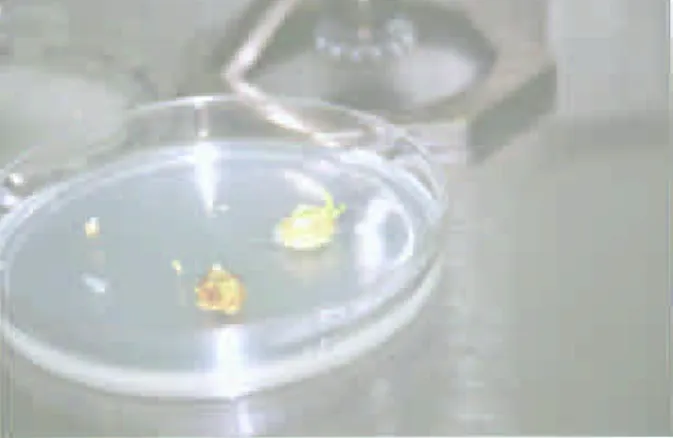
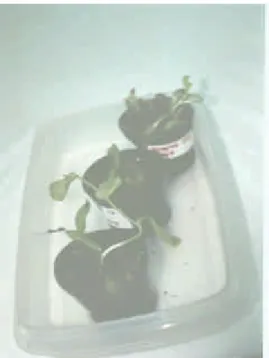
Inoculation of cotyledons: Cotyledons were dipped into A. tumefaciens grown overnight cultures (diluted 1 to 10 with MSO to 109 cells/mL), and gently blotted dry as soon as all wounded edges had contacted the inoculum, by a fast dive of the explant, without over-soaking the tissue. The explants were placed upside down on MS104 plates, and incubated at 25 oC for three days. The explants were then transferred to a selective medium (MS104; containing 500 mg/L carbenicilin and 300 mg/L kanamicin), and incubated at 25 oC for 14 days in parafilm sealed Petri dishes or magenta boxes to conserve humidity (From this moment on, all the Petri plates and magenta boxes were sealed with parafilm to retain humidity). Explants were cut, when possible, to obtain isolated shoots (Figure 1), and transferred to fresh selection medium. Following shoot initiation, explants were transferred each 14 days to selection medium, until strong shoots could be transferred to rooting medium (MSO with 0,6% agar, 500 mg/L carbenicilin; 100 mg/mL kanamicin, 0.5 mg/L NAA) in magenta boxes (Figure 2).
Figure 2 – Explants with strong shoots in rooting medium
Seed harvest: Plantlets with strong roots were planted in sterile soil in small pots. The pots were placed in a large tray containing a 2 cm layer of water (Figure 3). The tray was sealed with Saran paper to keep a high moisture environment, and maintained at room temperature (22 °C) until the plants started to grow (4 to 5 days). During this period, the Saran wrap was opened gradually until it was completely removed. The growing plants were then transferred to a greenhouse and kept there more 2-3 days to adapt to relative low humidity from in vitro culture to greenhouse environment. The plants were removed from the pots with all adhered soil, and transferred into bigger pots containing different soil types. In the greenhouse, the lettuce plants grew very fast, and could reach about one meter height. To avoid infestation by insects and diseases, a solution based on cured tobacco leaves extract was used, as well as manual catching of insects. Nitrogen feeding was decreased gradually to induce blooming (Figure 4). Blooming took two months, and the plants were self-pollinated. At this point, nitrogen and boron feeding were restarted to guarantee seed filling and maturation. The seeds were mature 12 days after the start of blooming. To prevent seed loss, the flowers were removed one by one. High humidity was avoided by placing the pots in drier areas of the greenhouse. Each flower produced 10 to 25 seeds. (Figure 5). The seeds were collected when dry. To break dormancy the seeds were exposed to cold temperature (4 oC) for two days or germinated under red light. The temperature was maintained at about 26 oC by day and 21 oC by night, to improve the seed formation.
Figure 3 - Plants with strong roots in small pots with sterile soil
Figure 4 - Flowers rising in terminal position
GUS staining procedure was modified from Jefferson et al. (1987). The substrate was 5-bromo-4-chloro-3-indolyl-glucoronidase (X-Glu. Gibco-BRL). The tissue fragments were added to 100 µL of staining solution in microcentrifuge tubes, and incubated at 37 oC for 2 to 4 hs (Figure 6).
Figure 6 – GUS analysis for fragments of transgenic plants. Only blue spot means GUS positive result (fragments 1, whole fragment, and 3, with spots)
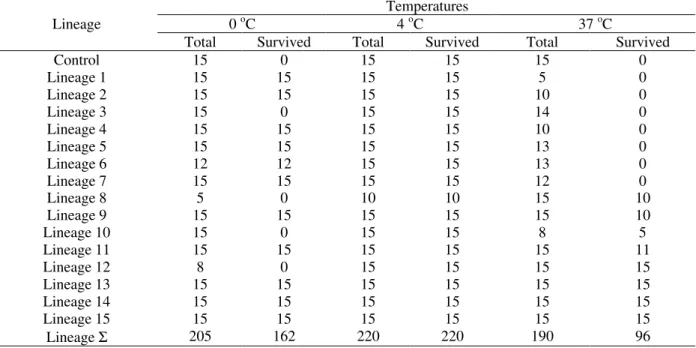
Temperature resistance in rich proline lettuce: From each independent transgenic lineage, 15 seeds were grown in MSO plates. Only the germinated seeds were counted in “Total” (labeled in Table 1). Three temperatures were chosen: 0 oC, 4 oC and 37 oC. The time at which the plants were submitted to sets of temperatures was 10 hours. After that, the material was recovered by constant illumination and temperature of 25 oC. Control was the wild type c.v. (Grand Rapids) with no transformation.
RESULTS AND DISCUSSION
When we used the first protocol, (Torres et al., 1993), we got no transformed explant, probably because another cultivar was used (South Bay). We accomplished some adaptations based on protocols of Torres et al. (1993), and Horsch et al. (1988). The major modifications related to the first one are listed here. No cheesecloth squares were used to keep the seeds together. This procedure brought some difficulty in catching the seeds into the cheesecloth tissue. As seeds were immersed in bleach solution, they could be easily decanted and washed in sterilized water. After that, they were picked with a wide spatula. No vacuum was used, because desinfestation was still very efficient. No filter paper platform over liquid media was used to germinate the seeds, because of difficulty to manipulate inborn plantlets. We increased the number of cut pieces from cotyledons, from 2 to 6
Agrobacterium and transformation efficiency. The time for pre-culture of explants was increased from 30 minutes to 2 days, with the purpose to improve the contact between plant and bacteria, and therefore transformation efficiency.
Agrobacterium was inoculated in YEP medium as this was more appropriate to grow this bacteria than LB. The cultures were incubated in an orbital shaker at 300 rpm rather than 150 rpm, with the purpose to get more bacteria to inoculation. Cotyledons were dipped into A. tumefaciens
overnight cultures (diluted 1 to 10 with MSO to 109 cells/mL), and gently blotted dry, as soon as all wounded edges had contacted the inoculum, rather than over-soaking the tissue for 10 minutes as over-soaking could damage the plant cells. Overnight cultures of A. tumefaciens were diluted 1 to 10 with MSO media with no centrifugation and suspension in MSO media. Kanamycin was also diluted and its residue could be helpful on initial transformed explants selection, with little damage in sensitive lettuce tissue. No acetosyringone or syringaldehyde was used to stimulate bacterial transformation, considering that no increase on transformation’s rates was observed in lettuce (Torres, personal communication). To improve selection of transformed explants, carbenicilin (to kill Agrobacterium) level was raised from 100 mg/mL to 500 mg/mL; and kanamicin (to select resistant explants) concentration was raised from 50 mg/mL to 300 mg/mL. We observed that just NAA was enough to induce rooting, so the hormones benzyladenine, isopentenyladenine and zeatin were not used in this medium.
About 84 to 88% of tissue culture platelets could be recovered in the greenhouse like fully mature plants. About 12 to 16% plants (3-4 plants out of 25) showed abnormal phenotypes as revealed by smaller leaves that faded soon. These phenotypes are probably due to somatic variation caused by hormones during callus growth and plant regeneration.
from transgenic plants. We got seeds from T1 and T2 generations. T1 generation was obtained from in
vitro plant culture, and T2 from ex vitro culture. To select transformed plants, was used constant selective pressure, kanamicyn. We also used a GUS staining over leaves fragments, choosing only the positive ones. As a matter of fact, GUS
and NPTII genes are close to P5CS gene, so selection for both genes could be indirectly selective to P5CS too.
The protocol for transformation and regeneration of lettuce with A. tumefaciens was adapted from Torres et al.. (1993), and Horsch et al. (1988). Unfortunately, both original protocols failed to promote transformation of cultivar Grand Rapids. Transformation and regeneration of this cultivar was successful using the methodology described in this paper. Also we got the acclimatization of ex vitro plants and transgenic seed production. The previous papers did not repeat these achievements.
Table 1 – Resistance results to stress temperatures in 15 independent transgenic strains of lettuce c.v. Grand Rapids Temperatures
0 oC 4 oC 37 oC
Lineage
Total Survived Total Survived Total Survived
Control 15 0 15 15 15 0
Lineage 1 15 15 15 15 5 0
Lineage 2 15 15 15 15 10 0
Lineage 3 15 0 15 15 14 0
Lineage 4 15 15 15 15 10 0
Lineage 5 15 15 15 15 13 0
Lineage 6 12 12 15 15 13 0
Lineage 7 15 15 15 15 12 0
Lineage 8 5 0 10 10 15 10
Lineage 9 15 15 15 15 15 10
Lineage 10 15 0 15 15 8 5
Lineage 11 15 15 15 15 15 11
Lineage 12 8 0 15 15 15 15
Lineage 13 15 15 15 15 15 15
Lineage 14 15 15 15 15 15 15
Lineage 15 15 15 15 15 15 15
Lineage Σ 205 162 220 220 190 96
Lineages 16, 17 and 18 did not germinated.
For plants, the major problem of freezing temperature is the ice crystals. When intracellular water freezes, there is an expansion in volume of ice crystals that can injure cell membranes. When the plant is put to recover, all the intracellular content is lost and the plant dies. As shown in Table 1, considering 0 oC evaluation, the results suggested that the P5CS mutated gene confers a high proline concentration as well as a high osmotic potential and a need to keep water without freezing, compared with control lineage. This excess of proline could help the plant in recovering phase, putting up more nitrogen and carbon supplies. However, some lineages showed no resistance to this temperature (3, 8, 10 and 12). This could mean that some lineages had their transgenes in tandem inserts inactive by heterocramatization. Future experiments using
Southern Blot could be fitted to check this explanation.
the roots, which could easily absorve water. In all temperature treatments, we postulated that the position of inserts must cause important effects, under different physiological conditions. Besides, transgenes could be inactivated in a multi copy way due to expression pattern presented by plants. So, independent transformed lineages could show distinct behaviors over different temperature treatments, as we can see in Table 1.
This approach turns very reasonable the achievement of new assays about stress environment, using, for instance, lineages of crops.
ACKNOWLEDGMENTS
Thanks are due to CNPq for a fellowship given to M.P.; to Dr. Marguerite Quoirin for her assistance in determining rooting medium conditions and to Dr. Zonglie Hong and Dr. Zhongming Zang for their assistance in all steps of this work.
RESUMO
Um método eficiente de obtenção de cultivares de alface por meio de transformação com
Agrobacterium tumefaciens foi descrito por Torres
et al., 1993. Neste trabalho foi desenvolvido um procedimento melhorado a partir do trabalho descrito acima foi aplicado para transformação da cultivar de alface Grand Rapids com o gene mutado P5CS. As principais modificações nos protocolos de transformação e regeneração, com o objetivo de torná-los mais práticos. Também foi procurado o melhoramento das etapas de transformação no sentido de se aumentar a infecção, além do aumento no tempo de co-cultivo com Agrobacterium (em uma alta concentração celular). Maior pressão seletiva foi utilizada contra plantas não transformadas e bactérias. Neste trabalho também se trabalhou na produção de sementes das gerações T1 e T2, para que se pudesse fazer os ensaios fisiológicos e
.
Este gene codifica para ∆1 -pirrolina-5-carboxilato sintetase, uma enzima bifuncional que catalisa dois passos na biossíntese de prolina em plantas (Zhang et al., 1995; Peng et al., 1996), só que neste caso se tornou insensível para inibição por retroalimentação por prolina. O potencial deste(seca, alta concentração salina, frio) devido ao aumento na concentração de prolina intracelular, que funciona como um osmoprotetor. Neste trabalho foram obtidas e analisadas linhagens de alface transgênicas resistentes ao congelamento.
REFERENCES
Delauney, A. J. and Verma D. P. S. (1993), Proline biosynthesis and osmoregulation in plants. Plant J.,4,
215-223
Hong, Z. (1997), Removal of feedback inhibition of ∆1 -pyrroline-5-carboxylate synthetase results in proline overproduction, oxidative stress relief and salt tolerance in transgenic plants. Master in Sciences Thesis, Ohio State University, Ohio, USA
Horsch, R. B.; Fry, J.; Hoffmann, N.; Neidermeyer, J.; Rogers, S.G. and Fraley, R.T. (1988), Leaf disc transformation. In-Plant Molecular Biology Manual, eds. Gelvin, S.B.; Schilperoort, R.A. and Verma, D.P.S. Kluwer Academic Publishers, Dordrecht., A5, 1-9
Kishor, P. B. K.; Hong, Z.; Miao, G.-H; Hu, C.A. and Verma, D.P.S. (1995), overexpression of ∆1 -pyrroline-5-carboxylate synthetase increase proline production and help maintain osmotic potential in transgenic plants during stress. Plant Physiol., 108,
1387-1394
McCue, K. F. and Hanson, A. D. (1990), Drought and salt tolerance: towards understanding and application.
TIBTECH,8, 358-362
Peng, Z.; Lu, Q. and Verma, D. P. S. (1996), Reciprocal regulation of ∆1-pyrroline-5-carboxylate synthetase and proline dehydrogenase genes controls proline levels during and after osmotic stress in plants. Mol. Gen. Genet.,253, 334-341
Torres, A. C.; Cantliffe, D. J.; Laughner, B.; Bieniek, M.; Nagata, R.; Ashraf, M. and Ferl, R. J. (1993), Stable transformation of lettuce cultivar South Bay from cotyledon explants. Plant Cell, Tissue and Organ Culture,34, 279-285
Zhang, C.-S.; Lu, Q. and Verma, D. P. S. (1995), Removal of feedback inhibition of ∆1 -pyrroline-5-carboxylate synthetase, a binfunctional enzyme catalyzing the first two steps of proline biosynthesis in plants. The Journal of Biological Chemistry, 270,
20491-20496