Filipa Alexandra de Madureira Peleja
M.Sc.Learning Domain-Specific Sentiment Lexicons with
Applications to Recommender Systems
Dissertação para obtenção do Grau de Doutor em Informática
Orientador: Professor Doutor João Miguel da Costa Magalhães
Learning Domain-Specific Sentiment Lexicons with Applications to Recommender Systems
Copyright © Filipa Alexandra de Madureira Peleja, Faculdade de Ciências e Tecnologia, Universidade Nova de Lisboa.
Acknowledgments
First of all, I would like to express my gratitude to my supervisor, João Magalhães. He provided me with invaluable advice and helped me comprehend the right research practice making these years of research a real pleasure.
I am very thankful to my PhD panel committee members, Cristina Ribeiro, Pável Calado, Gabriel Lopes and Nuno Marques, who agreed to proofread this dissertation, and who most definitely improved its quality through their comments and suggestions.
The pleasant atmosphere I found at the workplace I owe to my office mates and friends at NOVA-LINCS, Rui Nóbrega, Jorge Costa, Bruno Cardoso, André Sabino, Rui Madeira, Diogo Cabral, Serhiy Moskovchuk, Rossana Santos, Miguel Domingues, Miguel Lourenço, Luisa Lourenço, Inês Rodolfo, Sinan Egilmez, Sofia Gomes, Pedro Centieiro, Pedro Santos, João Santos, Pedro Dias, João Casteleiro, Sofia Reis, Tiago Santos, Flávio Martins, André Mourão, Carmen Morgado, Nuno Correia and Teresa Romão. I really appreciated helpful discussions, much needed coffee breaks and after-work drinks.
Abstract
Search is now going beyond looking for factual information, and people wish to search for the opinions of others to help them in their own decision-making. Sentiment expressions or opinion expressions are used by users to express their opinion and embody important pieces of information, particularly in online commerce. The main problem that the present dissertation addresses is how to model text to find meaningful words that express a sentiment. In this context, I investigate the viability of automatically generating a sentiment lexicon for opinion retrieval and sentiment classification applications. For this research objective we propose to capture sentiment words that are derived from online users’ reviews. In this approach, we tackle a major challenge in sentiment analysis which is the detection of words that express subjective preference and domain-specific sentiment words such as jargon. To this aim we present a fully generative method that automatically learns a domain-specific lexicon and is fully independent of external sources.
Contents
1 INTRODUCTION ... 1
1.1 CONTEXT AND CHALLENGES ... 1
1.2 RESEARCH OBJECTIVES ... 5
1.3 RESEARCH ORGANIZATION AND CONTRIBUTIONS ... 7
1.4 THESIS OUTLINE ... 9
2 RELATED WORK ... 11
2.1 SENTIMENT ANALYSIS ... 11
2.1.1 Granularity Levels of Sentiment Analysis ... 13
2.1.2 Dictionary-based ... 14
2.1.3 Corpus-based ... 15
2.1.4 Subjectivity Sentences ... 19
2.2 REPUTATION SYSTEMS ... 20
2.2.1 Online Reputation ... 21
2.2.2 Sentiment Influence on Online Reputation ... 22
2.3 RECOMMENDATION SYSTEMS ... 24
2.3.1 Ratings-only recommendations ... 25
2.3.2 Review-based recommendations ... 26
2.4 EXPERIMENTAL COMPARISON OF SENTIMENT CLASSIFICATION METHODS ... 29
2.4.1 Sentiment Analysis Framework ... 31
2.4.2 Orientation and intensity of sentiment words ... 32
2.4.4 Datasets and Pre-processing Steps ... 35
2.4.5 Results ... 38
2.5 SUMMARY ... 41
3 SENTIMENT-RANKED LEXICONS ... 43
3.1 SENTIMENT LEXICONS ... 44
3.2 TOPIC MODELLING NOTATION ... 45
3.2.1 Background: Probabilistic Topic Models ... 46
3.3 RANK-LDA ... 49
3.3.1 Graphical model for Rank-LDA ... 52
3.3.2 Relations to other LDA extensions ... 54
3.4 SENTIMENT ANALYSIS TASKS ... 56
3.4.1 Sentiment Classification ... 56
3.4.2 Sentiment Ranking ... 57
3.5 EVALUATION ... 58
3.5.1 Datasets ... 58
3.5.2 Evaluation Metrics ... 59
3.5.3 Baselines: Dictionary-based Sentiment Lexicons ... 60
3.5.4 Baselines: Corpus-based Sentiment Lexicons ... 60
3.5.5 Rank-LDA Lexicons ... 61
3.6 RESULTS AND DISCUSSION ... 62
3.6.1 Sentiment Ranking ... 62
3.6.2 Sentiment Classification ... 63
3.6.3 Qualitative Results ... 66
3.6.4 Sentiment-anchors ... 69
3.7 SUMMARY ... 70
4 A LINKED-ENTITIES REPUTATION MODEL ... 73
4.1 RANKING LINKED-ENTITIES ... 75
4.1.1 Entity Reputation Graph (ERG) ... 77
4.1.2 Reputation Calculation ... 80
4.1.3 Graph Structure: Entities and Sentiment Words Links ... 81
4.1.4 Relation to Previous Work ... 85
4.2 EVALUATION ... 87
4.2.2 Methodology ... 88
4.2.3 Baselines... 89
4.2.4 Evaluation metrics ... 89
4.2.5 Human Evaluation ... 90
4.3 EXPERIMENTS ... 91
4.3.1 Quality of Sentiment Lexicon for Entity Reputation ... 91
4.3.2 Sentiment Analysis for Entity Reputation ... 92
4.4 SENTIMENT GRAPH VISUALIZATION ... 96
4.5 DISCUSSION ... 98
4.6 SUMMARY ... 99
5 SENTIMENT-BASED RECOMMENDATION ... 101
5.1 COLLABORATIVE-SENTIMENT BASED RECOMMENDATION ... 104
5.1.1 Collaborative-Filtering Matrix Factorization ... 104
5.1.2 Matrix Factorization with Sentiment-based Regularization ... 107
5.1.3 Probabilistic Sentiment-Ratings Inference ... 108
5.2 LINKED-ENTITIES REPUTATION AND THE COLD-START PROBLEM ... 109
5.2.1 Formal Model ... 111
5.2.2 Social-Media Trends and Reputations ... 112
5.2.3 Recommendations with Social-Media Signals ... 113
5.3 EVALUATION ... 115
5.3.1 Datasets ... 115
5.3.2 Baselines... 117
5.3.3 Evaluation Metrics ... 118
5.4 EXPERIMENTS ... 118
5.4.1 Multiple-Bernoulli Sentiment Analysis ... 119
5.4.2 Sentiment-based Recommendations ... 120
5.4.3 Finer-grain Sentiment-based Recommendation ... 124
5.4.4 Linked-Entities Recommendation ... 128
5.5 SENTIMENT-BASED RECOMMENDATION VISUALIZATION... 131
5.6 SUMMARY ... 133
6 CONCLUSION ... 135
6.1 RESEARCH OBJECTIVES ... 136
List of Figures
Figure 1. Example of Amazon comparative reviews. ... 2
Figure 2. Different entities are mentioned as domain specific quality-references. ... 6
Figure 3. Process followed in the development of this thesis. ... 7
Figure 4. Graphical representation of the sentiment analysis tasks, source and techniques. ... 12
Figure 5. Sentiment analysis granularity levels. ... 14
Figure 6. Overview of the Sentiment Analysis Framework ... 32
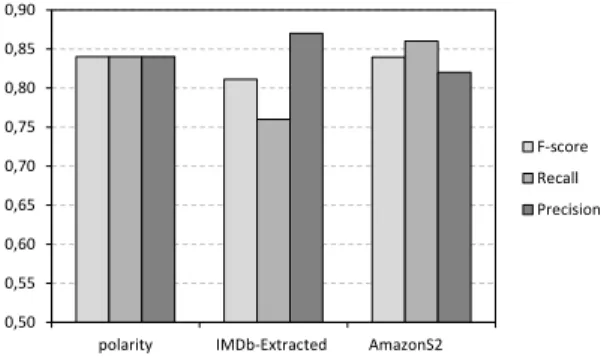
Figure 7: Binary classification for polarity, IMDb-Extracted and AmazonS2 datasets. ... 39
Figure 8: Binary classification for the multi-domain AmazonS1 dataset. ... 39
Figure 9: Unigram and bigram F-score with AmazonS1 dataset. ... 39
Figure 10: Sentiment analysis F-score with polarity dataset. ... 39
Figure 11: Sentiment analysis F-score with the multi-domain AmazonS2 dataset. ... 39
Figure 12: Multiple Bernoulli sentiment analysis evaluation for the IMDb-Extracted dataset. ... 41
Figure 13: Predicted ratings distribution for the IMDb-Extracted dataset. ... 41
Figure 14: Example of plate notation. ... 46
Figure 15: Graphical model representation of PLSI. ... 48
Figure 16: Graphical model representation of LDA. ... 49
Figure 17: (Left) The top 5-topics for lower and higher ratings. (Right) Top Rank-LDA sentiment words for movie reviews data. ... 50
Figure 18. The sentiment distributions of words emotion, love, wonderful, awful, heart and terrible. ... 51
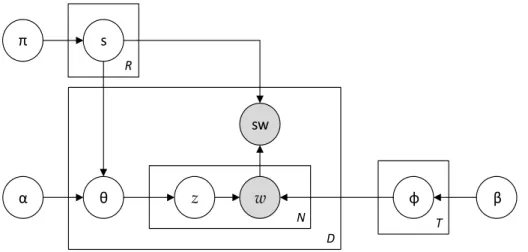
Figure 19. The Rank-LDA graphical model. ... 52
Figure 20: (Top) A graphical model representation of sLDA. (Bottom) The topics of a 10-topic sLDA model for movie reviews data (Blei and McAuliffe, 2007). ... 54
Figure 22: Precision for the binary sentiment classifier. The results with the IMDb dataset are on the left
and on the right the TripAdvisor dataset results. Considering the number of words within each
lexicon precision shows the results in the logarithmic value. ... 65
Figure 23: Sentiment word distributions for the datasets IMDb and TripAdvisor (TA). ... 67
Figure 24: Retrieval performance of the different methods. The top row concerns the IMDb dataset. The middle row is also on the IMDb dataset, but with restricted RLDA lexicon (e.g., no actor names, no movie names). The bottom row concerns the TripAdvisor dataset. ... 68
Figure 25: Sentiment words and entities that link to the entity Batman. ... 75
Figure 26: Graphical representation of entities in comparative opinions. ... 76
Figure 27: Word graph (Scheible and Schütze, 2012). ... 77
Figure 28. Entity reputation graph: the graph factors correspond to the connections entity-sentiment words (label “f”) and entity-entity (label “h”). ... 79
Figure 29. Entities semantic associations for different sentiment levels captured by RLDA methodology. Each graph shows a set of entities that are probabilistically linked. ... 84
Figure 30: Example of directed heterogeneous graph. The corresponding factor graph has factors corresponding to user-tweet dependencies (label “f”) and user-user dependencies (label “h”) (Tan et al., 2011). ... 87
Figure 31: Entities citations. ... 93
Figure 32: Sentiment words used as entities reputation qualifiers. ... 93
Figure 33: Top positive and negative RLDA sentiment words. ... 93
Figure 34. Accuracy and standard deviation of entities reputation analysis results. The results are shown for ERG reputation graph and the baselines SWN, MPQA and Hu-Liu. ... 94
Figure 35. The PopMeter visualization of linked-entities in a sentiment graph. ... 97
Figure 36. Opposite reputation influence. ... 98
Figure 37. Overview of the sentiment-based ratings framework. ... 102
Figure 38. Recommendations based on ratings and reviews. ... 104
Figure 39: Multiple-Bernoulli Sentiment analysis results (IMDb-Extracted). ... 120
Figure 40: Normalized predicted ratings distribution (Amazon). ... 120
Figure 41: Predicted ratings distribution for the Multiple-Bernoulli classification (IMDb-Extracted). ... 120
Figure 42: RMSE for LB, UB and SA blend with RS (Amazon). ... 122
Figure 43: RMSE of the recommendations versus the sentiment analysis output. As the threshold increases, less Φ𝑟𝑒𝑖 ratings are included (Amazon). ... 122
Figure 44: Sentiment analysis precision and recall per rating. The MAE measure indicates the average distance to the true ratings (Amazon). ... 123
Figure 45: RMSE when only ratings are used (IMD-TSA09). ... 124
Figure 46: RMSE when sentiment analysis inferred ratings are in included (IMDb-TSA09). ... 124
Figure 48: RMSE for baseline and review-based inferred rating #𝑅𝑟𝑒𝑣 > #𝑅𝑟𝑎. ... 127
Figure 49: Twitter-based Movie Ratings vs IMDb Movie Ratings. ... 129 Figure 50: Estimation of the importance of movies popularity (𝛼𝑡) to the movie rating prediction... 129
Figure 51. SentiMovie: visualization of users’ movies reviews analysis using sentiment analysis algorithms
in a sentiment-based recommendation RS framework (Section 5.1.2: Matrix Factorization with
Sentiment-based Regularization). ... 132
Figure 52. Sentiment rating prediction. Positive (enclosed in rectangles) and negative (enclosed in circles)
sentiment words are highlighted in the review. ... 132
List of Tables
Table 1. Recommendation systems techniques (Burke, 2002) ... 25
Table 2. Comparative summary of review-based recommendations frameworks. ... 28
Table 3. PMI pos/neg references ... 33
Table 4. Detailed information of the datasets ... 37
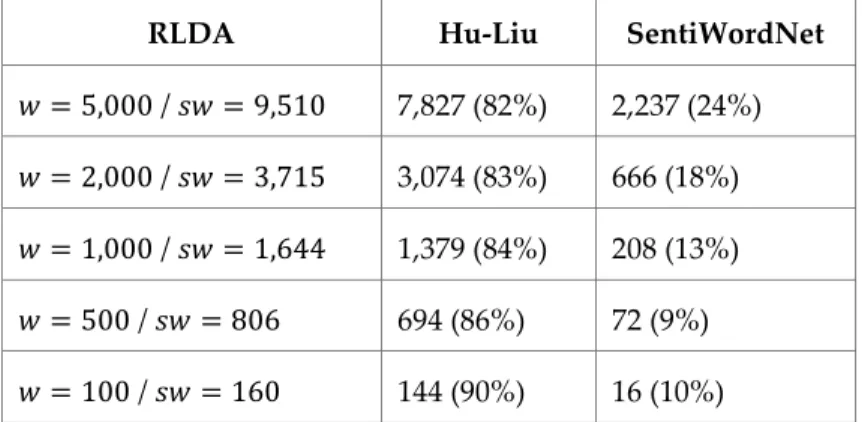
Table 5: Number of words in lexicons built from IMDb and TripAdvisor datasets. ... 61
Table 6: Detected Sentiment Words not found in Hu-Liu and SentiWordNet lexicons (IMDb). ... 61
Table 7: Sentiment ranking. P@5, P@30, MAP and NDCG for two datasets. * is the best result, the statistical significance t-test showed that the differences in retrieval results between D-RLDA and SentiWordNet are statistically significant. ... 62
Table 8: Sentiment classification. Micro-averaging precision (P), recall (R) and F1-measure for binary classification, P for multiple Bernoulli (MB) and one-against-all (OAA) for two datasets. * is the best result, significance was tested using t-test and all classifiers differ from the baseline with a value of 𝑝 < 0.01. ... 65
Table 9: Top sentiment words detected with the Rank LDA sentiment lexicon extracted from IMDb data. ... 67
Table 10: Top sentiment words detected with the Rank LDA sentiment lexicon extracted from TripAdvisor data. ... 67
Table 11: Summary for the feature picture of the product digital camera (Hu and Liu, 2004a). ... 86
Table 12: Detailed information of IMDb-Extracted. ... 88
Table 13: Sentence examples used in the crowdsource evaluation. ... 90
Table 14. Crowdsourcing for Entities Reputation measured with RLDA. ... 92
Table 15. Reputation analysis results for the top 12 most cited entities (accuracy). ... 96
Table 17: Detailed information of Amazon and IMDb-TSA09 dataset splits. ... 117
Table 18: Ratings confusion-matrix (Amazon). ... 120
Table 19: IMDb-Exctracted subsets for #𝑅𝑟𝑎 > #𝑅𝑟𝑒𝑣. ... 125
Table 20: IMDb-Exctracted subsets for #𝑅𝑟𝑒𝑣 > #𝑅𝑟𝑎. ... 126
Table 21: Examples of review textual content from IMDb-Extracted (split B). ... 128
Table 22: Linked-Entities comparative results. ... 130
1
Introduction
1.1
Context and Challenges
Communication and interaction among people has significantly changed with the growth of the World Wide Web. Vast amounts of information is available in digital format, and much of this information is stored in unstructured formats and not organised. This has an important impact in users’ behaviour. Users have become more demanding and are willing to give a certain amount of effort when trying to find information. More specifically, users have changed their behaviour on different aspects, and in the present thesis we will focus on the fact that nowadays users search for an opinion about different products online instead of only trusting their close circle of friends (Pang and Lee, 2008).
Technological advances in portable devices has facilitated the easy communication and spread of information via popular social-media platforms. People share, comment and publish their opinions on blogs, social networks, forums and other social media channels (Kwak et al., 2010). Social-media mentions to people, public figures, organizations or products emerge constantly and move rapidly over large communities. Nowadays users changed their behaviour from sharing and commenting what is happening around them, to search for recommendations and opinions reported by the other people that also participate in the same social-media platform. This phenomenon created a relationship between people opinions and entities reputation. The information targeting entities is generally controlled by users and consumers (Jansen et al., 2009; Glance et al., 2005). Figure 1 illustrates two comparative reviews from Amazon, a popular Web
site that allows users to comment on their purchases. This visualization can help users define their opinion about a product (e.g. movie), and it is based on what other users have commented.
Figure 1. Example of Amazon comparative reviews.
The analysis of humans’ viewpoints is known as sentiment analysis. Although this field of study had some research prior to year 2000 (Wiebe, 1994; Hatzivassiloglou and McKeown, 1997; Wiebe, 1990) this was the year in which sentiment analysis emerged as a very active research area. Sentiment analysis deals with an opinion-oriented natural language processing problem and is typically applied to the analysis of structured or unstructured free text documents. These text documents contain users’ opinions about one or more entities such as products, organizations, individuals and their features.
The analysis of users’ opinions is known by different names: sentiment analysis, emotion analysis, opinion mining, opinion extraction, sentiment mining, subjectivity analysis, affect analysis, emotion analysis and review mining (Liu, 2012). Opinions include appraisals, thoughts and emotions about a product or individual. Usually an opinion is given in a form of a review, comment or purchase evaluation. The sentiment analysis of an opinion can be defined as mapping the text to one of the sentiment classes (labels) from a predefined set. Usually the classes of the predefined set are negative and positive; objective and subjective; negative, positive and neutral or in a range of numbers such as 1 to 5 or 1 to 10 (Pang and Lee, 2008).
on compiling a set of sentiment words (known as sentiment lexicons) (Takamura et al., 2005; Baccianella et al., 2010; Esuli and Sebastiani, 2006; Rao and Ravichandran, 2009; Velikovich et al., 2010; Ding et al., 2008). In this context, we propose a method to compile a sentiment lexicon. To this end, a set statistical models are used to identify which words are more relevant for each sentiment level. This method shows that is possible to develop a framework that uses topic models in a sentiment analysis problem (Blei et al., 2003; Blei and McAuliffe, 2007). Topic models gained popularity as a tool for automatic corpus summarization and document browsing on large scale data. Such models have been integrated in the context of online commerce and are able to identify important pieces of information (i.e. sentiment expressions) (Moghaddam and Ester, 2011; Ramage et al., 2009; Titov and McDonald, 2008).
Opinionated text also known as subjective text is a set of words, phrases or sentences that express a sentiment. The difference between opinionated text and factual text is centred in the notion of private state. As Quirk et al. (1985) define it, a private state is a state that is not open to objective observation or verification: “a person may be observed to assert that God exists, but not to
believe that God exists. Belief is in this sense ‘private’.” (p. 1181). More recently the term subjectivity for this concept has been adopted by the community (Wilson and Wiebe, 2005; Liu, 2012). Although this area has been researched in academia the problem is still far from being completely solved (Liu, 2012). One of the main challenges is that opinionated language varies over a broad range of discourse, a system with a fixed vocabulary will not be enough to represent users’ opinions (Wilson et al., 2004). Also, sentiment words have a natural association to people’ opinions and opinions tend to target specific people, organizations or products. For this reason, this thesis deals with the problem of identifying sentiment words and measuring an entity’s reputation. In the present thesis we aim to: compute a sentiment lexicon that is human independent and useful for different domains; characterize entities’ reputation through their association with a domain sentiment lexicon; and learn how to improve recommendation algorithms with sentiment knowledge. For the mentioned tasks there are a number of challenges to overcome:
domain, sentiment words may have opposite directions; sentences containing sentiment words may not express any sentiment or (the opposite) sentences without sentiment words may be used to express a sentiment; users’ opinions frequently enclose sarcastic and idiomatic sentences; and sentiment words come in different strengths which may be interpreted in a scale with different intensities (Wilson et al., 2004; Liu, 2012).
Reference entities: Intuitively, sentiment words are associated with words or phrases that express a sentiment. For example, good, wonderful, poor and terrible represent sentiment words. However, beyond these words there are numerous words that are used to express a sentiment, e.g. Bollywood encloses a sentiment value in “Queen is not another Bollywood movie.” In this example is not obvious the sentiment expressed by Bollywood. Specific products, organizations or named entities characteristics are used in subjective sentences to express a sentiment. However, one must keep in mind that these entities might only reveal a sentiment in particular application domains (Ding et al., 2008; Liu, 2010).
Reputation of entities: identify relevant references that influence entities reputation is an ongoing research problem. In a sentiment analysis problem and from an algorithmic perspective, the challenge is to analyse how sentiment words affect entities’ public image. Previous work (Zhao et al., 2010; Jo and Oh, 2011; Hu and Liu, 2004b; Liu, 2012) have made significant advances in detecting product aspects or features. However, unlike opinions about products, entities are not structured around a fixed set of aspects or features which imply a more challenging task (Albornoz et al., 2012).
Sentiment-based recommendations: recommendation algorithms have proven their ability to provide valuable recommendations to different users (Koren et al., 2009). However, recommendation algorithms are more likely to use explicit ratings which we believe is a limited metric for assessing specific opinions about different products (e.g. movie). In some cases, such information can prove to be very scarce, especially if the movie is of low quality and users simply do not bother to rate it. In contrast users may discuss, or exchange impressions about the movie, hence the challenge is to be able to detect the opinion about the products and use it in a recommendation system.
1.2
Research Objectives
The broad objective of the research proposed in this thesis is to investigate the extraction of sentiment lexicons and the use of sentiment analysis techniques for reputation analysis and recommender systems. Once the challenges are identified I will focus on how to address the problem with the proposed approaches.
In the context of the analysis of online user reviews: Is it possible to effectively extract sentiment words? More specifically, identify their polarity (positive or negative) and sentiment strength. Also, characterize sentiment words in terms of their sentiment distribution: compute the polarity and sentiment strength fluctuation in respect to different sentiment levels. How to use automatic probabilistic methods with no human annotation to analyse user reviews? What is the most appropriate method to automatically identify sentiment words and their strength? To tackle these questions our first objective can be summarized as:
Objective 1: Apply probabilistic techniques to extract sentiment words from online reviews. Departing from the more traditional positive or negative representation, characterize sentiment words in terms of their sentiment distribution.
Beyond simple words, we also question if it is possible to infer the sentiment of named entities in specific domains? Can the entity sentiment value be used to infer its reputation? In this context, can we visualize in a graph of sentiment the relations between entities and sentiment words? This questions leads us to the second objective of this thesis:
Objective 2: Predict the reputation of entities by investigating in a sentiment graph the sentiment words and entities sentiment relations and co-occurrence probability using propagation algorithms.
Figure 2. Different entities are mentioned as domain specific quality-references.
After these, more fundamental research questions are addressed, we studied how we could enhance a recommendation framework with sentiment analysis techniques. More specifically, we are interested in questions such as: how can we improve a recommendation system with sentiment analysis algorithms? Can we effectively obtain a rating from the analysis of user reviews? Is this rating able to be used in a recommendation system as if it was a rating explicitly given by a user? Thus, we wish to integrate the output of the two first objectives into a closing objective:
Objective 3: Investigate two recommendation system problems: first, techniques that embedded sentiment based ratings (Objective 1) in a recommendation system algorithm; and second, apply entities reputation analysis (Objective 2) in a recommendation system.
Sentiment Lexicon
Capture: Sentiment words
Sentiment words: Polarity
Sentiment words: Sentiment Strength
Linked-Entities
Subjective Sentences
Named Entities Sentiment Words Sentiment Strength
Named Entities: Semantic Relation
Sentiment-based Recommendation
Subjective Sentences
Sentiment-based Rating
Probabilistic Sentiment-Ratings
inference Subjective Sentences
Figure 3. Process followed in the development of this thesis.
1.3
Research Organization and Contributions
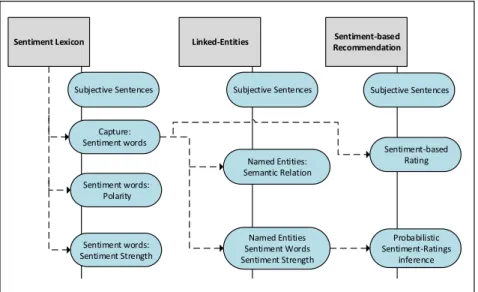
The research conducted in the context of this thesis is organized as depicted in Figure 3. The initial research is centred in understanding state-of-art sentiment analysis algorithms (Objective 1). In doing so, we investigated sentiment analysis classification tasks and performed an evaluation of sentiment analysis techniques. This evaluation (Peleja and Magalhães, 2013) has thoroughly examined the PMI-IR technique (Turney, 2002) and the sentiment lexicon SentiWordNet (Esuli and Sebastiani, 2006). We found that spam reviews contain specific domain words which influence the algorithms performance, and that a major challenge in opinion retrieval is the detection of words that express a sentiment and domain related idiosyncrasies where sentiment words are common, i.e. jargon. These experiments were reproduced, reviewed in chapter 2 – Related Work and reported at:
Peleja, F. and Magalhães, J. 2013. “Opinions in User Reviews: An Evaluation of Sentiment Analysis Techniques.” In EPIA 2013 - Local Proceedings of the 16th Portuguese Conference on Artificial Intelligence, pages 468–79. Angra do Heroísmo, Portugal.
doi:10.13140/2.1.3177.1206.
sentiment words. This research is detailed in chapter 3 – Sentiment-Ranked Lexicons, and the contributions of this chapter were published in the following papers:
Peleja, F. and Magalhães, J. 2015. “Learning Sentiment Based Ranked-Lexicons for Opinion Retrieval.” In Proceedings of the 37th European Conference on Advances in Information Retrieval (ECIR), pages 435-440, Vienna, Austria: Springer. doi: 10.1007/978-3-319-16354-3_47.
Peleja, F. and Magalhães, J. 2015. “Learning Ranked Sentiment Lexicons” In Proceedimgs 16th International Conference Computational Linguistics and Intelligent Text Processing (CICLing), pages 35-48, Cairo, Egypt: Springer. doi: 10.1007/978-3-319-18117-2_3.
Peleja, F. and Magalhães, J. “Learning Ranked Sentiment Lexicons for Opinion Retrieval,” Information Retrieval Journal (under review).
In a second phase we explored the sentiment expressed by some entities. Entities enclose a sentiment that we believe to be associated to their reputation value (Objective 2). In a three step procedure we perform a reputation analysis of domain entities. First, our method extracts the sentiment distribution of entities; second, a sentiment graph is created by analysing cross-citations in subjective sentences; and third, entities reputation are updated through an iterative optimization that exploits a graph of linked entities. The graph is represented in a pairwise Markov Network and represents relations existing in the corpus. This work was presented in Peleja et al. (2014b), Peleja et al. (2014a) and Peleja (2015). This research is detailed in chapter 4 – A Linked-Entities Reputation Model, and the contributions of this chapter were published in the following papers:
Peleja, F., Santos, J. and Magalhães, J. 2014. “Reputation Analysis with a Ranked Sentiment-Lexicon.” In Proceedings of the 37th International ACM SIGIR Conference on Research Development in Information Retrieval, pages 1207–10. SIGIR ’14. Gold Coast, Australia: ACM. doi:10.1145/2600428.2609546.
Peleja, F., Santos J. and Magalhães, J. 2014. “Ranking Linked-Entities in a Sentiment Graph.” In Proceedings of the IEEE/WIC/ACM International Conference on Web Intelligence and Intelligent Agent Technology (WI-IAT), pages 118–25. Warsaw, Poland: IEEE Computer Society. doi:10.1109/WI-IAT.2014.88.
Finally, we extended state-of-the-art recommender techniques by combining explicit ratings with sentiment ratings in a recommender system (Objective 3). With this approach we intended to broaden the usual scope of collaborative recommender systems which focus mainly on explicit ratings. The goal is to use sentiment analysis algorithms to compute more realistic and unbiased user ratings (Peleja et al., 2012; Peleja et al., 2013). This research is detailed in chapter 5 – Sentiment Analysis Applications, and the contributions of this chapter were published in the following papers:
Peleja, F., Dias, P. and Magalhães J. 2012. “A Regularized Recommendation Algorithm with Probabilistic Sentiment-Ratings.” In Proceddings on the IEEE 12th International Conference on Data Mining Workshops (ICDMW/SENTIRE), pages 701–8. Brussels, Belgium: IEEE Computer Society. doi:10.1109/ICDMW.2012.113.
Peleja, F., Dias P., Martins, F. and Magalhães J. 2013. “A Recommender System for the TV on the Web: Integrating Unrated Reviews and Movie Ratings.” Journal of Multimedia Systems, Springer-Verlag New York, Volume 19, Issue 6, pages 543–58. Springer. doi:10.1007/s00530-013-0310-8.
Santos, J., Peleja, F. and Magalhães, J. “Monitoring Social-Media for Cold-Start Recommendations”, Multimedia Tools and Applications, Special Issue on Immersive TV. (under review).
Besides the scientific contributions stated above, I worked in turning this state-of-the-art research into industry innovation. A deep analysis of customer preferences allow recommender systems to profile domain-specific linguistic traits and compute the reputation of popular entities. Such extracted information enables several services that engage users to improve their social interaction in a social-media context. I have submitted these ideas to an industry innovation competition and was awarded the first prize:
Peleja, F. 2014. “Social NOS.” First prize in DevDays 2014. NOS in collaboration with Microsoft set a challenge to university students –what it will be like “The Television of the Future”.
1.4
Thesis Outline
This document follows the following structure:
Chapter 3 - Sentiment-ran ked Lexicons: In this chapter we propose a model to learn domain specific sentiment ranked lexicons.
Chapter 4 - A Linked-Entities Reputation Model: In this chapter we extend the sentiment lexicons by identifying entities and model their popularity with sentiment analysis algorithms. Also, a visualization tool is described to examine domain-specific entities in terms of their popularity and relations.
2
Related Work
The research described in this thesis is concerned with the analysis of online reviews. Reviews influence user opinions about products and have a direct impact on product sales and reputation. In this context, research in sentiment analysis started as a field of study that is mainly interested in the analysis of user opinions about products, people and services. Linguistic techniques to process natural language texts (NLP) have a long history, however sentiment analysis research has mainly started in the early 2000s. The strategic importance of monitoring emergent comments that influence products reputation has captured the attention of the research community and e-commerce companies (Martín-Wanton et al., 2013). Consequently sentiment analysis has grown to be a very active research area (Liu, 2012). Throughout this document we will refer to user opinions as reviews or comments.
2.1
Sentiment Analysis
NLP is a field of computer science concerned with the problem of understanding the meaning of a sentence or a document written in natural language. NLP challenges involve natural language understanding and for this reason it is strongly related with sentiment analysis – the central topic of this thesis. In general sentiment analysis applies natural language processing techniques to capture subjective information. Hence sentiment analysis is a NLP research topic that covers many other challenges, as it will be discussed later in this chapter. Although research on NLP has strong roots, only after 2000 has sentiment analysis grown to become one of its most active areas (Turney, 2001; Turney, 2002; Pang et al., 2002; Liu, 2010).
General Inquirer (Stone and Hunt, 1963) is a system developed for content analysis research and it is one of the first introduced methods that among many different NLP tasks aimed at distinguishing between subjective and objective content. Only much later has Hatzivassiloglou and McKeown (1997) proposed a method to identify the positive and negative semantic orientation of adjectives. This was probably the first published work in sentiment analysis. In the early 2000 the burst of social media information led to the development of many other techniques to solve sentiment analysis problems (Turney and Littman, 2003; Turney and Littman, 2002; Turney, 2001; Dave et al., 2003; Hatzivassiloglou and Wiebe, 2000; Das and Chen, 2001). One important aspect of sentiment analysis tasks is that not every word expresses a sentiment, and a common approach is to identify sentiment bearing words by observing the respective words’ family. Sentiment bearing words are known as opinion words, polarity words, opinion-bearing words and sentiment words.
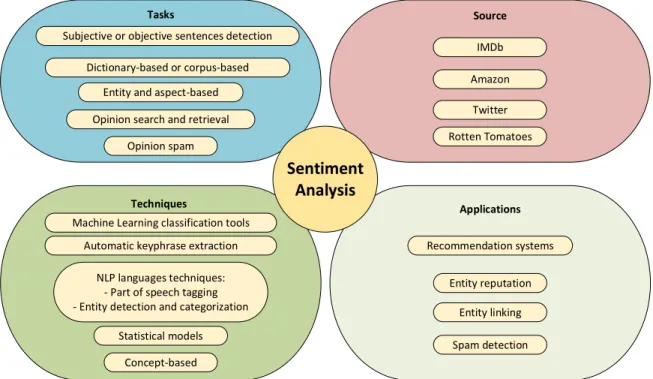
Figure 4 presents some of the topics related to sentiment analysis that will be discussed in this chapter: sentiment analysis tasks, the most common used sources, and approaches used by researchers to solve this type of research problems.
Subjective or objective sentences detection
Dictionary-based or corpus-based
Opinion search and retrieval Entity and aspect-based
Opinion spam
Tasks Source
IMDb
Amazon
Rotten Tomatoes
Techniques
Automatic keyphrase extraction Machine Learning classification tools
NLP languages techniques: - Part of speech tagging - Entity detection and categorization
Statistical models
Concept-based
Sentiment
Analysis
Applications
Recommendation systems
Entity reputation
Entity linking
Spam detection
2.1.1
Granularity Levels of Sentiment Analysis
Initial work in sentiment analysis aimed at identifying overall positive or negative polarity within full documents (e.g. reviews). Later, works identified that sentiment does not occur only at document-level, or is limited to a single valence or target (Cambria, 2013). Hence, sentiment analysis has been investigated at four granularity levels: document, sentence, word and entity or aspect. Usually entity or aspect level involves extracting product features that are used to express an opinion (Hu and Liu, 2004b; Hu and Liu, 2004a; Popescu and Etzioni, 2005). Finding semantic orientation at word or phrase level differs from entity or aspect level as it is related to specific word families that are mostly used to express a sentiment. At word level researchers have mainly used two methods to automatically annotate sentiment: dictionary-based and corpus-based (Figure 5). Others have also chosen to manually annotate at word level, however, relying in a manual approach is highly time consuming and subjective (Liu, 2012; Ding et al., 2008).
Sentiment Analysis
Word level Sentence level Document level
Corpus-based Dictionary-based
Entity or aspect level
Figure 5. Sentiment analysis granularity levels.
2.1.2
Dictionary-based
Dictionary-based approaches are the most straightforward approaches to obtain a sentiment lexicon. These methods only use a seed list of words or use them in a bootstrap approach to discover new words (Liu, 2012). The strategy is to use a thesaurus or lexical database (e.g. WordNet) as a seed list of words (Ding et al., 2008). A common assumption in such techniques is that semantic relations transfer sentiment polarity to associated words (Kamps et al., 2004; Hu and Liu, 2004a). For instance, using the synonyms semantic relation the sentiment word “lovely” will transfer its positive polarity to its synonyms “adorable”, “pretty” etc. (Bross and Ehrig, 2013). Others have chosen to use pre-compiled lists of sentiment words with similar techniques (Hu and Liu, 2004a). The previously pre-compiled lists are known as sentiment lexicons. Previous work has made available to the research community numerous sentiment lexicons: SentiWordNet1,
General Inquirer2, Urban Dictionary3, Twitrratr 4 and Multi-perspective Question Answering
(MPQA)5. A sample of generic positive seed of words can be words such as “good”, “nice” and
“excellent” and a negative set contain words such as “bad”, “awful” and “horrible”. Usually dictionary-based methods observe the sentiment word occurrence, and by observing the words proximity its influence towards other words. Moreover, takes into account negation and/or neutralization tokens. The scope of negation aims to detect polarity changes and neutralization, overriding the sentiment polarity effect. Indications of these tokens are words such as “not”,
“although”, “never” and “would”, “should” and “hope” for negation and neutralization respectively.
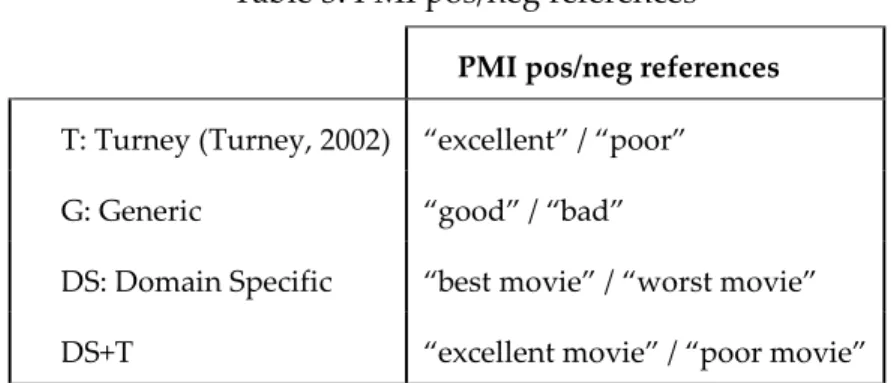
A simple and effective dictionary-based approach that is well-known by the community was proposed by Turney and Littman (2003). Here, a seed of words are manually selected as paradigms of positive and negative semantic orientation and applied the Pointwise Mutual Information (PMI) method. PMI has been previous proposed in Turney (2002) and is used to infer semantic orientation from semantic association.
In Hu and Liu (2004a) the authors proposed an iterative process that expands an initial seed of words. The bootstrapping method uses a small list of manually annotated adjectives with positive and negative labels. WordNet list of synonyms and antonyms are used to grow the initial seed of adjectives. Others (Baccianella et al., 2010; Valitutti, 2004) have also used relationships between terms in WordNet to expand positive and negative seed sets. In comparison Rao and Ravichandran (2009) proposed a more elaborated approach. Here, the authors use a three graph-based semi-supervised learning method to identify semantic orientation: Mincut (Blum and Chawla, 2001), Randomized Mincut (Blum et al., 2004) and label propagation (Zhu and Ghahramani, 2002). Similarly, to the aforementioned approaches, Rao and Ravichandran (2009) employed a dictionary-based approach to detect sentiment words by exploiting WordNet synonyms graph. A disadvantage of dictionary-based approach is that they are dependent on pre-built lexicons or manually selected seed of words. Such lexicons or list of words tend to limit the sentiment words scope and as a consequence does not allow to identify domain dependent sentiment words (i.e., jargon).
2.1.3
Corpus-based
perform sentiment classification analysis. In Turney (2002) sentiment phrases were captured by evaluating the proximity to an adjective or a verb. In this context Turney and Littman (2002) reported a study where sentiment classification using only adjectives as sentiment words improves the classifier performance. Nonetheless, previous work (Esuli and Sebastiani, 2005; Heerschop et al., 2011; Takamura et al., 2005; Turney and Littman, 2003) have also shown that other word families such as adverbs, nouns and verbs are also qualified with sentiment intensity. Bethard et al. (2004) devised a supervised statistical classification task to distinguish between opinionated (subjective) and factual documents. With the purpose of obtaining a sentiment lexicon, subjective documents were used to compute the words’ relative frequency. The authors used a pre-built lexicon – a seed list of 1,336 manually annotated adjectives (Hatzivassiloglou and McKeown, 1997) – and computed the sentiment lexicon with a modified log-likelihood ratio of the words’ relative frequency. Later, Qiu et al. (2009) proposed to obtain a domain specific sentiment lexicon by using an initial seed of sentiment words in a propagation method. Here, the authors used words from a sentiment lexicon as seed in a sentiment word detection process that iterates until no new sentiment words are added to the lexicon. The process detects sentiment words by observing its relation to the initial seed of sentiment words and later the newly extracted sentiment words are used to detect more sentiment words. For this work the authors explored syntactic relations between sentiment words and features. This technique contrasts with Hu and Liu (2004b) who proposed to extract features with distance-based rules. However, as Qiu et al. (2009) comment, Hu and Liu (2004b) proposed a method to detect product features not to expand a sentiment word lexicon.
quality of the obtained sentiment expressions. Then, these sentiment expressions are compared with gold standard sentiment dictionaries – MPQA, General Inquirer and SentiWordNet.
The aforementioned corpus-based methods are constrained to the initial seed of sentiment words. Even though for a particular domain a partial number of sentiment words that are used as seed may not reflect the accurate sentiment strength and orientation, their sentiment information is used to help detect new sentiment words. For example, the word “Oscar” can relate the Hollywood Movie’s Academy award (implying a positive sentiment) or relate to the given name of a person. An alternative to the abovementioned approaches is to compute algorithms that fully identify sentiment words automatically i.e. in a supervised manner (Jiang et al., 2011; Pang et al., 2002; Pang and Lee, 2005).
Pang et al. (2002) introduced one of the early works to perform a sentiment classification of movie reviews. Here, the authors used well-known machine learning classifiers in a topic-based text categorization strategy. Pang et al. (2002) proposes a corpus-based strategy whereas no initial seed of sentiment words is used. Later, Jiang et al. (2011) establish an important distinction between their work and Pang et al. (2002) work – target-independent strategies may assign irrelevant sentiments to a given target. Hence, Jiang et al. (2011) argue that a sentence where a sentiment is expressed does not contain necessarily the feature that is the target of the sentiment expressed by the user. They additionally point-out the need to observe the review content and its domain. One downside of using a supervised learning task in a corpus-based method over a dictionary-based method, is that corpus-based methods require a greater effort to generalize into different domains (Aue and Gamon, 2005; Pang and Lee, 2008). Nonetheless, from previous contributions, is important to highlight the importance of capturing relevant sentiment words that are strongly associated to a given context (Liu, 2012).
a better modelling of users’ opinions. In this work, the authors study the impact of using syntactic structure segments and syntactic features for capturing opinion expressions. Hence, the authors show that taking into account the syntactic structure helps in the task of detecting opinion expressions but with the weakness of the computational cost associated to parsing all the data.
There are also several works that uses the LDA (Latent Dirichlet Allocation) generative process (Blei et al., 2003) in NLP tasks. LDA has been previously used for a variety of NLP related tasks and has proven to be adequate and hold great results (Harvey et al., 2010; Kang et al., 2013; Blei and McAuliffe, 2007; Zhang et al., 2007). Blei and McAuliffe (2007) propose supervised LDA (sLDA) to predict ratings for movie reviews, this is done by using labelled documents. Reasoning on the rating scale that reflects how much a user liked or disliked a specific movie, in which, ratings represent a sentiment scale, this topic classification task could be seen as a supervised sentiment classification task. Zhang et al. (2007) proposed an LDA based hierarchical Bayesian algorithm, named SSN-LDA. This algorithm is used to discover communities in social networks and the respective associated researchers. Later, Harvey et al. (2010) used users’ bookmarking in a LDA hidden topics model to improve page ranking. More recently, Kang et al. (2013) proposed LA-LDA to create user models based on the analysis of social network friends. The authors argue that their method can be useful to capture information related to similar users. Then, automatically filter a chunk of information that might not be useful for a specific user. Hence, is noticeable the ability of this method to produce a set of concepts that are related, not only for topics but also for user preferences.
2.1.4
Subjectivity Sentences
Subjectivity in natural language refers to certain combinations of the language used to express an opinion Liu (2010). Early work by Wiebe (1994), defines subjectivity classification as an algorithm that evaluates in a sentence or document the linguistic elements that express a sentiment – sentiment words or, as Wiebe denotes, subjective elements. In other words, objective and subjective sentences can be defined as “An objective sentence expresses some factual information about the world, while a subjective sentence expresses some personal feelings or beliefs.”(B Liu, 2010). That is, subjectivity in natural language refers to certain combinations of the language that are used to express an opinion (Wiebe, 1994; Tang et al., 2009). It is common to apply a sentiment classifier to evaluate the sentiment polarity and/or strength of sentences labelled as subjective (Liu, 2010). This classification allows to differentiate factual and subjective sentences and for this reason, is commonly known as subjectivity classification. In addition, subjectivity classification has been extensively investigated in the literature (Hatzivassiloglou and McKeown, 1997; Hatzivassiloglou and Wiebe, 2000; Riloff et al., 2006; Riloff and Wiebe, 2003). In the task of creating a sentiment lexicon, subjectivity classification can prove to be a very important step: we should observe sentences that express an opinion (subjective) and ignore sentences that state a fact (objective).
Hatzivassiloglou and Wiebe (2000) claim that adjectives are strong indicators of subjective sentences. Their method uses adjectives to detect potential subjective sentences. Previous work by Wiebe et al. (1999) had a similar method but instead of adjectives, also used words from the family of nouns. More recently, Wiebe and Riloff (2005) introduce a bootstrapping method that learns subjective patterns from unannotated documents. For this method, one needs to define an initial set of rules that are manually annotated and to this aim require a linguist expert (Scheible and Schütze, 2012). Riloff et al. (2006) has also proposed a method that defines subsumed relationships between different elements (unigrams, n-grams and lexicon-syntactic patterns). The idea is that, if an element is subsumed by another, the subsumed element is not needed, thus, can remove redundant elements in the subjectivity classification (Bing Liu, 2012).
classification algorithms for the subjective and sentiment classification problem (Yu and Hatzivassiloglou, 2003; Turney, 2002; Hu and Liu, 2004a; Kim and Hovy, 2004).
Lourenco Jr. et al. (2014) propose an online sentiment classification method and argue that previous approaches lean towards offline classification. This is a critical point that is addressed by the authors – in their approach it is required to produce tweet sentiment judgements in real-time. To this end, an alternative classification strategy is proposed by the authors: to ensure a fast learning time the training sets are kept as small as possible. To this aim the authors describe a set of association rules that are used for sentiment scoring. More formally, a set of rules built from the vocabulary training set 𝒟𝑛 are used to define a classifier ℛ(𝑡𝑛) at each time step 𝑛. For a given message 𝑡𝑛a rule is valid if applicable to the respective message. Nevertheless, opinions context tend to drift over time and the quality of rules coverage require a reasonable amount of work which might require maintenance rules. As Wiebe and Riloff (2005) notice, rule-based classifiers do not involve learning but merely classify sentences by observing state-of-the-art polarity characteristics that have been previously published. On the other hand in Lourenco Jr. et al. (2014) work at each time step 𝑛 the classifier updates the vocabulary and sentiment drifts (e.g. polarity changes for the same entity) which slightly differs from traditional rule-based approaches.
2.2
Reputation Systems
Reputation systems address the welfare of e-business communities and individual participants. These systems facilitate decision making hence its importance encourages the community to understand its components and processes (Standifird, 2001). On last years the potential marketing usefulness of reputation analysis has led research to focus extensively on monitoring and profiling relevant issues for market brands and organizations on Twitter, such as Apple and Windows (Villena-Román et al., 2012; Wanton et al., 2012; Spina et al., 2013; Martín-Wanton et al., 2013).
A reputation system collects and aggregates feedback about users' past behaviours. These systems help users decide who to trust and as a consequence, encourage trustworthy behaviours. In this context trust can be defined as “a subjective expectation an agent has about another’s future
is built based on the will of each individual to trust. These actions generate a chain of events, indicating if the organization or individual is trustworthy. Hence, a reputation system can be defined as a system based on participants (organizations or individuals), where their behaviour assigns a reputation to participants.
The aforementioned definition for reputation systems excludes the possibility of referring to a reputation system as a collaborative filtering system. To predict products that users were not aware of its existence a collaborative filtering system observes large communities of users that rate products, and then their preferences are matched against other users’ preferences (Aciar et al., 2007). At scoring products, collaborative filtering systems assume that all products are trustworthy. Hence, these systems do not consider the reputation of the recommended products and by ignoring the product reputation the results might not match users’ opinion. As Clausen (2003) argues, collaborative systems capture a sub-community that the user fits into but that is not based on recommended products reputation. Both systems use large communities to engage peer-review analysis, however collaborative systems are not bi-directional as they only observe communities rating (Rietjens, 2006).
2.2.1
Online Reputation
A well-known reputation system is eBay6. Founded in 1995 eBay is an online auction marketplace
that allows users to purchase products and give feedback to each other. In this system the previously assigned feedback is used to calculate the reputation score, e.g. positive minus negative feedback. This is a simple system that does not take into account previous behaviours from other platforms. For example, a first-time user has the same reputation as a well-known product manufacture that sells thousands of products in another platform (Standifird, 2001; Rietjens, 2006). A few years after eBay launch, Page et al. (1998) proposed the popular PageRank reputation metric. PageRank calculates page recommendations by the source’s incoming links. Pages with a high number of users trust votes are more likely to be recommended, this information propagates through the network. Google used PageRank scores to choose which pages should appear with higher relevance in the search results. More recently, Sabater and Sierra (2001) proposed a research reputation system that estimates the reputation of an individual by selecting the most appropriate individual to evaluate its relevance. This system aims at having one individual that is selected considering its interaction, conflict of interests and social structure.
Although this system asserts the reputation based on a single individual, the authors claim they have a fairly good approximation to the general opinion about another specific individual. Another proposed reputation system is given by Mui et al. (2002). Here the authors propose a statistical method to assert the organization or individual reputation. This model computes the interactions between users and is not restricted to explicit ratings.
RepLab is a competitive evaluation exercise for online reputation management and RepLab 2013 made available a large collection of Twitter data for reputation monitoring. This data provides a reliable test collection for reputational polarity (Amigó et al., 2013). The collection contains tweets about 61 entities within four domains (automotive, banking, universities and music). The entities were manually chosen according to their inherently relation to the products. Hence the entities transparency and ethical side are highly affected by their products reputation. However, as Spina et al. (2014) notice, reputation monitoring tasks are usually fine-grained and suffer from data sparsity, with some exceptions for popular entities such as “Apple” or “Barack Obama”. To automatically capture the relation between entities that have their reputation affected by associated products is a challenging task and very costly as a manual task (Spina et al., 2014).
2.2.2
Sentiment Influence on Online Reputation
Research efforts in reputation analysis have focused not only on summarizing the overall reputation, but also in predicting the reputation of other instances or events (Oghina et al., 2012; Joshi et al., 2010). Joshi et al. (2010) explored the popularity of old movies among online critic reviews to predict opening weekend revenues for new movies. For this task, the authors observed the metadata similarity between classic movies – highly rated –and recent movies. In a similar approach, Asur and Huberman (2010) exploited bursty keywords on Twitter streams to predict box-office revenue for movies. For this purpose, the authors study how positive and negative comments propagate in the social network and how influences people opinions about movies. More recently, Oghina et al. (2012) predicted IMDb movie ratings by performing an analysis over their popularity on social media, more specifically Youtube and Twitter. The authors investigate textual tweets, comments and likes that are associated to a specific movie. This analysis leverages on the movie reputation, which is then translated into ranking scale from 1 to 10. Unlike Calais Guerra et al. (2011) and Hu et al. (2013) methods Oghina et al. (2012) and Joshi et al. (2010) did not use graph methods to explore the influence of users comments over movies reputation. Both Oghina et al. (2012) and Joshi et al. (2010) perform a feature engineering task and use it in a linear regression algorithm. The authors (Oghina et al., 2012; Joshi et al., 2010) choose a diverse number of features in which several features are extracted from the product metadata, for example: number of views, number of comments, likes, favourites, genre, running time among many others. Regression analysis allows the authors of the aforementioned works to depict a relationship between independent and dependent variables in a graph and regression is a statistical process that is popular for its usage in forecasting tasks.
2.3
Recommendation Systems
Recommender systems also known as recommendation systems tackle the problem of content overload. These systems emerged with the intent of obtaining personalized and meaningful recommendations based on user preferences and history. Although the increase of online information captured the attention of the recommender systems research community, these systems had their popularity peak in 2007 with the Netflix Prize contest7. This contest awarded
$1M to the recommender algorithm with a minimum of 10% improvement.
Early work Resnick and Varian (1997) on recommendation systems defined these systems as:
“(…) people provide recommendations as inputs, which the system then aggregates and directs to
appropriate recipients.” The aforementioned definition describes recommender systems as supporting the collaboration between users. Later work expanded this definition to include systems that recommend products regardless of how the recommendations are produced (Burke, 2002).
Table 1 presents how Burke (2002) split recommendation approaches into five main techniques: collaborative, content-based, demographic, utility-based and knowledge-based. In Table 1, U is a list of known users, I is of list of known products (or items), u is a user that will receive recommendations and i the recommended product. Collaborative filtering systems aggregate user preferences history to provide new recommendations (Schafer et al., 2007). On the other hand content-based systems only observe and match user profiles (preferences) (Adomavicius and Tuzhilin, 2005). Demographic systems analyse recommendations based on demographic categorization (Pazzani, 1999). Utility-based systems provide their recommendations based on the user profile. In comparison to content-based, utility-systems have the advantage of using non-product attributes (e.g. non-product availability) in the recommendation computation (Guttman, 1998). Finally, knowledge-based systems evaluates the product requirements to provide a user recommendation. Hence knowledge-based systems learn how a particular product meets user’s needs with functional knowledge (e.g. case-based reasoning) (Burke, 2007).
Table 1. Recommendation systems techniques (Burke, 2002)
Techniques Background Input Process
Collaborative filtering Ratings from 𝑼 of
items in 𝑰.
Ratings from 𝒖 of items in 𝑰.
Identify users
in 𝑼 similar to 𝒖, and
extrapolate from their ratings of 𝒊.
Content-based Features of items
in 𝑰.
𝒖's ratings of items in 𝑰.
Generate a classifier
that fits 𝒖’s rating
behaviour and use it on 𝒊.
Demographic Demographic
information
about 𝑼 and their ratings of items in 𝑰.
Demographic
information about 𝒖.
Identify users that
are demographically
similar to 𝒖, and
extrapolate from
their ratings of 𝒊.
Utility-based Features of items
in 𝑰.
A utility function
over items in 𝑰 that describes 𝒖’s
preferences.
Apply the function
to the items and determine 𝒊's rank.
Knowledge-based Features of items
in 𝑰. Knowledge of
how these items
meet a user’s needs.
A description of 𝒖’s
needs or interests.
Infer a match
between i and 𝒖’s
need.
2.3.1
Ratings-only recommendations
Recommendation algorithms have proven their ability to influence user’s future purchases by observing the available user ratings. Two popular families of recommendation algorithms are based filtering and collaborative filtering, and hybrid approaches that combine content-based and collaborative filtering.
approaches have two main short comings: first, makes the assumption that similar users like the same products, and users who consumed a given product are willing to consume similar products; the second short coming concerns a limitation known as overspecialization (Adomavicius and Tuzhilin, 2005). Overspecialization lies in the fact that users are restricted to get only recommendations of products with similar characteristics of those they have consumed.
Collaborative-filtering (CF) attempts to infer implicit ratings based on the pattern analysis of user preferences and consuming history. An early application with CF was introduced by Resnick et al. (1994) which aimed at filtering netnews based on the ratings given by users. Hence, this approach introduced the concept of user explicit feedback in the form of ratings. More recently, Hu et al. (2008) provided a recommendation system that only relies on implicit feedback, thus, feedback obtained from users’ activity analysis. Moreover, Koren (2008) has successfully proposed to blend explicit and implicit feedback in a CF approach.
2.3.2
Review-based recommendations
Sentiment analysis and recommendation systems (RS) have similar goals. Generally in sentiment analysis the main goal is to identify the users’ likes/dislikes by evaluating the overall sentiment or specific feature oriented sentiment. In contrast, RS algorithms aim at learning users’ likes to suggest new products. However, as Jakob et al. (2009) point out, most of RS algorithms focus on the explicit ratings and users/products characteristics disregarding the information enclosed in the free-text reviews. A few studies have proposed to integrate sentiment analysis with RS (Aciar et al., 2007; Jakob et al., 2009; Moshfeghi et al., 2011; W. Zhang et al., 2010).
additional spaces extracted from metadata) outperforms ratings-only approaches and reduces the effects of cold-start.
In the movie domain Jakob et al. (2009) present the advantages of improving the RS quality with the sentiment extracted from user reviews. According to the authors, the sentiment should be split into clusters where each cluster corresponds to different movie aspects. Hence, the overall sentiment regarding a movie is measured by observing the sentiment within these clusters. In comparison to Jakob et al. (2009) approach where the recommendations always need explicit ratings, we propose to infer ratings from reviews. In addition, Jakob et al. (2009) use a semi-automatic clustering method to infer movie aspects upon which users express some opinion. Wang et al. (2012) propose a framework similar to Jakob et al. (2009). More specifically, in Wang et al. (2012) framework a CF recommendation algorithm is improved with an aspect-based sentiment analysis approach. Unlike Jakob et al. (2009) Wang et al. (2012) approach does not require the explicit rating to predict a sentiment-based rating. Additionally, with the use of two semantic spaces (movie and emotion) Wang et al. (2012) have successfully compared their approach with Y Moshfeghi et al. (2011). However, Y Moshfeghi et al. (2011) framework was evaluated in a larger set of semantic spaces, also in the evaluation dataset Wang et al. (2012) had a sample of 53.353 reviews whilst Y Moshfeghi et al. (2011) evaluated their framework in two datasets with 100.000 and 1 million ratings respectively.
Leung et al. (2006) suggested to infer ratings from user reviews and integrate them in a CF approach. The authors tackle the extraction of multilevel ratings by proposing a new method to identify opinion words, semantic orientation and its corresponding sentiment strength. This method allows different semantic orientation values to similar words. For example, the words terrible and frightening may seem similar but in some domains (e.g. movies), frightening is likely to be applied in a positive context. However, in contrast to the present work, Leung et al. did not perform any evaluation of the recommendation part, thus, having only assessed the opinion words sentimental strength and orientation.
of each sentence. In addition, Zhang et al. (2010) identifies a list of keywords that are combined in an users’ matrix, a products’ matrix, and a ratings’ matrix.
In a different study, Aciar et al. (2007) propose to analyse the user reviews by developing an ontology to translate users’ reviews content. Aciar et al. (2007) presents an early work in a recommender system that uses the review text content. The ontology proposed by the authors relies on observing the review positiveness, negativeness and users’ skill level. The related-word concepts allow the identification of co-related product characteristics (features). For instance, on the photographic cameras domain the concept “carry” is related to the concept of “size” (Aciar et al., 2007). However, an important part of their work relies on a manually created ontology that captures related-words and the training examples are manually collected and labelled. Consequently, Aciar et al. (2007) ontology measures the quality of the several features within a product to create the user recommendations.
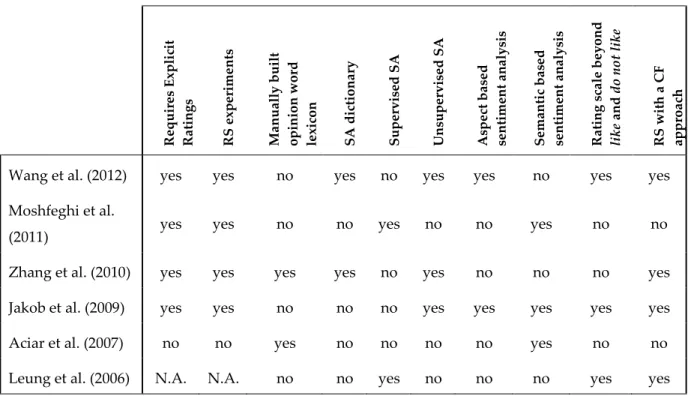
In Table 2 we provide a comparative summary of some approaches in a review-based recommendation. In the table N.A. (not applicable) refers to a RS framework proposed by Leung et al. (2006) in which the experiments were not clearly introduced and not completed.
Table 2. Comparative summary of review-based recommendations frameworks.
R e qu ir e s E x pli cit R a tin g s R S ex p e rime nts Ma nu a ll y bu ilt o pin io n w o rd le x ic o n SA d ic tio na ry Su pe rvise d SA U nsupe rvise d SA A spe ct ba se d se nti m e nt a n a ly sis Se m anti c ba se d se nti m e nt a n a ly sis R a tin g s ca le be y o nd lik e a nd d o n o t lik e R S w it h a CF a pp roa ch
Wang et al. (2012) yes yes no yes no yes yes no yes yes
Moshfeghi et al.
(2011) yes yes no no yes no no yes no no
Zhang et al. (2010) yes yes yes yes no yes no no no yes
Jakob et al. (2009) yes yes no no no yes yes yes yes yes
Aciar et al. (2007) no no yes no no no no yes no no