Proposal of a Low cost Mobile Robot
Prototype with On-Board Laser Scanner:
Robot@Factory Competition Case Study
Jos´e Gon¸calves∗ Paulo Costa∗∗
∗Polytechnic Institute of Bragan¸ca and INESC-TEC, Portugal. Email: [email protected]
∗∗University of Porto and INESC-TEC, Portugal. Email: [email protected]
Abstract: This paper presents the proposal of a Low cost Mobile Robot prototype with On-Board Laser Scanner, prototyped to compete at the Robot@Factory Mobile Robot competition. The robot is equipped with a hacked Neato XV-11 Laser Scanner, being a very low cost alternative, when compared with the current available laser scanners. It is presented the description of its sensors and actuators, providing valuable information that can be used to develop better designs of controllers and localization systems. The robot is equipped with the 37Dx52L, which is a low cost 12v motor equipped with encoders and a 29:1 reduction gearbox, being a very popular actuator in the mobile robotics domain. The robot is also equipped with an USB camera applied to acquire image, that will be processed, in order to provide information concerning the part material status.
Keywords:Mobile Robots, Prototyping, Sensors, Actuators
1. INTRODUCTION
Nowadays the industry faces the need to have plants more and more flexible. For some tasks, like raw material transportation from one place of work to another, AGVs can be used in order to allow flexible layouts. Theses transporters perform their tasks in a dynamic work en-vironment where unexpected obstacles may appear: the workers can cross the robot path, material left behind can block the intended route and even other robots can be an obstacle (1)(2)(3)(4)(5). Currently, the search for increased efficiency in a plant is a common activity and so AGVs and their deployment becomes a reason of an intense scientific research and pedagogical attention. This topic include fields like: control, localization and navigation. Ob-serving that paradigms, the Robot@Factory competition was designed as a test platform that can be used to solve problems similar to those present in future real plants. The Robot@factory competition attempts to recreate a problem similar to the one that an autonomous robot will face during its use in a plant. This scaled plant has a supply warehouse, a final product warehouse and eight processing machines (6).
The prototyped robot, was projected and prototyped so that it could be low cost and enter the Robot@Factory in a competitive way. The rules limit its size to a 45x40
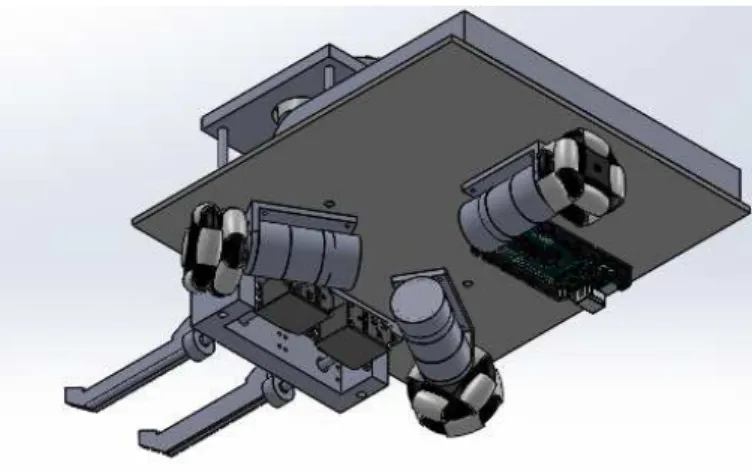
cm and 35 cm high box. The locomotion system can be built according to different topologies, for example differential, omnidirectional orAckerman. It was adopted an omnidirectional topology with three wheels where there are 120◦ between each wheel axis. This choice allows
independent translation and rotation movements. The
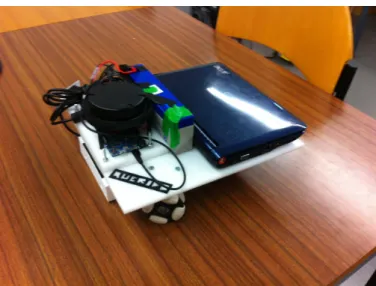
Fig. 1. Robot Prototype
four wheel configuration, while having some advantages, requires a mechanical suspension system.
The robot, shown in Figures 1 and 2, is equipped with the 37Dx52L, which is a low cost 12v motor equipped with encoders and a 29:1 reduction gearbox, being a very popular actuator in the mobile robotics domain. The robot is also equipped with a hacked Neato XV-11 Laser Scanner, being a very low cost alternative, when compared with the current available laser scanners. Neato XV-11 is a robot that includes a low cost 360◦ laser scanner, this
sensor can be extracted from the robot, allowing robotics practitioners to use it in their projects.
Preprints of the 11th IFAC Symposium on Advances in Control Education, Bratislava, Slovakia, June 1-3, 2016
Fig. 2. Robot Prototype CAD
The prototyped robot sensors and actuators are described in the next bsections, finally some conclusions and future work are presented.
2. 37DX52L GEARED MOTOR
The 37Dx52L is an actuator worldwide popular in the mobile robotics domain, being a low cost 12v motor equipped with encoders and a 29:1 reduction gearbox. The fact that it is equipped with encoders is an important feature because it provides important data to obtain the closed loop velocity control and to obtain relative measurements based on the odometry calculation (16). A 37Dx52L is shown in Figure 3.
Fig. 3. 37Dx52L Geared Motor.
The 37Dx52L model can be defined by the following equations, where Ua is the converter output, Ra is the
equivalent resistor, La is the equivalent inductance and e
is the back emf (electromotive force) voltage as expressed by equation (1).
Ua =e+RaIa+LaI˙a (1)
The motor can provide a torqueTLthat will be applied to
the load, being the developed torque (Td) subtracted by
the friction torque, which is the sum of the static friction (Tc) and viscous friction (Bω), as shown in equation 2.
TL=Td−Tc−Bω (2)
Current Ia can be correlated with the developed torque
Td through equation (3), the back emf voltage can be
correlated with angular velocity through equation (4) and the load torqueTL can be correlated with the moment of
inertia and the angular acceleration through equation 5 (17).
Td =KsIa (3)
e=Ksω (4)
TL=Jω˙ (5)
In order to obtain experimental data, a setup was imple-mented. The experimental setup is based on the Arduino micro-controller, the L6207 Drive, a DC Power source and a 37Dx52L actuator. The obtained data is the motor angular velocity and the input voltage. Two tests were per-formed, the first was to obtain a step response (transitory response data) and the second test was the steady state response for several input voltages (steady state data). Resorting to equation 2, equation 3 and equation 5, equation 6 was obtained.
˙
ω= KsIa−Tc−Bω
J (6)
After discretizing equation 6, equation 7 was obtained, where ∆T is the sampling time (50 ms).
ω[k] =ω[k−1] + ∆TKsia[k−1]−Tc−Bω[k−1]
J (7)
By minimizing the sum of the absolute error between the estimated (equation 7) and the real transitory response data (assuming initial know values forTcandKs),
param-etersB andJ were estimated. Then using equations 1, 2,
3, 4 and 5 and assuming that voltage drop due to Li is
negligible, equation 8 is obtained.
Jω˙ =Ks Ra
(Ua−Ksω)−Bω−Tc (8)
Solving the first order differential equation, equation 9 is obtained:
ω(t) = a b(1−e
−b t
) (9)
where:
a= KsUa−RaTc RaJ
(10)
b=K 2
s+RaB
RaJ
(11)
In steady stateω= a
b, resulting in equation 12.
ω= Ks
K2s +RaB
Ua−
RaTc
K2s+RaB
Fig. 4. Motor transitory response data
Fig. 5. Motor steady state response data
By minimizing the absolute error between estimated and the steady state data, assuming an initial value for Ra,
parameters Ksand Tc are estimated. Finally resorting to
equation 9, by minimizing the absolute error between the estimated data and the transitory response data, Ra is
estimated. The described optimization process must be repeated until the estimated parameters converge to their true values. Parameters such as Tc, Ra and Ks that are
initially assumed as known are replaced by the estimated ones, every time the estimate process is repeated. The es-timated and the real transitory and steady state responses are shown in Figures 4 and 5.
The estimated parameters are shown in Table 1, where the presented equivalent inductance was directly measured.
Parameters Value
Ks 1.89E-4
La 3.4E-3
Ra 2.1
B 2.44E-5
Tc 5.95E-5
J 2.03E-6
Table 1. DC Motor estimated parameters.
Fig. 6. Neato XV-11 (10)
3. HACKED NEATO XV-11 LASER SCANNER
In mobile robotics applications the most common tasks comprise mapping, localization, navigation and obstacle avoidance. In order to perform them efficiently, the robot needs to sense, calculate the distances to the obstacles and to build the map for robot navigation.
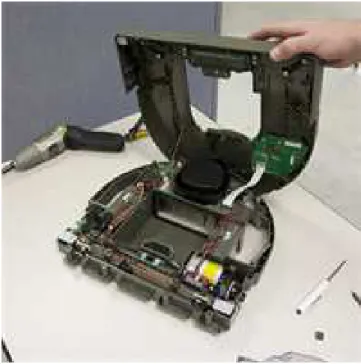
To achieve that, laser scanners are widely used in mobile robotics localization systems (7)(8) but, despite the enor-mous potential of its use, their high price tag is a major drawback, mainly for hobbyist and educational robotics practitioners that usually have a reduced budget. The Neato XV-11, shown in Figure 6, is a robot sold to vacuum domestic rooms(9), that includes a low cost 360 degree laser distance scanner. The laser scanner can be removed from the XV-11, allowing robotics practitioners to use it in their projects, being a very low cost alternative (10). A comparison between three laser rangefinders (URG-04LX, XV-11 laser scanner, Kinect derived) was developed (11), the XV-11 laser demonstrated to be reasonable accurate and precise with the more competitive cost. In (14) Neato XV-11 was used for Simultaneous Localization and Mapping, being modeled and simulated using V-Rep software with satisfactory results.
As described by Konolige et al. in (11), the Neato XV-11 laser scanner, shown in Figure 8, is a low-cost laser scanner equipped with features like eye-safe, fully functional in standard indoor lighting conditions and some outdoor conditions, it is small sized and has a low power consumption. Instead of using time of flight measurement, like the more expensive laser scanners, it uses triangulation to determine the distance to the target, using a fixed-angle laser, a CMOS imager and a DSP for subpixel interpolation (12).
acquisi-Fig. 7. Laser scanner motor closed loop control.
tion frequency. Its power consumption without motor is relatively low: 145 mA @ 3.3 V, which is a very important
factor in order to increase the autonomy of a mobile robot with its power based only on the on-board batteries. It provides a 360◦ range of measurements, with an angular
resolution of 1◦, with its range from 0.2 m up to 6 m
with an error inferior to 0.03 m. When the laser scanner is
removed from the Neato XV-11 robot, its motor has to be controlled by the user, being necessary to be powered with 3.0 V continuous voltage (60 mA), in order to produce
a turn rate of 240 rpm. Typically it is used a voltage regulator to obtain the 3.0 V. Although this approach is
the most popular, it is not the most efficient, because it is an open loop control, being observed oscillations in the motor velocity. An alternative to the referred approach is the use of the turn rate information contained in the data to close the loop (9) (11).
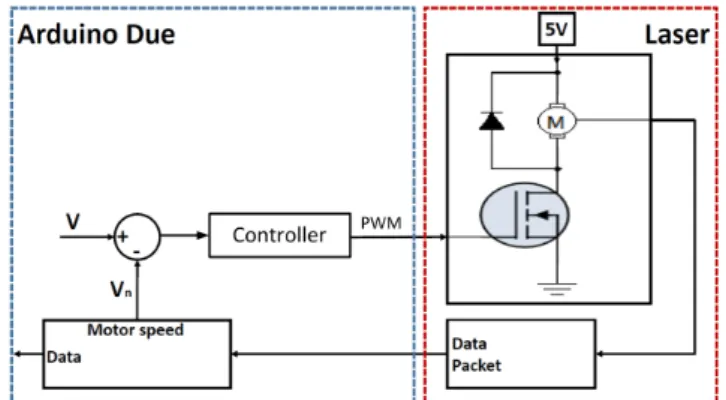
In this project the motor was controlled in closed loop. To control and to obtain measurements of the hacked Neato laser scanner, it was used an Arduino Due, which provides the 3.3 V requested by the laser scanner and can establish
the needed serial communication. The data packet sent by the sensor is composed by a start header, an index byte, the motor speed (Vn), the laser measured data and
a checksum.
Using the received motor speed data the control loop is closed by calculating the error relative to the speed (V), needed to maintain the laser frequency up to 5
Hz (5 Hz @ 240 rpm). Posteriorly the error is passed by an integrative like filter, resulting in a PWM control signal, which actuates on a N-Channel Mosfet powering the motor. In Figure 7 it is shown the control loop diagram. To model the hacked Neato XV-11 Laser Scanner an experimental setup was developed in order to obtain several measurement datasets. The data was obtained with the goal of extracting information about the sensor minimum and maximum ranges, its measurement error and noise. Details of the experimental setups used in order to obtain the laser scanner model and its simulation can be found in (13).
In Figure 9 are shown the mean values of the samples of each dataset relative to the real distance. As it can be seen in Figure 10 the laser scanner measurements tend to increase the error with the distance, reaching values up to 0.54 m at 5 m measurements to the object.
Fig. 8. Hacked Neato XV-11 laser scanner.
Fig. 9. Distance measured by the laser scanner.
Fig. 10. Distance error
Fig. 11. Laser scanner measure probability distribution.
Fig. 12. Normal probability plot.
4. MACHINE AND MATERIAL PART STATUS IDENTIFICATION
Each machine provides an area where the pieces should be placed in order to be processed by the machine. The robot must pick and place the material parts from the machine. While the part is placed in the machine it is processed and should not be removed. An RGB LED indicates that the machine is able to accept parts (light green), the machine is processing a part (yellow light), the part in this machine is already processed (white light) or that the machine is broken (blink red light). The material parts must also be identified by the robot, different colors mean different operations that have to be carried out by the robot. An example of a material part is shown in Figure 13.
In order to identify the material parts and the machine sta-tus image processing was used, being the robot equipped with a PS3 Eye camera, as shown in Figure 14.
Examples of the spectral analysis across a band of three images are shown in Figures 15, 16 and 17 (19).
Fig. 13. Material part
Fig. 14. Prototype front View.
Fig. 15. Spectral analysis example 1.
Fig. 16. Spectral analysis example 2.
5. CONCLUSIONS AND FUTURE WORK
In this paper it was presented the proposal of a Low cost Mobile Robot prototype with On-Board Laser Scanner, prototyped to compete at the Robot@Factory Mobile Robot competition. It is also presented the description of its sensors and actuators, providing valuable information that can be used to develop better designs of controllers and localization systems. The robot is equipped with the 37Dx52L, which is a low cost 12v motor equipped with encoders and a 29:1 reduction gearbox, being a very popular actuator in the mobile robotics domain. The robot is also equipped with a hacked Neato XV-11 Laser Scanner, being a very low cost alternative, when compared with the current available laser scanners.
One educational aspect, other than the natural motivating factor, is the availability of a challenge that is harder than some entry level competitions but still reachable for teams with some experience on those tasks. Also, it is expected that the problem scales well to more complex approaches. This means that more complex robot, thus a harder robot to build, will also be able to perform better. This can be a excellent motivation for teams to learn and use more advanced robots and algorithms.
By presenting a scaled down factory shop, this competition creates a benchmark that can be used to compare different approaches to the problems that arise on this kind of environments. Also, the ability, in some restricted areas, to alter the environment, can promote the test and evaluation of different localization mechanisms. Something that is usually, more restricted in most other competitions. That opens this area to be explored and benchmarked.
As future work the authors intend to develop localization and navigation systems for the proposed robot, in order to participate in the Robot@Factory competition in a competitive way.
ACKNOWLEDGEMENTS
This work is financed by the ERDF European Regional Development Fund through the Operational Programme for Competitiveness and Internationalisation - COMPETE 2020 Programme, and by National Funds through the FCT Funda¸c˜ao para a Ciˆencia e a Tecnologia (Portuguese Foundation for Science and Technology) within project POCI-01-0145-FEDER-006961.
REFERENCES
[1] Pinto, M., Moreira, A. P., & Matos, A. (2012). Lo-calization of mobile robots using an extended kalman filter in a LEGO NXT. IEEE Transactions on Edu-cation, 55, 135144. doi:10.1109/TE.2011.2155066 [2] Yu, J., Liu, K. H., & Luo, P. (2011). A mobile
RFID localization algorithm based on instantaneous frequency estimation.2011 6th International Confer-ence on Computer SciConfer-ence and Education (ICCSE),
525530. doi:10.1109/ICCSE.2011.6028694
[3] Ji, C., Wang, H., & Sun, Q. (2010). Improved particle filter algorithm for robot localization. 2nd International Conference on Education Technol-ogy and Computer (ICETC), 4, 171174. doi:doi: 10.1109/ICETC.2010.5529710
[4] Lee, S. C., Choi, J. S., & Lee, D. H. (2012). Trilateration based multi-robot localization under anchor-less outdoor environment. In ICCSE 2012 - Proceedings of 2012 7th International Conference on Computer Science and Education (pp. 958961). doi:10.1109/ICCSE.2012.6295224
[5] Choi, B.-S. C. B.-S., & Lee, J.-J. L. J.-J. (2007). The Position Estimation of Mobile Robot Under Dynamic Environment. IECON 2007 - 33rd Annual Conference of the IEEE Industrial Electronics Soci-ety. doi:10.1109/IECON.2007.4460261
[6] Gon¸calves, J., Lima, J.,Costa, P.,Moreira, A (June 2012). Manufacturing Education and Training resort-ing to a new mobile robot competition. Flexible Au-tomation Intelligent Manufacturing 2012 (Faim 12) Ferry Cruise Conference Helsinki-Stockholm-Helsinki
doi:10.1109/ICNN.1993.298623
[7] Arras, K., Tomatis, N., Improving robustness and precision in mobile robot localization by using laser range finding and monocular vision. Advanced Mo-bile Robots, 1999.(Eurobot’99) 1999 Third European Workshop on, 177-185, 1999, IEEE
[8] Surmann, H., Nuchter, A., Joachim, H., An au-tonomous mobile robot with a 3D laser range finder for 3D exploration and digitalization of indoor en-vironments. Robotics and Autonomous Systems 45.3, 2003, 181-198.
[9] Hacking the Neato XV-11, https://xv11hacking.wikispaces.com/, 2015
[10] Neato Robotics XV-11 Tear-down, https://www.sparkfun.com/news/490, 2015
[11] Konolige, K., Augenbraun, J., Donaldson, N., Fiebig, C., Shah, P., A low-cost laser distance sensor,
Robotics and Automation, 2008. ICRA 2008. IEEE International Conference on, vol., no., pp.3002,3008, 19-23 May 2008
[12] Shah, P., Konolige, K., Augenbraun, J., Donaldson, N., Fiebig, C., Liu, Y., Khan, H., Pinzarrone, J., Salinas, L., Tang, H., Taylor, R., Distance sensor system and method, US 2010/0030380 A1, 2010. [13] Campos, D., Santos, J., Gon¸calves, J., Costa, P.,
Modeling and Simulation of a Hacked Neato XV-11 Laser Scanner, ROBOT’2015 - Second Iberian Robotics Conference, Lisbon, 2015.
[14] Bajracharya, Suraj, ”BreezySLAM: A Simple, effi-cient, cross-platform Python package for Simultane-ous Localization and Mapping”, Washington Lee uni-versity, 2014
[15] Chambers, J., Cleveland, W., Kleiner, B., and Tukey, P., Graphical Methods for Data Analysis,Wadsworth, 1983.
[16] Borenstein, J., Everett, H., Feng, J.: ’Where am I?’ Sensors and Methods for Mobile Robot Positioning , Technical Report, The University of Michigan, 1996. [17] Bishop, R.: The Mechatronics Handbook , CRC
Press, New York, 2002.
[18] Ramsey, A.: Dynamics , Cambridge Library Collec-tion - Mathematics, 2009.