i
Hive on Spark and MapReduce: A Methodology for
Parameter Tuning
Rodrigo Richard Forster
Project work presented as partial requirement for
obtaining
the
Master`s
degree
in
Information
ii
ABBREVIATIONS
MapReduce A distributed data processing model and execution environment that runs on large clusters of commodity machines
HDFS A distributed filesystem that runs on large clusters of commodity machines.
Executor in Spark, executors are worker processes responsible for running the individual tasks in a given Spark job.
Hive A distributed data warehouse. Hive manages data stored in HDFS and provides a query language based on SQL (and which is translated by the runtime engine to MapReduce jobs or Spark jobs) for querying the data.
iii
TABLE OF CONTENT
i1.
Introduction ... 2
1.1.
Background ... 2
1.2.
Motivation ... 3
1.3.
Objectives of the project ... 3
2.
Project Work Plan ... 5
2.1.
Implementation strategy (development methodology) ... 5
2.2.
Resources and tools... 6
2.3.
Chronogram ... 6
3.
Theoretical Background ... 8
3.1.
Big Data ... 10
3.2.
Big Data Processing Frameworks ... 11
3.2.1.
Amazon ... 12
3.2.2.
Microsoft ... 13
3.2.3.
Google ... 14
3.3.
Apache Hadoop and Hive ... 16
3.3.1.
Hadoop Distributed File System ... 16
3.3.2.
MapReduce vs Traditional rational database management systems ... 17
3.3.3.
How does MapReduce work? ... 18
3.3.4.
Apache Hive ... 19
3.4.
Apache Spark ... 20
3.4.1.
Resilient Distributed Dataset... 21
3.4.2.
Spark ecosystem ... 21
3.4.3.
The Composition of a Spark Application ... 24
4.
Project development ... 26
4.1.
Spark’s User Interface ... 26
4.2.
YARN Tuning Parameter ... 28
4.3
Dynamic Executor Allocation... 29
4.3.
Spark Tuning Parameter ... 30
4.3.1.
Data Serialization ... 31
iv
4.4.
Hive Tuning Parameter ... 32
4.4.1.
Hash-Map Join Memory size property ... 34
4.4.2.
Parallelism: Reducer Properties ... 35
5.
Tuning Results ... 36
5.1.
Hive Tuning Result ... 36
5.1.1.
Hash-Map Join Memory Size ... 36
5.1.2.
Reducer Properties ... 38
5.2.
YARN and Executor Results ... 38
5.3.
Spark Data Serialization ... 39
5.4.
Final Tuning Results ... 40
6.
Obstacles of Improving Performance ... 42
1
ABSTRACT
As the era of “big data” has arrived, more and more companies start using distributed file systems to manage and process their data streams like the Hadoop distributed file system framework (HDFS). This software library offers a way to store large files across multiple machines. Large data sets are processed by using its inherent programming model MapReduce. Apache Spark is a relatively new alternative to Hadoop MapReduce and claims to offer a performance boost up to 10 times for certain applications, while maintaining its automatic fault tolerance. To leverage the Data Warehouse capabilities of Hadoop Apache Hive was introduced. It is a concept for Big Data analytics that works on top of Hadoop and provides data analysis tools and most importantly translates queries to MapReduce and Spark jobs. Therefore, it exploits the scalability of Hadoop and offers data exploration and mining capabilities to non-developers. However, it is difficult for users to utilize the full potential of the Apache Spark execution engine. This results in very long execution times. Therefore, this project work gives researches and companies a tuning methodology that significantly can improve the execution time of queries. As a result, this tuning methodology could optimize a real-world batch-processing query by 5 times. Moreover, it gives insides in the underlying reasons of this big improvement by using Apache Spark Monitoring tools. The result can be helpful for many practitioners and researchers that would like to optimise the performance of Spark and MapReduce queries executed in Hive on top of an Apache Hadoop cluster.
KEYWORDS
2
1. INTRODUCTION
1.1. B
ACKGROUNDThis thesis is written in cooperation with the ProSiebenSat.1 Group, one of the most successful independent media companies in Europe with a strong lead in the TV and the digital market. This project will be done in direct involvement with the Data Warehouse department. One major task of this apartment is to deliver and aggregate data from various sources in an efficient manner. One reason behind this is that the reporting team can create useful information from this data. For this purpose of managing data, the Apache Hadoop software library is used. It is a framework that allows distributed processing of large data sets across clusters of computers using simple programming models. Built on top of Apache Hadoop, the company uses the Apache Hive data warehouse software. This user interface provides easy additional features e.g. easy access to data via SQL (Apache Hive, 2018a). Apache Hive takes over mapping tasks that otherwise needed to be programmed manually. Thus, Apache Hive offers an effective, reasonably intuitive model to analyse data (Capriolo, Wampler, & Rutherglen, 2012, p. 1). With the Apache Hive software, it is possible to use different execution engines to run queries (Apache Hive, 2018a). Thus, this work aims to evaluate performance differences of the two execution engines MapReduce and Spark and optimize the Spark execution engine because it is known for better performance. The most popular execution engine is MapReduce, Hadoop’s native batch processing engine. MapReduce is a great solution for one-pass computations, but not very efficient for use cases that require multiple computations. Each step in the data processing workflow has one Map phase and one Reduce phase and you'll need to convert any use case into MapReduce pattern to leverage this solution. Spark is another popular framework built around speed, ease of use, and sophisticated analytics. It is supposed to take data processing to the next level with less expensive shuffles in the data processing. With capabilities like in-memory data storage and near real-time processing, the performance can be several times faster than other big data technologies.
Since the emergence of the Hadoop Software ecosystem many studies compared the performance of different execution engines, suggested configurations and analytic frameworks to enhance performance. However, most of the efforts are done over the standalone version of MapReduce and Spark without the Hive metastore that translates SQL queries into MapReduce and Spark. Moreover, this work aims to deliver a methodology to tune a Hive on Spark query and demonstrates this methodology by using a real-world batch-processing query. As a result, this tuning methodology could improve the execution time of Hive on Spark by 5 times and Hive on MapReduce by 4 times.
3
1.2. M
OTIVATIONThe company is currently using Hive on MapReduce as its data processing model and execution environment. Although this environment is up-to-date and has many advantages like fault tolerance and high scalability it also faces some challenges. With the increasing adoption of Hive the data volume managed by Hive has increased. Moreover, the query workloads that are executed on Hive have become more diverse. Although, Hive already delivers a high throughput by utilizing MapReduce as its execution engine. However, when new users start to use Hive they also expect Hive to provide a fast response time. Therefore, the query execution time of Hive must be further improved by using the Hive on Spark as execution engine and by optimizing configuration settings (Zhang Hong et al., 2016).
Apache Spark, a general-purpose cluster computing framework comes up with a fast alternative solution (Apache Spark, 2017a). The main difference to MapReduce is that Spark uses its Resilient Distributed Datasets (RDD) to process data in-memory. Therefore, it is faster for applications which repeatedly reuse the same set of data as MapReduce has to store data in disk for processing (Zaharia et al., 2012).
Thus, I plan to conduct several tests runs that measure the execution time of queries first executed over MapReduce and then via the Spark engine. The aim is to reveal bottlenecks of a certain query executed over Hive on Spark and therefore to improve the execution time of the query and deliver a tuning methodology.
1.3. O
BJECTIVES OF THE PROJECTThe objective of this project is to develop a methodology to improve the performance of Hive on Spark and MapReduce queries. This is demonstrated with a real-world business example.
It intends to deliver a use case that demonstrates the performance differences of the two frameworks and show the reason behind performance differences. Moreover, it will demonstrate configurations that have direct impact on the performance of the respective execution engine. As a result, this project work will deliver a practical example on how to switch from MapReduce to Spark and show its performance differences. There are many studies which measure performance differences on the Apache Hadoop framework. To my knowledge there is no study which uses the Apache Hive Software with a specific query in a company context.
4 The contribution of this study is to find generally valid configurations that can be transferred to other optimization projects. It also can serve as a guide on how to optimise queries on Hive on MapReduce and Hive on Spark.
These are the main objectives of the project:
I. Set a base line through first experiments and performance evaluations
II. Identify suitable configurations to enhance the performance of both execution engines III. Prioritize the best configurations until the optimal performance is reached
IV. Propose a configuration plan for optimizing queries on Hive for academia and industry This study is organized as follows. Section two provides information about development methodology, which resources and tools are going to be used and the development steps in a time context. Section three gives and overview of the related literature and a system overview of Hadoop, Spark and Hive. Section four describes the execution of the project justifying why certain parameter have been chosen and the theory behind them. Section 5 shows the results of the tuning test runs explained in section 4. Section 6 considers the limitations that come with tuning applications. The conclusion summarizes the results and reasons behind this and gives future research directions.
5
2.
PROJECT WORK PLAN
2.1. I
MPLEMENTATION STRATEGY(
DEVELOPMENT METHODOLOGY)
The configuration of the tested Hadoop cluster is left as the provider (Cloudera) has pre-configured it. There are many configuration options in a cluster that can improve the time a query needs to run different operations on the stored data. A Hadoop cluster is designed specifically to store and analyze massive amounts of unstructured data. The first results of the query executed over Hive on MapReduce and Hive on Spark can be considered as the out-of-the-box performance. The Tuning Results in section 5 can be seen as benchmark in this project.
The query of interest is responsible for aggregating raw data from an ad-server with already existing data. Thus, the query first needs to aggregate the raw data with certain ID’s from already existing tables. Therefore, the query also includes CASE WHEN functions to perform mappings and lookups with other tables. Then, the aggregated data is joined into one table. In a last step the most relevant data is listed by a GROUB BY function.
In this project the cluster has 10 hosts. A host is the Hadoop term for a computer, sometimes it is also referred as node. Each host is equipped with 40 or 56 virtual cores and 114 GB of memory.
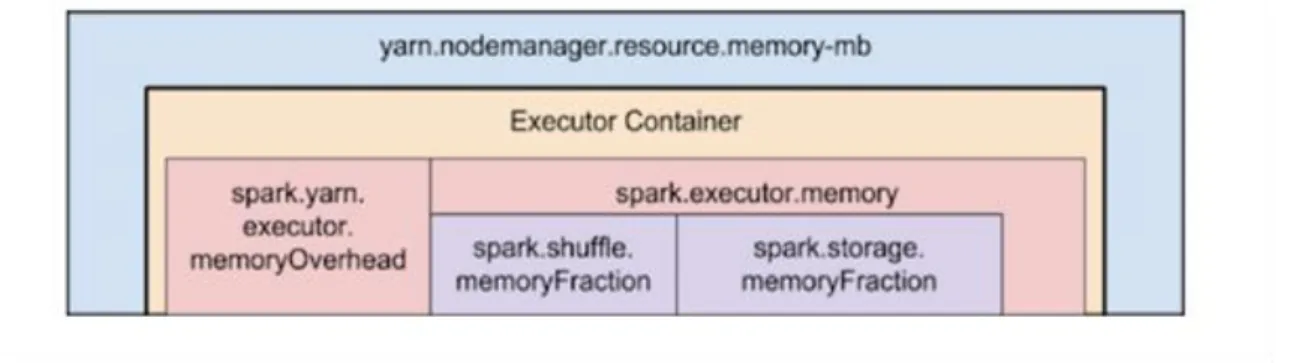
The first step of this project was to understand what the query does so that the most suitable configuration parameter can be selected. In addition, it is important to understand what every single configuration parameter does. Therefore, the literature of performance tuning and Hive’s and Spark’s official configuration guides were a useful source (Cloudera©, 2018c). In a second step the most suitable configuration parameters were selected because Hive, Spark and YARN have a lot of configurations that are not all relevant for the query and would have let to an unrealistically high number of test-runs. Thus, a researched list of suitable configuration parameter is created. In a third step, the candidate configurations are tested first in a single run when applicable in pairs. Some configuration parameter needs to be tested in pairs because they are built on each other or depend on each other. For example, the Spark memory overhead and executor memory parameter depend on each other, see Figure 2. Based on the previous steps the candidate configurations are tested all together against the benchmark to see synergies or to reveal Figure 1: Tuning
6 interference of the parameters. The last step shows the final configuration with the optimal configuration and best execution time.
Figure 2: Hierarchy of memory properties in Spark and YARN (Cloudera©, 2018d)
It is worth mentioning that some parameters already have the optimal configuration according to the Hive and Spark configuration guidelines. These parameters will not be included in the test runs. The parameters that have the greatest impact will be evaluated in the section 4 to better understand their impact on the query. Furthermore, when a parameter improves the performance of the default configuration it is kept and replaced by the new value, see Figure 2
The performance of the query will be evaluated by the execution time. Every configuration is executed 5 times and from the result the mean value will be presented as outcome.
2.2. R
ESOURCES AND TOOLSThe main resource to execute the performance tuning of the Hive on Spark Query is the Apache Hive framework accessed via Hue.
Hive is a distributed data warehouse. Hive manages data stored in HDFS and provides a query language based on SQL (which is translated by the runtime engine to MapReduce jobs or Spark jobs) for querying the data (Srinivasa & Muppalla, 2015, p. 36).
Hive is accessed via the Hue user interface (UI). It is a web-based interactive query editor in the Hadoop stack that lets you visualize and share data (Cloudera©, 2018a). It is provided by a US based software company called Cloudera Inc. The first evaluation of the Spark on Hive performance was done with Sparks User Interface. This interface gives an overview of the execution time of stages, their amount, write and read data and how many tasks one stage finished during execution.
2.3. C
HRONOGRAM7 Table 1: Chronogram of the work project
Total project work period July 17 - Aug 18
Distribution of the project work Expected Dates preliminary research
Definition of the project scope Project proposal
1. Introduction
1.1 Background Aug 17 - Nov 17
1.2. Motivation / Justification 1.3. Objectives of the project 2. Project Work Plan
2.1. Implementation strategy (development methodology) Nov 17 - Jan 18
2.2. Resources and tools 2.3. Chronogram
3 Theoretical Background 3.1 Big Data
3.2 Big Data Processing Frameworks
3.3 Apache Hadoop and Hive Jan 18 - May 18
3.4 Apache Spark 4. Project Development 4.1 Spark's User Interface 4.2 YARN Tuning
4.2 Hive Tuning Parameter
5. Tuning Results May 18 - Jun 18
5.1 Hive Tuning Results 5.2 YARN Tuning Results 5.3 Spark Tuning Results 5.3. Overall Tuning Results
6. Limitations Jun 18 - July 18
7. Conclusion
8. Final Thesis Revision
July 17
Final Delivery: 15th of August 2018 Delivery: 14th of July 2017
Completion: End of November 2017
Completion: End of January 2018
Completion: Mid of February 2018
Completion: Beginning March 2018
8
3. THEORETICAL BACKGROUND
In this literature review I considered not only the best fitting research papers, but also their quality. To quantify the quality, I used the SCImago Journal Rank (SJR, 2018). It measures the scientific influence of scientific journals through the number of citations and the importance of the journals where the citations come from. When I took a closer look at the ranking and applied a filter only for computer science journals and conference papers I noticed that from a total of 4171 top ranked scientific papers 67% (2798) constituted of conference papers and only 33% (1373) of journals. This is a reason why more related work can be found in conference papers compared to journals. However, under the top 30 rated journals and conference papers only 4 papers are conference papers. Thus, I took a closer look at top ranked journals to screen for related research. As a result, I noticed that there exist also a lot of Hadoop related research in top journals, however, these journals often deal with very specific topics. Apiletti et al. (2017), for example, develop an data mining algorithm based on MapReduce. Their experimental results on high-dimensional datasets show that their design outperforms other algorithms in terms of execution time, load balancing and robustness to memory issues. On the other hand, conference papers tend to deal with more practical performance related topics. In general, it can be said that he literature of Big Data frameworks has a wide spectrum. Since Hadoop has been proposed in the year 2005 the diversity and quantity of publications increased with every year. Polato et al. (2014) conducted a literature review to assess the various research topics of the Apache Hadoop project, Figure 3 represents the key areas of literature regarding Apache Hadoop literature.
9
Figure 3: Hierarchical overview of Apache Hadoop Literature (Polato, Ré, Goldman, & Kon, 2014)
Furthermore, throughout 2014 Hadoop increases in popularity. In their literature review regarding big data technologies and its possible classification, Volk et al. (2017) can confirm that Hadoop is most relevant when it comes to big data projects. In 44 out of 45 papers they retrieved from scientific databases, Hadoop or the implementation of MapReduce was mentioned or evaluated in detail. With the emergence of Spark in 2010 more and more papers were dealing with performance improvements and performance comparisons between Hadoop MapReduce and Apache Spark (Soualhia, Khomh, & Tahar, 2017). The literature on performance evaluation of Hadoop projects is very fragmented and specialised. In addition, there is also a separate research stream focusing on performance improvements on cloud environments. Although this research field has valuable insights that could be transferred to cluster management it must be viewed as separate silo of research. This is because of the different architecture of a cloud and a cluster, e.g. a cluster makes it much easier to allocate the full capacity of your data centre to a single task (Sadashiv & Kumar, 2011). Moreover, there is also a research stream that compares Hadoop MapReduce and Spark to other commodity cluster frameworks e.g. MPI/OpenMP on Bewolf, Apache Flink, HAMR, or Apache Storm (García-Gil, Ramírez-Gallego, García, & Herrera, 2017; N. Iqbal, Nadeem, & Zaheer, 2015; Reyes-Ortiz, Oneto, & Anguita, 2015; Zhao, 2017).
Literature that deals with tuning of parameters in the Spark standalone version and Hive on Spark version is also related to this work. As mentioned in a previous paragraph this project focuses on Spark running as execution engine on Hive. Moreover, YARN (Yet Another Resource Negotiator) is used as the Spark cluster manager in this project. Gounaris et al. (2017) provide a comprehensive
10 methodology of how to tune the most important Spark parameter concerning shuffling, serialization and compression on the application performance. They test these tuning parameters through evaluating three real-world case studies. Results show that it is possible to improve execution times by 20% by using this parameter tuning methodology.
Similarly, Nguyen and Kim (2017) evaluate the performance between Hive on MapReduce and Spark SQL on their big data system. It should be mentioned that there is a difference between Spark SQL and Spark on Hive. Hive on Spark uses Spark as underlying computing engine (Apache Hive, 2018a). Whereas Spark SQL is a component of the Spark cluster computing system. It is a component of the Spark Core responsible for processing data, it has the possibility to reuse the hive metastore (Apache Hive, 2018a). Nguyen and Kim’s (2017) work uses a benchmarking framework called BigBench which contains 30 queries. They find out that the Spark SQL outperforms MapReduce in every single BigBench query. This project work also deals with performance improvements on the SQL level with Apache Hive built on top of Apache Hadoop. The query is executed through the MapReduce engine and Spark engine.
3.1. B
IGD
ATAThe term Big data describes huge amounts of data that are characterized by high volume, high velocity, and high variety (Jin, Wah, Cheng, & Wang, 2015). More recently also by low veracity, and high value. Today the main challenge is still the high variety of data, meaning that applications have to manage data sources of structured, semi-structured and unstructured data, e.g. texts, images, video and voice recordings (Jin et al., 2015). Moreover, it also remains a challenge to extract, store and process data in a rapid manner so that enterprises can meet their business requirements (M. Iqbal & Soomro, 2015). Thus, it is of critical importance to use both, business tools and specialized big data analytics frameworks to get the best possible results. Big data analytics frameworks that guarantee the processing of newly generated information with low latency can be found in open source solutions like Hadoop (Chelliah, 2017). At this time Apache Hadoop is the most used platform across organizations (Chelliah, 2017). It excels the most with batch processing, however, it lacks capabilities in analyzing data that is generated in a continuous stream of information. Apache Spark can manage both, batch processing and the processing of such data that is in continuous motion. This project work, however, is limited to the performance improvement of batch processing. Thus, this project will focus on exploring the tuning possibilities of Hive on Spark batch processing and will compare the results with a MapReduce engine both executed via Hive. In the following sections the Data warehouse solutions of Amazon, Microsoft, and Google are compared. Where possible I try to
11 demonstrate the in-house solutions of Amazon, Microsoft and Google because I want to demonstrate alternative solutions apart from the Hadoop ecosystem.
3.2. B
IGD
ATAP
ROCESSINGF
RAMEWORKSIn this project a batch processing query that aggregates data from an ad server (DoubleClick for Publishers) is optimised. This query is part of a Big Data processing platform. Figure 4 shows the architecture of the Big Data processing platform of ProSiebenSat1 Digital. It has several data sources e.g. coming form and ad server or Google Analytics Tracking events etc. This data is processed through an ETL process into the Hadoop Distributed File System (HDFS). From there the data is processed via a second ETL process into a PostgreSQL database. In this database the data is aggregated with all important metrics, it can be considered as single point of truth. From there, it is possible to create reports with the reporting tool SAP Business Objects. Through Hive it is also possible to access the raw data on the cluster (HDFS). Hive is a user interface that provides a query language based on SQL to access data stored in HDFS.
Figure 4: Big Data Processing at ProSiebenSat1 Digital
The cluster where the test runs of the query are executed consists of 10 computer hosts. Each host is equipped with 40 or 56 virtual cores and 114 GB of memory. In the following chapter possible Big Data Processing Frameworks of Amazon, Microsoft and Google are presented. These solutions represent one of many solutions this companies offer. I chose solutions that are possible substitutions of the current solutions of this project. However, the current solution seems to be the most pragmatic in terms of costs which is explained in the last chapter of this section.
12
3.2.1. Amazon
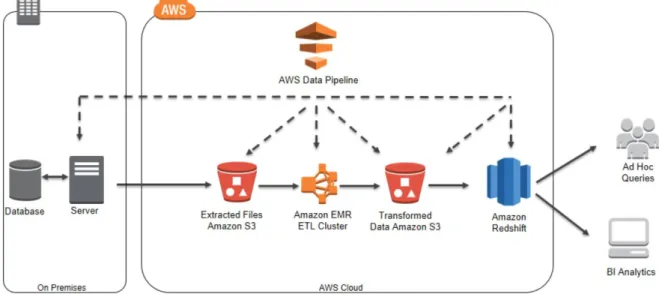
Amazon and Hadoop have a long history together. In the year 2006 Tom White a member of the original Hadoop Project Management Committee focused on making Hadoop run on Amazon’s Elastic Compute Cloud (Amazon EC2) and S3 Servers (White, 2012). Thus, Amazon offers a range of services that work well with the Hadoop ecosystem. Amazons cluster platform is called Amazon Elastic MapReduce (EMR) and offers the possibility to use HDFS (Hadoop Distributed File System) or Amazon S3 as underlying file system (Amazon, 2018b). As the name already suggests Amazon EMR uses MapReduce as underlying execution engine. Amazon lists the following options to run on top of EMR: Hadoop, Spark, Flink and Tez (Amazon, 2018b). The latter options all belong the Hadoop ecosystem and are open source projects. Apache Flink is specialized on real-time stream processing and thus not suitable for this project (Apache Flink, 2018). Apache Tez is a serious alternative to MapReduce and Spark. It’s a framework for high performance batch processing, it was developed to improve the speed of the MapReduce paradigm (Apache Tez, 2018). However, Apache Tez was excluded from this project work as alternative execution engine for two reasons. First, Apache Spark is the more recent, universal framework and claims to yield better performance than Apache Tez. Second, the Hue user interface provided by the company Cloudera does not support the execution engine Apache Tez (Cloudera©, 2018a). Amazon also offers a solution without the open source framework Hadoop. Its data warehouse service is called Amazon Redshift (Amazon, 2018c). Figure 5 shows an example of a Data Pipeline that first performs and ETL process to move data from an on-premises database to Amazon Redshift.
13 After the data is extracted from the on-premises Database Amazon EMR launches a cluster that uses the extracted dataset. Then, Amazon EMR validates and transforms the data to deliver an output to the Amazon S3 bucket. As a last step, the data is copied into the Redshift Data Warehouse. From there Ad hoc queries and BI Analytics reporting’s can be executed. Amazon states that this solutions is most suitable for batch-processing and data-driven workflows but lacks real-time processing capabilities (Amazon, 2018a).
3.2.2. Microsoft
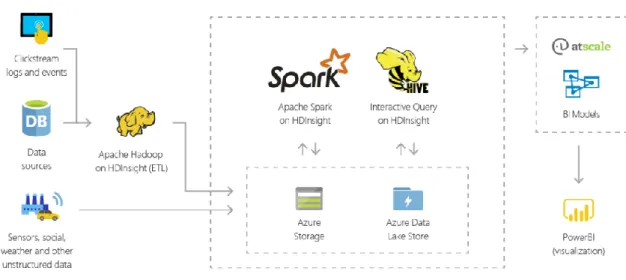
Microsoft pursues a similar strategy compared to Amazon in terms of distributed cluster platforms. Its big data framework is called Azure and mainly focuses on cloud services (Microsoft, 2018c). However, it also offers solutions to combine on-premises server clusters with Azure virtual networks. For processing the data, they also rely on open source solutions, see Figure 6 for their Data Warehouse Solution (Microsoft, 2018b). It uses Microsoft’s open-source analytics service platform for enterprises called Azure HDInsight. Moreover, the Figure shows that the ETL process is performed via Hadoop. The processing of the data is done with the Apache Spark framework. To access the raw data Apache Hive is used which in the next step passes the data via atscale to the visualization tool PowerBI.
Figure 6: Microsoft’s Data Warehouse Solution with Apache Spark on HDInsight (Microsoft, 2018b) Azure HDInsight supports the open source frameworks Hadoop, Spark, HBase, Kafka, Storm and also Microsoft’s own distributed cluster solution R Server (Microsoft, 2018a).
14
3.2.3. Google
Hadoop has its origins in the web crawler programme Apache Nutch. However, Google published pioneering papers about MapReduce and the Google File system which helped the creators of Apache Nutch to solve significant problems and to come up with the Nutch Distributed File System (NDFS) (White, 2012). A bit later, Yahoo! got interested in this topic and put together a team of experts, which also included some creators of Apache Nutch. Thus, the part of Nutch occupied with distributed computing was split off and thus NDFS was named Hadoop Distributed File System (HDFS). Due to the resources of Yahoo! and a fast-growing open source community Hadoop could grow in a scalable technology at a fast pace. Figure 7 shows how a thinkable DWH solution with Google products could look like. In the Data acquisition part, the data is run through an ETL process before its loaded in either a Google cloud storage solution or on a on-premises distributed cluster server network. In the data consolidation par, it is possible to query data from the storage or to load it into a last staging area. The processing of data is done with the Google Dremel execution engine.
Figure 7: Possible Google DWH Architecture with Big Query
Moreover, Figure 7 also shows Googles underlying execution engine called Google Dremel. Similar to MapReduce Dremel is a parallel computing engine. Dremel is specifically designed to run a query on huge data sets in few seconds (Sato, 2012). The reason behind this fast execution is, very high compression ratio and scan throughput possible through Dremel’s columnar storage, see Figure 8.
15 Figure 8: Columnar storage of Google Dremel (Sato, 2012)
Figure 8 shows the columnar storage of Dremel, it separates a record into column values and stores each value on a separate storage volume (Sato, 2012). This is opposed to the traditional databases where the whole record is stored on one volume. Secondly, also Dremel’s Tree architecture contributes to its fast Ad-hoc query capabilities. This architecture makes it possible to dispatch queries and collect results across thousands of machines. However, this very fast query response time mostly works on structured data, e.g. for ad hoc trial-and-error interactive queries (Sato, 2012). In this project the focus lies on batch processing of large data sets for time-intensive data aggregations. However, Google is continuously evolving its Dremel and its externalized version BigQuery. Thus, to this day, BigQuery can yield acceptable results for batch processing which will be discussed shortly in the next paragraph.
Big Query is Google’s Data Warehouse system comparable to Apache Hive. The BI Vendor atscale lately reported some query tests including BigQuery which uses the Dremel execution engine on Google’s cloud storage. They used a range of queries, for example queries with a small number of JOIN and GROUP BY operations as well as more complicated queries similar to this project (Klahr, 2017). In the SQL engine performance test of Klahr et. al (2017) the engines Tez on Hive and Spark SQL were tested. For large and small data sets BigQuery yielded close results to Tez on Hive and Spark SQL (Klahr, 2017). Thus, it can be considered as a serious alternative to the Hadoop ecosystem with Spark on Hive as execution engine. In this project there are no comparisons with Dremel as execution engine due to resource and time constraints.
Table 2 Overview of big data platform comparison
Google Microsoft Amazon
Present-day solution chosen alternative
Big Data Analytics BigQuery Hadoop on Azure Redshift
Execution Engine MapReduce Apache Spark Dremel Spark or MR Elastic MapReduce (Hadoop)
Big Data Storage HDFS HDFS Cloud Storage S3 EMR Cluster or AWS
Switching costs none none + +++ ++
Cloudera
16 Table 2 shows the most important Big data analytics platforms, with their corresponding execution engine and storage possibilities. In this project Cloudera is current vendor of the current Apache Hive Data Warehouse solution. The current execution engine is MapReduce. Apache Spark was chosen as alternative execution engine because of the literature suggests best results with Apache Spark. Moreover, it requires no additional costs to switch from MapReduce to Apache Spark as it is already included in the Hive solution. The solutions of Google, Microsoft and Amazon would require using their cloud storage which would lead to additional costs. Thus, in order to reach a better execution time of the query of interest Apache Spark as execution engine is the cheapest and most straight forward option.
3.3. A
PACHEH
ADOOP ANDH
IVEHadoop has become the most used processing platform in today’s cloud environments (Soualhia et al., 2017). It is a framework for large data sets on clusters built to run on a server cloud of commodity hardware (Holmes, 2012, p. 4). It has its origins in Apache Nutch, an open source project designed to search websites and index them (Mavridis & Karatza, 2017). A working version of Apache Nutch started in 2002, however, the architecture of this web search engine did not scale to billions of webpages on the Web. Gehmawat et al. (2003) realized this problem and proposed the architecture of Google’s distributed filesystem (GFS) which lays the ground for the Hadoop Distributed File System (HDFS). One year later Dean and Gehmawat (2004) present Hadoops programming model named MapReduce.
In the following two chapters Hadoop’s main components HDFS and MapReduce will be explained in greater detail.
3.3.1. Hadoop Distributed File System
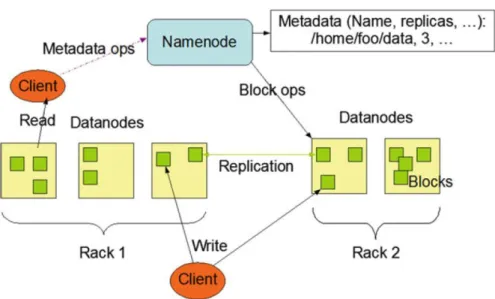
Many companies still store important data on a single physical server machine, but in many cases the data set outgrows the storage capacity. Thus, it becomes necessary to distribute the data across many individual machines. A filesystem that can manage storage across a network of machines is called distributed filesystem (White, 2012, p. 43). The Hadoop Distributed File System (HDFS) is one main components of the Hadoop project and runs the storage on large clusters of commodity machines. HDFS cluster has two different types of nodes and follows a master/slave model (Shvachko, Kuang, Radia, & Chansler, 2010). HDFS stores file system metadata in the master called NameNode and the application data is stored in several DataNodes (slaves). Moreover, the NameNode also regulates the access to files by clients, see Figure 9 (Apache Hadoop, 2017). Thus, the client communicates with the name node and DataNodes on behalf of the user. The data notes store and retrieve blocks when the client or NameNode delivers this command. Without the
17 NameNode, the filesystem would not be accessible. Therefore, it is important to make sure that the NameNode does always work properly. For this reason HDFS replicates the DataNodes multiple times (Shvachko et al., 2010). The HDFS architecture ensures that each file is split into one or more blocks, and these blocks are stored in a set of DataNodes.
Figure 9: HDFS Architecture (Apache Hadoop, 2017)
3.3.2. MapReduce vs Traditional rational database management systems
MapReduce is a widely-used programming model and Hadoops’ associated implementation for processing big amounts of data (Dean & Ghemawat, 2004). At this point the question may arise why a Rational Database Management System (RDBMS) cannot be used to process these large-scale data sets so many companies are facing nowadays. What is the advantage of MapReduce against this traditional Database System? This question can be answered with the trend that seek time of disk drives is improving at a slower pace than the transfer rate (White, 2012, p. 5). Seek time refers to the process of moving the disk’s head to the desired place on the disk to write or read data. It is the latency of the disk operation. The transfer rate refers to a disks bandwidth. If a large data set needs to be accessed predominately with seek requests the bottleneck usually is a high read and write time. Here MapReduce has an advantage over RDBMS because its transforms the problem of read and writes into a computation model over sets of keys and values, this will be explained in more detail in the following paragraph (White, 2012, p. 4). RDBMS is limited by the rate it can perform seeks. On the other hand, RDBMS work well for updating small data sets because its data structure called B-Tree is suitable for reading and writing data many times (White, 2012, p. 5). Table 1 shows
18 the differences between a traditional RDBMS and MapReduce. MapReduce works well for cases where data is written once and queries need to be performed on a daily basis. Relational databases suit applications where data is written continually. Another advantage of MapReduce is it can manage unstructured or semi-structured data. This is because it is possible to choose input keys and values depending on the data that is being processed or analyzed (White, 2012, p. 5).
Traditional RDBMS MapReduce Data size Gigabytes Petabytes Access Interactive adn batch Batch Updates
Read and write many times
Write once, read many times
Structure Static schema Dynamic schema
Integrity High Low
Scalling Nonlinear Linear
3.3.3. How does MapReduce work?
The computation is based on the concept of a map and reduce function. First, as can be seen in Figure 2, MapReduce splits work submitted by a client into small parallelized map and reduce workers (Holmes, 2012, p. 6). Then the Map operation is applied to every key-value pair to the node local data. This produces a set of intermediate key-value pairs. The Map function takes data structured in <key, value> pairs as input and outputs a set of intermediate <key, value> pairs (García-Gil et al., 2017):
(1) Map (< key1, value1 >) → list(< key2, value2 >)
The result is grouped by key and distributed across the cluster. The Reduce phase applies a function to each list value, producing a single output value:
(2) Reduce (< key2, list(value2) >) →< key2, value3 >
The Jobtracker has the task to manage activities across the slave TaskTracker process. It assigns job requests from the clients and schedules map and reduce tasks on TaskTrackers, see Figure 2. The TaskTracker, on the other hand, is a daemon process that spawns child processes to perform the actual map reduce work (Holmes, 2012, p. 9). The shuffle and sort phases accomplish two activities or tasks. First, finding the reduce task that is most suitable to receive the map output key/value pair and secondly, that each reduce step has all its input keys sorted.
19 Figure 10: Client, Job Tracker and Task Tracker interaction (Holmes, 2012)
3.3.4. Apache Hive
Since the original paper of Thusoo et al. (2010) has been published Hive has been significantly improved by new innovations and research. Hive was originally designed as a translation layer on top of Hadoop MapReduce. Today it is the de facto open source data warehouse system for Hadoop (Apache Hive, 2018a). Hive has its own SQL dialect that translates queries to a directed acyclic graph (DAG) of MapReduce jobs (Huai et al., 2014). Thus, users can use the Hive SQL user interface and do not need to worry about programming difficult MapReduce jobs to manipulate data stored in HDFS.
20 Figure 11: The Architecture of Hive (Apache Hive, 2018a)
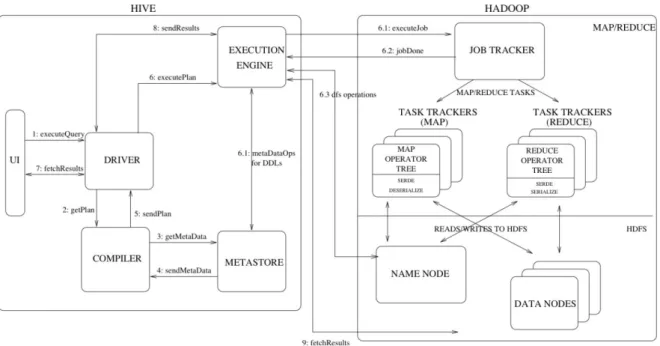
Figure 11 shows the major components of Hive and its interactions with Hadoop during a query execution. Through Hive’s user interface (UI) a statement is submitted to the Driver (Step 1). Then, the driver creates a session handle for the query and sends the query to the complier to generate an execution plan (Step2). In steps 3 and 4 the complier retrieves the metadata from the metastore. This metadata is used to validate the data type expressions in the query tree (Apache Hive, 2018a). In addition, Hive runs some partition pruning based on the metadata. In step 5 the complier generates a directed acyclic graph (DAG) which consists of stages of Map and Reduce jobs, in case the execution engine was set to MapReduce. It also can consist of a metadata operation or an operation on HDFS. In the case of MapReduce stages, the plan contains operator trees that are executed on the mappers and reduce operations that need reducers. In Steps 6, 6.1 and 6.2 the execution engine submits the different stages to appropriate components. In each Map or Reduce task the Deserializer associated with the table or intermediate outputs is used to read the rows from HDFS files. When the output is generated, it is stored to a temporary HDFS file through the Serializer. The temporary files can be used to provide useful data to later map and reduce stages within the plan. In steps 7, 8 and 9 the query contents of the temporary file are read by the execution engine directly from HDFS as part of the fetch request from the Driver.
3.4. A
PACHES
PARKApache Spark is a distributed and highly scalable in-memory data analytics system It provides the function to develop applications in many different programming languages e.g. Python, Java, Scala and R. In their original paper, Zaharia et. al (2010) propose Spark as a framework that has the same
21 scalability and fault tolerance as MapReduce. On top of that, they wanted to offer a better solution for applications that reuse data across multiple operations, e.g. machine learning (ML) algorithms. Spark is often considered as an alternative for MapReduce because it also can be used for distributed data processing when used on top on Hadoop (Karau & Warren, 2017, p. 17). In 2016, the project had more than 1000 contributors. In addition, more and more companies start to implement Spark as their main big data analytics framework (Yadav, 2017).
3.4.1. Resilient Distributed Dataset
In this chapter, I will present the concept of the Resilient Distributed Dataset (RDD) abstraction in more detail, because RDDs extend the MapReduce and Dryad programming model introduced by Dean and Ghemawat (2004) and Isard et al.(2007). Therefore, understanding the concept of RDDS will be crucial for understanding the performance differences between Spark and MapReduce. The latter, is still the most widely used big data analysis framework today (Liu, Xu, & Li, 2017). Big Data processing frameworks like MapReduce are successful because they let developers create computations with high-level operators and at the same time offer them adequate distribution and fault tolerance. However, because cluster workloads get more complex big data programming models became inefficient in certain situations (Zaharia et al., 2012). For example, for interactive queries or data stream processing. This led to the development of new more specialized data flow systems. More specifically, the two main problems with the older generation of big data frameworks, e.g. MapReduce, are data sharing across computations and massive overheads because of data replication (Zaharia, 2016, p. 9). In MapReduce, for example, the only way to share data between two computations is to write in on a physical disk or distributed file system. This can lead to substantial overheads because of data replication and in many cases is the reason for long execution times of computations.
Sparks abstraction called resilient distributed datasets (RDDs) promises to offer the feature of data sharing across computations. According to Zaharia (2016, p. 10) RDDs are parallel, fault-tolerant data structures that let users store in memory or on a physical disk, control its partitioning, and manipulate through various components. A board overview of the main components of Spark will be given in the next chapter.
3.4.2. Spark ecosystem
The Spark project consists of various closely integrated components. The main idea about this ecosystem is to provide a general-purpose framework so that different areas can work seamlessly together and deliver added value (Karau, Konwinski, Wendell, & Zaharia, 2015, p. 2). For example, it is possible the develop an application that uses Sparks machine learning to structure data in real time
22 and at the same time analysts can access the resulting data via SQL to join the data with unstructured data of other sources. Figure 12 shows all components as well as the main cluster managers. In the following, all components from this Figure will be briefly discussed.
Figure 12: Spark ecosystem (Karau & Warren, 2017)
Spark Core
The main component of the Spark project is the Spark Core which can be considered as the computational engine. Its tasks are to manage the job scheduling, memory management, fault recovery, and communicating with storage systems (Karau et al., 2015, p. 3). Spark Core is also responsible for the API that defines resilient distributed datasets (RDDs). RDDs represent a collection of predefined, distributed items across several compute nodes. RDD will be explained in more detail in the following chapter. The Spark Core provides APIs in Java, Python and R that help manipulate this item collections, e.g. with map or reduce functions that are applied to a big data set (Karau & Warren, 2017, p. 8).
Spark SQL and Hive Query Language
Spark SQL is a Spark module for structured data processing. It runs as a library on top of Spark, as can be seen in Figure 13. Through Spark SQL it is possible to access different Spark interfaces. This can be done through JDBC or ODBC, the already integrated Data Frame API or a command-line console (Apache Spark, 2017c). This Spark SQL command-line is a tool to run the Hive metastore service on your local machine. Another way for working with structured data using SQL is through Hive Query Language (HQL). It allows the easy access to Hive tables and access to HDFS (Karau et al., 2015, p. 3).
23 Figure 13: Spark SQL and Spark Core interaction (Karau et al., 2015)
Spark Streaming
Spark Streaming is a part of Spark that makes it possible to process continuous stream of data. One example of such live stream of data are production web servers that generated logfiles. To get the most out of this stream of data Spark Streaming uses the scheduling of the Spark Core to analyze minibatches of data (Karau & Warren, 2017, p. 9). This makes it easy for developers to move between application that have data stored in the virtual memory, physical disk or streaming data.
MLib
MLib is Spark’s machine learning library it aims to make ML easy and scalable. MLib offers various types of ML algorithms such as (Apache Spark, 2017c):
▪
ML Algorithms: common learning algorithms like regression and clustering
▪
Featurization: feature extraction, transformation, dimensionality reduction
▪
Pipelines: tools for manipulating ML Pipelines
▪
Persistence: load and saving algorithms
▪
Utilities: descriptive statistics and data handling, etc.
GraphX
GraphX is is a component of Spark that lets you analyze graphs and perform parallel computations with that graph, e.g. a social network graph (Karau et al., 2015, p. 4). Similar to Spark Streaming GraphX extends the RDD API by allowing the user to create a directed graph with various properties attached to each vertex and edge (Apache Spark, 2017b).
24
Cluster Managers
Cluster managers ensure that Spark achieves it scalability and fault tolerance. The main task of the cluster managers is to allocate resources across applications. Sparks applications run on a cluster coordinated by the SparkContext object in its driver program, see Figure 5 (Apache Spark, 2017b)
Figure 14: Spark Cluster Manager (Apache Spark, 2017b)
The SparkContext can connect to various types of cluster managers to run on a cluster. More specifically, the SparkContext is the object through which the Driver Program can access Spark. It is automatically generated through the variable “sc”, (Karau et al., 2015, p. 15). Currently, there exist three cluster managers: Sparks own solution the standalone cluster manager, Mesos and Yet Another Resource Negotiator (YARN). In this project, YARN is used as cluster manager. YARN makes it possible to distribute resources dynamically for several jobs (Vavilapalli et al., 2013). Thus, YARN specifies the capacities of the cluster for Jobs through Queues. For every application the user can configure these capacities, thus the YARN configuration can play a crucial role in performance optimizations (Gounaris et al., 2017).
Once Spark is connected through a cluster manager it gets executers on nodes in the cluster. These executers are processes that store data for an application and run computations. In the following step, SparkContext sends the application code, written in python or Scala, to the executers. In the last step, SparkContext sends the tasks to the executers to run (Apache Spark, 2017b).
3.4.3. The Composition of a Spark Application
Figure 15 helps to distinguish and separate the terms Application, Job, Stage and Task in the context of Spark. The Spark application starts by corresponding with the SparkContext or Spark Session (Karau & Warren, 2017). Each application contains many jobs that speak to one RDD action. Each job
25 contains numerous stages that correspond to wide transformations. Wide transformations also called wide dependencies are operations such as sort or groupByKey. Each stage consists of several tasks that correspond to a unit of computation that occurs in each stage. The tasks in one stage perform the same code on a different piece of data.
Figure 15: Spark Application Tree (Karau & Warren, 2017)
In other words, one stage can be considered as a set of tasks that each can be computed on one executor. One task cannot be executed on more than one executor. But, each executor has a dynamically set number of slots for every task and therefore can run several tasks in parallel. Spark executors are processes that manage individual tasks in a Spark Job. The two main jobs of an executor are to run tasks and to return the results to the driver. Secondly, an executor delivers in-memory storage for RDDs (Karau et al., 2015).
26
4. PROJECT DEVELOPMENT
This section explains the parameter of interest and why they have been chosen. Furthermore, it will explain why Apache Spark was chosen as big data processing framework in this project. In section 4.6 the obstacles of the project will be described.
First, there is no “either/or” choice when we compare the big data processing frameworks Spark and MapReduce. Because with the Apache Hive Data Warehouse system you can easily switch between those two engines via a short command in the user interface. The user can choose which programming model fits best to its individual applications. In the specific case of this project there was no other option than Apache Spark because, first, several journal articles and documentations proved that Apache Spark is a comprehensive programming model and a suitable execution engine for batch processing and real time processing, see (Cloudera©, 2018c; Zaharia, 2016). Second, as the Hadoop ecosystem is open source there exist only few alternative options offered by companies like Microsoft, Amazon and Google. In Fact, these companies offer big data frameworks that integrate and support the Hadoop ecosystem. It is also possible to exclusively rely on the technology of Microsoft, Amazon and Google without using the open source Hadoop technology. However, as these alternatives are not open source there is an obvious cost disadvantage. Moreover, open source technologies also give companies more freedom in terms of switching costs e.g. costs that can occur if a company decides to change the server or cloud provider. In addition, by choosing an open source framework combined with an on-premises server cluster a company does not have to share sensitive data with companies like Microsoft, Amazon, or Google. In section 4.1 the use of the Spark User Interface is described, because it is the most important tool to evaluate the different tuning parameter which will be tested in the following chapters. Chapter 5 demonstrates the results of the tuning experiments explained in chapter 4.
4.1. S
PARK’
SU
SERI
NTERFACEWhen a user runs a Spark Job over Hive it is possible to monitor detailed progress information and performance metrics of that executed Spark Job. In this project work, the Spark Web User interface (UI) was the first tool used to learn about the behaviour and performance of the Spark Job of interest. The Spark Jobs page, see Figure 16, has detailed information for active jobs and completed jobs. The most useful information is the number of completed tasks of one stage, e.g. the one active job in Figure 16 has 654 tasks of 852 tasks completed.
27 Figure 16: The Spark UI’s jobs index page
This first overview page is used to get an idea of the performance of the various stages. The first step in this project was to identify the stages of the job that have a particularly high or low running time across multiple runs of the same job. Once a stage with a high execution time is identified, in this case the active Job with an execution time of 22 minutes, see Figure 17, the Job can be analysed further by clicking on the link of the “Description”. The next Figure shows the detail page of this active Job, taking a closer look can deliver valuable information to narrow down performance issues. For example, a common source of performance problems is skew (Karau et al., 2015, p. 151). This can occur when a few tasks take a very high execution time compared to the others. In the job of this project, there is one stage which takes by far the longest execution time. This stage, this would-be Job 3, see Figure 16, with 22 minutes duration compared to 5, 0.8 and 14 seconds.
28 Figure 17: The Spark UI’s stage detail page
Figure 17 also shows the write and read time of each completed stage. An extreme uneven distributed runtime can also be a hint for potential bottlenecks of this jobs. If tasks take a long execution time without reading and writing a lot of data their might be a optimization potential (Karau et al., 2015, p. 153).
4.2. YARN
T
UNINGP
ARAMETERBased on documentation of the software vendor Cloudera (2018c) the resource manager YARN (Yet Another Resource Negotiator) configurations will be tested. In this section the configuration parameters and the idea behind the YARN tuning will be explained. YARN is the resource and job scheduling manager of Hadoop (Vavilapalli et al., 2013). It allocates the system resources to running applications and schedules tasks that are executed on different computers hosts. A host is another word for computer, in YARN terms it is also referred as a node.
Figure 18 shows an example of a YARN cluster with one host computer (Cloudera©, 2018c). One host provides certain memory and CPU resources. A virtual core (Vcore) is a usage share of a host CPU. A container performs certain tasks consisting of memory and Vcores.
29 Figure 18: Container abstraction on a host consisting on Vcores and memory (Cloudera©, 2018c) Thus, optimizing the performance of YARN involves mainly defining the containers of the host computers. Some tasks within the containers need a big amount of processing power (Vcores) others need more memory. This can be defined with the YARN properties
• yarn.nodemanager.resource.cpu-vcores • yarn.nodemanager.resource.memory-mb
In this project the cluster has 10 hosts. Each host is equipped with 40 or 56 virtual cores and 114 GB of memory. In this project the value for the property yarn.nodemanager.resource.cpu-vcores is set to 36 virtual cores because for the services YARN resource manager and HDFS DataNode need each 1 core and 2 additional cores are reserved for the operating system (Cloudera©, 2018c). For the property yarn.nodemanager.resource.memory-mb it is recommended to leave 8 GB of memory for the Operating system and 12 GB for the services. As a result yarn.nodemanager.resource.memory-mb is set to 114 GB – 20 GB = 94 GB. For test purposes also slightly higher and lower values are tested. The results of this configurations can be observed in the results section.
4.3 D
YNAMICE
XECUTORA
LLOCATIONDynamic allocation enables Spark to dynamically distribute the resources of the cluster (Cloudera©, 2018b). It allocates the resources to your application based on the workload. Through dynamic allocation Spark requests executors based on the backlog of tasks. All resources are distributed to the first submitted job, this causes the following applications to be queued up. When the application is done, its executors are allocated to other applications. It is worth mentioning that in this version of
30 Spark (1.6.0) Dynamic allocation is enabled by default. From a performance stand point, dynamic allocation already makes a respectable job. This can be observed by the YARN and Executor results in section 5.2. The default configuration is tested against a manual executor allocation to test whether there is potential in the resource allocation of executors and memory.
Cloudera recommends using Dynamic Executor Allocation in a production environment because normally several users are querying data via a user interface. Thus, allocating a fixed number of executors to a user session could be problematic regarding resource sharing. Thus, a manual configuration like demonstrated in the Tuning Results section 5.2 is not recommended in a production environment.
4.3. S
PARKT
UNINGP
ARAMETERThe Spark application also has significant resource allocation parameter that can influence the execution time of a certain Spark Job. Spark and YARN manage mainly CPU and memory configurations (Cloudera©, 2018d). Disk and network I/O are not managed by Spark and YARN. Each Spark executor in an application has the same fixed number of virtual cores and same amount of fixed heap size. The number of spark executor cores can be manipulated with the spark.executor.cores property. The heap size can be configured with the spark.executor.memory parameter. For example, when the property spark.executor.cores is set to 5 cores, this means an executor can run a maximum number of five task simultaneously. The memory parameter tells Spark how much data Spark is able to cache. Moreover, it also controls the maximum sizes of shuffle data which is important for joins, aggregations and group by functions (Cloudera©, 2018d). Figure 19 shows the hierarchy of the YARN resource allocation parameter and the spark resource allocation parameter. This image demonstrates that a configuration of the YARN nodemanger should be done together with the executor configurations as the affect each other.
31 As mentioned in the previous section the test cluster has 10 hosts. Each host is equipped with 40 or 56 virtual cores and 114 GB of memory. The goal of the executor memory configuration is to is to minimize unused cores. In other words, we are looking for the maximal number of executors that can run in parallel. The number of Spark executor cores is depended on the number of cores allocated to YARN (Cloudera©, 2018c). The maximal number of executors that can run in parallel can be calculated through the available cores of YARN divided by the chosen Executor number (Vcores/Executors). As explained in the previous section the optimal number of YARN cores is 36. Following this procedure, the maximal number of cores that can run in parallel would be 36/4= 9 Executors. 114 GB is the total memory available 114 GB – 20 GB for other services results in 94 GB of available memory. 94 GB/9 results in approximately 10 GB as total available memory space. Cloudera recommends 20% of that as memory overhead (2 GB) for memory. Thus, the values for memory per executor is 8 GB and for memory overhead 2 GB. Choosing 6 executors instead of 4 would be also possible for the hosts with 36 cores, because 36 is divisible by 6. However, there exists some hosts with 52 cores that would leave 4 cores unused because 52 divided by 6 results in 8 cores and 8 times 6 executors results in 48. With these configurations, each host can run up to 9 executors at the same time. Each executor can run up to 4 tasks (one per core). This results in an average of 2.5 GB of memory per task (10/4 GB). The results of this test runs can be seen in section 5.2.
4.3.1. Data Serialization
Data Serialization plays a significant role in the performance of an distributed Spark application (Apache Spark, 2018). Spark uses serialization for activities related to computations and data movement. This includes activates such as tasks triggering, caching, shuffle and spilling. Serializing is a method to transform an object into a stream of bytes. Some formats need a long time to serialize objects or they consume many bytes, this will affect the computation time negatively (Apache Spark, 2018). Spark offers two serialization libraries, by default Spark uses the Java serialization framework. Java serialization is flexible but often rather slow and let the classes consume a large number of serialized formats. The Kyro library can serialize objects faster because it uses up to one-tenth of the memory the Java serializer uses and generates objects faster. The results of the serialized configuration can be seen in the results section. The Kyro serializer can be activated with the spark.serializer=org.apache.spark.serializer.KryoSerializer property.
4.3.2. Shuffle
Shuffling is a process of transferring data across stages which is a common process during a computation (Karau et al., 2015). Shuffles can be negative to the performance of Spark applications because they can consume high processing power and also lead to disk writes when a spill occurs
32 (Karau & Warren, 2017). Shuffles have a greater negative impact with increasing data and increasing proportion of that data that has to be moved to a new partition. Thus, it is recommended to shuffle less often or in a more effective way (Karau & Warren, 2017). To trigger less shuffles, it is recommended to preserve partitioning across narrow transformations. This will avoid creating reshuffles of data. In some cases, it is also possible to use the same partitioner for several wide transformations. This is particularly helpful to avoid shuffles during joins. Figure 20 shows the Spark User Interface details page for the query of interest of this project. This is a practical example of how a shuffle spill on the disk influences the execution time negatively. When the limit of virtual memory is reached Spark writes data on the disk also called shuffle spill (disk). This influences the execution time negatively (8.5 minutes).
Figure 20: Spark User Interface Details page for Stage 7
In this project, an increased spill during shuffling was observed. The only parameter that positively influenced this phenomenon was the Hive parameter hive.auto.convert.join.noconditionaltask.size, see section 5.1.1 for more detail. There could not be identified a Spark property that influences the shuffle spill positively. The properties spark.shuffle.compress and spark.shuffle.spill.compress which are responsible for compressing map output files are already configured in an optimal manner “true” as default. Thus, there are no separate tuning results for these shuffle properties in the results section.
4.4. H
IVET
UNINGP
ARAMETERHive configurations have a significant impact on the performance of Spark because Spark is executed over Hive as engine. Following the methodology, the following tuning parameter have been tested in a trial and error manner. Table 3 shows the tested Hine Tuning parameter suggested by the Cloudera documentation (Cloudera©, 2018c). In a first step it needed to be checked which configuration is actually deployed in the cluster. This value can be found in the default column. The column optimal