Universidade de Lisboa
Faculdade de Medicina Dentária
Effect of Ethanol Solutions
as Post-Polymerization Treatment
on the Properties of Acrylic Reline Resins
Joana Vieira Almeida e Costa
Dissertação
Mestrado Integrado em Medicina Dentária
Universidade de Lisboa
Faculdade de Medicina Dentária
Effect of Ethanol Solutions
as Post-Polymerization Treatment
on the Properties of Acrylic Reline Resins
Joana Vieira Almeida e Costa
Dissertação
orientada pela Professora Doutora Maria Cristina Bettencourt Neves
e coorientada pelo Professor Doutor Jaime Portugal
Mestrado Integrado em Medicina Dentária
Table of Contents i
Table of Contents
Agradecimentos ... ii Resumo ... iv Abstract ... viii 1. Introduction ... 1 2. Objectives ... 63. Materials and Methods ... 7
3.1. Shear bond strength ... 8
3.2. Surface free energy ... 11
3.3. Statistical analysis ... 13
4. Results ... 14
4.1. Shear bond strength ... 14
4.2. Surface free energy ... 16
5. Discussion ... 19 6. Conclusions ... 25 7. References ... 26 Appendices ... 32 Appendix 1 – Tables ... 32 Appendix 2 – Figures ... 34
Appendix 3 – List of Tables ... 37
Appendix 4 – List of Figures ... 38
Appendix 5 – List of Abbreviations ... 39
ii
Agradecimentos
A concretização desta dissertação deve-se à colaboração de um conjunto de pessoas, todos aqueles que fizeram parte e me acompanharam durante este percurso académico, a quem não posso deixar de agradecer.
À minha orientadora, Professora Doutora Maria Cristina Bettencourt Neves, Professora Auxiliar da disciplina de Prostodontia Removível da Faculdade de Medicina Dentária da Universidade de Lisboa, quero expressar os mais sinceros agradecimentos pelo constante incentivo, disponibilidade, orientação científica e dedicação durante a realização desta tese de mestrado. Agradeço também todo o seu apoio e amizade. A oportunidade e confiança foram determinantes para a execução desta tese.
Ao meu coorientador, Professor Doutor Jaime Portugal, Professor Associado e Regente da disciplina de Biomateriais da Faculdade de Medicina Dentária da Universidade de Lisboa, pela disponibilidade sempre demonstrada, pelos conhecimentos transmitidos na área de Biomateriais, bem como todo o incentivo e apoio prestado ao longo da realização deste estudo.
À Doutora Filipa Chasqueira, Assistente Convidada da disciplina de Biomateriais da Faculdade de Medicina Dentária da Universidade de Lisboa, pelas informações fornecidas sobre os estudos de adesão e pela sua simpatia e constante apoio durante o ensaio laboratorial.
À Professora Doutora Ana Francisca Bettencourt, Professora Auxiliar do Departamento de Ciências Toxicológicas e Bromatológicas da Faculdade de Farmácia da Universidade de Lisboa, pela disponibilidade das instalações e de todos os recursos necessários durante a execução prática deste trabalho. Agradeço também a permanente disponibilidade, interesse e auxílio teórico e prático.
À Doutora Ana Cristina Matos, do Instituto de Investigação do Medicamento da Faculdade de Farmácia da Universidade de Lisboa, pelo apoio e interesse pelo presente trabalho, bem como toda a disponibilidade para o esclarecimento de dúvidas relativas ao teste de energia de superfície.
Às técnicas de prótese Margarida Santos e Leonor Costa agradeço toda a ajuda prestada no decorrer do estudo nas instalações de Prótese Dentária na Faculdade de Medicina Dentária da Universidade de Lisboa.
Effect of ethanol solutions as post-polymerization treatment on the properties of acrylic reline resins
iii
À técnica de anatomia patológica citológica e tanatológica, Ana Cruz, do laboratório de análises histomorfológicas da Faculdade de Medicina Dentária da Universidade de Lisboa, o meu agradecimento pelo apoio e ajuda prática na diluição do etanol para obter as soluções necessárias para a realização do trabalho laboratorial.
A todos os docentes e funcionários da Faculdade de Medicina Dentária da Universidade de Lisboa que direta ou indiretamente contribuíram para a minha formação pessoal e profissional.
Gostaria, igualmente, de agradecer aos meus amigos e colegas pelo convívio e constante motivação, apoio e incentivo ao longo deste percurso académico. Em especial, à minha colega e amiga Sara Palmares por todo o apoio e amizade, mesmo nos momentos mais difíceis. E à minha amiga e colega Catarina Sousa, com quem partilhei este projeto, deixo aqui uma palavra de agradecimento especial pela sua amizade, motivação e colaboração.
Às minhas amigas, Daniela, Cristiana e Lídia, que mesmo distantes foram importantes pela permanente e fiel amizade.
Por último, à minha família, um eterno agradecimento por estar sempre presente. Aos meus pais, pelo incondicional apoio, compreensão, carinho e incentivo ao longo de todas as fases da minha vida. E aos meus irmãos, João Pedro Costa e Mariana Costa, pela força e alegria que sempre me transmitiram.
iv
Resumo
Como consequência da reabsorção contínua e progressiva do rebordo alveolar, a desadaptação da prótese aos tecidos de suporte é frequentemente observada em pacientes portadores de próteses removíveis. Assim, um controlo periódico e rigoroso deve ser realizado para a avaliação da necessidade de um rebasamento. O rebasamento é um procedimento que permite ajustar a base de uma prótese removível aos tecidos de suporte, contribuindo para uma melhor retenção e estabilidade das mesmas. Existem dois métodos para realizar um rebasamento de uma prótese: direto (realizado diretamente na cavidade oral) ou indireto (por intermédio de procedimentos laboratoriais).
As resinas acrílicas autopolimerizáveis têm sido desenvolvidas para serem utilizadas como material de rebasamento, restabelecendo a adaptação e suporte da prótese, permitindo uma maior igualdade na distribuição da carga e contribuindo para a saúde e preservação dos tecidos adjacentes. As resinas para rebasamento direto apresentam uma composição base de pó em polietilmetacrilato (PEMA), enquanto a composição do líquido varia consoante o material, podendo incluir, por exemplo, os monómeros 1,6-hexanedioldimetacrilato (1,6-HDMA) ou isobutilmetacrilato (IBMA). Por seu lado, as resinas para rebasamento por intermédio de procedimentos laboratoriais apresentam uma constituição semelhante às resinas convencionais utilizadas para a base da prótese, com polimetilmetacrilato (PMMA) no pó e metilmetacrilato (MMA) no líquido.
Este material é classificado como um polímero, ou seja, apresenta-se sobre a forma de uma cadeia longa de pequenas unidades repetidas (monómeros). Durante a reação de polimerização das resinas acrílicas, um iniciador, geralmente o peróxido de benzoílo, quebra a ligação dupla do monómero, ficando exposto um local de ligação para o contínuo crescimento da cadeia. Esta conversão de monómeros em polímero nunca é completa e quantidades variáveis de monómero não convertido (monómero residual) permanecem na rede polimérica ou são libertados para o meio circundante.
Apesar de ser o grau de conversão o fator mais importante que determina a quantidade de monómero residual, esta quantidade está dependente de vários fatores, como, por exemplo, o tipo de resina, a composição da mistura, o tipo de reação de
Effect of ethanol solutions as post-polymerization treatment on the properties of acrylic reline resins
v
polimerização, a duração do ciclo de polimerização, a natureza do iniciador, a espessura da resina e o tipo de polimento.
De forma a diminuir as alterações das propriedades mecânicas dos materiais e as reações adversas dos tecidos na cavidade oral, como consequência da libertação gradual de monómero residual, foram propostos diversos tratamentos pós-polimerização. Assim, a imersão da prótese num banho térmico com água a 55 ºC ou a radiação com micro-ondas promove a libertação de monómero residual antes da inserção da prótese na cavidade oral.
Mais recentemente foi proposto como tratamento pós-polimerização a imersão de próteses removíveis rebasadas com resinas de rebasamento direto, Ufi Gel Hard e Kooliner, em soluções específicas de etanol a 20% e 50%, respetivamente, aquecidas a 55ºC durante 10 minutos.
Um dos objetivos do presente estudo foi avaliar o efeito do tratamento pós-polimerização com etanol na resistência ao corte de três resinas acrílicas autopolimerizáveis de rebasamento (Kooliner, Ufi Gel Hard e Probase Cold) quando aderidas a uma resina termopolimerizável para base da prótese (Probase Hot). Foi também estudado o efeito do tipo de resina nos valores de resistência ao corte.
Cento e cinquenta espécimes (12×10×6 mm) de resina para base da prótese foram confecionados. Após a polimerização, os espécimes foram submetidos a 2 500 ciclos de termociclagem (5-55 ºC). De seguida, as resinas de rebasamento foram unidas à superfície preparada da resina para base da prótese através de um molde de silicone (5×3 mm). Após a polimerização, os espécimes foram divididos em 5 grupos (n=10) e submetidos a um dos seguintes tratamentos: imersão em água ou em soluções de etanol a 20%, 50% ou 70% a uma temperatura de 55±2 ºC durante 10 minutos. Como controlo, foram utilizados espécimes que não foram submetidos a qualquer tratamento pós-polimerização. Depois do armazenamento em água destilada numa estufa a 37 ºC durante 48 horas, os espécimes de cada grupo foram submetidos a testes mecânicos de resistência ao corte, com uma máquina de testes universal Instron, utilizando uma velocidade de 1 mm/min. As superfícies foram observadas com um esteromicroscópio para determinar o tipo de falha, sendo estas classificadas como: adesivas, quando a falha ocorre na interface de adesão, ou mista, quando existiu a combinação de falha adesiva e coesiva da resina acrílica de rebasamento.
vi
Outro dos objetivos foi avaliar o efeito do mesmo tratamento pós-polimerização na energia de superfície das mesmas resinas acrílicas autopolimerizáveis de rebasamento e comparar os valores entre as diferentes resinas acrílicas.
As resinas de rebasamento (Kooliner, Ufi Gel Hard e Probase Cold) foram colocadas no interior de moldes de aço (160×18×1 mm) e, após a sua polimerização, foram seccionadas de forma a obter 75 espécimes (24×18×1 mm). De seguida, os espécimes foram divididos em 5 grupos (n=5) e foram submetidos a um dos seguintes tratamentos: imersão em água ou em soluções de etanol a 20%, 50% ou 70%, a uma temperatura de 55±2 ºC durante 10 minutos. Como controlo, foram utilizados espécimes que não foram submetidos a qualquer tratamento pós-polimerização. Após o armazenamento em água destilada numa estufa a 37 ºC durante 48 horas, utilizando-se a técnica da placa de Wilhelmy, no tensiómetro de Kruss, os ângulos de contacto foram determinados. A energia de superfície foi posteriormente calculada pelo método de Wu. Os resultados obtidos foram analisados estatisticamente através de testes não paramétricos segundo o método de Kruskal-Wallis, seguindo-se múltiplas comparações pelo teste de Mann-Whitney com correção Bonferroni. Em todos os testes estatísticos foi considerado o nível de significância de 5%.
Não foram encontradas diferenças estatisticamente significativas (p=0.378) entre os valores de resistência ao corte obtidos para os diferentes tratamentos realizados. Os valores de resistência ao corte obtidos com Probase Cold foram estatisticamente superiores (p<0.001) aos valores encontrados com as outras duas resinas testadas. No entanto, não se encontraram diferenças estatisticamente significativas (p=0.714) entre Kooliner e Ufi Gel Hard. Todos os grupos apresentaram somente falhas adesivas.
Relativamente à energia de superfície, todas as resinas apresentaram diferenças entre os diversos grupos testados. Para o material Kooliner, o grupo tratado com água apresentou valores de energia de superfície estatisticamente superiores (p<0.05) ao grupo controlo pelo aumento da sua componente polar. Para o material Ufi Gel Hard, o tratamento pós-polimerização com etanol a 70% demonstrou valores de energia de superfície estatisticamente inferiores, quer pelo aumento da sua componente dispersa, quer pela diminuição da sua componente polar. No Probase Cold, apesar de existirem diferenças nos valores de energia de superfície entre os diferentes grupos, ambas as componentes, dispersa e polar, não demostraram diferenças significativas. Quando comparadas as resinas acrílicas entre si, Ufi Gel Hard apresentou valores mais elevados (p<0.001) de energia de superfície, pelo aumento da sua componente dispersa
Effect of ethanol solutions as post-polymerization treatment on the properties of acrylic reline resins
vii
(p<0.001), comparado com Kooliner. Enquanto que o Probase Cold demonstrou valores mais elevados (p<0.001) de energia de superfície pelo aumento da sua componente polar (p<0.001), comparando com Kooliner. No entanto, não se encontraram diferenças estatisticamente significativas (p=0.914) entre Ufi Gel Hard e Probase Cold.
Concluindo, o tratamento pós-polimerização com etanol não afeta a adesão entre a base da prótese e as resinas acrílicas de rebasamento, apesar da adesão de Probase Cold ser melhor quando comparada com as outras resinas acrílicas, Kooliner e Ufi Gel Hard.
Em relação à outra propriedade, o tratamento pós-polimerização com etanol não afeta a energia de superfície para Kooliner e Probase Cold. No entanto, para Ufi Gel Hard a energia de superfície foi afetada pelo tratamento pós-polimerização com etanol a 70%. Quando comparadas entre si as resinas acrílicas de rebasamento, Kooliner apresentou valores de energia de superfície inferior a Ufi Gel Hard e Probase Cold.
Dentro das limitações deste estudo, pode-se concluir que o tratamento pós-polimerização com etanol continua a ser um método simples, de rápida aplicação e que não implica custos adicionais para o profissional. É um tratamento eficaz na redução do monómero residual sem prejudicar as propriedades mecânicas das resinas acrílicas de rebasamento.
Palavras-chave: Resistência ao corte, Energia de superfície, Resinas acrílicas, Tratamentos pós-polimerização, Etanol.
viii
Abstract
Immersion of relined dentures in ethanol solutions has been proposed as post-polymerization treatment to increase materials biocompatibility.
The main purpose of this work was to evaluate the effect of ethanol solutions as post-polymerization treatment on the properties of acrylic reline resins (Kooliner, Ufi Gel Hard and Probase Cold): shear bond strength to the denture base resin and the surface free energy.
Shear bond strength test was performed on specimens of reline resins attached to denture base resin, after submitted to water, 20%, 50% or 70% ethanol solutions at 55 ºC for 10 minutes (n=10). Controls were left untreated. After this test, the failure mode was assessed.
Surface free energy was estimated by contact angles determination, performed by the Wilhelmy plaque technique, on specimens submitted to the treatment with ethanol solutions (n=5).
For all resins there were no statistically significant differences (p=0.378) in shear bond strength between groups. However, the Probase Cold showed higher values (p<0.001) than the others. All of the failures were adhesive.
All resins showed differences of surface free energy between groups. For Kooliner the water group showed higher results in surface free energy and its polar component than control group (p<0.05). Considering Ufi Gel Hard, treatment with 70% ethanol solution showed significant lower values in surface free energy and its polar component and higher values in the dispersive component. For Probase Cold specific differences of total surface free energy between groups were not followed by an alteration on their components equilibrium. Kooliner showed lower values (p<0.001) in surface free energy than the other resins.
Ethanol solutions as post-polymerization treatment did not deteriorate the bond strength of acrylic reline resin studied. In general, changes in surface free energy were minimal and not considered clinically relevant.
Keywords: Shear bond strength, Surface free energy, Acrylic resins, Post-polymerization treatments, Ethanol.
Introduction
1
1. Introduction
Tooth loss is a significant problem affecting the elderly population (Minami et
al., 2004) and, at the moment, an aging population increases the number of edentulous
and partially dentate patients (Harwood, 2008). According to a study performed by Douglass et al. (2002) in the United States, the number of people who need complete dentures will increase over the next twenty years despite of an anticipated decline in the age-specific rates of edentulism (Douglass et al., 2002). Therefore, the usage of removable dental prostheses, partial as well as complete, will be still a necessity for many people (Kranjcic et al., 2013).
Alveolar resorption, an inevitable consequence of tooth loss,is a continuous and progressive process with resulting loss of fit in local areas of the denture base,because the shape of residual ridges is altered (Reis et al., 2006; Urban et al., 2007b; Kranjcic et
al., 2013). In a study done by Tallgren et al. (2003), when the resorption progresses
over the years, the prosthetic replacement of the lost tissues will give rise to increasing treatment problems and may cause the patient extreme difficulties in managing their dentures (Tallgren, 2003). Therefore, the denture and the ridges should be examined periodically to detect these changes (Leles et al., 2001; Reis et al., 2006).
Relining procedure consists in resurfacing the base of a denture with a new material to fill the space which exists between the original denture contour and the altered tissue contour (Ahmad et al., 2009; van Meegen and Kalk, 2011). It has been described to be an effective procedure for improving the retention, stability and support of the prosthesis (Campanha et al., 2006; Murata et al., 2007; Ohkubo et al., 2009; Neves et al., 2013).
For this purpose some materials may be used, like acrylic resins. Acrylic resins consist of polymeric biomaterials and are frequently used in daily dental practice for diverse functions, like denture base or denture liners. They can be classified as chemical, heat or light activated depending on the factor that promotes the reaction. Chemical or autopolymerizing materials involves a chemical activator like N,N-dimethyl-p-toluidine. For heat-activated materials, heat can be generated by hot water bath or microwave energy, while the light-activated uses visible light as energy source (Bettencourt et al., 2010). For relining, a low polymerization temperature is desirable to minimize distortion of the remaining denture base, hence a chemically activated resin
2
usually is chosen (Phoenix, 2003). Relining with autopolymerizing acrylic resins can be through indirect method in which the denture base is used as individual tray and a functional impression of the tissue is made (Cucci et al., 1996; Yoshida et al., 2013). Alternately, it can be done a direct relining, as it is performed directly in the mouth (chairside) (Machado et al., 2002; Azevedo et al., 2007; Vergani et al., 2010; Yoshida
et al., 2013). The composition of indirect reline resins is based on
polymethylmethacrylate (PMMA) polymer and methylmethacrylate (MMA) monomer. To be possible to polymerized on the oral cavity, hard chairside reline resins were created and based on polyethylmethacrylate (PEMA), whereas the liquid composition varies among materials and could contain isobutylmethacrylate (IBMA),
butylmethacrylate (BMA), 2-hydroxyethylmethacrylate (HEMA) or
1,6-hexanedioldimethacrylate (1,6-HDMA) (Urban et al., 2007a). They also can be hard reline resin or soft lining material (Bettencourt et al., 2010) depending of the amount of plasticizer on their composition.
The polymerization of acrylic resins represents a conversion of low molecular weight molecules (monomers) into high molecular weight macromolecules (polymers) (Urban et al., 2007b). Free radicals created open the double bonds of carbon of monomer and promotes a chain reaction in which the monomer attaches (Cucci et al., 1996). During the polymerization reaction of the acrylic resins, the conversion of monomers to polymers is never complete and some unpolymerized monomers are left in the materials (Campanha et al., 2006; Urban et al., 2007b; Bural et al., 2011; Neves et
al., 2013). The residual monomers can be trapped on the polymer matrix, affecting the
mechanical and physical properties of the biomaterial, because the residual monomer is a well-known plasticizer (Vergani et al., 2005; Urban et al., 2007a; Urban et al., 2007b; Neves et al., 2013). Also, residual monomer can be diffused into the surrounding medium causing undesirable biological reactions including local chemical irritation, hypersensitivity, mucosal inflammation, vesiculation and ulceration, burning sensation and systemic allergic reactions (Bural et al., 2011; Neves et al., 2013). The amount of residual monomer present depends on the type of resin. Since the residual monomer content is usually higher in autopolymerizing that heat-polymerizing acrylic resins (Lee
et al., 2002; Machado et al., 2002; Jorge et al., 2004; Vergani et al., 2005; Bayraktar et al., 2006; Campanha et al., 2006; Urban et al., 2007b). Also, the amount of residual
monomer depends on the type of polymerization reaction, the duration of polymerization cycle and the thickness of the material (Jorge et al., 2004).
Introduction
3
Over the years the literature has been showing that the amount of residual monomer of acrylic resins can be reduced by post-polymerization treatments such as immersion in water at elevated temperatures (Lee et al., 2002; Urban et al., 2009; Bural
et al., 2011) or microwave radiation (Araújo et al., 2002; Vergani et al., 2005; Urban et al., 2007a; Urban et al., 2007b). Tsuchiya et al. (1994) recommended the immersion of
acrylic resin dentures in hot water (50 ºC for 60 minutes) after polymerization, especially for autopolymerizing resins, with the purpose of minimizing the risk of adverse reactions in patients who wear acrylic resin dentures (Tsuchiya et al., 1994). A study performed by Urban et al. (2007) concluded that water-bath and microwave radiation are potential methods to reduce residual monomer content in hard chairside reline resins and improving their mechanical properties and biocompatibility of the relining materials base (Urban et al., 2007a). Due to an increasing concern of the scientific community about the toxicological consequences related to the use of these resins, the search for effective post-polymerization treatments to decrease the residual monomer content has become relevant (Neves et al., 2013).
The effect of ethanol post-polymerization treatment has been investigated. Since 2002, when Bettencourt et al. (2002) have decided to study whether immersion in ethanol could be related to an increased liberation of MMA from the polymer matrix of acrylic bone cement used in joint arthroplasty. These authors concluded that ethanol enhances the leaching of the monomer from the polymer matrix (Bettencourt et al., 2002). The effect of different concentrations of ethanol on several properties of a denture base material was evaluated in a study by Regis et al. (2009) and the findings of this study showed that ethanol concentrations affects the physical properties of the investigated acrylic resin (Regis et al., 2009). Since water immersion post-polymerization treatment is dependent on temperature (Urban et al., 2009), experiments of Neves et al. (2013) also enclosed the possible benefits of the interaction between ethanol aqueous solutions and temperature (Neves et al., 2013). In fact, temperature is known to promote an additional polymerization of the resins and a decrease of residual monomer content (Urban et al., 2007a; Urban et al., 2010; Neves et al., 2013).
Recently, Neves et. al. (2013) concluded that, under experimental conditions, a post-polymerization treatment based on a combination approach of ethanol-water solutions and temperature (55 ºC) for 10 minutes enables the reduction of the monomer content and cytotoxicity of acrylic reline resins, without affecting microhardness and flexural strength (Neves et al., 2013).
4
Adequate bond strength between the two different materials that compose a relined denture is essential for successful clinical performance (Minami et al., 2004; Azevedo et al., 2007; Vergani et al., 2010). The ability of a reline material to bond to an acrylic denture base depends on the chemical composition of the two materials (Ahmad
et al., 2009) since the facility of the monomers of the reline material to penetrate into
the denture polymer and establish an interwoven polymer network are key elements of this bond (Takahashi and Chai, 2001a; Mutluay and Ruyter, 2005; Azevedo et al., 2007; Vergani et al., 2010; Giampaolo et al., 2011). A weak bond will probably result in adhesive failure under low stress (Azevedo et al., 2007; Vergani et al., 2010) that could result in debonding between the two materials and gap formation with ingress of bacteria and fungus and promote staining (Cucci et al., 1998; Azevedo et al., 2007; Vergani et al., 2010; Giampaolo et al., 2011).
Besides good mechanical strength, surface properties are also crucial for adequate performance of dentures. One of these is the surface free energy, a property that strongly influences the wettability of relining materials which is one of the most important factor that influences the denture retention (Jin et al., 2009). The surface free energy of a solid can be determined by measuring the contact angle (Ozden et al., 1999; Zissis et al., 2001a; Jin et al., 2009). Low contact angle indicates high surface free energy and good wettability and therefore the retention would be expected to be greater (Kilani et al., 1984; Aydin et al., 1997; Ozden et al., 1999; Jin et al., 2009). As the contact angle increases, the surface free energy diminish and wettability decreases (Jin
et al., 2009). Poor wettability may lead to frictional problems and patient discomfort
(Waters et al., 1999; Jin et al., 2009). Also, along other surface properties such as hardness and roughness, surface free energy contributes to the adherence, bonding and colonization of fungal species. Oral candidiasis associated with prosthetic surfaces is by far considered the most common fungal infection in denture wearers and Candida
albicans species being the primary etiological agent associated with this infection
(Waters et al., 1997; Webb et al., 1998; Moura et al., 2006; de Freitas Fernandes et al., 2011; Al-Dwairi et al., 2012). Studies on denture base materials have shown that there is a strong relationship between the cell numbers of Candida albicans adhering and the contact angle measurement (Minagi et al., 1985; Al-Dwairi et al., 2012). Furthermore, other studies concluded that the factor that contributes more to the adherence process is the cell’s surface energy, which can be different between species (Waters et al., 1997; Webb et al., 1998).
Introduction
5
In spite of the importance of the above properties, the effect of ethanol solutions as post-polymerization treatment on shear bond strength between acrylic reline resins and denture base and on the surface free energy of acrylic reline resins has not been investigated.
6
2. Objectives
The main purpose of this work was to evaluate the effect of post-polymerization treatment with several ethanol solutions on the shear bond strength of three autopolymerizing acrylic reline resins to one heat-polymerizing denture base resin and on the surface free energy of the reline resins, according to the following hypotheses:
H0: Post-polymerization treatment doesn’t affect the shear bond strength between denture base and reline resins.
H1: Post-polymerization treatment affects the shear bond strength between denture base and reline resins.
H0: The acrylic reline resins used don’t influence the shear bond strength to denture base resin.
H1: The acrylic reline resins used influences the shear bond strength to denture base resin.
H0: The surface free energy of reline resins isn’t affected by the post-polymerization treatment.
H1: The surface free energy of reline resins is affected by the post-polymerization treatment.
H0: The values of surface free energy of the acrylic reline resins are not different.
H1: The values of surface free energy of the acrylic reline resins are different.
Materials and Methods
7
3. Materials and Methods
This study evaluated the effect of ethanol solutions as post-polymerization treatment on properties of acrylic reline resins, shear bond strength to the denture base and a surface property, the surface free energy.
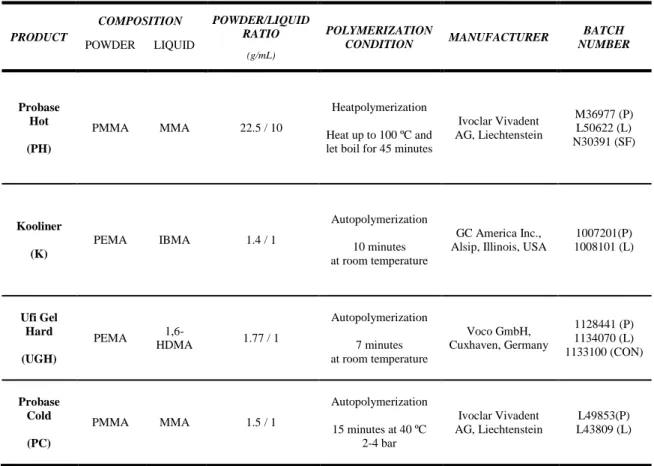
Materials used in this study (Appendix 2, Figures 1, 2, 3 and 4) included one heat-polymerizing denture base acrylic resin and three autopolymerizing acrylic reline resins. The name, composition, power/liquid ratio, polymerization condition and manufacturer of the products used in the present investigation are listed in Table 3.1.
Table 3.1 – Materials used in the study.
PRODUCT COMPOSITION POWDER/LIQUID RATIO (g/mL) POLYMERIZATION CONDITION MANUFACTURER BATCH NUMBER POWDER LIQUID Probase Hot (PH) PMMA MMA 22.5 / 10 Heatpolymerization Heat up to 100 ºC and let boil for 45 minutes
Ivoclar Vivadent AG, Liechtenstein M36977 (P) L50622 (L) N30391 (SF) Kooliner (K) PEMA IBMA 1.4 / 1 Autopolymerization 10 minutes at room temperature GC America Inc., Alsip, Illinois, USA
1007201(P) 1008101 (L) Ufi Gel Hard (UGH) PEMA 1,6-HDMA 1.77 / 1 Autopolymerization 7 minutes at room temperature Voco GmbH, Cuxhaven, Germany 1128441 (P) 1134070 (L) 1133100 (CON) Probase Cold (PC) PMMA MMA 1.5 / 1 Autopolymerization 15 minutes at 40 ºC 2-4 bar Ivoclar Vivadent AG, Liechtenstein L49853(P) L43809 (L)
P = Powder, L = Liquid, SF = Separating Fluid, CON = Conditioner, PMMA = Polymethylmethacrylate, MMA = Methylmethacrylate, PEMA = Polyethylmethacrylate, IBMA = Isobutylmethacrylate, HDMA = Hexanedioldimethacrylate.
8
3.1. Shear bond strength
Preparation of denture base specimens
A modified flasking technique was used to make 150 denture base specimens. Rectangular wax specimens (12x10x6 mm) were prepared using a silicon mold. These wax specimens were flasked and placed on top of the investment with gypsum type II. Then, the first layer of gypsum was coated with vaseline and in the upper half of the flask a second mix of gypsum type II (50%) and III (50%) investment was placed and covering the specimens. Before the second layer set, the flask cover was put in place and tapped to fit properly, allowing the excess gypsum to flow out of the holes. After the complete set of the gypsum, the flask was placed in boiling water for 4 to 6 minutes. Then, it was removed from the water and opened for the wax washed away. After elimination of the wax, a separating fluid (Ivoclar Vivadent AG, Liechtenstein) was applied on the gypsum. Thereafter, the heat-polymerizing resin was manipulated, packed into the flask using a hydraulic press and polymerized according to manufacturer’s instructions (Table 3.1). The flasks were removed from the water bath and bench cooled to room temperature before specimens were removed.
After the 150 specimens were removed from the molds, their sides were grounded in a rotational grinding and polishing machine (DAP-U, Struers, Denmark) with 600-grit silicon carbide paper (Carbimet Paper Discs, Buehler Ltd., Lake Bluff, IL) under water supply to remove irregularities (Ahmad et al., 2009; Ohkubo et al., 2009).
All denture base specimens were treated by a standardized thermocycling aging procedure of 2 500 cycles thermal fluctuations between 5 ºC and 55 ºC (20 seconds each bath) with 5 seconds of dwell time in a specific machine (Refri 200-E, Aralab, Cascais, Portugal) (Appendix 2, Figure 5).
Relining procedure
Surfaces of denture base specimens were finished to a 3 mm thickness using a rotational grinding and polishing machine (DAP-U, Struers, Denmark) with 600-grit silicon carbide paper (Carbimet Paper Discs, Buehler Ltd., Lake Bluff, IL). This simulates the preparation of the denture base to be relined. The thickness was confirmed with digital micrometer (Mitutoyo Digimatic, MFG.Co., Ltd. Tokyo, Japan) with precision ± 0.01 mm.
Materials and Methods
9
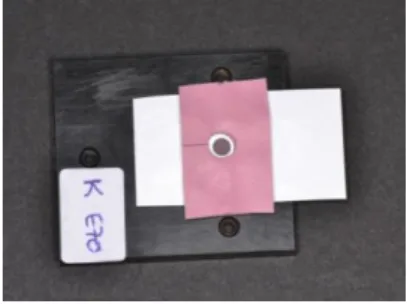
The 150 denture base specimens were randomly divided into three groups, corresponding to the three different acrylic reline resins. To customize and define an area of 3 mm in diameter, a perforated adhesive tape (Glossy White Film EA, Xerox) was positioned on the center of the surface of denture base providing a uniform bonding area. As recommended by the manufacturer, specific adhesive was applied on the denture specimen’s surface and let it dry in the air (30 seconds) when relined with Ufi Gel Hard. With the Kooliner or Probase Cold specimens, the bonding sites were wetted with the corresponding monomer. Then, a silicon mold having a circular opening (5 mm internal diameter × 3 mm height) was placed over the adhesive tape (Figure 3.1) and each acrylic reline resin was mixed and applied according to the manufacturer’s instructions (Table 3.1) (Figure 3.2). With direct relining materials, polymerization was carried out at 37 ºC to simulate the temperature of the oral cavity during the specific time as recommended by the manufacturer (Table 3.1). For the indirect relining material, an Ivomat pressure device (IvoclarVivadent, Lichenstein) was used to maintain 40 ºC and 2-4 bar for 15 minutes (Table 3.1) (Appendix 2, Figure 6).
Ethanol post-polymerization treatment
The 50 constructed specimens of each reline resin were randomly divided into five groups (n=10) of post-polymerization treatment. Each specimen was exposed to 5 mL of water or ethanol/water solutions of 20, 50 and 70% (V/V) at 55±2 ºC in closed plastic flasks for 10 minutes. The control specimens of the reline resins (C) were exposed to dry conditions at room temperature (no treated).
After submitted to the post-polymerization treatment, specimens were stored in distilled water at 37±2 ºC for 48±2 hours in an incubator (Memmert, Schwabach, Germany) before shear bond strength tests.
Figure 3.1 –Shear bond strength device with adhesive tape and silicon mold.
Figure 3.2 - Shear bond strength
10
Shear bond strength test
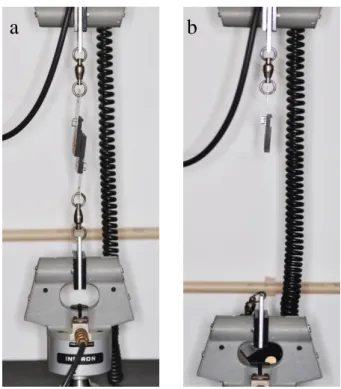
Specimens were included in a single plan lap shear bond strength device with gypsum type III (Figure 3.3) (Seabra et al., 2014) and tested in an universal testing machine model 4502 (Instron Ltd, Bucks, HP 12 3SY, England) (Figure 3.4a). Shear bond strength was determined with 1kN load cell and a crosshead speed of 1 mm/min until debonding of the materials (Figure 3.4b) (Watanabe et al., 2000). All tests were performed under uniform atmospheric conditions at room temperature.
Failure Mode
After shear bond testing for all specimens (Figure 3.5), failure mode was analyzed with a stereomicroscope (EMZ-8TR, Meiji Techno Co, Saitama, Japan). The failure was classified by 2 independent observers as adhesive, if the failure occurred at the adhesive interface, or mixed, when a combination of adhesive and cohesive failure in the acrylic reline resin was observed.
b
a
Figure 3.4 – One example of specimen submitted to
shear bond strength test in an universal testing machine. a) Before test; b) After test.
Figure 3.3 – Shear bond strength
Materials and Methods
11
3.2. Surface free energy
Preparation of specimens
Each acrylic reline resin (Kooliner, Ufi Gel Hard and Probase Cold) specimen was obtained by packing the mixed material into rectangular metal molds (160×18×1 mm) and then each mold was clamped together in order to displace any material’s excess (Figure 3.6). After the polymerization with specific conditions according to the manufacturer’s instructions (Table 3.1) (Figure 3.7), 25 rectangular specimens of each resin with approximate dimensions of 24 mm width, 18 mm height and 1 mm were obtained from the cured strips. The edges of each sample were polished manually with 600-grit silicon carbide paper (Carbimet Paper Discs, Buehler Ltd., Lake Bluff, IL) in order to remove irregularities.
Ethanol post-polymerization treatment
The 25 specimens of each material were randomly divided into five groups (n=5) of post-polymerization treatment. Each specimen was exposed to 5 mL of water or ethanol/water solutions of 20, 50 and 70% (V/V) at 55±2 ºC in closed plastic flasks
Figure 3.5 – Shear bond strength device after
submitted to shear bond strength test.
Figure 3.6 – Compression of one resin’s
dough in the metal mold.
Figure 3.7 – Metal mold opened after
12
for 10 minutes. The control specimens of the reline resins (C) were exposed to dry conditions at room temperature (no treated).
The specimens were stored in distilled water at 37±2 ºC for 48±2 hours in an incubator (Memmert, Schwabach, Germany) before setting the contact angle and surface free energy.
Surface free energy determination
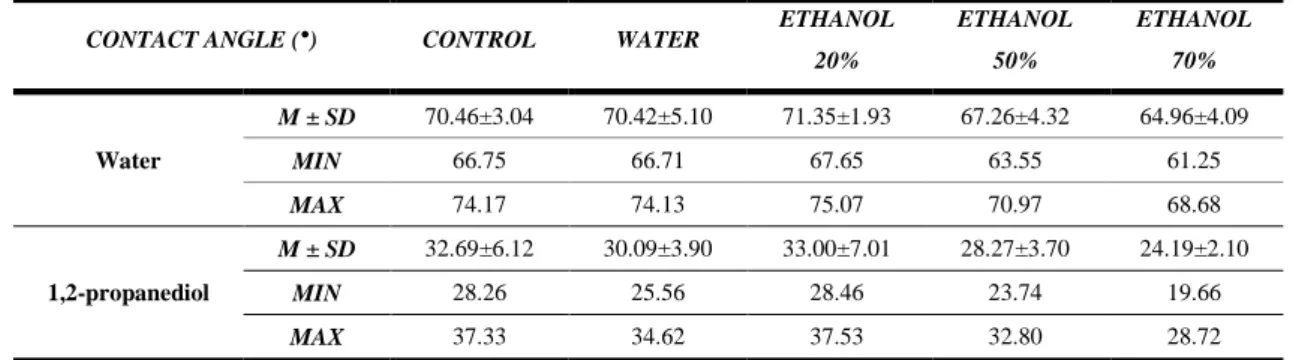
To determine the surface free energy of the acrylic reline resin specimens, contact angles of distilled water and 1,2-propanediol were measured on 5 specimens from each group by using Wilhelmy technique (Bettencourt et al., 2004).
Testing was carried out using a Processor Tensiometer K12 (Kruss, Hamburg, Germany) linked to a computer and the advancing and regression contact angle were measured (Appendix 2, Figures 7, 8, 9 and 10).
The system was set in a “Perspex®” box to ensure an artificially controlled
environment. A glass cuvette containing the liquid was placed in a steel container with thermostatic circulating water (25±1 ºC). Before each change of the liquid, the cuvette glass was carefully washed with water and acetone mixture and was further assed into the flame of a Bunsen burner to reduce the likelihood of surface contamination.
First, the specimen’s dimensions (height, width and thickness) were measured with digital micrometer (Mitutoyo Digimatic, MFG.Co., Ltd Tokyo, Japan) with precision ± 0.01 mm and introduced in the software. At the beginning of each experiment, specimen of acrylic reline resin was suspended in the balance (sensitivity equal to 10-4 g) of the equipment. A motorized platform allowed the immersion of 4 mm of specimen in the liquid under study (water or 1,2-propanediol) at a speed of 20 µm s-1 (Figures 3.8 and 3.9). In all the procedure, care was taken handling the specimens to reduce the chance of contamination of their surfaces.
Advancing contact angles were used for surface free energy (γ) estimation of all specimens, as well as its dispersive (γd) and polar components (γp) based on the harmonic mean method proposed by Wu (1971) (Wu, 1971). Equations for surface free energy estimation were solved using the equation handling KRUSS-software program: contact angle measuring system K121 (version 2.049) (Appendix 2, Figure 11).
Materials and Methods
13
3.3. Statistical analysis
Data were statistically analyzed using SPSS Statistics 20 (SPSS Inc., Chicago, IL, USA). Data did not follow a normal distribution (verified by a Kolmogorov-Smirnov normality test) and were submitted to nonparametric tests according to Kruskall-Wallis method followed by multiple comparisons using Mann-Whitney tests with Bonferroni correction to determine whether there were specific significant differences among materials and groups.
In all statistical tests, it was considered the 5% level of significance (p<0.05).
Figure 3.8 – Specimen of acrylic
reline resin suspended in the balance of the equipment.
Figure 3.9 – Specimen of acrylic reline resin
immersed in the glass cuvette with distilled water.
14
4. Results
4.1. Shear bond strength
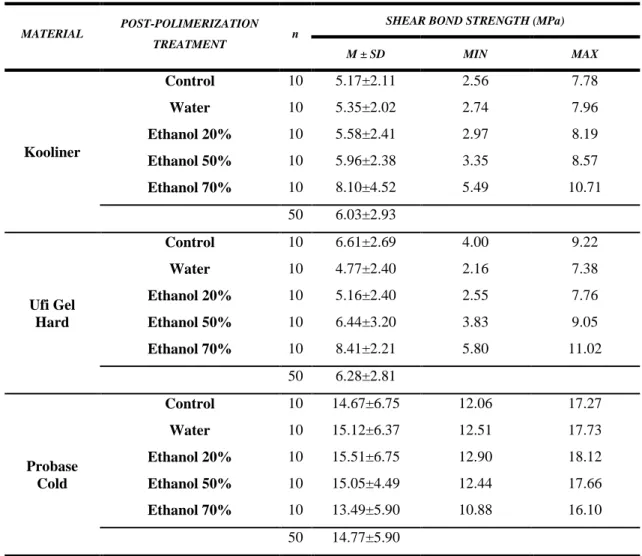
The results of the shear bond strength test are summarized in Table 4.1, where the mean, standard deviation, minimum and maximum values of the groups were registered.
Table 4.1 – Shear bond strength data by reline resins.
MATERIAL POST-POLIMERIZATION
TREATMENT n
SHEAR BOND STRENGTH (MPa)
M ± SD MIN MAX Kooliner Control 10 5.17±2.11 2.56 7.78 Water 10 5.35±2.02 2.74 7.96 Ethanol 20% 10 5.58±2.41 2.97 8.19 Ethanol 50% 10 5.96±2.38 3.35 8.57 Ethanol 70% 10 8.10±4.52 5.49 10.71 50 6.03±2.93 Ufi Gel Hard Control 10 6.61±2.69 4.00 9.22 Water 10 4.77±2.40 2.16 7.38 Ethanol 20% 10 5.16±2.40 2.55 7.76 Ethanol 50% 10 6.44±3.20 3.83 9.05 Ethanol 70% 10 8.41±2.21 5.80 11.02 50 6.28±2.81 Probase Cold Control 10 14.67±6.75 12.06 17.27 Water 10 15.12±6.37 12.51 17.73 Ethanol 20% 10 15.51±6.75 12.90 18.12 Ethanol 50% 10 15.05±4.49 12.44 17.66 Ethanol 70% 10 13.49±5.90 10.88 16.10 50 14.77±5.90
M = Mean, SD = Standard deviation, Min = Minimum, Max = Maximum.
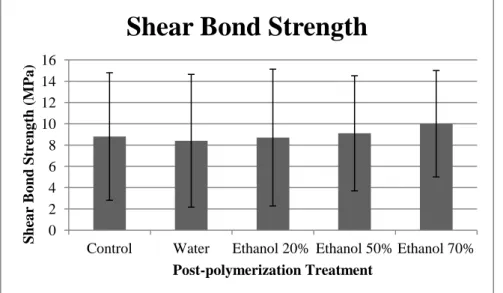
No significant differences in shear bond strength between post-polymerization treatments were found (p=0.378) (Figure 4.1).
However statistical differences (p<0.001) were found between resins. No statistical differences (p=0.714) were observed between Kooliner and Ufi Gel Hard specimens, but Probase Cold showed significantly higher (p<0.001) shear bond strength than the other two resins (Figure 4.2).
Results 15 0 2 4 6 8 10 12 14 16
Control Water Ethanol 20% Ethanol 50% Ethanol 70%
Sh ea r B o nd Str eng th ( M P a ) Post-polymerization Treatment
Shear Bond Strength
0 5 10 15 20 25
Kooliner Ufi Gel Hard Probase Cold
Sh ea r B o nd Str eng th ( M P a )
Acrylic Reline Resin
Shear Bond Strength
Figure 4.1 – Mean and standard deviation of values of shear bond strength (MPa) of experimental
groups.
Figure 4.2 – Mean and standard deviation of values of shear bond strength (MPa) of experimental
groups.
After analyzes of acrylic resin surfaces, it was found that all specimens showed adhesives failures.
16
4.2. Surface free energy
For each material, the descriptive analysis of the data was carried out, including mean, standard deviation and minimum and maximum values for contact angle (Appendix 1, Tables 1, 2 and 3) and surface free energy (Appendix 1, Tables 4, 5 and 6).
The values of the total surface free energy (γ) and their components, the dispersive (γd) and polar (γp
), are summarized in Table 4.2, 4.3 and 4.4, where the mean and standard deviation values of the groups by the reline resin were registered.
Considering Kooliner specimens (Table 4.2), a statistical significant differences (p=0.015) in total surface free energy were found between post-polymerization treatments. Specimens treated with water showed significant higher (p=0.040) values than the control group. In the dispersive component, there were no significant differences (p=0.113) between groups, but significant differences (p=0.018) were found in the polar component, where the water group also showed higher (p=0.023) values than the control group.
Table 4.2 – Mean and standard deviation (M±SD) values for surface free energy of Kooliner.
Horizontally identical superscripted capital letters denote significant differences among groups (p<0.05).
For Ufi Gel Hard specimens (Table 4.3), the total surface free energy showed significant differences (p=0.007) when post-polymerization treatments were compared. Specimens treated with 70% ethanol showed significant lower (p=0.040) values than the control group. In dispersive and polar component, there were significant differences (p<0.05) between groups, with 70% ethanol group presenting significant higher values in the dispersive components and significant lower values in the polar component (p<0.05).
γ (mN/m) CONTROL WATER ETHANOL 20% ETHANOL 50% ETHANOL 70%
γTotal 32.93±1.72A 36.68±1.77A 33.17±1.32B 33.70±1.50C 35.89±1.67D
γDispersive 17.46±1.89A 16.33±0.68B 16.96±0.86C 18.21±0.95D 18.26±1.84E
Results
17
Table 4.3 – Mean and standard deviation (M±SD) values for surface free energy of Ufi Gel Hard.
Horizontally identical superscripted capital letters denote significant differences among groups (p<0.05).
For Probase Cold specimens (Table 4.4), means of groups of post-polymerization treatment in total surface free energy showed differences that were considered statistically significant (p=0.024). The 70% ethanol yielded significant higher (p=0.046) surface free energy than 20% ethanol. In dispersive and polar component there were no significant differences (p>0.05) between groups.
Table 4.4 – Mean and standard deviation (M±SD) values for surface free energy of Probase Cold.
Horizontally identical superscripted capital letters denote significant differences among groups (p<0.05).
γ (mN/m) CONTROL WATER ETHANOL 20% ETHANOL 50% ETHANOL 70%
γTotal 42.55±3.61A 42.61±2.62B 39.74±2.61C 37.26±0.63D 37.26±1.65A
γDispersive 20.98±1.57A 19.43±0.96B 19.66±2.54C 20.91±1.82D 27.71±2.10BC
γPolar 21.57±4.83A 23.19±3.25B 20.08±0.96C 16.35±2.24D 9.55±3.48AB
γ (mN/m) CONTROL WATER ETHANOL 20% ETHANOL 50% ETHANOL 70%
γTotal 38.41±1.16A 38.79±2.70B 37.87±1.21C 40.57±2.02D 42.36±2.33C
γDispersive 18.05±2.06A 18.82±1.18B 18.09±1.97C 18.73±1.47D 19.77±1.34E
18 0 5 10 15 20 25 30 35 40 45 50
γTotal γDispersive γPolar
Su rf a ce E nerg y ( m N/ m )
Surface Free Energy
Kooliner Ufi Gel Hard Probase Cold
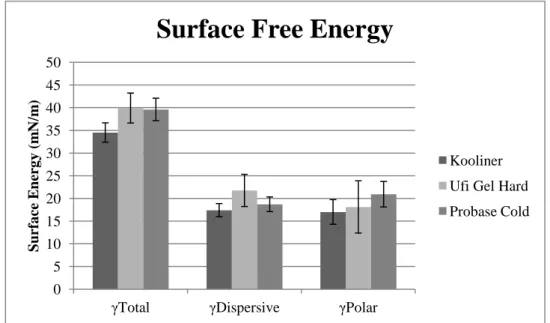
A statistical (p<0.001) influence of the acrylic reline resin in the surface free energy was found (Figure 4.3). Kooliner’s total surface free energy was significantly (p<0.001) lower than the total surface free energy of Ufi Gel Hard and Probase Cold. No differences were found (p=0.974) between Ufi Gel Hard and Probase Cold. In dispersive component Kooliner showed statistically lower (p<0.001) values than Ufi Gel Hard and in polar component statistically lower values (p<0.001) than Probase Cold.
Figure 4.3 – Mean and standard deviation of values of surface free energy (mN/m) of experimental
Discussion
19
5. Discussion
Since Neves et al. (2013) showed that ethanol post-polymerization treatment was considered an easy and effective treatment to reduce residual monomer and therefore to decrease biological effects, it was important to test the effects of this treatment on the unstudied properties of acrylic reline resins, bond strength to the denture base and the surface free energy (Neves et al., 2013).
In order to full field this requirement, one objective of the present work was to evaluate the effect of ethanol solutions as post-polymerization treatment on the bond strength between three acrylic reline resins (Kooliner, Ufi Gel Hard and Probase Cold) and a denture base resin (Probase Hot).
According to the current literature, there is no general agreement about the most precise method to be used for evaluation of the bond strength of relining materials (Mutluay and Ruyter, 2005). In the present study a shear bond strength test was used. Shear bond strength test has been widely used in acrylic resins, since it represents a shear load directly to the reline-denture base polymer interface and therefore considered more accurate to what happens in the oral cavity compared to the tensile load test (Stipho and Talic, 2001; Takahashi and Chai, 2001a; Takahashi and Chai, 2001b; Minami et al., 2004; Sarac et al., 2005; Mariatos et al., 2006; Neppelenbroek et al., 2006; Azevedo et al., 2007; Ahmad et al., 2009; Vergani et al., 2010; Al Rifaiy, 2012). Others advantages of this test are the simplicity of the specimen’s preparation and the capacity of easily align the specimen in the machine without creating deleterious stress distribution (Placido et al., 2007).
The results of the present study showed that there were no differences in shear bond strength between water and the 20%, 50% or 70% ethanol solutions as post-polymerization treatment compared to control in the three acrylic reline resins.
Neves et al. (2013) found decreased in the flexural strength and no alteration of hardness in Kooliner or Ufi Gel Hard when post-polymerization treatments with ethanol solutions were done (Neves et al., 2013). According to earlier studies from Seo et al. (2007) and Urban et al. (2009), the surface properties of the materials were not influenced by the post-polymerization treatments, like hot water or microwave irradiation, and these facts suggest that the effect of post-polymerization treatments is
20
more pronounced in the bulk of the specimens rather than in their superficial layers (Seo
et al., 2007; Urban et al., 2009). In the present study this finding is corroborated
because the post-polymerization treatments with ethanol solutions didn’t altered significantly the bond strength, considered to be a property attributed to the most superficial layers of a resin.
At this point it may be conclude that the first hypothesis of this study couldn’t be rejected, since it wasn’t found any effect of the post-polymerization treatment in the bond strength between denture base and acrylic reline resins.
In the present study, Probase Cold showed significant higher bond strength compared to the other resins. This result was already proven in earlier studies since PMMA based reline resin demonstrated significantly higher bond strength to PMMA based denture base resin, compared with non-PMMA-based reline resin (Sarac et al., 2005; Ahmad et al., 2009). Also, no differences were found between Kooliner and Ufi Gel Hard on shear bond strength.
These findings corroborate the theory that bond strength is dependent on the chemical composition of both materials, defended previously by others authors (Arima
et al., 1996; Cucci et al., 1999; Leles et al., 2001; Stipho and Talic, 2001; Takahashi
and Chai, 2001b; Minami et al., 2004; Ahmad et al., 2009). Bonding of autopolymerizing resins to denture base resin seems to be achieved by penetration and diffusion of monomer into denture base resin. As so, a monomer with smaller molecular weight (like MMA monomer that weights approximately 100 g/mol) may be advantageous for bonding then a heavier monomer (like 1,6-HDMA monomer with 254 g/mol) (Minami et al., 2004). This fact suggests that greater crosslinking occurred between similar base materials. Another monomer with higher molecular weight is IBMA, monomer available in Kooliner, which might have limited monomer penetration (Ahmad et al., 2009). This supported the theory that, when compared with conventional polymers based on methylmethacrylate, the bond strength of hard denture reline resins could not be so effective because of the low penetration of the monomers with relatively greater molecular weight (Arima et al., 1996; Minami et al., 2008; Giampaolo et al., 2011).
An aspect that strengths the present study was innovative approach of the denture based specimens being submitted to a process of ageing. The earlier studies use simply techniques for simulating the usage of a denture before the reline procedure, like
Discussion
21
immersion of the specimens for 48 hours (Stipho and Talic, 2001; Urban et al., 2007a; Hasan, 2009). In the present study, ageing was performed by thermal cycling. This is a laboratory process where the specimens are immersed in almost extreme temperatures baths: 5 and 55±2 ºC with a dwell time of 20 seconds (Minami et al., 2004; Giampaolo
et al., 2011). Thermal cycling is in vitro test from what really happens on the oral
cavity, because, in clinical use, the temperature that the denture base can suffer may vary considerably through the intake of hot and cold food and drinks or the use of warm or hot water in cleaning (Neppelenbroek et al., 2006). The literature described that 10 000 cycles of cyclic thermal stressing correspond to a 1-year period of intraoral conditions (Gale and Darvell, 1999), so 3 months of intraoral conditions were simulated by a 2 500 cycles protocol. This was considered the minimal duration for performing a denture evaluation and need for replacement of its base by a relining procedure.
At this point it was possible conclude that the second hypothesis of this study could be rejected, since Probase Cold showed higher shear bond strength to denture base resin than the other resins.
Another objective of the present work was to evaluate the effect of post-polymerization treatment based on ethanol solutions on the surface free energy of the same three acrylic reline resins.
The analysis of the surface free energy was done through an indirect method since contact angle measurements were necessary to calculate the surface free energy. This method is relatively inexpensive, rapid, sensitive and as a wide application in studies of characterization of surfaces of solids (Buckton, 1995). Since it is impossible to directly determine the surface free energy of a solid, it was necessary to resort to determination of the contact angles between the specimens of biomaterial and two liquids, one with a polar nature (water) and a non-polar nature (1,2-propanediol).
There are two ways to determine contact angle: static and dynamic technique. The static sessile drop technique involves the measurement of contact angles formed by a drop of liquid on the investigated material. Difficulty in determining the precise point of contact between the edge of the liquid drop and the surface of the material leads to inaccuracies. Variations in reading will also occur because of drop evaporation, unless measurement is performed in a chamber saturated with vapor (Waters et al., 1999). More recently, the dynamic contact angle analysis technique (Wilhelmy technique) has been introduced, showing advantages in the surface measurement evaluation regarding
22
the simplicity of the technique and the minimal measurement errors (Waters et al., 1999; Zissis et al., 2001a). Furthermore this technique is quick, reliable (Zissis et al., 2001b) and very precise since does not depend on the subjectivity of the operator, allowing the analysis of a considerable surface area (Neumann and Spelt, 1996). So, this technique was used to compare the surface property of materials in the present study as well as in earlier studies (Sipahi et al., 2001; Zissis et al., 2001a; Bettencourt et al., 2002; Bettencourt et al., 2004). Also, it was able to calculate the advancing contact angle, determined when the board is in the liquid and the contact angle retraction. Although both the values of the contact angle could be considered in the calculation of surface free energy, it is demonstrated that the retraction angles reflects surface impurities and was less reproducible than the advancing. This justifies, therefore, that advancing angles, representative of total surface energy of the solid, should be use to the calculations of surface free energy (Neumann and Spelt, 1996).
In the present study, for the material Kooliner, the water group showed an increase in total surface free energy through the increase of its polar component. The dispersive component suffered no changes, so we can deduce that Kooliner surface becomes more polar with water. According to Neves et al. (2013), the residual monomer molecules are replaced by the solvent molecules (Neves et al., 2013) so, when this acrylic reline resin was treated with water, the molecule that replaced the residual monomer left was water, which has less volatility than ethanol, and material becomes more polar (Paraizo, 2012). Nevertheless, the surface free energy of Kooliner isn’t affected by the post-polymerization treatment with 50% ethanol group, the treatment elected by Neves et. al (2013) as being the most effective on reducing residual monomer content of Kooliner (Neves et al., 2013).
For the Ufi Gel Hard, differences between treatments groups were considered statistically significant but only in 70% ethanol solution they were found, showing lower values in total surface free energy and its polar component compared to the control group. Though, it was also found that the dispersive component showed an increase when specimens were treated with this solution. These two facts lead to the conclusion that this resin has a tendency to become more apolar with 70% ethanol solutions as post-polymerization treatment. Nevertheless, treatment with 70% ethanol solution was already considered inadequate to be used in this resin since Neves et al. (2013) found a significant decrease in mechanical properties, in spite of maximum removal of residual monomer. The surface free energy of Ufi Gel Hard isn’t affected by
Discussion
23
the post-polymerization treatment with 20% ethanol solution, the treatment elected by Neves et. al (2013) as being the most effective on reducing residual monomer content of this material (Neves et al., 2013).
On Probase Cold, significant differences were found between the post-polymerization ethanol solutions applied, when total surface free energy was considered. This result are not similar to those found by Bettencourt et al. (2002) who demonstrated that ethanol does not considerably change the wettability properties of the MMA polymer (Bettencourt et al., 2002). This can be explained by the different concentration of ethanol solutions used. The only difference observed is in the 70% ethanol solution as post-polymerization treatment that showed higher total surface free energy, but there were no significant differences in the dispersive component and in the polar component. This means that surface free energy is different when 70% ethanol solutions is used, but the balance between polar and dispersive components assures equilibrium.
At this point it may be conclude that the third hypothesis of this study could be rejected, since it was found effect of the 70% ethanol solutions as post-polymerization treatment in the surface free energy for Ufi Gel Hard.
The treatment proposed by Neves et al. (2013) continues to be feasible since in spite of differences found between treatment groups in the three materials surface free energy they are considered small in a clinical point of view. They probably do not affect the lubrification around the relining denture which may not lead to friction with adjacent tissues and, thus, paciente discomfort.
Surface energy is one of the main factors related to the development of denture related stomatitis (Minagi et al., 1985). A controversial literature about the Candida
albicans adherence exists so the effect of ethanol solutions as post-polymerization
treatment on Candida albicans adhesion to acrylic reline resin surface remains to be investigated. In addition, others factores should also be considered, such as cell surface factores, diet, salivary composition and secretion rates, and antibody titers, which are all controlling factors in plaque formation and could therefore influence yeast attachment (Al-Dwairi et al., 2012).
In the present study, the total surface free energy of Kooliner was lower than ones of Ufi Gel Hard and Probase Cold. Higher values of the dispersive component and similar of the polar component of Ufi Gel Hard can explain this result, concluding that
24
Ufi Gel Hard resin has a tendency to become more apolar than Kooliner. This can be explained possibly because of differences in the polymeric structure between these two resins. Ufi Gel Hard undergoes rapid polymerization reaction and solidifies quickly. It is likely that air voids are entrapped during mixing of the power and liquid components, which result in a porous structure (Urban et al., 2007a; Urban et al., 2009; Urban et al., 2010). According to others studies, beyond the surface chemistry, wettability of a substrate is sensitive to the topographical texture (Meuler et al., 2011) and this parameter must be considered when surface free energy data are evaluated (Kilani et al., 1984).
The surface free energy of Kooliner and Probase Cold specimens showed differences. Probase Cold showed higher values in total surface free energy by the polar component than Kooliner and similar results in the dispersive component, so Probase Cold has a tendency to become more polar than Kooliner.
Other parameters must be evaluated in the future, such as the surface roughness and microbiological assays. Furthermore, it is important to note that information obtained from this test is limited and in future this should be complemented with other surface analysis technique, the X-ray photoelectron spectroscopy (XPS), for example.
At this point it was possible conclude that the fourth hypothesis of this study could be rejected, since Kooliner showed lower values of surface free energy than Ufi Gel Hard and Probase Cold.
The treatments proposed by Neves et al. (2013) continuing to be feasible, because enable the reduction of the monomer content and the biological effects, while keeping their properties, like microhardness, flexural strength, shear bond strength and surface free energy. This is a simple method and easy to achieve with equipment in a dental office to improve the biocompatibility of resins.
Conclusions
25
6. Conclusions
Within the limitations of this study, the main conclusions are:
Post-polymerization treatment based on ethanol solutions did not negatively affected the shear bond strength between denture base and reline resins.
The acrylic reline resins used influences the shear bond strength to denture base resin. Probase Cold revealed higher values of shear bond strength than Ufi Gel Hard and Kooliner, whose values were similar.
The surface free energy of the reline resins is affected by the polymerization treatment. Mainly, the 70% ethanol solutions as post-polymerization treatment affected the surface free energy for Ufi Gel Hard. The values of surface free energy of three acrylic reline resins are different. Kooliner showed lower values of surface free energy than Ufi Gel Hard and Probase Cold.
26
7. References
Ahmad F, Dent M, Yunus N. Shear bond strength of two chemically different denture base polymers to reline materials. J Prosthodont 2009; 18:596-602.
Al-Dwairi ZN, Al-Quran FA, Al-Omari OY. The effect of antifungal agents on surface properties of poly(methyl methacrylate) and its relation to adherence of Candida albicans. J Prosthodont Res 2012; 56:272-80.
Al Rifaiy MQ. Shear bond strength between light polymerized hard reline resin and denture base resin subjected to long term water immersion. Saudi Dent J 2012; 24:23-7.
Araújo PHH, Sayer C, Poço JGR, Giudici R. Tecniques for reducing residual monomer content in polymers: a review. Polymer Engineering and Science 2002; 42:1442-68.
Arima T, Nikawa H, Hamada T, Harsini. Composition and effect of denture base resin surface primers for reline acrylic resins. J Prosthet Dent 1996; 75:457-62.
Aydin AK, Terzioglu H, Ulubayram K, Hasirci N. Wetting properties of saliva substitutes on acrylic resin. Int J Prosthodont 1997; 10:473-7.
Azevedo A, Machado AL, Giampaolo ET, Pavarina AC, Vergani CE. The effect of water immersion on the shear bond strength between chairside reline and denture base acrylic resins. J Prosthodont 2007; 16:255-62.
Bayraktar G, Guvener B, Bural C, Uresin Y. Influence of polymerization method, curing process, and length of time of storage in water on the residual methyl methacrylate content in dental acrylic resins. J Biomed Mater Res B Appl Biomater 2006; 76:340-5.
Bettencourt A, Calado A, Amaral J, Alfaia A, Vale FM, Monteiro J, et al. Surface studies on acrylic bone cement. Int J Pharm 2004; 278:181-6.
Bettencourt A, Calado A, Amaral J, Vale FM, Rico JM, Monteiro J, et al. The effect of ethanol on acrylic bone cement. Int J Pharm 2002; 241:97-102.
Bettencourt AF, Neves CB, de Almeida MS, Pinheiro LM, Oliveira SA, Lopes LP, et al. Biodegradation of acrylic based resins: A review. Dent Mater 2010; 26:e171-80.
Buckton G. Interfacial Phenomena in Drug Delivery and Targeting. AT Florence and G Gregoriadis, editors. Switzerland: Harwood Academic Publishers; 1995. 27-81 p.
Bural C, Aktas E, Deniz G, Unlucerci Y, Kizilcan N, Bayraktar G. Effect of post-polymerization heat-treatments on degree of conversion, leaching residual MMA and in vitro cytotoxicity of autopolymerizing acrylic repair resin. Dent Mater 2011; 27:1135-43.