PHYSICIANS IN CORPORATE GOVERNANCE OF PRIVATE
HEALTHCARE INSTITUTIONS IN PORTUGAL: PERCEPTIONS,
EXPERIENCE, AND ENGAGEMENT
Fei Liangchen
Dissertation submitted as partial requirement for the conferral of Master of Science in Business Administration
Supervisor:
Prof. Nelson José dos Santos António, ISCTE Business School, Department of Marketing, Operations and General Management
Co-supervisor:
Prof. Cátia Miriam Costa, CEI-IUL, Centre for International Studies
PHYSIC
IANS
I
N
COR
POR
AT
E
G
O
VERNA
N
CE
OF
PRIVA
TE
HEAL
THCAR
E
INSTI
TU
TI
O
NS I
N PORT
UGA
L:
PERCEP
TI
O
NS,
EXPE
R
IE
NC
E,
A
ND E
NGA
GE
ME
NT
Fe
i L
ia
n
gc
hen
Abstract
This dissertation examines how corporate governance is used with the engagement of medical professionals in the private healthcare entities in Portugal. Previous studies analyzed the
relationship between healthcare organizations, administrations, and other stakeholders by using the principal-agent theory, the theory of “separation of ownership and control”, the theory of “stakeholder”, and the theory of “New Public Management”. In addition, the theories that connecting management and clinical work were explored, and the examples of medical manager in various countries were also presented in the literature review. Yet it is not well understood how these elements connect to foster the engagement of medical profissionals in everyday workplaces under the private healthcare industry in the Portuguese context. Through
interviewing 10 employees and clinicians at four private healthcare companies in Portugal, the analysis sheds light on the job characteristics, people’s perceptions and attitudes at the
workplace. The analysis reveal that job perceptions bring advance in realization of patient-center care, meanwhile the managerial colleagues and even medical doctors themselves are
(un)consciously reproducing management culture, especially lean-adapted culture, in private healthcare services. The findings suggest that lean initiatives sponsored at different
organizational ladders have reinforced the “status quo”– in a few words, have helped to maintain the existing engagement.
Key words: Private healthcare, Corporate governance, Physicians’ engagement, Portugal
Resumo
Esta dissertação analisa a forma como a governança corporativa é utilizada com o envolvimento de profissionais médicos nas entidades de saúde privada em Portugal. Estudos anteriores
analisaram a relação entre organizações de saúde, administrações e outras partes interessadas usando a teoria do agente principal, a teoria da “separação de propriedade e controle”, a teoria do “stakeholder” e a teoria de “New Public Management”. Além disso, as teorias que conectam gestão e trabalho clínico foram exploradas, e os exemplos de gestor médico em vários países também foram apresentados na revisão da literatura. No entanto, não é bem compreendido como esses elementos se conectam para fomentar o engajamento dos profissionais médicos nos locais de trabalho cotidianos sob o setor de saúde privada no contexto português. Através da entrevista de 10 funcionários e médicos em quatro empresas privadas de saúde em Portugal, a análise lança luz sobre as características do trabalho, percepções das pessoas e atitudes no local de trabalho. As análises revelam que as percepções de trabalho trazem avanços na realização dos cuidados com o paciente, enquanto os colegas gerentes e até os próprios médicos estão (des)
conscientemente reproduzindo a cultura gerencial, especialmente a cultura adaptada ao Lean, nos serviços privados de saúde. Os resultados sugerem que as iniciativas lean patrocinadas em diferentes escadas organizacionais reforçaram o “status quo” - em poucas palavras, ajudaram a manter o engajamento existente.
Palavras-chave: Cuidados de saúde privados, Governação corporativa, Engajamento dos médicos, Portugal
Acknowledgement
The two years’ study in Portugal develops me a broader eyesight to observe this world, and it would be a memorable experience in my life. As the final challenge in my master peroid, I tried my best and worked hardly to acheive this study. Also, the thesis was finished under my friends’ and professors’ help. I would like to take this opportunity to express my sincere appreciation to those who offered me enthusiastic supports.
My special gratitude will go to my dear friends who I met during my study in Portugal: Dr. Ricardo Vale de Andrade and Dr. Nuno Filipe Andrade de Oliveira. Their kindness, rigorous attitude and goal-oriented insistence inspired me not only during the elaboration of the thesis but also in my future life. From the preparation of the interview to its final collection, they are generous in sharing their unique opinions and provided me with helpful advice. Here, I want to show my sincerely thanks to the doctors who kept me accopany during my stay here.
Additionally, I would like to say thank you to my family. They are my strongest supports that always encourage and reach my potentital.
Lastly, the special thanks also go to my portuguese boyfriend. The love you gave me is a great comfort and warm during the far-way-from-home period.
Table of Contents
1. Introduction ... 1
2. Literature review ... 5
2.1 The origin and application of corporate governance in the healthcare sector ... 5
2.2 Theories of linking management with clinical work ... 7
2.3 The role of medical managers in hospital settings ... 9
3. Methodology ... 12 3.1 Research Strategy ... 12 3.2 Settings ... 13 3.3 Interview participants ... 15 3.4 Data generation ... 16 3.5 Interpretation method... 17 4. Findings ... 21
4.1 Perceptions towards working as medical doctors in private healthcare services ... 21
4.1.1 general perceptions towards private healthcare services ... 21
4.1.2 the perception as workers ... 22
4.1.2.1 the perception from general medical professionals ... 22
4.1.2.2 the perception from management levels ... 24
4.2 Medical professionals’ engagement in management ... 25
4.2.1 Motivations for medical professionals’ engagement in management ... 25
4.2.2 career pursuits and corporate value ... 26
4.3 Actual attempts to construct the management culture in healthcare ... 27
4.3.1 Lean thinking and lean-adapted culture ... 27
4.3.2 Management’s strategy: Proving ourselves ... 28
4.3.3 Team integration ... 29
4.3.4 Clinicians’ resistance ... 31
5. Discussion ... 33
5.1 Research questions ... 33
5.2 Theoretical and practical implications ... 36
5.3 Limitations and further research possibilities ... 36
6. Conclusion ... 38
Bibliography ... 39
1
1. Introduction
Public healthcare institutions and private healthcare organizations coexist in Portugal, and the involvement of private sector has even increased in developing, financing and providing public health infrastructure and service delivery through public-private partnerships (PPPs) (Jens K. Roehrich, Michael A. Lewis, Gerard George, 2014). In 2004, the share of private inpatient hospital beds was 25% in Portugal (HOPE: European Hospital and Healthcare Federation, 2012). We can see from the table below; this number was increased steadily in the year 2009, 2010 and 2011.
Table1: Share of the public and private sector in the number of inpatient beds in three years
Items and indicators Data
2009 2010 2011 Public inpatient hospital beds (% of all beds) 73,18% 73,06% 72,60% Private inpatient hospital beds (% of all beds) 26,82% 26,94% 27,40% Source: One report from the European Hospital and Healthcare Federation (HOPE), 2012
These figures also indicate that private healthcare in Portugal is attracting more interests from patients and medical professionals recently. Similarly, private healthcare service in Portugal is relatively pricier but the waiting time is typically shorter. Meanwhile, there is a more abundant availability to considerable amounts of services in this type of healthcare organizations (Bupa Global, 2017).
Despite the widespread debate about the appropriateness and effectiveness of private commercial model applied in healthcare organisations, there is also a growing discussion on the question about whether medical professionals, for example, doctors and nurses, should be part of the presidents or members of the boards. One of the news on the Atlantic (Viswanathan, 2014) reported that the number of medical schools which provide conjoint M.D./M.B.A. programs in America has increased from 6 to 65 till the year 2012. Thus, more and more doctors are adding three extra letters - M.B.A. after their names. One study (Giuliano Russo, Bruno de Sousa, Mohsin Sidat, Paulo Ferrinho, Gilles Dussault, 2014) also shows that more and more physicians are motivated to change their practice behaviors in a business-like way while considerable
2 numbers of healthcare delivery problems are gradually recognised as business issues. In 2015, the total average number of physicians on hospital boards were 2.7 with a median of 1 in 14 large hospital organisations in the US. In 2013, these numbers were 2.5 and one respectively (Peisert, 2015). Some studies have even found a strong positive correlation between the ranked quality of a hospital and whether the CEO is a physician (Goodall, 2011), and even showed that doctors representation is an indispensable factor in decent performance in healthcare governance (Eekloo K, L Delesie, A and Vleugels, 2007). Nevertheless, there exists enormous reluctance to increase physician representation on the boards (Satiani B, Prakash S., 2016). Veronesi and Keasey (Veronesi G., Keasey K., 2011) noted that the sufficient degree of medical involvement is highly variable, particularly when the financial issues are prioritised by the board.
Furthermore, the essential skills that physicians need to be on health care boards have been questioned since medical professionals, in general, have not been formally trained in
management and leadership (Clark J and K Armit, 2008). The lack of management training and the limited supports from general non-medical managers have hampered clinical professionals’ ability to make their voices heard on boards (Veronesi G., Keasey K., 2011).
Meanwhile, other studies have raised questions about whether the positive performance
outcomes of medical involvement result from all medical professions’ representation including nurses and other affiliated technical professions in boards or only doctors. It can also be argued that nursing is universally considered to be more systematised and team-based, which enable nurses to directly participate in boards, better together with doctors’ partnership (Murphy, J., Quillinan, B., & Carolan, M., 2009). Some doctors, on the other hand, would highly advocate prioritising the interests of their specialities when the hospital boards make strategic decisions (Addicott, 2008).
Even though the private healthcare service has existed for a long time, the emergence of physician managers and medical officers in Portuguese healthcare sector is a relatively recent phenomenon which places more pressure on the general public healthcare performance in terms of service quality and reimbursement, proposes a threat to the public sector to compete for scarce
3 medical employees, and creates diverse opportunities for medical finance and economic
development (Europe, 2002).
The ultimate question arises: What is the current status of medical professionals’ engagement in management for the performance of private healthcare organizations which operate as legal entities under the corporate governance?
The main research question can be divided into the following sub-questions:
(1) What are motivations or drivers for physicians to work in private hospitals and clinics in Portugal? It would be better to know the reasons why they decided to become employees of private organizations and step into the business world from the real field of medicine.
(2) The engagement degree of medical doctors in the hospital management. Are medical professionals represented on governing bodies in private healthcare groups? What kind of managerial, financial, and operational decisions do medical professionals working in private healthcare organizations usually make? It would be vital to know the activities which managers daily take so that the involvement degree of physicians in the decision-making process can be measured since there might be a significant difference with the general medical professionals who have a far-reaching autonomy in the public healthcare organizations.
(3) To what extent are the medical professionals able to (re)construct the hospital
governance in private market-oriented context? What are the barriers to healthcare professionals’ being represented to these governing bodies? How did they prepare to address these barriers?
The objectives of this research include:
(1) Understand the main reasons and motivations that drive to work in private healthcare institutions, and even step into the business world in the healthcare industry.
(2) Have a knowledge of the engagement process of medical doctors in hospital management when working in private hospitals under corporate governance in Portugal.
(3) Explore the engagement level of medical professionals in the private healthcare groups and its impact.
4 There was a considerable amount of research introducing the healthcare industry's characteristics within European countries, explaining current management norms and problems. However, there is limited empirical research about physician managers and leaders of Portuguese healthcare. The aim of this research paper is designed to explore the association between physician leaders and outcomes of private hospitals, to provide insight for the impact of physician leadership on the decisions of corporate governance as well as to inform policy-makers, managers and investors who have no medical backgrounds to be aware of the managerial differences and reach
5
2. Literature review
This chapter gives an overview of the literature and available research within the scope of this study which focuses on the involvement of medical professionals within the hospital
management. Therefore, the following topics are discussed: the origin and application of the corporate governance in the healthcare sector, theories of linking management with clinical work, and the role of medical managers in hospital settings.
2.1 The origin and application of corporate governance in the healthcare sector
Corporate governance is a study focusing on the empowerment of the professional managers and the supervision of professional managers’ behaviours from the ownership level of a corporation (L'huillier, 2014). One corporation has two separate rights: Shareholder proprietary right and Managerial right. Corporate governance is based on the first right and pays much attention to the authorization and supervision of professional managers (Secretary-General, 2015).
One model applied in Portugal private healthcare is corporate governance, of which the primary emphasizes are strategy development and market share maximisation (SM, 1989). Corporate governance from the private side has advantages of relatively smaller board size, limited range of membership, and firm focusing on the strategic and entrepreneurial activities through dynamic managerial participations on board (Alexander J. A., Morlock L., Gifford B., 1988). The most common form in corporate governance is the Agent theory, which is a contractual relationship between the principal and authorized agent (International Finance Corporation, 2015). The agent theory means the dissociation of the ownership and the control of capital, which can be found worldwide in the private health market (Bichanan, 1988). Take one study on the prescribing patterns of private healthcare providers in Vietnam for example (Nguyen, 2011), private
providers, being the imperfect agents of patients, would be able to induce demand by prescribing more drugs than public providers for a similar illness and patient profile, which act to maximize their profits at the expense of the patients’ interests when lacking of professional regulations and directly existing incentives to link providers’ actions to their profits, such as a fee-for-service payment system.
6 Along with the agency theory, the Separation of Ownership and Control Theory arise and
develop. This theory emphases the separation of corporate ownership of property with the management and administrative rights, which means the owner does not manage and operate his property but authorize others to do the management and operational work (Christos Pitelis, Roger Sugden, 1986). For example, there are four public hospital partnerships with private capitals in Portugal, which is believed to be more flexible and highly adaptable (Jens K. Roehrich, Michael A. Lewis, Gerard George, 2014). The government, as an owner, is pursuing the value of capital preservation and hopes to solve more medical problems by less investment; the private healthcare management companies are eager for-profit maximization, and desire to maximize their income. Information asymmetric between the government, medical staffs, and private healthcare management companies requires the principal to supervise the management and administrative side and ask for information disclosure. This partnership is considered as innovated and successful since PPPs, which was rarely applied to healthcare services, proves that corporate governance in the public healthcare services works even better, to some extents than public philanthropic governance model (Miranda Sarmento, J; Renneboog, Luc, 2014).
Furthermore, Stakeholder theory appeared when coping with issues of morals and values in managing organizations in the healthcare and education field. Instead, this theory argues that except for the shareholders, there are other parties involved as stakeholders, including
employees, customers, trading partners, financiers, communities, governmental bodies, political groups, trade associations or trade unions, even natural environment and human offspring, since these objects are influenced by business operations directly or indirectly (R. Edward Freeman, 1984). As for private hospitals, public health politics, pharmaceutical companies, patients, commercial health insurance corporates, medical equipment suppliers, medical professionals, doctor and nursing commissions, and so on, can be picked up as stakeholders. However, because of the evident existence of shareholder in the private healthcare organizations, the stakeholders are considered in supplementary positions during the primary decision-making process.
Moreover, being produced mainly from practices in private sectors, New Public Management (NPM) theory put much emphasis on customer satisfaction, entrepreneurial spirit, and the “Rules of the Game” (Barzelay, 2001). NPM theory is regarded as a more efficient way to obtain the
7 same product or service, in which citizens are viewed as customers, and public administrators are under the title of public managers. In terms of the healthcare sector, the health system has both public and private funding in Portugal. Similar with out-of-pocket payment and voluntary health insurance as the source of private funding, public funding also uses financial supports from the Serviço Nacional de Saúde (SNS), and special health insurance schemes for professions or particular sectors, including civil servants and employees at national banks and state-owned companies (JA Simões, Gonçalo Augusto, Inês Fronteira, Cristina Hernández-Quevedo, 2017).
2.2 Theories of linking management with clinical work
There has been little mutual understanding between clinicians and managers. Clinical practice and administrative work were thought to be mutually exclusive. Many observations (Ackroyd, Stephen, 1996) shows that clinical professionals have assumed a narrow focus, differentiating themselves both from senior executive management and routine operational management. Nevertheless, conflicts of interest between professionals and managers have been diffused around the differential areas of expertise associated with their work through boundary
maintenance (Llewellyn, Sue, 1998). Clinicians and managers are working with different ideas in the separated 'communities of knowing' because of this differentiation. Thus, these differences have developed different logics; clinicians have been guided by the logic of healthcare service quality and appropriateness, while managers have been occupied by a logic of consequences (Jonsson, 1998). Meanwhile, a growing number of investigations have demonstrated that this could not improve the effectiveness of medical organizations to the maximum. Previous researchers have argued that the processes of financial management and resource allocation should consider both clinical and managerial work simultaneously (Abernethy Margaret, Johannes Stoelwinder, 1990).
At the same time, collaborative work between clinicians and managers has been developed and supported as a critical activity in healthcare organizations along with newly emerged cross-boundary tasks of budgeting, rationing, performance appraisal and risk management (Pettigrew, Andrew, Ewan Ferlie, Loma McKee, 1992). As for establishing collaborative work, the critical issue was information delivery since messages from clinicians to managers and from managers to clinicians were not easily transmitted (Lyotard, Jean-Franois, 1984). However, messages from
8 managers have tended only to make sense to other managers, and the same for clinicians,
primarily due to their distinct sets of ideas and different thinking logic. Thus, such messages lacked communication transparency and led to varying frames for sense-making (Jonsson, 1998). When involving two groups of different expertise together in work, the more dominant group tends to have a higher opportunity for influencing the less powerful group (Mulder, Mauk, 1971). In this view, although working together involves possibilities for alignment between them, it can also result in a consequence that prioritizes one group of expertise over another. According to Borum Finn (Finn, 1995), there are three determinations of expertise: the access to the sets of ideas concerning the issue to be decided; the control over the means of interpreting information; and the ability to disseminate the interpretations to other groups. Clinical
professionals have access to the sets of managerial ideas, gain more control over the interpretations of these ideas to other clinicians, and able to disseminate information from management. However, managers generally do not have easy access to, or control over, sets of ideas from clinical practice. This indicates clinical work is more likely to be privileged since managers usually have no authorities to make comments on clinical matters or professional behaviours (Thorne Marie, 1997).
Mintzberg's work (Mintzberg Henry, 1973) classified three main groups of activities for
managers: interpersonal, informational and decisional activities. Interpersonal activities include the roles of representation, liaison and leadership; Informational tasks contain the ones of monitoring, disseminating and spokesperson; Decision-making work covers initiating change, handling disturbances, allocating resources and strategic negotiating. As previously mentioned, the clinician group encompasses all these aspects of managerial work. Clinical directors can embed administrative tasks in their work, while managers are unable to conduct clinical practices. It is the critical one that contributes to the unique advantage position of doctors with managerial responsibilities in medical organisations. This increased power disparity happens to reflect the nature of their 'two-way' role (Thorne Marie, 1997). Doctors with managerial
responsibilities make up the field within which medicine and management are integrated. Thus, physician leaders have the power to act and direct the new understandings of the evolving medical organisations.
9 2.3 The role of medical managers in hospital settings
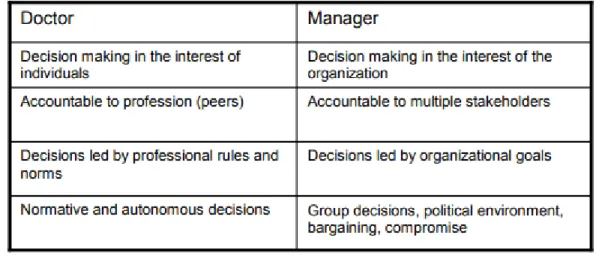
As being described in the past studies as either ‘medical management’ or ‘medical leadership’, these physicians have formal managerial roles. The participants who included in these studies had either administrator’s work at the executive level or clinical director’s work at the medical level. These positions were full-time occupations in which the physicians ceased to perform clinical practice, whereas in other cases, the positions were perceived as part-time jobs, meaning that they would first and foremost be a physician (Quinn JF, Perelli S, 2016). Another type of physicians had informal roles. These included participants who are described as physicians but also act as a leader in their daily clinical work, such as physicians who are responsible for quality improvement projects in departments of hospitals or clinics. One research (Ludwig Kuntz, Stefan Scholtes, 2008) directly shows that clinical role and managerial role have different mindsets, illustrated in table 2.1 below.
Table 2.1: clinical vs managerial role
Source: Ludwig Kuntz, Stefan Scholtes, 2008
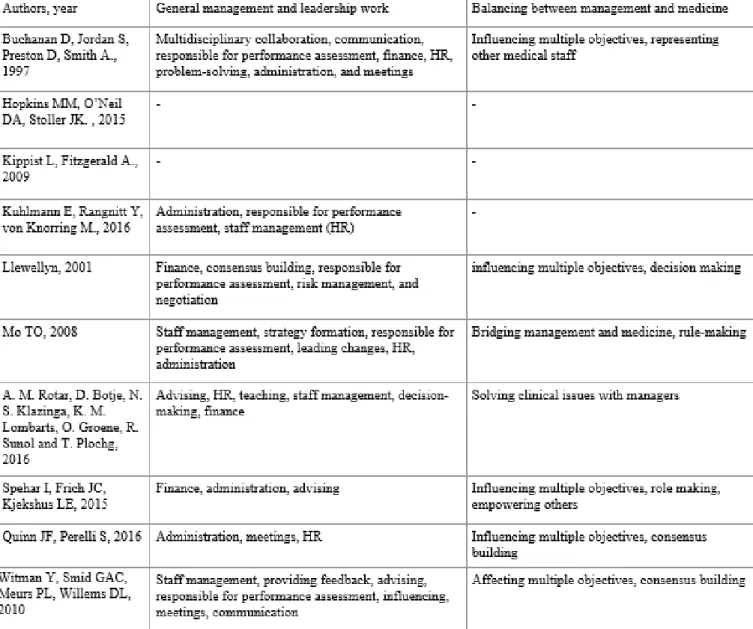
Some leadership activities were concluded as ‘general management and leadership’, including finance, strategy, staff management, human resources, leading change, or administration. Meanwhile, additional activities mentioned include policy activities, business planning, coordination and delegation, advising committees, providing feedback, risk management, attending meetings, maintaining networks within and outside the hospitals, negotiation,
contracting and making decisions (See table 2.2). Furthermore, some other duties and activities, performed exclusively to achieve organisational and patient objectives even if these activities
10 have conflicts with personal or department goals, were grouped as ‘balancing between
management and medicine’. To be specific, ‘balancing between management and medicine’ belongs to ‘boundary work’, which emphasises more concerns with avoiding clinical errors and strengthening multidisciplinary collaboration to improve the quality of care. To achieve these, medical leaders were supposed to influence and empower peers, communicate information to medical practitioners as well as to managers, build a consensus and solve problems.
Table 2.2 Activities and roles of physicians with management responsibilities
Source: Mathilde A. Berghout, Isabelle N. Fabbricotti, Martina Buljac-SamardzÏić, Carina.J. M. Hilders, 2017
11 Therefore, physician leader is a somewhat rational profession in which medical professionals take more responsibilities for departmental performance regarding the outcomes (e.g., quality of care and costs control) and the smooth functions of other medical colleagues than the general doctors and clinicians.
12
3. Methodology
This chapter will explain in detail how the research was conducted. Firstly, the choice of qualitative researching approach will be discussed. Subsequently, it will explain how the data was generated and gathered, and, lastly, how it was analyzed.
3.1 Research Strategy
Building upon the aim for this research and the literature review performed, the methodology of the present research is based on inductive approach taking a qualitative angle since qualitative research has characteristics of understanding the meaning of ‘naturally
occurring phenomena’ in the social world and can help to collaboratively generate changes and produce knowledge with people (Mark N.K. Saunders, Philip Lewis, Adrian Thornhill, 2015).
As for the qualitative approach, interviews, in which other people’s experiences and views are understood by asking questions and listening, would be my best choice. Interviews generally produce in-depth investigation because of quality and depth matter over quantity and breadth within my research. ‘Semi-structured’ interviews would be applied since closed questions enable me to screen the population, thus generate homogeneous interview, while open-ended questions invite free expressions and provide a chance to go deeper, therefore give more general flexibility.
The research is planned to conduct two phases. In phase 1, a screener is supposed to be used first (see appendix 1). The screener and confirmation letter (see appendix 2) are considered as my recruiting tools. My sampling strategies include web searches, electronic and mailed surveys with snowball sampling method, which means direct sampling first using the screener and email, then ask for a recommendation or referral.
In phase 2, interviews with administrators and executives, junior and senior medical
professionals and medical managers are carried out. Potential participants are invited through emails. Potential participants are asked via emails that explained the purpose of the study. An officially-approved letter, signed by supervisors and stamped by the university academics to show the confidentiality and scientific purpose, is shown to the participants. All the interviewees need to complete an informed consent form (see appendix 3) that including a consent to be audio-recorded and transcribed without their names included.
13 3.2 Settings
In this study, four local Portuguese healthcare organizations with a corporate governed model inside were selected to be the research objects. Four local private healthcare organizations are labelled LM, LA, LZ and LJ, respectively.
From a small dental practice to an international brand, LM is one of the best dental clinics in Portugal. With more than 23 years of history, innovation, ingenuity, rigour and dedication, LM has gathered knowledge, developed techniques, formed new teams and cared for patients for more than two decades. Founded in 1995 by one local dentist, LM nowadays recognized worldwide for its know-how and innovation, and had established itself worldwide, with a
presence in 6 continents and 22 countries. Its growing internationalization and training of foreign doctors have led the Portuguese Dental Medicine, particularly in the field of implantology, to high quality and recognition levels. The research and development, the creation of innovative surgical techniques, unique implants, components, surgical objects, the fixed prosthesis bridge, as well as the publication of numerous articles and scientific studies, have all contributed to an enormous visibility and notoriety of the LM, making it possible to be, now, a worldwide reference in oral rehabilitation and dental aesthetics. In Portugal, with the headquarters of the 100% Portuguese group, LM has been opening a set of clinics strategically located so that its presence covers the entire national territory from north to south and islands, thus being able to respond more broadly to the needs of the Portuguese population. Since its founding, LM has sustained its growth in this set of factors that differentiate it, and which have been decisive for it to assume an essential role in Oral Health internationally, taking into account the complexity of the cases treated, the number of patients and the size of their clinics.
The rest of the three are comprehensive medical care units and healthcare services’ providers. First and foremost, with a commitment that we never lose sight of ensuring that the customers feel in good hands, not only for the excellence, rigor and innovation that define us but for the care in the smallest details, LA is a reference group in the health sector in Portugal. LA is a brand with hospitals and clinics from north to south of the country, which provides a service offering based on a network that covers the entire national territory, with over 6,000 health professionals. 4 private hospitals and 8 outpatients clinics across the country. Founded in 1998, LA has always
14 distinguished itself with an innovative vision, combined with a strong spirit of continuous
improvement, excellence and rigor, as well as the sustained growth and expansion of the healthcare network throughout the country. Two of the company's significant milestones were the opening of the main hospital in 2008, and the opening, with more meanings in the
management practice, of the Cascais Hospital (a hospital of the national health service operated under the Public-Private Partnership program) since 2009. In 2013, this demand and commitment to excellence and quality of health services had gained a new lease on the acquisition of the company by the one Brazilian private healthcare group. That is, LA, started to count on a business model based on long years of experience in the sector.
Being established in 2000, LZ is one of the largest health care groups in the Portuguese market. The group provides its services through 30 units (including 14 private hospitals, a hospital of the national health service operated under the Public-Private Partnership program, 13 private
outpatient clinics and two senior residences), located in the North, Central and Central-South regions of Portugal Continental and Madeira. On February 2014, LZ became the first private company in the health sector publicly listed through an initial public offering, becoming the first private company in the health sector to be traded in Euronext Lisbon. On October 2014, the Portuguese private commercial insurer became the majority shareholder of the company, owning the majority of the shares of LZ. This acquisition intended to guarantee the continuity of the project, maintaining its identity using an autonomous brand. In 2018, they had three private hospitals located in Portugal starting their activities.
Lastly, being founded in 1945, LJ is a reference company in the provision of health care in Portugal, and a partner for the development of the country. In 1945, an innovative private hospital, with a strong social responsibility component, served 80,000 employees and family members of the LJ Group. In 1995, LJ provided the first experience of Public-Private Partnership in Portugal. In the year 2001, Leveraging its experience of more than 50 years and satisfying the needs of the market, LJ consolidates its image of reference in private hospitalization in Lisbon. In 2006, LJ acquiesced the participation of shareholder in a reference operator in Spain. Two years after, LJ ended the management contract of the first hospital under the Public Private Partnership. However, one year later, LJ signed another contract and started of the management
15 of one public hospital located in the north part of the country. In 2011, another two years after, LJ started the management of another public hospital located in the central region. LJ currently manages 9 hospitals (2 of them in public-private partnerships), 1 institute and 6 clinics in Portugal.
3.3 Interview participants
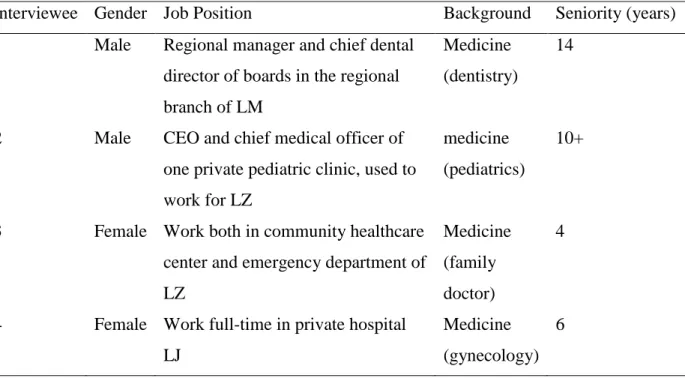
Ten interviewees including five medical professionals and five management personals are the main participants of the study. The ten people are all working or have worked in the four local private healthcare organizations but in different departments. They could be divided into three groups: the first group includes two clinician managers, who are initially medical professionals, but also held management responsibilities; the second group has two female doctors and one male surgeon, all having working experience in the private healthcare units; and, the third group is the managerial layer that contains four department leaders and one senior manager. Table 3.1 provides the basic information of all interviewees. The interviewees’ backgrounds range from professional medicine to non-medical business majors, and their seniorities go from at least 3 to more than 15 years.
Table 3.1 Basic information of all interviewees in the research
Interviewee Gender Job Position Background Seniority (years) 1 Male Regional manager and chief dental
director of boards in the regional branch of LM
Medicine (dentistry)
14
2 Male CEO and chief medical officer of one private pediatric clinic, used to work for LZ
medicine (pediatrics)
10+
3 Female Work both in community healthcare center and emergency department of LZ
Medicine (family doctor)
4
4 Female Work full-time in private hospital LJ
Medicine (gynecology)
16 5 Male Surgeon in one private center of day
surgery, used to work for LJ
Medicine
(surgery) 15+
6 Female Business development director of private healthcare group LM
Non-medicine 3
7 Female Corporate HR development specialist in LJ
Non-medicine 9
8 Male CFO and COO in private healthcare group LA
Non-medicine 5
9 Female Healthcare program manager, responsible for general operation department in LZ
Medicine-related
(bio-engineering) 11+
10 Male Clinical information and business intelligence leader in LJ
Medicine-related
(bio-engineering) 4
Source: the author
3.4 Data generation
The key method of data collection in this research work is the in-depth interviews with ten voluntary participants. They were all interviewed in person using a semi-structured interview format (see appendix 4 Interview guide). The interview questions were generated on the following aspects: job profile of clinical work; the obstacles and difficulties people might
encounter during the integration; the role of physicians and doctors in the management team; the engagement of medical professionals with the management work and the decision-making; and managerial leaders’ personal working experience. All the interviews were taken place from September to December in the year 2018. The interviewees were informed about the purpose of the interview, and their names and identities will not be exposed in the study report. The
interviews lasted, on average, about thirty-two minutes. All interviews were conducted face-to-face in English and recorded. The interviews were undertaken in different places. Most doctors were invited to nearby public places like coffee shops to have a break during the interviews, while others took place in the meeting rooms of the healthcare enterprises.
17 3.5 Interpretation method
Three types of content analysis were described and identified by Shannon and Hsieh, which mainly differ in their coding schemes and origins of codes (Hsiu-Fang Hsieh, Sarah E. Shannon, 2005). In this study, I used summative content analysis, in which keywords are derived from the author’s own interests, and often approached as single words or in relation to particular content, and findings from the study are hoped to build on the contextual meaning of specific terms or content (Hsiu-Fang Hsieh, Sarah E. Shannon, 2005).
In order to get a more detailed insight into how the interviews were transferred into analyzable contents for the study, the proceeded steps are described in the following. As a first step, categories including sub-categories were defined and explained in a coding agenda (see table 3.2).
Table 3.2 Coding Agenda
Category Sub-category Definition of the Category Meaning and implications Perceptions towards private healthcare services a) general attitude
A belief or opinion, often held by many people and based on how things seem in private healthcare units
This sub-category gives a big picture of the industry and general reason why they decided to become employees of private healthcare organizations.
b) as a worker A belief or opinion held by medical professionals and administrates working in private healthcare units
This sub-category shows specific working routine and gives further details on the work in the private healthcare groups.
Engagement to management
a) motivations The willingness, needs or enthusiasm for
participating in the management
This sub-category is to answer the research question one completely and gives the further driver for the medical doctors in joining the private hospital management. b) career pursuit
and corporate value
The meaningful things which valued by the medical personals in line with the benefits and environments given in the private healthcare groups
It would be vital to know the internal and external conditions when the involvement of physicians in the decision-making process happens because there might be a significant difference with the general medical professionals who have a far-reaching autonomy in the public healthcare organizations.
18 Construction management culture in healthcare services a) lean thinking and lean-adapted culture
The methods, mindset to eliminate waste and increase care quality
The sub-category emphasizes the importance of applying the scientific, managerial methods to continually improve healthcare delivery while always focusing on the needs of patients.
b)
Management’s strategy: Proving ourselves
The hard work and various means adopted by
managerial people to improve the hospital performance and maximize the value of healthcare deliveries
The sub-category partially answered the research question two and three, showing the strong willing and robust power that the management could bring to revolutionize the healthcare delivery process. c) Team
integrations
Attempts used to make medical professionals involved with
management in providing solutions that will meet the high requirements in the care delivery process.
The sub-category partially answered the research question three,
emphasizing the importance of everyone on the front line
participating in creating solutions and continually modifying
standardized work. d) Clinicians’ resistance Negative opinions or behaviours against managerial work expressed and showed from frontline clinical workers
The sub-category partially answered the research question three and gave a glance at the barriers to healthcare professionals’ being represented to these governing bodies.
Source: the author
Subsequently, the researcher read the transcript and underlined every statement that seemed relevant at first glance. After reconsidering the defined categories, the content of the transcript was structured using a color scheme. Statements, opinions, narratives and quotes were taken out by order of their color; summarizing them into the category system. In case the contents did not fit in existing categories, new ones were developed. There are three categories and eight sub-categories being created in total, and moreover, the third category ‘construction management culture in healthcare services’ should draw more attention because it could explain and gives
19 more lights to the import answers of the research questions two and three in this study. After being allocated entirely to the categories system, a category agenda with the number of the interviewees has been developed (see table 3.3)
Table 3.3 category agenda No. Interviewee job position 1 clinician manager 2 clinician manager 3 medical doctors 4 medical doctors 5 medical doctors 6 managerial staff 7 human resource 8 senior executive 9 managerial staff 10 managerial staff Category 1: Perception towards private healthcare services
1) general attitude Positive Positive Positive Positive Positive Neutral Neutral Positive Neutral Neutral
2) as a worker Positive Positive Neutral Positive Neutral (mixed)
Positive Neutral Positive Neutral Positive Category 2: Engagement to management
1) motivation High High Low Medium High High - - High - 2) career pursuits and
corporate value
Extreme high
Extreme high
Medium Medium Extreme high
High High High High -
Category 3: Construction management culture in healthcare services 1) Lean thinking and
lean-adapted culture
- - Yes Yes Yes - - Yes Yes Yes
2) Management’s strategy: Proving ourselves
- - - Yes Yes Yes Yes - Yes -
3) Team integration Yes - Yes Yes Yes Yes - Yes Yes Yes 4) Clinicians’ resistance Not
applicable
Yes - Not applicable
- - Yes - - -
In category 1, ‘positive’, ‘neutral’ and ‘negative’ were further labeled to show the feelings in the statements accordingly; while in category 2, ‘extreme high’, ‘high’, ‘medium’ and ‘low’ were used to describe the desires and goals in the contents; in the last category,
20 only ‘yes’, ‘no’, and ‘not applicable’ were applied to illustrate what attempts and reactions have happened in their organizations. The symbol ‘-’ means this has not been discussed or asked by the researcher during the interview.
21
4. Findings
This chapter will gradually present some results following the interviews: perceptions towards working as doctors in private healthcare services, internal and external motivations for medical professionals’ involvement to management, and different groups’ reactions and attempts towards the involvement of medical professionals with the managerial personals under the privatization of healthcare services.
4.1 Perceptions towards working as medical doctors in private healthcare services 4.1.1 general perceptions towards private healthcare services
Most participants expressed positive impressions and open-up attitudes toward the privatization of healthcare services. The following two examples are shared by a junior and a senior medical person; they described how they rate the increasing privatization or commercialization in the healthcare industry in Portugal:
“These areas of personal needs and social needs intersect. It is always a mixed mode; it’s not necessary that only one single mode can solve all problems effectively.... It is not a shame to make healthcare marketization or commercialization. However, the government should have the means to guarantee the basic needs.” (Interviewee 4)
“Currently, the demand for medical care is good medical care and good doctors. The best hospitals are not afraid of spending money. The needs for strong and high-end medical are reflected…It [privatization] is reasonable to make healthcare services more diverse because health is both the basic needs of people and the ultimate demand.” (Interviewee 1)
The two supportive opinions are presented through the two interviewees’ statements. From the macro-level, society is composited by mixed types in everything, and so is healthcare. One single type cannot meet all the needs from different classes. Meanwhile, from the micro-level, high-end private healthcare services appeared due to the appearance of the available market along with the rapid rise of people’s demands. According to the Maslow's hierarchy of needs (Maslow, 1943), a lower level must be wholly or partially satisfied and fulfilled before moving onto a higher
22 pursuit. After the basic needs have been guaranteed by the national public healthcare system, the higher demand for health care started to be highlighted in the market. At this point, the fast emergence of private healthcare groups and relevant companies is consistent with social development.
4.1.2 the perception as workers
4.1.2.1 the perception from general medical professionals
Doctors who are in the private hospitals work as main labour force and main value creator. They are in the center of the entire healthcare value chain. This chain connects all major players in the healthcare field, including pharmaceutical, biotech, and medical device companies as producers. Hospitals and other facilities, as well as healthcare service providers, are at the center of the value chain with the public as their consumers and producers as their suppliers. Unlike working in public hospitals, the main task is not only treating patients well, but also improving quality of healthcare services perceived by patients, which means that outstanding communicational skills, empathy capacity, safe hospital environment and optimal treatment process are indispensable when working in the private hospitals.
In this study, almost all medical candidates pointed out that their working concept inside is more ‘patient-centered’, respecting the interests of the patients. However, junior and senior medical professionals have different concepts and career goals, the interviewees’ narratives appeared variedly. Senior doctors tend to focus on a deeper understanding of practising medicine and the meaning of treating patients. Some considered that the private healthcare service is a way to integrate personal ideas and dreams in a career. Moreover, the time spent in the private hospital allows them to develop business thinking and communicational skills that would be practical and easily applied to a new job position:
“… After my careful consideration, I decided to give up the job in the public hospital and joined the private hospital LJ. If you want to do the business of ‘moving a knife’, you must enter the private medical industry and learn from the best institutions.
23 Frankly speaking, I have completed the reshaping of my mind and initial establishment of
commercial thinking in LJ... However, I felt that the excellent medical service concept runs through the daily operations in LJ, which means doctors treat patients as family members who need care.” (Interviewee 5)
“I was working before in the private hospital and made friends with some senior managers in private hospitals on purpose. I participated in some forum in a current observation about the healthcare industry in Portugal, EU and read research reports from McKinsey and IQVIA at my free time. I knew various private healthcare institutions with all kinds of different operational modes…” (Interviewee 2)
Yet, the junior medical staff working in private hospitals tends to have a positive experience and a superficial feeling. The nice working environment and more financial subsidies were often mentioned by the juniors. For instance, two medical practitioners expressed their impressions explicitly about working in private hospitals and clinics:
“…As an employee in a public hospital, the salary is limited. They [the private hospital LZ] offered the payment on an hour-basis so that I can make more money through my work.” (Interviewee 3)
“Furthermore, the working environment here is far better than the one in public hospital, like high-end atmospheric buildings, beautiful back gardens, spacious and independent wards, one office for doctors, and various gyms, study rooms, and cafes. Compared with public hospitals, private hospitals are obviously better. After half a year here, my insomnia was almost cured.” (Interviewee 4)
With regard to the better working environment, senior medical staff are more concentrated on the culture and belief of private healthcare institutions. They would give up the job when they found the value is not consistent with what they believed, no matter how high they are paid for.
24 4.1.2.2 the perception from management levels
Most executives in private healthcare group view medical personals both as ‘employees’ and ‘cooperators’. Besides the medical levels and qualifications, humanistic cultivation is valued greatly and regarded as an essential element in developing a medical career in private healthcare units:
“We will have some tests on the languages and situation simulations to measure the personality, if he can handle some interpersonal problems that happen between parents and doctors…For juniors, we have a trainee program and various lectures about respecting and protection of patient privacy, some communication skills based on different cultural backgrounds to facilitate the process of integration. Further, we will judge the doctor's communication ability and the maintenance status of the patient's relationship through the patient's 6-month follow-up rate.” (Interviewee 7)
“The most important thing is that doctors must have good communication skills, because one of the keys to winning the trust of the patient is how well you communicate with the patient. For example, once I brought my child to see a doctor. We went to the urgency center. The child is a few months old but what the doctor gave me was tablets. If I were a colleague of him, I would throw the pills on the doctor's face. There are so many kinds of syrup, and why not use syrup? Such doctors are very reluctant to communicate, and will not consider from the patient's perspective, how can patients be satisfied?” (Interviewee 8)
In private hospitals and clinics, medical professionals are encouraged to talk more with the patients, think from patients’ perspectives and make patients fully satisfied. From these statements, both diagnosis-treating abilities and the communication art with the patients are evaluated, and these are critical requirements for medical career advancement in private
healthcare organizations. Therefore, the organizational goal of improving the perceived quality of healthcare services may create a suitable environment for medical professionals to engage with hospital governance and management.
25 4.2 Medical professionals’ engagement in management
4.2.1 Motivations for medical professionals’ engagement in management
There are various reasons causing the intervention from the management side. The economic causes were shown for the commercial management in the healthcare industry. Two healthcare providers said their opinions from the economic perspective respectively:
“The opposition to healthcare "marketization" comes mostly from the fear that patients will pay more for this, but in fact, it is not. In other words, the medical expenses that different groups of groups can bear are different. Free deprives consumers of the possibility of automating medical prices and maximizing profits, also deprives the opportunity of the rich to subsidize the poor. Partly commercialized healthcare services show the law and the value of the market economy.” (Interviewee 3)
“It [Commercial involvement] is also considered to be ‘of different quality and different price, or homogeneous but different price’. Therefore, we are subjectively maximizing profits and exposed the psychological bottom line of the public, but the objective reality is to ensure that more people can enjoy the service. This is the charm of marketization, and it is also the ethical justice of the market.” (Interviewee 2)
The above expressions realized that medicine is an art, but healthcare is a business. Private healthcare services can complete the health market through cost shifting and cost subsidizing. For different groups of patients or quick pathway of hospital administration, the charge might be different despite the treating outcomes and medications are the same. Moreover, the profitable service in some departments would subsidize the unprofitable service and haemorrhaging departments within the hospital, so that the public can be assured to have wholesome and comprehensive health care.
Obviously, there is no right or wrong answer towards the phenomenon of capital intervention in healthcare services. However, since the healthcare industry used to be public dominated in Portugal and the growth of private healthcare groups is prosperous in this industry, capital
26 interventions and business-style operations are naturally expected to happen. The interactions between medical personals and the managerial level are naturally regarded as proper, which might lead to easier acceptation and open-up attitudes from the medical side.
4.2.2 career pursuits and corporate value
Most doctors have thought themselves wearing a glorious shirt with hope and enthusiasm. They believe in what they understand for medical care. For example, one dentist working in private dental chain clinics commented:
“In the past, the value and the operational style of the former clinic did not meet my expectation. I have my understanding of dental services. And I saw too much outside of healthcare impacts about the medical service itself, including academic, commercial, official, and even the doctor's own, and the patient experience as the core of medicine is often overlooked. At our clinic, everything you see, hotel-like lobby, piano, running water, sunroof, the sunshine, and an old dean... This is entrepreneurship because no one else knows what Eden garden is like in your heart unless you build it yourself.” (Interviewee 1)
It could be seen that personal dream-like ‘garden in the heart’, ‘understanding of health care’ and ‘Eden garden’ are reinforced by doctors who worked outside the public healthcare system. Moreover, this participant suggests that these personal pursuits and sense of mission would influence the choice of the job position and career pathway. The words ‘build it yourself’, ‘entrepreneurship’ and ‘no one else knows’ indicate that previous work is regarded as
inconsistent with personal belief and perceived value of health care, which implies that private healthcare group might be more willing to provide the working conditions that can be more suitable for the realization of personal value and sense of self-satisfaction.
Correctly, the leaders and managers working in the private healthcare groups showed needs of consultancy and help from the medical sides when they need to attract more patients and
maximize the profit. Here is one example shared by a business director in one private Portuguese dentistry group respectively:
27 “The medical professionals can participate in the design of the service products…We want a person to have different products to solve oral problems at different ages from birth to old age. Thus, we asked the doctors to list all the oral disorders and problems that most likely to happen at different ages and stage. According to the suggestions, we recently designed and launched the Children’s Oral Health Program.” (Interviewee 6)
Like the example showed above, relevant doctors and medical personals would be automatedly invited to involve in discussing the managerial process with their professional suggestions. Everyone inside worked together and openly discussed the problems and correspondent
solutions. In other words, the private healthcare service company established a culture of safety through mutual respect and transparency.
4.3 Actual attempts to construct the management culture in healthcare 4.3.1 Lean thinking and lean-adapted culture
The above positive attitudes and high personal perceptions have subjectively led to the visible result: there is a more substantial proportion of interaction and engagement between the medical professionals and the management in the private healthcare groups. One junior gynecologist said the neccessity of eliminating uneccessary waste:
“Here we must control the expense. Because the insurance company would only pay a certain amount of money based on the diagnosis, we need to reduce the complications of surgery, the average length of hospital stays and unnecessary examinations. Therefore, we must minimize the inspection and medication, such as strict disinfection of the operating room, patients can go home even after the surgery without drugs. Also, it can reduce the medical costs, increased bed utilization rate. Thus, we are more motivated to improve medical quality and safety, streamline and lean the medical procedures.” (Interviewee 4)
28 In another interview, one administrator recalled an episode that suggested management staff try to gain more acceptance by helping to indeed improve physicians’ work efficiency through experiencing the doctors’ daily work:
“In the beginning, most hospitals are not designed with the idea of minimizing motion of the nurses, physicians, and other healthcare workers. Rather than being assigned to a single ward, these patients ended up being located on several different floors. the doctors wasted one hour per day walking from room to room. Then I came up with standardized work and value stream mapping. They are tools, which are classical in management, can dramatically reduce this form of waste.” (Interviewee 9)
From the narratives, it seems that they adopted lean thinking in order to socialize and integrate with their medical co-workers. With the application of the lean scientific methods to continually improve healthcare delivery while always focus on the needs of patients, administrative staffs seem to find a better way to communicate with medical doctors and optimize the operational process, regardless of individual career pursuits and motivations of engagement.
4.3.2 Management’s strategy: Proving ourselves
Consequently, other behaviours can be observed as well. For instance, the managerial staffs referred that they must double the efforts on communicating with doctors and nurses, and to demonstrate a significant business performance to avoid themselves from the image of ‘outsiders’ in the mind of medical team:
“I have talked a lot with the medical professionals and told them that our dental company is not a personal institution. We hope that more like-minded doctors can join, absorb medical teams with more quality to cooperate with us, and each store has an independent doctor partner... I believe that this can help us to recruit more medical talents to join to expand team strength…. If I did not speak with doctors and no communication, this medical institution would not have enough vitality. While using educational institutions to do internal hematopoiesis and follow-up training, this is a deeper hiding system of doctor’s management.” (Interviewee 6)
29 “I hope my work could change the ‘outsider’ views and gain more acceptance from the medical staff.” (Interviewee 9)
From the participants’ experiences, the ‘talk’ and ‘platform’ did by managerial directors were with cooperative expectation, like what was said ‘internal hematopoiesis’. Under this situation, only the exceeding efforts and outstanding managerial outcomes are vital and significant to prove themselves.
As Kanter (Kanter, Rosabeth Moss, 1993) argued, the minority would face performance pressure in a dominant group. The presence of non-clinical administrator in clinical healthcare units is easily noticed, but it does not mean that their performance could achieve the same attention and appraisal since their capacities tend to be eclipsed by the educational backgrounds and general stereotype of the professional role. It appears that performance pressures come from
occupational expectation, which is the primary reason making managerial personals work hardly with doctors and nurses to prove their competence.
In fact, management’s strategy to prove themselves is a manifestation that they are standardizing working operations and improving the perceived quality of private healthcare services. With the goal of being accepted as a family and ‘insiders’, management’s strategy is to maximize the value of healthcare services by producing lean norms and constructing management culture.
4.3.3 Team integration
In this research, some physician leaders recalled narratives that showed the managers try to facilitate interactions and integration. Here is an example of a dental director’s experience in the evaluation meeting:
“However, later we found that doctors also have the pursuit of experience, such as doctors need a more optimized medical facilities and humanized management platform to achieve more optimized medical services. With the liberalization of doctors, we can provide such an online platform for doctors.” (Interviewee 1)
30 It could be seen from the above example that the administrates and managerial leaders are aware that medical professionals have problems during the engagement. However, he oversimplified this problem and used a straightforward way to solve it. According to a newly-published study (C. P. West, L. N. Dyrbye, T. D. Shanafelt, 2018), overuse of digital utilities and long-term using electronic medical records are significant contributions to physician burnout and decreased quality of healthcare.
While other leaders gave another method to convince those who are working on the frontlines to make as a whole:
“We used some data as key performance indicators, KPIs, which reflect we are doing it right or not. We have a white board which everyone can see in the office with those specific KPIs for each program. We created a graph every month, and we had a goal line. We can see the changes and constant remind ourselves to reach our goals… We will break the visiting process down to several steps and set corresponding indicators. And we will align owner for each indicator and analyze those data. Everybody within the team should be comfortable with those data, results and suggestions.” (Interviewee 10)
“We do not point fingers; we do not blame people. The first thing that we did was we got a true time study using time stamps and making sure we understood who came in and how long that they were there. For instance, we would make a process map of patient check-in for an operating room with doctors and nurses during their normal routine work. Here, the red one is shown when the patient is being transported from the admission office to the operating room since the distance is excessively long, and delays patient arrival to the OR [operation room]. Therefore, the hospital would need to consider if an admission office can be relocated to a site that is physically closer to the operating room.” (Interviewee 9)
From this example, we can see that process map is a visual tool which is easily created by and could actively engage the frontline staff with management task, allowing them to visualize the
31 workflow and create effective solutions. With identifying the proper sequencing of procedural steps, the managerial professionals no longer felt excluded from the highly specified medical complex. Moreover, the waste and workload of healthcare providers were reduced through the cooperative analysis. Performing this activity creates various buy-in by managerial leaders and those on the front lines because they understand why.
4.3.4 Clinicians’ resistance
With such encouraging and active team building, some clinicians are reluctant to think about the senior management roles. Here it is another narrative introduced by a senior medical executive:
“To be honest, I have not finished the transformation [from being a doctor to be the owner and manager of an individual clinic] yet. In fact, I still hope that I can be free between the two. If a doctor becomes a pure operator, it is very... I think it is a very cruel thing; this is not what I wanted to do. I still hope that I have a doctor's feelings and some operational ideas. I will also explore the scale. If you are a professional manager and you are not a doctor, you may have been operating in a medical institution for ten years, and maybe change to other industries for another ten years.” (Interviewee 2)
It is observed that this physician interviewee is acutely aware of the risks of losing his clinical skills. Medical participants gave expression of conflicted feelings and a strong identification with the medical professional background. It could be seen that physician’s acceptance to undertake senior management position is relatively higher, since it is easier for physicians to maintain their clinical practice than surgeons, where constant repetition of practical procedures is important (Hazim Sadideen, Abtin Alvand, Munir Saadeddin, Roger Kneebone, 2013). Though clinician’s resistance is an obstacle making the integration, the healthcare quality improvement has brought management and medical leadership together because it became a quality issue instead of either a medical issue or a management issue.
To sum up, this chapter demonstrates different groups’ perceptions and their reactions towards the engagement with medical professionals. Meanwhile, actual attempts and examples of private
32 healthcare groups were presented to promote integration and improve the quality of healthcare service. The lean thinking produced by their strategies, furthermore, was showed to be effective in tackling the issues encountered between senior management and clinicians.
33
5. Discussion
In this chapter, the research questions will be answered, while the results of the study will be discussed. Furthermore, the theoretical and practical implications will be explored. Last but not least, the limitations are described, and further recommendations for future research are made.
5.1 Research questions
The first sub-question is ‘what are motivations or drivers for physicians to work in private hospitals and clinics in Portugal?’ The answers from the interviews demonstrate several main concerns: the financial reimbursement, opportunities to study, freedom and autonomy, and elegant working environment. Those results also got confirmed from the previous study, which showed physicians predominantly turn to the private sector for economic reasons (Ferrinho P, Lerberghe WV, Julien MR, Fresta E, Gomes A, Dias F, Goncalves A, Backstrom B, 1998).
Other dissertations are showing contradictive conclusions, which held the hypothesis that
increased earnings do not play such a predominant role in physicians’ decisions to shift from the public sector (Giuliano Russo, Bruno de Sousa, Mohsin Sidat, Paulo Ferrinho, Gilles Dussault, 2014). This interpretation is not consistent with what the author analyzed from the interview data, which might be caused because of the countries’ economic situations. The result was mainly generated in high-income countries, while the payment to doctors in Portugal is relatively lower in the European countries (Villanueva, 2012), which might be the primary explanation for this inconsistency.
Furthermore, the opportunities to further study and more autonomy to managerial functions in private healthcare sectors are important drivers as well. From the interviews, we can see that those are more valued by the senior doctors. This finding was also mentioned in existing studies, hypnotizing that senior physicians are less inclined to multiple clinical activities, opt for less demanding managerial work and shift towards leisure opportunities in the work-life balance as they passed the peak of their medical careers (EM, 2005). However, our data offers a different opinion on this point. Instead of passing the top of the medical career and avoiding demanding clinical work, the seniors put more value on management because they have a robust clinical experience and comprehensive understanding of healthcare delivery. They understand deeper