470
ARTICLE
DOI: 10.1590/0004-282X20130064
Chronic unremitting headache
associated with Lyme disease-like illness
Dor de cabeça incessante crônica associada com a doença de Lyme símile
Pedro André Kowacs1,2,3, Rodrigo Tomazini Martins1, Elcio Juliato Piovesan3, Maria Cristina Araujo Pinto4,
Natalino Hagime Yoshinari5
Lyme disease (LD) is a multifaceted infectious disease1
caused by Borrelia burgdorferisensu lato spirochetes, which are transmitted to humans by tick bites in at-risk areas in the Northern hemisphere2,3. Since this microorganism is diicult to
culture, the disease is usually diagnosed by serological tests3. he
most common neurological presentations of LD are meningitis, cranial neuritis, and radiculoneuritis4.
Brazilian Lyme-disease-like illness (BLDLI) or Baggio-Yoshinari syndrome (BYS) is a unique zoonosis found in Brazil. It reproduces all clinical symptoms of LD except for the high frequencies of relapse and the presence of autoimmune manifestations5-7. he vector of BLDLI belongs to genera
Amblyomma and Rhipicephalus rather than to the Ixodes ric-inus complex, which is responsible for transmission in the Northern hemisphere6,8,9.
To date, the etiologic agent has not been isolated or cultured in Brazil. However, electron microscopy analysis of patients’ blood samples showed microorganisms resembling spirochetes with atypical morphologies5. Recently, a polymerase chain
reaction (PCR) analysis carried out with primers derived from the lgE gene has proven that Brazilian zoonosis is caused by microorganisms from Borrelia9.
Since the etiological agents of BLDLI and LD are diferent, researchers from Laboratório de Investigações Médicas-17
1Neurology Department, Instituto de Neurologia de Curitiba, Curitiba PR, Brazil;
2Neurology Department, Curitiba PR, Brazil;
3Departamento de Clínica Médica do Hospital das Clínicas, Universidade Federal do Paraná (UFPR), Curitiba PR, Brazil;
4Dermatologist, Curitiba PR, Brazil;
5Laboratório de Investigação em Reumatologia do Hospital das Clínicas, Faculdade de Medicina, Universidade de São Paulo (USP), São Paulo SP, Brazil.
Correspondence: Pedro André Kowacs; Rua Jeremias Maciel Perretto 300; 81510-350 Curitiba PR - Brasil; E-mail: [email protected]
Conflict of interest: There is no conflict of interest to declare.
Received 14 August 2012; Received in final form 12 March 2013; Accepted 19 March 2013. ABSTRACT
The Brazilian Lyme-disease-like illness (BLDLI) or Baggio-Yoshinari syndrome is a unique zoonosis found in Brazil. It reproduces all the clinical symptoms of Lyme disease except for the high frequencies of relapse and the presence of autoimmune manifestations. Two cases of borreliosis manifesting with unremitting headache, which is a symptom associated with late-stage BLDLI, were presented. Clinical, thera-peutic, and prognostic aspects of the BLDLI and its associated headaches were showed and discussed in this article. BLDLI diagnosis re-quires additional attention by physicians, since the disease has a tendency to progress to the late, recurrent stage or the chronic form, and the associated headache can be confused with chronic primary headache or with analgesic-overuse one. Special attention should be paid to patients with headaches who have traveled to endemic areas.
Key words: borrelia burgdorferi, erythema chronicum migrans, headache disorders, Lyme disease, zoonoses.
RESUMO
A doença de Lyme símile brasileira (BLDLI) ou síndrome de Baggio-Yoshinari é uma zoonose diferenciada encontrada no Brasil. Ela reproduz todos os sintomas clínicos da doença de Lyme, exceto as altas frequências de recidivas e a presença de manifestações autoimunes. Dois casos de borreliose, manifestando-se com cefaleia incessante, que é um sintoma associado à fase tardia da BLDLI, foram apresentados. Os aspectos clínicos, terapêuticos e prognósticos da BLDLI, bem como as cefaleias associadas com a doença de Lyme, foram mostrados e discutidos. O diagnóstico da BLDLI requer maior atenção dos médicos, já que a doença tende a progredir em seu estágio tardio, na forma recorrente ou crônica, e a cefaleia pode ser confundida com cronificação primária ou por abuso excessivo de analgésicos. Atenção especial deve ser dada aos pacientes que viajaram para áreas endêmicas.
471
Pedro André Kowacs et al. Lyme disease-like: headache
(LIM-17), Hospital das Clínicas da Faculdade de Medicina da Universidade de São Paulo — HCFMUSP (the Brazilian Reference Center for BLDLI research)developed diagnostic criteria speciically to conirm suspected cases of Brazilian borreliosis (Table 1)5. Serological tests — ELISA and Western
blotting (WB) — were carried out with the North American G39/40 strain of Borrelia burgdorferi, isolated primarily from
Ixodes scapularis.
Two cases of neuroborreliosis associated with unremitting headache, which is a symptom associated with late-stage BLDLI, are presented herein. his symptom can be unnoticed or misdiagnosed by Brazilian physicians due to its diicult diagnosis and late appearance in the course of the disease.
CASE REPORTS
Case 1
A 44-year-old female dentist whose migraine without aura was controlled in the previous year with atenolol 25 mg one day (QD), presented in November 2009 due to worsening of her headaches. Previous medical consultations had identiied be-nign postural vertigo, symptomatic cervical disk herniation, allergic rhinitis, hiatal hernia, saphenectomy, and hysterectomy. he patient reported that her irst headache attacks due to BLDLI were quite similar to her previous migraine ones and responded well to the use of over-the-counter (OTC) drugs (simple analgesic drugs and/or nonsteroidal anti-inlammatory drugs – NSAIDs).
After six months, when the diagnosis of Lyme-like dis-ease was concluded, her headaches were occurring daily without any respite and were no longer responsive to simple an-algesic drugs, NSAIDs, or anti-migraine drugs such as dihydroer-gotamine (DHE) or triptans. he patient also stated that the headaches were accompanied by anorexia, nausea, disequi-librium, and depressive mood. In the patient’s own words: “it was just like having migraine and labyrinthitis together, but on a larger scale.” he participant also reported that at that time, she was experiencing a decrease in the quality of her sleep and waking up tired. Atenolol was withdrawn, and methysergide and trazodone were started without success. Meanwhile, she consulted a dermatologist because of a skin lesion in her left groin, which was diagnosed as erythema
migrans (EM). A review of her history revealed that she had been having some dizziness and minor joint and ankle pains. She denied history of tick bites but said that recently, dur-ing her vacations, she had worked in a mission in Northern Brazil, a known risk area for BLDLI.
he brain magnetic resonance imaging (MRI) revealed a small hyperintense lesion in the head of the left caudate nucleus (Figure) and a bilaterally delayed P100 latency in her visual evoked responses. Her cerebrospinal fluid (CSF) examination was normal. Serology for B. burgdorferi was performed at LIM-17 HCFMUSP and was positive (WB: IgG, two bands; IgM, one band). he patient received intravenous ceftriaxone 2 g one day (QD) for 30 days and then doxycy-cline 100 mg twice a day (BID) for three months. Her frequent headaches and dizziness had already abated when she was receiving intravenous therapy, but the joint pains remitted only after sulphasalazine 1 g BID and hydroxychloroquine 400 mg QD had been added.
In February 2011, the woman had a recurrence of EM (a secondary annular skin lesion) on her left ankle, and doxycycline 100 mg BID for three months was restarted. A control MRI revealed that the left caudate lesion had been solved. In July 2011 topiramate 25 mg BID was started for
Table 1. Diagnostic criteria for the Brazilian Lyme disease-like illness adopted by LIM-175.
Major criteria
Epidemiology (tick bite or contact with wild or domestic animals in risk areas)
Erythema migrans or systemic manifestation (arthritis, neurological abnormalities, cardiac involvement) Positive serology for Borrelia burgdorferi
Minor criteria Relapsing symptoms
Chronic fatigue or cognitive disturbances
Identification of spirochete-like structures by dark-field microscopy or Giemsa staining
Cases are defined as positive if three or two major and two minor criteria are positive.
472 Arq Neuropsiquiatr 2013;71(7):470-473
her continuing migraines, and trazodone was reintroduced for her disturbed sleep. In November 2011, she started a new course of ceftriaxone because of bilateral retinal lesion.
Case 2
A 40-year-old female presented in April 2011 with intrac-table headaches. She had had sporadic nondisabling head-aches since her twenties, but at the age of 37 (in 2008) her attacks increased in frequency and intensity and became dis-abling. he headaches were bilateral, pressure-like or throb-bing with a temporo-parieto-occipital distribution, being stronger in the occipital region. he pain would reach a ten-point intensity on a ten-ten-point verbal pain scale with dizzi-ness. Attacks were accompanied by nausea and intense os-mophobia, but not by photophobia or phonophobia. hey did not happen at any speciic time, and occurred up to twice a week. hey lasted from 24 to 72 hours, sometimes starting early in the morning and getting worse in the evening.
Her medical history revealed a sequela of toxoplasmosis in her left eye, intermittent vertigo, allergic rhinitis, gastro-esophageal relux, cervical disk herniation, femoral dyspla-sia, and three pregnancies (two until term and one spon-taneous abortion). She had also had an EM lesion over her left shoulder in 2005 and bilateral knee pains starting there-after. Her neurological examination was unremarkable. he brain MRI was normal, as was the CSF luid examination. Serology for antibodies to B. burgdorferi was performed at LIM-17 HCFMUSP and proved to be positive WB (IgG, one band; IgM, two bands), satisfying the Brazilian Reference Center’s standard criteria for diagnosis ofBrazilian borrelio-sis. Because of her past history of EM and arthritis, BLDLI was diagnosed and treated with intravenous ceftriaxone 2 g QD for 30 days followed by doxycycline 100 mg BID for three months. Her frequent headaches, dizziness, and knee pains abated at the beginning of intravenous ceftriaxone therapy and had not recurred at the time of writing. However, she was placed on atenolol and lunarizine for the infrequent mi-graine headaches. She continued to have mild sporadic bi-temporal headaches, which got worse in the evening. Also, she did not have any associated symptoms, and these were enhanced by heat and occurred twice a month.
DISCUSSION
BLDLI, also known as BYS, is a new zoonosis described in Brazil. It difers from LD in that to date its etiological agent has not been isolated, its vector does not belong to the
Ixodes ricinus complex, and its clinical symptoms are often recurrent6,10,11.
Researchers from LIM-17 HCFMUSP believe that geo-graphic conditions and ecological biodiversity in Brazil favored the evolution of spirochetes with atypical mor-phologies adapted for survival in Brazilian vertebrate and
invertebrate hosts6. Borrelias with atypical morphologies
tend to survive inside host cells and become resistant to antibiotics and antibodies, explaining the occurrence of relaps-ing symptoms and low immune reactivity to B. burgdorferi sensu lato antigens5,9-11. hese BLDLI peculiarities explain
why Brazilian patients usually do not meet the Centers for Disease Control and Prevention (CDC) criteria for serologic diagnosis of LD.
In light of this, LIM-17 HCFMUSP established the follow-ing diagnostic criteria for recognizfollow-ing most suspected cases of BLDLI in Brazil (Table1)5: epidemiology, clinical
manifesta-tions and serology (major criteria); and relapsing symptoms, chronic fatigue and/or cognitive disturbances and identii-cation of spirochete-like microorganisms by dark ield mi-croscopy (minor criteria). A positive diagnosis is made if the results for three major criteria or two major and two minor criteria are positive.
Patients with BLDLI present with EM in nearly 50% of the cases. In the secondary stage of the disease, arthritis and neuropathy are observed in 35%, and cardiac manifestation in 5%6. Relapsing episodes are found in almost 75% of the
situations when patients are diagnosed in the late stage of the disease (more than three months after disease onset) even after antibiotic treatment6,10,11.
Both patients reported here came to the service with pre-vious EM, arthritis, and positive serology for B. burgdorferi.
Interestingly, patient 1 had recurrent skin lesion (secondary annular erythema) and bilateral retinal lesion even after antibiotic treatment, conirming that BLDLI has late relapsing symptoms. Shinjo et al.11 studied 30 patients with
neuropsy-chiatric symptoms related to BLDLI and found meningitis in 50% of their series, peripheral motor neuropathy in 40%, peripheral sensitive neuropathy in 33.3%, encephalitis/myeli-tis in 33%, facial palsy in 26.7%, ocular symptoms in 36.7%, dysacusis in 10%, dysarthria in 6.7%, dysphagia in 6.7%, and psychiatric symptoms in 20%. It is noteworthy that EM was reported by 43.3% of neurological patients and arthritis by 50%. Extended follow-up of some of them showed that 73.3% had recurrent symptoms. In addition, the frequency of skin lesions diminished as the disease progressed, making it very diicult to identify BLDLI in the late relapsing stage.
Treatment of BLDLI is also diferent from that recom-mended for LD. In the acute stage of the disease, doxycycline 100 mg twice a day for at least three weeks is recommended. If the disease is diagnosed more than three months after onset, continued treatment with the same substance for three months is recommended. If neurological symptoms are present, the use of ceftriaxone 2 g/day for one month with an additional three-month course of doxycycline is indicated.
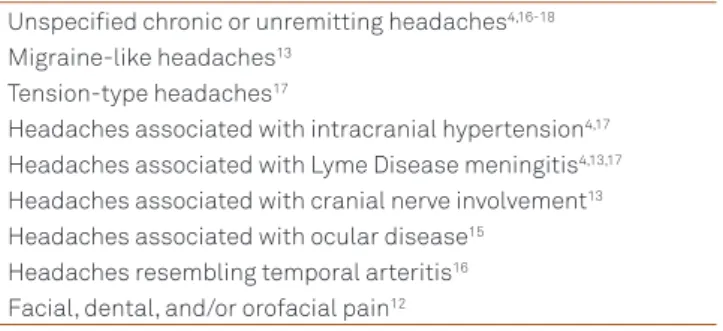
Several types of headaches have been reported to be associated with LD4,12,13,15-18 (Table 2). In a large sample of
conirmed LD patients, headache, orofacial, and dental pains were reported to be common complaints12. Migraine
473
Pedro André Kowacs et al. Lyme disease-like: headache 1. Burgdorfer W, Barbour AG, Hayes SF. Lyme disease: a tick borne
spirochetosis. Science 1982;216:1317-1319.
2. Steere AC, Malawista SE, Snydman DR, et al. Lyme arthritis: an epidemic of oligoarticular arthritis in children and adults in three Connecticut communities. Arthritis Rheum 1977;20:7-17.
3. Steere AC. Lyme disease. N Engl J Med 2001;345:115-125.
4. Pachner AR, Steere AC. The triad of neurologic manifestations of Lyme disease: meningitis, cranial neuritis, and radiculoneuritis. Neurology 1985;35:47-53.
5. Mantovani E, Costa IP, Gauditano G, Bonoldi VLN, Higuchi ML, Yoshinari NH. Description of Lyme disease-like syndrome in Brazil. Is it a new tick borne disease or Lyme disease variation? Braz J Med Biol Res 2007;40:443-456.
6. Yoshinari NH, Mantovani E, Bonoldi VL, Marangoni RG, Gauditano G. [Brazilian Lyme-like disease or Baggio-Yoshinari syndrome: exotic and emerging Brazilian tick-borne zoonosis]. Rev Assoc Med Bras 2010;56:363-369.
7. Costa IP, Bonoldi VLN, Yoshinari NH. Search for Borrelia sp in ticks from potential reservoir in an urban forest in the State of Mato Grosso do Sul, Brazil: a short report. Mem Inst Oswaldo Cruz 2002;97:631-635.
8. Abel IS, Marzagão G, Yoshinari NH, Schumaker TT. Borrelia-like spirochetes recovered from ticks and small mammals collected in the Atlantic Forest Reserve, Cotia county, State of São Paulo, Brazil. Mem Inst Oswaldo Cruz 2000;95:621-624.
9. Mantovani E, Marangoni RG, Gauditano G, Bonoldi VL, Yoshinari NH. Amplification of the flgE gene provides evidence for the existence of a Brazilian borreliosis. Rev Inst Med Trop Sao Paulo 2012;54:153-157.
10. Gouveia EA, Alves MF, Mantovani E, Oyafuso LK, Bonoldi VL, Yoshinari NH. Profile of patients with Baggio-Yoshinari Syndrome admitted at “Instituto de Infectologia Emilio Ribas”. Rev Inst Med Trop São Paulo 2010;52:297-303.
11. Shinjo SK, Gauditano G, Marchiori PE, et al. Manifestação neurológica na síndrome de Baggio-Yoshinari (síndrome brasileira semelhante à doença de Lyme). Rev Bras Reumatol 2009;49:492-505.
12. Heir GM, Fein LA. Lyme disease awareness for the New Jersey dentist. A survey of orofacial and headache complaints associated with Lyme disease. J N J Dent Assoc 1998;69:62-63.
13. Scelsa SN, Lipton RB, Sander H, Herskovitz S. Headache characteristics in hospitalized patients with Lyme disease. Headache 1995;35:125-130.
14. Avery RA, Frank G, Glutting JJ, Eppes SC. Prediction of Lyme meningitis in children from a Lyme disease-endemic region: a logistic-regression model using history, physical, and laboratory findings. Pediatrics 2006;117:1-7.
15. Wiegand W. Eye manifestations in borreliosis--bilateral panuveitis with exudative retinal detachment. Fortschr Ophthalmol 1989;86:659-662.
16. Pizzarello LD, MacDonald AB, Semlear R, DiLeo F, Berger B. Temporal arteritis associated with Borrelia infection. A case report. J Clin Neuroophthalmol 1989;9:3-6.
17. Brinck T, Hansen K, Olesen J. Headache resembling tension-type headache as the single manifestation of Lyme neuroborreliosis. Cephalalgia 1993;13:207-9.
18. Moses JM, Riseberg RS, Mansbach JM. Lyme disease presenting with persistent headache. Pediatrics 2003;112:e477-e479.
19. Lipton RB, Cady RK, Stewart WF, Wilks K, Hall C. Diagnostic lessons from the spectrum study. Neurology 2002;58(Suppl 6):S27-S31.
References
conirmed LD and is more common in those with central nervous system involvement13. In a study by Avery et al.14,
approximately one-third of LD headache patients had men-ingitis or other signs of central nervous system involvement. Headache in LD has also been described to occur in as-sociation with cranial nerve involvement14, ocular disease15,
and temporal arteritis16. However, there are few reports of
LD where chronic unremitting headache is the only primary symptom4,16-18.
Diagnosis of atypical headaches can pose a problem, es-pecially in patients who previously presented with migraine headaches, since in these patients non-migrainous ones may be a part of the spectrum of migraine19. Indeed,
diag-nosis of chronic, unremitting headache in association with LD or BLDLI is diicult and can be confused with chronii-cation of primary or with analgesic-overuse headaches13,17,18.
Nevertheless, making the correct diagnosis is important be-cause when this symptom is associated with borreliosis, it has a tendency to remit with antibiotic therapy, as in the cas-es dcas-escribed.
hus, ecotravelers presenting with new and/or chronic headaches must be carefully screened for visits to geograph-ic risk areas, tgeograph-ick bite episodes, and contact with animals. Diagnosis of BLDLI requires additional attention by phy-sicians, since the disease has a tendency to progress to the late, recurrent stage or to the chronic form. Unfortunately, patients’ remote epidemiological and clinical history, which is important for recognizing the disease, may be neither
investigated by physicians nor spontaneously recalled by pa-tients themselves. Notably, acute disease stage could happen in weeks, months, or years from the current symptoms. In this respect, special attention should be paid to patients who have traveled to endemic areas.
BLDLI is a very frequent, neglected, and unrecognized infectious and reactive syndrome. he dissemination of knowledge about BLDLI among physicians is of great impor-tance in view of the elusive nature of the disease.
ACKNOWLEDGEMENTS
he authors would like to thank Marisa Avellar de Morais and Cibele Motta Gonçalves for their invaluable help in preparing the manuscript.
Table 2. Types of headaches described to date in patients with Lyme Disease.
Unspecified chronic or unremitting headaches4,16-18
Migraine-like headaches13
Tension-type headaches17
Headaches associated with intracranial hypertension4,17
Headaches associated with Lyme Disease meningitis4,13,17
Headaches associated with cranial nerve involvement13
Headaches associated with ocular disease15
Headaches resembling temporal arteritis16