DOI: 10.1590/0004-282X20160006
ARTICLE
Patients with essential tremor can have
manual dexterity and attention deficits with
no impairments in other cognitive functions
Pacientes com tremor essencial podem apresentar prejuízo na destreza manual e déficit
de atenção sem prejuízo em outras áreas da cognição
Leonardo Mariano Inácio Medeiros1, Pollyanna Celso Felipe de Castro1,André C. Felício1,2, Bárbara Bernardo Queiros1, Sonia Maria Cesar Azevedo Silva1, Henrique Ballalai Ferraz1, Paulo Henrique Ferreira Bertolucci1, Vanderci Borges1
Essential tremor (ET) was long believed to be a monosymp-tomatic disorder where tremor is the single clinical manifes-tation1. However, new evidence has been produced in recent
years, and it is now considered as a complex, heterogeneous disease characterized by a progressive course, that is possibly
caused by diferent pathogenic mechanisms, with potential
cognitive impairments2 suggesting non-motor compromise.
Several studies have shown that ET is associated with cognitive impairments. Lombardi et al. showed naming,
short-term memory, working memory and verbal luency def
-icits in 18 patients with ET3. Gasparini et al. evaluated
fron-tal lobe dysfunction in 27 patients with ET, 15 patients with Parkinson’s disease (PD) and 15 healthy controls and they
found attention and verbal luency deicits in the two former
1Universidade Federal de São Paulo, Departamento de Neurologia e Neurocirurgia, Unidade de Distúrbios do Movimento, Sao Paulo SP, Brazil;
2Hospital Israelita Albert Einstein, Instituto Israelita de Ensino e Pesquisa, Sao Paulo SP, Brazil.
Correspondence: Leonardo Mariano Inácio Medeiros; Avenida Nossa Senhora de Fátima, 60 / quadra 16; 17017-337 Bauru SP, Brasil; E-mail: [email protected]
Conflict of interest: There is no conflict of interest to declare.
Received 29 April 2015; Received in final form 04 September 2015; Accepted 24 September 2015. ABSTRACT
Essential tremor (ET) was long believed to be a monosymptomatic disorder. However, studies have evidenced structural changes and attention is now being focused on non-motor symptoms. The objective of the study is to describe and compare ET patients with control groups according to their cognitive functions, and secondarily, to compare their sociodemographic characteristics and other clinical features. All participants were assessed using the Fahn-Tolosa-Marin Tremor Rating Scale for the severity of tremor; a neuropsychological assessment battery and a screening questionnaire for mood and anxiety symptoms. There were no significant age and gender differences between all groups. As for neuropsychological assessment results, a significant difference was found only in the Pegboard test. We also found a significant negative correlation between a poorer cognitive test results and disease severity and a significant differences regarding depression or anxiety symptoms in patients with ET. The study results suggest that patients with ET have impaired manual dexterity and attention.
Keywords: essential tremor, cognition, anxiety, depression, manual dexterity.
RESUMO
O tremor essencial (TE) era considerado como um transtorno monossintomático. Contudo estudos tem demonstrado alterações anatômicas despertando o interesse para sintomas não-motores.O objetivo do estudo é descrever e comparar pacientes com grupos controles segundo suas funções cognitivas, e secundariamente, comparar suas características demográficas e outros sintomas clínicos. Todos os participantes foram submetidos à escala de Fahn, Tolosa e Marin para avaliação da intensidade do tremor, a uma bateria neuropsicológica e a um questionário para detecção de transtorno de humor e ansiedade. Não houve diferença significativa na idade e gênero entre todos os grupos. Quanto ao resultado da avaliação neuropsicológica, foi encontrado uma diferença significativa apenas no Test Pegboard. Nós também encontramos uma correlação negativa no desempenho dos testes cognitivos e intensidade do tremor, presença de sintomas depressivos e ansiosos. Os resultados deste trabalho sugerem que pacientes com TE apresentem alteração na destreza manual e na atenção.
groups of patients compared to controls.Louis et al. recently demonstrated greater cognitive decline in patients with ET suggesting it is a potential risk factor for dementia4,5.
However, these studies3,4,5,6 have methodological
limita-tions, including small sample size with limited age range4,7,
no comparison to a control group3,8, no control for
comor-bidities9, use of drugs that may afect cognition5, and other
psychiatric disorders6.
hus, in the light of the methodological limitations of previ -ous studies and lack of studies assessing cognition in patients with ET in Brazil, we conducted a cross-sectional study to eval-uate the neuropsychological performance and a screening for psychiatric symptoms in ET patients compared to two control groups of (related and unrelated) healthy individuals.
METHOD
Patient selection
We conducted the present study from November 2011 to June 2013. We selected medical records of patients previ-ously diagnosed with ET and followed up at our clinic (hav-ing attended two or more visits). All patients were examined by at least two neurologists specialized in movement
disor-ders and their clinical diagnoses fulilled the consensus crite
-ria for the diagnosis of ET10. Exclusion criteria included use
of medications known to afect cognitive performance (ben
-zodiazepines, antidepressants, anticonvulsants, antihista-mines, neuroleptics and hypnotics); prior diagnosis of mood or anxiety disorders; refusal to answer the questionnaire; and less than four years of schooling. All patients selected were able to answer the study questionnaire.
Clinical protocol
he initial strategy was to select cases matched by con
-trols at 3:1:1 ratio of three cases to one related and one
unrelated control. First, we selected cases through random
review of medical records and assessed them all. he patients
were recruited by personal or phone invitation. hen we re
-cruited controls who underwent a clinical examination for ruling out any type of tremor or comorbidities that could pre-vent their participation in the study. Related controls had to
be irst-degree relatives and they were recruited in order to
try to detect pre motor symptoms.
A priori selection of cases included 100 medical records before applying exclusion criteria.
We collected demographic information on the following variables: gender, age, comorbidities, level of education, mari-tal status, use of medications and disease duration.
Demographic and clinical features
Of 100 randomly selected medical records, 44 patients
with ET were included in the inal sample. We excluded 56 patients for diferent reasons (40% attended only one visit; 30% had less than four years of schooling; 20% were diag
-nosed with mood disorders; and 10% were on psychotropic
medication). After the inclusion of patients in the study, we actively recruited related and unrelated controls. We
divid-ed them into three groups: ET (n = 44); irst-degree relatives
without tremor (n = 20); and unrelated individuals without tremor (n = 39). We reached a ratio of approximately 2:1:2.
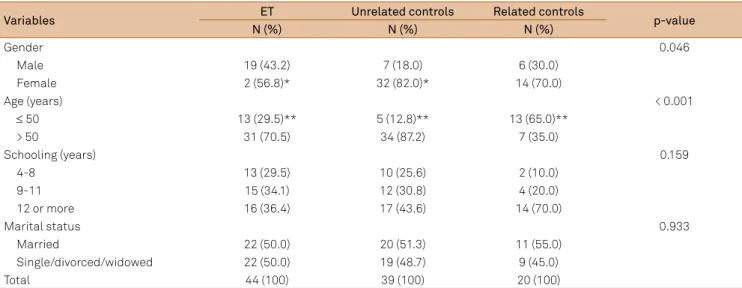
Demographic characteristics of the sample studied are
presented in Table 1. here was a signiicantly greater pro
-portion of females among unrelated controls and of younger individuals among related controls.
Regarding comorbidities, there was no diference be
-tween patients with ET and related (p = 0.083) and unrelated controls (p = 0.110). Related controls had lower prevalence of heart diseases compared to unrelated controls (p = 0.005).
Tremor was assessed using the Fahn-Tolosa-Marin Tremor Rating Scale (TRS)11, translated into Portuguese and
validat-ed for the Brazilian population12. We calculated the total TRS
Table 1. Distribution of cases and controls according to sociodemographic characteristics.
Variables ET Unrelated controls Related controls p-value
N (%) N (%) N (%)
Gender 0.046
Male 19 (43.2) 7 (18.0) 6 (30.0)
Female 2 (56.8)* 32 (82.0)* 14 (70.0)
Age (years) < 0.001
≤ 50 13 (29.5)** 5 (12.8)** 13 (65.0)**
> 50 31 (70.5) 34 (87.2) 7 (35.0)
Schooling (years) 0.159
4-8 13 (29.5) 10 (25.6) 2 (10.0)
9-11 15 (34.1) 12 (30.8) 4 (20.0)
12 or more 16 (36.4) 17 (43.6) 14 (70.0)
Marital status 0.933
Married 22 (50.0) 20 (51.3) 11 (55.0)
Single/divorced/widowed 22 (50.0) 19 (48.7) 9 (45.0)
Total 44 (100) 39 (100) 20 (100)
score as follows: (Part A + Part B + Part C) / 156 x 100. he high
-er the inal score (%) the more sev-ere the patient’s condition.
All patients were assessed using the Montreal Cognitive Assessment (MoCA)13, validated for Brazilian population14, for
global cognitive evaluation. In addition, the following neuropsy-chological assessment battery was used: Pegboard test (manual dexterity, bimanual coordination and attention)15; Forward and
Backward digit-span task (attention and immediate memory)16;
Semantic Verbal luency (semantic categories of animals and
fruits) (executive function)17,18; Brown-Peterson task (short-term
memory and attention)19,20; and the Frontal Assessment Battery
(FAB) (Part 1) (abstraction and similarity)21.
We irst compared cognitive test results among the three groups. hen we compared patients with ET older than 65
with unrelated controls following the same methodological approach of prior studies3,4,6,22. We also used the cut-of of age
65 to compare cognitive test results among patients with ET to check for any age-related changes.
We compared demographic characteristics and pres-ence of depression and anxiety symptoms in all analyses. Comorbidities studied were heart, kidney, endocrine, infec-tious and musculoskeletal conditions.
We also carried out a separate analysis including patients receiving or not primidone for the treatment of ET. Primidone is metabolized to phenobarbital that can cause somnolence
and cognitive impairment as side efects23,24 and could afect
the results.
he Hospital Anxiety and Depression Scale (HADS) was
used to screen for depression and anxiety disorders. A score
of nine was set as cut-of for each subsection, HADS-Anxiety
(HADS-A) and HADS-Depression (HADS-D), as suggested by Zigmond and Snaith25.
his study was approved by the local Research Ethics
Committee (CEP/UNIFESP 5609/12). All participants signed an informed consent form.
Statistical analysis
he Shapiro-Wilk test was used to test for the normality
of the data and the independent two-tailed Student’s t-test to assess parametric data. Mann-Whitney test was performed to compare nonparametric data, the chi-square test to com-pare frequencies, and Fisher’s exact test to analyze contin-gency data. We conducted ANOVA with Bonferroni’s post hoc test for multiple comparisons or the Kruskal-Wallis test
after non-normality of the data was veriied in the
Shapiro-Wilk test. Data were presented as mean (m) ± standard
de-viation (SD) or as number of subjects (n) and percentage (%). he statistical signiicance was set at p ≤ 0.05.
RESULTS
Analysis of cognitive aspects
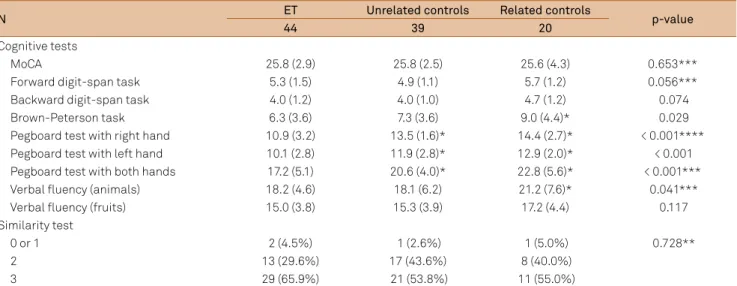
he groups studied showed no statistically signii
-cant diferences in results of the MoCA test (p = 0.653),
Forward digit-span task (p = 0.056), Backward digit-span
task (p = 0.074), Verbal luency (semantic category of fruits)
(p = 0.117) and Similarity test (p = 0.728) (Table 2).
A signiicant diference in mean scores of the three
groups was found on the Brown-Peterson test (p = 0.029),
Verbal luency (semantic category of animals) (p = 0.041)
and Pegboard test (right hand, left hand and both hands,
p < 0.001). A signiicant diference in mean scores of the
Brown-Peterson test was seen between patients with ET and related controls (p = 0.024). On the Pegboard test, patients with ET had lower scores compared to related and unrelated
controls in all tasks. he indings are as follow: right hand
test (p < 0.001 for patients versus unrelated controls and tients versus related controls; left hand test (p = 0.009 for pa-tients versus unrelated controls and p = 0.001 for papa-tients versus related controls); and both hands working together
Table 2. Results of the cognitive tests obtained for patients with essential tremor (ET) versus related and unrelated controls (mean (SD)).
N ET Unrelated controls Related controls p-value
44 39 20
Cognitive tests
MoCA 25.8 (2.9) 25.8 (2.5) 25.6 (4.3) 0.653***
Forward digit-span task 5.3 (1.5) 4.9 (1.1) 5.7 (1.2) 0.056***
Backward digit-span task 4.0 (1.2) 4.0 (1.0) 4.7 (1.2) 0.074
Brown-Peterson task 6.3 (3.6) 7.3 (3.6) 9.0 (4.4)* 0.029
Pegboard test with right hand 10.9 (3.2) 13.5 (1.6)* 14.4 (2.7)* < 0.001**** Pegboard test with left hand 10.1 (2.8) 11.9 (2.8)* 12.9 (2.0)* < 0.001 Pegboard test with both hands 17.2 (5.1) 20.6 (4.0)* 22.8 (5.6)* < 0.001***
Verbal fluency (animals) 18.2 (4.6) 18.1 (6.2) 21.2 (7.6)* 0.041***
Verbal fluency (fruits) 15.0 (3.8) 15.3 (3.9) 17.2 (4.4) 0.117
Similarity test
0 or 1 2 (4.5%) 1 (2.6%) 1 (5.0%) 0.728**
2 13 (29.6%) 17 (43.6%) 8 (40.0%)
3 29 (65.9%) 21 (53.8%) 11 (55.0%)
(p = 0.007 for patients versus unrelated controls and p < 0.001 for patients versus related controls).
In the semantic category of animals of the Verbal luency
test, both patients with ET and unrelated controls showed lower scores than related controls (p = 0.030 and p = 0.015,
respectively). his diference could be explained by lower age
of the related controls.
A comparison of patients with unrelated controls older
than 65 showed no signiicant diferences with regard to gen
-der (p = 0.162), level of education (p = 0.803) and marital
sta-tus (p = 0.492). In addition, there was no diference regarding co -morbidities and results of the following cognitive tests: MoCA (p = 0.789), Forward span task (p = 0.356), Backward
digit-span task (p = 0.525), Brown-Peterson test (p = 0.188), Verbal lu
-ency (category of animals) (p = 0.073), Verbal lu-ency (category
of fruits) (p = 0.892) and Similarity test (p = 0.262). However, pa-tients with ET were older than controls (p = 0.049) and had low-er mean scores on the Pegboard test with right hand (p < 0.001), left hand (p = 0.015) and both hands (p = 0.002). We made no comparisons between patients and related controls as the maxi-mum age in this group was 64 years.
A comparison between younger and older than 65 ET pa-tients showed higher mean scores on the Forward digit-span
test (p = 0.033), Brown-Peterson test (p = 0.020), Pegboard test with right hand (p = 0.003), left hand (p < 0.001) and both hands (p = 0.001) among those aged up to 65.
We found no signiicant correlation between cognitive
test results and disease duration (Table 3). However, we
found a negative signiicant correlation between disease se
-verity and some cognitive test results (Table 3).
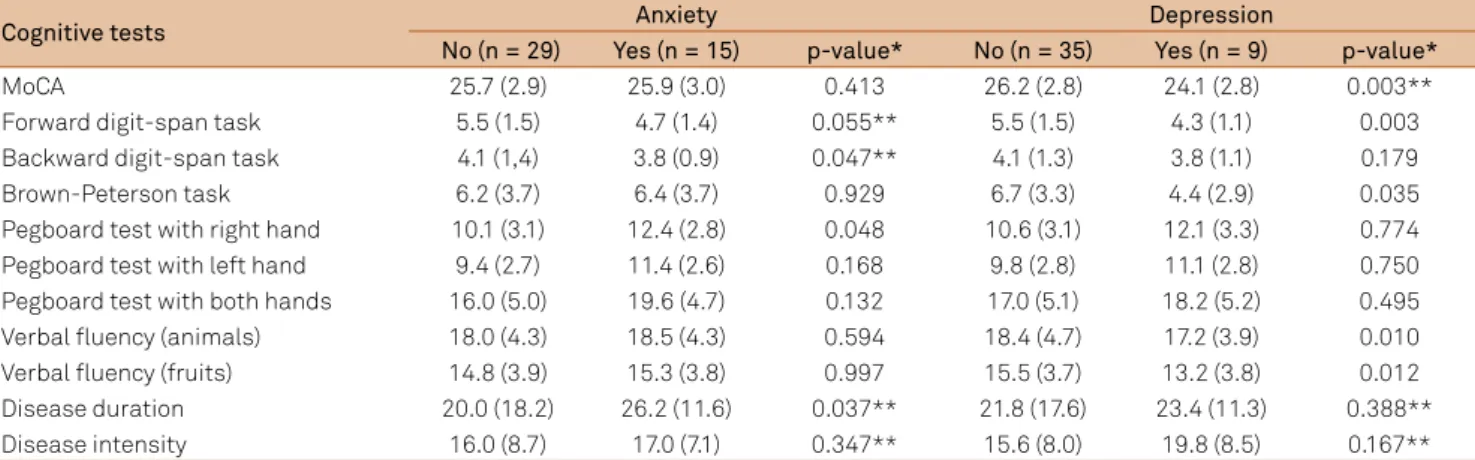
Table 4 shows cognitive test results according to the pres-ence of depression and anxiety symptoms.
Finally, we found that patients with ET on primidone had lower mean scores on the MoCA (p = 0.021), Pegboard with right hand (p = 0.002), left hand (p < 0.001) and both hands (p = 0.002) when compared to patients without use of primidone.
DISCUSSION
he results of this study suggest that patients with ET are more likely to have manual dexterity and attention deicits,
with no diferences compared to the control groups in cogni
-tive or other psychiatric functions assessed. In addition, pa-tients with more severe disease showed poorer performance
on cognitive tests. Another important inding of this study
Table 3. Correlation coefficients between cognitive test results and duration or severity of essential tremor.
Cognitive tests Disease duration Disease severity*
rS p-value rS p-value**
Moca 0.030 0.847 -0.346 0.022
Forward digit-span task -0.114 0.460 -0.341 0.024
Backward digit-span task -0.245 0.110 -0.357 0.017
Brown-peterson task -0.079 0.613 -0.421 0.005
Pegboard test with right hand 0.002 0.989 -0.419 0.005
Pegboard test with left hand -0.099 0.522 -0.461 0.002
Pegboard test with both hands -0.054 0.728 -0.502 < 0.001
Verbal fluency (animals) -0.020 0.899 -0.268 0.079
Verbal fluency (fruits) 0.052 0.738 -0.436 0.003
Similarity test 0.072 0.644 0.086 0.580
rS: Spearman’s correlation test; MoCA: Montreal Cognitive Assessment; *Disease severity according the total score of the Fahn-Tolosa-Marin Tremor Rating Scale; **p < 0.05.
Table 4. Analysis of cognitive test results according to the presence or not of psychiatric comorbidity (mean ± standard deviation).
Cognitive tests Anxiety Depression
No (n = 29) Yes (n = 15) p-value* No (n = 35) Yes (n = 9) p-value*
MoCA 25.7 (2.9) 25.9 (3.0) 0.413 26.2 (2.8) 24.1 (2.8) 0.003**
Forward digit-span task 5.5 (1.5) 4.7 (1.4) 0.055** 5.5 (1.5) 4.3 (1.1) 0.003 Backward digit-span task 4.1 (1,4) 3.8 (0.9) 0.047** 4.1 (1.3) 3.8 (1.1) 0.179
Brown-Peterson task 6.2 (3.7) 6.4 (3.7) 0.929 6.7 (3.3) 4.4 (2.9) 0.035
Pegboard test with right hand 10.1 (3.1) 12.4 (2.8) 0.048 10.6 (3.1) 12.1 (3.3) 0.774 Pegboard test with left hand 9.4 (2.7) 11.4 (2.6) 0.168 9.8 (2.8) 11.1 (2.8) 0.750 Pegboard test with both hands 16.0 (5.0) 19.6 (4.7) 0.132 17.0 (5.1) 18.2 (5.2) 0.495 Verbal fluency (animals) 18.0 (4.3) 18.5 (4.3) 0.594 18.4 (4.7) 17.2 (3.9) 0.010 Verbal fluency (fruits) 14.8 (3.9) 15.3 (3.8) 0.997 15.5 (3.7) 13.2 (3.8) 0.012 Disease duration 20.0 (18.2) 26.2 (11.6) 0.037** 21.8 (17.6) 23.4 (11.3) 0.388**
Disease intensity 16.0 (8.7) 17.0 (7.1) 0.347** 15.6 (8.0) 19.8 (8.5) 0.167**
was that patients with ET with depression and/or anxiety symptoms and those on use of primidone showed poorer manual dexterity and cognitive performance.
We decided to keep a control group of patients’ relatives
trying to ind pre motor subclinical change. his could sup
-port the hypothesis of a disease with greater range of
symp-toms but that was not the inding in our study.
A comparison between groups showed signiicant age and gender diferences. his could be explained by the fact
that unrelated controls were recruited through educational lectures attended by a greater proportion of females, which is in agreement to that described in the literature26. As for
age, healthy controls had to attend a visit at the study site
for testing, which made it diicult for older ones. In addi -tion, many relatives of patients lived far from the study site and those who lived closer were their children. We found no
statistical diferences between ET patients and controls in
results on the MoCA test, Verbal luency (categories of ani
-mals and fruits) and Similarity test, but we found a diference in the Forward and Backward digit-span task. hese results
contrast with those reported in other studies3,6,7,9. One of the
most important points of our study was to demonstrate that
there was no diference in neuropsychological assessment in
patients with ET compared with controls when controlled properly some biases.
he authors of the NEDICES study reported that patients
with ET showed poorer verbal luency in the semantic catego
-ry of fruits9; nevertheless, mean age of their patients was
high-er than that of the patients in our study (75 vs. 60 years, re-spectively). Even after comparing only those over 65, we found
no signiicant diferences in verbal luency. Furthermore, when we checked the cutof point in the Verbal luency test,
semantic category of animals, for the Brazilian population27,
we found that the mean score on the test was higher than the proposed one, demonstrating no loss of the cognitive function
assessed. We saw signiicant diferences only in test results of
the Pegboard test and Brown-Peterson task.
We found manual dexterity and coordination deicits
among patients with ET compared to controls in the Pegboard test. To our best knowledge, there is no study in the literature with patients with ET using the Pegboard test to assess
man-ual dexterity. We may assume these indings could be related
not only to dexterity but also to attention deicits. Some stud
-ies assessing patients with ET showed they had poorer quality
of life than healthy controls. he most afected domains were
functional performance and physical limitation28,29, which
may be explained by impaired manual dexterity.
With regard to the Brown-Peterson task, patients with
ET showed lower scores that were signiicantly diferent only
when compared to scores in related controls. Related con-trols had lower mean age, which may suggest that age may
afect attention and working memory, as assessed in this
test. his was veriied when we compared patients and unre
-lated controls age 65 years or more: we found no signiicant
diference in the Brown-Peterson task scores. Yet, this difer
-ence was evid-enced once again when we compared patients with ET younger and older than 65. In a 2001 study, Gasparini
et al. found executive function and attention deicits in pa
-tients with ET compared to controls suggestive of frontal lobe dysfunction6. he NEDICES study also showed abnor
-mal results in attention assessment tests9.
Kim et al. compared 34 patients with ET with 33 controls
and found signiicant diference mainly in the Forward and Backward digit-span task and Verbal luency test, but they
did not assess depression and anxiety disorders, and use of
medications that could afect cognitive performance22. Our
study found a diference when we compared patients with ET younger and older than 65, indicating an overall deicit of
attention with age.
Many studies evaluating cognitive aspects in patients
with ET did not investigate the efects of depression and
anxiety disorders and psychotropic medication use. In our
study, we excluded patients on medications that may afect
cognitive ability and those previously diagnosed with
depres-sion and anxiety disorders. Yet, we screened for depresdepres-sion
and anxiety symptoms. A comparison between anxiety and non-anxiety patients showed altered results mainly in the Backward digit-span task that requires a high level of atten-tion and in the Pegboard test with the right hand. Another
interesting inding was a higher prevalence of anxiety found
among patients with longer disease duration.
With regard to depression, we found lower scores on the MoCA test, Forward digit-span task, Brown-Peterson task and Verbal Fluency, in both categories of animals and fruits.
Contrasting with Duane et al. indings, we found a lower fre
-quency of depression and anxiety symptoms in our study
(20.5% vs. 55% of depression, and 34.1% vs. 49% of anxiety)30.
As for the use of medications that may afect cognitive
ability, we included in the study only patients on use of primi-done. A comparison of patients who were on primidone and
those who were of primidone showed diferences in the
Pegboard test and the MoCA. Possibly this can be explained by a greater mean age of patients on primidone and its
meta-bolic efects24.
We did not ind a correlation of cognitive test results
with disease duration but we did ind it with disease sever
-ity. Lombardi et al. and Troster et al. evaluated patients un-responsive to medication requiring surgical treatment3,7, and
they were found to have more severe disease, which could ex-plain the abnormal results in cognitive assessment.
Notwithstanding the aforementioned limitations, our study was able to show that patients with ET had manual
dexterity and attention deicits with no impairments in other
cognitive functions studied. In addition, patients with more
severe disease showed poorer performance on cognitive tests. Cognitive symptoms and poor manual dexterity were more common among those with depression and anxiety symptoms as well as those taking primidone.
References
1. Grau-Veciana JM, Peiro Grasa A. [Benign essential tremor. Review of a series of cases]. Neurologia. 1986;1(5):198-201. Spanish.
2. Jankovic J. Essential tremor: a heterogenous disorder. Mov Disord. 2002;17(4):638-44. doi:10.1002/mds.10221
3. Lombardi WJ, Woolston DJ, Roberts JW, Gross RE. Cognitive deficits in patients with essential tremor. Neurology. 2001;57(5):785-90. doi:10.1212/WNL.57.5.785
4. Louis ED, Viner AS, Gillman A. Mental status test scores are inversely correlated with tremor severity: a study of 161 elderly essential tremor cases. Tremor Other Hyperkinet Mov (N Y). 2012;2:tre-02-69-279-1.
5. Benito-Leon J, Louis ED, Sanchez-Ferro A, Bermejo-Pareja F. Rate of cognitive decline during the premotor phase of essential tremor: a prospective study. Neurology. 2013;81(1):60-6. doi:10.1212/WNL.0b013e318297ef2b
6. Gasparini M, Bonifati V, Fabrizio E, Fabbrini G, Brusa L, Lenzi GL et al. Frontal lobe dysfunction in essential tremor: a preliminary study. J Neurol. 2001;248(5):399-402. doi:10.1007/s004150170181
7. Woods SP, Scott JC, Fields JA, Poquette A, Troster AI. Executive dysfunction and neuropsychiatric symptoms predict lower health status in essential tremor. Cogn Behav Neurol. 2008;21(1):28-33. doi:10.1097/WNN.0b013e3181684414
8. Lacritz LH, Dewey R Jr, Giller C, Cullum CM. Cognitive functioning in individuals with “benign” essential tremor. J Int Neuropsychol Soc. 2002;8(1):125-9. doi:10.1017/S1355617702001121
9. Benito-Leon J, Louis ED, Bermejo-Pareja F. Population-based case-control study of cognitive function in essential tremor. Neurology. 2006;66(1):69-74. doi:10.1212/01.wnl.0000192393.05850.ec
10. Deuschl G, Bain P, Brin M. Consensus statement of the Movement Disorder Society on Tremor. Mov Disord. 1998;13(S3):2-23. doi:10.1002/mds.870131303
11. Fahn S, Tolosa E, Marin C. Clinical rating scale for tremor. In: Jankovic J, Tolosa E, editors. Parkinson’s disease and movement disorders. 3rd ed. Michigan: Michigan University Press 1993. p. 271-80. Williams & Wilkins.
12. Nicaretta DH, Pereira JS, Pimentel MLV. Tremor: adaptação de uma escala clínica. Arq Neuropsiquiatr. 1997;55(3a):381-6. doi:10.1590/S0004-282X1997000300005
13. Price CC, Cunningham H, Coronado N, Freedland A, Cosentino S, Penney DL et al. Clock drawing in the Montreal Cognitive Assessment: recommendations for dementia assessment. Dement Geriatr Cogn Disord. 2011;31(3):179-87. doi:10.1159/000324639
14. Bertolucci PHF, Sarmento ALR, Wajman JR. P4-062: Brazilian Portuguese version for the Montreal Cognitive Assessment (MoCA) and the preliminary results. Alzheimers Dement (N Y). 2008;4(4 suppl):T686. doi:10.1016/j.jalz.2008.05.2127
15. Tiffin J, Asher EJ. The Purdue pegboard; norms and studies of reliability and validity. J Appl Psychol. 1948;32(3):234-47. doi:10.1037/h0061266
16. Wechsler D. WMS-R: Wechsler memory scale-revised: manual. 3rd ed. Harcourt Brace Jovanovich; 1987.
17. Strauss E, Sherman EMS, Spreen O. A compendium of
neuropsychological tests: administration, norms, and commentary. 3rd ed. Oxford: Oxford University Press; 2006.
18. Brucki SM, Rocha MS. Category fluency test: effects of age, gender and education on total scores, clustering and switching in Brazilian Portuguese-speaking subjects. Braz J Med Biol Res. 2004;37(12):1771-7. doi:10.1590/S0100-879X2004001200002
19. Anil AE, Kivircik BB, Batur S, Kabakçi E, Kitis A, Güven E, et al. The Turkish version of the auditory consonant trigram test as a measure of working memory: a normative study. Clin Neuropsychol. 2003;17(2):159-69. doi:10.1076/clin.17.2.159.16510
20. Mertens VB, Gagnon M, Coulombe D, Messier C. Exploratory factor analysis of neuropsychological tests and their relationship to the Brown-Peterson task. Arch Clin Neuropsychol. 2006;21(7):733-9. doi:10.1016/j.acn.2006.08.005
21. Beato RG, Nitrini R, Formigoni AP, Caramelli P. Brazilian version of the Frontal Assessment Battery (FAB): preliminary data on administration to healthy elderly. Dement Neuropsychol. 2007;1(1):59-65.
22. Kim JS, Song IU, Shim YS, Park JW, Yoo JY, Kim YI et al. Cognitive Impairment in Essential Tremor without Dementia. J Clin Neurol. 2009;5(2):81-4. doi:10.3988/jcn.2009.5.2.81
23. Ding D, Zhang Q, Zhou D, Lin W, Wu Q, Sun J et al. Cognitive and mood effects of phenobarbital treatment in people with epilepsy in rural China: a prospective study. J Neurol Neurosurg Psychiatry. 2012;83(12):1139-44. doi:10.1136/jnnp-2012-303042
24. Brodie MJ, Kwan P. Current position of phenobarbital in epilepsy and its future. Epilepsia. 2012;53(Suppl s8):40-6. doi:10.1111/epi.12027
25. Zigmond AS, Snaith RP. The hospital anxiety and depression scale. Acta psychiatrica Scandinavica. 1983;67(6):361-70. doi:10.1111/j.1600-0447.1983.tb09716.x
26. Ministério da Saúde (BR), Secretaria de Vigilância em Saúde. Saúde Brasil 2007: uma análise da situação de saúde. Brasília, DF: Ministério da Saúde; 2008. (Série G Estatística e informação em saúde).
27. Brucki SMD, Malheiros SMF, Okamoto IH, Bertolucci PHF. Dados normativos para o teste de fluência verbal categoria animais em nosso meio. Arq Neuropsiquiatr. 1997;55(1):56-61. doi:10.1590/S0004-282X1997000100009
28. Benito-León J, Louis ED. Clinical update: diagnosis and treatment of essential tremor. Lancet. 2007;369(9568):1152-4. doi:10.1016/S0140-6736(07)60544-3
29. Lorenz D, Schwieger D, Moises H, Deuschl G. Quality of life and personality in essential tremor patients. Mov Disord. 2006;21(8):1114-8. doi:10.1002/mds.20884