AR
TICLE
1 Faculdade de Filosofia, Ciências e Letras de Ribeirão Preto, Universidade de São Paulo. Av. Bandeirantes 3900, Monte Alegre. 14040-901 Ribeirão Preto SP Brasil. carol_leonidas@ hotmail.com
Family relations in eating disorders:
the Genogram as instrument of assessment
Abstract The present study aimed to evaluate the transactional patterns in families of women with EDs, through the use of the Genogram. The study included 12 girls and women linked to a multidisciplinary service. For the preparation of Genograms, a semistructured interview script was built that included specific topics regarding family relationships. Genograms´ analysis followed the recommendations professed by the specialized lit-erature. It was evident that families presented few skills in managing stressful events and resolving conflicts, resulting in emotional distance between members and vulnerability of bonds. The Geno-gram was proved useful as a resource for research and evaluation in the area of EDs, and the gen-erated data was convergent with the literature. Results provide important subsidies for health professionals, since they indicate the need for care and development of therapeutic alliance with the family in the treatment for EDs.
Key words Eating disorders, Genogram, Family, Health assistance
Carolina Leonidas 1
L
e
o
nidas C,
S
Introduction
The occurrence of a mental disorder in a fami-ly member causes the other famifami-ly members to experience changes in life and in the household, including the experience of new emotions and responsabilities1. The way that family reacts to
these new experiences and responsibilities exert direct influence on the evolution of the disorder and the welfare of the affected person2, which
justify the need for studies that address family’s experience with mental illness.
Currently, researches on family networks have documented the crucial role that social support, especially from family, carries on prevention and treatment of diseases3. In this interface of family
support networks and promotion of health, Bull-ock mentions the reduction of mortality rates, improvement in management of symptoms of serious diseases and the increase of preventive care practices in health assistance3.
Eating disorders (ED) are health problems that have acquired more visibility in recent years. They can be defined as psychiatric conditions with multifactorial etiology4, i.e., several
etiolog-ical and pathogenic factors interact in a complex way, precipitating and perpetuating the psycho-pathological condition. ED affect mainly women between 12 and 28 years old5. Family dynamics is
one of the main factors involved in the genesis of symptoms. Morgan et al.4 claim that families that
include a member with ED present very peculiar patterns of interaction. In families with an indi-vidual diagnosed with anorexia nervosa (AN), the standards include features such as rigidity, in-trusiveness and avoidance of conflicts. In cases of bulimia nervosa (BN), family organization tends to be disrupted and disorganized, and women affected often complain of lack of affection and care4. In addition, relations between father and
daughter with ED are usually defined as emo-tionally distant and devoid of affection6.
However, it is noteworthy that considering family dynamics as part of the factors that pre-dispose to the occurrence of ED is not intended to blame the family entirely for its occurrence7.
On the contrary, researches addressing family usually seek to investigate how the interactions between family members can contribute to the maintenance of the disorder, so that health mul-tidisciplinary team can plan interventions to in-dex family members as allies in treatment. Thus, it becomes feasible to propose changes in family dynamics, especially in the way parents deal with the difficulties of the affected member, turning
family into a valuable resource in health assis-tance8.
The inclusion of family in the treatment of ED was officially legitimized in the United States in 2006, with the launch of the Practice Guideline for the Treatment of Patients with Eating Disor-ders9, a manual containing guidelines to be
fol-lowed in the treatment of patients with ED, in which authors point out the relevance of includ-ing families, since evidence consistently suggests that interventions based on family care are asso-ciated with patients’ recovery8.
In England, the National Institute of Clinical
Excellence (NICE) has also developed a manual
on treatment of ED, which was also emphasized the need to include family as care strategy10.
Sys-temic approach proposes that family can be de-fined as a system, featuring a complex web of el-ements which are dynamically related in mutual interaction11. Accordingly, each family configures
an interactional unit and each of its members is a subsystem of that unit. However, these members may also be characterized as systems themselves, constituted of several subsystems, since they bear physical, biological and psychological aspects of human life. Thus, each individual with their par-ticular subsystems, helps composing the whole family, which is much more than the simple sum of each member’s contribution.
The interaction established between individ-uals, in general, explains the individual behavior of each of the members, so that any changes that significantly affect any of them, affects everyone in variable degrees11. Serious and persistent
ill-nesses, such as ED, are potentially disruptive and affect family as a whole, changing and disturbing its dynamics12. Furthermore, the onset of
symp-toms in one of the family members can also inforce and crystallize the dynamics that rule re-lations between family members. For this reason, health assistance should include assessment of the strengths and weaknesses of families, in order to identify their coping resources.
In this scenario, the Genogram is one of the most useful tools that health professionals own to delineate the internal structure of families and map their strengths and vulnerabilities. It is noteworthy that social support is not restrict-ed to family social network, but can also come from other networks such as friends, co-work-ers, neighbors, among others3. Therefore, as a
aúd
e C
ole
tiv
a,
20(5):1435-1447,
2015
The Genogram can be defined as a standard-ized graphic structure, universally used by genet-ics, to represent the internal structure of a fam-ily. The instrument was developed as a device to evaluate, plan and intervene on family function-ing, in order to facilitate the interpretations of family experience11. It aims to gather information
on members and family relationships through generations and configures an assessment tool used also by systemic family therapy13.
Nowadays, the Genogram has been widely used as data collection tool, especially by sci-entific research with qualitative approach that address family relations14,15. As instrument of
as-sessment, the Genogram allows the detection of existing relationships in the family and, from the characterization of family structure and its posi-tion in the life cycle, also allows the researcher to develop hypotheses about the patterns of bonds and types of borders established within that con-text12. In addition, the instrument also allows to
identify possible triangulations within the family, understanding that triangulation refers to the re-lationships among three people, in which the way that one of them behaves depends and influences the behavior of the other two. The configuration of triangulations in families involves two people together against a third person, and aims to re-duce the tension between the pair12.
Genogram´s graphic layout resembles gene-alogical schemes: it is a family tree representing the family structure. Family members are placed in horizontal series that indicate generations, marriages are indicated by horizontal lines and the children by vertical lines11.
Considering these assumptions, the present study aimed to evaluate the transactional pat-terns in families of women with ED, through the use of the Genogram.
Method
This is a descriptive and exploratory study, with qualitative research approach.
Participants
Women diagnosed with ED (n = 12), linked to a care service specialized in the treatment of ED, located in a university hospital in the state of São Paulo. Participants´ average age 27.7 years (SD = 5.18 years). Eight of them had been diag-nosed with AN purging type and four with BN. The inclusion criteria were: female patients,
di-agnosed with ED (AN or BN), registered in mul-tidisciplinary treatment regardless of age, educa-tion level, marital status, duraeduca-tion of illness and psychiatric comorbidity. The following exclusion criteria were also applied: evidence of serious in-jury in language or communication, cognitive or sensory loss (hearing) that could communication and understanding of the task, patient in recov-ery phase of treatment.
This is a non-probabilistic sample, in which the number of participants was defined accord-ing to the criteria of data saturation for qualita-tive research16, which proposes that the
comple-tion of data colleccomple-tion should be given at the time that obtained data do not add new information about the object of study.
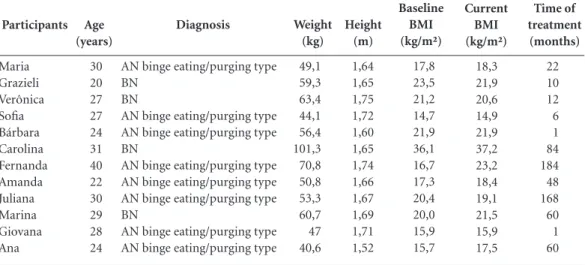
To prevent participants´ identification (Table 1), real names were replaced by fictitious names.
Instruments
Genogram and consultations to hospital re-cords, which enabled the collection of partici-pants´ demographic and anthropometric data. To develop the Genograms, a script of specific ques-tions was built, including the following topics: with whom participants lived; how she described the relations with these people; how did they relate to members of the family of origin (par-ents, brothers, uncles, grandpar(par-ents, etc.); how did they relate to their children and husband (if applicable); how these relations were configured before the ED; if they would like that these rela-tionships were different; if any members of the family distanced themselves from participants after the occurrence of the ED; if participants felt that they received family support to deal with the disorder, and if they would like the family to cope with the problem in a different way.
Literature that address families suggest the existence of “patterns of relationships crystal-lized within the family system”15, i.e., each family
has particular and recurrent forms of relation-ships among its members, generating the effect that Wendt and Crepaldi15 named as
L
e
o
nidas C,
S
- Harmonic relationship:can be defined as the
emotional experience of union between family members, who share positive feelings regarding each other. In this transactional pattern there is reciprocity of interests, attitudes and values, as well as differentiation between members among themselves and their respective families of origin.
- Very close relationship or over involvement:
relationships in which fusion and emotional de-pendency are predominant, characterizing mem-bers´ psychological indiferentiation.
- Merged and conflictual relationship:marked
by severe emotional dependency and the exis-tence of frequent conflicts among Family mem-bers. There is indiferentiation between them and, consequently, individual lines become blurred.
- Alliance: characterized by connections based
on invisible loyalties that, despite generating pos-itive interactions, can interfere in the process of differentiation between members, even though in lower levels than in over involvement.
- Conflictual relationship: refers to relations
that involve frequent arguments and disagree-ments in family enviroment, expressed by diffi-culties in communication, which involve disqual-ifications and disenpowerment of one another. These disfunctional patterns of communication can evolve to symmetric patterns, capable of gen-erating physical violence.
- Vulnerable relationship:there are no explicit
conflicts, but there is the possibility that opened
conflicts may occur in adverse conditions or transition phases.
- Distant relationship:type of bonding
usu-ally found in families which are, from the affec-tive point of view, disconnected and with rigid boundaries. There is little contact between mem-bers, especially the emotional kind of contact.
- Breakup: in this transactional pattern there
is no contact between family members, even though they still maintain emotional connection.
- Triangulation: emotional setting involving
three family members, in which the “triangu-lated” individual has the role of regulating the tension between the other two members. When there is no explicit conflict, that individual expe-riences feelings of insecurity or emotional dis-tress. When conflict occurs, the embarrassment or distress is usually transferred to the members of the dyad, awakening sense of relief in the third one.
- Coalition: property of triads, defined by the
union of two family members against a third par-ty.
It is noteworthy that the transactional pat-terns, although recurrent, may be modified over time, especially during transitional phases and regulatory crises that family experiences throughout the family life cycle. These changes constitute important means by which members of the family can differentiate from each other and thus continue the family15. Accordingly, the
Participants Maria Grazieli Verônica Sofia Bárbara Carolina Fernanda Amanda Juliana Marina Giovana Ana Age (years) 30 20 27 27 24 31 40 22 30 29 28 24 Diagnosis
AN binge eating/purging type BN
BN
AN binge eating/purging type AN binge eating/purging type BN
AN binge eating/purging type AN binge eating/purging type AN binge eating/purging type BN
AN binge eating/purging type AN binge eating/purging type
Table 1. Characterization of participants according to age, diagnosis, anthropometric data (weight, height, baseline BMI and current BMI) and time of treatment.
aúd
e C
ole
tiv
a,
20(5):1435-1447,
2015
transitions triggered by the illness may enhance both negative and positive changes in family network, depending on how family members face the tensions triggered in the process, and the predominant transactional patterns. Mental disorders, characterized by severe and persistent symptoms, can disturb family relationship pat-terns or accentuate preexisting dysfunctional re-lationships17.
Genogram’s legends, developed in accor-dance with the standards proposed by the spe-cialized literature15,18 is in Figure 1.
Ethical considerations
The study was approved by the Research Eth-ics Committee of the hospital where the study was conducted.
Data collection
The Genograms were applied individually during a single meeting with each participant, in a reserved room of the hospital. Joint work be-tween participant and researcher was proposed during the instrument construction. Three gen-erations of participants´ family were included. The focus of the data collection started from the graphical creation of families for further explora-tion of the meanings attributed to relaexplora-tionships, extracted from family stories13.
Initially, it was requested that participants described their current family configuration. From that initial report, the researcher formulat-ed questions about family relationships, inviting participants to share stories and events of family life13, in order to investigate possible influences of
ED symptoms in family dynamics. Names men-tioned by the participants were noted and it was identified the type of relationship between par-ticipants and family members15, allowing detailed
examination of the proximity and the pattern of interaction established with each member.
Data analysis
Genograms were prepared manually by the researcher during data collection. Thereafter, they were diagrammed using a specific program for creating graphic elements (CorelDRAW Graphics Suite). The interpretation of obtained results was based on the analysis guidelines rec-ommended by the literature based on systemic approach12,15,19. Data extracted from Genograms´
analysis were organized into thematic
catego-ries, taking into account the core meanings that emerged – that is, the regularity of responses and convergent patterns of contents20 obtained both
from reports, as from graphic illustrations of Genograms.
Results and Discussion
Next, five thematic categories will be present-ed and discusspresent-ed, which were developpresent-ed by the analysis of Genograms and participants´ reports, raised during instrument application.
Category 1. Merged and conflictual relationship with mother
Type of relationship between mother and daughter that refers to mutual emotional depen-dence, in which both members of the pair expe-rience difficulties to differentiate themselves of one another and to relate to each other in a more individualized way12. In this pattern of
codepen-dency, individual borders are blurred. This kind of relationship favors a wide range of conflict, since the pattern of fusional relationship between individuals is inevitably characterized by ambiv-alence and tension.
Seven participants in this study described their relationships with their mothers as fusion-al and conflictufusion-al, characterized by persistent need for the presence and frequent company of the mother. There is an alternation between the pressing need for closeness versus the need for distance, i.e. there is ambivalence between merged experiences and need for separation, denoting fear of differentiation and loss of iden-tity limits. For this reason, human relations be-come threatening, leading to withdrawal that can sometimes be confused with contempt. Howev-er, these participants felt excessively charged by mothers, which aroused intense feelings of help-lessness and incomprehension. Five participants reported alliance with the mother, without ex-pression of manifest conflicts.
When asked about the relationship with the mother, those participants who described fused and conflictual relationships could explain them only through the relationship to food, as can be seen in the following report:
L
e
o
nidas C,
S
would say: “My God, my mom is saying that I´m
eating too much”, you know? When it´s not actually
true… (Ana)
Ana has a very reticent speech, indicating difficulty to express the feelings aroused by her mother’s comments. However, it is possible to
infer the anguish aroused by the way the mother expressed her discomfort with how her daughter fed. The patient reports that in the past, when ex-posed to her mother´s comments and rebuke re-garding her feeding behavior, she felt her self-im-age being attacked and, therefore, her
self-es-Figure 1. Legends of the Genogram, according to the specialized literature14,17.
Man Woman Undefined gender Stated person
Alcohol and/or drug abuse Death = Living together
Marriage Divorce Marital separation
Birth of a dead child
Miscarriage Induced
abortion
Fraternal twins Identical twins Pregnancy
Children: Order of birth with the older one on the left
Adoptive child
Distant
Relationships:
Conflictual Break up
Very close Merged and
conflictual
Alliance
aúd
e C
ole
tiv
a,
20(5):1435-1447,
2015
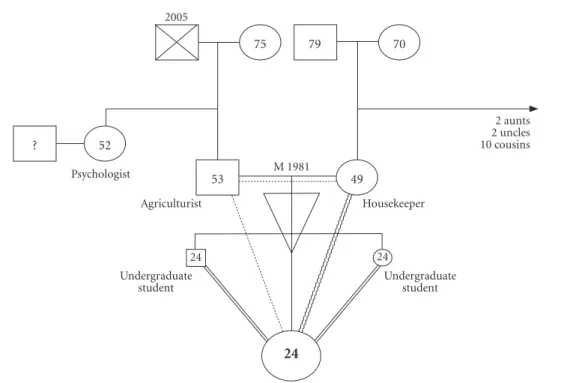
teem was depreciated. Ana´s Genogram (Figure 2) illustrates, in a sense, participant´s report during the interview. It is evident fusional and conflictual relationship with mother, vulnerable relationship with father and perception of emo-tional distance between the parental couple. It is also evident the alliance with the siblings. Partic-ipants´ relationships with father and siblings will be better addressed in the following categories, as well as the relationship between the parental couple.
The available literature on the relationship between mother and daughter affected by an ED is convergent in proposing the hypothesis of a standard fusional type of interaction, which would involve the experience of ambivalent and conflictual emotions. These relationships are built on a process of psychological indifferen-tiation, characterized by the non-recognition of individuality. The relationship of fusion and indifferentiation in ED is commonly marked by ambivalence between love and hate, as mother and daughter love each other and want to stay close, but at the same time trying, unsuccessfully, to separate and individuate21. Mother and
daugh-ter become dependent on each other and, on the other hand, feel fear and horror to this codepen-dency, which implies a recurring search for the completeness and supplementation of an inner emptiness that never seems to be fulfilled22.
Category 2. Distant and/or vulnerable relation with father
Five participants described their relationships with their fathers as vulnerable, since there once have been severe conflicts and tense situations with father figure. However, at the moment of the interview, the relationship was peaceful. The de-nomination “vulnerable relationship” necessarily implies on the possibility of relapse of conflicts in adverse situations15. Accordingly, it was evident
that, among participants, the father-daughter relationship was configured by superficial inter-actions, which did not enable the expression of emotions and did not offer support to cope with distressful experiences, since this type of open-ing in relationship could contribute to generate new doubts, difficulties and, consequently, new conflicts.
Figure 2. Ana’s Genogram.
79
Undergraduate student
2 aunts 2 uncles 10 cousins 70
75
Undergraduate student
Physical disability Agriculturist
Psychologist 52 ?
M 1981
24
Housekeeper 49
53 2005
24
L
e
o
nidas C,
S
I remember that when I was ten, more or less, he
[father] said that I was chubby... He said: “You´re chubby, something like that, when you grow up you won´t get a boyfriend, you´ll be just like F.”, F. was a friend of my sister who was fat and did not have a boyfriend because of that. After that I stopped eat-ing... Understand? I was... Then I started dieting, started losing weight... The more I lost weight, the
more I wanted to lose weight. (Juliana)
The relationship with father figure was de-scribed as distant by three participants, and con-flictual by two. Carolina and Amanda reported not caring about father´s withdrawal, as if this type of bonding had already been naturalized within family dynamics. Ana, in turn, wished that family members were emotionally closer and that they could talk more with each other. However, the participant reported believing that little dia-logue is part of her family´s profile, and that this pattern is not changeable.
So, I don´t talk very much with my father, we just talk about other people… Other people´s stuff, sometimes he tells me about someone that I know, something like this… But he doesn´t talk much,
there´s not a dialogue. (Ana)
Maria characterizes the relationship with her father as friendly, respectful, but not intimate. She reported that she had experienced several con-flicts with her parents in the past, especially when the symptoms of ED were more severe, because they tried to make her see things, and she did not
accepted it.
Well, I think they had to fight with me a lot. You know, to make me... Get to treatment... To make me see things... It was a constant struggle, you know? It was... It was a fight to take me to psychotherapy, it was a fight to make me eat, it was a fight to make me take my medication… So, for them… It was
very complicated. (Maria)
Maria´s family structure and transactional patterns are presented in Figure 3.
Two participants had lost their fathers at the time of data collection. Data extracted from Gen-ograms regarding father-daughter relationships were convergent with findings from literature, which characterize this relation as typically su-perficial23. Father is described as a blurred and
tenuous figure, and also as weak, passive, with obsessive structured personality. On the other hand, when compared to mothers, fathers are presented as warm and permissive, interfering very little on family decisions24.
Category 3. Diversity in fraternal relations
Four participants from this study reported keeping happy relationships with their siblings, and two characterized these relations as alliance. Happy relationships include feelings of union and reciprocity, and also include clear differenti-ation between members15. Alliances also refer to
union, but in this case there might be difficulties in the process of differentiation.
However, five participants described their re-lationships with siblings as distant, and three de-scribed them as conflictual. These distances and conflicts were related to the feeling of not being comprehended by siblings, not receiving support and considering that everyting was for them [sib-lings] (Grazieli).
Yeah... I´d like us to be closer. Understand? Even when we´re together, we´re like… Arguing,
you know? We´re apart. (Fernanda)
It is noteworthy that three participants main-tained different types of relationships with each sibling, i. e., they reported alliance with a broth-er and conflictual relation with a sistbroth-er, which showed multiple possibilities regarding types of relationships within family networks.
Literature shows very few data regarding fra-ternal relations of individuals with ED. Siblings may influence the disorder in a positive or neg-ative way25. This influence may happen through
the active presence of siblings in the family, the variable ways that they may react to the disorder and also through the level of influence that they exert over their parents. Many factors may af-fect siblings´ influence, including: their compre-hension over ED, prevalent type of relationship before the occurrence of the disorder, whether siblings´ involvement was stimulated or not by parents and the affected daughter, siblings´ char-acteristics of personality and family dynamics, as well as professional interventions that include siblings in health assistance.
Quality of life of siblings is usually negative-ly affected by sister´s ED26. Authors point out to
aúd
e C
ole
tiv
a,
20(5):1435-1447,
2015
Category 4. Parental couple: impoverishment of the bond and triangulation
Genograms’ analysis showed the existence of conflicts between parents of eight participants, which appear to have culminated in couple´s emotional withdrawal and, in the case of two participants, in separation. These data corrob-orate specialized literature, which suggests and relationships within families with a member af-fected by an ED are fragile, with predominance of problematic bonds, frequent arguments, triangu-lation and negative retriangu-lation with food4.
Triangulation, a phenomenon strongly pres-ent in families of individuals with ED4, was
iden-tified in the analysis of eight participants of this study. It corresponds to the connection between three people, in which one´s behavior depends and influences the other two. Triangulation´s configuration in families involve two people unit-ed when facing a third one, aiming to runit-educe the tension between the couple. It is believed that for a health development of an individual, it is
neces-sary that family members can differentiate them-selves from one another, especially regarding the ability of taking charge and making decisions on their own, independently of relations established with other people12. An example of triangulation
can be viewed in Verônica´s Genogram (Figure 4). In this case, it is noteworthy that the participant maintained an alliance with her mother, forming a couple that acts against a third member, the fa-ther, with whom the participant has a vulnerable relationship. The existence of conflicts between the parental couple can also be observed.
In the presence of ED, family relations pres-ent typical patterns of anxiety, ambivalence and excessive concern, especially in mother-daughter relationship, which usually result in the exclusion of a third member – the father, characterizing tri-angulation. Women with ED experience frequent conflicts between their parents, which can be real or imminent, and they also feel trapped in the middle of these conflicts and coerced to take the side of one parent4.
Accordingly, it is hipothesized that the over involved relationship between mother and
Figure 3. Maria’s Genogram.
27 34
High school student
High school student
Housekeeper Lawyer
Assistant in school
Works at supermarket
M 1996 S 1999
30
59 70
15 14
32 12 uncles, as
follows: 10 dead, 2 alive
and retired M 1975
L
e
o
nidas C,
S
daughter is a reflex of implicit or ostensive ten-sions between the parental couple, which are co-vert by daughter´s ED. Thereby, it can be consid-ered that the psychopathological disorder works as a “distraction”, to parents, from their own co-vert conflicts12.
Category 5. Constituted family: conflicts and vulnerability
Only three participants were married, and one of them (Maria) did not have children. She characterized the relationship between her and her ex-husband as very conflictual, since he did
not accept her way, her personality. The
relation-ship lasted for three years. Carolina, in turn, re-ported that she had two marital relationships, the first of which lasted for two years and the second for 13 years. Both relationships were defined as
very troubled, i. e., there were many struggles
be-tween the couple, especially regarding husband’s episodes of adultery. Marina also defined her marriage with her ex-husband as troubled,
es-pecially because of the extramarital relationships that he maintained many women, including par-ticipant´s cousin. It is noteworthy the conver-gence of the reports regarding the existence of conflicts and severe distrust in marital relations, which culminated in breakups.
Carolina had two children, one of each mar-riage. She reported having the habit of being physically violent to the older child, due to the fact that she used to “outburst” her anger and aggressive feelings towards him. When her sec-ond child was born, the participant reported that she could cope better with her aggressiveness, so that the violent acts against the older child were ceased. By the time of data collection, Carolina´s relationship with her older child was less con-flictual, characterized as vulnerable.
Marina also had two children: a 11 year-old daughter and a three year-old son. She mentioned her son very few times, but when she referred to her daughter it was evident a very dysfunctional relationship, characterized by the Genogram as merged and conflictual: Marina clearly expressed
Figure 4. Veronica’s Genogram
High school student Bricklayer
90
35
9 uncles who she has not seen for a long time
Has not seen in 5 years
3 Works at
supermarket 17
48 53
Informal seller
Security Housekeeper
1994 1988
M 1978 S 2000 C 2006
S 2008
M 2000
aúd
e C
ole
tiv
a,
20(5):1435-1447,
2015
desire to have a body similar to her daughter’s, which was followed by hate of her own body and, consequently, her daughter’s.
Personality of women with AN is usually distinguished by traits of inferiority, inadequacy and insecurity, followed by perfectionism, obses-siveness, compulsivity, negative emotions, with-drawal and avoidance conducts27-29. On the other
hand, women with BN usually present impulsive behaviors, histrionic traits and borderline per-sonality disorders as comobidity30,31, besides
mal-adaptative thoughts and emotions, which com-monly result in chaotic attitudes that undermine many aspects of life, such as studies, work and romantic relationships32,33.
Considering these assumptions, it is inferred that personality traits play a crucial influence in participants´ difficulties to establish and main-tain healthy relationships with people from their environment, especially those with whom they have daily contact, such as husband and children. Introversion and withdrawal, as well as impulsive behaviors and chaotic attitudes, seem to culmi-nate in difficulties of interaction, which result in shortage of members in their social networks32,34,
in performing very few leisure activities and in experiencing conflicts in marital, parental and fraternal relationships. Given the existing asso-ciation between social interaction and quality of life35, it is possible that the impoverishment of
social and family networks and the lack of leisure activities are related to the chronicity of the ED.
Final remarks
The present study aimed to evaluate transaction-al and relationtransaction-al patterns in families of women with ED, through the use of the Genogram. Data collected from the application of the instrument were convergent with the specialized literature regarding the dynamics of family relations of individuals with ED. The use of the Genogram allowed the graphic illustration of the existing types of relationships within these families, en-abling visualization the bonding patterns. The results are similar to the studies available on the literature.
In general, it was observed that participants´ relationship with their mothers was based on a very close alliance that, in most cases, configured merged relationship and resulted in indiferen-tiation between mother and daughter, causing numerous conflicts between the couple. Howev-er, the relationship with father figure emerged in participants´ reports as vulnerable and/or emo-tionally distant, prevailing superficial contact and impoverished bond.
This study allows to enlarge the accumulated knowledge since it provides evidence that family relationships in ED are distinguished by impov-erishment and vulnerability of bonds. Therefore, participants perceive their families as lacking emotional resources to deal with conflicts and difficulties aroused by the ED. Failure to reset relations after the occurrence of stressful events seems to have resulted in impairment of family dynamics, which for some member is configured for merged and conflictual relationships, and to other members is characterized by emotional distance, vulnerability and/or struggles.
L
e
o
nidas C,
S
Collaborations
C Leonidas designed the study, conducted data collection and analysis, and contributed to the final draft of the article. MA Santos designed the study, contributed to data analysis, reviewed the manuscript and worked on general supervision of the article.
Acknowledgments
aúd e C ole tiv a, 20(5):1435-1447, 2015
McGoldrick M, Gerson R. Genetogramas e o ciclo de vida familiar. In: Carter B, McGoldrick M, organizado-ras. As mudanças no ciclo de vida familiar: uma estru-tura para a terapia familiar. 2ª ed. Porto Alegre: Artes Médicas; 1995.
Moré CLOO. As redes pessoais significativas como ins-trumento de intervenção psicológica no contexto co-munitário. Paidéia 2005; 15(31):287-297.
Minayo MCS. O desafio do conhecimento: pesquisa
qua-litativa em saúde. São Paulo, Rio de Janeiro: Hucitec,
Abrasco; 1994.
Bruno CANB. Anorexia: um ponto de vista freudiano. In: Bruno CANB, organizadora. Distúrbios alimentares:
uma contribuição da psicanálise. Rio de Janeiro: Imago;
2011. p. 49-60.
Miranda MR. A complexidade da relação mãe-filha nas patologias dos contrários. In: Bruno CANB, organiza-dora. Distúrbios alimentares: uma contribuição da psica-nálise. Rio de Janeiro: Imago; 2011. p. 123-154. Nodin L, Leal IP. Representações paternas na anorexia nervosa. Anal Psicol 2005; 23(2):201-208.
Marcelli O, Braconnier A. Manual de psicopatologia do
adolescente. Porto Alegre: Artes Médicas; 1989.
Honey A, Clarke S, Halse C, Kohn M, Madden S. The influence of siblings on the experience of anorexia nervosa for adolescent girls. Eur Eat Disord Rev 2006; 14(5):315-322.
Areemit RS, Katzman DK, Pinhas L, Kaufman ME. The experience of siblings of adolescents with eating disor-ders. J Adolesc Health 2010; 46(6):569-576.
Cassin SE, Von Ranson KM. Personality and eating disorders: a decade in review. Clin Psychol Rev 2005; 25(7):895-916.
Nilsson K, Sundbom E, Häglöf B. A longitudinal study of perfectionism in adolescent onset anorexia nervosa, restricting type. Eur Eat Disord Rev 2008; 16(5):386-394.
Peres RS, Santos MA. Contribuições do Desenho da Figura Humana para a avaliação da imagem corporal na anorexia nervosa. Medicina (Ribeirão Preto) 2006; 39(3):361-370. Kaye W. Neurobiology of anorexia and bulimia nervo-sa. Physiol Behav 2008; 94(1):121-135.
Vindreau C. A bulimia na clínica psiquiátrica. In: Brus-set B, Couvreur C, Fine A, organizadores, A bulimia. São Paulo: Escuta; 2003. p. 81-102
Limbert C. Perceptions of social support and eating disorder characteristics. Health Care Women Int 2010; 31(2):170-187.
Oliveira EA, Santos MA. Perfil psicológico de pacientes com anorexia e bulimia nervosas: a ótica do psicodiag-nóstico. Medicina (Ribeirão Preto) 2006; 39(3):353-360. Leonidas C, Crepaldi MA, Santos MA. Bulimia ner-vosa: uma articulação entre aspectos 34. emocionais e rede de apoio social. Psicol teorprat 2013; 15(2):62-75. Sluzki CE. A rede social na prática sistêmica: Alterna-tivas terapêuticas. São Paulo: Casa do Psicólogo; 1997.
Article submitted 16/06/2014 Approved 08/10/2014
Final version submitted 10/10/2014 18. 19. 20. 21. 22. 23. 24. 25. 26. 27. 28. 29. 30. 31. 32. 33. 34. 35. References
Galera SAF, Zanetti ACG, Ferreira GCS, Giacon BCC, Cardoso L. Pesquisas com famílias de portadores de transtorno mental. Rev Bras Enferm 2011; 64(4):774-778.
Silva I, Pais-Ribeiro J, Cardoso H, Ramos H, Carvalho-sa SF, Dias S, Gonçalves A. Efeitos do apoio social na qualidade de vida, controle metabólico e desenvolvi-mento de complicações crônicas em indivíduos com diabetes. Psicol Saúde Doenças 2003; 4(1):21-32. Bullock K. Family social support. In: Bomar PJ, editor.
Promoting health in families: Applying research and the-ory to nursing practice. Philadelphia: Saunders; 2004. p. 141-161.
Morgan CM, Vecchiatti IR, Negrão AB. Etiologia dos transtornos alimentares: aspectos biológicos, psicológi-cos e socioculturais. Rev Bras Psiquiatr 2002; 24(3):18-23.
Vale AMO, Kerr LRS, Bosi MLM. Comportamentos de risco para transtornos de comportamento alimentar entre adolescentes do sexo feminino de diferentes es-tratos sociais do Nordeste do Brasil. Cien Saude Colet
2011; 16(1):121-132.
Dallos R, Denford S. A qualitative exploration of re-lationship and attachment themes in families with an eating disorder. Clinl Child Psychol Psychiatry 2008; 13(2):305-322.
Scorsolini-Comin F, Souza LV, Santos MA. A construção de si em um grupo de apoio para pessoas com transtornos alimentares. Estud Psicol 2010; 27(4):467-478.
Souza LV, Santos MA. Familiares de pessoas diagnos-ticadas com transtornos alimentares: Participação em atendimento grupal. Psicol Teor Pesqui 2012; 28(3):325-334.
American Psychiatric Association. Practice guideline for the treatment of patients with eating disorders. Washing-ton: American Psychiatric Association; 2006. National Institute of Clinical Excellence. National clini-cal practice guideline: core interventions in the treatment and management of anorexia nervosa, bulimia nervosa, and related eating disorders. London: National Institute for Clinical Excellence; 2004.
Wright L, Leahy M. Enfermeiras e família: um guia para
avaliação e intervenção na família. 3ª ed. São Paulo:
Roca; 2002.
McGoldrick M, Gerson R, Petry S. Genograms:
assess-ment and intervention. 3ª ed. Nova York: W. W. Norton
Co Inc; 2008.
Krüger LL, Werlang BSG. O genograma como recurso no espaço conversacional terapêutico. Rev Aval Psicol
2008; 7(3):414-426.
Gerson R, McGoldrick M. Genogramas en la evolución familiar. Barcelona: Gedisa; 1993.
Wendt NC, Crepaldi MA. A utilização do genograma como instrumento de coleta de dados na pesquisa qua-litativa. Psicol Reflex Crit2008; 21(2):302-310. Carter B, McGoldrick M. As mudanças no ciclo de vida
familiar: uma estrutura para a terapia familiar. 2ª ed.
Porto Alegre: Artmed; 2011.
Guest G, Bunce A, Johnson L. How many interviews are enough?: An experiment with data saturation and variability. Field Methods 2006; 18(1):59-82.