ABSTRACT
In the last few years, new primary immunodeficiencies and genetic
defects have been described. Recently, immunoglobulin products
with improved compositions and for subcutaneous use have become
available in Brazil. In order to guide physicians on the use of human
immunoglobulin to treat primary immunodeficiencies, based on
a narrative literature review and their professional experience, the
members of the Primary Immunodeficiency Group of the Brazilian
Society of Allergy and Immunology prepared an updated document of
the 1
stBrazilian Consensus, published in 2010. The document presents
new knowledge about the indications and efficacy of immunoglobulin
therapy in primary immunodeficiencies, relevant production-related
aspects, mode of use (routes of administration, pharmacokinetics,
doses and intervals), adverse events (major, prevention, treatment
and reporting), patient monitoring, presentations available and how
to have access to this therapeutic resource in Brazil.
1 Universidade Federal do Rio de Janeiro, Rio de Janeiro, RJ, Brazil.
2 Universidade Federal de Pernambuco, Recife, PE, Brazil.
3 Hospital Servidores do Estado do Rio de Janeiro, Rio de Janeiro, RJ, Brazil.
4 Faculdade de Medicina do ABC, Santo André, SP, Brazil.
5 Universidade de São Paulo, São Paulo SP, Brazil.
6 Universidade Federal de São Paulo, São Paulo, SP, Brazil.
7 Hospital Infantil Pequeno Príncipe, Curitiba, PR, Brazil.
8 Hospital das Clínicas, Faculdade de Medicina, Universidade de São Paulo, São Paulo, SP, Brazil.
9 Hospital de Base do Distrito Federal, Brasília, DF, Brazil.
10 Universidade Federal de Uberlândia, Uberlândia, MG, Brazil.
11 Centro Universitário do Estado do Pará, Belém, PA, Brazil.
12 Faculdade de Ciências Médicas, Santa Casa de São Paulo, São Paulo, SP, Brazil.
Corresponding author: Ekaterini Simões Goudouris – Instituto de Puericultura e Pediatria Martagão Gesteira - Rua Bruno Lobo, 50 - Cidade Universitária – Zip code: 21941-912 – Rio de Janeiro, RJ, Brazil Phone: (55 21) 2205-0996 – E-mail: [email protected]
Received on: Aug 19, 2016 – Accepted on: Jan 4, 2017
Conflict of interest: none.
DOI: 10.1590/S1679-45082017AE3844
Keywords:
Immune system diseases; Immunoglobulins; Immunoglobulins,
intravenous; Immunologic deficiency syndromes; Immunization, passive
RESUMO
Nos últimos anos, novas imunodeficiências primárias e defeitos genéticos
têm sido descritos. Recentemente, produtos de imunoglobulina, com
aprimoramento em sua composição e para uso por via subcutânea,
tornaram-se disponíveis em nosso meio. Com o objetivo de orientar
o médico no uso da imunoglobulina humana para o tratamento das
imunodeficiências primárias, os membros do Grupo de Assessoria em
Imunodeficiências da Associação Brasileira de Alergia e Imunologia
produziram um documento que teve por base uma revisão narrativa
da literatura e sua experiência profissional, atualizando o I Consenso
Brasileiro publicado em 2010. Apresentam-se novos conhecimentos
sobre indicações e eficácia do tratamento com imunoglobulina nas
imunodeficiências primárias, aspectos relevantes sobre a produção,
II Brazilian Consensus on the use of human immunoglobulin
in patients with primary immunodeficiencies
II Consenso Brasileiro sobre o uso de imunoglobulina humana em pacientes
com imunodeficiências primárias
Ekaterini Simões Goudouris
1, Almerinda Maria do Rego Silva
2, Aluce Loureiro Ouricuri
3, Anete Sevciovic Grumach
4,
Antonio Condino-Neto
5, Beatriz Tavares Costa-Carvalho
6, Carolina Cardoso de Mello Prando
7,
Cristina Maria Kokron
8, Dewton de Moraes Vasconcelos
8, Fabíola Scancetti Tavares
9,
Gesmar Rodrigues Silva Segundo
10, Irma Cecília Douglas Paes Barreto
11, Mayra de Barros Dorna
8,
Myrthes Anna Maragna Toledo Barros
8, Wilma Carvalho Neves Forte
12; in name of
Since the 1960’s, different preparations for intravenous
administration have been developed and put to use,
but it was only in the late 1970’s and early 1980’s that
this route became the route of choice for Ig replacement
in PID patients.
(16,18,19)In the 1980’s, improvements were made to
the production process and composition of this
immunobiological for intravenous infusion, allowing the
use of higher Ig doses with better infection control, but
still with many adverse effects.
(18,20)At that point in time,
subcutaneous administration started to be reported by
several services.
(21-27)It has been increasingly used in
the last 10 to 15 years, with good clinical results, few
adverse effects and other advantages when compared
to intravenous, as described later.
(28-42)Products for
subcutaneous use have been available in Brazil since
2015.
In the context of major advancements in the
knowledge of PIDs and the production of human Ig,
and with new products available in the market, we must
update the first consensus published in 2010, which is
currently in use in Brazil.
OBJECTIVE
To update the 1
stBrazilian Consensus on the Use of
Human Immunoglobulin in Patients with Primary
Immunodeficiencies, published in 2010. The text presents
advancements in knowledge of indications and efficacy
of Ig replacement in primary immunodeficiencies,
in addition to relevant facts about production, mode
of use (administration routes, pharmacokinetics,
doses and intervals), adverse events (major effects,
prevention, treatment and reporting), patient monitoring,
presentations available and how to have access to this
therapy in Brazil. The use of human Ig in secondary
immunodeficiencies or as an immunomodulator in
autoimmune and inflammatory diseases is not addressed
in this paper.
METHODS
A foundation text was prepared by the coordinators of
the advisory group, based on scientific publications on
the use of Ig in primary immunodeficiencies in the last
10 years, retrieved from PubMed and Google Scholar,
as well as relevant textbooks and guidelines, in the form
of a narrative literature review.
The text was sent by e-mail to the other 14 members
of the group, to be expanded and modified so as to
reflect the technical and literature-based knowledge as
well as the clinical experience of all involved.
forma de utilização (vias de administração, farmacocinética, doses e
intervalos), efeitos adversos (principais efeitos, prevenção, tratamento
e notificação), monitorização do paciente, apresentações disponíveis e
forma de obtenção deste recurso terapêutico em nosso meio.
Descritores:
Doenças do sistema imune; Imunoglobulinas; Imunoglobulinas
intravenosas; Síndromes de imunodeficiência; Imunização passiva
ABOUT THIS PAPER
This document was collaboratively prepared by members
of the Primary Immunodeficiency Group of the
Brazilian Society of Allergy and Immunology, based
on a narrative literature review and their professional
experience, to guide Brazilian physicians on the use
of human immunoglobulin (Ig) to treat primary
immunodeficiencies.
(1)INTRODUCTION
Primary immunodeficiencies (PID) are a very
heterogeneous group currently made up of more than
300 diseases caused by genetic mutations, leading to
abnormal development and function of the immune
system, and are characterized by recurrent infections
(either severe or caused by unusual or low-pathogenicity
agents), autoimmune or inflammatory manifestations,
and a greater predisposition to cancer.
(2-6)In the past
few years, new diseases and new genetic defects have
been described.
Several registries around the world, including the
Latin American, show that at least 50% of PIDs
predominantly affect antibody production, which is also
impaired in other types of immune system defects.
(3,7-13)The use of serum from animals or convalescent
humans in the treatment and prevention of infectious
diseases started at the end of the 19
thcentury. Purification
of Immunoglibulin G (IgG) became possible in the
1940’s with the Cohn-Oncley fractionation method,
(14)used to produce albumin for the injured during World
War II.
(15,16)Human Ig replacement therapy was performed
for the first time in 1952, by Bruton, in the first
patient described with agammaglobulinemia, using the
subcutaneous route.
(17)In the years that followed, the
intramuscular route became the most widely used for
Ig replacement. However, this mode of administration
is painful, reaches serum concentrations in about 24
hours, and has low bioavailability and less than 50%
recovery.
(18)With the use of higher doses, side effects,
A final review of the text was carried out by two
specialists in the field who were not part of the group.
INDICATIONS AND EFFICACY OF HUMAN IMMUNOGLOBULIN
IN PRIMARY IMMUNODEFICIENCIES
Treatment with Ig is currently the leading therapeutic
approach in almost 75% of PDIs,
i.e
. those in which
antibody production is impaired,
(5,43)promoting the
replacement of immunoglobulin G or IgG. The
objectives are to maintain stable and adequate serum
concentrations of this type of Ig and achieve good
clinical management of patients.
(44-48)The target serum IgG concentration had been set
at 500mg/dL in blood samples collected immediately
before the infusion,
(44,49-52)but the clinical monitoring
of patients has shown that higher values, approximately
700 to 1,000mg/dL, are more efficient to control
infections, particularly pneumonia.
(8,49,53-60)Higher target
IgG concentrations are especially important in patients
with chronic pulmonary disease and bronchiectasis,
promoting improved lung function.
(55,61-64)It is important to note that the IgG concentrations
required for infection prevention vary among individuals,
and the treatment must be individualized to find the
doses and serum IgG concentrations leading to good
clinical responses in each patient (also known as
biological IgG level).
(8,38,45,55,56,58,60,65-67)“Good clinical
control” is defined as a decrease in the number and
severity of infectious and inflammatory conditions, and
a decrease in hospitalizations and use of antibiotics,
preventing certain complications and improving general
health and quality of life.
(59,67-71)In patients with normal
IgG concentrations before initiating treatment (specific
antibody deficiencies, for example), the clinical response
alone is used for adjustment of Ig therapy.
(67)The recommendations of the European Society
for Primary Immunodeficiencies (ESID) regarding
human Ig replacement are
(72,73)serum IgG<200mg/dL is
always an indication, except for patients with transient
hypogammaglobulinemia of infancy with no severe
infections; serum IgG between 200 and 500mg/dL is an
indication in case of antibody production deficiency or
recurrent and/or severe infections; serum IgG>500mg/dL
is an indication for Ig replacement only when abnormal
production of specific antibodies is verified, and recurrent
and severe infections are present.
According to these recommendations, the use of
human Ig is indicated in all PIDs in case of documented
impairment in the production of IgG antibodies.
(47,74)However, there are evidence-based indications in
some PIDs: abnormal antibody production related to
B-cell defects (X-linked agammaglobulinemia, common
variable immunodeficiency, defective production of
specific antibodies, defects of IgG subclasses with
abnormal antibody production), except for selective
IgA deficiency, as well as combined immunodeficiencies
with or without associated syndromes (severe combined
immunodeficiencies, X-linked hyper-IgM syndrome,
X-linked lymphoproliferative syndrome, Wiskott-
Aldrich syndrome, NEMO deficiency, Warts syndrome,
WHIM syndrome - warts, hypogammaglobulinemia and
immunodeficiency), and after hematopoietic stem cell
transplant in PID patients.
(47,74-79)There is some evidence
of benefits in hyper-IgE syndrome, ataxia-telangiectasia,
DiGeorge syndrome and
anticytokine-autoantibody-mediated disorders (Chart 1).
(78,79)The immunoglobulin
may also be used as an immunomodulator, at higher
doses, to treat autoimmune manifestations associated
with some PIDs, such as thrombocytopenia or hemolytic
anemia.
(74,80,81)Chart 1. Primary immunodeficiencies in which immunoglobulin replacement is indicated
Ig indication level Primary immunodeficiencies
Required and immediate start X-linked and autosomal recessive agammaglobulinemia
Common variable immunodeficiency Severe combined immunodeficiencies X-linked and autosomal recessive hyper-IgM Wiskott-Aldrich syndrome
NEMO deficiency and IKKB WHIM syndrome Reticular dysgenesis Depends on confirmation of diagnosis
and severity of clinical condition
IgG subclass deficiency
Specific antibody deficiency X-linked lymphoproliferative syndrome Possible Transient hypogammaglobulinemia of infancy*
Ataxia-telangiectasia DiGeorge syndrome Hyper-IgE syndrome
IgA + IgG2 and/or IgG4* deficiency
Source: Abolhassani H, Asgardoon MH, Rezaei N, Hammarstrom L, Aghamohammadi A. Different brands of intravenous immunoglobulin for primary immunodeficiencies: how to choose the best option for the patient? Expert Rev Clin Immunol. 2015;11(11):1229-43. Review;(5) Albin S, Cunningham-Rundles C. An update on the use of immunoglobulin for the treatment of immunode ciency disorders. Immunotherapy. 2014;6(10):1113-26. Review;(78) Bonilla FA, Khan DA, Ballas ZK, Chinen J, Frank MM, Hsu JT, Keller M, Kobrynski LJ, Komarow HD, Mazer B, Nelson RP Jr, Orange JS, Routes JM, Shearer WT, Sorensen RU, Verbsky JW, Bernstein DI, Blessing-Moore J, Lang D, Nicklas RA, Oppenheimer J, Portnoy JM, Randolph CR, Schuller D, Spector SL, Tilles S, Wallace D; Joint Task Force on Practice Parameters, representing the American Academy of Allergy, Asthma & Immunology; the American College of Allergy, Asthma & Immunology; and the Joint Council of Allergy, Asthma & Immunology. Practice parameter for the diagnosis and management of primary immunodeficiency. J Allergy Clin Immunol. 2015;136(5):1186-205.e1-78. Review.(79)
* In the face of major infections.
Despite having increased in recent years, the use of
Ig in patients with secondary hypogammaglobulinemia
(Chart 2)
(53,82-84)must be further investigated and is
indicated in case of lower levels of serum IgG and/or
documented impairment of antigen-specific antibody
production and/or presence of relevant infections.
(43,74,85)A
condition that has become more frequent in recent years
is hypogammaglobulinemia associated with the use of
rituximab, an anti-CD20 monoclonal antibody indicated
for some autoimmune diseases, lymphoproliferative
syndromes, or refractory nephrotic syndrome. This
type of hypogammaglobulinemia affects up to 50% of
patients, especially those on regular use of rituximab;
is symptomatic in less than 10% of cases, and can
persist for a long time
(86-89)requiring Ig replacement,
either intravenous or subcutaneous.
(90)Persistent
hypogammaglobulinemia may occur in a small group
of genetically predisposed patients on rituximab.
(91,92)Numerous studies showed a reduction in infections
and mortality rates, and an overall improvement of
health status and quality of life promoted by intravenous
Ig replacement in PID patients.
(9,44,46-48,93-97)We searched the literature and found a number of
studies with similar or even better results with the use
of subcutaneous Ig, especially in regard to improved
quality of life.
(20,29,31,34,35,41,42,56,59,68,72,98-104)This route has
also been shown effective and safe in children,
(31,37,105-109)elderly (even those on anticoagulation and antiplatelet
therapy),
(30,69,110)pregnant women
(69,111)and obese
patients,
(112,113)at the same dose recommended for
intravenous use.
Although replacement therapy with human Ig
showed to be effective in a specific group of PIDs, it
must also be considered for other PIDs in case of
documented impairment of antibody production and
presence of recurrent and/or severe infections. This
therapy is safe and effective when administered either
intravenously or subcutaneously.
PRODUCTION
Ever since the first method for plasma protein
fractionation using ethanol was introduced by
Cohn-Oncley in the 1940’s,
(14)a series of improvements have
been made to the production of Ig, leading to enhanced
safety and tolerability.
(114)This process allowed for
higher doses to be used intravenously with better clinical
management of patients.
The immunoglobulin is purified from human plasma
obtained from thousands of donors, ensuring a broad
spectrum of protective antibodies. On the other hand,
this could increase the theoretical risk for transmission
of blood-borne pathogens, but this risk is eliminated
by quarantining the donated blood and applying
multiple purification steps. Different manufacturers use
different combinations of precipitation, filtration, and
chromatography to improve product purity (reaching
an IgG concentration over 95%).
(115,116)The diverse
preparations also contain a small amount of IgA and
traces of IgM.
The products available differ in their physicochemical
characteristics (presentation, concentration, osmolarity
and pH) and excipients (preservatives and IgG
aggregation inhibitors).
(5,116,117)The latest products are
safe from the standpoint of infection transmission;
they are stabilized with amino acids rather than sugars,
have lower sodium concentrations and IgA content
under 50mg/ml.
(5,16,48,114)The immunoglobulins are not generic products.
The characteristics of each product must be considered
at the time of prescription, as shown below, and
switching must be avoided, except when indicated by
the physician.
(70,116,118)Chart 2. Causes of secondary hypogammaglobulinemia
Disease-related
B-cell disorders Multiple myeloma, chronic lymphocytic leukemia, Hodgkin's and non-Hodgkin's lymphoma
Protein-losing disorders Nephrotic syndrome, protein-losing enteropathy and large burns
Lymphatic circulation-related diseases Intestinal lymphangiectasis, chylothorax, and Proteus syndrome
Infectious diseases HIV (in children), congenital infections due to rubella, cytomegalovirus, Epstein-Barr virus and toxoplasmosis
Diseases related to increased immunoglobulin catabolism
Myotonic dystrophy and hypersplenism
Secondary to the use of drugs
Immunosuppressants Corticosteroids, cyclophosphamide, acetyl mycophenolic acid, and cyclosporine
Anticonvulsants Carbamazepine, phenytoin, lamotrigine and sodium valproate
Immunobiologicals Rituximab, belimumab, imatinib, dasatinib, and atacicept
Other drugs Fenclofenac, chloroquine, captopril, sulfasalazine, gold salts, chlorpromazine and D-penicillamine
MODE OF USE (ADMINISTRATION ROUTES, DOSES
AND INTERVALS)
Human Ig can be administered as intramuscular,
intravenous and subcutaneous injections. Considering
the rate of adverse effects and the limited volume that
can be used, the intramuscular route is no longer used.
The standard loading dose of intravenous Ig is
400 to 600mg/kg/dose, starting at every 21 days.
(5,47,119)The relation between intravenous Ig doses, serum IgG
concentrations and clinical control was demonstrated
in several studies,
(59)but we must remember that
the metabolism of the administered IgG varies
among different individuals.
(39,49,50,80,120)Considering the
importance of individualizing therapy, the doses and
infusion intervals must be adjusted according to the
clinical response and IgG concentrations obtained for
each patient.
(80,116,121)Higher doses between 600 and
800mg/kg/dose (or up to 1,200mg/kg) may be required
and are particularly indicated in case of chronic lung
and/or sinus disease.
(16,55,56,61,65,94,96,116)Moreover, Ig is
better metabolized during infections and autoimmune/
inflammatory diseases, as well as with losses due
to comorbidities or PID complications, or yet, in
patients with neonatal Fc receptor promoter gene
polymorphisms.
(38,39,41)Therefore, greater doses of Ig
may be required, even if temporarily, in acute infections
(increased IgG catabolism), severe and/or persistent
diarrhea (gastrointestinal loss) or hypersplenism
(sequestration).
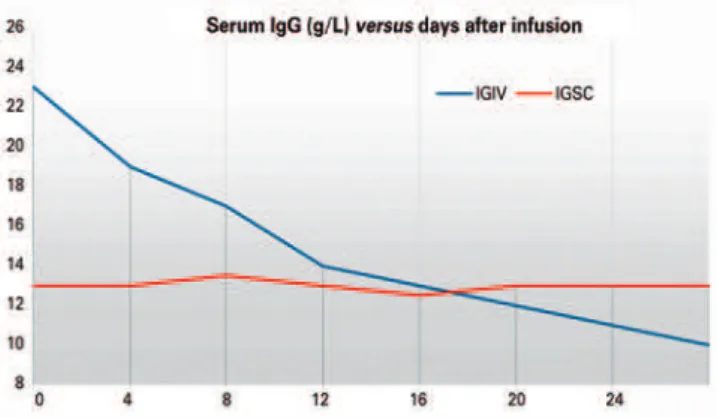
(16,80)Increase of serum concentrations with intravenous
administration occurs within a few hours at about 100
to 200mg/dL for every 100mg/kg immunoglobulin
administered, decreasing rapidly through tissue
redistribution within the first few days, with half life
around 21 to 28 days (Figure 1).
(51,56,120,122)As good
clinical control and stable serum IgG concentrations are
established, intravenous Ig infusions can be performed
every 28 days.
(42,97,123)Stable IgG values are usually
achieved within 3 (or up to 6) months of infusions.
(47,51)Patients with very low IgG concentrations (<200mg/
dL) are initially treated with intravenous Ig, often at
initial doses of 800 to 1,000mg/kg, leading to a faster
increase in serum concentrations.
(116)Subcutaneous Ig is used at the same dose as
intravenous Ig − about 400 to 600mg/kg/month,
i.e
.,
approximately 100 to 150mg/kg every week.
(42,56,59)The
increase in serum IgG concentrations was estimated
at 84.4mg/dL for each 100mg/kg/month increase in the
subcutaneous Ig dose.
(59)Blood IgG concentrations
increase less rapidly than with intravenous infusions,
(123)peaking at 2 to 4 days.
(51,125)When starting subcutaneous
administration, shorter intervals are recommended
as follows: 100mg/kg for 5 consecutive days in the first
week,
(126,127)or twice-weekly in the first 2 weeks.
(128,129)Serum IgG concentrations are more stable with
subcutaneous Ig
(130)and reached within 6 to 10 weeks of
use (Figure 1).
(124,125)The interdose interval may go from
fortnightly to daily, using infusion pumps or push
.
(67,109)There has been recent evidence showing that higher
doses of subcutaneous Ig, as has been established for
intravenous Ig, are related with superior clinical control
of patients.
(42,59)In patients who wish to switch from intravenous to
subcutaneous, we must use a quarter of the previous
monthly dose, starting subcutaneous infusions one to two
weeks after the last intravenous infusion.
(29,59,67,100,104,127,131)Subcutaneous administration should be preferably
in the abdomen, but can also be given in the arms or
thighs,
(132)without the need for site rotation.
(32)Local skin
hygiene must be performed with alcohol or chlorhexidine.
Local anesthetics or ice may be applied to reduce pain
if necessary.
(132)There is no need to use gloves, but
proper hand washing is critical.
(132)The infusion can
be administered in two to four sites, simultaneously or
sequentially, weekly or every two weeks.
(132,133)When
using infusion pumps, the infusion rate must be 0.1 to
0.25mL/kg/hour/site, reaching up to 15mL/hour/site
initially, and then a maximum of 25mL/hour/site.
(67)In
case of more frequent administration by push, doses can
be daily, twice or three times per week, or even weekly,
with adequate safety and a shorter administration time
when compared with pumps.
(67,134,135)Administration
requires 1 to 10mL syringes with 25 to 23 gauge wing sets,
Source: modified from Wasserman RL, Melamed I, Nelson RP Jr, Knutsen AP, Fasano MB, Stein MR, et al. Pharmacokinetics of subcutaneous IgPro20 in patients with primary immunodeficiency. Clin Pharmacokinet. 201150(6):405-14.(124) IgG: immunoglobulin G; IVIg: intravenous immunoglobulin; SCIg: subcutaneous immunoglobulin.4 to 6mm needles for children and 9 to 15mm needles for
adults,
(108,132,136)or special perpendicular needles,
(26,137)at a
rate of 1ml/minute.
(35)The total volume applied per site
depends largely on the individual tolerability and also
varies according to the product, dose and administration
time.
(67,135,136)In children, depending on the weight and
age group, it is usually possible to give up to 10 to 20mL
per site, whereas in adults, 30 to 40mL/site or up to 80mL,
in some cases.
(27,48,67,132,134,135)A recent survey in Europe
showed that most patients receive about 20mL per site
with good tolerability.
(134,138)A new product for subcutaneous use, already
commercially available though not in Brazil, includes
the application of hyaluronidase first and then (10
minutes later) the Ig solution, using the same route,
allowing for a higher infusion volume per site.
(139,140)In
this setting, it is possible to inject subcutaneous Ig every
21 to 28 days, just like intramuscular injections, with
appropriate safety and good clinical results.
(19)Doses
must be gradually increased over 7 weeks, which limits
the use of this product when initial IgG levels are too
low (<200mg/dL). In countries where this product is
available, it has not yet been released for use in pregnant
women and patients under 18 years of age.
(67)Studies indicate that Ig therapy is safe during
pregnancy, both intravenously or subcutaneously.
(111,141)Doses should be increased according to the clinical
control and serum IgG concentrations achieved.
Although the IgG given to pregnant women can cross
the placenta and passively protect the fetus, the dose
must be increased (20 to 30%) in the last trimester of
pregnancy, to ensure adequate levels of antibodies to
the newborn.
(111,119,142)Therapy must continue throughout the patient’s
life, except in those subjected to hematopoietic stem
cell transplantation, and in patients with unspecified
hypogammaglobulinemia, who can regain the ability to
produce Ig.
(74,79,119)In those cases, infusions can be given
at increasingly longer intervals, with close monitoring
of the patient and serum IgG values, until they can be
discontinued.
(143)However, there is no consensus in the
literature on how to proceed in these situations.
ADVERSE EFFECTS, PREVENTION, TREATMENT AND
REPORTING
Treatment with Ig is quite safe, but adverse effects have
been described in 1 to 81% of patients or infusions;
30 to 40% of patients; and 5 to 15% of infusions.
(144)They can be mild, moderate or severe,
(145,146)immediate
(during or shortly after infusion) or late (hours to
days after infusion).
(147)Those considered mild do
not cause any changes to vital signs and are resolved
with symptomatic drugs without the need to stop the
infusion. If signs and symptoms progress and/or persist
requiring interruption of the infusion, the adverse
effects are considered moderate. Severe adverse effects
require immediate discontinuation of the drug and
implementation of urgent therapeutic measures.
(145,146)Most adverse events are mild and immediate, occur
within the first infusions, are related to the rate of
infusion, and are rapidly reversible.
(115,145-152)Headache, fever, malaise, flu-like symptoms, nausea,
chills, fatigue, myalgia, low back pain, tachycardia,
blood pressure changes and erythroderma are the most
common events.
(115,144,146,147,149,152)Severe reactions occur in less than 1% of infusions
and usually with higher doses indicated for autoimmune
and inflammatory diseases.
(75,144,152,153)The exact pathophysiology of adverse events is
still unknown. Some possibilities have been raised
over the years, such as formation of IgG aggregates,
interaction between the infused IgG and microbial
antigens circulating in patients leading to formation of
immune complexes, and reaction to vasoactive plasma
components, contaminants, or other ingredients used
during processing.
(115,116,144,147,149)Anaphylactic-type reactions mostly do not involve
IgE. They usually evolve with hypertension instead
of hypotension, and are less severe in subsequent
infusions.
(116,144,151)IgE-mediated anaphylaxis is a very
rare event in patients with absence of IgA and preserved
IgE production.
(144)In these cases, the use of low-IgA
intravenous preparations or subcutaneous Ig infusions
is indicated.
(16,116,154)However, there is no need to assess
the presence of anti-IgA antibodies before starting Ig
therapy.
(144,154)Although rare, there are descriptions of neurological,
respiratory, cardiovascular, gastrointestinal, renal,
skin and blood abnormalities including headaches,
aseptic meningitis, dyspnea, bronchospasm,
transfusion-related acute lung injury (TRALI)
,
hypotension or
hypertension, arrhythmias, nausea, vomiting, diarrhea,
renal failure, hives, skin rash, pruritic dermatosis,
hemolytic anemia and thromboembolic events
(Chart 3).
(16,75,115,144,147,149,151,153,155)Some factors are associated with a higher
risk of adverse effects and are listed in chart
4.
(1,41,47,59,116,144,146,148,151-153,155,156)It is worth noting that the
Most adverse effects can be resolved by reducing
the rate or briefly stopping the infusion, and by giving
analgesics and/or anti-histamines.
(5,146,147,151)Some patients
may require corticosteroids.
(146,149,158)In case of adverse reactions during intravenous
administration, proper measures must be taken for
future infusions (Chart 6).
(146,147,151,157)Chart 3. Types and frequency of adverse effects associated with administration of intravenous immunoglobulin
Symptoms and signs Frequency
Related to infusion rate
Chills Frequent
Headache Frequent
Dyspnea Frequent
Chest pain or tightness Frequent
Back pain Frequent
Fatigue and malaise Frequent
Fever Frequent
Hypotension or hypertension Frequent
Myalgia Frequent
Nausea and vomiting Frequent
Pruritus Frequent
Skin rash and hives Frequent
Flu-like symptoms Frequent
Tachycardia Frequent
Central nervous system
Aseptic meningitis Rare
Severe headache Rare
Renal
Acute renal failure (acute tubular necrosis) Rare (usually associated with sucrose as a stabilizer)
Azotemia Rare
Thromboembolic events
Thrombosis and cerebral infarction Rare
Myocardial infarction Rare
Pulmonary thromboembolism Rare
Posterior leukoencephalopathy syndrome Rare Other
Anti-IgA IgE-mediated anaphylaxis Very rare Abnormal heart rhythm Isolated reports (very rare)
Coagulopathy Isolated reports (very rare)
Hemolysis – alloantibodies against A and B blood types
Isolated reports (very rare)
Cryoglobulinemia Isolated reports (very rare)
Neutropenia Isolated reports (very rare)
Alopecia Isolated reports (very rare)
Uveitis Isolated reports (very rare)
Non-infectious hepatitis Isolated reports (very rare) Source: Ballow MC. Immunoglobulin therapy: replacement and immunomodulation. In: Rich RR, editor. Clinical immunology: principles and practice. 4th. USA: Elsevier; 2013. p. 1041-63;(60) Späth PJ, Granata G, La Marra F, Kuijpers TW, Quinti I. On the dark side of therapies with immunoglobulin concentrates: the adverse events. Front Immunol. 2015;6:11. Review.(115) IgA: immunoglobulin A; IgE: immunoglobulin E.
Chart 5. Measures to prevent adverse effects of intravenous immunoglobulin
Control of predisposing factors: treat infectious processes and slow down infusion in case of major infection, avoid product switching, avoid long periods between infusions Pre-hydration (30 minutes prior) with 0.9% saline solution, 10 to 20mL/kg in children, and 500mL in adults
Allow product to reach room temperature Properly reconstitute lyophilized products Monitor vital signs every 20 to 30 minutes
Slow infusion rate, particularly in first infusions, and using infusion pumps, whenever possible. Start at 0.01mL/kg/minute (0.5 to 1mg/kg/minute), increasing gradually (every 15 to 30 minutes) to 0.02mL/kg/min, 0.04mL/kg/min, 0.06mL/kg/min up to 0.08mL/kg/min (4 to 8mg/kg/min, respectively for products at 5 and 10%), over 3 to 6 hours
A scaled regimen with shorter intervals can be used in subsequent infusions, or even continuous infusion, as tolerated by the patient
Observe for 30 to 60 minutes after completion, before releasing the patient
Chart 4. Factors associated with a greater rate of adverse effects of intravenous immunoglobulin
Presence of infections Fever with no apparent source Dehydration
Obesity Age over 65 years
High blood pressure, heart disease or kidney disease Concomitant use of nephrotoxic drugs
Hypercoagulable states First infusions
Long interval between infusions Product switching
Products with high concentrations (and high osmolarity) Products with high sodium and/or sugar content High rate of infusion
Higher doses
products, or even between different batches of the
same product. Some patients have adverse effects with
one or more Ig products, but not all of them.
(144)Considering the predisposing factors presented,
proper measures must be taken to prevent adverse
effects resulting from intravenous Ig infusions
(Chart 5).
(1,47,116,146,148,151,157)Chart 6. Measures for secondary prevention of adverse reactions to intravenous immunoglobulin
Slower rate of infusion in patients with prior reaction
Pre-medication with analgesics and/or nonsteroidal anti-inflammatory drugs, H1 (and anti H2) antihistamines, and corticosteroids
Pre-hydration with 0.9% saline solution
Switch product or consider subcutaneous Ig in case of major reactions with no response to symptomatic drugs
Special attention is needed for patients with
comorbidities, such as heart diseases, kidney diseases,
liver diseases, coagulation disorders (thrombophilia),
and
diabetes mellitus
. In these situations, some product
characteristics, such as the presence of sugars, osmolality,
sodium, among others, must be assessed. Chart 7
describes the most relevant factors according to the
associated morbidity, and chart 8 lists the products
available to facilitate this choice.
(5,117,147)Subcutaneous administration is rarely associated
with systemic adverse effects, which occur in less than
1% of infusions.
(42,72,144)Approximately 75% of patients
Chart 8. Human immunoglobulin, commercial products available in Brazil
Brand name Manufacturer/distributor Sugar Sodium Osmolarity pH IgA concentration
Intravenous use
Endobulin Kiovig 10% solution Baxter Hospitalar Does not contain
Does not contain 240-300mOsmoI/kg 46-5.1 Maximum: 0.14mg/mL
Flebogamma DIF 5% solution Grifols D-Sorbitol <3.2mmol/L 32±4.5mOsmI/kg 5.6±0.1 <0.003mg/mL
Flebogamma DIF 10% solution Grifols D-Sorbitol <3.2mmol/L 342±7.2mOsmI/kg 5.5±0.1 <0.003mg/mL
Blau* Immunoglobulin Blausiegel Maltose - - -
-OCTAGAM® 5% solution Octapharma Maltose ≤0.015mmol/mL 310-380mOsmol/Kg 5.1-6.0 <0.2mg/mL
OCTAGAM® 10% solution Octapharma Maltose ≤0.03mmol/mL ≥240mOsmol/Kg 4.5-5.0 <0.4mg/mL
Privigen CSL Behring Does not
contain
Does not contain 320mOsmol/kg 4.8 ≤0.025g/L
TEGELINE® 5% lyophilized powder LFB Sucrose 2mg/mL NaCL 340-480mOsmol/kg 4.0-7.4 Maximum: 17mg/g
TEGELINE® NEWY 5% solution LFB Mannitol Does not contain 270-330mOsmol/kg 4.0-7.4 Maximum: 0.022mg/mL
Vigam®* Meizler Sucrose <160mmol/L >240mOsmol/kg - <100mcg/mL
Subcutaneous use
Endobulin Kiovig 10% solution† Baxter Hospitalar Does not contain
Does not contain 240-300mOsmol/kg 4.6-5.1 Maximum: 0.14mg/mL
Hizentra®‡ CSL™ Behring Does not
contain
Does not contain 380mOsmol/kg 4.8 Maximum content: 50mcg/L
Source: data obtained from manufacturers.
* Data obtained from product inserts; † Product previously approved only for intravenous use, recently released for subcutaneous use (Resolution 1789 of June 19, 2015, published in the Official Federal Gazette of June 22, 2015); ‡ Product exclusively for subcutaneous use as recently approved by the National Health Surveillance Agency (ANVISA) (Resolution 2617 of September 18, 2015, published in the Official Federal Gazette of September 21, 2015).
Chart 7. Immunoglobulin characteristics to be assessed before prescribing commercial intravenous immunoglobulin products, considering comorbidities and age groups
Comorbidities and age groups Characteristics of Ig products
Volume Osmolarity Sodium Sugar Other stabilizers pH IgA
Heart failure x x x - x
Glycine
x
-Renal failure x x x x
Sucrose-glucose
- -
-Anti-IgA antibodies - - - x
Thromboembolic risk x x x - - -
-Diabetes mellitus - - - x
Glucose-maltose
- -
-Hyperprolinemia - - - - x
L-proline
-
-Hereditary fructose intolerance - - - x
Sorbitol
- -
-Corn allergy - - - x
Maltose
- -
-Seniors x x x x
Glucose
- -
-Newborn/children x x x - - x
-Source: modified from Abolhassani H, Asgardoon MH, Rezaei N, Hammarstrom L, Aghamohammadi A. Different brands of intravenous immunoglobulin for primary immunodeficiencies: how to choose the best option for the patient? Expert Rev Clin Immunol. 2015;11(11):1229-43. Review.(5)
present with any grade of edema and hyperemia at the
administration site which, however, usually resolve
within 24 to 48 hours and tend to disappear in later
infusions, without impairing treatment continuity
using this route.
(29,32,69,99,144,146,151,159,160)Therefore, there
is no need for pre-medications or medical supervision
during infusions after proper training of patients/
caregivers.
(16,144)It is important to report the adverse effects of Ig
administration observed by physicians as well as patients
and their caregivers, at the website NOTIVISA - Health
Surveillance Reporting System: http://www.anvisa.
gov.br/hotsite/notivisa/index.htm. The manufacturers,
according to Decree 6523, of 31 July 2008, by the Chief
of Staff, must have a customer service call center (SAC)
with lines readily available. And physicians and patients
must be able to use this call center to report signs and
symptoms related with the use of different human Ig
presentations commercially available.
CHOOSING BETWEEN INTRAVENOUS AND SUBCUTANEOUS
ADMINISTRATION
Treatment of patients with PID as well as other patients,
particularly those with chronic diseases, must always be
individualized to achieve good control of the disease
and its manifestations, as well as good quality of life, and
must be as adjusted as possible to patient characteristics
and preferences.
(27,41,70,116,123)Each of the routes, intravenous or subcutaneous,
has interesting features (Chart 9) depending on factors
related to the disease, the patient and their family,
as well as their socioeconomic level. What can be
described as a disadvantage for a certain patient can
be quite beneficial in other situations. For example,
monthly intravenous application in a hospital could be
interesting for patients with more severe disease, whose
family does not adhere to the treatment, in which case
close clinical monitoring is critical.
Chart 9. Comparison between intravenous and subcutaneous immunoglobulin
Items for comparison Intravenous Ig Subcutaneous Ig*
Infusion frequency Every 3 to 4 weeks From daily to every 2 weeks
Infusion volume Large Small
Infusion time 2 to 6 hours 30 to 90 minutes (pump)
5 to 20 minutes (push)
Use of high doses Possible Limited by volume/sites and number of sites
Control of serum IgG levels Before each infusion Anytime
Pharmacokinetics Rapid rise in IgG levels after infusion, with subsequent fluctuating levels and wear-off effect
Slower increase in IgG levels, with subsequent stable levels and no wear-off effect
Infusion Requires venous access secured by qualified professionals at a healthcare unit
No need for venous access, can be applied by the patient, caregiver or healthcare professional after training, can be
administered at home
Efficacy Effective in infection control Effective in infection control
Infusion site reactions Rare Frequent but usually mild and improving with time
Systemic reactions Rare, more prevalent in the first infusions and depending on the presence of comorbidities
Very rare
Level of patient satisfaction Generally preferred by patients and caregivers who do not wish to self-administer or want less frequent applications
Overall improvement in the quality of life of patients who want independence and fewer trips to the healthcare unit, or patients
who experience adverse events with intravenous Ig Patient characteristics Preferable in patients of low socioeconomic and education level
requiring closer clinical follow-up, with poor adherence to the treatment, with extensive or severe skin lesions, coagulation disorders,
and patients resistant to self-administration
Preferable in the presence of some comorbidities, difficult venous access, poor clinical control or significant adverse effects with intravenous infusion, difficult access to the healthcare facility; indicated for patients with good treatment
adherence, good hygiene conditions at home, and trained and motivated to perform administration Cost Higher (product, healthcare facility, infusion supplies, healthcare staff) Lower (product, infusion supplies and pump)
Source: Wasserman RL. Progress in gammaglobulin therapy for immunodeficiency: from subcutaneous to intravenous infusions and back again. J Clin Immunol. 2012;32(6):1153-64. Review;(18) Kobrynski L. Subcutaneous immunoglobulin therapy: a new option for patients with primary immunodeficiency diseases. Biologics. 2012;6:277-87;(35) Shapiro R. Subcutaneous immunoglobulin. Immunol Allergy Clin North Am. 2012. In press;(36) Torgerson TR, Bonagura VR, Shapiro RS. Clinical ambiguities--ongoing questions. J Clin Immunol. 2013;33(Suppl 2):S99-103;(41) Shabaninejad H, Asgharzadeh A, Rezaei N, Rezapoor A. A Comparative Study of Intravenous Immunoglobulin and Subcutaneous Immunoglobulin in Adult Patients with Primary Immunodeficiency Diseases: a systematic review and meta-analysis. Expert Rev Clin Immunol. 2016;12(5):595-602. Review;(42) Peter JG, Chapel H. Immunoglobulin replacement therapy for primary immunodeficiencies. Immunotherapy. 2014;6(7):853-69. Review;(48) Albin S, Cunningham-Rundles C. An update on the use of immunoglobulin for the treatment of immunode ciency disorders. Immunotherapy. 2014;6(10):1113-26. Review;(78) Sriaroon P, Ballow M. Immunoglobulin Replacement Therapy for Primary Immunodeficiency. Immunol Allergy Clin North Am. 2015;35(4):713-30. Review;(116) Berger M. Choices in IgG replacement therapy for primary immune deficiency diseases: subcutaneous IgG vs. intravenous IgG and selecting an optimal dose. Curr Opin Allergy Clin Immunol. 2011;11(6):532-8. Review;(130) Abolhassani H, Sadaghiani MS, Aghamohammadi A, Ochs HD, Rezaei N. Home-based subcutaneous immunoglobulin versus hospital-based intravenous immunoglobulin in treatment of primary antibody deficiencies: systematic review and meta analysis. J Clin Immunol. 2012;32(6):1180-92. Review;(161) Shapiro R. Why I use subcutaneous immunoglobulin (SCIG). J Clin Immunol. 2013;33 Suppl 2:S95-8. Review.(173)
The intravenous route allows for faster achievement
of higher IgG concentrations, has documented efficacy
and accommodates longer administration intervals.
In addition, by infusing at the hospital, it is possible
to have patients under stricter supervision by the
healthcare staff. However, it is necessary to secure
venous access, which can be difficult in many patients,
and the procedure must be preferably performed at a
hospital, requiring monthly visits. There is also systemic
adverse effects, even if not frequent. The serum IgG
concentrations obtained are unstable, with significant
reduction 15 to 20 days after administration, sometimes
associated with symptoms such as fatigue and malaise
(wear-off effects).
(48,130)With subcutaneous use, serum IgG concentrations
are more stable, allowing for easier application, without
the need for venous access. In some countries, there is
no need to visit the healthcare facility, offering greater
independence to patients and caregivers.
(48,161)Other
countries have vast experience with the subcutaneous
route, with proven efficacy and safety,
(31,35,104,160,162)including fewer systemic adverse effects.
(31,32,130,163)Furthermore, there are many studies demonstrating
improved quality of life with subcutaneous Ig
replacement.
(35,59,68,102,164)Serum IgG concentrations
rise more slowly, which could be considered a
disadvantage in cases of very low initial IgG levels,
but is an advantage in patients with hypersplenism or
high renal/gastrointestinal loss.
(165)There is a need for
training and engagement of patients and/or caregivers,
which is usually possible to be achieved over 4 to 6
weeks, and close monitoring of the infusion technique
must be maintained subsequently.
(27,104,137,162)There are
several studies,
(31,166-171)including national studies,
(172)pointing to a considerable cost reduction associated
with subcutaneous administration, particularly when
performed at home.
Intravenous Ig is effective, safe, leads to a rapid
rise in IgG concentrations, and can be obtained via the
public healthcare system in Brazil (SUS -
Sistema Único
de Saúde
) as well as the private system. Subcutaneous
Ig has been offered only by the private healthcare
system. The classic indications for subcutaneous Ig are
problems with intravenous infusion: inadequate IgG
concentrations, poor clinical control, wear-off, systemic
adverse effects, difficulty securing venous access, or
difficult access to healthcare facilities.
(42,116,173)Individual
aspects which can improve the quality of life of patients
must also be considered when this choice is made, as
well as reduction of treatment costs.
(18,27,41,57,71,116,173)MONITORING
Clinical and laboratory monitoring of patients must be
performed to ensure good disease control and watch for
complications and potential side effects of the therapy.
It is critical to record the product brand, the lot number
and the expiration date of every infusion.
(52,60)Regular clinical evaluations must be performed at
variable intervals, depending on the severity of the PID,
as well as personal, familial and social characteristics
of the patient. It is important to observe the number,
type and severity of infections, use of antibiotics, need
for hospitalizations, attendance of every day activities
(school or work), new complaints and symptoms, and
presence of comorbidities, in addition to performing a
complete physical examination.
(5,27,59)The following tests are recommended before the
start of infusions: Ig levels (A, M, G and E), evaluation
of vaccine response and lymphocyte count (T, B and
NK), complete blood count, direct Coombs, kidney
and liver function, and PCR for infectious agents
(because these patients have impaired antibody
production, serologic tests for infectious agents are not
indicated).
(47,57,116,144,157)Laboratory control must be carried out every
3 to 6 months in the first year, and then every 6 to
12 months depending on the clinical condition. It
must include
(5,72,116,119)serum IgG, and also IgA and
IgM, particularly in very young patients, in order
to detect recovery in patients with unspecified
hypogammaglobulinemia; complete blood count;
sedimentation rate; C-reactive protein; direct Coombs;
and kidney and liver function tests.
APPROVED PRODUCTS
The products approved for sales in Brazil are presented
in chart 8.
(LME); medical report with rationale for use, clinical
condition and diagnosis; results of auxiliary tests and
two copies of the prescription; informed consent
form. All information can be found on the websites of
State Health Departments in Brazil.
The use of subcutaneous or intravenous Ig at
home is not yet approved in our country, despite it
being common in other countries,
(27,29,37-39,41,161)as well
as demonstratedly effective and safe.
(25,99,107,145,162,174)A
recent survey conducted by the International Patient
Organisation for Primary Immunodeficiencies (IPOPI),
in 20 countries, showed that among 300 patients, 53%
received intravenous Ig and 45%, subcutaneous Ig,
and that 14% of patients on intravenous Ig and 94%
of patients on subcutaneous Ig received infusions at
home.
(138)CONCLUSION
Ever since the 1
stBrazilian Consensus on the Use of
Human Immunoglobulin in Patients with Primary
Immunodeficiencies, published in 2010, several new
primary immunodeficiencies have been described.
Since then, new human immunoglobulin products have
been made available in our country, with different
compositions and administration routes. Therefore, the
recommendations for the use of immunoglobulin in
our country need to be updated.
This work provides new knowledge on the products
available, their indications, mode of use and monitoring
information.
The indication of each product depends on clinical
and laboratory characteristics of patients, and treatment
individualization and patient monitoring are critical,
irrespective of the brand or route of administration of
the product.
ACKNOWLEDGEMENTS
For the final review of the text, we thank Fernanda
Pinto Mariz and Flavia Amendola Anísio de Carvalho,
Allergy and Immunology specialists from the Brazilian
Society of Allergy and Immunology.
REFERENCES
1. Costa-Carvalho BT, Solé D, Condino-Neto A, Rosário Filho N. I Consenso Brasileiro sobre o Uso de Imunoglobulina Humana em Pacientes com Imunodeficiências Primárias. Rev Bras Alerg Imunopatol. 2010;33(3):104-16. 2. Ochs HD, Hagin D. Primary immunodeficiency disorders: general classification, new molecular insights, and practical approach to diagnosis and treatment. Ann Allergy Asthma Immunol. 2014;112(6):489-95. Review.
Chart 10. Primary immunodeficiencies and International Classification of Diseases (ICD-10) for which immunoglobulin replacement is indicated, as per the 2010 proposal to update the Clinical Protocol and Therapeutic Guidelines for primary immunodeficiencies with antibody defects
D80.0 - Hereditary hypogammaglobulinemia D80.1 - Non-familial hypogammaglobulinemia D80.3 - Selective IgG subclass deficiency D80.5 - Hyper IgM immunodeficiency
D80.6 - Antibody deficiency with near-normal immunoglobulins or hypergammaglobulinemia
D80.7 - Transient hypogammaglobulinemia of infancy*
D80.8 - Other immunodeficiencies with predominantly antibody defects D81.0 - Severe combined immunodeficiency (SCID) with reticular dysgenesis D81.1 - Severe combined immunodeficiency (SCID) with low T and B-cells D81.2 - Severe combined immunodeficiency (SCID) with low or normal B-cells D81.3 - Adenosine deaminase deficiency
D81.4 - Nezelof Syndrome
D81.5 - Purine nucleoside phosphorylase deficiency D81.6 - Major histocompatibility complex class I deficiency D81.7 - Major histocompatibility complex class II deficiency D81.8 - Other combined immune deficiencies
D82.0 - Wiskott-Aldrich Syndrome D82.1 - DiGeorge Syndrome
D83.0 - Common variable immunodeficiency with predominantly B-cell number and function abnormalities
D83.2 - Common variable immunodeficiency with anti-B or T-cell autoantibodies D83.8 - Other common variable immunodeficiencies
Source: http://bvsms.saude.gov.br/bvs/saudelegis/sas/2010/cop0022_10_05_2010.html
OBTAINING HUMAN IMMUNOGLOBULIN FOR THERAPEUTIC
USE IN BRAZIL
Treatment with human Ig can be obtained via the
private healthcare system (regulated by the National
Health Agency - ANVISA) or the public system.
To obtain from the private healthcare system,
the assisting physician must write a report with
the rationale for use, clinical condition, results of
diagnostic and auxiliary tests, containing the ICD-10
and the prescription of the product with the proposed
dose and frequency, informing where infusions will be
performed. Products for intravenous or subcutaneous
use can be administered at infusion centers, hospitals,
day-hospitals or at home for patients on home care.
3. Rezaei N, Vries ED, Gambineri E, Haddad E. Common presentations and diagnostic approaches. In: Sullivan KE, Stiehm ER, editors. Stiehm’s Immune Deficiencies. United States: Elsevier; 2014. p. 3-58.
4. Bousfiha A, Jeddane L, Al-Herz W, Ailal F, Casanova JL, Chatila T, et al. The 2015 IUIS Phenotypic Classification for Primary Immunodeficiencies. J Clin Immunol. 2015;35(8):727-38. Review.
5. Abolhassani H, Asgardoon MH, Rezaei N, Hammarstrom L, Aghamohammadi A.
Different brands of intravenous immunoglobulin for primary immunodeficiencies: how to choose the best option for the patient? Expert Rev Clin Immunol. 2015; 11(11):1229-43. Review.
6. Picard C, Al-Herz W, Bousfiha A, Casanova JL, Chatila T, Conley ME, et al.
Primary immunodeficiency diseases: an update on the classification from the nternational Union of Immunological Societies Expert Committee for Primary Immunodeficiency 2015. J Clin Immunol. 2015;35(8):696-726. Review.
7. Leiva LE, Zelazco M, Oleastro M, Carneiro-Sampaio M, Condino-Neto A,
Costa-Carvalho BT, Grumach AS, Quezada A, Patiño P, Franco JL, Porras O, Rodríguez FJ, Espinosa-Rosales FJ, Espinosa-Padilla SE, Almillategui D, Martínez C, Tafur JR, Valentín M, Benarroch L, Barroso R, Sorensen RU; Latin American Group for Primary Immunodeficiency Diseases. Primary immunodeficiency diseases in Latin America: the second report of the LAGID registry. J Clin Immunol. 2007;27(1):101-8.
8. Ballow M, Notarangelo L, Grimbacher B, Cunningham-Rundles C, Stein M,
Helbert M, et al. Immunodeficiencies. Clin Exp Immunol. 2009;158 Suppl 1:14-22. Review.
9. Errante PR, Franco JL, Espinosa-Rosales FJ, Sorensen R, Condino-Neto
A. Advances in primary immunodeficiency diseases in Latin America: epidemiology, research, and perspectives. Ann N Y Acad Sci. 2012;1250:62-72. Review.
10. Grimbacher B; ESID Registry Working Party. The European Society for Immunodeficiencies (ESID) registry 2014. Clin Exp Immunol. 2014;178 Suppl 1:18-20.
11. Kobrynski L, Powell RW, Bowen S. Prevalence and morbidity of primary immunodeficiency diseases, United States 2001-2007. J Clin Immunol. 2014; 34(8):954-61.
12. Mahlaoui N, Gathmann B, Kindle G, Ehl S, Quinti I, Grimbacher B, on behalf of the ESID Registry Working Party Steering Committee (Isabella Quinti, Italy, Bodo Grimbacher, Germany, Matthew Buckland, United Kingdom, Markus Seidel, Austria, Joris van Montfrans, The Netherlands) and the ESID Society. The European Society for Immunodeficiencies (ESID) Registry: recent advances in the epidemiology of Primary Immunodeficiencies and how does that translate in clinical care. Rare Dis Orphan Drugs. 2014;1(4 Suppl 4):25-7. 13. Modell V, Quinn J, Orange J, Notarangelo LD, Modell F. Primary
immunodeficiencies worldwide: an updated overview from the Jeffrey Modell Centers Global Network. Immunol Res. 2016;64(3):736-53. 14. Oncley J, Melin M, Richert D, Cameron J, Gross P. The separation of the
antibodies, isoagglutinins, prothrombin, plasminogen and beta1 lipoprotein into subfractions of human plasma. J Am Chem Soc. 1949;71(2):541-50.
15. Eibl MM. History of immunoglobulin replacement. Immunol Allergy Clin North
Am. 2008;28(4):737-64, viii. Review.
16. Berger M, Stiehm ER. From subcutaneous to intravenous immunoglobulin and
back. In: Etzioni A, Ochs HD, editors. Primary immunodeficiency disorders: a historic and scientific perspective. United States: Academic Press; 2014. p. 307-77.
17. Bruton O. Agammaglobulinemia. Pediatrics. 1952;9(6):722-8.
18. Wasserman RL. Progress in gammaglobulin therapy for immunodeficiency: from subcutaneous to intravenous infusions and back again. J Clin Immunol. 2012;32(6):1153-64. Review.
19. Wasserman RL, Stein M, Melamed I, Kobrynski LJ, Gupta S, Puck J, et al. Long-term efficacy and safety of recombinant human hyaluronidase (rHuPH20)- facilitated subcutaneous infusion of immunoglobulin G (IgG) (HyQvia; IGHy) in patients with primary immunodeficiencies (PI). J Allergy Clin Immunol. 2015;135(2 Suppl):AB96.
20. Skoda-Smith S, Torgerson T, Ochs HD. Subcutaneous immunoglobulin replacement therapy in the treatment of patients with primary immunodeficiency disease. Ther Clin Risk Manag. 2010;6:1-10.
21. Berger M, Cupps TR, Fauci AS. Immunoglobulin replacement therapy by slow subcutaneous infusion. Ann Intern Med. 1980;93(1):55-6.
22. Roord JJ, van der Meer JW, Kuis W, de Windt GE, Zegers BJ, van Furth R, et al. Home treatment in patients with antibody deficiency by slow subcutaneous infusion of gammaglobulin. Lancet. 1982;1(8273):689-90. 23. Ugazio AG, Duse M, Re R, Mangili G, Burgio GR. Subcutaneous infusion
of gammaglobulins in management of agammaglobulinaemia. Lancet. 1982; 1(8265):226.
24. Roord JJ, van der Meer JW, Kuis W, van Furth R. Treatment of antibody deficiency syndromes with subcutaneous infusion of gamma globulin. Birth Defects Orig Artic Ser. 1983;19(3):217-21. Review.
25. Chapel H, Brennan V, Delson E. Immunoglobulin replacement therapy by
self-infusion at home. Clin Exp Immunol. 1988;73(1):160-2.
26. Gardulf A, Hammarström L, Smith CI. Home treatment of hypogammaglobulinaemia with subcutaneous gammaglobulin by rapid infusion. Lancet. 1991;338(8760): 162-6.
27. Chapel H, Gardulf A. Subcutaneous immunoglobulin replacement therapy: the European experience. Curr Opin Allergy Clin Immunol. 2013;13(6):623-9. Review. 28. Gardulf A, Andersen V, Björkander J, Ericson D, Frøland SS, Gustafson R, et al.
Subcutaneous immunoglobulin replacement in patients with primary antibody deficiencies: safety and costs. Lancet. 1995;345(8946):365-9.
29. Chapel HM, Spickett GP, Ericson D, Engl W, Eibl MM, Bjorkander J. The comparison of the efficacy and safety of intravenous versus subcutaneous immunoglobulin replacement therapy. J Clin Immunol. 2000;20(2):94-100. 30. Berger M. Subcutaneous immunoglobulin replacement in primary
immunodeficiencies. Clin Immunol. 2004;112(1):1-7. Review.
31. Gardulf A, Nicolay U, Asensio O, Bernatowska E, Böck A, Carvalho BC, et al. Rapid subcutaneous IgG replacement therapy is effective and safe in children and adults with primary immunodeficiencies--a prospective, multi-national study. J Clin Immunol. 2006;26(2):177-85.
32. Gardulf A. Immunoglobulin treatment for primary antibody deficiencies: advantages of the subcutaneous route. BioDrugs. 2007;21(2):105-16. Review. 33. Misbah S, Sturzenegger MH, Borte M, Shapiro RS, Wasserman RL, Berger
M, et al. Subcutaneous immunoglobulin: opportunities and outlook. Clin Exp Immunol. 2009;158 Suppl 1:51-9. Review.
34. Berger M, Murphy E, Riley P, Bergman GE; VIRTUE Trial Investigators. Improved quality of life, immunoglobulin G levels, and infection rates in patients with primary immunodeficiency diseases during self-treatment with subcutaneous immunoglobulin G. South Med J. 2010;103(9):856-63.
35. Kobrynski L. Subcutaneous immunoglobulin therapy: a new option for patients with primary immunodeficiency diseases. Biologics. 2012;6:277-87. 36. Shapiro R. Subcutaneous immunoglobulin. Immunol Allergy Clin North Am.
2012. In press.
37. Bezrodnik L, Gómez Raccio A, Belardinelli G, Regairaz L, Diaz Ballve D, Seminario G, et al. Comparative study of subcutaneous versus intravenous IgG replacement therapy in pediatric patients with primary immunodeficiency diseases: a multicenter study in Argentina. J Clin Immunol. 2013;33(7):1216-22.
38. Bonagura VR. Illustrative cases on individualizing immunoglobulin therapy in primary immunodeficiency disease. Ann Allergy Asthma Immunol. 2013; 111(6 Suppl):S10-3. Review.
39. Gouilleux-Gruart V, Chapel H, Chevret S, Lucas M, Malphettes M, Fieschi C, Patel S, Boutboul D, Marson MN, Gérard L, Lee M, Watier H, Oksenhendler E; DEFI study group. Efficiency of immunoglobulin G replacement therapy in common variable immunodeficiency: correlations with clinical phenotype and polymorphism of the neonatal Fc receptor. Clin Exp Immunol. 2013;171(2): 186-94.