75 7575 7575 Rev Saúde Pública 2002;36(1):75-80
www.fsp.usp.br/rsp
Intra-population plasticity of Anopheles
darlingi’s (Diptera, Culicidae) biting activity
patterns in the state of Amapá, Brazil
Plasticidade intrapopulacional nos padrões de
atividade hematofágica de
Anopheles darlingi
(Diptera: Culicidae) no Estado do Amapá, Brasil
Jaco Voorham
Instituto de Pesquisas Científicas e Tecnológicas do Estado do Amapá (IEPA). Amapá State, Brazil
Correspondence to:
Jaco Voorham Caixa Postal 5
68906-970 Macapá, AP, Brasil E-mail: [email protected]
Received on 20/7/2001. Reviewed on 9/10/2001. Approved on 30/10/2001.
Keywords
Anopheles.# Ecology, vectors.# Insect
vectors.# Malaria, vectors.# –
Anopheles darling. Biting behavior.
Anopheles marajoara.
Descritores
Anopheles.# Ecologia de vetores.#
Insetos vetores.# Malária, vetores.# –
Anopheles darling. Atividade
hematofágica. Anopheles marajoara.
Abstract
Objective
To assess the variation in Anopheles darlingi’s biting activity compared to An.
marajoara in the same locality and to biting activity data from other regions.
Methods
Using human bait, eight observations of the biting activity of An. darlingi and An.
marajoara were carried out during 1999 and 2000 in the municipality of São Raimundo do Pirativa, state of Amapá, Brazil. Each observation consisted of three consecutive 13-hour collections, close to full moon. There were shifts of collectors in the observation points and nocturnal periods.
Results
An. darlingi revealed considerable plasticity of biting activity in contrast to An. marajoara, which showed well-defined crepuscular biting peaks. No significant correlation between density and biting activity was found, but a significant correlation existed between time and proportional crepuscular activity, indicating underlying ecological processes not yet understood. Two of the four available data sets having multiple observations at one locality showed considerable plasticity of this species’ biting patterns as well.
Conclusion
Intra-population variation of biting activity can be as significant as inter-population variation. Some implications in malaria vector control and specific studies are also discussed.
Resumo
Objetivo
Examinar a variação no ciclo de atividade hematofágica de Anopheles darlingi em uma localidade, em comparação com An. marajoara na mesma localidade e com dados de atividade hematofágica de outras regiões.
Métodos
Durante 1999 e 2000 foram feitas oito observações da atividade de picar de An.
darlingi e An. marajoara, utilizando isca humana, na localidade de São Raimundo do
76 7676 76
76 Rev Saúde Pública 2002;36(1):75-80
www.fsp.usp.br/rsp
Intra-population plasticity of An. darlingi.
Voorham J
Resultados
An. darlingi mostrou considerável plasticidade na atividade hematofágica, em contraste
com An. marajoara, que sempre mostrou um pico crepuscular bem definido. Nenhuma
correlação significativa entre densidade e atividade hematofágica foi encontrada, mas houve uma correlação significativa entre tempo e atividade proporcional crepuscular, indicando mecanismos ecológicos subjacentes ainda não compreendidos. Dois dos quatro conjuntos de dados, contendo observações múltiplas na mesma localidade, também mostraram considerável plasticidade na atividade hematofágica dessa espécie.
Conclusão
Variações intrapopulacionais na atividade hematofágica podem ser tão grandes quanto as interpopulacionais. Algumas implicações para o controle de vetores de malária e de estudos específicos são discutidas.
INTRODUCTION
Knowing the biting activity patterns of malaria vectors is essential for accurately planning vector control actions. The biting behavior of Anopheles darlingi Root, 1926, main malaria vector in Amazon region, has been studied extensively throughout the last six decades. Great differences in biting activity patterns have been reported throughout the species’ geographic extent, from very pronounced almost ex-clusively crepuscular to almost exex-clusively noctur-nal activity.4
The variation of biting activity patterns contrasts to those reported for most other Anopheline mosqui-toes in the region, that most often follows a crepuscu-lar biting pattern.8,13,14 This fact, in addition to other biological variation, has originated the hypothesis that An. darlingi is a species complex. Species com-plexes are common within the Nyssorhynchus
subgenus of Anopheles. Of currently recognized or possible species complexes,11 An. albitarsis, An. triannulatus, An. oswaldoi, and An. nuneztovari, only
An. nuneztovari is known for its marked differences in biting activity patterns.13 Genetic studies of An. darlingi have shown so far that this is a monotypic species.11 And there is no evident geographical dis-tinction of biting activity patterns.
The present study examines the plasticity of An. darlingi’s biting activity at one locality to assess whether the type of variation of biting behavior found at one site is present in the whole range. An-other important Anopheles species, An. marajoara, collected at the same site and that shows a distinct crepuscular biting behavior, was used as a compari-son to An. darlingi.
METHODS
Study area
The biting activity observations were carried out at the locality of São Raimundo do Pirativa, munici-pality of Santana, state of Amapá, Brazil (0°2’ N, 51°15’ W). Amapá has an equatorial hot and humid climate with temperatures varying between 22–32 °C. The rainy season extends from January until July with a mean monthly rainfall of 2,100 mm. The dry season extends from August until December with a mean monthly rainfall of 178 mm. The average rela-tive humidity is 85%. The study site lies along the Matapí River in a flooded forest area (“várzea”) with tidal influence. It is a small riverine community of approximately 200 inhabitants. Their main economic activities are fishing, small-scale extraction of forest products, small-scale agriculture, and per diem work in neighboring buffalo farms. Malaria transmission is intense and year-round and both Plasmodium falciparum and P. vivax are notified as vectors by the local health services. Plasmodium malariae occurs as well, evidenced through population immunologi-cal examination (36% IgG antibody prevalence) and CS-rate studies of the Anopheles species (Branquinho and Voorham*).
A recent study looking for the An. albitarsis com-plex in an area close to the study site revealed only the presence of An. marajoara. Therefore, analysis of the available data will be carried out assuming a one-species setting, and this species name will be used throughout the text. This species has recently been shown to be a potentially important vector, (Conn5 and Branquinho and Voorham*) in the state of Amapá.
77 7777 7777 Rev Saúde Pública 2002;36(1):75-80
www.fsp.usp.br/rsp
Intra-population plasticity of An. darlingi.
Voorham J
Data collection and processing
Along seven consecutive months, from May to October 1999, and once in March 2000, three con-secutive night collections were performed close to full moon. Local community adults were hired as mosquito collectors. These people have already been exposed to the circulating Plasmodium parasites, and were offered chemoprophylaxis according to the Ministry of Health guidelines. Mosquitoes landing on the bare legs of three human collectors outdoors were caught before biting and kept in separate col-lection cups for each observation hour. The observa-tion night started 30 minutes before sunset and ended 30 minutes after sunrise. Since the study site is situ-ated almost at 0° latitude, there were 13 hours of ob-servation per night. There were two collection shifts: the first 6 hours of nighttime followed by the last 7 hours. Over the three nights of observation, there was a rotation of collectors regarding their shift periods and observation points. Immediately after the com-pletion of an hour of observation, the species of col-lected mosquitoes were identified, and stored on silica gel for further infectivity studies, until 1 AM. Process-ing continued the next mornProcess-ing.
Data obtained from three consecutive nights of observation were lumped into a biting activity data set, thus correcting for eventual individual differences between collectors and collecting spots. Three-night observation is referred by a week number, the March 2000 observation is referred as a continuation of the 1999 week-count.
In May 1999 an age-composition study was done with the collected An. darlingi from the first 7 hours of the night, using parity observations following Detinova.
RESULTS
The results are summarized in Table 1 and show that An. darlingi (74.7%) and An. marajoara (22.7%) were the most abundant species collected. Anopheles darlingi showed a sharp increase in density by the
Table 1 - Number of Anopheles specimen collected per three-day observation per species, at São Raimundo do Pirativa, State
of Amapá, Brazil, from May 1999 until March 2000. Collections are coded according to the week number of the year 1999, with the March 2000 collection as a continuation of the 1999 numbering.
Collection (week number) Total Species W18 W22 W26 W30 W35 W39 W43 W62 N %
An. darlingi 229 1,436 3,320 7,908 2,823 2,152 1,558 1,092 20,518 74.7
An. marajoara 1,500 1,709 734 656 366 438 370 464 6,237 22.7
An. triannulatus 0 35 63 19 58 41 38 14 268 1.0
An. nuneztovari 0 43 55 80 41 16 15 146 399 1.5
An. braziliensis 0 2 0 4 6 8 14 0 34 0.1
An. oswaldoi 0 0 0 0 0 1 1 0 2 0.0
1,729 3,225 4,172 8,667 3,294 2,656 1,996 1,716 27,458 100
end of the rainy season, while An. marajoara density was fairly constant throughout the study.
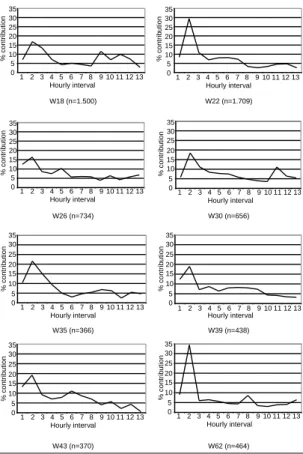
The observed biting activity patterns are shown in Figure 1 for An. darlingi and in Figure 2 for An. marajoara. A large variability in biting activity over the eight observations was observed for An. darlingi, contrasting to more stable patterns seen for An. marajoara. While the latter continuously showed a well-pronounced peak during the first three hours of the night, the former species varied considerably in its activity pattern. In addition, An. darlingi showed a more pronounced nocturnal activity than An. marajoara.
Two potential causes for the observed plasticity of
An. darlingi were examined. First whether relative
Figure 1 - Biting activity patterns of An. darlingi during the
eight observations at São Raimundo do Pirativa, State of Amapá, Brazil, from May 1999 until March 2000.
0 2 4 6 8 10 12 14 16 18
1 2 3 4 5 6 7 8 9 10 111213
% contr ib ution % contr ib ution 0 2 4 6 8 10 12 14 16 18
1 2 3 4 5 6 7 8 9 10 111213 hourly interval hourly interval 0 2 4 6 8 10 12 14 16 18
1 2 3 4 5 6 7 8 9 10 111213
% contr ib ution hourly interval 0 2 4 6 8 10 12 14 16 18
1 2 3 4 5 6 7 8 9 10 111213
% contr ib ution hourly interval 0 2 4 6 8 10 12 14 16 18
1 2 3 4 5 6 7 8 9 10 111213
% contr ib ution hourly interval 0 2 4 6 8 10 12 14 16 18
1 2 3 4 5 6 7 8 9 10 111213
% contr ib ution hourly interval 0 2 4 6 8 10 12 14 16 18
1 2 3 4 5 6 7 8 9 10 111213
% contr ib ution hourly interval 0 2 4 6 8 10 12 14 16 18
1 2 3 4 5 6 7 8 9 10 111213
% contr
ib
ution
hourly interval
W18 (n=229) W22 (n=1.436)
W26 (n=3.320) W30 (n=7.908)
W35 (n=2.823) W39 (n=2.152)
78 7878 78
78 Rev Saúde Pública 2002;36(1):75-80
www.fsp.usp.br/rsp
Intra-population plasticity of An. darlingi.
Voorham J
density contributed to the variation. Results showed that there was no significant relationship between density and the proportional contribution of biting during the first three hours for An. darlingi (p=0.82) and An. marajoara (p=0.93).
Second whether there was a time of year effect on the collection. A significant positive correlation be-tween week-number (i.e. time) and the proportional contribution of biting during the first three hours can be observed for An. darlingi (r=0.85, p=0.007) but not for An. marajoara (r=0.46, p=0.25).
The single parity observation was performed using 311 An. darlingi specimens divided over the first seven hours of the night, and showed no significant differences of parity-rate between the hours (χ2,
p=0.07), and a mean value of 66%.
DISCUSSION
Overall biting activity patterns of An. darlingi in the study is similar to the results reported for the state of Amazonas, Brazil,6 French Guiana,9 Colombia,* Suriname,7 and Venezuela.**
Figure 2 - Biting activity patterns of An. marajoara during
the eight observations at São Raimundo do Pirativa, State of Amapá, Brazil, from May 1999 until March 2000.
35 30 25 20 15 10 5 0
1 2 3 4 5 6 7 8 9 10 11 12 13 Hourly interval % contr ib ution 35 30 25 20 15 10 5
01 2 3 4 5 6 7 8 9 10 11 12 13 Hourly interval % contr ib ution W22 (n=1.709) 35 30 25 20 15 10 5
01 2 3 4 5 6 7 8 9 10 11 12 13 Hourly interval % contr ib ution W26 (n=734) 35 30 25 20 15 10 5
01 2 3 4 5 6 7 8 9 10 11 12 13 Hourly interval % contr ib ution W30 (n=656) 35 30 25 20 15 10 5
01 2 3 4 5 6 7 8 9 10 11 12 13 Hourly interval
% contr
ib
ution
W35 (n=366) W39 (n=438)
W43 (n=370) W62 (n=464)
35 30 25 20 15 10 5 0
1 2 3 4 5 6 7 8 9 10 11 12 13 Hourly interval % contr ib ution 35 30 25 20 15 10 5
01 2 3 4 5 6 7 8 9 10 11 12 13 Hourly interval % contr ib ution 35 30 25 20 15 10 5
01 2 3 4 5 6 7 8 9 10 11 12 13 Hourly interval
% contr
ib
ution
W18 (n=1.500)
Although these regions are located in the northern part of the continent, it does not imply a geographi-cal determination of biting activity patterns. For in-stance, in the state of Rondônia, Brazil8, occasion-ally this species has shown very little crepuscular activity, and in several localities in the northern state of Pará, Brazil14,15– relatively close to the study area –, this species has shown pronounced crepuscular bit-ing activity.
Few studies have been conducted on the biting ac-tivity patterns of An. marajoara, partly due to diffi-culties in identifying the species-complex’s members. In Venezuela13 and Trinidad,1An. albitarsiss.l. (prob-ably An. marajoara) showed similar activity patterns to the ones found in this study with a very pronounced crepuscular peak.
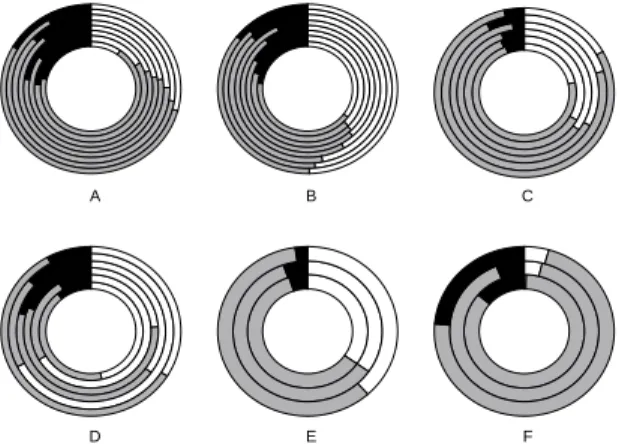
One of the most important aspects of a vector’s biting activity is how it relates to human activity. Throughout rural South America, where malaria is mostly found, human activity is mostly outdoors during crepuscular hours and indoors during noc-turnal hours. Therefore, to better compare human and Anopheline activities, the biting patterns in Fig-ures 1 and 2 were converted to relative contribu-tions of three functional periods: 1) the first three hours of the night; 2) the last three hours of dawn; and 3) the nocturnal period in between. This arrange-ment also facilitates comparing the same species in other regions and other species, given that different methodologies have been used in other studies re-garding time-scales, study design, and collection methods. Figure 3 shows the results for both species (A and B). From these functional diagrams it can be drawn that An. marajoara has a much higher contri-bution to biting than An. darlingi when the human individuals are outdoors (Period 1).
Although in two out of eight observations An. marajoara showed lower densities than An. darlingi, its higher contribution to extra-domiciliar biting clearly indicates this species’ importance as a poten-tial malaria vector, especially where vector control measures are mainly house-based.
Of 34 studies examined, four also described local variation of the biting activity of An. darlingi. These studieswere conducted in the state of Amazonas6 and Rondônia,8 Brazil, Honduras,10 and Venezuela.** Fig-ure 3 presents functional-period diagrams for each location. Local variation in biting activity by collec-tion period was minimal in Venezuela (F) and Hon-duras (E), but considerable in Rondônia (D) and
79 7979 7979 Rev Saúde Pública 2002;36(1):75-80
www.fsp.usp.br/rsp
Intra-population plasticity of An. darlingi.
Voorham J
Figure 3 - Overview of variation in biting contribution in
the three functional periods of the night. (A) Present study,
An. darlingi; (B) Present study, An. marajoara; (C) Amazonas State, Brazil6, An. darlingi; (D) Rondônia State, Brazil8, An.
darlingi; (E) Honduras10, An. darlingi; (F) Santa Maria de
Los Guiacas, Venezuela(Rubio-Palis, unpublished data),
An. darlingi. White = first 3 hours, Gray = middle 7 hours, Black = last 3 hours.
A B C
D E F
Amazonas (C). Compared to Amazonas, the observed pattern in Amapá showed considerably more early morning biting activity, although early evening ac-tivity was similar. Early morning biting acac-tivity con-tribution in Rondônia was similar to Amapá, but the early evening crepuscular activity in Rondônia was much greater, but also more variable. Thus, behavioral plasticity is not always observed as seen in Venezuela and Honduras. However, other data obtained in the Amazon region clearly show that this is not a peculi-arity of this study area.
The likelihood of mosquito density interfering with the biting behavior was discarded in the present study, as previously reported elsewhere in Brazil2 and French Guiana.9 However, studies conducted in Colombia* suggested a correlation between biting activity and the population density of An. darlingi. A regional study in Brazil also alluded to this possibility.15
Moonlight could have influenced the biting activ-ity patterns and densities12 of previously mentioned observations with local variation, but this was not the case for the present study since all collections were carried out during the same moon phase. A higher variability can be expected when not correcting for this influence.
The age composition of biting An. darlingi was shown to be different during the crepuscular peaks in Brazil,2 opposing results have been found in other studies4,9 as well as in the present one. Age-compo-sition differences between activity periods do not necessarily indicate subgrouping, and it is more likely to be a result of specific ecological settings
than of age-specific activity patterns. However, ad-ditional studies on age structure of An. darlingi and
An. marajoara at the study site are intended, using more precise methods.
The observed correlation between time and the contribution to crepuscular biting for An. darlingi
still requires further clarification, and indicates the existence of underlying ecological processes not yet understood.
Population variations throughout An. darlingi’s wide geographical range could explain the differences in biting activity patterns.4 However, this does not provide an explanation for intra-population varia-tionσ, which can be as extent as inter-population
vari-ations. It is beyond this study’s scope to further dis-cuss possible causes for An. darlingi being so plastic in its biting activity patterns on regional and local levels. Evidence up to date strongly indicates that ecological determinants play a role instead of genet-ics or local population specific characteristgenet-ics. Fur-ther studies on population dynamics and individual mosquito’s behavior are needed on the subject.
Plasticity in biting activity patterns can result in increased vectorial potential and control strategies may have to be adjusted to account for differences in human vector contact over time.
Knowledge of vector biting activity plasticity is also essential for specific entomological studies. Sampling assumes knowledge of the population’s activity pat-tern. When biting pattern observations are limited to only a few nights of observation, the plasticity of this behavior can not be evidenced and could lead to mis-interpretation of data. To illustrate that, a comparison between relative density estimates of whole-night and
*Suarez et al – Unpublished date
Table 2 - Comparison of relative density and nocturnal period
contribution between all-night observations and partial (hours 2-3) observations for An. darlingi and An. marajoara
at São Raimundo do Pirativa, 1999-2000. Collections are coded according to the week number of the year 1999, with the March 2000 collection as a continuation of the 1999 numbering.
An. darlingi An. marajoara
80 8080 80
80 Rev Saúde Pública 2002;36(1):75-80
www.fsp.usp.br/rsp
Intra-population plasticity of An. darlingi.
Voorham J
2-hour periods (hours 2 and 3 – the most commonly used sampling period) is shown in Table 2, as well as the proportion of total biting during the 2-hour obser-vation period for both studied species throughout eight observations. Around 6-20 % of all bites are due to An. darlingi, while 25-41% are due to An. marajoara. This difference in sampling could lead to bias due to pe-riod-specific characteristics.
The relative density estimates from partial collec-tions are closer to all-night density estimates for An. darlingi than for An. marajoara, which are con-stantly overestimated. The combination of different sampling of the two species populations and over-estimation of the relative density of one species could have lead to an overestimation of the impor-tance of An. marajoara as a vector in a recent study in Amapá,5 as it is likely to have occurred in other studies on multiple-vector settings.
In conclusion, inter-population variation in biting activity may be as great as intra-population
varia-tion. Variability in biting activity should be taken into account for intervention design and specific entomological studies, especially where there is vec-tor heterogeneity. Comparison of one species populations in different areas, or two species populations at the same site should be done with sam-pling methods that minimize bias for density and age-composition estimates. It is also recommended to minimize the use of partial-night observations in situ-ations where biting activity varies greatly.
ACKNOWLEDGEMENTS
To the personnel of the Zoology Department of In-stitute of Technological and Scientific Research of the State of Amapá (Pesquisas Científ icas e Tecnológicas do Estado do Amapá) for their contri-bution to the fieldwork; to the community of São Raimundo do Pirativa for their cooperation. To Robert Zimmerman for his collaboration in discussing ideas; to Yasmin Rubio-Palis, Marco Suarez and co-workers for making their unpublished data available.
REFERENCES
1. Chadee DD. Indoor and outdoor host-seeking rhythms of Anopheles albitarsis (Diptera: Culicidae) in Trinidad, West Indies. J Med Entomol 1992;29:567-9. 2. Charlwood JD, Hayes J. Variações geográficas no
ciclo de picada do Anopheles darlingi Root no Brasil.
Acta Amaz 1978;8:601-3.
3. Charlwood JD, Wilkes TJ. Studies on the age-composition of samples of Anopheles darlingi Root (Diptera: Culicidae) in Brazil. Bull Entomol Res
1979;69:337-42.
4. Charlwood JD. Biological variation of Anopheles darlingi Root. Mem Inst Oswaldo Cruz 1996;91:391-8. 5. Conn JE, Wilkerson RC, Segura MNO, Souza RTL de,
Schlichting CD, Wirtz RA, Póvoa MM. Emergence of a new neotropical malaria vector facilitated by human migration and changes in land use. Am J Trop Med Hyg 2001. In press.
6. Hayes J, Charlwood JD. Dinâmica estacional de uma população de Anopheles darlingi, numa área endêmica de malária no Amazonas. Acta Amaz
1979;9:79-86.
7. Hudson JE. Anopheles darlingi Root (Diptera: Culicidae) in the Surinam rain forest. Bull Entomol Res
1984;74:129-42.
8. Klein TA, Lima JBP. Seasonal distribution and biting patterns of Anopheles mosquitoes in Costa Marques, Rondonia, Brazil. J Am Mosq Control Assoc
1990;6:700-7.
9. Pajot F, Le Pont F, Molez J, Degallier N. Agressivité d’Anopheles (Nyssorhynchus) darlingi Root, 1926 (Diptera, Culicidae) en Guiane française. Cah ORSTOM Ser Entomol Med Parasitol 1977;15:15-22. 10. Rivera Núñez LA. Algunos aspectos de
comportamiento de Anopheles darlingi (Diptera: Culicidae) de la Ceiba, Atlántida [Tesis de maestría].
Honduras Panama: Universidad de Panamá; 1990.
11. Rosa-Freitas MG, Oliveira RL de, Carvalho-Pinto CJ de, Flores-Mendoza C, Fernandes Silva-do-Nasci-mento T. Anopheline species complexes in Brazil. Current knowledge of those related to malaria transmission. Mem Inst Oswaldo Cruz 1998;93:651-5. 12. Rubio-Palis Y. Influence of moonlight on light trap
catches of the malaria vector Anopheles
nuneztovari in Venezuela. J Am Mosq Control Assoc
1992;8:178-80.
13. Rubio-Palis Y, Curtis CF. Biting and resting behaviour of anophelines in western Venezuela and implications for control of malaria transmission. Med Vet Entomol
1992;6:325-34.
14. Tadei WP, Mascarenhas BM, Podestá MG. Biologia de anofelinos amazônicos. VIII. Conhecimento sobre a distribuição de espécies de Anopheles na região de Tucuruí-Marabá (Pará). Acta Amaz 1983;13:103-40. 15. Tadei WP, Thatcher BD, Santos JM, Scarpassa VM,