Ruan Cabral,1 Antonio Egídio Nardi2
Ansiedade e inibição de ataques de pânico
no contexto das pesquisas translacionais e prospectivas
Anxiety and inhibition of panic attacks within
translational and prospective research contexts
Abstract
Basic research involving animal models is an important tool to improve our understanding of clinical conditions related with anxiety and panic attacks. In fact, animal models have been used to study several paradigms on analogous and homologous elements of human anxiety phenomena. However, the direct transposition (translation) to clinical practice of the results obtained with animal models may be restricted by the different constructs used to describe and explain empirical evidence of anxiety phenomena among humans. We aimed to analyze whether theoretical assumptions on the potential inhibitory effects of anxiety on panic could be observed among humans in prospective studies designed to analyze the relationship between anxiety and panic. A systematic literature review including papers published in English language between 1997 and 2011 was undertaken on the MEDLINE database. The search yielded a total of 257 articles, of which 11 were included in the review. In three studies, the global dimension of the anxiety sensitivity construct worked as a facilitator of panic attacks. Six studies showed a positive correlation between the AS-Physical Concerns subfactor and the occurrence of panic attacks, whereas two studies found a greater effect of the AS-Mental Incapacitation Concerns subfactor on panic. There was no evidence that anxiety might act as an inhibitor of panic attacks in humans, and there
were no conclusive indings on the possibility that any anxiety
construct could contribute toward inhibiting panic attacks.
In sum, there seems to be a need for reining descriptions of
anxious phenomena addressed both in basic preclinical research and in prospective-longitudinal studies involving humans.
Keywords: Construct, anxiety, panic, prospective studies, animal models, basic research.
Resumo
As pesquisas básicas elaboradas com modelos animais são im-portantes ferramentas para melhorar a compreensão de condi-ções clínicas relacionadas a ansiedade e ataques de pânico. De fato, modelos animais tem servido de base para vários para-digmas sobre elementos análogos e homólogos aos fenômenos ansiosos humanos. No entanto, a transposição (translação) di-reta dos resultados dessas pesquisas para a prática clínica pode ser limitada pelos diferentes construtos usados para descrever e explicar as evidências empíricas de fenômenos ansiosos em hu-manos. Este artigo buscou analisar se proposições teóricas sobre o potencial efeito inibitório da ansiedade sobre ataques de pânico poderiam ser observadas em estudos prospectivos envolvendo humanos e desenhados para analisar a relação entre ansiedade e pânico. Uma revisão sistemática da literatura incluindo artigos publicados em língua inglesa entre 1997 e 2011 foi realizada na
base de dados MEDLINE. Foram identiicados 257 artigos, dos
quais 11 foram incluídos na revisão. Em três pesquisas, a dimen-são geral do construto anxiety sensitivity atuou como facilitador de ataques de pânico. Seis pesquisas apresentaram correlação positiva entre o subfator AS-Physical Concerns e a ocorrência de ataques de pânico, e duas apontaram para um maior efeito de favorecimento do pânico pelo subfator AS-Mental Incapacitation Concerns. Não foi possível observar se de fato a ansiedade pode agir como um agente inibidor de ataques de pânico em huma-nos, e os artigos analisados não ofereceram resultados conclu-sivos sobre a possibilidade de algum construto sobre ansiedade contribuir para a inibição de ataques de pânico. Em suma, parece
evidente a necessidade de um reinamento das descrições sobre
fenômenos ansiosos abordados tanto em pesquisas básicas pré--clínicas quanto em estudos prospectivos envolvendo humanos.
Descritores: Construtos, ansiedade, pânico, estudos prospecti-vos, modelos animais, pesquisa básica.
1 Psicólogo, Universidade Federal de São João Del Rei (UFSJ), São João Del Rei, MG, Brazil. 2 PhD. Professor, Medicina Psiquiátrica, Universidade Federal do Rio
de Janeiro (UFRJ), Rio de Janeiro, RJ, Brazil.
Submitted Nov 10 2011, accepted for publication Jan 20 2012. No conlicts of interest declared concerning the publication of this article.
Introdução
Anxiety constructs: translational and nomological perspectives
The term construct is extremely important in clinical research on anxiety disorders. It refers to the theoretical framework supporting the development of instruments (scales, questionnaires, inventories) used to assess clinical conditions such as anxiety and panic disorder. However, theoretical constructs need to be rooted in empirical evidence for the establishment of operational variables. In this sense, construct validity is precisely related with the degree to which an instrument is able or unable to adequately measure what it has been intended to measure.1 As a result, a construct is always based on two fundamental axes: one theoretical and one empirical.
The aim of translational research is to investigate the possibilities of transferring evidence from basic preclinical research involving animal models to clinical studies involving humans. In other words, translational research deals with the degree to which the results of basic research can be generalized, as in the case of indings on fear- and anxiety-based phenomena.
Different constructs have been proposed for the understanding of clinically observed anxiety phenomena. Constructs differ both in the concept of anxiety and in the structure of the factorial dimensions covered by the clinical instrument (scale, questionnaire, inventory) used to individually measure each variable. The following are some constructs frequently addressed in clinical research on anxiety disorders, as will be shown in the present review: anxiety sensitivity, negative affect, generalized anxiety, trait anxiety, state anxiety, panic history, and panic disorder, among others.
The anxiety sensitivity (AS) construct refers to how the individual perceives signs of physiological changes as conditions that precede aversive consequences.2 In other words, changes caused by sympathetic activation are believed to precede, for example, a heart attack, social embarrassment, or even cognitive deicit situations. Another construct frequently used in clinical research as a risk factor for panic attacks and panic disorders is trait anxiety, i.e., the subject’s stable tendency to respond with anxiety. With regard to this construct, however, essential differences between trait anxiety and state anxiety need to be established. According to Gorestein & Andrade,3 although some authors already distinguish between trait anxiety and state anxiety, anxiety is still generally conceived as a unidimensional construct.
According to Watson & Clark,4 the negative affect construct consists of the individual’s ability to present
negative emotions when faced with a myriad of environmental situations. This construct should be understood taking into consideration its close relationship with motivational states that tend to be associated with a reduced threshold for behavioral inhibition system activation.5 This system is involved in responses to cues of imminent punishment, concurrent contingencies, and novel contexts.
In addition to the problems inherent to the variables regulating instrument application, there are also problems related with the theoretical validity of the construct used during the development of scales, questionnaires, and tests.6 In this sense, attention should be given once again to construct validity and consequently to the development of instruments that can adequately measure clinical phenomena involving anxiety and panic attacks.
Animal models and the investigation of basic anxiety processes
Studies involving animal models may be used to test new theories, to identify correlates and clinical markers, to assess causal or correlational relationships,7 as well as to enhance the understanding of pathological mechanisms in general. Among the several advantages of animal studies, it is possible to mention the possibility to conduct experimental manipulation under strict control of intervening variables, and the possibility to undertake analyses that would not be feasible or accessible in human subjects (e.g., variations in electrical stimulation of brain structures in in vitro and in vivo electrophysiological experiments). The irst studies speciically designed to identify neural circuits involved in defensive behavioral strategies include those performed with hypothalamus stimulation and lesions in rats.8 In those studies, electrophysiological procedures were subsequently extended to other structures, such as the dorsal periaqueductal gray matter (DPAG). In neurosurgical patients, reports of fear, with feelings of terror and death, were observed when the DPAG was stimulated.8
on results reported by Magierek et al.9 Conversely, some studies involving humans have shown opposite indings, with anxiety either facilitating and inhibiting panic attacks. Also, according to Magierek et al.,9 a higher incidence of panic attacks soon after their clinical onset would be associated with non-severe generalized anxiety; however, as the panic disorder evolves, increased anxiety severity would contribute to a decrease in the incidence of panic attacks.
Controlled laboratory experiments have suggested the involvement of at least two distinct neural networks in different defensive behaviors in animal models. One of such networks would be related with defensive freezing (classical/respondent conditioning), involving activation of the amygdaloid complex and of the ventral periaqueductal gray matter (VPAG).8 As a result, some of the characteristics of generalized anxiety disorder would be correlated with mechanisms modulated by the hippocampus, amygdala, and ventral longitudinal neuronal columns present in the midbrain. DPAG, in turn, would be closely associated with active ight-or-light responses (or ight-or-light-or-freeze responses, i.e., unconditioned responses), and its excessive stimulation seems to be present in panic attacks.
Briely, Magierek et al.9 used an experimental animal
model of anxiety based on respondent conditioning with an aversive stimulus, combined with a DPAG electrical stimulation paradigm mimicking panic attacks. The authors concluded that an increase in anxiety could cause a decrease in unconditioned responses as a result of DPAG stimulation, and consequently a reduction in panic attacks. In that study, the authors observed a higher electric threshold for DPAG activation in rats that had been additionally submitted to aversive respondent conditioning. Because an increase in the intensity of electrical current was necessary so that rats would present unconditioned freezing responses (DPAG stimulation) and consequently ight-or-light responses, it is possible to infer that an increase in the intensity of electrical current would inhibit panic attacks via direct stimulation of the DPAG.
Objectives and hypothesis
The primary objective of this systematic literature review was to analyze prospective studies somehow designed to understand the possible correlations between anxiety and panic attacks, regardless of the anxiety construct adopted. According to our review methodology, two major groups of prospective studies were established. The irst group comprised studies whose main objective was to assess the possibility of
correlating the main AS construct with panic attacks or panic disorder. The second group included longitudinal studies with follow-up periods longer than 8 years. Analysis of this second group of studies is currently underway and will be described elsewhere.
In the irst group of studies, here analyzed, the Anxiety Sensitivity Index (ASI) was the primary instrument used to assess anxiety, more speciically the AS construct. As the review progressed, reports of the use of other instruments arose, with the aim of measuring other anxiety constructs. Based on this inding, we established a secondary but fundamental objective for the study, namely to assess whether the scores obtained with any instrument designed to measure anxiety would present an inverse variation when compared with the scores obtained with instruments designed to measure other outcome variables, e.g., panic disorder and panic attacks. As a result, in addition to investigating the presence of correlations between anxiety and panic, the present review also evaluated the presence of Deakin-Graeff theoretical assumptions10 in prospective studies. According to this theory, anxiety would have an inhibitory effect on panic; as a result, higher anxiety scores would be expected to generate lower panic scores. However, a still unanswered question is which of the anxiety constructs available shows correspondence with the general theoretical assumptions of Deakin-Graeff,10 i.e., a nomological assessment. In other words, it would be necessary to assess the degree to which degree the Deakin-Graeff10 theory would be adequate and applicable to prospective studies.
Our initial hypothesis was that some studies would present inversely proportional anxiety and panic scores, i.e., higher anxiety scores associated with lower panic scores. From a translational standpoint, then, this systematic review aims to understand how some constructs of fear, panic, and anxiety have been studied in animals and humans based on the assumptions of Deakin-Graeff,10 and also to which degree the results obtained in both types of studies can be shifted.
to which basic science results can be applied in clinical studies and procedures.
The theory describing the inhibitory effects of anxiety on panic attacks has been primarily supported by cross-sectional studies,10 and therefore seems to lack prospective-longitudinal evidence. The present study is translational in that it seeks to understand the extent to which results obtained in basic preclinical research involving animal models can be converted into clinical practice and prospectively evaluated.
Method
Studies addressing associations between anxiety and panic attacks published between 1997 and 2011 were identiied by searching the MEDLINE database. Studies were selected if they included human participants of both sexes, either adults or adolescents, clinical samples, elementary, high school or college students, or the general population.
A systematic literature review was performed with the aim of detecting, selecting, and analyzing articles and abstracts designed to investigate possible associations between anxiety and panic attacks. The following search options were used on MEDLINE: by descriptors (anxiety, panic attacks, prospective studies; anxiety, panic attacks, comorbidities) and by words (anxiety, panic, longitudinal). Only English language papers were included. Longitudinal, prospective studies, and those describing comorbidity between anxiety and depressive disorders were selected based on the frequent co-occurrence of both conditions as suggested by Nardi et al.11
Studies describing the following comorbidities were excluded: bipolar disorders, post-traumatic stress disorder, emphasis on alcohol use, emphasis on smoking, studies investigating asthma, studies investigating migraine, correlation with Parkinson’s disease, correlation with chronic obstructive pulmonary disease, multiple personality disorders, emphasis on social phobia, emphasis on the use of psychoactive substances, hypochondria, psychotic patients. Studies focusing on quality of life, genetic or pharmacological aspects, or with a retrospective design were not included in the review.
In the second phase of the review, all selected articles were read in full and assigned to one of two lists: one of articles kept in the analysis and another of articles excluded. Articles either not selected or not included in the analysis were not discarded; rather, they were kept in separate lists, arranged in chronological order and with their abstracts numbered. Articles included were then compared and assessed according to their internal validity, study power, and external validity, and also in
relation to the following aspects: 1) research aims, 2) year and country of origin of authors, 3) sample size and sample selection method, 4) data collection setting, 5) mean age of participants, 6) study design, 7) setting, 8) instrument(s) used in the study to measure risk factors (independent variables) and outcomes (dependent variables), 9) experimental losses, 10) results and conclusions, differences, gaps, contradictions, and missing information (not all data are shown).
Results
As a result of the search strategy described above, a total of 257 abstracts were selected and read. Subsequently, the full texts of 73 articles were read; of these, 55 articles were not selected, and 18 were selected. Of the selected articles, 11 were included in the analysis because their primary objective was to investigate possible correlations between the AS construct and panic attacks or panic disorder. In three studies, the global dimension of the AS construct acted as a facilitator of panic attacks.2,12,13 Six studies showed a positive correlation between the AS-Physical Concerns subfactor and the occurrence of panic attacks,14-19 whereas two studies found a greater effect of the AS-Mental Incapacitation Concerns subfactor on panic.20,21
We observed a predominance of prospective designs,2,12,13,15,18-21 in addition to three cross-sectional studies.14,16,17 Sample sizes varied from 80 to 2,365 participants, comprising clinical groups,16,17,19 high school students,12,15,18 college students,2,12,14,15,20,21 and/or the general population.12,13,15 Table 1 describes the main characteristics of the studies included in the review.
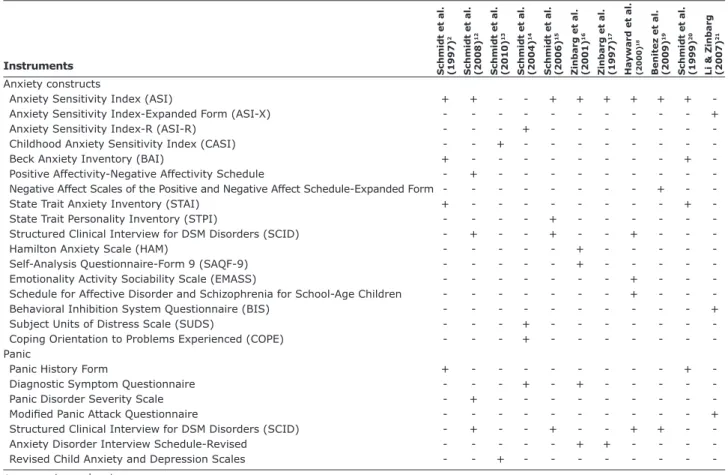
All the 11 studies suggested a facilitating effect of the AS construct on the development of panic attacks2,12-21 and axis I psychopathologies.12,15 Among the different instruments used to measure the main risk factor (anxiety), the ASI was the most frequently used for the empirical evaluation of the AS construct2,12,15-20; one study21 used the Anxiety Sensitivity Index-Expanded Form (ASI-X), and another,14 the Anxiety Sensitivity Index-Revised (ASI-R), a modiied version of the ASI that includes fear of cardiac and respiratory symptoms. Finally, in one study,13 the AS construct was measured using the Childhood Anxiety Sensitivity Index (CASI), which includes the 16 items of the ASI plus two additional items speciically developed for children and adolescents. Table 2 lists the instruments used in the different studies for the assessment of anxiety constructs, panic attacks, and/or panic disorder.
+ = present; - = absent.
Instruments
Anxiety constructs
Anxiety Sensitivity Index (ASI) + + + + + + + + -Anxiety Sensitivity Index-Expanded Form (ASI-X) - - - - + Anxiety Sensitivity Index-R (ASI-R) + -Childhood Anxiety Sensitivity Index (CASI) + -Beck Anxiety Inventory (BAI) + + -Positive Affectivity-Negative Affectivity Schedule + Negative Affect Scales of the Positive and Negative Affect Schedule-Expanded Form - - - + - -State Trait Anxiety Inventory (STAI) + + -State Trait Personality Inventory (STPI) + Structured Clinical Interview for DSM Disorders (SCID) - + - - + - - + - - -Hamilton Anxiety Scale (HAM) + -Self-Analysis Questionnaire-Form 9 (SAQF-9) + -Emotionality Activity Sociability Scale (EMASS) + Schedule for Affective Disorder and Schizophrenia for School-Age Children - - - + - - -Behavioral Inhibition System Questionnaire (BIS) - - - - + Subject Units of Distress Scale (SUDS) + -Coping Orientation to Problems Experienced (COPE) +
-Panic
Panic History Form + +
-Diagnostic Symptom Questionnaire + + -Panic Disorder Severity Scale +
Modiied Panic Attack Questionnaire - - - +
Structured Clinical Interview for DSM Disorders (SCID) - + - - + - - + + - -Anxiety Disorder Interview Schedule-Revised + + -Revised Child Anxiety and Depression Scales +
-Table 2 – Instruments used for the assessment of panic attacks/disorder and anxiety constructs in the 11 studies included in the systematic literature review
Schmidt et
al.
(1997)
2
Schmidt et al. (2008)
12
Zinbarg et al. (2001)
16
Schmidt et al. (2010)
13
Zinbarg et al. (1997)
17
Li & Zinbarg (2007)
21
Hayward et al. (2000)
18
Schmidt et al. (2004)
14
Benit
ez et al.
(2009)
19
Schmidt et al. (2006)
15
Schmidt et al. (1999)
20
Li & Zinbarg (2007)
21
- = absent; + = present.
Study characteristics
Sample
Clinical + + +
-Non-clinical + + +
-High school students + + +
-College students + + - + + - - - - + +
Design
Prospective/longitudinal + + + - + - - + + + +
Prospective/cross-sectional + + +
-Data collection setting
Highly aversive context + +
-CO2 inhalation + +
-Hyperventilation +
Patients seeking psychiatric assistance - - - + + - + - -Experimental prevention study + + -Correlational study + + -Web- and telephone-based interviews - - - - - - - - +
Table 1 – Main characteristics of the 11 studies included in the systematic literature review
Schmidt et
al.
(1997)
2
Schmidt et al. (2008)
12
Zinbarg et al. (2001)
16
Schmidt et al. (2010)
13
Zinbarg et al. (1997)
17
Hayward et al. (2000)
18
Schmidt et al. (2004)
14
Benit
ez et al.
(2009)
19
Schmidt et al. (2006)
15
Schmidt et al. (1999)
at the United States Air Force.2,20 These two works by Schmidt et al.2,20 included large samples of military academy students (n = 1,172 and 1,139) subjected to highly stressful situations and high levels of unavoidable and unpredictable (i.e. imminent) punishment. Cadets were asked to complete the following instruments: Beck Anxiety Inventory (BAI), State Trait Anxiety Inventory, and Beck Depression Inventory (BDI) for the assessment of anxiety and depressive symptoms; the self-report Panic History Form and ASI for the assessment of panic attacks and the AS construct, respectively. The Panic History Form was designed to assess non-clinical populations with regard to history of spontaneous panic, frequency of panic attacks, fear of having new panic attacks, and history of psychiatric treatment. The State Trait Anxiety Inventory was also used to assess the level of the subject’s chronic tendency (trait anxiety) to respond to environmental stimuli with anxiety.
Zinbarg et al.16 observed fear and depressive symptoms with the use of two different biological tests and the ASI multidimensional hierarchical model (global factor and lower irst-order factors). Data were collected during CO2 inhalation and hyperventilation16 and also after CO2 only.14 The study included a clinical sample of 198 outpatients seeking assistance at psychiatric services.16 Patients were stratiied according to different comorbidity combinations, and all participants were diagnosed using the Anxiety Interview Schedule-Revised (ADIS-R) semistructured interview. In another study,17 clinical samples undergoing outpatient treatment were assessed to determine which ASI dimension would be more evidently related with panic disorder (with and without agoraphobia). Patients showed more evident elevations in the AS-Physical Concerns subfactor, with a mean score of 18.65 for panic disorder and 19.46 for panic disorder with agoraphobia.
Again, in the study by Zinbarg et al.,16 data were obtained in two distinct situations. Participants irst completed the Hamilton Anxiety Scale (HAS) and the self-report ASI and Self-Analysis Questionnaire-Form 9 (SAQF-9). The SAQF-9 form includes 34 statements divided into three subscales (Anxiety, Stress, Depression). The outcome variable (panic symptoms) was assessed using the Diagnostic Symptom Questionnaire (DSQ). Data were collected at the end of a rest period following CO2 inhalation and hyperventilation in a laboratory setting. The DSQ is a 9-point scale used to evaluate panic attack symptoms and general aspects such as emotional and cognitive responses to CO2 inhalation procedures. Scores may range from 0 = no occurrence up to 8 = intense feeling. Data were analyzed using multiple logistic regression.16
In the same study, Zinbarg et al.16 give due attention to the co-occurrence of AS and anxiety constructs; when
the latter is excluded from the analysis, the correlation between scores obtained for all ASI subfactors and panic attacks signiicantly reduces, showing a possible interference of the anxiety construct on the combined distribution of ASI and DSQ scores. In the study by Spira et al.,14 in turn, a non-clinical sample comprising 167 participants was assessed: the study started with 80 subjects with a mean age of 19.8±2.8 years. The predictor variable AS was measured using the ASI-R, a self-report instrument comprising 36 statements to investigate fear of anxiety-related sensations through four hierarchical factors: 1) fear of respiratory symptoms; 2) fear of displaying anxiety responses in public; 3) fear of cardiovascular symptoms; and 4) fear of losing cognitive control. The DSQ was used at the end of the CO2 inhalation procedure to assess the frequency and intensity of panic attacks according to criteria of the Diagnostic and Statistical Manual of Mental Disorders, 4th edition (DSM-IV). Anxiety was assessed after CO2 inhalation using the Subjective Units of Distress Scale (SUDS).
Spira et al.14 also observed coping strategies to work as possible risk factors for anxiety and panic in threatening situations. Coping strategies were assessed using the Coping Orientation to Problems Experienced (COPE) inventory, which comprises 11 factors that evaluate functionally different dimensions of the strategies observed in situations with predominantly negative reinforcement (fear and avoidance). Also, the study conducted physiological measures such as heart rate and skin conductance. The authors assessed the AS construct with the ASI-R.14
In two of the studies analyzed,12,15 data were collected as part of research projects primarily designed to reduce AS in high-risk populations (high ASI scores), including students attending schools in the metropolitan area of Columbus (OH) (n = 46), students of the Ohio State University (n = 263), and individuals selected from the general population of Columbus (n = 95). The mean age of participants was 19.3±3.9 years.
panic attacks in the 1-year prospective study conducted by Benitez et al.,19 which included 136 participants with panic disorder (with or without agoraphobia). Multiple regression analyses indicated that the AS-Physical Concerns subfactor of the AS construct was the predictor most closely associated with panic attacks. Negative affect as measured by the Negative Affect Scales of the Positive and Negative Affect Schedule-Expanded Form (PANAS-X-NA) did not seem to interfere with the clinical course of panic disorder; conversely, AS was signiicantly correlated with panic disorder.19
In the two studies by Schmidt et al., evaluations of the clinical course of panic attacks and of the presence of axis I disorders were performed with the Structured Clinical Interview for DSM Disorders (SCID)12,15 and the Panic Disorder Severity Scale (PDSS).12 The SCID was used in both studies to identify the presence of axis I psychopathologies and an underlying history of panic attacks during follow-up. PDSS is a semistructured interview that covers the following aspects: 1) frequency of panic attacks; 2) intensity; 3) concerns about having additional panic attacks; 4) avoidance; 5) sensations; and interference with 6) work and 7) social life. In one of those studies,12 the PDSS was used combined with SCID to assess the frequency of panic attacks over a 2-year study period.
Hayward et al.18 investigated general and speciic risk factors for panic attacks (both full-blown and four-symptom panic attacks). Data were collected during a 4-year prospective study (1 year baseline and 3 years follow-up). The aim of the authors was to identify risk factors (preexisting variables) for the onset of panic attacks in a non-clinical sample of adolescents/students (n = 2,365) with a mean age of 15 years. The authors found two possible risk factors for panic attacks, namely negative affect (measured using the Emotionality Activity Sociability Scale, Emotionality subscale) and AS (measured with ASI).18 Another possible predictor described by the authors was the presence of childhood separation anxiety disorder (measured with the Schedule for Affective Disorder and Schizophrenia for School-Age Children).18 Clinical events identiied as outcomes of interest were panic attacks and major depression, both diagnosed with SCID.
The study by Li & Zinbarg21 lasted for 1 year (four waves, one baseline and follow-up) and prospectively analyzed an initial sample of 223 university students. Participants who experienced panic attacks during the study21 were additionally interviewed by telephone and then invited to interviews based on the Modiied Panic Attack Questionnaire (MPAQ), which comprises 28 statements aimed to assess the history and symptoms of panic attacks in non-clinical populations.21 AS was measured using the ASI-X, an expanded version of the ASI developed by Li & Zinbarg, with 13 additional items
intended to increase the validity and reliability of the AS-Social Concerns subscale, in addition to further assessing beliefs and cognitions in the three subscales/dimensions.
In the same study, the trait anxiety construct was analyzed as a possible preexisting variable favoring panic attacks.21 The following instruments were used to measure this construct: Behavioral Inhibition System Questionnaire (BIS) – rather than the State and Trait Anxiety Inventory (STAI) or the Manifest Anxiety Scale (MAS). The BIS was chosen due to the authors’ belief that this instrument has a greater predictive validity than STAI or MAS.21 In order to obtain an accurate assessment of the incidence of new diagnoses over the prospective follow-up period, at least four studies12,14,15,21 excluded from some analyses participants with a diagnosis of panic attacks or axis I disorders during the baseline year.
The AS construct, considered as a predictor and measured with the ASI, was correlated with the development of spontaneous panic (p < 0.001, r = 0.16).2 In the same study, AS was also found to be a risk factor for depression. However, in the multiple logistic analyses conducted by those authors2 (AS, history of panic, and trait anxiety as independent variables), generalized anxiety and depressive symptoms were not included as possible predictors of panic attacks. Although ASI scores were high (mean ± standard deviation of 7.5±3.6 for participants who experienced panic attacks during the study period vs. 3.8±2.9 for those who did not), results were lower than the mean scores obtained in non-clinical samples.2 Cadets reporting panic showed higher scores of symptoms measured with BAI and BDI at the second stage of the study, suggesting that higher levels of AS could predict anxiety and depressive symptoms.2 A history of panic was associated with a two-fold higher risk of experiencing panic attacks in highly aversive contexts (odds ratio, OR = 1.9, 95% conidence interval = 1.1-3.2). One limitation of the study2 was that statistical analyses did not distinguish between the different dimensions of the ASI: only global scores are obtained, which makes comparisons with other studies more dificult. Another relevant aspect was the difference between anxiety intensity as measured by the BAI and the ASI.2 At baseline, military students showed slight elevations in anxiety levels as measured by the BAI (mean = 18) when compared with other non-clinical samples of students22; conversely, at the irst stage, scores measured with the ASI were considered low (mean = 4).
Both the HAS and the Self-Analysis Questionnaire Anxiety Scale (SAQA) were added to the logistic equations conducted by Zinbarg et al.16 as predictors before the inclusion of global or dimensional ASI scores. Following removal of scores speciically related to anxiety, only AS-Physical Concerns was found to contribute to variations in fear responses to biological tests. These results reported by Zinbarg et al.16 are compatible with those reported by Zinbarg et al.17 with regard to a more evident inluence of the AS-Physical Concerns subscale, compared with a null predictive effect of AS-Mental Incapacitation Concerns or AS-Social Concerns in the development of panic attacks. The AS construct, when assessed from a multifactorial perspective, as in the study by Hayward et al.,23 seems to be correlated with the onset of panic attacks, but not with major depressive disorder. In the longitudinal study by the same authors,18 the primary speciic potential risk factor for panic symptoms was the AS-Physical Concerns subscale. This scale was the only predictor of panic attacks (at least four-symptom), and none of the four dimensions of the ASI (AS-Physical Concerns, AS-Mental Incapacitation Concerns, AS-Social Concerns, AS-Global) predicted limited-symptom panic attacks.18 The effect of AS was adjusted so that both the interaction between panic attacks and depression and also past and current history of depression could be taken into consideration. Similarly to AS, past history of depression was a predictor of the onset of four-symptom panic attacks, but not of full-blown attacks; the incidence of panic attacks in the same period was 7.5% (n = 22). Hierarchical multiple regression analyses showed that AS was signiicantly associated with the frequency of panic attacks and with the incidence of panic; as a result, AS was a prospective predictor of axis I pathologies.12
Li & Zinbarg21 replicated previous prospective studies2,18,20 and included the analysis of panic attacks as causing subsequent changes to AS scores. The study was designed to investigate the role played by AS in the genesis and maintenance of panic among students at Northwestern University. The AS-Mental Incapacitation Concerns was found to be an important risk factor for the genesis of panic, accounting for 16% of the total variation in the onset of panic attacks, regardless of the trait anxiety construct.21
When analyzed independently, the AS-Mental Incapacitation Concerns subfactor was a signiicant risk factor for the onset of panic attacks (OR = 1.36, p < 0.05).21 In fact, the results reported by Schmidt et al.20 and Li & Zinbarg21 are concordant: both pointed to the AS-Mental Incapacitation Concerns subscale as a major risk factor for panic.
Another study conducted by Schmidt et al.13 analyzed a sample of 244 participants with a mean age of 11±0.82
years (range: 9-13 years); about 44% were females. Participants regularly visited the research center to complete the Revised Child Anxiety and Depression Scale (RCADS), designed to assess anxiety disorder symptoms according to DSM-IV criteria. The RCADS also includes speciic subscales for the assessment of major depressive disorder, social phobia, panic disorder, separation anxiety disorder, generalized anxiety disorder, and obsessive-compulsive disorder, all with a focus on symptom frequency. In the study by Schmidt et al.,13 AS scores at baseline measured with the CASI appeared to be correlated with panic disorder (r = 0.45, p < 0.001).
Discussion
The results assessed in the present review revealed a
discrepancy of indings: while three studies2,12,13 reported
the global dimension of the AS construct to be the main cause of panic attacks, others9,14-18 pointed to the AS-Physical Concerns subfactor as the most signiicant variable inluencing the occurrence of panic attacks. There was also a divergence between the latter results and two other studies,20,21 which presented the AS-Mental Incapacitation Concerns subfactor as the most signiicant factor for the genesis of panic.
In addition to the difference observed for ASI subfactors and for the different dimensions of the AS construct in relation to the onset of panic attacks, none of the studies pointed to an inhibitory effect of any anxiety-related construct on panic responses, as suggested by the Deakin-Graeff theory,10 posing dificulties for the translation of animal research results. In addition, the divergent results found did not allow to conclude to which extent AS would act as a predictor of panic attacks, or whether ASI global scores or any ASI subscale (AS-Physical Concerns, AS-Mental Incapacitation Concerns, or AS-Social Concerns) would more strongly predict panic attacks and panic disorder. Some of the inconsistencies observed may be due to the diversity of instruments used to measure the variables of interest, such as AS, panic attacks, and depressive symptoms.
The three subgroups of studies (focusing on either AS-Physical Concerns, AS-Mental Incapacitation Concerns, or AS-Global subscales) included samples of college
students; however, as noted by Li & Zinbarg,21 in two
substantial part of the contradictions observed. While, on the one hand, the studies by Schmidt et al.2,12 analyzed global ASI scores only, other studies13-21 analyzed both global AS scores and also subscale scores (AS-Physical Concerns, Mental Incapacitation Concerns, and AS-Social Concerns). As a result, the two studies by Schmidt et al.2,12 are different from the others with regard to the predictor variable.
In samples of cadets of the United States Air Force, Schmidt et al.2,20 found relatively low levels of susceptibility to AS, which may have restricted the distribution of ASI scores. The absence of psychiatric diagnoses as a criterion for the selection of participants at high risk for developing panic disorders (high ASI scores) is an important limitation in terms internal validity and may have contributed to the low risk factor associated with AS in the samples analyzed by Schmidt et al.2,20 Also, although the predominance of male participants may have been a limitation due to the low ASI scores observed, mean BAI scores were above the expected mean for non-clinical samples.
One clear limitation of non-clinical samples deserves to be mentioned. On the one hand, these samples contribute to increase the external validity of the study. On the other hand, they may also provoke a reduction in the study’s internal validity, restricting the possibility to establish correlations between predictor (anxiety) and dependent (panic) variables. As a possible methodological alternative, non-clinical samples could be used, selected based on high initial scores of the predictor variable. The studies by Schmidt et al.12,15 assessed participants with a high risk for developing panic attacks, but they were not characterized as clinical samples. The limitation associated with clinical samples would be the occurrence of a response variable (panic) before the beginning of study, possibly compromising the temporal precedence of an existing variable if regarded as an anxiety risk factor.
The potential interference of certain clinical conditions on the correlation between two variables was demonstrated in the study by Zinbarg et al.,16 where anxiety changed the relationship between variables AS and panic. In other words, the correlation between AS risk factor and panic attacks seems to depend on a third variable (anxiety); therefore, statistical analyses should always consider the absence or presence of an intervening variable in correlation results.
One of the greatest drawback in the translation of basic preclinical research studies into clinical practice may be the lack of speciicity of some animal models of anxiety disorder, e.g., rats and mice, which may also hinder the investigation of the interference of one anxiety construct with another similar construct, e.g., generalized anxiety and AS.
Deining the outcome variable (panic) was important for analyzing the effect of anxiety, and consequently for the establishment of risk factors. For example, when panic attacks were deined as the presence of at least four symptoms (according to DSM-IV criteria), AS was found to be a potential predictor of attacks.18 However, when panic attacks were deined as limited-symptom (restricted to four), AS scores did not work
as a signiicant preexisting agent.18 In the same study,
the authors investigated whether the occurrence of any preexisting disorder could act as an additional risk factor for the occurrence of panic attacks.18
Another problem faced in the transposition (translation) of basic preclinical research conducted with animals is the limited possibility of observing previous clinical conditions, as usually is the case with humans.23 Additionally, it might be important to conduct a more detailed analysis, e.g., in longitudinal animal studies, which suggests the need for further research in this ield.
All studies assessed in the present review2,13-21 pointed toward a facilitating and non-inhibitory effect of anxiety, more speciically of the AS construct, on panic attacks. These results suggest that caution should be taken when translating evidence generated by animal research studies, which point to an inhibitory effect of anxiety on panic attacks or even panic disorder, into experiments with humans.
Some studies carried out by Schmidt et al.2,12,15,20 analyzed the possibility combined variations of different constructs for the prediction of certain clinical outcomes. In addition to the analysis of the preexisting variable AS, other previous events were also investigated, e.g., trait anxiety, history of panic, and depressive symptoms. A statistical resource commonly used in risk factor studies is multiple regression analysis, where more than one predictor variable can be analyzed simultaneously. Conversely, in the empirical analysis of anxiety constructs, it is only possible to observe the synergistic effect or the simultaneous variation of more than one risk factor, e.g., the combined variation of AS and trait anxiety. The results reported by Schmidt et al.2,12,15,20 suggest that there is no clear combination of AS and trait anxiety constructs. In other words, AS is described as a facilitator of panic attacks even when results are statistically controlled for the variation of trait anxiety scores. Conversely, trait anxiety would act as a predictor of panic only when combined with AS.
with lower baseline ASI scores pointing to a restricted overall distribution of the scores of the dependent variable. This seems to be a limitation common to several studies assessing non-clinical samples.2,12,15,18,20 In sum, three dificulties (limitations) were associated with non-clinical samples in the studies here assessed: 1) low scores of the predictor variable anxiety as measured by the ASI; 2) relatively low rates of panic; 3) low rates of axis I psychopathologies.
Another important limitation was the absence of clinical psychiatric diagnosis in the studies assessed.2,12,14-18,20,21 In the two studies assessing clinical samples, diagnosis was based on the ADIS-R semistructured interview only; in turn, in studies with non-clinical samples,12,15 the SCID structured interview was used to detect the presence of axis I disorders. Finally, the small incidence of axis I psychopathologies may also have been the result of short study periods, e.g. in the studies by Schmidt et al.2,12,15,20
When the results of the present review are compared with other longitudinal studies with longer follow-up periods and involving clinical samples, it is possible to observe that axis I psychopathologies are more evident in the latter.24,25 Notwithstanding, those studies, which have not been included in the review,24,25 were able to assess the combined effect of different comorbidity combinations on the variation of panic attacks and other anxiety disorders. For example, Bruce et al.24 considered generalized anxiety disorder as a comorbidity and observed that its presence could affect recovery from social phobia (risk ratio = 0.56, p < 0.05) and increase by approximately 4 times the probability of relapse (risk ratio = 4.15, p < 0.05) in relation to the group of patients with social phobia and no comorbidity with generalized anxiety disorder. However, the main limitation of the study by Bruce et al.24 was that the methodology was not designed to assess risk ratio of panic disorder as the primary diagnosis (rather, the primary diagnosis assessed was social phobia). As a result, the study failed to assess the possible occurrence of generalized anxiety disorder comorbid with a primary diagnosis of panic disorder. Notwithstanding, the same authors observed an association between generalized anxiety disorder and panic disorder when considering the former as the primary diagnosis and the latter as a secondary, comorbid condition. Among the subjects with generalized anxiety disorder, those presenting comorbidity with panic disorder (agoraphobia) showed a lower probability of recovery (risk ratio = 0.67, p < 0.05) when compared with those with no comorbidities. In the present review, only two studies25,26 considered the interference of different comorbid psychiatric conditions, and they differ from Bruce et al. for the longer follow-up period assessed in the latter (12 years).24
In the studies by Schmidt et al.,12,15 a non-clinical sample presented low risk factors, which can probably be explained by the experimental design of the study, conducted simultaneously with a longitudinal study. Moreover, the experimental study may not have been adequate, and the study power was compromised as a result of the low incidence of psychopathologies.20
According to Hayward et al.,18 in another study by Schmidt et al.,26 the AS construct was closely associated with anxiety, but not with depressive symptoms. Although AS may be correlated with major depression, it seems to be a risk factor with limited effect for this disorder. Non-clinical samples are more representative, however they may yield lower scores for the variables assessed (predictors and dependent variables). Clinical samples, in turn, may yield higher ASI scores and increase the internal validity of studies, although they may not allow an adequate observation of the direction of the correlational relationship. In other words, the temporal precedence criterion may not be met, once the dependent variable would probably already be expressed in a clinical sample, thus working as a confounder for the temporal priority of the independent variable.
Some studies showed limitations with regard to the instrument used (self-report) to measure signs and symptoms of anxiety and panic.2,14,20,21 In the study by Li & Zinbarg,21 only 16 of the 26 participants who reported having experienced panic attacks completed the structured interview to conirm such occurrence. According to Hayward et al.,18 a structured interview designed to detect panic in adolescents yields 30% lower frequencies than data collected via questionnaires. As suggested by Campos et al.,23 there have been gradual changes to the references used to distinguish between clinically observed disorders, i.e., longitudinal studies now have the same relevance as the dynamics of the relationship between subjects and their treatment. In this sense, Darwich & Tourinho27 underscore the importance of paying attention to the subject’s verbal discriminations when distinguishing between different clinical conditions that share anxiety as a common underlying symptom.
Correspondence
Ruan Cabral
E-mail: [email protected]
could be a result of variable methodologies and objectives, once studies were not designed speciically to evaluate the theory and therefore do not have an appropriate design.
Conclusions
We sought to address the problem of conceptual construction and consensus of clinical and behavioral phenomena that comprise what we attempt to deine as anxiety. Results published so far are inconclusive, and there is no evidence on which constructs would favor and which would inhibit panic attacks or even panic disorder. As a result, the is an evident need for reining the descriptions of anxiety phenomena, especially with regard to basic preclinical research and prospective, longitudinal studies performed with human participants.
The main question that remains unanswered is whether the results obtained with animals can be applied to any anxiety construct, with a special focus on AS, generalized anxiety, trait/state anxiety, and negative affect, among others. The use of different instruments to measure the same construct provides grounds for concern, bringing back the discussion on the multifactorial nature of the anxiety construct and the broad scope encompassed by the empirical phenomenon on which this construct is based.
References
1. Pasquali L. Princípios de elaboração de escalas psicológicas
Rev Psiquiatr Clin. 1998;25:206-13.
2. Schmidt NB, Lerew DR, Jackson RJ. The role of anxiety sensitivity in the pathogenesis of panic: prospective evaluation of spontaneous panic attacks during acute stress.
J Abnorm Psychol. 1997;106:355-64.
3. Andrade LH, Gorenstein C. Aspectos gerais das escalas de
avaliação de ansiedade. Rev Psiquiatr Clin. 1998;25:285-90. 4. Watson D; Clark LA. Negative affectivity: the disposition
to experience aversive emotional states. Psychol
Bull.1984;96:465-90.
5. Gray JA. The psychology of fear and stress. New York:
Cambridge University; 1987.
6. Bernik MA. Diiculdades na utilização de escalas de avaliação
de sintomas ansiosos em psicofarmacologia clínica e
experimental Rev Psiquiatr Clin. 1998;25:326-30.
7. Kazdin AE, Kessler RC, Kraemer HC. Contributions of risk-factor research to developmental psychopathology. Clin
Psychol Rev. 1997;17:375-406.
8. Brandão ML, Vianna D, Masson S, Santos J. Organização neural dos diferentes tipos de medo e suas implicações na
ansiedade. Rev Bras Psiquiatr. 2003;25:36-41.
9. Magierek V, Ramos PL, Fernandez JL. Context fear conditioning inhibits panic-like behavior elicited by electrical stimulation of dorsal periaqueductal gray. Neuroreport.
2003;16:1641-4.
10. Graeff FG. Serotonin, the periaqueductal gray matter and
panic. Neurosci Biobehav Rev. 2004;28:239-59.
11. Nardi AE, Valença AM. Transtorno de pânico: diagnóstico e
tratamento. Rio de Janeiro: Guanabara Koogan; 2005.
12. Schmidt NB, Richey A. Anxiety sensitivity as an incremental predictor of later anxiety symptoms and syndromes. Compr
Psychiatry. 2008;49:407-12.
13. Schimdt NB, Keouhg ME, Mitchell MA, Reynolds EK, Macpherson L, Zvolensky MJ, et al. Anxiety sensitivity: prospective prediction of anxiety among early adolescents.
J Anxiety Disord. 2010;24:503-8.
14. Spira AP, Zvolensky MJ, Eiert GH, Feldner MT. Avoidance-oriented coping as predictor of panic-related distress: a test
using biological challenge. J Anxiety Disord. 2004;18:309-23.
15. Schmidt NB, Zvolensky MJ, Maner JK. Anxiety sensitivity: prospective prediction of panic attacks and Axis I pathology.
J Psychiatr Res. 2006;40:691-9.
16. Zinbarg ER, Brown TA, Barlow DH, Rapee RM. Anxiety sensitivity, panic, and depressed mood: a reanalysis teasing apart the contributions of the two levels in the hierarchical structure of the Anxiety Sensitivity Index. J Abnorm Psychol.
2001;110:372-7.
17. Zinbarg ER, Barlow DH, Brown TA. The hierarchical structure and general factor saturation of the Anxiety Sensitivity Index:
evidence and implications. Psychol Assess. 1997;9:277-84.
18. Hayward C, Killen JD, Kraemer HC, Taylor CB. Predictors of panic attacks in adolescents. J Am Acad Child Adolesc
Psychiatry. 2000;39:207-14.
19. Benitez CL, Shea MT, Raffa S, Rende R, Dyck IR, Ramsawh HJ, et al. Anxiety sensitivity as a predictor of the clinical course of panic disorder: a 1-year follow-up study. Depress
Anxiety. 2009;26:335-42.
20. Schmidt NB, Lerew DR, Jackson RJ. Prospective evaluation of anxiety sensitivity in the pathogenesis of panic: replication
and extension. J Abnorm Psychol. 1999;108:532-7.
21. Li W, Zinbarg RE. Anxiety sensitivity and panic attacks: a
1-year longitudinal study. Behav Modif. 2007;31:154-61.
22. Telch MJ, Lucas JA, Nelson P. Nonclinical panic in college students: an investigation of prevalence and symptomatology.
J Abnorm Psychol. 1989;98:300-6.
23. Campos RN, Campos JAO, Sanches M. A evolução histórica dos conceitos de transtorno de humor e transtorno de personalidade: problemas no diagnóstico diferencial. Rev
Psiquiatr Clin. 2010;37:162-6.
24. Bruce ES, Yonkers MD, Otto WO, Eisen JL, Weisberg RB,
Pagano M, et al. Inluence of psychiatric comorbidity on
recovery and recurrence in generalized anxiety disorder, social phobia, and panic disorder: a 12-year prospective
study. Am J Psychiatry. 2005;162:1179-87.
25. Biederman J, Pollack MH, Rosenbaum JF. Moderating effects of major depression on patterns of comorbidity in patients
with panic disorder. Psychiatry Res. 2004;126:143-9.
26. Schmidt NB, Lerew DR, Joiner TE. Anxiety sensitivity and pathogenesis of anxiety and depression: evidence for
symptom speciicity. Behav Res Ther. 1998;36:165-77.
27. Darwich RA, Tourinho EZ. Respostas emocionais à luz do modo causal de seleção por conseqüências. Rev Bras Ter