Cop
yright
© ABE&M t
odos os dir
eit
os r
eser
vados
.
1 Disciplina de Endocrinologia, Universidade Federal do Triângulo Mineiro (UFTM), Uberaba, MG, Brasil 2 UFTM, Uberaba, MG, Brasil 3 Disciplina de Epidemiologia, UFTM, Uberaba, MG, Brasil
Correspondence to:
Heloísa Marcelina da Cunha Palhares Disciplina de Endocrinologia, Departamento de Clínica Médica, Hospital de Clínicas,
Universidade Federal do Triângulo Mineiro
Av. Getúlio Guaritá, s/n 38025-440 – Uberaba, MG, Brasil [email protected]
Received on Mar/14/2012 Accepted on Jul/6/2012
Incidence of congenital
hypothyroidism in the city
of Uberaba/Minas Gerais
and etiological evaluation
of the affected subjects
Incidência do hipotireoidismo congênito no município de Uberaba/Minas Gerais e avaliação etiológica dos afetados
Heloísa Marcelina da Cunha Palhares1, Lilian Carla Silva2, Luciene
Mayumi Sato2, Beatriz Hallal Jorge Lara1, Sybele de Souza Castro
Miranzi3, Adriana de Paula Silva2, Maria de Fátima Borges1
ABSTRACT
Objective: The objective of this study was to determine the incidence and etiology of congenital
hypothyroidism (CH) in Uberaba, MG. Subjects and methods: From 2001 to 2010, by reviewing
patient iles from a public reference outpatient unit. The screening program covered 88% of live-born children. Results: CH was diagnosed in 16 children, representing an incidence of 1:2,017
live-born children screened. The etiological evaluation was done in 15 children and revealed seven cases of thyroid dysgenesis, seven of dyshormonogenesis, and one case of transient hypothyroidism. One child moved away from the state before etiological investigation was car-ried out. Conclusion: We concluded that both the incidence of CH and of dyshormonogenesis
as the main causes of CH were increased in the investigated region, but molecular studies are necessary for a better deinition of etiology. Arq Bras Endocrinol Metab. 2012;56(5):305-12
Keywords
Congenital hypothyroidism; newborn screening; epidemiology
RESUMO
Objetivo: O objetivo deste estudo foi determinar a incidência e etiologia do hipotireoidismo
congênito (HC) em Uberaba, MG. Pacientes e métodos: Mediante revisão dos prontuários de
pacientes atendidos no ambulatório de referência do serviço público, no período de 2001 a 2010. Resultados: A cobertura do programa foi de 88%, sendo diagnosticadas 16 crianças com
HC, com incidência de 1:2.017 nascidos vivos investigados. A avaliação etiológica foi realizada em 15 crianças, sendo diagnosticados sete casos de disgenesia tireoidiana, sete casos de disor-monogênese e um caso de hipotireoidismo transitório. Uma criança não foi investigada devido à mudança de residência para outro estado. Conclusões: Concluímos que a incidência do HC é
maior nesta região, assim como a disormonogênese como principal causa, sendo necessários estudos moleculares para melhor deinição etiológica. Arq Bras Endocrinol Metab. 2012;56(5):305-12
Descritores
Cop
yright
© ABE&M t
odos os dir
eit
os r
eser
vados
.
INTRODUCTION
C
ongenital hypothyroidism (CH) is a clinicalsyn-drome caused by thyroid hormone (TH) deicien-cy, resulting in reduction of metabolic processes and impaired neurodevelopment. The disorder is classiied as primary when the origin of the defect is in the gland itself, or secondary, when the hypothalamic-pituitary axis is affected (1-5).
Thyroid organogenesis and hormonogenesis and the structuring of the hypothalamic-pituitary-thyroid axis are essential early steps of embryonic life (3,4,6). As the amount of TH that crosses the placenta is not suficient to meet the needs of the fetus, fetal synthesis and secretion are important during the course of the gestation. Any interference that results in inadequate production of fetal TH represents a severe obstacle to the development of the synapses and neuronal myelina-tion, which is clinically expressed by mental retardation and learning dificulties when the disorder is not diag-nosed early and properly treated (4).
Based on newborn screening programs, the prev-alence of primary CH is approximately 1:3,000 to 1:4,000. Some studies suggest an ethnic variation, with a higher prevalence among Hispanics and Native Amer-icans (1:2,000) and a lower prevalence among Blacks (1:10,000), besides preponderance of female over the male gender (2:1) (3,5,7,8). The main causes of the disorder are: thyroid agenesis; ectopia due to a failure in embryonic migration of the gland; dyshormonogenesis caused by an inborn error of one of the many steps of thyroxin synthesis; and, inally, suppression of the fetal thyroid gland by medication used by the mother (5,8).
The greatest challenge to control CH is neonatal detection by screening programs. The irst programs of this kind were developed in Quebec (Canada) and Pittsburgh (USA) in 1974, using radioimmunoassay to measure TH in capillary blood samples obtained by heel puncture (3,9). In Brazil, the Newborn Screening Pro-gram started in 1976 with a project to detect phenyl-ketonuria (PKU), coordinated by Prof. Dr. Benjamin J. Schmidt and carried out at the São Paulo Association of Parents and Friends of the Mentally Handicapped (10). In 1983, the screening for PKU and CH by heel punc-ture became mandatory in the State of São Paulo for children born in public hospitals (State Law no. 3914,
of November 14th, 1983), and in 1990 it was extended
to children born in the whole country, both in pub-lic and in private healthcare facilities (Federal Law no. 8069, of July 13th, 1990) (11,12).
Despite the existence of the Federal Law, the Nation-al Newborn Screening Program was only established in 2001 by the Ministry of Health (13), thereby starting the systematic screening of live-born Brazilian children, and ensuring the performance of all steps, from blood collection to treatment and follow-up of the detected cases, with funding provided by the Fede ral HealthCare System. In the State of Minas Gerais, the program is coordinated by the Nucleus of Actions and Research in Diagnostic Support, headquartered in the State capital Belo Horizonte, in collaboration with the Municipal Health Ofices of the State of Minas Gerais.
According to the program protocol, blood for the neonatal screening test is ideally collected on the 5th day of life, in order to ensure early diagnosis and onset of treatment. Once detected, the affected child is referred to a trained physician for follow-up. In Minas Gerais, this screening program was set up in 1993, and until 2008 a total of 3,574,476 children had been screened (14).
The objective of the present study was to determine the incidence of CH in Uberaba, a medium-sized city of Minas Gerais, and to outline the screening, treatment and etiology of CH cases detected from 2001 to 2010.
MATERIAL AND METHODS
Study protocol
This is a descriptive, retrospective study, performed by reviewing patient records from a public reference out-patient unit for the treatment and follow-up of children with CH diagnosed by the State Newborn Screening Program. The study was approved by the Ethics Com-mittee of the institution.
Neonatal screening has been systematically per-formed in all newborns in public healthcare facilities, and was analyzed since 2001. The healthcare units are directed to collect blood samples between the 3rd and
5th day of life by heel puncture and impregnation of
Cop
yright
© ABE&M t
odos os dir
eit
os r
eser
vados
.
Once CH is conirmed, i.e,. by serum TSH
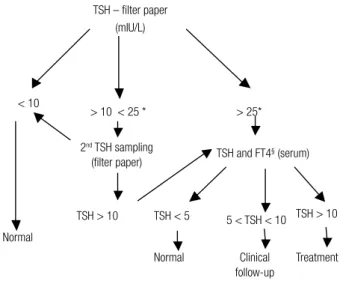
concen-trations higher than 10 mIU/L and low free T4 (FT4), treatment is started with levothyroxine, 10-12 µg/kg/ day. The child is referred to a local physician, trained to provide proper care. Borderline TSH values in the screening test (10-25 mIU/L) indicate the need to re-peat blood collection on ilter paper and, if conirmed (TSH > 10 mIU/L), serum measurement and medical evaluation are also required (Figure 1).
Incidence coeficient = number of tests performed during the year in the city x 1000 number of live-born babies screened during the
year in the city
Clinical and laboratory data and the information obtained by the protocol (baby’s age upon the irst medical appointment, gender, clinical signs, and symp-toms suggestive of CH, age at screening, value of the irst serum TSH and FT4 measurements, age at the beginning of treatment and etiology of the CH) were analyzed.
Statistics
All observations were recorded in a database, using
Excel 7.0 (Microsoft®) and GraphPad 5.0 (Graph Pad
Prism®). Descriptive analysis based on absolute
fre-quencies and percentages was used for the categorical variables, and measures of centrality (mean and me-dian) and dispersion (standard deviation, coeficient of variation, minimum and maximum) were used for nu-merical variables. Data are presented in tables.
To calculate coverage, the following formula was used:
Figure 1. Protocol proposed by the Nucleus of Actions and Research in
Diagnostic Support for newborn screening test analysis (Modiied from Pezzuti IL, 2009).
TSH – ilter paper (mIU/L)
< 10
> 10 < 25 * > 25*
2nd TSH sampling
(ilter paper) TSH and FT4
§ (serum)
TSH > 10 TSH < 5 5 < TSH < 10 TSH > 10
Normal
Normal Clinical follow-up
Treatment
§ FT4: free T4.
* Since 2007, TSH test level was changed to < 20 mIU/L.
Thereafter, the child is followed up by means of periodic medical examinations and L-thyroxine doses are adjusted according to clinical progress and periodic TSH and FT4 measurements.
After reaching three years of age, children have their medication suspended to determine CH etiology, and they undergo the following exams: thyroid scintigraphy with 123I, ultrasound, and perchlorate test, besides anti-thyroperoxidase antibodies and thyroglobulin measure-ments.
In the studied population, TSH analysis on ilter paper was performed using ELISA (enzyme-linked im-munosorbent assay; reference value < 10 mIU/L), and serum TSH and FT4, anti-thyroperoxidase antibodies and thyroglobulin measurements were carried out by chemoluminescence (reference values: 0.3 to 5.0 µIU/ mL; 0.75 to 1.8 ng/dL; and < 15 IU/mL and < 30 ng/mL, respectively).
Coverage = number of local live-born babies screened during the year in the city x 100 total number of live-born babies during the year in the city
The formula used to calculate the incidence coef-icient per year was:
Taking into account that the incidence of a disease is deined as the number of new cases that occur within a certain period of time in a population exposed to the risk of getting sick (15), we considered for the inci-dence calculation of each time period the number of conirmed cases screened by means of the newborn test, and the total number of newborn tests performed by the public healthare system from 2001 to 2010.
RESULTS
From 2001 through 2010, a total of 36,666 babies were born in Uberaba/MG, and 32,278 of them un-derwent the newborn screening test provided by the public healthcare system. Thus, 88% of the babies were screened for CH, and 16 cases were detected, indica-ting a CH incidence of 1: 2,017 screened newborns during this period (2001-2010).
Cop
yright
© ABE&M t
odos os dir
eit
os r
eser
vados
.
Of the 16 babies diagnosed with CH, 11 (68.8%) were female, representing a Female/Male ratio of 2.2:1.
Gestations of most of the babies with CH (n = 15; 93.8%) were normal; in one case, pre-eclampsia and gestational diabetes occurred. Half of the deli-veries were normal and at term; one was normal but post-term (42 weeks), ive babies were delivered by cesarean section, and two by pre-term cesarean sec-tion (34 and 36 weeks). Eight babies (50%) presented prolonged neonatal jaundice. One baby, small for ges-tational age at birth, had trisomy 21. In seven babies (43.8%), the screening test was positive, but signs did not suggest hypothyroidism. In the baby with trisomy 21, the characteristics of the syndrome were predomi-nant. The other eight babies (50%) showed manifest hypothyroidism, with pale, dry, and rough skin or cutis marmorata, macroglossia, open anterior and posterior fontanels, umbilical hernia, and iniltrated appearance.
The newborn screening test was performed on the 5th day of life in ive of the babies diagnosed with CH, and between the 5th and 10th day in eight babies (mean of 7 ± 2 days). Three babies had their tests delayed (performed at 17, 20, and 30 days of life, respectively) due to intercurrences at birth.
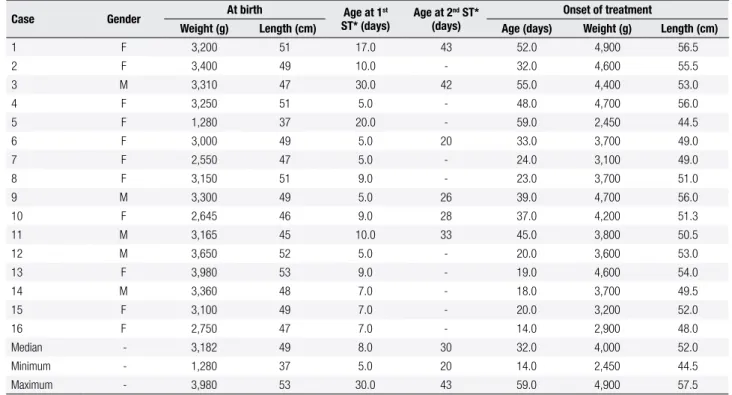
Once the diagnosis was conirmed, therapy was started between day 14 and 59 after birth (median: 32
days; Table 1). Excluding the cases of late blood collec-tion and/or recall, mean time of treatment onset was at 24.2 ± 10.2 days (14 to 48 days).
Of the 16 babies diagnosed with CH, 6 (37.5%) presented TSH < 25 mIU/L upon the irst screening test, so a second blood sample was collected on ilter paper, which delayed the diagnosis.
The babies’ irst medical visit occurred at 14 to 59 days of age (median: 32 days), when they presented the anthropometric characteristics listed in table 1.
TSH concentrations obtained in the newborn screening test, TSH and free T4 measurements per-formed later on, and anti-thyroperoxidase and thyro-globulin values are presented in table 2. Anti-thyroid antibodies at low concentrations do not support the ex-istence of intrauterine autoimmune thyroiditis. There was one case with a rather low thyroglobulin level, and CH etiology in this patient is still being investigated (ultrasound showed normal topic thyroid).
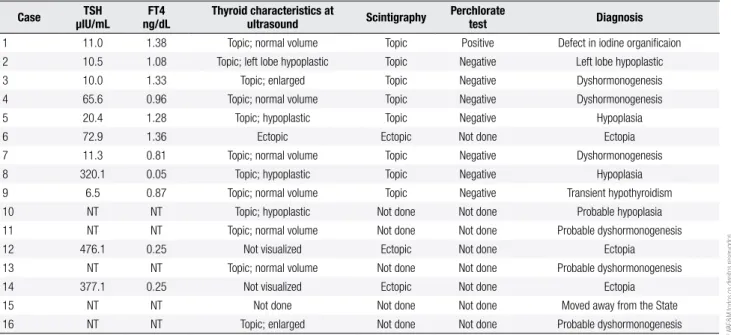
An etiologic investigation was carried out in 15 children, between 3 and 4 years of age; one patient moved away from the State before the etiologic in-vestigation was carried out. Cervical ultrasound (n = 15) showed a topic thyroid in 12 cases (80%), thy-roid ectopia in one case (6.7%), and in two cases the gland was not visualized. Among the topic thyroids,
Table 1. Clinical data on the children with CH at birth and at the onset of treatment (Uberaba/MG, 2001-2010)
Case Gender At birth Age at 1
st
ST* (days)
Age at 2nd ST*
(days)
Onset of treatment
Weight (g) Length (cm) Age (days) Weight (g) Length (cm)
1 F 3,200 51 17.0 43 52.0 4,900 56.5
2 F 3,400 49 10.0 - 32.0 4,600 55.5
3 M 3,310 47 30.0 42 55.0 4,400 53.0
4 F 3,250 51 5.0 - 48.0 4,700 56.0
5 F 1,280 37 20.0 - 59.0 2,450 44.5
6 F 3,000 49 5.0 20 33.0 3,700 49.0
7 F 2,550 47 5.0 - 24.0 3,100 49.0
8 F 3,150 51 9.0 - 23.0 3,700 51.0
9 M 3,300 49 5.0 26 39.0 4,700 56.0
10 F 2,645 46 9.0 28 37.0 4,200 51.3
11 M 3,165 45 10.0 33 45.0 3,800 50.5
12 M 3,650 52 5.0 - 20.0 3,600 53.0
13 F 3,980 53 9.0 - 19.0 4,600 54.0
14 M 3,360 48 7.0 - 18.0 3,700 49.5
15 F 3,100 49 7.0 - 20.0 3,200 52.0
16 F 2,750 47 7.0 - 14.0 2,900 48.0
Median - 3,182 49 8.0 30 32.0 4,000 52.0
Minimum - 1,280 37 5.0 20 14.0 2,450 44.5
Maximum - 3,980 53 30.0 43 59.0 4,900 57.5
Cop
yright
© ABE&M t
odos os dir
eit
os r
eser
vados
.
four were hypoplastic, six had normal volume, and two were enlarged. Scintigraphy was performed in 11 (68.8%) children. In three of them (27.2%), the thyroid was ectopic (sublingual), in the other cases
(72.7%) it was topic. The perchlorate test, performed in eight children with topic thyroid, was positive in one case (12.5%), indicating a defect in iodine organi-ication (Table 3).
Table 2. Results of the screening test and hormone dosages conirming CH (Uberaba/MG, 2001-2010)
Case
Filter paper Serum
1st ST*
TSHmIU/L
2nd ST*
TSHmIU/L
TSH µIU/mL
FT4 ng/dL
Anti-TPO IU/mL
TG** ng/mL
1 11.8 249.2 129.1 0.62 1.0 1,176.0
2 33.9 - 371.0 0.34 1.0 300.7
3 13.8 10.8 13.8 1.35 3.0 94.3
4 77.4 - 48.0 1.04 1.0 102.8
5 134.0 - 138.2 0.78 NT NT
6 23.0 24.9 24.5 1.11 13.0 66.0
7 27.2 - 11.5 1.08 1.0 21.1
8 38.6 - 61.9 0.66 73.0 281.1
9 10.8 33.1 15.7 1.02 1.0 483.0
10 24.2 49.3 75.6 0.77 1.0 180.0
11 22.6 13.7 32.4 0.91 1.0 61.2
12 119.3 - 317.4 0.50 NT NT
13 164.7 - 397.4 0.40 1.0 0.1
14 30.0 - 166.5 0.53 3.0 66.4
15 150.0 - 500.0 0.01 3.0 66.1
16 34.2 - 108.0 0.21 2.0 737.3
Median 34.0 29.0 91.8 0.71 1.0 98.6
Minimum 10.8 10.8 11.5 0.01 1.0 0.1
Maximum 164.7 249.2 500.0 1.35 73.0 1176.0
TSH: 0.3 to 5.0 µIU/mL; FT4: 0.75 to 1.8 ng/dL; ANTI-TPO: < 15 IU/mL; TG: up to 30 ng/mL. * ST: screening test; ** TG: thyroglobulin; NT: not tested.
Table 3. Results of etiologic and diagnostic tests of children with CH (Uberaba/MG, 2001-2010)
Case TSH µIU/mL
FT4 ng/dL
Thyroid characteristics at
ultrasound Scintigraphy
Perchlorate
test Diagnosis
1 11.0 1.38 Topic; normal volume Topic Positive Defect in iodine organiicaion
2 10.5 1.08 Topic; left lobe hypoplastic Topic Negative Left lobe hypoplastic
3 10.0 1.33 Topic; enlarged Topic Negative Dyshormonogenesis
4 65.6 0.96 Topic; normal volume Topic Negative Dyshormonogenesis
5 20.4 1.28 Topic; hypoplastic Topic Negative Hypoplasia
6 72.9 1.36 Ectopic Ectopic Not done Ectopia
7 11.3 0.81 Topic; normal volume Topic Negative Dyshormonogenesis
8 320.1 0.05 Topic; hypoplastic Topic Negative Hypoplasia
9 6.5 0.87 Topic; normal volume Topic Negative Transient hypothyroidism
10 NT NT Topic; hypoplastic Not done Not done Probable hypoplasia
11 NT NT Topic; normal volume Not done Not done Probable dyshormonogenesis
12 476.1 0.25 Not visualized Ectopic Not done Ectopia
13 NT NT Topic; normal volume Not done Not done Probable dyshormonogenesis
14 377.1 0.25 Not visualized Ectopic Not done Ectopia
15 NT NT Not done Not done Not done Moved away from the State
16 NT NT Topic; enlarged Not done Not done Probable dyshormonogenesis
Cop
yright
© ABE&M t
odos os dir
eit
os r
eser
vados
.
Of the children investigated thoroughly, only one case had transient hypothyroidism, so the medication was discontinued. This child was nevertheless followed up for other 2 years and, as he remained euthyroid, he was discharged from the program. Ten of the re-maining children were diagnosed with permanent hy-pothyroidism and resumed the treatment with sodium levothyroxine. Currently, four children are waiting for a complementation of their etiologic investigation (scin-tigraphy and perchlorate test) while under treatment.
Neuropsychomotor development has been consi-dered adequate for age in 12 children, except for one who presented neonatal seizures and the patient with trisomy 21. Six children are already at school age and six are at preschool age.
DISCUSSION
Access to the newborn screening test is still highly va-riable in Brazil, ranging from virtually 100% in the sou-thern states to less than 60% in the norsou-thern states of the country, where geographic, political, economic, so-cial, cultural, and educational barriers still persist (16).
In the State of Minas Gerais, the coverage of the newborn screening program is 94.6% (17) and com-prises almost 100% of the 853 cities of the state. In Uberaba, this coverage has been maintained over the years at around 88%, and we believe that the remaining babies are screened by the private healthcare system, since the socioeconomic conditions of part of the po-pulation allows them to afford private healthcare. This assumption is corroborated by 2003 data showing that almost one fourth of the Brazilian population (24.6%) was covered by private health insurance plans (18). This overall coverage rate is similar to the States of Paraná and Santa Catarina, which in 2007 presented an 88% and 88.5% coverage, respectively (19), and higher than in states of Pernambuco and Piauí, where in 2007 only 51% and 64% of the live-born babies were screened, respectively (20), and Sergipe, where in 2005 the co-verage was 76.3% (21).
The incidence of CH in Uberaba is higher (1:2,017) than the reported by most of the newborn screening programs in Brazil. This city is situated in a well-deve-loped region of the State of Minas Gerais that has been considered iodine-deicient in the past. However, there is no recent data on the regional iodine status (22). The greater number of cases may also be due to not yet identiied environmental factors. An even higher
inci-dence was observed in the State of Rio de Janeiro from 2005 to 2007 (1:1,030). This inding was attributed to variations in the neonatal TSH cutoff values among the screening models used there (23). According to a Brazilian newborn screening epidemiologic survey, in 2001, the prevalence of CH was 1:3,694, and in 2002, it was 1:3,808 (24).
Ideally, the age for collecting the irst blood sample for TSH screening is between the 3rd and the 5th day of life, when the postnatal peak of physiological TSH elevation has already decreased (25-27). In Uberaba, the mean age at the irst blood collection of the diag-nosed patients was 7 days, except for the three cases with late blood collection due to various reasons. This value is similar to the newborn screening program of the city of Ribeirão Preto, state of São Paulo (8 days) (12), but higher than the limits established as ideal in the Administrative Rule no. 822 (13) of the Brazilian Ministry of Health (2 to 7 days of life). Compared with other Brazilian states, the mean of 7 days is higher than the one found in the states of Paraná (3 days) and Santa Catarina (5 days), but lower than in Rio Grande do Sul (11 days) (19) and in Paraíba (29.8 days) (28). In a study published in 2006 on CH screening in Scotland (29), the median age at blood collection for the test was 6 days, and 93.8% of the samples were collected before eight days of life.
Treatment was started on average at 24.6 days of life and, in the last 4 years, it was observed that, even if the screening test was not carried out exactly on the 5th day, but between the 5th and the 10th day, treatment was started before 20 days of age. This observation proves how fast samples are sent to the reference labo-ratory, results are provided, and the children oficially called in for medical examination, conirmation of the diagnosis, and onset of treatment. In a further effort to start treatment as early as possible, ideally by the second week of life, the Newborn Screening Program of the State of Minas Gerais has called in children with TSH test results higher than 20 mIU/L (rather than 25) for a medical examination since 2007 (30). In the long run, this intervention will certainly show an impact on achieving the desired results.
Cop
yright
© ABE&M t
odos os dir
eit
os r
eser
vados
.
days (19). It is, however, still longer than in the States of Paraná (15 days) and Santa Catarina (16 days) (data for 2007) (19). National data obtained by the Brazilian Society of Newborn Screening for the years 2001 and 2002 showed that the mean age at start of CH treat-ment was 34 ± 17 days (19). In the Scottish study (29), the median age at treatment start was 11 days, but 12% of the evaluated children started treatment at over 16 days of life, which was considered late.
In order to be able to start treatment as early as possible, campaigns directed to healthcare professionals have been conducted in Uberaba, so that they would instruct parents regarding the importance of early tes ting (up to the 5th day of life), and alert the basic healthcare unit professionals about the importance of collecting blood samples properly, and quickly sending them to the reference laboratory.
So far, the analysis of CH etiology conirmed six cas-es of thyroid dysgencas-esis and four cascas-es of dyshormono-genesis. Four cases are still under investigation (prob-able dysgenesis in one case and dyshormono genesis in three). Compared with the literature, where thyroid dysgenesis is predominant (9,31-34), in the CH pa-tients of Uberaba, dyshormonogenesis was observed to have a higher frequency. One case of iodine organiica-tion defect and three cases with a normal perchlorate test were also found. In three children with a topic thy-roid on ultrasound, scintigraphy and perchlorate test are still to be performed, and molecular studies will be necessary in the future for a better etiologic deinition. We raised the possibility of parental consanguinity (35) as the factor responsible for this inding, but informa-tion obtained from the parents did not conirm this hypothesis. The results found in Uberaba are consis-tent with a study carried out on 243 patients with CH from the Newborn Screening Program of the State of Minas Gerais from 1996 to 2003, which also observed a higher frequency of hormone synthesis defects (52%) than thyroid dysgenesis (47%) (36).
CH is one of the most common causes of preventa-ble mental retardation, and its natural course can be dramatically modiied depending on how early it is diag nosed and how quickly proper treatment is started. Thus, every effort should be made to carry out new-born screening programs, in order to ensure early diag-nosis and treatment. To reach this goal, it is impor-tant to set time patterns for each step of the screening process, because delays in one or more steps will lead to unacceptable delays in the treatment of the affected
children. The Newborn Screening Program of the State of Minas Gerais is actively attempting, together with the municipal health ofices, to overcome the dificul-ties and, consequently, reach the desired goals. Spe-ciically in Uberaba, it is still necessary to optimize the extent of program coverage, and to reduce the age at sample collection. However, promising results are al-ready being obtained, offering a better perspective to the patients.
Acknowledgments: the authors are grateful to the Health Ofice of Uberaba/MG and to the Nucleus of Actions and Research in Diagnostic Support of the Federal University of Minas Gerais for giving them access to all the records, and to Ms. Silvana Silva, social worker of the Newborn Screening Program of the City of Uberaba, for her invaluable help.
Disclosure: no potential conlict of interest relevant to this article was reported.
REFERENCES
1. Cooper DS, Greenspan FS, Ladenson PW, Oxon MA. The thyroid gland. In: Greenspan FS, Gardner DG, editors. Basic & Clinic En-docrinology. 8th ed. New York: McGraw-Hill; 2007. p. 209-80. 2. Medeiros-Neto G, Knobel M. Hipotireoidismo congênito. In:
Mon-te O, Longui CA, Calliari PE, Kochi C, editors. Endocrinologia para o pediatra. 3th ed. Atheneu; 2007. p. 819-39.
3. Rapaport R, Simpser T. Update on some aspects of neonatal thyroid disease. J Clin Res Ped Endo. 2010;2(3):95-9.
4. Setian N. Hypothyroidism in children: diagnosis and treatment. J Pediatr (Rio J). 2007;83(5 Supl):209-16.
5. Dantas M, Miguel D, Pereira M, Toralles MB, Alves C. A impor-tância da triagem neonatal no hipotireoidismo congênito: análise secundária de dados. Gaz Méd Bahia. 2007;77(1 Supl):82-7. 6. Knobel M, Nogueira CR, Medeiros-Neto G. Genética
molecu-lar do hipotireoidismo congênito. Arq Bras Endocrinol Metab. 2001;45(1):24-31.
7. Maciel LM. Hipotireoidismo congênito. Projeto Diretrizes – As-sociação Médica Brasileira e Conselho Federal de Medicina. 2006. p. 10. Avaiable at: <http://www.projetodiretrizes.org.br/4_ volume/18-Hipotiroid.pdf >. Accessed on: Nov 10, 2011.
8. LaFranchi S. Congenital hypothyroidism: etiologies, diagnosis, and management. Thyroid. 1999;9(7):735-40.
9. American Academy of Pediatrics, Rose SR; Section on Endocrino-logy and Committee on Genetics, American Thyroid Association, Brown RS; Public Health Committee, Lawson Wilkins Pediatric Endocrine Society, Foley T, Kaplowitz PB, Kaye CL, Sundararajan S, Varma SK. Update of neonatal screening and therapy for con-genital hypothyroidism. Pediatrics. 2006;117(6):2290-303. 10. Carvalho TM, Santos HP, Santos IC, Vargas PR, Pedrosa J.
Neo-natal screening: a national public health programme in Brazil. J Inherit Metab Dis. 2007;30(4):615.
11. Tuoto EA. História da Medicina – O Teste do pezinho no Brasil. Avaiable at: <http:// historyof medicine.blogspot.com/2007>. Ac-cessed on: Nov 10, 2011.
Cop
yright
© ABE&M t
odos os dir
eit
os r
eser
vados
.
13. Ministério da Saúde. Portaria nº. 822, de 06 de junho de 2001. Avaia-ble at: <http://dtr2001.saude.gov.br/sas/PORTARIAS/Port2001/GM/ GM-822.htm>. Accessed on: Nov 10, 2011.
14. Chagas AJ. Rastreamento neonatal em Minas Gerais. In: Medei-ros-Neto G, Knobel M, editors. Hipotireoidismo congênito no Brasil: desaios à busca de soluções. São Paulo: Conectfarma Pu-blicações Cientíicas, 2008. p. 77-9.
15. Laprega MR, Fabro ALD. Coeicientes e índices mais usados em epidemiologia. In: Franco LJ, Passos ADC, editors. Fundamentos de epidemiologia. 2ª ed. Barueri, SP: Manole, 2011. p. 117-48. 16. Martinho LP. Diiculdades de triagem na região norte. In:
Medei-ros-Neto G, Knobel M, editors. Hipotireoidismo congênito no Brasil: desaios à busca de soluções. São Paulo: Conectfarma Pu-blicações Cientíicas, 2008. p. 87-8.
17. Dias VMA. Exposição de Centros de Referência Regionais – Re-gião Sudeste. In: Medeiros-Neto G, Knobel M, editors. Hipotireoi-dismo congênito no Brasil: desaios à busca de soluções. São Paulo: Conectfarma Publicações Cientíicas, 2008. p.103-6. 18. Brasil, Indicadores Básicos para a Saúde no Brasil: conceitos e
aplicações. Rede Interagencial de Informação para a Saúde – Ripsa. 2ª. ed. Brasília: Organização Pan- Americana da Saúde, 2008. p. 349: il. Avaiable at: <http://tabnet.datasus.gov.br/tabdata/ livroidb/2ed/apresent.pdf>. Accessed on: Out 21, 2011.
19. Vargas PR. Exposição de Centros de Referência Regionais – Re-gião Sul. In: Medeiros-Neto G, Knobel M, editors. Hipotireoidis-mo congênito no Brasil: desaios à busca de soluções. São Paulo: Conectfarma Publicações Cientíicas, 2008. p. 107-9.
20. Geroldo SR. Exposição de Centros de Referência Regionais – Re-gião Nordeste. In: Medeiros-Neto G, Knobel M, editors. Hipoti-reoidismo congênito no Brasil: desaios à busca de soluções. São Paulo: Conectfarma Publicações Cientíicas, 2008. p. 95-8. 21. Ramalho ARO, Ramalho RJR, Oliveira CRP, Santos EG,
Olivei-ra MCP, Aguiar-OliveiOlivei-ra MH. ProgOlivei-rama de Triagem Neonatal para Hipotireoidismo Congênito no Nordeste do Brasil: Crité-rios Diagnósticos e Resultados. Arq Bras Endocrinol Metab. 2008;52(4):617-27.
22. Lima MA, Fagundes TA, Raffaelli CM, Ferreira BP, Resende EM, Fonseca EC, et al. Alcoholization in the treatment of thyroid no-dule in colloid goiter endemic region. Arq Bras Endocrinol Metab. 2007;51(6):1007-12.
23. Botler J. Avaliação de desempenho do programa de triagem neo-natal do estado do Rio de Janeiro. 2010. 239f. Tese (Doutorado em Saúde Pública) – Escola Nacional de Saúde Pública Sergio Arouca, Rio de Janeiro, 2010.
24. Sociedade Brasileira de Triagem Neonatal. Dados estatísticos 2002/2003. Avaiable at: <http://www.sbtn.org.br>. Accessed on: Out 10, 2011.
25. American Academy of Pediatrics AAP Section on Endocrinology and Committee on Genetics, American Thyroid Association Com-mittee on Public Health. Neonatal screening for congenital hypo-thyroidism: recommended guidelines. Pediatrics. 1993;91:1203-9. 26. Fisher DA. Clinical review 19: management of congenital
hypo-thyroidism. J Clin Endocrinol Metab. 1991;72:523-9.
27. Fisher DA. Physiological variations in thyroid hormones: phy-siological and pathophyphy-siological considerations. Clin Chem. 1996;42(1):135-9.
28. Ramos AJS, Rocha AM, Costa ADM, Benicio AVL, Ramos ALC, Silva CRA, et al. Avaliação do programa de rastreamento de do-enças congênitas em Campina Grande-PB, Brasil. Arq Bras Endo-crinol Metab. 2003;47(3):280-4.
29. Jones JH, Mackenzie J, Croft GA, Beaton S, Young D, Donaldson MD. Improvement in screening performance and diagnosis of congenital hypothyroidism in Scotland 1979-2003. Arch Dis Child. 2006;91:680-5.
30. Pezzuti IL, Lima PP, Dias VMA. Congenital hypothyroidism: the clinical proile of affected newborns identiied by the neonatal screening Program of the State of Minas Gerais, Brazil. J Pediatr (Rio J). 2009;85(1):72-9.
31. Ramos HE, Nesi-França S, Boldarine VT, Pereira RM, Chiamolera MI, Camacho CP, et al. Clinical and molecular analysis of thyroid hypoplasia: a population-based approach in Southern Brazil. Thyroid. 2009;19(1):61-8.
32. Rubio IGS, Knobel M, Nascimento AC, Santos CL, Toniolo JV, Me-deiros-Neto G. Hipotireoidismo congênito: recentes avanços em genética molecular. Arq Bras Endocrinol Metab. 2002;46(4):391-401. 33. Perone D, Teixeira SS, Clara SA, Santos DC, Nogueira CR. Aspec-tos genéticos do hipotireoidismo congênito. Arq Bras Endocrinol Metab. 2004;48(1):62-9.
34. Toniolo JV, Kopp P. Thyroglobulin gene mutations and other ge-netic defects associated with congenital hypothyroidism. Arq Bras Endocrinol Metab. 2004;48(1):70-82.
35. Hashemipour M, Amini M, Talaie M, Kelishadi R, Hovespian S, Iranpour R, et al. Parental consanguinity among parents of ne-onates with congenital hypothyroidism in Isfahan. East Mediterr Health J. 2007;13(3):567-74.