RESUmo
A segurança do paciente representa um de-saio para a excelência da qualidade no se -tor saúde. Este estudo objeivou: veriicar a adequação entre a alocação da equipe de enfermagem e as horas de cuidado re-queridas pelos pacientes, bem como iden -iicar a relação entre essa alocação com eventos adversos/incidentes (EA/I). Trata --se de pesquisa observacional, descriiva e prospeciva, desenvolvida nas Unidades de Terapia Intensiva Clínicas do 4º andar e 6º andar de um Hospital Universitário, do mu -nicípio de São Paulo, Brasil, no período de 01/11/07 a 10/12/07, com 46 pacientes. Nas UTIs 4º andar e 6º andar, respeciva -mente, 43,3% e 10,3% das alocações foram inadequadas (p = 0,000). Houve diferença na frequência de EA/I nas alocações ade -quadas e inade-quadas da equipe de en -fermagem da UTI 4º andar e UTI 6º andar, p = 0,0004 e p = 0,000, respecivamente. Concluiu-se que, quanto maior a diferen -ça entre as horas disponíveis e requeridas de cuidado nas alocações de enfermagem, menor a frequência de EA/I.
dEScRitoRES
Unidades de Terapia Intensiva Equipe de enfermagem Cuidados de enfermagem Segurança do paciente
Nursing allocation and adverse events/incidents
in intensive care units
*O
riginal
a
r
ticle
AbStRAct
Paient safety is a challenge for the quality in health care system. This study aimed to analyze the appropriateness of the alloca -ion of nursing staf according to the hours of care required by paients and to idenify the relaionship between this allocaion and adverse events/incidents (EA/I). This research was observaional, descripive and prospecive, developed in Clinics ICU located in the 4th loor and 6th loor at a university hospital, in São Paulo, Brazil, from 01/11/07 to10/12/07, with 46 pa -ients. In the 4th loor and 6th loor ICU, respecively, 43,3% and 10.3% of alloca -ions were inadequate (p=0.000). There was a diference in the frequency of EA/I between the adequate and inadequate allocaion of nursing staf in the 4th loor and 6th loor ICU, p=0.0004 and p=0.000, respecively. It was concluded that the gre -ater the diference between available and required hours of care in nursing alloca -ions, the lower the frequency of EA/I.
dEScRiPtoRS
Intensive Care Units Nursing, team Nursing care Paient safety
RESUmEN
Este estudio tuvo como objeivos determi -nar la distribución de personal de enfer -mería conforme las horas de los cuidados requeridos por los pacientes y ideniicar la relación entre esta distribución con los eventos adversos/incidentes (EA/I). Estu -dio observacional, descripivo y prospec -ivo, desarrollado en la UCI Clínicas de 4º y 6º piso de un hospital universitario, en Sao Paulo, Brasil, desde 01/11/07 hasta 10/12/07, con 46 pacientes. Los resultados apuntan que en la UCI 4º piso y en la UCI 6° piso, respecivamente, 43,3% y 10,3% de las distribuciones fueron inadecuadas (p=0,000). Hubo diferencia en la frecuen -cia de EA/I en la distribución de personal de enfermería adecuada e inadecuada en la UCI 4º y 6º piso, respecivamente, p = 0,0004 y p=0,000. Se concluyó que cuanto mayor la diferencia entre horas disponibles y necesarias de cuidados en la distribución de acividades del equipo de enfermería, menor es la frecuencia de EA/I.
dEScRiPtoRES
Unidades de Cuidados Intensivos Grupo de enfermería
Atención de enfermería Seguridad del paciente
Leilane Andrade Gonçalves1, Rafaela Andolhe2, Elaine machado de oliveira3, Ricardo Luís barbosa4, Ana cristina mancussi e Faro5, Renata mahfuz daud Gallotti6, Katia Grillo Padilha7 AlocAção dA equipe de enfermAgem e ocorrênciA de eventos Adversos/ incidentes em unidAde de terApiA intensivA
distriBuciÓn de lA equipo de enfermerÍA Y ocurrenciA de eventos Adversos/incidentes en unidAd de cuidAdos intensivos
*extracted from the thesis “segurança do paciente em unidade de terapia intensiva: carga de trabalho de enfermagem e sua relação com a ocorrência de eventos adversos e incidentes”, university of são paulo school of nursing, 2011. 1ph.d. in Adult Health nursing, university of são paulo school of nursing.
são paulo, sp, Brazil. [email protected] 2doctoral student of the graduate program in Adult Health nursing, university of são paulo school of nursing.
cApes fellow. são paulo, sp, Brazil. [email protected] 3post-doctorate student of the graduate program in Adult Health nursing, university of são
paulo school of nursing. cApes fellow são paulo, sp, Brazil. [email protected] 4post-doctorate student of the graduate program in Adult Health
nursing, university of são paulo school of nursing. pnpd fellow são paulo, sp, Brazil. [email protected] 5 rn. Associate professor, university of são
paulo, medical-surgical nursing department, são paulo, sp, Brazil. [email protected] 6md. ph.d. professor of the department of clinical emergencies at
the university of são paulo faculty of medicine. são paulo, sp, Brazil. [email protected] 7full professor of the department of medical-surgical
iNtRodUctioN
Paient safety represents a major challenge toward the excellence of quality in the healthcare sector.
The high occurrence of adverse events and incidents clearly expressed by the yearly numbers of preventable deaths as a result of inadequate health care(1) - ranging
between 44,000 and 98,000 - has been rising great con
-cern across the globe. By deiniion, adverse events (AE)
are understood as the emergence of non-intenional in
-juries unrelated to the natural evoluion of an underly
-ing disease that generate measurable injuries in afected paients and/or prolong the length of stay and/or cause
death(2); Incidents (I) are health complicaions that origi
-nate in the health care process that do not generate mea
-surable injuries or prolong the length of stay(3).
Adverse events and incidents (AE/I) are relevant quali
-ty indicators, as they allow for the measurement of the ex
-ising distance between the rendered health service and the ideal care, thus ofering indispensable informaion
toward the construcion of a safer health care system(4).
In Intensive Care Units (ICU), paients who require in
-tensive care are considered vulnerable to the occurrence of adverse events, as they present constant hemodynamic alteraions and imminent death risks, thus demanding health professionals to provide them with complex care, uninterrupted atenion and
immediate decisions(5).
The environment, the tasks, the organi
-zaion and the technology are pointed out by speciic invesigaions as the health care
system elements that interfere in the quality of the care delivered to criical paients. Work condiions, especially
the adequacy of the staf, are factors that may compro
-mise the quality of intensive care(6).
The indings poining out the workload as a risk factor
to paient safety(7) are endorsed by literature reviews pro
-duced between 1970 and 2005.
Therefore, an adequate number of professionals is an
indispensable premise toward a safe care, and it is an in
-situional responsibility to provide human resources with favorable work condiions in health care units. Ater all, the quanitaive adequacy of professionals to the needs of the paients not only lowers their vulnerability, but also decreases the incidence of more serious risks to the health workers(8).
Among the diferent health teams that work in the ICU, the nursing staf stands out as a fundamental player in the processes aimed to ensure and improve the quality
of the rendered care. However, isolated training and quali
-icaion measures toward nursing staf are not a guarantee of total absence of risks, which jusiies this study related
to the hours of nursing staf available / hours required by paient care and nursing allocaion processes in the ICUs.
In the last decade, several studies have observed the correlaion between workloads in the nursing pracice
and care results(7-8). Some authors(9) concluded that a 0.1%
increase in the paient/nurse raio could lead to a 28% rise in adverse event rates.
Addiionally, the clinical pracice clearly shows that the
occurrence of adverse events is not only related to the to
-tal number of the nursing staf, but also to the allocaion of these professionals at bed side, or in other words, the inadequate distribuion of paients for each professional whenever the 1:1 raio is not a reality. This is a common proile observed both in naional and internaional ICUs.
However, we did not ind studies that addressed such is
-sue.
In this context, this study aims to verify the balance between the allocaion of nursing staf and the care hours
required by paients, as well as idenify the correlaion be
-tween the allocaion of nursing staf per paient and the occurrence of adverse events/incidents.
mEtHod
This observaional, descripive, prospec
-ive study was performed in four ICUs of a
University Hospital Clinical Emergency Ser
-vices (Emergency Room, Medical Outpa
-ient Clinic, Pneumology and Hematology)
located in the central area of São Paulo, Bra
-zil. For standardizaion purposes, the emer
-gency room ICU was analyzed together with
the Hematology unit, designated as 4th Floor ICU, and the
medical clinic ICU was analyzed in conjuncion with the
Pneumology unit, designated as 6th Floor ICU. The jusii
-caion for such grouping is based on the fact that all units are located in a single physical structure, having the same professionals working in the teams.
During the study interval, the 4th Floor ICU showed a
paient/nurse distribuion of 5:1, while the distribuion ra
-io on the 6th Floor ICU was 6:1. The paient/nursing tech
-nician distribuion in both units was 2:1.
The convenience sampling studied between 1 Novem
-ber 2007 and 10 Decem-ber 2007 was comprised of all pa
-ients aged 16 or older admited into the ICUs, submited to clinical and/or surgical treatments, and who stayed for a minimum of 24 hours in those units; readmited paients were also taken into account.
Data collecion was performed ater the Research Eth
-ics Commitee approved the study proposal and counted
on the acive paricipaion of doctors, nurses and un
-dergraduate students taking the 2nd and 3rd years in the
Nursing College. Health care professionals, including one
some authors concluded that a 0.1% increase in the patient/
doctor and two nurses expert in the applicaion of the in
-struments used in this study and with vast knowledge on other research instruments, provided the data collecion team with speciic training. The data collecion process was similar in all four units and complied with the same methodological proceeding.
The study made use of following instruments:
The so-called Adverse Events and Incidents in ICUs
in-strument was employed toward collecing data related to the ideniicaion of paients, injury severity parameters and adverse events and incidents.
The Simpliied Acute Physiology Score II (SAPS II) was applied on a daily basis in order to measure the paients’
severity of illness(10). All necessary informaion required to
ill in the instrument was taken from the paients’ medical reports; whenever data was missing, the reference value
of each respecive parameter was employed. For the pur
-poses of this study, the following AE/Is were taken into account: loss of therapeuic devices, medicaion error,
diet management failures, hypoglycemia, phlebiis, er
-rors related to the collecion and/or forwarding of exams to clinic analysis laboratories, and mistaken entries in the Nursing Care System (NCS).
Aiming to monitor AE/Is, medical reports were daily skimmed and analyzed by researchers and data collectors. In addiion, the 7 a.m. and 7 p.m. shit change processes, as well as the medical visits scheduled to take place in the morning shit, were followed up throughout the 40 days
of the invesigaion in order to capture and noify even
-tual AE/Is during those aciviies.
Ater this set of informaion was illed in, the assigned researchers categorized the observaions found in the AE/I forms.
The applicaion of the second instrument aimed to
collect informaion related to the nursing workload mea
-sured by the Nursing Aciviies Score (NAS). Developed
by Miranda et al.(11), this instrument consists of 23 items
related to medical and nursing intervenions ICU paients were submited to. The instrument’s maximum score reaches 176.8%. The NAS’s total score calculaion results from the sum of the scored items, which expresses, in a percentage basis, the ime spent by the nursing staf to care for criical paients(11).
Ater the ICU’s nursing staf was trained to ill in the
NAS, individual data collecion processes were daily car
-ried out for each paient, based on the informaion gath
-ered in the previous 24 hours. The excepion was the irst
admission day, which took into account the aciviies per
-formed from the paient’s admission to 7 o’clock. A similar procedure was applied to paients discharged from the
ICU: intervenions that took place up unil the ime of dis
-charge were reckoned, whether or not the 24 hour-period was completed.
This second instrument was illed in by the data col
-lecion team based on the informaion made available in
the medical report and in the atached instrument - Nurs
-ing Aciviies Score. In order to homogenize the records of
each one of the index components, we adopted the Nurs
-ing Aciviies Score(12).
A third form was elaborated in order to assess nursing
available working hours and allocaion of nurses per pa
-ient. In this instrument, the ideniicaion of the profes
-sional (assistant nurse or nursing technician) held respon
-sible for the care of admited paients and respecive beds in all three work shits were noted down in a daily basis.
First, the nursing care required for each paient-day was calculated based on the NAS index. This calculaion took into account that each NAS score is equivalent to 14min40sec(13).
The number of assistant nurses or nursing technicians working at the ICUs, the hour-based work journey of each professional (6 hours in the morning and aternoon shits, and 12 hours in the night shit), as well as the number of admited paients, were taken into account to calculate the available nursing working hours per paient.
As for the allocaion of the nursing staf, the analysis
of the personnel’s daily shit distribuion, that is, the di
-vision of professionals by paients, took into account all distribuions carried out throughout the study month, on all three work shits (morning, aternoon and night). The allocaion of professionals was considered adequate whenever the available nursing working ime was equal to or higher than the ime required to care for paients according to the NAS. On the other hand, whenever the available nursing working hours were lower than the ime
required to the paient’s care, the allocaion of profession
-als was considered as inadequate. For this calculaion, it is worth highlighing that the working hours of those nurses
responsible for up to ive paients were proporionally dis
-tributed, taking into account the number of paients un
-der their personal responsibility.
Quanitaive variables were iniially analyzed by the Kolmogorov-Smirnov test, aiming to select the tests that would it the analyses. The comparison of quanitaive variables among the groups was carried out by the t-Test for age and the Mann-Whitney test for length of stay (LOS), severity of illness and discharge.. This same test was applied to analyze the AE/I average and the adequate allocaion of professionals. The Spearman correlaion test
and the Square-Chi test were used to analyze the difer
-ence between available and required working hours in the allocaion processes, as well as the AE/I frequency and the AE/I proporion between the studied ICUs.
In order to compare the diference between ICUs
related to required and available working hours, the re
-search used the t-Test, as those variables presented nor
The signiicance level of all performed tests was 5% and all of them made use of version 19.0 of the Staisical Package for the Social Sciences (SPSS).
RESULtS
Characterizaion of paients, hours of nursing staf avai
-lable, required paient care hours, and AE/I
Throughout the period of the study (n = 40 days), 46
paients were admited into the 4th Floor ICU and 40 pa
-ients were admited into the 6th Floor ICU.
The gender (p = 0.536), age (p = 0.869), severity of ill
-ness according to the SAPS II (p = 0.142) and LOS in the unit (p = 0.774) indexes were similar in both ICUs.
The average age of paients was 53.1 years (sd = 18.1) and 53.7 years (sd = 16.2), and the SAPS II average reached 43.7 (sd = 20.4) and 36.5 scores (sd = 14.7), respecively in the 4th and 6th Floor ICUs.
The LOS reached an average of 6.7 days (sd = 7.3) at
the 4th Floor ICU, and 8.0 days (sd = 9.7) at the 6th Floor
ICU. The sepic shock was the major reason for the pa
-ients’ admission in the units (41.4% and 47.5%, respec
-ively, in the 4th and 6th Floor ICUs).
The analysis of the discharge from the 4th Floor ICU
showed that 50.0% out of the 46 paients (n = 23) evolved
to death. At the 6th Floor ICU, on the other hand, the mor
-tality rate reached 22.5% (n = 9). The diference between both groups was p = 0.016.
The paients’ required hours for caring (NAS average
= 60.9% and 57.5% at the 4th and 6th Floors, respecively)
reached 15.7 hours (sd = 1.7) at the 4th Floor ICU and 14.7
hours (sd = 1.7) at the 6th Floor ICUs (p = 0.008), showing
that 4th Floor ICU’s paients demanded more hours than
the paients admited into the 6th Floor ICU.
The hours of nursing staf available per paient-day showed an average of 16.9 hours (sd = 2.8) and 24.4 hours
(sd = 3.9) at the 4th and 6th Floor ICUs, respecively. The
staisical diference between them was p = 0.000. There
-fore, the available nursing staf hours in the 4th Floor ICU
were lower than the available nursing staf hours in the 6th
Floor ICU.
A total amount of 1,082 occurrences (AE/I) was ob
-served in both ICUs during the study period; from these,
669 (61.8%) took place at the 6th Floor ICU and 413
(38.2%) at the 4th Floor ICU. The average AE/I per
paient-day was higher at the 6th Floor ICU than in the 4th Floor ICU
(p = 0.000), 2.2 (sd = 0.9) and 1.3 (sd = 0.7) occurrences, respecively.
In the 4th Floor ICU, 301 (81.6%) incidents and 68
(18.4%) adverse events were observed, totaling 369 re
-ported AE/I. In the 6th Floor ICU, from the total amount of
618 reported EA/Is, 564 (91.2%) incidents and 54 (8.8%) adverse events were recorded.
As for the type of AE/I, the 4th Floor ICU showed that
the majority of occurrences was related to mistaken check
into the medical records (n = 116; 28.1%), followed by er
-rors in the preparaion and administraion of medicaion
(n = 93; 22.5%), errors regarding the collecion and/or for
-warding of exams to clinic analysis labs (n = 55; 13.4%),
and hypoglycemia (n = 42; 10.2%). The 6th Floor ICU also
ideniied frequent errors in the preparaion and adminis
-traion of medicaions (n = 226; 33.8%), mistaken checks into medical reports (n = 197; 29.4%) and failures in diet management (n = 78; 11.7%).
Allocaion of the nursing staf and occurrence of AE/I
Taking into account the morning, aternoon and night shits during the 40-day study, there was a total amount of 1,165 nursing staf allocaion processes per paient in both ICUs (Table 1).
Table 1 – Adequacy of the nursing staff allocation process per patient in the 4th and 6th Floor Intensive Care Unit, according to the
NAS - São Paulo, 2007
Allocation according to the
NAS
4th Floor ICU 6th Floor ICU p-value 4th and 6th Floor
ICUs p-value
n % n % N %
Inadequate 199 43.7 73 10.3 0.0001 272 23.3 0.0001
Adequate 256 56.3 637 89.7 0.0001 893 76.7 0.0001
Total 455 100.0 710 100.0 1.165 100.0
note: 4th floor icu (n=455) and 6 th floor icu (n=710)
When taken separatedly, the 4th Floor ICU shows a
total of 455 allocaions, from which 199 (43.3%) were in
-adequate. The 6th Floor ICU, on its turn, showed 710 al
-locaion processes; from these, 73 (10.3%) presented in
Table 2 – Descriptive statistics of AE/I in the 4th and 6th Floor
Intensive Care Units, according to adequate and inadequate allo-cations - São Paulo, 2007.
Adverse Events and Incidents
Adequate Inadequate
4th loor 6th loor 4th loor 6th loor
Average (n = 256) (n = 637) (n = 199) (n = 73)
Minimum 0 0 0 0
Maximum 6 6 4 8
Standard Deviation 1.2 1.1 1.0 1.6
Table 2 shows that the average occurrence of EA/I in
the 4th Floor ICU concerning adequate and inadequate
allocaions of nursing staf per paient was 0.8 (dp = 1.2)
and 0.9 (dp = 1.0), respecively. In the 6th Floor ICU, on the
other hand, adequate allocaions showed an AE/I occur
-rence average of 0.8 (dp = 1.1), while inadequate alloca
-ions reached 1.6 (dp = 1.6).
When the AE/I frequency is analyzed in adequate and
inadequate allocaion processes of the nursing staf, a sig
-niicant diference is shown both in the 4th Floor ICU (p =
0.004) and in the 6th Floor ICU (p =0.00). Therefore, these
results allow us to airm that the more inadequate the distribuion of paients per professional, the higher the frequency of AE/I in both ICUs.
Table 3 – AE/I in the 4th and 6th Floor ICUs together, according
to adequate and inadequate allocations - São Paulo, 2007.
Adverse Events and Incidents
Adequate (n = 893)
Inadequate
(n = 272) p-value
Average 0.8 1.1 0.0001
Minimum 0 0
Maximum 6 8
Standard Deviation 1.1 1.2
When analyzed together, results in Table 3 show that the average of AE/I occurrences in adequate allocaions reached 0.8 (dp = 1.1) and 1.1 (dp = 1.2) in inadequate allocaions in the ICUs, highlighing a signiicant diference between them (p = 0.000).
Table 4 – Correlation between the difference of hours of nursing
staff available and patients’ required care hours in nursing staff
allocation processes and AE/I frequency in the 4th and 6th Floor
Intensive Care Units - São Paulo, 2007.
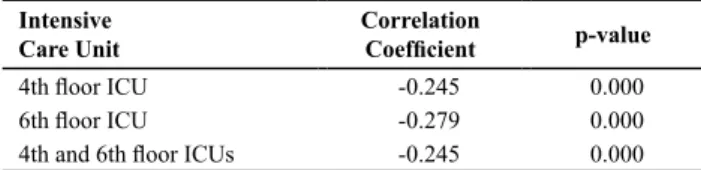
Intensive Care Unit
Correlation
Coeficient p-value
4th loor ICU -0.245 0.000
6th loor ICU -0.279 0.000
4th and 6th loor ICUs -0.245 0.000
According to Table 4, the 4th and 6th Floor ICUs show a
signiicantly negaive correlaion between the diference of available nursing staf hours and paients’ required care hours, and the AE/I frequency when units are analyzed either together or separately. The Table shows that the
higher the diference between hours of nursing staf avail
-able and paients’ required care hours in nursing alloca
-ion processes, the lower is the AE/I frequency.
diScUSSioN
For several years, the correlaion between available
nursing working hours and number of exising profession
-als and paient safety has been drawing the atenion of healthcare professionals who work in hospitals. In criical units, such as the ICU, this becomes a much more relevant
issue, as they demand a proper adequacy of human re
-sources and the care of severely ill paients. In this study, the paients’ required nursing care hours showed a NAS
average of 60.9%, or 15.7 hours per paient-day in the 4th
Floor ICU and a NAS average of 57.7% or 14.7 hours in the
6th Floor ICU (p = 0.008). These values were found to be
above the average shown by a study carried out in a gen
-eral private hospital in São Paulo, which observed a varia
-ion of 9-13 care hours(14). However, several other studies
obtained higher NAS averages(15-16), which can be jusiied
by demographic and clinic characterisics, as well as by the paient’s illness severity.
On the other hand, taking into account the character
-isics of the studied ield hospital, that is, a high complex
-ity, reference hospital in caring for severely ill paients, the NAS average was expected to be higher. These indings presuppose at least two hypotheses: low demand of real
care, or otherwise, high demand of nursing care by an in
-suicient number of professionals, causing implemented
intervenions not to be faithfully recorded and conse
-quently an underesimated NAS.
The second hypothesis is corroborated by the fact that
the available nursing staf hours in the 4th Floor ICU (16.9
hours) are lower than the 6th Floor ICU’s (24.4 hours), al
-though the care demands by paients in the 4th Floor ICU
are found to be higher. Such results allow us to infer that lower available nursing staf hours cause relevant reports not to be made, including those related to AE/Is.
With regards to the occurrences, therefore, average daily AE/Is in the studied units was 2.2 occurrences (sd =
0.9) in the 6th Floor ICU and 1.3 (sd = 0.7) in the 4th Floor
ICU; the largest number of occurrences was found in the 6th Floor ICU (p = 0.000). These values are respecively
above and below the average of occurrences found in a study carried out in a university hospital’s ICU located in Jerusalem, which ideniied 1.7 occurrences per paient
per admitance day(17).
As for the adequacy of nursing staf allocaion process
-es aimed to care for criical paients (Table 1), a staisical
-ly signiicant diference between the units was observed.
Supported by the data shown in Table 3, these results al
-lowed for the conclusion that the occurrence of AE/Is was
higher when allocaion processes were not adequate (av
-erage of 0.8 AE/I). The results not only point to the need of an adequate re-dimensioning of nursing personnel in the unit as a whole, but also show the need of adjusing
allocaion processes according to the hours of care re
-quired by paients.
In this sense, an American study carried out in general
hospitals with 10,184 nurses and 232,342 paients con
-cluded that in a condiion of high proporion of paients per nurse, surgical paients presented higher risks of death 30 days following the admitance process, as well as higher
levels of inadequate rescue rates (death caused by poten
-ially preventable complicaions). The authors observed that adding one single paient per nurse was associated with a 7% higher risk in the probability of death in a 30-day period following a hospital admitance process and a 7%
increase in the death risk originated by complicaions(18).
Besides reporing a higher number of AE/Is when al
-locaions were inadequate, the study also observed that the correlaion between available nursing hours and the hours required by paients in staf allocaion processes
was negaive and meaningful when they were both sepa
-rately and conjointly analyzed. The study showed that the
higher the diference between the available nursing work
-ing hours and the paients’ required care ime, the lower the frequency of AE/Is (Table 4). These results reinforce
the indings of other studies, which ideniied lower infec
-ion rates (63) and AE/Is (73,79) when the propor-ion of available care hours was higher than those required by paients/day.
Paient care as a process is managed by the nurse when
-ever he plans, delegates or executes it by training his team, educaing paients, interacing with other professionals, ariculaing and negoiaing on behalf of the consolidaion and improvement of care, and also when he foresees and
provides both human and material resources(19).
Within this context, in addiion to caring for the health of paients, the objecive of the nursing work is to ariculate, integrate and coordinate the nursing staf toward organizing a work structure that favors care and minimizes risks.
Although the human factor may be present in the oc
-currence of AE/Is, the structural aspects of the unit, in ad
-diion to the work process oten determined by the nurses
themselves, become factors that make way to profession
-al errors(20).
In the everyday acivity of ICUs, the daily distribuion of nursing staf based on subjecive criteria concerning
the care requirements demanded by paients may inlu
-ence the occurr-ence of AE/Is, thus jeopardizing paient safety, as shown in this present study.
In the light of these indings, the adequate allocaion of nursing staf per paient in ICUs should essenially make use of objecive instruments that can measure the care demand per paient, in a way to contribute toward a safe care pracice both for paients and for professionals.
Contribuions and limitaions of the study
The implementaion of a prospecive study that counted on a follow-up process comprised of daily visits to the units and to each change of nursing staf shits, in addiion to the full reading and thorough analysis of the paients’ report toward collecing AE/Is, is the turning
point of this present study. The achievement of AE/I oc
-currences through these strategies enabled us to make progress in the collecion process of this informaion, allowing for the suppression of the deiciencies related to voluntary, subjecive noiicaions that work against more precise analyses.
However, the major contribuion of this study may stem from the results of the analysis of the nursing staf allocaion process per paient in the daily life of the ICU, as they allowed for the invesigaion of the inluence of this issue in the safety of criical paients.
Despite the relevance of achieved results, some limita
-ions must be menioned and considered by other stud
-ies. Among them we may state the performance of the study in one single hospital and the convenient choice for the ICUs, in addiion to the short-term follow up (40 days). Last, another limitaion was the calculaion of the available nursing working hours per paient, which took
into account the nurse’s available working hours pro
-porionally distributed among admited paients in the
above-menioned period, leaving aside the precise mea
-surement of the ime spent by the professional to care for each paient.
coNcLUSioN
The AE/I average showed to be higher in inadequate
nursing staf allocaion processes in comparison with ade
-quate allocaions, both in the 4th Floor ICU (p = 0.004) and
in the 6th Floor ICU (p = 0.000). The average of occurrences
for adequate distribuions was equal (0.8) in both 4th and
6th Floor ICUs. In inadequate allocaion distribuions, AE/I
averages were 0.9 and 1.6 in the 4th and 6th Floor ICUs,
respecively.
When analyzed together, the average of AE/I occur
-rences in adequate allocaions was 0.8 (sd = 1.1) and 11 (sd = 1.2) in inadequate allocaions, showing a staisically signiicant diference (p = 0.000).
When analyzed both separatedly and together, the correlaion between available nursing staf hours and paients’ required care hours and nursing staf allocaion
processes was negaive and quite signiicant in the 4th
and 6th Floor ICUs. The study concluded, therefore, that
REFERENCES
1. Kohn L, Corringan J, Donaldson M, editors. Insitute of Medi
-cine Report. To err is human: building a safer health system. Washington: Insitute of Medicine; 2000.
2. Hiat HH, Barnes BA, Brennan TA, Laird NM, Lawthers AG, Leape LL, et al. A study of medical injury and medical malprac
-ice. N Engl J Med. 1989;321(7):480-4.
3. Chang A, Schyve PM, Croteau RJ, O’Leary DS, Loeb JM. The JCAHO paient safety event taxonomy: a standardized termi
-nology and classiicaion schema for near misses and adverse events. Int J Qual Health Care. 2005;17(2):95-105.
4. Leape LL, Woods DD, Hatlie MJ, Kizer KW, Schroeder SA, Lun
-dberg GD. Promoing paient safety by prevening medical er
-ror. JAMA. 1998;280(16):1444-7.
5. Rothschild JM, Landrigan CP, Cronin JW, Kauschal R, Lockley SE, Burdick E, et al. The Criical Care Safety Study: the inci
-dence and nature of adverse events and serious medical er
-rors in intensive care. Crit Care Med. 2005;33(8):1694-700.
6. Laschinger HK, Leiter MP. The impact of nursing work envi
-ronments on paient safety outcomes: the mediaing role of burnout/engagement. J Nurs Adm. 2006;36(5): 259-67.
7. Carayon P, Gurses AP. A human factors engineering conceptu
-al framework of nursing workload and paient safety in inten
-sive care units. Inten-sive Crit Care Nurs. 2005;21(5):284-301.
8. Inoue KC, Matsuda LM. Sizing the nursing staf in an intensive care unit for adults. Acta Paul Enferm. 2010;23(3):379-84.
9. Weissman JS, Rothschild JM, Bendavid E, Sprivulis P, Fachi F, Cook EF, et al. Hospital workload and adverse events. Med Care. 2007;45(5):448-55.
10. Le Gall JR, Lemeshow S, Saulnier F. A new Simpliied Acute
Physiology Score (SAPS II) based on a European/North American mulicenter study. JAMA. 1993; 270(24):2957-63.
11. Miranda DR, Raoul N, Rijk A, Schaufeli W, Iapichino G. Nurs
-ing aciviies score. Crit Care Med. 2003;31(2):374-82.
12. Gonçalves LA, Padilha KG, Sousa RMC. Nursing Aciviies Score (NAS): a proposal for pracical applicaion in intensive care units. Intensive Crit Care Nurs. 2007; 23(6):355-61.
13. Lima MKF, Tsukamoto R, Fugulin FMT. Aplicação do Nursing Aciviies Score em pacientes de alta dependência de enfer
-magem. Texto Contexto Enferm. 2008;17(4): 638-46.
14. Tranquiteli AM, Ciampone MHT. Número de horas de cui
-dados de enfermagem em Unidade de Terapia Intensiva de Adultos. Rev Esc Enferm USP. 2007;41(3):371-7.
15. Padilha KG, Sousa RMC, Garcia PC, Bento ST, Finardi EM, Hata
-rashi RHK. Nursing workload and staf allocaion in an inten
-sive care unit: a pilot study according to Nursing Aciviies Score (NAS). Intensive Crit Care Nurs. 2010;26(2):108-13.
16. Conishi RMY, Gaidzinski RR. Nursing Aciviies Score (NAS) como instrumento para medir carga de trabalho de enferma
-gem em UTI adulto. Rev Esc Enfern USP. 2007; 41(3):346-54.
17. Donchin YG, Olin M, Badihi Y, Biesky M. Sprung CL, Sprung CL, et al. A look into the nature and causes of human errors in the intensive care unit. Crit Care Med. 1995;23(2):294-300.
18. Cho SH, Keteian S, Barkauskas VH, Smith DG. The efects of nurse staing on adverse events, morbidity, mortality, and medical costs. Nurs Res. 2003;52(2):71-9.
19. Rossi FR. Tecnologias leves nos processos gerenciais do en
-fermeiro: contribuição para o cuidado humanizado [disser
-tação]. Porto Alegre: Escola de Enfermagem, Universidade Federal do Rio Grande do Sul; 2003.