Ada Ávila AssunçãoI Tânia Maria de AraújoII Rafael Brito Nery RibeiroIII Sérgio Vinícios Soares OliveiraIV
I Departamento de Medicina Preventiva e Social. Faculdade de Medicina (FM). Universidade Federal de Minas Gerais (UFMG). Belo Horizonte, MG, Brasil II Departamento de Saúde. Universidade
Estadual de Feira de Santana. Feira de Santana, BA, Brasil
III Programa de Pós-Graduação em Saúde Pública. FM-UFMG. Belo Horizonte, MG, Brasil
IV Curso de Graduação em Medicina. FM-UFMG. Belo Horizonte, MG, Brasil Correspondence:
Ada Ávila Assunção
Universidade Federal de Minas Gerais Av. Alfredo Balena 190 - 6º andar – Sala 705 Santa Efi gênia
30310-150 Belo Horizonte, MG, Brasil E-mail: [email protected] Received: 7/19/2011
Approved: 2/1/2012
Article available from: www.scielo.br/rsp
Hepatitis B vaccination and
occupation exposure in the
healthcare sector in Belo
Horizonte, Southeastern Brazil
ABSTRACT
OBJECTIVE: To identify factors associated with vaccination against hepatitis B among healthcare workers.
METHODS: This was a cross-sectional study on 1,808 public-sector healthcare workers in Belo Horizonte, Southeastern Brazil, in 2009. A self-administered questionnaire was used and the vaccination situation was analyzed taking sociodemographic characteristics, lifestyle and working conditions and characteristics into consideration. Univariate (p < 0.20) and multiple (p < 0.05) statistical analyses were performed using Poisson regression to evaluate factors associated with vaccination.
RESULTS: Of the workers, 85.6% declared that they had been vaccinated, although only 74.9% of the vaccinated professionals had received a complete imunization schedule. Not having been vaccinated was associated with not having a partner; having high school, technical or incomplete higher education level; work characteristics such as working in surveillance or the administrative/ general services sector; and not using personal protection equipment.
CONCLUSIONS: Groups with lower vaccination coverage were identifi ed. Efforts are required to ensure access and adherence to vaccination among healthcare workers, such as awareness-raising mechanisms.
DESCRIPTORS: Health Personnel. Hepatitis B Vaccines. Occupational Exposure. Accidents, Occupational. Hepatitis B, prevention & control. Cross-Sectional Studies.
INTRODUCTION
Approximately 360 million people are chronic carriers of viral hepatitis B and more than one million die every year as a result of acute fulminant hepatic failure.3,a The case detection rate was 6.1 per 100,000 inhabitants in Brazil in 2010, among which 71.8% were concentrated between the ages of 20 and 49 years.a Data divided according to occupation are not available.
The hepatitis B virus (HBV) is transmitted through contact with body fl uids by parenteral, sexual and vertical means and is able to remain active in infected individuals. It is also responsible for acute and chronic hepatic diseases. HBV is responsible for 60% of the cases of chronic hepatic disease in India.22 In Portugal, viral hepatitis is in second place among the causes of liver diseases.15
The main groups at risk are healthcare workers (HWs), patients undergoing dialysis and newborns whose mothers are AgHBs carriers. The infectivity of HBV is 57 times greater than that of the human immunode-fi ciency virus (HIV).14 The duration and frequency of HWs’ contacts with biological fl uids and patients’ rate of positivity for AgHBs12 are determining factors for occupational HBV infection.
Despite HWs’ key position in society through caring for individuals and their communities, they consti-tute a vulnerable group that is exposed to unsafe working conditions.19 HWs who carry out invasive procedures are groups with high HBV prevalence,20 and these include surgeons, dentists, emergency workers and those who handle human samples, such as laboratory technicians.
Lesions on the professionals’ hands and wrists imply exposure of the patient’s tissues to the blood of the affected professional.23 A Dutch surgeon transmitted the hepatitis B virus to eight patients in 1999, with suspected transmission to another 28.8 In Poland, infection represents 13.9% of the infectious disease cases of occupational origin, with highest frequency among nursing workers and 10% to 11% among non-vaccinated HWs who work in surgical areas.9
HW vaccination decreases the incidence of infection by 95%.10 The vaccine for hepatitis B is safe and has recog-nized effi cacy: 95% of vaccinated individuals respond with adequate levels of protective antibodies.2,5,a Despite the effi cacy of the vaccination, which has been available since 1986, universal coverage has still not been achieved.
Different factors constitute barriers against vaccina-tion among HWs: fear regarding the side effects, lack of perception of the risk of infection, absence of information about transmission, pressure at work, access diffi culties and cost of the vaccine. Access in Brazil is public and distribution of the vaccine occurs without costs to users. The vaccine against hepatitis B was introduced to places with high prevalence in 1989, and culminated with universal vaccination in the infant calendar from 1998 onwards. In 2012, the Ministry of Health extended the immunization age group, which used to be until the age of 19 years, to the age of 29 years.a
Despite access to vaccination against hepatitis B, the rare studies carried out on the vaccinal situ-ation of HWs at different healthcare levels have shown that important and unclarifi ed problems exist regarding vaccinal coverage.11 The objective of the present study was to identify factors associated with vaccination against hepatitis B among HWs in the municipal sector.
METHODS
This was a cross-sectional study on 1,808 HWs in the municipal public healthcare system of Belo Horizonte, MG, in 2009. Professionals who were effectively active were considered eligible, regardless of their employ-ment status (permanent or temporary).
The total number of workers in the sector (N = 13,602), the expected proportion of vaccinal coverage against hepatitis B among HWs of 79.2%,11 a confidence interval of 95% and 3% precision for the sample size calculation were all taken into consideration. The estimated sample was 669 workers and, taking into account a 20% rate of losses and refusals, the sample was estimated as 803 workers.
The percentage composition of the sample was constructed following the numbers and proportions of employees according to the region and type of service provided: a) primary healthcare units, b) outpatient specialty clinics, c) emergency services, and d) manage-ment. A random proportional sample (considering geographical area, type of service provided and occu-pation) was selected. The professionals who were not active because of vacation, transfer, retirement or death were replaced by means of a further draw, respecting function, level of activity and geographical region (corresponding to healthcare districts) available from the same baseline list.
Demographic data and information on working conditions, health conditions and vaccinal history relating to hepatitis B were gathered by means of a self-administered questionnaire. A total of 38 questionnaires (2.1%) were lost, since these were inadequately answered.
The response variable was elaborated with reference to the question: “have you been vaccinated against Hepatitis B?” (yes/no). In cases of an affirmative answer, the interviewees answered the following ques-tion: “If so, did you receive one, two or three doses?”.
The data analysis was carried out considering whether the individual had or had not been vaccinated against hepa-titis B. The vaccinal situation was evaluated according to sociodemographic characteristics (sex, age, marital status and educational level), lifestyle habits (leisure activities, practice of physical activity and smoking) and factors relating to occupational exposure (occupation, length of time working in the public service, employment linkage, use of personal protective equipment, biological risk, level of the complexity of the service provided and geographical area/district).
in the multiple model. Precision of 5% (p ≤ 0.05) and a confi dence interval of 95% were considered in the
multiple analysis.
Odds ratios would not have been appropriate for the analyses, because these would overestimate the risk
associations, considering that vaccination is a high-prevalence event. On the other hand, the high-prevalence ratio (PR) is a more conservative estimate for associa-tion strength. Since PR cannot be directly derived from logistic regression equations, it was decided to estimate it using Poisson regression. The Poisson method is used
Table 1. Sociodemographic and lifestyle characteristics and vaccinal situation against hepatitis B, regardless of the number of
doses received by the healthcare workers. Belo Horizonte, Southeastern Brazil, 2009.
Variable Vaccinated Not vaccinated
n % n %
Vaccinal situation 1,515 85.6 255 14.4
Sex 1,770
Male 405 80.8 96 19.8
Female 1,110 86.7 159 13.3
Age (years) 1,765
Up to 34 470 83.5 93 16.5
35 to 46 526 87.7 74 12.3
47 or more 515 85.5 87 14.5
Number of children 1,718
None 541 83.9 104 16.1
1 or 2 677 87.1 100 12.9
3 or more 256 86.5 40 13.5
Marital status 1,775
With partner 855 88.5 111 11.5
Without partner 665 82.2 144 17.8
Educational level 1,767
Completed higher education or more 604 91.9 5 3 8.1
High school, technical education or incomplete higher
education 796 82.9 164 17.1
Elementary education 112 74.7 38 25.3
Skin color 1,756
White 634 86.1 102 13.9
Brown 603 85.3 104 14.7
Black 205 87.2 30 12.8
Other 64 82.1 14 17.9
Takes part in regular leisure activities 1,764
Yes 1,129 86.4 178 13.6
No 381 83.4 76 16.6
Frequency of physical activity 1,546
3 or more times a week 374 88.0 51 12.0
1 or 2 times a week 511 86.5 80 13.5
Does not practice physical activities 445 84.0 85 16.0
Smoking 1,743
Non-smoker or former smoker 1,272 86.4 200 13.6
Current smoker 223 82.3 48 17.7
Gross monthly income (R$) 1,637
Up to 504,00 303 79.1 80 20.9
505.00 to 850.00 216 78.5 59 21.5
851.00 to 1,243.00 285 87.7 40 12.3
1,244.00 to 3,300.00 293 89.6 34 10.4
to analyze longitudinal studies in which the dependent variable is the count of the number of occurrences of an event over a period of time. In cross-sectional studies, in which there is no follow-up of the sample, time can be adjusted by considering that the time at risk for each indi-vidual is equal to one. This measure allows estimation of point prevalence. However, Poisson regression applied to cross-sectional studies may cause overestimation of the relative risk. To get around this problem, the robust variance method was used, which allows convergence of the results from the regression with similar results obtained using the Mantel-Haenszel method.7
To calculate the association measurements, the refer-ence group for the analysis on factors associated with vaccination was the group of vaccinated individuals. PR > 1 represented greater prevalence in the strata analyzed strata and PR < 1, lesser vaccination prevalence in the strata analyzed, comparatively to the reference group.
The data analysis was carried out using the Stata 10.0 software.
The professionals were informed about the objectives of the research, the institution responsible for this and the voluntary and confi dential nature of each person’s participation. The study was approved by the Ethics Committee of the Federal University of Minas Gerais (542/07) and followed the ethical principles expressed in the Declaration of Helsinki.
RESULTS
Out of the 1,770 workers who answered the question “Have you been vaccinated against Hepatitis B?”,
85.6% reported that they had been vaccinated and 14.4% that they had not. Among those who reported they had been vaccinated, 90.2% informed the number of doses of the vaccinal scheme received and 74.9% had received the full vaccine scheme.
There was greater coverage among women (86.7%) than men (80.8%). Younger individuals (up to the age of 34 years), those without children and those without a partner presented lower prevalence of vaccination (respectively 83.5%, 83.8% and 82.2%). The vaccinal situation was similar in relation to self-declared skin color, with slightly higher prevalence among those who declared themselves to be Caucasian (86.1%) (Table 1).
The prevalence of vaccination decreased with lower educational level, ranging from 91.9% for higher tion/postgraduate level to 74.7% for elementary educa-tion level. The proporeduca-tion of non-vaccinated individuals was 3.1 times greater in the second group than in the fi rst.
Greater prevalence of vaccination (86.4% and 88.0%, respectively) was reported among those with more active behavior (participation in leisure activities and physical activity practice) and non-smokers (86.4%).
Greater prevalence of vaccination was also observed among nurses and nursing technicians (96.1%) and doctors (95.7%), while lower prevalence was identifi ed among technicians involved in surveillance (64.3%) and among administrative workers and general service personnel (72.2%) (Figure).
The proportion of non-vaccinated individuals among temporary workers was 2.3 times greater than among the permanent workers (23.4% versus 10.3%) (Table 2).
*Nurses and nursing technicians
92.7
92.5
84.1
27.8
0 20 40 60 80 100 120
72.2
64.3 4.3
7.3
7.5
15.9
35.7
95.7 3.9
96.1
Other higher level professionals
Technicians involved with surveillance Administrative workers, general services and others High school level technicians
Community health agents Doctors
Not vaccinated Vaccinated
There was a smaller proportion of non-vaccinated individuals (10.9%) in the group that reported working hours > 40 hours, compared with the group that reported working hours ≤ 40 hours (15.8%).
The proportion of non-vaccinated individuals was 21.5% among those who did not use personal protec-tive equipment (PPE), whereas it was only 7.6%
among those who did use PPE. Among individuals who reported never having contact with biological material, 24.9% had not been vaccinated, while the proportion was only 7.5% in the group that reported always having contact with biological material (Table 2).
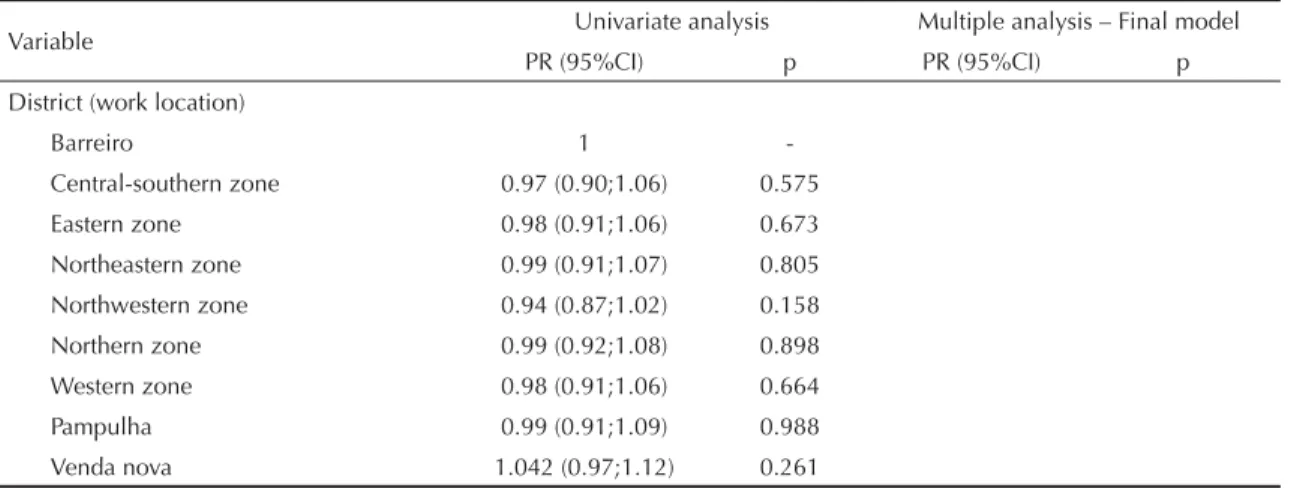
All the factors in the model were shown to be associ-ated with vaccination at a 20% level of confi dence in the univariate analysis (Table 3). After analyzing the multiple model, four variables remained signifi cantly associated with reports of not being vaccinated: not having a partner (p = 0.01), high school, technical or incomplete university educational levels (p = 0.043), working in surveillance or as an administrative/general services employees (p < 0.001) and not using personal protective equipment (p < 0.001).
DISCUSSION
The prevalence of vaccination against hepatitis B was found to be 85.6% of the HWs, among whom 74.9% said that they had received the complete vaccination scheme. This rate is similar to the estimate of 75.0% vaccination coverage against hepatitis B among American hospital HWs.18 The results also approach those observed among hospital workers (73.5%),6 laboratory professionals (74.5%),17 dentists (75.0%)15 and workers who were victims of accidents with biological material (72.8%) in Brazil.1 However, vaccinal coverage in some subgroups may reach lower frequencies, for example 64.6% among primary care HWs in Florianópolis, Santa Catarina11 and 65.6% of the anesthesiologists in Goiânia, GO.4
The overall non-vaccination rate was 42.9% in Greece, i.e. greater than the rate found in the present study (14.4%). Moreover, significant differences were identifi ed in the vaccination rates according to occu-pational groups: 45.5% among nurses and 25% among doctors.16 In the present study, there was no difference in vaccination prevalence between doctors and nursing workers. The wide access to vaccination, ensured by the municipal authorities of Belo Horizonte for HWs directly involved in care, would probably explain the similarities between these categories.
The vaccination rates were signifi cantly lower among the administrative workers and general services employees. Despite less frequent contact with users, this group is not free from handling biological fl uids or having contact with potentially contaminated surfaces. Working in general services represented a signifi cant risk of acquiring HBV infection in Goiânia.17 In Egypt, similarly, there were differences in vaccination rates, with a disadvantage for the HWs in the cleaning sector (who are included in the general services classifi ca-tion): 38% of the professionals who provided direct care to users had been vaccinated, versus only 3.5% of
Table 2. Occupational characteristics and vaccinal situation
against hepatitis B, regardless of the number of doses received by the healthcare workers. Belo Horizonte, Southeastern Brazil, 2009.
Work characteristic / Vaccinal situation
Vaccinated vaccinatedNot
n % n %
Type of work linkage 1,740
Permanent worker 1,089 89.7 125 10.3
Temporary worker 403 76.6 123 23.4
Total weekly work load
(hours) 1,536
Up to 40 823 84.2 155 15.8
More than 40 497 89.1 61 10.9
Time on the job (years) 1,740
Up to 10 781 83.7 152 16.3
More than 10 709 87.8 98 12.2
Level of complexity of
the service provided 1,778
Primary 927 87.7 129 12.3
Secondary 242 82.3 52 17.7
Tertiary 235 92.5 19 7.5
Management 119 68.3 55 31.7
Use of personal
protective equipment 1,402
Yes 899 92.4 74 7.6
No 337 78.5 92 21.5
Contact with biological
material 1,763
Never 364 75.1 121 24.9
Rarely 198 84.3 37 15.7
Sometimes 402 88.7 51 11.3
Always 546 92.5 44 7.5
District (work location) 1,779
Barreiro 169 86.6 26 14.4
Central-southern zone 137 84.6 25 15.4
Eastern zone 244 85.3 42 14.7
Northeastern zone 157 85.8 26 14.2
Northwestern zone 202 81.8 45 18.2
Northern zone 169 86.2 27 13.8
Western zone 172 85.1 30 14.9
Pampulha 97 86.6 15 13.4
Table 3. Results from the univariate and multiple analyses on the associations between the vaccinal situation against hepatitis
B and the sociodemographic and occupational variables among healthcare workers. Belo Horizonte, Southeastern Brazil, 2009. (n = 1,770)
Variable Univariate analysis Multiple analysis – Final model
PR (95%CI) p PR (95%CI) p
Sex
Male 1
-Female 1.08 (1.03;1.13) 0.001*
Age (years)
Up to 34 1
-35 to 46 1.05 (1.00;1.10) 0.043*
47 or more 1.02 (0.98-1.08) 0.331
Marital status
With partner 1 - 1
-Without partner 0.93 (0.89;0.97) < 0.001* 0.95 (0.91;0.99) 0.01a
Educational level
Completed higher education or more 1 - 1
-High school, technical education or
incomplete higher education 0.90 (0.87;0.94) < 0.001* 0.95 (0.91;1.00) 0.043a
Elementary education 0.81 (0.74;0.89) < 0.001* 0.93 (0.83;1.04) 0.211
Occupation
Doctor 1 - 1
-Nurse or nursing technician 1.00 (0.97;1.04) 0.852 1.01 (0.97;1.06) 0.508
Other higher level professionals 0.96 (0.92;1.01) 0.160 0.98 (0.94;1.03) 0.468
Technicians involved with surveillance 0.67 (0.58;0.77) < 0.001* 0.71 (0.62;0.82) < 0.001a
Community agents 0.88 (0.82;0.94) < 0.001* 0.98 (0.91;1.06) 0.694
High school level technicians 0.97 (0.93;1.01) 0.156 1.01 (0.95;1.07) 0.703
Administrative workers, general
services and others 0.75 (0.70;0.81) < 0.001* 0.83 (0.76;0.91) < 0.001a
Time on the job (years)
Up to 10 1
-More than 10 1.05 (1.01;1.09) 0.013*
Work linkage
Permanent worker 1
-Temporary worker 0.85 (0.81;0.90) < 0.001*
“Do you use personal protective equipment?”
Yes 1 - 1
-No 0.85 (0.81;0.90) < 0.001* 0.89 (0.84;0.94) < 0.001a
“Do you have contact with biological material?”
Never 1
-Rarely 1.12 (1.04;1.21) 0.003*
Sometimes 1.18 (1.11;1.26) < 0.001*
Always 1.23 (1.17;1.30) < 0.001*
Smoking
Non-smoker or former smoker 1
-Current smoker 0.95 (0.90;1.01) 0.103
Level of complexity
Primary 1
-Secondary 0.94 (0.89;0.99) 0.028
Tertiary 1.05 (1.01;1.10) 0.013*
Management 0.78 (0.70;0.86) < 0.001*
the HWs responsible for the cleaning, thus suggesting weaknesses in the surveillance programs.21
The schooling level, which is generally lower among HWs of the cleaning sector or general services,13 may be associated with a lower rate of vaccination. Having been vaccinated against hepatitis B was associated with schooling level, and those with lower educational level were less protected. In Florianópolis, SC,11 20.9% of the HWs did not have training on health and safety at work, thereby indicating the severity of the situation. In Montes Claros, MG, a need for more information was expressed by 37% of the dentists who reported that they had not or had been incompletely vaccinated.14
The greatest prevalence of individuals who were not using PPE was in the group of non-vaccinated HWs. Adherence to vaccination may be connected with high perception of risk in situations in which PPE is used16 or when exposure to biological material occurs.
Memory bias, which is present in situations in which self-administered questionnaires are used, may have been a limitation in the present study. This bias is frequently observed when past events in the subject’s history are investigated and does not always refl ect the reality, which can interfere in the results. Self-reporting of vaccination status may be overestimated, considering the tendency to report positively on situations that are recognized as desirable.11 The loss of information regarding the number of doses that were received (not all the individuals who reported having been vaccinated informed the number of doses) indicates that there may have been infl ation in reports on whether vaccination had been received. A question regarding the number of doses was included in the light of the overestimation hypothesis, which allowed a more detailed evaluation of the frequency of the outcome of interest.
Despite these possible limitations, the study evaluated randomly selected samples, including a signifi cant number of workers (1,770) from all geographical areas of Belo Horizonte. The approach towards the different levels of healthcare and occupational groups within the healthcare services was in tune with the hierarchical principal, which takes into account the differences and levels of complexity of users’ demands, and was also well-adjusted in evaluating the context within which, despite the universalization principal, some individuals are vaccinated and others are not. Thus, the present study produced relevant information on the vaccination coverage against hepatitis B and on the factors associ-ated with the observed situation, which may guide the actions that will be adopted.
Occupation was the explanatory factor for the outcome studied. Occupation was the summary marker for the likelihood of vaccination, since both self-protection behavior and achievement of better work positions in the labor market depend on educational factors (educational level, training and background) that infl uence adherence to health protection programs,2 including vaccination.
Although the estimated number of chronic hepatitis B carriers is approximately 600,000 people in Brazil, close to 12,000 are under treatment in this country,a which suggests that a large number of hepatitis carriers do not have access to diagnosis. Healthcare workers may be present in this group, thus indicating the impor-tance of surveillance programs that take into account the subjects’ occupational positions and the vulnerability of HWs regarding exposure to biological material, with emphasis on immunization against hepatitis B.
Measures towards promoting greater vaccination coverage are needed, with emphasis on awareness-raising mechanisms that reach groups that are less covered.
Table 3. Continuation
Variable Univariate analysis Multiple analysis – Final model
PR (95%CI) p PR (95%CI) p
District (work location)
Barreiro 1
-Central-southern zone 0.97 (0.90;1.06) 0.575
Eastern zone 0.98 (0.91;1.06) 0.673
Northeastern zone 0.99 (0.91;1.07) 0.805
Northwestern zone 0.94 (0.87;1.02) 0.158
Northern zone 0.99 (0.92;1.08) 0.898
Western zone 0.98 (0.91;1.06) 0.664
Pampulha 0.99 (0.91;1.09) 0.988
Venda nova 1.042 (0.97;1.12) 0.261
1. Almeida CAF, Benatti MCC. Exposições ocupacionais por fl uidos corpóreos entre trabalhadores
da saúde e sua adesão à quimioprofi laxia.
Rev Esc Enferm USP. 2007;41(1):120-6. DOI:10.1590/S0080-62342007000100016
2. Benavides FG, Benachi J, Muntaner C, Delclos GL,
Catot N, Amable M. Associations between temporary employment and occupational injury: what are the
mechanisms? Occup Environ Med. 2006;63(6):416-21.
DOI:10.1136/oem.2005.022301
3. Carlson AL, Perl TM. Health care workers as source of hepatitis B and C virus transmission. Clin Liver Dis.
2010;14(1):153-68. DOI:10.1016/j.cld.2009.11.003
4. Carneiro AF, Daher RR. Soroprevalência do
vírus de hepatite B em anestesiologistas.
Rev Bras Anestesiol. 2003;53(5):672-9. DOI:10.1590/S0034-70942003000500015
5. Chávez JH, Campana SG, Haas P. Panorama da
hepatite B no Brasil e no Estado de Santa Catarina.
Rev Panam Salud Publica. 2003;14(2):91-6. DOI:10.1590/S1020-49892003000700003 6. Ciorlia LA, Zanetta DM. Hepatitis B in healthcare
workers: prevalence, vaccination and relation to occupational factors. Braz J Infect Dis. 2005;9(5):384-9. DOI:10.1590/S1413-86702005000500005
7. Coutinho LMS, Scazufca M, Menezes PR. Métodos
para estimar razão de prevalência em estudos de corte transversal. Rev Saude Publica. 2008;42(6):992-8. DOI:10.1590/S0034-89102008000600003
8. Daha TJ, Bilkert-Mooiman MA, Ballemans C, Frijstein
G, Keeman JN, De Man RA, et al. Hepatitis B virus infected health care workers in The Netherlands, 2000-2008. Eur J Clin Microbiol Infect Dis. 2009;28(9):1041-4. DOI: 10.1007/s10096-009-0744-2
9. Ganczak M, Ostrowski M, Szych Z, Korzen
M. A complete HBV vaccination coverage among Polish surgical nurses in the light of anti-HBc prevalence: a cross-sectional sero-prevalence study. Vaccine. 2010;28(23):3972-6. DOI:10.1016/j.vaccine.2010.03.042
10. García P, De la Cerda G, Calvo M, Godoy R, Covarrubias C, Potin M, et al. Inmunogenicidad de una vacuna recombinante anti hepatitis B en personal de salud. Rev Chil Infectol. 2002;19(3):133-9. DOI:10.4067/S0716-10182002000300001
11. Garcia LP, Facchini LA. Vacinação contra a hepatite B entre trabalhadores da atenção básica à saúde. Cad Saude Publica. 2008;24(5):1130-40. DOI:10.1590/S0102-311X2008000500020 12. Lopes CRL, Martins RMB, Araújo Teles S, Silva SA,
Maggi PS, Yoshida CFT. Perfi l soroepidemiológico da infecção pelo vírus da hepatite B em profi ssionais das unidades de hemodiálise de Goiânia-Goiás, Brasil
Central. Rev Soc Bras Med Trop. 2001;34(6):543-8. DOI:10.1590/S0037-86822001000600008 13. Maia LDG, Silva ND, Mendes PHC. Síndrome de
Burnout em agentes comunitários de saúde: aspectos
de sua formação e prática. Rev Bras Saude Ocup.
2011;36(123):93-102.
14. Martins AMEBL, Barreto SM. Vacinação contra a hepatite B entre cirurgiões dentistas.
Rev Saude Publica. 2003;37(3):333-8. DOI:10.1590/S0034-89102003000300011 15. Mota A, GuedesF, AreiasJ, PinhoL, Cardoso MF.
Perfi l epidemiológico e genotípico da infecção pelo vírus da hepatite B no Norte de Portugal.
Rev Saude Publica. 2010;44(6):1087-93. DOI:10.1590/S0034-89102010000600014 16. Rachiotis G, Goritsas C, Alikakou V, Ferti A,
Roumeliotou A. Vaccination against hepatitis B virus in workers of a general hospital in Athens. Med Lav.
2005;96(1):80-6.
17. Silva PA, Fiaccadori FS, Borges AMT, Silva SA, Daher RR, Martins RMB. Seroprevalence of hepatitis B virus infection and seroconvertion to anti-HBsAg in laboratory staff in Goiânia, Goiás.
Rev Soc Bras Med Trop. 2005;38(2):53-156. DOI:10.1590/S0037-86822005000200005 18. Simard EP, Miller JT, George PA, Wasley A, Alter MJ,
Bell BP, et al. Hepatitis B vaccination coverage levels among healthcare workers in the United States, 2002-2003. Infect Control Hosp Epidemiol. 2007;28(7):783-90. DOI:10.1086/518730
19. Smith DR, Leggat PA, Araki S. Emerging occupational hazards among health care workers in the new millennium. Ind Health. 2007;45(5):595-7. DOI:10.2486/indhealth.45.595
20. Suckling RM, Taegtmeyer M, Nguku PM, Al-Abri SS, Kibaruc J, Chakaya JM, et al. Susceptibility of healthcare workers in Kenya to hepatitis B: new strategies for facilitating vaccination uptake. J Hosp Infect. 2006;64(3):271-7. DOI:10.1016/j.jhin.2006.06.024
21. Talaat M, Kandeel A, El-Shoubary W, Bodenschatz C, Khairy I, Oun S, et al. Occupational exposure to needlestick injuries and hepatitis B vaccination coverage among health care workers in Egypt.
Am J Infect Control. 2003;31(8):469-74. DOI:10.1016/j.ajic.2003.03.003
22. Thakur V, Pati NT, Gupta RC, Sarin SK. Effi cacy of Shanvac-B recombinant DNA hepatitis B vaccine in health care workers of Northern India. Hepatobiliary Pancreat Dis Int. 2010;9(4):393-7.
23. The viral hepatitis prevention board. Differing guidelines toward the infected healthcare worker. Viral Hepat. 2005;14:14.
REFERENCES
This research was fi nanced by the Research Support Foundation of Minas Gerais (Fundação de Amparo à Pesquisa de Minas Gerais, FAPEMIG – EDT 3339-2006).