(1) Universidade de Ciências da Saúde de Alagoas – Uncisal, Maceió, Alagoas, Brasil.
(2) Santa Casa de Misericórdia de Maceió, Hospital Escola Dr. Hélvio Auto e Universidade de Ciências da Saúde de Alagoas – Uncisal, Maceió, Alagoas, Brasil.
Conlict of interest: non-existent
Speech Therapy Practice in the Intensive Care Unit
of a hospital of infectious diseases of Alagoas
Atuação da fonoaudiologia em unidade de terapia intensiva
de um hospital de doenças infecciosas de alagoas
Diêgo Lucas Ramos e Silva(1)
Fabrício Osman Quixadá Lira(1)
Julio Cesar Cavalcanti de Oliveira(1)
Marisa Siqueira Brandão Canuto(2)
Received on: July 24, 2015 Accepted on: October 30, 2015
Mailing address:
Marisa Siqueira Brandão Canuto. Rua Ariosvaldo Pereira Cintra, nº 758, Serraria, Condomínio Le Parc, bloco 01, apartamento 05
Maceió – AL – Brasil CEP: 57046-295
E-mail: [email protected]
doi: 10.1590/1982-0216201618112015
ABSTRACT
Purpose: to describe the speech therapy in Intensive Care Unit of a main-hospital.
Methods: the sample consisted in all records of the minutes book of the research site in 2014. The period
data was collected and tabulated in Excel®, analyzed using statistical methods and the results was pre-sented in graphs and tables.
Results: in the sample of 166 patients, 77 has participated the research. 40 (51.9%) through speech
therapy and 37 (48.1%) through monitoring. This number of patients assisted by speech therapy service was signiicant, once the average hospital stay was twenty days by the severity of the main-pathologies. Most patients that had some kind of speech therapy was discharged from the intensive care unit being transferred to other hospital units.
Conclusion: speech therapy was an important help in the Intensive Care Unit, making bigger the
possibi-lity of discharge
Keywords: Speech, Language and Hearing Sciences; Intensive Care Units; Communicable Diseases
RESUMO
Objetivo: descrever a atuação fonoaudiológica em Unidade de Terapia Intensiva no hospital de referência. Métodos: a amostra foi composta por todos os registros no livro ata do local da pesquisa no período de
2014. Os dados foram coletados e tabulados em planilha Excel, analisado por meio de método estatístico e os resultados apresentados em gráicos e tabelas.
Resultados: da amostra de 166 pacientes, 77 tiveram intervenção fonoaudiológica, sendo 40 (51,9%)
por meio de fonoterapia e 37 (48,1%) por meio de gerenciamento. Este número de pacientes assistidos pelo serviço de fonoaudiologia foi signiicante, uma vez que em média o período de internação foi de vinte dias pela gravidade das patologias de base. A maioria dos pacientes que tiveram algum tipo de intervenção fonoaudiológica recebeu alta da Unidade de Terapia Intensiva sendo transferidos para outras unidades do hospital.
Conclusão: a fonoaudiologia tem uma atuação importante na Unidade de Terapia Intensiva favorecendo a
possibilidade de alta dos pacientes internados nesta unidade.
Descritores: Fonoaudiologia; Unidades de Terapia Intensiva; Doenças Transmissíveis
Original articles
INTRODUCTION
The Intensive Care Units (ICU) were established in Brazil since 1970 and their appearance improved the care of critical patients, previously performed in the ward with inadequate areas and shortage of techno-logical and humans resources1.
Intensive care hospital services occupy spaces for the care of critically ill patients who require complex and specialized care. The reality experienced by the multidisciplinary team which works in intensive care is permeated by various feelings and emotions and
routine requires an excellent technical and scientiic
training and professional preparation to deal with the loss, the pain and the suffering2.
The speech therapy was recently introduced in hospital settings. Speech therapy in the ICU is inserted in several areas, among them NICU, pediatric, coronary, burns, trauma, and cancer. The clinical assessment in the ICU aims to identify the possible functional changes that affect the oral and pharyngeal phase of swallowing. For an accurate clinical evaluation, the use of items described in the literature is required such as testing the water, pulse oximetry and cervical auscultation3.
In hospitals, rehabilitation performed by this
profes-sional involves dificulty in swallowing (dysphagia) as
well as cognitive and communicative aspects. In the case of dysphagia, stroke, prolonged intubation and tracheostomy are considered as risk factors 3-5.
Regarding communication of ICU inpatients of infec-tious diseases, the speech therapist can act evaluating, planning and discussing with other professionals of the multidisciplinary team aspects related to very important cognitive incentives for the inpatient in the ICU,
consid-ering that it may favor the dificulties of individuals with
neurological disorders6.
The speech therapist should be the professional inserted in health care services that enhance the humanized assistance, since the humanization process permeates communicative skills and attitudes whose scope and intervention come from the speech therapist.. In addition, the National Policy of Humanization (PNH) is the basis of successful therapeutic procedures and, above all, It is an exercise of citizenship7.
Infectious diseases are among the most prevalent diseases in intensive care units. Unfortunately, Brazilian data based on the prevalence of infection in the ICU
are scarce8. Therefore, information on the speech
therapists work in the rehabilitation of inpatients in intensive care units in infectious diseases hospitals are practically nonexistent.
Thus the aim of this study was to describe the speech therapists in the intensive care unit in the referral hospital in the state of Alagoas.
METHODS
This study was approved by the Research Ethics Committee (CEP) of UNCISAL with the protocol number 834 026 in 2014.
The survey was conducted in a teaching hospital of the University of Health sciences of Alagoas (UNCISAL), which is a reference in infectious diseases in this state. The records of all inpatients from this ICU during the period from January to December 2014, whose age were from 24 years of age or over were included, because according to the Brazilian Institute of Geography and Statistics (IBGE)9 they are considered
adults or seniors. Patients under this age are
discon-nected from the proile of this intensive care unit
because they are considered to belong to the children and youth group. Patients who progressed to death
after the irst 24 hours of admission were also excluded.
Data collection was held in the corresponding minute book records for the period from January to December of 2014 at the research site, which considered the length of stay in the ICU, the basic
pathology and speech therapy period what deine its
characterization.
Because it is a retrospective study in which there
was no identiication of hospitalized individuals, there
was no need of Informed Consent (IC), therefore its decline was required. The research site authorized its realization.
Data were collected through a structured form for the acquisition of key information from research, namely: length of stay, speech therapy time, medical hypotheses base, kind of speech therapy and hospital-ization outcomes of patients (Attachment 1), recorded in a spreadsheet Excel (2007) and analyzed using statistical method.
The variables were described by frequency distri-bution. Charts and graphs were built. To verify the association between variables speech therapy through speech therapy or speech therapy management, which is known as patient dysphagia follow up and the outcome of the hospitalization of patients the chi-square test was applied in two independent groups (with and
without speech therapy). The 0.05 signiicance level
RESULTS
183 records of patients present in the minute book of the year Speech Therapy occurrence of 2014 were selected for this study. However, 17 of these records were excluded from the study because such patients came to death in less than 24 hours of hospitalization in infectious ICU. Thus, only 166 patient records were analyzed in this study, 77 (46.4%) of patients who had had speech therapy as part of the treatment and 89 (53.6%) of patients who had not had speech therapy as part of the treatment according to the minute book recordings.
As for the length of stay in the ICU, it was observed that 160 patients remained less than one month in the ICU, in which 77 patients were assisted by speech therapist 72 (93, 5%) were hospitalized during this period and 5 (6.5% ) between 1 and 3 months. 88 (9.9%)) out of 89 patients who had no intervention by the speech therapist were hospitalized in less than one month and only 1 patient (1.1%) between 1 and 3 months. The prevalence of hospital stay to be less than one month was due to the fact that patients who were served by speech were discharged from the ICU on the contrary of those who had no intervention of the speech therapist because they were under severe general condition which prevented them from having such intervention. In either group, were no reports of patients who have been admitted to a period between 4 and 6 months or up to seven months.
As for medical diagnosis, we observed the presence of four basic conditions that were more recorded among the 77 patients who had speech therapy, the most frequent were: AIDS which affected 27 patients (55.8%) and tuberculosis which affected 20 patients (35%) . In addition, records of 13 patients (16.8%) affected by meningitis and 3 patients (3.8%) affected by tetanus were found and also other records of less
frequent base diseases ( ilariasis, leptospirosis, dengue hemorrhagic fever, inluenza virus The subtype
-H1N1, liver disease, encephalitis, ascites, etc.) which affected a total of 43 patients (55.8%), these diseases were brought together in a single group. Some oppor-tunistic infections were also recorded, and the most frequent was cerebral toxoplasmosis which affected 14 patients (17.8%), followed by tuberculosis, which affected 7 patients (8.8%) and candidiasis, which
affected ive patients (6.5%) . All these disorders were
associated with AIDS.
In patients who had not had speech therapy, were observed 5 more basic conditions which were recorded among the 89 patients, the most frequent were: tuber-culosis which befell 29 patients (32.5%) and AIDS that also befell 29 patients (32.5 %). Moreover, records of 10 patients (11.2%) affected by meningitis were found and also records of 8 patients (8.9%) affected by lepto-spirosis and 2 patients (2.2%) by tetanus. Other less frequent pathologies were also recorded (dengue, snakebite, endocarditis, uterine cancer, esophagitis, hydrocephalus, liver disease, etc.) affecting a total of 62 patients (69.6%) these were brought together in a single group. Some opportunistic infections were reported, the most frequent were cerebral toxoplas-mosis in 15 patients (21.3%), followed by tuberculosis, which affected 10 patients (16.8%) and candidiasis, occurred in 8 patients (9%). All these disorders were associated with AIDS.
It is noteworthy that more than one medical diagnosis were recorded in the same patient in cases of HIV positive, reinforcing these immunosuppression.
Speech therapy was the kind of intervention that prevailed in most patients assisted by a speech therapist in the ICU of infectious diseases. 40 (51.9%) out of the 77 patients had speech therapy and 37 (48.1%) were monitored (Table 1). In speech therapy oral motor sensory stimulation exercises were
performed for itness of tone, sensitivity and mobility of
the speech organs (OFA’s), and language stimulation in patients with AIDS associated with toxoplasmosis.
In patients after invasive mechanical ventilation and in some cases of tuberculosis, voice features as the voice quality on the scale that considers hoarseness-R, degree of coarseness-A degree of breathiness-S, grade asthenia-A , degree of tension-T and degree of instability-I (RASATI), pitch (feeling low / high frequency-) and loudness (feeling low / high-intensity) were also worked on them.
Table 1. speech therapy type in infectious intensive care unit
N %
Speech therapy 40 51,9
Monitoring 37 48,1
The management occurred in patients who were evaluated and showed no speech therapy demand, remaining under observation while hospitalized to monitor the integrity of oromotoras functions and others patients were in serious overall condition resulting from a greater number of opportunistic disease or they were admitted in ICU due to a respiratory failure which evolved to intubation orotraqueal.
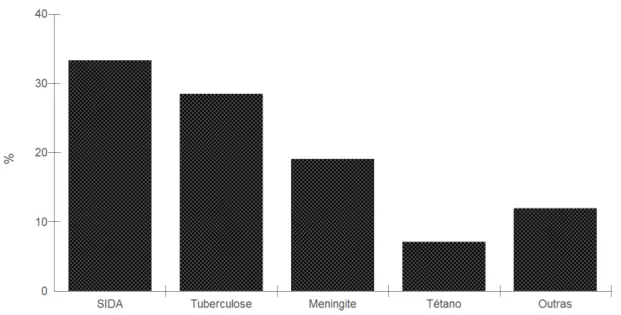
In the 40 patients who had phoniatrics the predom-inant diseases were AIDS (n = 14; 33.3%) and menin-gitis (n = 12; 28.5%), and this type of intervention has also occurred in some patients with tuberculosis (n = 8; 19.1%) in all patients with tetanus (n = 3; 7.1%)
and other basic conditions such as H1N1, ilariasis,
ascites, hepatic disease, encephalopathy (n = 5; 12% ) (Figure 1).
Other: H1N1, ilariasis, ascites, encephalopathy and liver disease.
Figure 1. Speech therapy intervention: speech therapy x base pathologies
In the 37 patients who were monitored the most frequent base diseases were AIDS (n = 13; 33.3) and tuberculosis (n = 12; 30.8%), this type of intervention was also observed in a patient with meningitis (n = 1; 2.6%) and other basic conditions such as leptospirosis, chronic obstructive pulmonary disease, hepatitis and others (n = 13; 33.3%) (Figure 2).
Most patients who have had some kind of speech therapy were discharged from the Intensive Care Unit and were transferred to other hospital units. In the
Statistical analysis with Chi Square test this inding was highly signiicant (p <0.000) because it demonstrates
pathology determines the length of hospitalization but the general condition of the patient.
In this study, phoniatrics was the kind of speech therapy that prevailed in the ICU of infectious diseases. In the practitioner dysphagia can be observed as a frequent manifestation among patients in ICU, which
conirms another research carried out in an ICU of
a hospital in Maranhão where a high incidence of oropharyngeal dysphagia was notice in 12 inpatients12.
Thus, the speech therapy to adjust the myofunctional aspects that impact on swallowing becomes essential for the rehabilitation of patients admitted to the infec-tious diseases ICU.
The monitoring in patients with invasive mechanical ventilation (IMV) was also performed via intubation considering the serious general condition of these patients and, associated with the least hospital stay, in disagreement with the results of another study that found that patients on IMV with severe general condition remain for long time in ICU, preventing any
DISCUSSION
The role of the speech therapist in hospitals provides an early assessment and a differential diagnosis in cases of dysphagia, with the objective of prevention as well as prevent and / or minimize clinical complications to the patient10.
The participation of these professionals in multidisci-plinary team aims to prevent and reduce complications as a consequence from changes in the stomatognathic system, thereby contributing to the reduction of hospital stay and the rate of re-admissions for complications5.
The length of stay of the inpatients in the infectious diseases ICU participant in the survey was less than 1 month, similarly studies in HIV-positive patients who had been hospitalized in the infectious diseases ICU for about 22 days were also observed, which occurred at the same time of another study in an ICU in Acre which
showed an average of hospital stay of 20 days1,11.
Such reports suggest that not necessarily the type of
Other: Leptospirosis, chronic obstructive pulmonary disease and hepatitis.
Figure 2. Speech therapy intervention: Monitoring x base pathologies
Table 2. Relationship between speech therapy with the fate of patients in the intensive care unit of infectious diseases
With speech therapy Without speech therapy P value
N % N %
Discharge 53 68,8 25 28,1 P<0,000
Death 24 31,2 64 71,9
N = Number of patients; % = Percentage
increased loudness, improved voice quality and pneumophonoarticulatory coordination were worked in those undergoing invasive mechanical ventilation for a long time.
Meningitis is characterized by inlammation of the meninges and etiology deined by bacterial, fungal
and viral agents causing broad spectrum of signs and symptoms such as increased headache, vomiting, stiff neck, constipation and neurological signals19,20. In this
study it was observed changes in speech pathology affecting the tone and mobility of the speech organs,
dificulty in swallowing function and voice disorders.
Thus, there were indirect or direct therapy techniques according to the level of consciousness presented by the patient; and postural maneuvers to assist in
the eficient and safe swallowing for maintaining oral
feeding route. In addition, there was use of vocal therapy for adjustment of vocal quality, pitch and loudness.
Tetanus is a non-contagious infectious disease caused by tetanospamina (TS) produced by toxigenic strains of Clostridium tetani bacteria. Infection generally occurs by introducing Clostridium spores. The TS prevents the release of inhibitory neurotransmitters that act on the lower motor neuron increasing frequency of shots. Clinically, the release of the shots of the lower motor neuron manifested by increased muscle tone, and muscle spasms to sensory stimuli, especially visual and auditory. The muscles most often early affected in the tetanus is the proximal muscles, with sardonic laughter, lockjaw, neck stiffness and choking5 .
Tetanus is the kind pathology in which the speech
therapist has an important role as the dificulty in
swallowing and speech, lockjaw and drooling are some of the symptoms found in patients with this condition in the Intensive Care Units5.
In this study the intervention of the speech therapist reinforced the literary accounts, emphasizing the adequacy of the orofacial muscles tone with relax-ation and stretching of the muscles responsible for mandibular opening, favoring exercise of speech articu-lation and postural maneuvers to effect swallowing and also the vocal therapy after tracheal intubation and later tracheostomy to favor regularity of vibrating vocal folds and lower airway protection.
Despite progress in the treatment and control of
infection with Human Immunodeiciency Virus (HIV), Acquired Immune Deiciency Syndrome (AIDS) persists
as a major cause of death worldwide, moreover, opportunistic infections remain the leading cause of kind of rehabilitation activities for the characterization
of the patient’s condition5. It is observed that there is
only agreement between the severity of the patient’s condition and infeasibility of intervention.
In this study, AIDS, tuberculosis, meningitis and tetanus were the most common diseases reported in patients treated by a speech therapist in the ICU.
AIDS is a syndrome caused by the Retroviridae family of retroviruses, HIV-1 and HIV-2, which is unfolded by a quantitative and qualitative reduction of T lymphocytes in HIV-infected patients with advanced disease manifestations often have CD4 + lymphocyte below 200 cells / mm4, an increased plasma levels of
ribonucleic acid (RNA) of HIV, and indicative clinical
manifestations of severe immunocompromised13.
In patients with AIDS, intra-oral lesions are observed, changes in tone, mobility, strength and sensitivity of the
speech organs, which relect on the adequacy of the stomatognathic functions. Other studies also deine
this interpretation considering dysphagia and chewing change as outstanding conditions of patients with AIDS14.
In patients HIV-positive with associated neuro-logical comorbidities speech therapy is important to speech because of organic repercussions inherent to the condition, mainly because swallowing is a neuro-logical control function with considerable impact on the patient’s general condition. This analysis is reinforced by authors that state that all HIV-positive patients with
neurogenic dysphagia have a conirmed diagnosis of
cerebral toxoplasmosis in which the speech-language intervention is vital in order to adjust consistency, temperature, food volume and more propitious attitudes
to a safe and eficient diet15.
Tuberculosis is an infectious disease whose agent is Koch’s bacillus16. Cough for more than two weeks,
production of phlegm, fever, sweating, fatigue, chest pain, loss of appetite and weight loss are the main symptoms of tuberculosis. In more advanced cases sputum with blood may appear 17.
In patients with tuberculosis speech therapy includes initial indirect techniques of stimulation of swallowing, passive and active vocal training to increase the maximum phonation time and to improve the pneumotransport phonoarticulatory 18 coordination.
considered to be under impaired general health status
are those in whom stability hemodynamic exist24,
however, they occur with refractory alterations of vital functions. Patients with severe general state are in insta-bility hemodinâmica24. The obstacle in speech therapy
is characterized only by the intervention of infeasibility in serious cases that could lead to a worsening of hemodynamic instability.
It was found that the presence of speech therapists in this UTI contributed to organize the orofacial and cervical musculature and to identify the swallowing function changes. Thus, rehabilitation was provided and feeding was conducted orally. It is worth to highlight vocal rehabilitation and cognitive incentives, especially in cases with respiratory and neurological effects.
CONCLUSION
In this research AIDS, tuberculosis, meningitis and
tetanus were identiied as the base of diseases that
most affect patients assisted by speech therapist in the ICU of a infectious diseases hospital. The only obstacle to speech therapy was the severe general condition of some patients, which determines the impossibility of the speech therapist to work as the clinical condition can be worsened by the hemodynamic instability.
The proposed rehabilitation was more used in speech therapy with emphasis on the organization of the orofacial and cervical muscles and in the rehabili-tation of swallowing disorders in the case of AIDS and meningitis and vocal and swallowing disorders in cases of tuberculosis and tetanus rehabilitation.
Therefore, speech therapy care in the Intensive Care Unit of an infectious diseases hospital encompasses aspects of orofacial motor and dysphagia as rehabili-tation areas more used, which contribute to patients discharge from this unit.
REFERENCES
1. Acuña K, Costa E, Grover A, Camelo A, Junior RS. Características clínico-epidemiológicas de adultos e idosos atendidos em unidade de terapia intensiva pública da Amazônia. Rev. bras. ter. intensiva. 2007;19(3):304-9.
2. Leite MA, Vila VSC. Diiculdades vivenciadas
pela equipe multiproissional na unidade de
terapia intensiva. Rev. Latino-am. Enfermagem. 2005;13(2):145-50.
hospitalization and death in people living with HIV / AIDS21.
In the study, the opportunistic diseases associated with HIV / AIDS in patients who have had or had not had speech therapy were: cerebral toxoplasmosis, tuberculosis and candidiasis in order of prevalence respectively, corroborating with the literature in which it is observed that these diseases are the third most common co infections reported in patients with HIV / AIDS 13,15.
One of the most responsible for the increase in morbidity and mortality in patients with
immunode-iciency is HIV and TB co infection, because, on one
hand HIV infection increases the incidence of tuber-culosis and on the other hand tubertuber-culosis decreases the survival of people with HIV12,22. Such evidence was
conirmed by the high number of deaths in patients with
both associated pathologies.
According to Health Ministry data cerebral toxoplas-mosis is a neurological disease more frequent in AIDS patients, occurring in 20-30% of patients with HIV23. The
study data were against these indings ranging 2% from
the lowest percentage range considered by WHO, no
coincidence may have been inluenced by the absolute
number of internal research.
Oral candidiasis represents one of the most common injuries in HIV / AIDS patients. Some studies claim that over 75% of infected patients have candidíasis15
in disagreement with the indings of this research, in
which candidiasis appears as third most common co infection in HIV / AIDS patients. One can infer that prior medication use might have occurred to soften the symptoms of this comorbidity, since it is characterized by physical manifestations (oral cavity), therefore it is a
noticeable injury not necessarily identiied by a previous
medical intervention which may favor self-medication in some individuals.
Regarding to the outcome of patients’ hospital-ization, in this study most patients who had speech therapy were transferred to other hospital wards. The differential of speech therapy is evident in the rehabili-tation of these patients, favoring the discharge from the ICU. One study found a higher death rate compared with the transfer rate in patients with HIV positive in an infectious diseases hospital 11. However there was not a
speech therapist in this hospital.
To be admitted to the ICU patients are classiied
according to their status. In general, patients at steady
state are those whose vital functions are modiied,
15. Araújo DR, Bicalho JCS, Francesco, RD. Disfagia em pacientes portadores da síndrome da
imunodeiciência adquirida – AIDS. Rev CEFAC.
2005;7(1):42-9.
16. Ribeiro KCS, Lima KMSR, Loureiro AD. Coinfecção hiv/tuberculose (mal de pott) um estudo de caso. DST, J. Bras. Doenças Sex. Transm. 2009;21(2):83-6.
17. Drauzio Varella. Sinais e sintomas da tuberculose: São Paulo [acesso em 2015 abr 15]. Disponivel em: http://drauziovarella.com.br
18. Efsen AMW, Panteleev AM, Grint D, Podlekareva DN, Vassilenko A, Rakhmanova A et al. TB meningitis in HIV-Positive patients in Europe and Argentina: clinical outcome and factors associated with mortality. Biomed Res. Int. [serial on the internet]. 2013 [cited 2015 Apr 20]; 2013(2013): [about 9 p.]. Available from: http://dx.doi. org/10.1155/2013/373601.
19. Fiorillo AM, Lima RHP, Martinez R, Levy CE, Takayanagui OM, Neto JB. Meningite criptocócica: aspectos clínicos, evolutivos e histopatológicos segundo a condição predisponente. Rev. Soc. Bras. Med. Trop. 1990;23(1):19-25.
20. Mendonça JS - Meningoencefalite tuberculosa. In: Rodrigues EAC. Infecções hospitalares: prevenção e controle. São Paulo: Sarvier; 1997. p.3-27.
21. Coelho L, Veloso VG, Grinsztejn B, Luz PM. Trends in overall opportunistic illnesses, Pneumocystis carinii pneumonia, cerebral toxoplasmosis and Mycobacterium avium complex incidence rates over the 30 years of the HIV epidemic: a systematic review. Braz. J. Infect. Dis. 2014;18(2):196-210.
22. Santos RP, Deutschendorf C, Scheid K, Goldani LZ. In-hospital mortality of disseminated tuberculosis in patients infected with the human
immunodeiciency virus. Clin. dev immunol.
[serial on the internet]. 2011 [cited 2015 Apr 22]; 2011(2011): [about 6 p.]. Available from: http:// dx.doi.org/10.1155/2011/120278.
23. Programa Nacional de DST e AIDS. Brasilia: Ministério da Saúde [acesso em 2015 abr 15]. Disponível em: http://www.aids.gov.br
24. Bezerra GKA. Unidade de Terapia Intensiva
– Peril das admissões: Hospital Regional de
Guarabira, Paraíba, Brasil. Rev. Bras. Cienc. Saúde. 2012;16(4):491-6.
3. Padovani AR, Andrade CRF. Peril funcional da deglutição em unidade de terapia intensiva clínica. Einstein. 2007;5(4):358-62.
4. Canuto MSB, Pereira RJS. Fonoaudiologia e disfagia em ambiente hospitalar. Rev. intensiv. 2011;6:28-34.
5. Mangilli LD. Disfagia e tétano: caracterização fonoaudiológica de pacientes em UTI [Dissertação]. São Paulo (SP): Universidade de São Paulo; 2008. 6. Celín SH, Gobbi FHA, Lemos SMA. Fonoaudiologia
e humanização: percepção de fonoaudiólogas de um hospital público. Rev CEFAC. 2012;14(3):516-27.
7. Gonçalves MJ. O signiicado da comunicação no atendimento ao paciente em UTI: como o fonoaudiólogo pode ajudar? Mundo Saúde. 2008;32(1):79-84.
8. Lisboa T, Faria M, Jorge A, Borges LAA, Gómez J, Schifelbain L et al. Prevalência de infecção nosocomial em Unidades de Terapia Intensiva do Rio Grande do Sul. Rev. bras. ter. intensiva. 2007;19(4):414-20.
9. Henriques FA. O aprendizado após a juventude: discutindo o conceito de “adulto” e as tendências pedagógicas modernas. 2a ed. Vila Velha: FACEVV; 2009.
10. Drozdz DRC, Costa CC, Jesus PRO, Trindade MS, Weiss G, Neto ABM et al. Análise da fase faríngea da deglutição em portadores de tosse crônica. Int. Arch. Otorhinolaryngol. 2012;16(4):502-8.
11. Perrut JF, Santos EP, Oliveira BR, Carneiro ACLL, Oliveira GL, Júnior ABE et al. Risco nutricional e sua associação com o tempo e desfecho da internação de pacientes com AIDS em um hospital de referência em infectologia de Belo Horizonte. Espaç. Saúde. 2014;15(1):57-65.
12. Moraes MAS, Coelho WJP, Castro G, Nemr K. Incidência de disfagia em unidade de terapia intensiva de adultos. Rev CEFAC. 2006;8(2):171-7. 13. Soares MT, Pinheiro JBF, Freitas CHSM, Smith
AAF, Moreira EFR. Prevalência das coinfecções
em pacientes notiicados com Aids no centro de
referência na Paraíba. Rev. Bras. Cienc. Saude. 2014;18(1):5-12.
14. Martins MR, Capistrano SFS, Pacheco MTT. O
peril da disfagia em pacientes com AIDS. In: XII Encontro Latino Americano de Iniciação Cientiica e
FORM OF DATA EXTRACTION
Register number: _______________ Gender:________________________ Date: ________________________ Month: _______________________
1 – Number of inpatients _____________________ 2 – Patient length of hospital stay:
( ) Less than one month ( ) Between 1 and 3 months ( ) Between 4 and 6 months ( ) Between 7 and 9 months ( ) Between 10 and 12 months
3 – Speech therapy period with the patient: ( ) Less than one month
( ) Between 1 and 3 months ( ) Between 4 and 6 months ( ) Between 7 and 9 months ( ) Between 10 and 12 months
4 – Basic medical diagnosis:
( ) Tuberculosis ( ) AIDS ( ) Tetanus ( ) Meningitis ( ) Other
5 – Type of speech therapy: