www.eerp.usp.br/rlae
Corresponding Author: Tânia Couto Machado Chianca
Universidade Federal de Minas Gerais. Escola de Enfermagem Av. Alfredo Balena, 190
Bairro: Santa Eigênia
CEP: 30130-100, Belo Horizonte, MG, Brasil E-mail: [email protected]
Mapping nursing goals of an Intensive Care Unit to the Nursing
Outcomes Classification
Tânia Couto Machado Chianca
1Patrícia de Oliveira Salgado
2Juliana Peixoto Albuquerque
3Camila Claudia Campos
4Meire Chucre Tannure
5Flávia Falci Ercole
6Aim: to analyze whether nursing goals formulated for nursing diagnoses can be mapped to
nursing outcomes classification and to identify the scales most appropriate to the outcomes
mapped. Method: a descriptive study was developed in an intensive care unit. Data collection
involved extraction of goals in 44 medical records, content standardization, cross-mapping
to the outcomes, identification of appropriated scales and validation. Descriptive analysis
and agreement with the cross-mapping process were performed. Results: nursing goals
(59) were mapped to (28) different outcomes, with agreement of 83% in the mapping
process. All goals were mapped to outcomes, which allows to affirm that these outcomes
contemplates the goals elaborated to patient care. Conclusion: these results favor the
inclusion of outcomes and scales validated in the planning and evaluation phases of the
nursing process of a software in construction.
Descriptors: Nursing; Nursing Process; Intensive Care Units; Validation Studies; Nursing
Assessment.
1 PhD, Full Professor, Escola de Enfermagem, Universidade Federal de Minas Gerais, Brazil.
2 RN, Hospital Municipal Odilon Behrens, Brazil. Doctoral Student, Escola de Enfermagem, Universidade Federal de Minas Gerais,
Brazil.
3 RN, PhD Consult, Brazil.
Mapeamento de metas de enfermagem de uma Unidade de Terapia Intensiva por meio da Classiicação de Resultados de Enfermagem
Objetivo: analisar se metas formuladas, a partir de diagnósticos de enfermagem, podem ser mapeadas por meio de resultados e identiicar escalas apropriadas aos resultados mapeados. Método: estudo descritivo, realizado em unidade de terapia intensiva. A
coleta envolveu extração das metas registradas em 44 prontuários, normalização de conteúdo, mapeamento de resultados, identiicação das escalas apropriadas e validação. Análise descritiva e de concordância com o processo de mapeamento foram procedidas.
Resultados: metas de enfermagem (59) foram mapeadas por diferentes resultados
(28), com concordância de 83% no processo de mapeamento. Todas as metas foram mapeadas através de resultados, o que permite airmar que esses contemplam as metas elaboradas para os pacientes cuidados. Conclusão: os achados favorecem a inclusão de
resultados e escalas nas etapas de planejamento e avaliação em um software com o
processo de enfermagem em construção.
Descritores: Enfermagem; Processos de Enfermagem; Unidades de Terapia Intensiva;
Estudos de Validação; Avaliação em Enfermagem.
Identiicación de metas de enfermería de una Unidad de Cuidados Intensivos a la Clasiicación de Resultados de Enfermería
Objetivo: analizar si en las metas formuladas desde diagnósticos de enfermería pueden ser identiicados resultados y escalas apropiadas a los resultados identiicados. Método: estudio descriptivo realizado en unidad de terapia intensiva. La colecta envolvió extracción de las metas registradas en 44 prontuarios, normalización de contenido, identiicación de resultados, de las escalas apropiadas y validación. Análisis descriptivo y de concordancia con el proceso de identiicación fueron procedidas. Resultados: En las metas de enfermería (59) fueron identiicados diferentes resultados (28), con concordancia del 83% en el proceso de identiicación. En todas las metas fueron identiicados resultados, lo que permite airmar que ésos contemplan las metas elaboradas para los pacientes atendidos. Conclusión: los hallazgos favorecen la inclusión de resultados y escalas en las etapas de planiicación y evaluación en un software con el proceso de enfermería en construcción.
Descriptores: Enfermería; Procesos de Enfermería; Unidades de Cuidados Intensivos;
Estudios de Validación; Evaluación en Enfermería.
Introduction
Nursing care is considered essential for the treatment
of the majority of patients, however, it is still not very
visible or recognized. One reason for the invisibility of
nursing in healthcare is the number of nurses who do
not document in the medical records of patients the problems identiied, the planning and the actions they perform to minimize/address the needs diagnosed. The
low amount of data recorded in the patient records, as
well as its low quality, is observed in the practice. This
registration need to be standardized and improved, both
in terms of presentation, as well as in the structure and
content of the nursing annotations(1). There are faults in
the language and the identiication information, in the use of technical terminology and problems in the accuracy, brevity, legibility and identiication of information(2). This
deiciency has been taking place despite legislation(3)
which determines that the deployment of the Nursing
Care Systematization (NCS) must occur throughout
the national territory and that the steps of the Nursing
of the patients. It should, however, be noted that
some Brazilian nurses recognize, utilize and have demonstrated the advantages of the registration of the
steps of the NP and of the use of standardized nursing languages in the clinical practice(4-5). Others have shown
its use in nursing research (identiication, mapping and validation studies)(6-9).
The use of recognized classiication systems, such as nursing diagnoses, interventions and outcomes, collaborate with adoption of standardized languages that can help give visibility to the nurses work. In nursing, to classify means to develop a language that can describe the clinical judgments, what they do, what
they diagnose and what they usually evaluate, which are the responsibility of the nurse. The terms used in nursing are grouped based on their similarities (10).
Some classiications are recognized and used, such as the NANDA International (NANDA-I)(11), the Nursing
Interventions Classiication (NIC)(12) and the Nursing
Outcomes Classiication (NOC)(13). The NOC was
developed by a team of researchers from the College
of Nursing of the University of Iowa, in the United States of America (USA). It is a systematic organization
of the nursing outcomes obtained with patients which are sensitive to the nursing interventions(13). The NOC
outcomes are measurable items of the patient, family and
community. They may be a state, behavior or perception and must be determined after the establishment of a nursing diagnosis (ND). They are heavily inluenced by the nursing interventions(13). The NOC is useful
for evaluating the effectiveness of the nursing care.
It provides a standardized language to describe what outcomes nurses can achieve with the patients, families
and communities.
Currently, there are few health databases of the Brazilian population that include nursing data. However,
with the growing demands for improved quality of care and decreased hospital costs in Brazil, it is imperative
that nurses document their practice and establish the value of their work in healthcare. Thus, it becomes relevant to perform studies that favor the development
of nursing databases to quantify the quality of healthcare (effectiveness) in Brazil. Studies to identify
the usefulness of standardized nursing languages (diagnoses, interventions and outcomes) are important in that they collaborate in the description of the nursing
practice in healthcare services, among these the adult Intensive Care Unit (ICU). Also, they can contribute to
the inclusion of these data in information systems and databases that will be used to establish the quality of nursing care.
In an Adult ICU of Belo Horizonte city, Minas Gerais
(MG), the steps of the NP have been implemented since 2006. However, unlike ND prepared for patients hospitalized in this service using the NANDA-I(11) as a
reference, nursing outcomes/goals for the diagnoses
established are formulated based on the experience and knowledge of the nurses, supported by textbooks of the nursing area, with no classiication of nursing outcomes being used. Thus, the question is: can the
terms contained in the nursing goals formulated for the
NANDA-I nursing diagnoses be mapped to the NOC? This study is justiied considering that the use of a set of outcomes/indicators enables the progress or lack thereof to be measured in relation to the prescribed nursing care. Furthermore, it is intended
that the NOC will be integrated to a piece of software
under development to assist in implementing the NCS
in adult ICUs. This study aims to analyze the nursing
goals documented in the patient records of patients
hospitalized in an adult ICU of Belo Horizonte; to map the terms contained in the goals identiied to the NOC; to identify the NOC scales that were most appropriate
regarding the outcomes mapped and to validate the
mapping process performed.
Methodology
This descriptive study was performed in the ICU
of a private hospital in Belo Horizonte with a 10 bed
capacity. The study population consisted of 494 medical
records of patients hospitalized in the ICU in the period
1st September 2008 to 30th September 2009. The
sample consisted of 44 medical records (9% of the
population), estimated as being representative of the
494 patient records through the permutation resampling
method(14). The free software R(15) was used to construct
the algorithm.
The study was composed of 4 steps: The irst step consisted of analyzing the patient records to identify
the nursing goals. All the nursing goals in the period of
hospitalization of the patient in the ICU were considered.
This choice was made due to the strong possibility of
change in the clinical status of the patients during this
period. In the second step the standardization of the
contents of the nursing goals was performed using
the Excel for Windows program. The standardization
consisted of correction of the spelling and verb
tenses, and the standardization of the synonyms and
elements which occur in casual speech, but that do
not designate particular concepts(16). The third step
was composed of mapping the terms contained in the identiied nursing goals to the outcomes listed in the NOC. Furthermore, the NOC scales were identiied that were most appropriate regarding the outcomes mapped.
The mapping was performed using the methodological procedure termed “cross mapping”, which consists of connecting the words with similar or identical meanings,
using inductive and deductive strategies by means of a decision-making process(17). This method involves the
use of rules that can be outlined throughout the study.
These rules should be based on characteristics of the structure of the data collected and of the classiication adopted(6). In this study we used the model, with
adaptations of the rules, to connect the terms contained
in the nursing goals with the labels of the NOC outcomes.
The fourth step consisted of the validation of the cross
mapping performed and of the NOC scales chosen.
Primarily the validation occurred through the analysis and conirmation of the mapping by the researchers from a Nursing Classiications study center. Then, the mapping conirmed in the irst analysis was validated by a group of expert nurses in a workshop context.
The sample of expert nurses was selected by
convenience through individual invitation and based on
the criteria of Fehring(18) adapted to the area of intensive
care and nursing classiication. All the invited nurses answered the questionnaire adapted from the criteria
of Fehring(18) and those who scored more than ive were
selected to participate in the validation workshop. After the selection, the group was composed of six nurses
who agreed to participate in the study by signing the Terms of Free Prior Informed Consent. The workshops technique was chosen as this is a way to collect research
data in a structured manner, focused around a central
question that the group proposes to develop. It does not restrict the subjects to rational relection, but involves them in an integral way, considering their ways of thinking, feeling and acting, creating learning spaces(19).
The workshop was structured in three moments: in the irst, the study proposal was presented followed by the delivery of an instrument composed of the set of
nursing goals by nursing diagnosis label of the NANDA-I
extracted from the clinical records and the cross mapping
of the NOC outcomes performed. The nurses were asked to give their opinion regarding the concordance with the
cross mapping performed. In the second moment of the workshop the NOC scales chosen and the deinitions elaborated were presented, and the nurses gave their
opinions regarding the concordance with the process.
Finally (third moment), after the individual recordings,
the nurses were invited to express their opinions in
the group in order to foster a discussion based on the
analysis of their impressions.
Descriptive analysis of the demographic data of
the 44 patients whose clinical records were included
in the sample and of the nurses (age, gender, year of
graduation) who validated the nursing goals was carried
out. To evaluate the degree of concordance of the nurses
with the mapping performed, the partial and total
concordance index was determined for each nursing
target mapped using the formula Concordance Index
(CI) = (No. of concordances/No. of concordances + No.
of disconcordances) x 100(20). The total concordance
consisted of the sum of all the concordances about nursing outcomes, scales and deinitions, divided by the sum of the concordances and disagreements of outcomes, scales and deinitions multiplied by 100. The index of 70% was adopted as the minimum acceptable
level of concordance to be obtained from the experts in
the validation process.
The nurse who presented the higher scores
according to Fehring model adaptation(18) was considered
as the gold standard. This nurse obtained a score of 14
points. The study was approved by the Research Ethics
Committee (REC) of the Federal University of Minas
Gerais (REC Protocol No. 315/09).
Results
Among the 44 patients who comprised the sample
30 (68%) were female. Their ages ranged between 28
and 93 years, with the mean age being 64 years, the
median 66.5 years, and a standard deviation of 17.5
years. There was a concentration of elderly patients
(68.3%), with chronic diseases. In the patient records
analyzed 59 nursing goals were proposed for the 32
NANDA-I nursing diagnoses labels formulated. Figure
1 presents the nursing diagnoses formulated and the
Nursing diagnoses Nursing goals
Breastfeeding interrupted Breast engorgement will not be presented while hospitalized in the sector.
Anxiety Anxiety levels will be alleviated during the hospitalization.
Acute confusion Pattern of confusion will improve within 2 days.
Chronic Confusion Guidance will be frequently provided regarding time and space.
Constipation Regular intestinal movements will be restored within 2 days.
Decreased cardiac output Cardiac output will be optimized within 24 hours.
Self care bathing/hygiene deficit Bathing/hygiene will be maintained while the self care deficit remains.
Self care intimate hygiene deficit Adequate intimate hygiene will be maintained while the self-care deficit remains.
Self-care feeding deficit Oroenteric tube feeding will be performed while the feeding deficit remains.
Ineffective airway clearance
Airway patency will be maintained while remaining without expectorate tracheal secretion conditions.
Airway patency will be maintained while sedated and intubated.
Clear airways will be maintained while tracheostomized and unable to expectorate tracheal secretions.
Bronchial toilet will be performed whenever there is pulmonary rhonchi and excessive secretions, maintaining clear airways.
Acute pain Cessation of pain will be presented within 24 hours.
Chronic Pain Pain control will be maintained while hospitalized in the sector.
Impaired urinary elimination Bladder emptying in up to 6 hours will be presented; urinary retention will not be presented while hospitalized in this sector.
Hyperthermia An improved thermal curve will be presented within 2 days.
Impaired skin integrity
Lesion improvement will be presented after 7 days.
Skin integrity will be recovered within 26 days.
Cicatrization will be presented within 30 days and there will not be any other lesions.
Skin around the device will be maintained intact while this remains.
Abdominal and operative wound tissue integrity will improve within 13 days and the condition of tissue around the insertion of invasive devices will be maintained while these remain.
Impaired tissue integrity Abdominal and operative wound tissue integrity will improve within 3 days and the condition of tissue peripheral to the insertion of invasive devices will be maintained while these remain.
Impaired bed mobility
Movement every 2/2 hours, hydration protection and decompression of the bony prominences will be performed while immobile in the bed.
Mobilization in the bed will be performed while hospitalized in the sector.
Mobilization in the bed will be performed every 2/2 hours and when required while hospitalized in this ICU.
Unbalanced nutrition: less than the body requirements Adequate nutritional status will be restored within 10 days.
Ineffective breathing
pattern Effective breathing pattern will be restored within 24 hours.
Ineffective renal perfusion Adequate renal tissue perfusion will be reestablished within 2 days.
Interrupted family processes
Integral care will be provided, including social assistance, while hospitalized in the sector.
Ineffective protection
Normal blood profile will be restored within 5 days.
Platelet count above 140,000 will be reestablished within 96 hours
Bleeding will not be presented while hospitalized and global levels of leukocytes will improve within 72 hours.
Leukocytes will be reduced to normal values within 24 hours.
Dysfunctional ventilator weaning response
Will remain on mechanical ventilation until ventilator weaning conditions are presented. Adequate respiratory capacity for the performance of ventilator weaning will be presented within 72 hours.
Risk for aspiration
Gastric and/or oropharyngeal contents will not be aspired while drowsy
Gastric and/or oropharyngeal contents will not be aspired while receiving enteral nutrition and having a decreased level of consciousness.
Risk for constipation Constipation will not be presented while hospitalized in this ICU.
Control to prevent constipation will be performed while hospitalized in the sector.
Risk for neurovascular dysfunction Neurovascular dysfunction will not develop while the device remains.
Risk for unstable blood glucose level Glycemic control will be performed while hospitalized in the sector. The glucose level will be maintained during the stay in the ICU.
Risk for infection
Infection related to invasive devices will not be presented while hospitalized in the sector. Infection related to invasive procedures and surgical wounds will not develop while hospitalized in the ICU.
Infection related to peripheral venous access will not develop while hospitalized; injuries while hospitalized in this ICU.
Decubitus change every 2/2h, protection, hydration and decompression of the bony prominences will be performed at integral times so that new lesions do not occur, while hospitalized in the sector.
Skin integrity will be maintained while hospitalized in the ICU.
Figure 1 - Nursing diagnoses and goals documented in the patient records. Belo Horizonte, MG, Brazil, 2011
Nursing diagnoses Nursing goals
Risk for impaired skin integrity
New lesions will not develop while hospitalized in this ICU
Decubitus change every 2/2h, protection, hydration and decompression of the bony prominences will be performed at integral times so that new lesions do not occur, while hospitalized in the sector.
Skin integrity will be maintained while hospitalized in the ICU.
Risk for relocation stress syndrome
Relocation stress syndrome will not be presented while hospitalized in the sector. Attention and guidance will be provided so as not to introduce stress syndrome while hospitalized in the ICU.
Impaired gas exchange
Effective exchange of gases will be presented within 3 days. Improved oxygenation/perfusion will be presented within 2 days
Arterial gas and radiological improvements will be presented within 24 hours. Arterial carbon dioxide level will improve within 24 hours.
Fluid Volume Excess An adequate volume of fluids will be restored within 5 days.
An adequate volume of extravascular fluids will be restored within 7 days.
Mapping of the nursing goals to the NOC outcomes and suggestion of scales
The 59 nursing goals identiied were mapped to the nursing outcomes proposed from the NOC. The terms
contained in the goals were mapped to 28 different
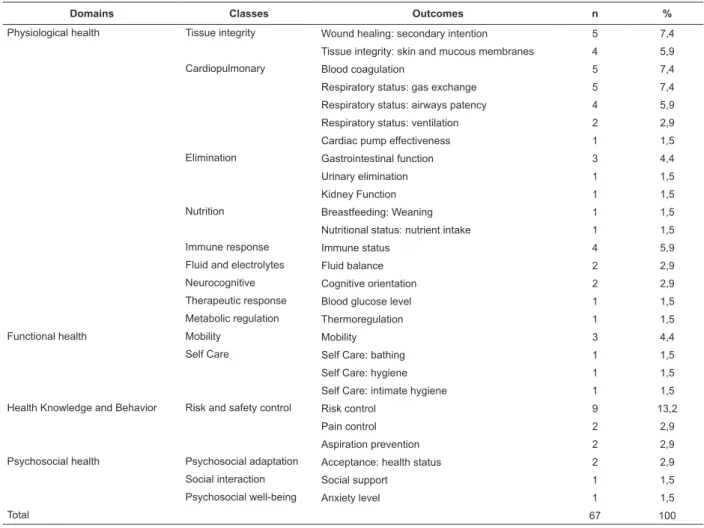
(8.7%) outcomes established from the NOC. Table
1 presents the domains, classes and NOC outcomes
mapped and the frequency with which they were used.
Table 1 - Domains, Classes and NOC Outcomes mapped. Belo Horizonte, MG, Brazil, 2011
Domains Classes Outcomes n %
Physiological health Tissue integrity Wound healing: secondary intention 5 7,4
Tissue integrity: skin and mucous membranes 4 5,9
Cardiopulmonary Blood coagulation 5 7,4
Respiratory status: gas exchange 5 7,4
Respiratory status: airways patency 4 5,9
Respiratory status: ventilation 2 2,9
Cardiac pump effectiveness 1 1,5
Elimination Gastrointestinal function 3 4,4
Urinary elimination 1 1,5
Kidney Function 1 1,5
Nutrition Breastfeeding: Weaning 1 1,5
Nutritional status: nutrient intake 1 1,5
Immune response Immune status 4 5,9
Fluid and electrolytes Fluid balance 2 2,9
Neurocognitive Cognitive orientation 2 2,9
Therapeutic response Blood glucose level 1 1,5
Metabolic regulation Thermoregulation 1 1,5
Functional health Mobility Mobility 3 4,4
Self Care Self Care: bathing 1 1,5
Self Care: hygiene 1 1,5
Self Care: intimate hygiene 1 1,5
Health Knowledge and Behavior Risk and safety control Risk control 9 13,2
Pain control 2 2,9
Aspiration prevention 2 2,9
Psychosocial health Psychosocial adaptation Acceptance: health status 2 2,9
Social interaction Social support 1 1,5
Psychosocial well-being Anxiety level 1 1,5
Total 67 100
The NOC taxonomy is composed by 7 domains and
31 classes. It can be observed that the NOC nursing
outcomes mapped are contemplated in 4 (57%)
domains and 15 (47%) of the NOC classes. The greatest
number of NOC outcomes mapped, 17 (60%) are found
are found in the Functional health domain distributed in
the mobility and self-care classes. A total of 3 nursing outcomes were found in the Health knowledge and behavior domain, in the class risk and safety control. The Psychosocial Health domain also had 3 outcomes
distributed in the psychosocial adaptation, social
interaction and psychosocial well-being classes. From
the outcomes mapped NOC scales were proposed, with
six (54.5%) different scales being selected from the 11
existing measurement scales. Figure 2 also presents
examples of the mapping process performed.
Figure 2 - Nursing outcomes and NOC scales proposed for the nursing goals formulated - Example of cross-mapping
Nursing Goals NOC Outcomes NOC Scales
Anxiety levels will be alleviated during the hospitalization. Anxiety level Severe to none
The pattern of confusion will improve within 2 days. Cognitive orientation Severely compromised to not compromised
Regular intestinal movements will be restored within 2 days. Gastrointestinal function Severely compromised to not compromised
Cardiac output will be optimized within 24 hours. Cardiac pump effectiveness Severely compromised to not compromised
Feeding by OET will be performed while the feeding deficit
remains. Nutritional status
Serious deviation from the normal parameters to Without deviation from the normal parameters
Validation of the nursing goals mapped and deinition
of the scales
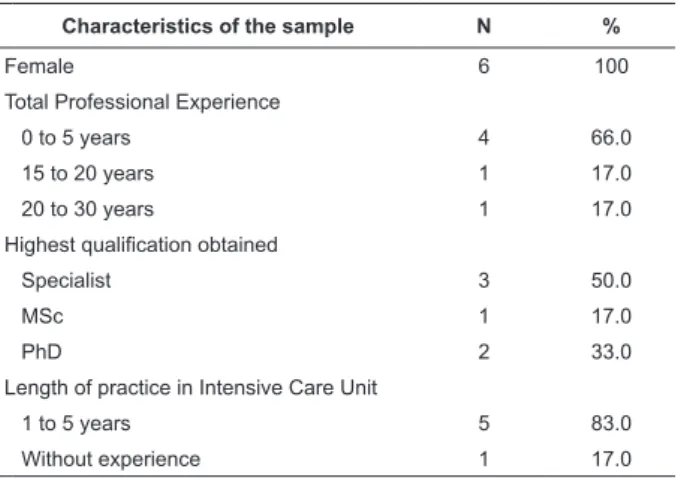
All the nurses who participated in the validation process of the nursing goals mapped worked and lived in Belo Horizonte, MG and were female (Table 2).
Table 2 - Characteristics of the sample of expert nurses.
Belo Horizonte, MG, Brazil, 2011
Characteristics of the sample N %
Female 6 100
Total Professional Experience
0 to 5 years 4 66.0
15 to 20 years 1 17.0
20 to 30 years 1 17.0
Highest qualification obtained
Specialist 3 50.0
MSc 1 17.0
PhD 2 33.0
Length of practice in Intensive Care Unit
1 to 5 years 5 83.0
Without experience 1 17.0
The majority of the expert nurses had up to 5 years experience, working from one to ive years in the intensive care area (ive nurses), three of the nurses were specialists in the area, one obtained a Master’s
degree and two PhDs. A concordance index of 86%
was obtained regarding the NOC outcomes mapped;
78% regarding the NOC scales suggested; and 90% regarding the deinitions proposed for the suggested scales, since conceptual and operational deinitions for the scales are not established in this classiication. A total concordance in the mapping of outcomes process, scales and deinitions was performed yielding an index of 83%.
Discussion
The majority (68.3%) of the patients concentrated
in the age group of people aged greater than or equal to
60 years. The mean age of ICU patients has increased
in recent years and will further increase with the aging
of the general population. In Western countries, the
percentage of individuals over 65 years of age represents
18% of the general population, accounting for 45.5% of
hospital admissions(21). Cross mapping is a process of
comparing data by using words with identical or similar
meanings(8). Studies have shown the validity of the
methodology in comparing non-standardized nursing languages to uniform nursing classiication terminologies identifying similarities between the terms(6-9,22).
The NOC “Risk control” was the most frequent. It can be observed that nine (13.2%) of the 29 different
NOC outcomes(13) were employed, followed by the NOCs
“Wound cicatrization: secondary intention”, “Blood Coagulation” and “Respiratory status: gas exchange”, all with a score of 5 (7.4%). The NOC “Risk control” is allocated in the Health knowledge and behavior(13)
domain, despite the predominance of the NOCs
present in the Physiological health domain. A similar
study conducted in two ICUs of Iowa, in which 42 NOC
outcomes were collected, showed that the majority were
found in the Physiological health domain, corroborating
the results of the present study. The principle NOCs found in common were: “Tissue integrity: skin and mucous membranes”, “Respiratory status: Ventilation” and “Nutritional status: nutrient intake”(23). The NOC “Risk
control” is deined as the “actions to eliminate or reduce actual, personal, and modiiable health threats”(13) which
used in the mapping process. It relects the proile of critical patients treated in an ICU. These are severe
patients who require continuous nursing care.
All the nursing goals formulated were mapped to NOC outcomes, which allow it to be afirmed that, despite the use of the NOC classiication being recent, its NOCs include the nursing goals elaborated by the
nurses for the patients they care for and can be used
to represent the nursing practice in the context of an
ICU. When the different NOC outcomes used in
cross-mapping are analyzed and their relationship with the domains of this classiication(13), it is veriied that these
comprehend 4 of the 7 domains, with the majority being
located in the Physiological health domain (17 - 60%)
followed by the Functional health domain (5 - 18%). This data indicates the tendency of nurses working in adult ICUs to formulate nursing diagnoses and consequently
to establish outcomes to be achieved focused on the
psychobiological needs of the individuals.
From the outcomes mapped, six (54.5%) different
scales were selected from the 11 present in the NOC. The NOC scales are of the Likert type with ive points and permit a characterization of the state of health of
the patient at a more concrete level which is reproducible
over a continuum(13). The mapping of the NOC nursing
goals and its validation performed in the present study
contribute to the systematization and standardization of
the nomenclature used in the practice of evaluation of
the nursing care provided. This contribution corroborates
withstudies that consider the application of the steps of
the NP extremely important, especially the evaluation of
the outcomes. The use of isolated steps, such as when employing only the nursing diagnosis, is insuficient to mitigate or solve all the needs of the patients(24) and
to give visibility to the nursing work performed. The scientiic literature related to the use of the NOC(13)
is recent and mostly North American. This inding demonstrates the need to develop more of these studies
in Brazil in order to incorporate the nomenclature into
the nursing practice reality(25).
Conclusions
The terms contained in the nursing goals for the
range of outcomes to the nursing diagnoses were identiied and mapped to the NOC and NOC scales were suggested for the outcomes mapped. The mapping was
considered adequate as it obtained acceptable levels of
concordance regarding the NOC outcomes mapped, the NOC scales suggested and the deinitions proposed for
the scales suggested. A total concordance index of 83%
regarding the mapping process performed was achieved. Thus, it can be afirmed that the mapping process was validated by expert nurses since a concordance index
greater than 70% was obtained.
These results favor the introduction of NOC
outcomes mapped to goals that nurses have previously
documented in the patient records and the respective
scales suggested for inclusion in the planning stage of
nursing care in a piece of systematization of nursing
care software being implemented in the unit. These NOC
outcomes and its scales can be used in the evaluation
phase of nursing care since they generate quality of care
indicators, which promotes the determination of the
effectiveness of the care provided by nurses in hospital
inpatient units.
References
1. Setz VG, D’Innocenzo M. Evaluation of the quality
of nursing documentation though the review of patient
medical records. Acta Paul enferm. [periódico na Internet].
2009 Jun [citado 2012 Mar 12]; 22(3):313-7. Disponível
em: http://www.scielo.br/scielo.php?script=sci_
arttext&pid=S0103-1002009000300012&lng=pt.
http://dx.doi.org/10.1590/S0103-21002009000300012
2. Matsuda LM, Silva DMP, Évora YDM, Coimbra JAH.
Anotações/registros de enfermagem: instrumento de
comunicação para a qualidade do cuidado? Rev Eletr
Enferm. [periodico na Internet]. 2006 [acesso 12 mar
2012]; 8(3):415-21. Disponível em: http://www.fen.
ufg.br/revista/revista8_3/v8n3a12.htm
3. Conselho Federal de Enfermagem (COFEN (BR).
Resolução n° 358/2009 de outubro de 2009. Dispõe sobre a Sistematização da Assistência de Enfermagem e a implementação do Processo de Enfermagem em
ambientes, públicos ou privados, em que ocorre o cuidado profissional de Enfermagem e dá outras providências [internet]. 15 out 2009. [acesso 1 jun 2011]. Disponível
em: http://site.portalcofen.gov.br/node/4384
4. Tannure MC, Chianca TCM. Terminology bank of nursing language for the adult intensive care unit. Rev
Enferm UFPE on line. [periódico na Internet]. 2009 July/
Sep [acesso 10 mar 2012]; 3(2):786-8. Disponível em:
http://www.ufpe.br/revistaenfermagem/index.php/
revista/article/view/197/pdf_938
5. Tannure MC, Bedran T, Ercole FF, Sampaio MM, Werli
A, Silva CC, Andrade CR, Chianca TCM. Mapeamento
dos termos da CIPE - versão 1.0, com os registros de
Received: Oct. 17th 2011
Accepted: Aug. 31st 2012
Enferm UFPE on line. [periódico na Internet]. 2009 July/
Sept [acesso 26 mar 2012]; 3(2):534-40. Disponível
em: http://www.ufpe.br/revistaenfermagem/index.
php/revista/article/view/161/pdf_903
6. Moorhead S, Delaney C. Mapping nursing intervention
data into the nursing interventions classification (NIC):
process and rules. Nurs Diagn. 1997;8(4):137-44.
7. Chianca TCM. Mapeando ações de enfermagem da
CIPESC para as intervenções da NIC. Rev Bras Enferm.
2003;56(5):513-8.
8. Lucena AF, Barros ALBL. Mapeamento cruzado: uma
alternativa para a análise de dados em enfermagem.
Acta Paul Enferm. 2005;18(1):82-8.
9. Salgado PO, Chianca TCM. Identification and mapping
of the nursing diagnoses and actions in an Intensive
Care Unit. Rev. Latino-Am. Enfermagem. July/Aug
2011;19(4):928-35.
10. Chianca TCM. A pesquisa em enfermagem e os
sistemas de classificação dos elementos da prática.
In: Tannure MC, Gonçalves AMP. Sistematização da Assistência de Enfermagem: Guia Prático. 2. ed. Rio de Janeiro (RJ): Guanabara Koogan; 2010. 298 p.
11. North American Nursing Diagnosis Association.
Diagnósticos de enfermagem da NANDA: definições e
classificação 2009-2011. Porto Alegre: Artmed; 2009.
456 p.
12. Bulechek GM, Dochterman JMcC, Butcher HK. NIC - Classificação das intervenções de enfermagem. 5.ed.
Rio de Janeiro: Elsevier; 2010. 901 p.
13. Johnson M, Maas M, Moorhead S. Classificação dos
resultados de enfermagem (NOC). 4. ed. Porto Alegre:
Artmed; 2010. 906 p.
14. Good PI. Permutation Tests: a pratical guide to
resampling methods for testing hyphoteses. 2nd. ed. New York: Springer-Verlag; 1994. (Springer series in statistics)
15. Ross SM. Simulation. 4th. Ed. San Diego: Elsevier;
2006.
16. Pavel S, Nolet D. Manual de terminologia. Canadá:
Public Words and Govermment Services; 2001. 166 p.
17. Coenen A, Ryan P, Sutton J. Mapping nursing
interventions from a hospital information system to the
nursing interventions classification (NIC). Nurs Diagn.
1997;8(4):145-51.
18. Fehring RJ. Methods to validate nursing diagnoses.
Heart & Lung. 1987;16(6):625-9.
19. Duarte ED, Sena RR, Xavier CC. Processo de trabalho
na Unidade de Terapia Intensiva Neonatal: construção
de uma atenção orientada pela integralidade. Rev Esc
Enferm USP. [periodico na Internet]. set 2009 [acesso 26
mar 2012]; 43(3):647-54. Disponível em: http://www.
scielo.br/scielo.php?script=sci_arttext&pid=S0080-62342009000300021&lng=en. http://dx.doi.
org/10.1590/S0080-62342009000300021.
20. Batista CG. Concordância e fidedignidade na
observação. Psicologia. 1977;3(2):39-49.
21. Nagappan R, Parkin G. Geriatric critical care. Crit Care Clin. 2003;19(2):253-70.
22. Nonino FOL, Napoleão AA, Carvalho EC, Petrilli JF
Filho. A utilização do mapeamento cruzado na pesquisa
de enfermagem: uma revisão de literatura. Rev Bras
Enferm. nov-dez 2008;61(6):872-7.
23. Beglen MA, Goode CJ, Reed L. Nurse Staffing and
Patient Outcomes. Nurs Res. 1998; Jan-Feb 47(1):43-50.
24. Seganfredo DH, Almeida MA. Validação de conteúdo
de resultados de enfermagem, segundo a Classificação
dos Resultados de Enfermagem (NOC) para pacientes
clínicos, cirúrgicos e críticos. Rev. Latino-Am.
Enfermagem. [periódico na Internet]. fev 2011 [acesso
10 jun 2011]; 19(1): 34-41. Disponível em: http://www.
scielo.br/scielo.php?script=sci_arttext&pid=S0104-11692011000100006&lng=pt. http://dx.doi.
org/10.1590/S0104-11692011000100006.
25. Garbin LM, Rodrigues CC, Rossi LA, Carvalho EC.
Classificação de resultados de Enfermagem (NOC):
identificação da produção científica relacionada. Rev