1. M.S., Department of Physiotherapy – Faculdades Adamantinenses In-tegradas. Physical Education School – Unoeste – Presidente Prudente, SP. Ph.D. underway in Health Sciences – Famerp. Brazilian Athletics Team Coach.
2. Ph.D., Department of Orthopedics and Traumatology, Famerp, São José do Rio Preto, SP.
3. Ph.D., Department of Physical Education, Sciences School, Unesp – Bauru, SP.
4. M.S., Department of Physiotherapy, Technology and Sciences Scholl, Unesp – Presidente Prudente, SP. Ph.D. underway in Health Sciences – Famerp. Brazilian Athletics Team Coach.
5. Ph.D., Department of Biostatistics, Biosciences Institute, Unesp – Botu-catu, SP.
Received in 16/11/04. 2nd version received in 8/12/04. Approved in 20/12/04. Correspondence to: Carlos Marcelo Pastre, Rua Fernão Dias, 950, Vila Santa Tereza – 19023-280 – Presidente Prudente, SP. E-mail: marcelopastre @hotmail.com
Sports injuries in Brazilian elite of the
athletics: study based on referred morbidity
Carlos Marcelo Pastre1, Guaracy Carvalho Filho2, Henrique Luiz Monteiro3,
Jayme Netto Júnior4 and Carlos Roberto Padovani5
O
RIGINALA
RTICLEKey words: Sports injuries. Athletics. High performance. ENGLISH VERSION
ABSTRACT
The sports injuries (SI) quantification and association processes to their possible causal factors are important for a better under-standing on the subject. The objective of the present study was the observation of SI in athletes of the Brazilian elite of the athlet-ics, associating them to their installation mechanisms and charac-teristics of the modality. Eighty-six athletes were interviewed (47 men and 39 women) summoned to represent Brazil during the season of 2003. A previously validated inquiry of referred morbid-ity was used for the attainment of data regarding the athletes and their injuries. For the analysis of the results the test of Goodman was adopted for contrasts among and within binomial proportions, being all of the conclusions discussed for 5% of statistical signifi-cance. The results showed that there is a higher rate of injuries for athlete (I/a), in the combined events (3.5 I/a), followed by events of intensity (2.6 I/a), resistance (1.9 I/a) and jumps (1.9 I/a), respec-tively. The main causal mechanism is the high intensity, attacking preferentially sprinters and endurance runners. Another strong as-sociation was observed between muscular injuries and intensity events, that also present preference for injury occurrence in the thigh’s region. The mechanism of high intensity was the main re-sponsible for muscular injury while bone or joint injuries and tendi-nopathies occur in high training volume. It is concluded, based on those findings, there are associations between types of injuries and causal factors, as among events and injuries, injuries mecha-nisms and anatomical place.
INTRODUCTION
According to Kettunen et al.(1), the increased demand on
mod-ern and competitive exercises has caused the concurrent risk of injuries, bringing concerns both for those who practice physical activities and for coaches and athletes from all performance lev-els, once these injuries interrupt the evolutive process of the sys-tematic adaptations imposed by training.
The occurrence of sports injuries (SI) is possibly a result of exer-cises performed until exhaustion or even performed without orien-tation and improperly, where the injuries prevalence and incidence are underestimated due the lack of report in all sportive universe, both in the initiation of modalities and in high levels of perfor-mance(2,3).
Among the sportive modalities, the athletics stands out for the diversity of events, each one being characterized by the presence of specific training conditions and basic elements such as running, jumping, throwing or hurling, which are observed in the other sports
with their respective adaptations(4).
For the installation of injuries, among wide possibilities of caus-al factors, the events specificity and the training methods adopted contribute significantly for the occurrence of such events. Addi-tionally, the effects of the referred causal factors, also identified in other modalities, are divided into intrinsic (age, gender and bio-type) and extrinsic (climate, type of floor for the sportive practice or event practiced)(5-7).
In this context, Horta(5) classified training as important factor for
the occurrence or not of loss of physical integrity in athletes and concluded that high levels of performance may result in high risk to the athlete’s health and yet that some types of exercises with high volume or intensity may predispose to specific injuries for each situation.
The knowledge on the situational cause, injury mechanism, risk factors, among other aspects, may aid sports professionals in the prevention process, diagnosis and treatment of these injuries, par-ticularly in the athletics; therefore, being characterized as
impor-tant contribution for health and sport sciences(8).
Thus, the objective of the present study was to know the SI frequency distribution in athletes from the Brazilian elite of the ath-letics, associating them to their installation mechanisms and char-acteristics of the modality.
METHODOLOGY
Identification of the type of study
This study is characterized as analytical observational(9). In this
modality of investigation, although no intervention from the re-searcher has occurred, the variables investigated were treated rig-orously in order to avoid errors in the measurement and control processes. The specific characteristic of the population researched itself facilitates this control, above all due to the systematization of the training processes, recovery and moderate lifestyle.
Study population
population. All athletes investigated were summoned to represent Brazil abroad during the current year.
The measures of central tendency and variability of age, stature, body weight and time of training of the participants are presented by gender in table 1 below.
For the analysis of the results, the Goodman test was adopted
for contrasts among and within multinomial proportions(11). Thus,
for the significance representation of findings, the tables present-ed letters as follows: i) small letters indicate the comparison of groups associated to the response category; ii) capital letters indi-cate the comparison of response indi-categories within the group. All conclusions were discussed for 5% of statistical significance.
Legal aspects
The participation of the population investigated occurred by means of reading, comprehension and written consent through a free consent form, approved by the Ethics Research Committee of São José do Rio Preto Medical School, as well as by the Athletic Brazilian Association (CBAt).
RESULTS
Table 2 presents the frequency distribution of athletes with inju-ries and respective injuinju-ries rates by participant and by injured ath-lete. The highest injuries rates were observed among specialists in combined events (3,25), sprinters (2,26), endurance runners and jumpers (1,93). When the injury rate is analyzed by injured athlete, the combined events (3,25) and sprinters (2,26) stand out with the highest values.
TABLE 1
Descriptive measures of participants according to gender
Gender Variables
Age Stature Weight Time of training (years) (m) (kg) (years)
Male 26.9 ± 5.4 1.83 ± 0.13 83.60 ± 20.16 10.6 ± 4.3 Female 25.7 ± 5.2 1.69 ± 0.07 63.53 ± 13.83 10.8 ± 4.7
Techniques and procedures
The data used in this work were obtained by means of the Inqui-ry of Referred Morbidity (IRM). This instrument is the most used to obtain information on the health state of specific populational
groups(9), presenting as objective, in the present research, to
sur-vey data on nature, frequency, body region and condition that caused the injury associated to sportive training and competitions. In this context, a specific form based on the practical experi-ence with the modality was elaborated. It was decided, during the interview, to request information on the training season, in other words, approximately eight months ago.
Although the period may seem too long for the interviewed to remember the injuries occurred, it is worth recalling that the high-performance athlete presents distinct characteristics from
non-ath-letes. According to Netto Júnior(10), for this group, the injury is
sig-nificantly remarkable and frequently hinders them from their athletic activities for some period of time, unlike what is usually observed in IRM in populations where there is no specific interest on the specific type of injury.
The instrument to be used was previously tested and validate
by Pastre et al.(3) specifically for the period to be analyzed,
espe-cially with regard to the interval between the exposition to the event and the report to the researcher, thus assuring the data reli-ability, even with time intervals of eight months.
Description of the morbidity inquiry
The IRM was elaborated by means of closed model containing personal data such as gender, age, weight, stature and time of training in years, as well as the modality in which the athlete is specialist.
For the attainment of information with regard to lesions, ques-tions on the type of lesion, anatomical place and condition that caused the lesion were inserted and the codified classification of the variables used to facilitate the information collecting with ath-letes was presented. In cases where medical diagnosis was veri-fied, when the athlete could remember, the athlete was asked to inform the injury diagnosed by the physician specifically.
For study purposes, it was considered as sportive lesion any pain or muscle-skeleton affection resulting of sportive trainings and competitions sufficient to cause alterations on the regular training,
regardless form, duration, intensity or frequency(2).
With the objective of facilitating the identification of the exact injury place, an illustrative figure of the human body was present-ed, so that the interviewed could identify the body region.
The causal condition of injury is characterized as the athlete’s perception on the exact moment in which signals and symptoms typical of acute episode appear and/or the type of activity in which such manifestations are intensified.
Statistical analysis
The data collected were stored in spreadsheet and grouped ac-cording to similar characteristics with the objective of facilitating the statistical procedures.
TABLE 2
Lesion rate by participant and injured athlete and relative frequency of athletes according to event
Event Lesion rate Frequency of Lesion rate by by participant injured athletes injured athlete
Combined 3.25 100.0% 3.25 Jumps 1.93 086.7% 2.08 Throws 1.45 085.0% 1.53 Resistance 1.93 100.0% 1.93 Hurdles 1.83 075.0% 2.11 Sprint 2.62 100.0% 2.62
TABLE 3
Absolute and relative frequency distribution (%) of causal conditions of lesions according to the type of event
Event Causal condition of lesion Total
Intensity Excessive Force Others repetitions
Combined 1(7.7)ab 10(76.9)b 0(0.0)a 2(15.4)a 13
A B A A
Jumps 1(3.7)a 19(70.4)b 2(7.4)a 5(18.5)a 27
A B A A
Throws 4(15.4)ab 4(15.4)a 17(65.4)b 1(3.8)a 26
A A B A
Resistance 12(44.4)bc 12(44.4)ab 1(3.7)a 2(7.4)a 27
B B A A
Hurdle 7(36.8)abc 6(31.6)ab 1(5.3)a 5(26.3)a 19
B AB A AB
Sprint 34(61.8)c 12(21.8)a 3(5.5)a 6(10.9)a 55
B A A A
Note: Data analyzed based on the Goodman test, with conclusions discussed for 5% of statistical significance. Letters are used for the comparison between rates. When there is statistically sig-nificant difference, the letters are different and when there is not, letters are equal. Small letters indicate comparison of groups in each column (causal condition), for fixed response category, considering a < b < c. Capital letters indicate comparison of responses category in each line (event), within the group, considering A < B.
exces-sive repetitions are considered as the main causal situations. Throw-ers (65.4%) are preferentially attacked during the performance of strength works while jumpers (36.8% – intensity; 31.6% – exces-sive repetitions) divide their occurrence between the practice of high repetitions volume and intense exercises. Sprinters (61.8%) are the most injured during high-intensity activities, being empha-sized with statistical significance.
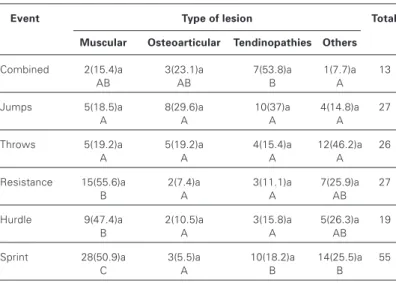
The types of lesions according to the event and the respective results of the statistical test are presented in table 4. In combined events, the tendinopathies prevail (53.8%); in resistance events (55.6%) and in jumps events (47.4%), the muscular lesions prevail and in endurance events, the muscular lesions prevail (50.9%) fol-lowed by tendinopathies (18.2%). In the comparison between groups associated to the nature of the lesion, no significant differ-ence between the types of events was observed.
The anatomical place of lesions in relation to the events per-formed is presented in table 5. Combined events and jumps ath-letes presented no preferential distribution by anatomical place. Throwers (42.3%) presented higher lesions frequency in the clas-sification “others”, containing the upper limbs. Among jumpers (36.8%) and resistance (44.4%), the thigh injuries are significantly more frequent than those identified as “others”. In sprinters (49.1%), the occurrence of injuries at the thigh’s region presents statistically significant difference when compared to any other an-atomical site.
Table 6 presents the associations between the type of injury and the causal mechanisms. The results indicate that the muscu-lar lesions are installed preferentially during high-intensity activi-ties (74.6%). The osteoarticular injuries are attributed to the ex-cess of repetitions (23.8%), while the tendinopathies related to the high number of repetitions (34.9%) are significantly distin-guished only from intense activities (8.5%).
TABLE 4
Absolute and relative frequency distribution (%) of types of lesions according to the type of event
Event Type of lesion Total
Muscular Osteoarticular Tendinopathies Others
Combined 2(15.4)a 3(23.1)a 7(53.8)a 1(7.7)a 13
AB AB B A
Jumps 5(18.5)a 8(29.6)a 10(37)a 4(14.8)a 27
A A A A
Throws 5(19.2)a 5(19.2)a 4(15.4)a 12(46.2)a 26
A A A A
Resistance 15(55.6)a 2(7.4)a 3(11.1)a 7(25.9)a 27
B A A AB
Hurdle 9(47.4)a 2(10.5)a 3(15.8)a 5(26.3)a 19
B A A AB
Sprint 28(50.9)a 3(5.5)a 10(18.2)a 14(25.5)a 55
C A B B
Note: Data analyzed based on the Goodman test, with conclusions discussed for 5% of statistical significance. Letters are used for the comparison between rates. When there is statistically sig-nificant difference, the letters are different and when there is not, letters are equal. Small letters indicate comparison of groups in each column (type of lesion), for fixed response category, con-sidering a = a. Capital letters indicate comparison of responses category in each line (event), within the group, considering A < B < C.
TABLE 5
Absolute and relative frequency distribution (%) of sites of lesions according to the type of event
Event Sites of lesion
Knee Leg Thigh Ankle/foot Others
Combined 2(15.4)ab 2(15.4)a 2(15.4)ab 6(46.2)a 1(7.7)a
A A A A A
Jumps 7(25.9)ab 2(7.4)a 6(22.2)ab 6(22.2)a 6(22.2)a
A A A A A
Throws 8(30.8)b 3(11.5)a 3(11.5)a 1(3.8)a 11(42.3)a
AB AB AB A B
Resistance 5(18.5)ab 3(11.1)a 12(44.4)ab 5(18.5)a 2(7.4)a
AB A B AB A
Hurdle 0 (0.0)a 3(15.8)a 7(36.8)ab 3(15.8)a 6(31.6)a
A AB B AB B
Sprint 6(10.9)ab 7(12.7)a 27(49.1)b 7(12.7)a 8(14.5)a
A A B A A
Note: Data analyzed based on the Goodman test, with conclusions discussed for 5% of statistical significance. Letters are used for the comparison between rates. When there is statistically sig-nificant difference, the letters are different and when there is not, letters are equal. Small letters indicate comparison of groups in each column (anatomical site), for fixed response category, con-sidering a < b. Capital letters indicate comparison of responses category in each line (event), within the group, considering A < B.
TABLE 6
Absolute and relative frequency distribution (%) of types of lesions according to causal condition
Causal Type of lesion Total condition
Muscular Osteoarticular Tendinopathies Others of lesion
Intensity 44(74.6)c 2(3.4)a 5(8.5)a 8(13.6)a 59
B A A A
Excessive 13(20.6)b 15(23.8)b 22(34.9)b 13(20.6)ab 63 repetitions A A A A Force 7(29.2)b 1(4.2)a 6(25.0)ab 10(41.7)ab 24
B A B B
Others 0 (0.0)a 5(23.8)b 4(19.0)ab 12(57.1)b 21
A B B C
Note: Data analyzed based on the Goodman test, with conclusions discussed for 5% of statistical significance. Letters are used for the comparison between rates. When there is statistically sig-nificant difference, the letters are different and when there is not, letters are equal. Small letters indicate comparison of groups in each column (type of lesion), for fixed response category, con-sidering a < b < c. Capital letters indicate comparison of responses category in each line (causal condition), within the group, considering A < B < C.
DISCUSSION
The investigations on injuries in sports find many difficulties due to aspects such as registering criteria of the lesion concept, the description of its incidence, the inclusion and description of inju-ries in study protocols as well as the diversity of the groups of
athletes in each modality(12). Furthermore, the perception of the
own athlete on his lesion, what indeed could help in future preven-tion processes, seems not to be considered as important.
Thus, precise initiatives emerge as result of: i) clinical approach-es with the evaluation of athletapproach-es or those who practice physical
activities, for example, the study of Cohen et al.(13) with 205
Brazil-ian elite swimmers who participated in the Brazil Swimming Meet-ing in 1998, whose objective was to survey data on the incidence of shoulder pain; ii) application of the Inquiry of Referred Morbidity (IRM), among which one may mention investigations such as by
Ghirotto et al.(14) with 142 athletes participants of the XII Men
Vol-leyball World Championship or the hard task of Steinman et al.(15),
interested in obtaining epidemiological information on surf acci-dents in Brazil, distributed 21,300 questionnaires throughout Bra-zilian coastal states and obtained return of 930 surfers.
Although IRM is considered as useful instrument in public health to search and to know which injuries attack a given populational group, their use has been considered as restrict because people only remember with reasonable accuracy lower seriousness
Notwithstanding, for the population of the present investigation,
high-performance athletes, Pastre et al.(3) compared the results from
information provided by IRM with data from clinical records of the subjects investigated and concluded that it is possible to apply the respective instrument with regard to the period of one training season, in other words, approximately eight months. The results indicated that the values were within the confidence limit estab-lished in the statistical test, as follows: 88% for variables nature and injury mechanism, and 92% for questions related to the ana-tomical site and training period. In other words, the use of IRM not only seems adequate, but based on these data, its use must grow in the sportive environment.
Based on the results obtained in the present research, it was observed that the highest lesions rates were observed among spe-cialists in combined events, sprinters, endurance runners and jump-ers.
In similar investigation performed by Laurino et al.(16), 103
ath-letes (69 men and 34 women) who practice the athletics, distribut-ed in amateurs and professionals, were studidistribut-ed. They observdistribut-ed that 43.3% of lesions occurred among specialists in sprint and hurdle events, followed by jumpers (30.8%). This study did not include specialists in combined events among the most attacked athletes; however, one must emphasize that in the casuistic of 103 athletes investigated, only two were decathletes, reason why one may conclude by concordance between the data obtained in both investigations conducted.
In relation to the causal condition of lesion, it was observed that: the combined events and the jumps have as main cause the ex-cess of repetitions; the throws, the strength elements and the sprints, the high intensities. These results may be explained when analyzed based on the principles that guide the sportive training.
Among them, the general adaptation syndrome (GAS) seems to be one of the most important and is characterized by identifying stressing factors. The GAS foresees that the human body should present three ways to react against stress. The first one is known as alarm phase and is defined as a shock and counter shock reac-tion; the second and most interesting for human performance pur-poses, is known as resistance phase, when the organism reacts in such way to produce adaptations for the organism to resist to new demands imposed by stimulus; and the third is known as exhaus-tion phase, when the capacity to react to a given stimulus satu-rates(17).
The problem is that coaches and athletes need to search for limits and many times go beyond the adaptation phase resulting in exhaustion. Although there are parameters to control the stimuli applied, there is also great difficulty to articulate the different ways the training stress manifest, which may be divided into: biochem-ical and metabolic, physbiochem-ical or structural, and mental or psycholog-ical, according to Sharkey(18).
Thus, it seems reasonable to suppose that a higher attention should be attributed to metabolic fatigue mechanisms during exer-cise in combined events and jump athletes; in throwers, the acute structural stress indicators; and among sprinters, according to the
American College of Sports Medicine(19), the training nature is a
result of the neural, hypertrophic and metabolic response, there-fore, suggesting that it is important to control simultaneously the biochemical and physical parameters of the exercise.
Among athletes of sprint, throw and resistance events, approx-imately half of injuries are of muscular nature, while among ath-letes of combined events, the tendinopathies are of higher occur-rence. Among sprinters, the thigh is the most affected anatomical site.
Studies of Bennell and Crossley(2) and Laurino et al.(16)
corrobo-rate observations of the present study, described above. Indeed, they support that the high tension on the myotendinous unit is associated with two important aspects: the size of the ischiotibial muscles and their contractile activity. These two factors together may cause high tension in the myotendinous unit during running, what furthers the appearance of lesions of the most several de-grees. The occurrence of injuries described for the ischiotibial muscles is due to many factors, such as the biarticular shape of this muscle, the increased proportion of type II fibers, the unbal-ance between forces in relation to the femoral quadriceps muscle, improper elongation and warm-up exercises, muscular retraction, and low capacity of neuromuscular coordination of the movement structure.
Although in lower number and in disagreement with studies of
Lysholm and Wicklander(20), and Marti et al.(21), who identified the
tendinopathy as the most frequent lesion in the athletics, this inju-ry also seemed to be remarkable for the population studied.
Whiting and Zernicke(22) identified the tendinopathies as
origi-nated from a direct outrage to tissue due to an external condition, or indirect, resulting from excessive tensive loads applied in ten-dons and that is what seems to occur to participants of this re-search, who reported to be attacked by such injury from excessive repetitive gestures.
Excessive repetitions also seem to be the cause of osteoarticu-lar lesions. In this case, besides the tissue structure, responsible for absorbing the tension loads resulting from the motor activity,
Whiting and Zernicke(22) warn for the possibility of interference of
auxiliary factors that may be related with the excessive use, among others the physical and mental fatigue, that impairs abilities, such as strength and coordination, and previous lesions that may impair the proprioceptive control, affecting mechanisms of defense against outside injuries(23).
Thus, based on observations and comparisons conducted in this study, it is concluded that there are associations between lesions and causal factors, as well as between events and lesions and between lesion mechanism and anatomical site, with high injuries rate, among high-performance athletes from the athletics, being the muscular lesion the most prevalent, high intensities the main cause and the thigh the most frequent site for the installation of lesions in this sport modality.
All the authors declared there is not any potential conflict of inter-ests regarding this article.
REFERENCES
1. Kettunen JA, Kujala UM, Kaprio J, Koskenvuo M, Sarna S. Lower-limb function among former elite male athletes. Am J Sports Med 2001;29:2-8.
2. Bennell KL, Crossley K. Musculoskeletal injuries in track and field: incidence, distribution and risk factors. Aus J Sci Med Sport 1996;28:69-75.
3. Pastre CM, Carvalho Filho G, Monteiro HL, Netto Jr J, Padovani CR. Lesões desportivas no atletismo: comparação entre informações obtidas em prontuá-rios e inquéritos de morbidade referida. Rev Bras Med Esporte 2004;10:1-8. 4. Weineck J. Biologia do esporte. 3a ed. São Paulo: Manole, 1991.
5. Horta L. Prevenção de lesões no desporto. Lisboa: Caminho, 1995. 6. Hollmann W, Hettinger T. Medicina do esporte. São Paulo: Manole, 1992.
7. Watson AWS. Sports injuries, incidence, causes, prevention. Rev Fisiot USP 1997;4:16-7.
8. Flegel MJ. Sport first aid. Updated ed. Champaign: Human Kinetics, 1997. 9. Pereira MG. Epidemiologia: teoria e prática. Rio de Janeiro: Guanabara Koogan,
1995.
10. Netto JR J. Lesão muscular: estudo a partir da equipe brasileira de atletismo que participou dos jogos olímpicos de Atlanta 1996 [Dissertação]. Campinas: Unicamp, Faculdade de Educação Física, 2000.
12. Marqueta PM, Terrero LT. Epidemiologia das lesões no basquete. Rev Bras Med Esporte 1999;5:73-6.
13. Cohen M, Abdalla RJ, Ejnisman B, Schubert S, Lopes AD, Mano KS. Incidência de dor no ombro em nadadores brasileiros de elite. Rev Bras Ortop 1998;33: 930-32.
14. Ghirotto FMS, Padovani CR, Gonçalves A. Lesões desportivas: estudo junto aos atletas do XII campeonato mundial masculino de voleibol. Arq Bras Med 1994; 68:307-12.
15. Steinman J, Vasconcelos EH, Ramos RM, Botelho JL, Nahas MV. Epidemiologia dos acidentes no surfe no Brasil. Rev Bras Med Esporte 2000;6:9-15. 16. Laurino CFS, Lopes AD, Mano KS, Cohen M, Abdalla RJ. Lesões
músculo-es-queléticas no atletismo. Rev Bras Ortop 2000;35:364-8.
17. Hernandes Jr, BDO. Treinamento desportivo. Rio de Janeiro: Sprint, 2002. 18. Sharkey BJ. Condicionamento físico e saúde. Porto Alegre: Artmed, 1998. 19. American College of Sports Medicine. Progression models and resistance
train-ing for healthy adults. Med Sci Sports Exerc 2002;34:364-80.
20. Lysholm J, Wicklander J. Injuries in runners. Am J Sports Med 1987;15:168-71. 21. Marti B, Vader JP, Minder CE, Abelin T. On the epidemiology of running injuries.
Am J Sports Med 1988;16:285-94.
22. Whiting WC, Zernicke RF. Biomecânica da lesão músculo-esquelética. Rio de Janeiro: Guanabara Koogan, 2001.