Received on 12/16/2008. Approved on 05/8/2009. We declare no conflict os interest.
Study undertaken at the High Cost Medication Distribution Center (CEDMAC, from the Portuguese) of the Hospital das Clínicas – FMUSP 1. Biomedicine Trainee at Universidade Cidade de São Paulo
2. Head nurse at CEDMAC
3. Assisstant physician of the Rheumatology Department of the Hospital das Clínicas of the Medical School of Universidade de São Paulo 4. Rheumatology Professor of the Medical School of Universidade de São Paulo
5. Collaborator professor at the Medical School of Universidade de São Paulo
Correspondence to: Jozélio Freire de Carvalho. Rheumatology Department of the Medical School of USP. Av. Dr. Arnaldo, 455, 3º andar, sala 3.190, Cerqueira César, São Paulo-SP, CEP: 01246-903. Phone/Fax: 55 11 30617490. E-mail: [email protected]
Frequency of antibodies against the etiologic
agents of acquired imunodeiciency syndrome,
syphilis, hepatitis B and C, and Chagas’
disease in patients with rheumatic diseases
treated with anti-tumor necrosis factor
Bárbara Santos Pires da Silva1, Ana Cristina Endo2, Ana Cristina de Medeiros3, Carla Gonçalves3,
Júlio César Bertacini de Moraes3, Eloísa Bonfá4, Jozélio Freire de Carvalho5
ABSTRACT
Introduction: Patients with rheumatic diseases treated with anti-tumor necrosis factor (anti-TNF) are considered to be immunosuppressed. Therefore, investigation for infectious diseases is mandatory in this population due to the high morbidity and, occasionally, mortality associated with this condition. Objectives:The objective of the present study was to evaluate the frequency of seropositivity for the following infectious agents: syphilis, Chagas’ disease, acquired human immunodeiciency virus (HIV), and hepatitis B and C in patients under anti-TNF therapy. Patients and Methods: This observational study evaluated 143 rheumatology patients with rheumatoid arthritis, ankylosing spondylitis, psoriatic arthritis, and others, under anti-TNF therapy (adalimumab, etanercept, and inliximab) from September 2007 to November 2008. Clinical and demographic data, as well as presence of antibodies against HIV, hepatitis B and C, syphilis, and Chagas’ disease, were evaluated. Results: The study population had a mean age of 45.78 ± 12.7 years; 60.1% were females and 76.9% Caucasian. Thirteen (9%) patients had at least one positive serology. None of the patients had antibodies to Chagas’ disease and HIV. Only two (1.4%) individuals were positive for syphilis (positive ELISA and negative VDRL). The frequency of total anti-HBc was 5% (7/140), and those patients were also positive for anti-HBs. All patients were negative for AgHBs. Four patients were HCV positive: and two of them had negative virus PCR and the other two were positive, but they were stable. Conclusion: The frequency of seropositivity for different infectious diseases in patients under anti-TNF therapy is low. Individuals with positive serology for hepatitis C deserve close attention.
Keywords: infections, HIV, tumor necrosis factor, anti-tumor necrosis factor, syphilis, Chagas’ disease, viral hepatitis.
INTRODUCTION
Tumor necrosis factor (TNF) inhibitors play an important role in the treatment of rheumatologic diseases. Currently, three drugs are available in the Brazilian market: etanercept, a TNF-α receptor analogue, does not have direct action on the TNF-α molecule, but it blocks its action by binding to
its receptors; inliximab, a chimeric monoclonal anti-TNF antibody; and adalimumab, which differs from the latter since it is a humanized antibody.1
According to Calabrese et al.2, the use of anti-TNF
patients with hepatitis C, but not with hepatitis B, unless it is associated with antiviral therapy; and it is also associated with the risk of reactivation of some granulomatous diseases, such as tuberculosis.3,4 Patients with rheumatic diseases, such
as rheumatoid arthritis, have a higher risk of infection than the general population,5 since the standard treatment with
conventional drugs is also associated with an increased risk of infections.2 The use of anti-TNF agents can represent an
increase in the risk of infectious diseases.2
The literature has very few studies on the influence of anti-TNF therapy in patients with Chagas’ disease and none in syphilis. Chagas’ disease is associated with a high concentration of TNF-α in the inflammatory infiltrate associated with the cardiac lesion, leading to the conclusion that it can be associated with the pathogenesis of the disease.6
The objective of the present study was to demonstrate the frequency of antibodies against a few infectious diseases (HIV, HBV, HCV, Chagas’ disease, and syphilis) in a population of patients with rheumatic diseases (rheumatoid arthritis, ankylosing spondylitis, psoriatic arthritis, and others) undergoing anti-TNF therapy.
PATIENTS AND METHODS
This is an observational study with 143 patients with rheumatic diseases, i.e., rheumatoid arthritis, ankylosing spondylitis, psoriatic arthritis, juvenile idiopathic arthritis, and others (Behçet’s disease, Still’s disease) followed at the High Cost Medication Distribution Center (CEDMAC, from the Portuguese) of the Hospital das Clínicas of the Medical School of Universidade de São Paulo, and on anti-TNF therapy (adalimumab, etanercept, and inliximab) from August 2007 to November 2008. Clinical and demographic data were collected from electronic medical records (ProntMed – Prontuário Eletrônico 3.0, ProntMed, São Paulo, SP, Brazil). A blood sample was collected for posterior analysis of antibodies against the infectious diseases mentioned above.
This study was approved by the Ethics on Research commission and all patients signed and informed consent (approval #1186/07).
Diagnostic Tests: Commercially available kits were used for all serologies as follows: Serology for Chagas’ disease (Biomérieux, Marcy l’Étoile, France); enzyme immunoassay (ELISA). Syphilis serology: ELISA, using the Treponema as antigen, and locculation – Venereal Disease Research Laboratory (VDRL) (Symbiosis, São Paulo, SP, Brazil). HIV 1 and 2 serologies (Vitros, USA) and Hepatitis C serology (Vitros, USA): ampliied chemiluminescence and qualitative
detection of hepatitis C virus RNA and, in patients with positive serology, polymerase chain reaction (PCR) was also performed. Hepatitis B serology (total HBc, AgHBs, anti-HBs, AgHBe, anti-HBe, and anti-HBc IgM): MEIA technique (ELISA microparticles, AxSym, Illinois, USA). Total anti-HBc and anti-HBs were used for triage, and the latter was used to detect patients vaccinated. Blood for HIV and hepatitis B and C tests was collected before exposure to anti-TNF therapy. Syphilis and Chagas’ disease serologies were performed during this treatment.
Statistical analysis: Data are presented as means, standard deviation, or percentage. Descriptive statistics was used to present the data.
RESULTS
Patients included in this study had a mean age of 45.78 ± 12.7 years, 76.9% were Caucasian, and 60.1% were females. The mean duration of the disease was 15.2 ± 9.4 (Table 1).
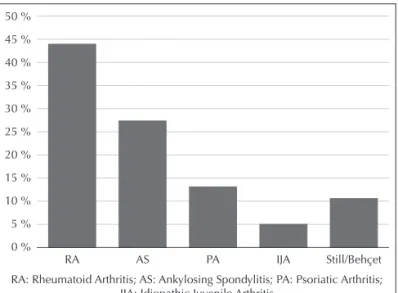
The diseases evaluated included rheumatoid arthritis (n = 63), ankylosing spondylitis (n = 39), psoriatic arthritis (n = 19), juvenile idiopathic arthritis (n = 7) and others (Reiter’s syndrome, Still’s disease) (n = 15) (Figure 1).
All patients in this study had negative serologies for Chagas’s disease and they were all asymptomatic for cardiac or gastrointestinal manifestations of this disease. Serology for HIV was also negative in all patients. Only two patients (1.4%) had positive serologies for syphilis. Both of them had positive ELISA and negative VDRL. One of them was being treated with adalimumab and the other with etanercept.
Four (2.8%) patients had positive serologies for hepatitis C. Polymerase chain reaction was performed in all four, being negative in two and positive in the other two. Both patients with negative hepatitis C PCR were asymptomatic. As for the other two, one had psoriatic arthritis and had been diagnosed with hepatitis C in 1996, conirmed by liver histopathology that showed chronic active hepatitis, AST 41 U/l, and ALT 62 U/l; he was treated with interferon and ribavarin, which led to negative viral load. This patient was being treated with adalimumab. The second patient with positive PCR for hepatitis C has rheumatoid arthritis. He is being followed by the Hepatology Department and biopsy or treatment has not been indicated so far; he was being treated with adalimumab. Both patients have normal liver function tests and stable viral load.
DISCUSSION
The present study detected a low frequency of positive serologies for infectious diseases in patients on anti-TNF therapy.
We found only one study in the literature on the association of Chagas’ disease and rheumatic diseases in patients on anti-TNF therapy. The blockade of TNF in patients with Chagas’ disease can lead to ventricular dysfunction, suggesting that the absence of this cytokine can be deleterious for the heart, according to Bilate et al.7 The study of Andrade
et al. 8 revealed that TNF can be important in the reduction
of parasitemia and destruction of the parasite. However, paradoxically, TNF can contribute for the high mortality in experimental models by inducing acute phase inlammatory factors, such as endothelial adhesion molecules, chemical mediators (cytokines and chemokines), and growth factors, among others.9 Anti-TNF therapy could, in theory, contribute
to control those effects of TNF.8
Tumor necrosis factor is highly related to the pathogenesis of HIV infection, contributing for the dissemination of the virus, deletion of lymphocytes, and worsening of the clinical manifestations.10,11 Tumor necrosis factor is also capable
of increasing apoptosis of CD4 cells, contributing with the immunocompromised state of the patient. The use of anti-TNF drugs can affect even more the immunological system of the individual with HIV, especially against intracellular pathogens.2 In the present study, none of the patients was
seropositive for HIV, suggesting that they were triaged previously, before the institution of this therapy, or that this infection has a low incidence in the population of patients with rheumatic diseases. However, studies on the prevalence of HIV in patients with rheumatic diseases are lacking in the literature. Additionally, rheumatologic complaints, which are more frequent in HIV-infected individuals than in the general population, can be one of the irst signs of infection with the human immunodeiciency virus.12-14
According to Negussie,15 inlammatory cytokines, such as
TNF, and interleukins-6 and 8, could be responsible for the severe symptoms seen in syphilis like the Jarisch-Herxheimer reaction, and could be present in the pathophysiology of syphilis. The lipoproteins (LPS) produced by the etiological agent of syphilis induce the production of TNF by macrophages, and they could play an important role in the development of the local inflammation and systemic manifestations that characterize this infection.16 The patients in the present study
who tested positive for syphilis did not have any relationship with the anti-TNF therapy, since they all represented cases of serologic scarring characterized by positive ELISA and negative VDRL.
The effects of TNF blockade on the hepatitis C virus have been the focus of several studies. Anti-TNF suppresses elements of the immune system, such as cytokines and chemical mediators (inteleukin-1, inteleukin-6, and TNF), and at the same time stimulates mechanisms of antimicrobial defense, activating peripheral T cells directed against speciic antigens.17 Other studies have demonstrated that TNF can
also cause liver damage, suggesting that, maybe, anti-TNF- therapy, alone or associated with some other treatment for hepatitis C like interferon (IFN), could be beneicial2. The case
of a patient with a diagnosis of hepatitis C who was treated satisfactorily with ribavarin and interferon, achieving control of the hepatitis has been reported in the literature. After nine years, the patient was diagnosed with psoriatic arthritis and treated with inliximab with reduction in quantitative RNA by PCR and of the symptoms of the rheumatologic disease.18
This case is very similar to one of the patients described here.
Table 1
Demographic data and disease duration of 143 patients with rheumatologic disease undergoing anti-TNF therapy who were investigated for infectious diseases
n = 143
Mean age, years 45.78 ± 12.7
Female, % 60.1%
Caucasian, % 76.9%
Duration of the disease, years 15.2 ± 9.4
Results are presented as mean ± standard deviation or percentage.
Figure 1. Distribution of rheumatologic diseases in 143 patients under-going anti-TNF therapy.
RA: Rheumatoid Arthritis; AS: Ankylosing Spondylitis; PA: Psoriatic Arthritis; IJA: Idiopathic Juvenile Arthritis
50 %
45 %
40 %
35 %
30 %
25 %
20 %
15 %
10 %
5 %
0 %
It has been reported that treatment with infliximab reactivated chronic hepatitis C; however, the association of antiviral therapy, such as lamivudine, stabilized the disease activity.3 So far, approximately 50 patients with hepatitis C have been treated with inliximab or etanercept and none of them presented virus reactivation.20-24 It is the current
consensus that the use of anti-TNF in patients with chronic hepatitis C seems to be safe.3,25 Since the information we
have is based on case reports and very few prospective, randomized, double-blind, placebo-controlled studies, serial monitoring of aminotransferases and, maybe, viral load is currently recommended because there are very few studies in the literature on the use of biological therapy in patients with hepatitis C.2
Until 2006, 11 cases of patients with hepatitis B treated with anti-TNF had been reported.3 In one of those cases, the viral
DNA in the serum became negative; and the viral infection was reactivated in two patients who were treated with inliximab and methotrexate, and treatment with lamivudine inhibited viral replication.26 In all cases, the use of lamivudine seemed
to prevent or treat the HBC infection.2,3,27 On the other hand,
reactivation of HBV after the use of anti-TNF, including cases with probable association with fulminating hepatitis, has been reported.3 Our results show that seven out of 140 patients were
anti-HBc and anti-HBs positive, suggesting that those patients had prior contact with the virus and presented serologic cure of the disease even before the administration of anti-TNF.
To conclude, one observes a low incidence of positive serology for infectious diseases in patients under anti-TNF therapy. None of our patients was positive for HIV or Chagas’ disease. A minority of the patients presented positive serologic for syphilis and hepatitis B, which did not led to dificulties in managing those patients. Two patients presented hepatitis C; one of them had been treated in the past with an antiviral drug; however, infusion of anti-TNF did not bring any clinical-laboratorial change in those individuals.
REFERÊNCIAS REFERENCES
1. Martin P, Medeiros AC, Goldenstein-Schainberg C. O papel dos inibidores do fator de necrose tumoral no tratamento da artrite idiopática juvenil – revisão de literatura. Rev Bras Reumatol 2006; 46:126-33.
2. Calabrese LH, Zein N, Vassilopoulos D. Safety of antitumor necrosis factor (anti-TNF) therapy in patients with chronic viral infections: hepatitis C, hepatitis B, and HIV infection. Ann Rheum Dis 2004; 63:ii18-ii24.
3. Desai SB, Furst DE. Problems encountered during anti-tumour necrosis factor therapy. Best Practice & Research Clinical Rheumatology 2006; 20:757-90.
4. Vassilopoulos D, Calabrese LH. Risks of immunosuppressive therapies including biologic agents in patients with rheumatic diseases and co-existing chronic viral infections. Curr Opin Rheumatol 2007; 19:619-25.
5. Doran MF, Crowson CS, Pond GR, O’Fallon WM, Gabriel SE. Frequency of infection in patients with rheumatoid arthritis compared with controls: A population-based study. Arthritis & Rheumatism 2002; 46:2287-93.
6. http://www.iocruz.br/chagas/cgi/cgilua.exe/sys/start.htm?sid=170 7. Bilate AM, Salemi VM, Ramires FJ. TNF blockade aggravates
experimental chronic Chagas disease cardiomyopathy. Microbes and Infection 2007; 9:1104-13.
8. Andrade SG, Magalhães A, Pessina DH. Importance of TNF-alpha in the course of acute infection with Trypanosoma cruzi: inluence of its inhibition by pentoxifylline treatment. Mem Inst Oswaldo Cruz 2008; 103:21-6.
9. Kumar V, Abbas AK, Fausto N. Robbins e Contran. Patologia – Bases Patológicas das Doenças. In: Kumar, Abbas, Fausto. Inlamação aguda e Crônica. São Paulo: Elsevier, 2005, p.73.
10. Lane BR, Markovitz DM, Woodford NL. TNF-alpha inhibits HIV-1 replication in peripheral blood monocytes and alveolar macrophages by inducing the production of RANTES and decreasing C-C chemokine receptor 5 (CCR5) expression. J Immunol 1999; 163:3653-61.
11. Herbein G, Khan KA. Is HIV infection a TNF receptor signalling-driven disease?. Trends Immunol. 2008; 29:61-7.
12. Oliveira RL, Salgado MC, Dancour MA. Síndromes e manifestações reumáticas em pacientes infectados pelo vírus da imunodeiciência humana (HIV). An. Acad. Nac. Med 2002; 162:18-22.
13. Batista RS, Gomes AP, Nacif MS. Manifestações reumáticas da síndrome da imunodeiciência adquirida. Rev Bras Reumatol 2004; 44:339-46.
14. L o u t h r e n o o W. R h e u m a t i c m a n i f e s t a t i o n s o f h u m a n immunodeiciency virus infection. Curr Opin Rheumatol. 2008; 20:92-9.
15. Negussie Y, Remick DG, DeForge LE. Detection of Plasma Tumor Necrosis Factor, Interleuklns 6, and 8 during the Jarisch-Herxheimer Reaction of Relapsing Fever. J. Exp. Med 1992; 175:1207-12. 16. JD Radolf, MV Norgard, ME Brandt. Lipoproteins of Borrelia
burgdorferi and Treponema pallidum activate cachectin/tumor necrosis factor synthesis. Analysis using a CAT reporter construct. J. Immunol. 1991; 147:1968-74.
17. Cravo AR, Tavares V, Silva JC. Terapia anti-TNF alfa na espondilite anquilosante. Acta Med Port 2006; 19:141-150.
18. Aslanidis S, Vassiliadis T, Pyrpasopoulou A. Inhibition of TNFα does not induce viral reactivation in patients with chronic hepatitis C infection: two cases. Clin. Rheumatol. 2007; 26:261-64. 19. Marotte H, Fontanges E, Bailly F. Etanercept treatment for three
months is safe in patients with rheumatological manifestations associated with hepatitis C virus. Rheumatol. 2007; 46:97-9. 20. Galeazzi M, Giannitti C, Manganelli S. Treatment of rheumatic
diseases in patients with HCV and HIV infection. Autoimmunity Reviews 2008; 8:100-03.
22. Peterson JR, Hsu FC, Simkin PA, Wener MH. Effect of tumor necrosis factor alpha antagonists on serum transaminases and viraemia in patients with rheumatoid arthritis and chronic hepatitis C infection. Ann Rheum Dis 2003; 62:1078–82.
23. Oniankitan O, Duvoux C, Challine D et al. Inliximab therapy for rheumatic diseases in patients with chronic hepatitis B or C. J Rheumatol. 2004; 31:107-9.
24. Bellisai F, Giannitti C, Donvito A, Galeazzi M. Combination therapy with cyclosporine A and anti-TNF-alpha agents in the treatment of rheumatoid arthritis and concomitant hepatitis C virus infection. Clin. Rheumatol. 2007; 26:1127–9.
25. Ferri C, Ferraccioli G, Ferrari D et al. Safety of anti-tumor necrosis factor-alpha therapy in patients with rheumatoid arthritis and chronic C vírus infection. Rheumatology 2008;35:1944-9.
26. Ostuni P, Botsios C, Punzi L. Hepatitis B reactivation in a chronic hepatitis B surface antigen carrier with rheumatoid arthritis treated with inliximab and low dose methrotrexate. Ann. Rheum Dis. 2003; 62:686-7.