HTLV-1 AND MYELOPATHY IN SALVADOR
(NORTHEASTERN BRAZIL)
A CASE CONTROL STUDY
INES LESS A *, DILCINEIA MORAES * * , LUCIANA MOURA, AÍLTON MELO * *
SUMMARY — The principal aim of the study was to determine the degree of association between cerebrospinal fluid (CSF) that is positive for HTLV-1 and myelopathy in Salvador, Brazil. From the same hospital, twenty-eight cases of myelopathy and twenty-eight cases showing no neurological disorder were studied using blind selection matched 1:1 by age and sex. The twenty-eight pairs underwent HTLV-1 serology tests. In thos« with a positive result, anti-HTLV-1 antibodies were investigated in the CSF. The ELISA method was used, complemented by the Western-blot test. Myelopathy was considered associated with HTLV-1 only when the CSF was positive indicating neurotropism of the virus. The mean age of the cases was 44.6 ± 15.6 years and the control group was 43.5 ± 16.0 (p]>0.05). An OR of 9.0 was detected with a reability interval (95%) of 1.652-48.866 and chi-square significant at the 0.02 level. Despite a strong degree of association and considering the low level of precision, there is a need for analytical studies with larger samples which besides improving the pre-cision will allow for greater control of the confounding variables.
K E Y WORDS: HTLV-1, retrovirus, analytical studies, tropical spastic paraparesis, Brazil.
Estudo caso-controle de mielopatia* por HTLV-1 em Salvador
RESUMO — Procurou-se determinar a magnitude da associação entre positividade do líquido cefalorraqueano (LCR) para HTLV-1 e mielopatias em Salvador. Foram estudados 28 casos de mielopatias e 28 casos sem doença neurológica, todos procedentes de um único hospital. A sele-ção foi de modo cego, com pareamento 1:1, por idade e sexo. Os 28 pares realizaram sorologia para HTLV-1 e, nos casos com mielopatia, foram pesquisados anticorpos para HTLV-1 no LCR. Na investigação dos anticorpos foram utilizados os métodos ELISA e Western-blot. Os casos tiveram média de idade de 44,6 ± 15,6 anos e os controles de 43,5 ± 16,0 (p>0,05). Observa-mos um O R = 9 , 0 com intervalo de confiança 95% de 1,652-48,866 e qui-quadrado significante a 0,02. Apesar do grande nível de associação encontrado, estudos analíticos com associações maisi amplas são necessários com o objetivo de melhorar a precisão e o controle de variáveis intervenientes.
PALAVRAS-CHAVE: HTLV-1, retrovirus, estudo analítico, paraparesia espástica tropical, Brasil.
After Gessain and colleagues 7 published their findings on the association
between positive serology for human T-lymphotropic virus type-1 (HTLV-1) and
tropical myelopathy in Martinique, several other observations confirmed the
association in different geographic areas
2.3,8,14,17-21,23. i
n1985 and 1986 the first
cases were published regarding CSF positivity for HTLV-1 in patients with
tro-pical spastic paraparesis
3,8,18and in patients with myelopathy in temperate
Federal University of Bahia (UFBA), Salvador: * Department of Preventive Medicine; ** Department of Neuropsychiatry. Aceite: 13-maio-1993.
zones
1 4. There is suggestive evidence that HAM may be autoimmune in nature.
The findings of high levels of antibodies against HTLV-1 and oligoclonal IgG
bands in CSF and serum is, perivascular cuffing by lymphocytes observed in
autopsy
1, and improvement of the clinical state with steroids and danazol .15
favor a role for autoimmunity in the pathogenesis of HAM. Several papers have
described that HAM may be associated with other non-neurologic diseases as
ichthyosis, uveits, arthropathy, polymiosytis, vasculitis, Sjogren's syndrome,
alveolitis and adult T-cell leukemia/lymphoma is. These pleomorphic
manifesta-tions and the findings that less than 1% of seropositives subjects will manifest
clinical disease, points to an immunological systemic disease whose clinical
express is related to the immunogenetic relationship between the organism and
the virus.
In Brazil, positive serology for HTLV-1 was observed in AIDS risk groups 5,
among natives in the Amazon region
1 2and among adult patients with T-cell
leukemias or lymphomas is. The first cases of myelopathy associated with
posi-tive serology for HTLV-1 in Brazil were detected in São Paulo and later in
Forta-leza and Salvador 4-6; positive CSF was observed by Spina-França and colleagues
in 24 of 56 cases of spastic myelopathies 22.
Out of two papers
2»2iy
all the information regarding the association
be-tween HTLV-1 and myelopathy are descriptive being necessary analytical studies
whose features are more appropriate to establish associations. It is our proposal
to establish the risk of infections due to HTLV-1 in patients with myelopathy
in Salvador.
PATIENTS AND METHOD'S
The study was carried out in Salvador, the capital city of the State of Bahia, located in the Northeastern region of Brazil, at 12 degrees 59 minutes South latitude and 38 degrees 31 minutes West longitude. The city's population is predominantly mulatto due to miscegena-tion. The study was based on 28 cases of myelopathy out of 49 which were diagnosed between June 1990 and December 1991. Both the study and the control groups were chosen using the blind selection method and were matched 1:1. The matching criteria were age (margin of ± 3 years) and sex. All the patients were from the same hospital, a philantropic institution exclusively for lower income individuals. All participants in both the study and control groups underwent serology tests for HTLV-1 and HIV. The cases of myelopathy with positive results also underwent CSF tests for anti-HTLV-1 antibodies.
The CSF from all participants was tested for cells, proteins, protein electrophoresis and infectious or parasitic diseases (syphilis, toxoplasmosis, cysticercosis, and schistosomosis). These exams were carried out in a single laboratory by the same researcher using identical techniques. All participants also underwent either magnetic resonance of the spinal cord or myelography.
Study group criteria:
a. Clinical criteria. Patients with myelopathy diagnosed clinically by: 1. progressive paraparesis, with a duration of between 6 and 36 months; 2. pyramidal syndrome, characterised by spasticity, hyperreflexy predominantly of the lower limbs, Babinski sign, clonus, spinal automatisms, sincinesis; 3. neurogenic spastic bladder, reduction in libido or masculine sexual impotence; 4. lower motor neuron syndrome, characterised by atrophy of the quadriceps and, in some cases, bilateral arreflexy of the achilleus; 5. sensitive syndrome, characterised by paresthesia and dysesthesia in lower limbs in some cases.
b. Laboratory criteria: sera and CSF negative for syphillis, toxoplasmosis, schistoso-mosis and cysticercosis.
c. Radiological criteria: absence of compressive, expansive or traumatic lesions of the spinal cord diagnosed by myelography or magnetic resonance imaging.
Criteria for the control group: patients from the same hospital, with no neurologic disorders selected blindly with respect to their HTLV-1 serology, taking into account the above mentioned age and sex factors.
Serum and CSF exam for HTLV-1: antibodies to HTLV-1 were detected with a commer-cially available enzyme immunoassay (EIA). EIA repeatedly reactive samples were further examined using a new dot blot confirmatory immunoassay with highly purified HTLV-1 viral and recombinant proteins as an antigen source. Samples were considered positive if antibo-dies against both the gag (p24) and env (p21E) gene products were present.
The odds ratio (OR) was calculated for analysis of case-control studies matched 1:1 and the respective 95% confidence intervals. A statistical significancy test was carried out using the McNemar chi-square test for studies matched 1:1. The mean age was compared by t-student.
RESULTS
Of the 28 pairs, 14 were male and 14 were female; 17 of the study group and 17 from the control group (60.7%) have always resided in the State capital; the others are from other parts of the State and currently reside in Salvador. The patients were predominantly mulatto. The participants from both the study and control groups were blue collar workers (construction workers, masons, farm workers, maids, etc.) in the study group there were three people from a high risk group for AIDS (one homosexual, one prostitute and one who had received a blood transfusion in the past).
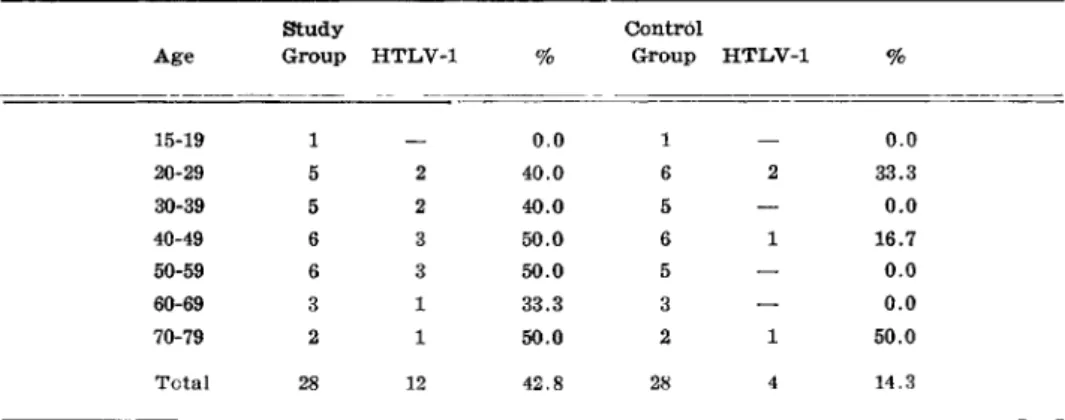
Study and control groups had mean ages of respectively 44.6 ± 15.6 years and 43.5 ± 16 years, p > 0 . 0 5 (Table 1).
Of the 28 study cases, 12 (42.8%) had positive serology and CSF for HTLV-1 and 4 controls (14.3%) had positive serologies. Their pairs, according to their test results, appear in Table 2, with an estimated relative risk (odds ratio, OR) of 9.0, p<^0.02.
No patient showed suggestive images of spinal cord compression using MRI or myelo-graphy. All patients had a CSF cellularity from 1 to 40, with a predominance of lymphocytes. In 100% of the patients the total proteins were above 40mg% and gamaglobulin in the CSF was above 14%. No patient showed positive tests for infectious or parasitic diseases; none were HIV positive.
COMMENTS
Despite the fact that there were 49 patients with myelopathy who fulfilled
the methodological study criteria, it was possible to find only one adequate pair
for 28 among those who fulfilled the criteria for the control group and who
had already undergone serology tests for HTLV-1. As patients with myelopathy
Table 1. Age and positivity for • HTLV-1 for study and control groups.
Study Control
Age Group HTLV-1
%
Croup HTLV-1%
15-19 1 0.0 1 0.0
20-29 5 2 40.0 6 2 33.3
30-39 5 2 40.0 5 — 0.0
40-49 6 3 50.0 6 1 16.7
50-59 6 3 50.0 5 — 0.0
60-69 3 1 33.3 3 — 0.0
70-79 2 1 50.0 2 1 50.0
Total 28 12 42.8 28 4 14.3
with other aetiologies can show positive serologies for HTLV-1, only those
pa-tients with positive antibodies in their CSF were considered. This was an attempt
to guarantee that the cases considered positive had HTLV-1 as the aetiology of
their myelopathy.
The magnitude of the OR (9.0) confirms the association discussed in the
scientific literature. The wide range of the reliability interval (1.652-48.866)
sug-gests a low level of precision. However, this does not invalidate the association.
Despite the fact that the OR (9.0) was high, it was four times lower than the
forty obtained by Roman and colleagues in a non-matched study that was based
on a study group of 20 and a control group of 16 21. If the association criteria
had been HTLV-1 seropositivity the OR would have been higher.
Since this is the third analytical study on the association between HTLV-1
and myelopathy available to the scientific community, this model should be
encouraged and more detailed case studies should be carried out, thus allowing
greater control of the confounding, variables.
REFERENCES
1. Akizuki S, Nakazato O, Higuchi Y, Tanabe K, Setohushi M, Yoshida S, Miyasaki Y, Yama-moto S, Sudou S, Sannomiya K, Okajima T. Necropsy findings in HTLV-1 associated myelopathy. Lancet 1987, 1:156-157.
2. Arango C, Concha M, Zaninovic V, Corral R, Biojo R, Borrero I, Rodgers-Jodgers-Johnson P, Mora C, Garruto RM, Gibbs Jr CJ. Epidemiology of tropical spastic paraparesis in Colombia and associated HTLV-1 infection. Ann Neurol 1988, 23(Suppl) :S161-S165. 3. Bartholomew C, Cleghorr F, Charles W , Ratan P, Roberts L, Maharaj K, Jankey N,
Dais-ley H, Hanchard B, Blattner W . HTLV-1 and tropical spastic paraparesis. Lancet 1986, 2:99-100.
4. Castro LAM, Chaves CJ, Callegaro D, Nobrega JPS, Scaff M. HTLV-1 associated mye-lopathy in Brazil: a preliminary report. Arq Neuropsiquiatr 1989, 47:501-502.
5. Cortes E, Detels R, Aboulafia D, Li X L , Maudgil T, Alam M, Bonecker C, Gonzaga A, Oyafuso L, Tondo M. HIV-1, HIV-2 and HTLV-1 infection in high risk groups in Brazil. N Engl J Med 1989, 320:953-958.
6. Costa CMC, Vale OC, Goubau P, Desmyter J, Carton H. HTLV-1 and tropical spastic paraparesis in Fortaleza (Northeastern Brazil). J Trop Geogr Neurol 1991, 1:45-48. 7. Gessain A, Barin F, Vernant JC, Gout O, Maurs L, Calender A, De Thé G. Antibodies to
human T-lymphotropic virus type-1 in patients with tropical spastic paraparesis. Lancet 1985, 2:407-408.
8. Gessain A, Francis H, Soran T, Giordano C, Akani F, Pignemal M, Caudie, C, Malone G, Essex M, De Thé G. HTLV-1 and tropical spastic paraparesis in Africa. Lancet 1986, 2:698.
9. Grimaldi LM, Roos RP, Devare SG, Casey JM, Maruo Y, Hamada T, Tashiro K. HTLV-1 associated myelopathy: oligoclonal immunoglobulin G bands contain anti HTLV-1 p24 anti-body. Ann Neurol 1988, 24:727-731.
10. Harrington W J Jr, Sheremata W A , Snodgrass SR, Emerson S, Phillips S, Berger JR. Tropical spastic paraparesis/HTLV-1 associated myelopathy treatment with an anabolic steroid: danazol. AIDS Res Hum Retrov 1991, 7:1031-1034.
REFERENCES
1. Akizuki S, Nakazato O, Higuchi Y, Tanabe K , Setohushi M, Yoshida S, Miyasaki Y, Yama-¬ moto S, Sudou S, Sannomiya K , Okajima T. Necropsy findings in H T L V - 1 associated myelopathy. Lancet 1987, 1:156-157.
2. Arango C, Concha M, Zaninovic V, Corral R, B i o j o R , Borrero I, Rodgers-Jodgers-Johnson P, Mora C, Garruto R M , Gibbs Jr CJ. Epidemiology of tropical spastic paraparesis in Colombia and associated H T L V - 1 infection. Ann Neurol 1988, 23(Suppl) :S161-S165.
3. Bartholomew C, Cleghorr F, Charles W , Ratan P, R o b e r t s L, Maharaj K , Jankey N, Dais-¬ ley H, Hanchard B, Blattner W . H T L V - 1 and tropical spastic paraparesis. Lancet 1986, 2:99-100.
4. Castro L A M , Chaves CJ, Callegaro D, Nobrega JPS, Scaff M. H T L V 1 associated m y e -lopathy in Brazil: a preliminary report. A r q Neuropsiquiatr 1989, 47:501-502.
5. Cortes E, Detels R , Aboulafia D , Li X L , Maudgil T, Alam M, Bonecker C, Gonzaga A, Oyafuso L, T o n d o M. HIV-1, HIV-2 and H T L V - 1 infection in high risk groups in Brazil. N Engl J Med 1989, 320:953-958.
6. Costa CMC, Vale OC, Goubau P, Desmyter J, Carton H . H T L V - 1 and tropical spastic paraparesis in Fortaleza (Northeastern Brazil). J T r o p Geogr Neurol 1991, 1:45-48. 7'. Gessain A, Barin F, Vernant JC, Gout O, Maurs L, Calender A, De T h é G. Antibodies to
human T-lymphotropic virus type-1 in patients with tropical spastic paraparesis. Lancet 1985, 2:407-408.
8. Gessain A, Francis H, Soran T, Giordano C, Akani F, Pignemal M, Caudie, C, Malone G, Essex M, De T h é G. H T L V - 1 and tropical spastic paraparesis in Africa. Lancet 1986, 2:698.
9. Grimaldi L M , R o o s R P , Devare SG, Casey JM, Maruo Y, Hamada T, Tashiro K . HTLV-1 associated m y e l o p a t h y : oligoclonal immunoglobulin G bands contain anti H T L V - 1 p24 anti-body. Ann Neurol 1988, 24:727-731.
11. Melo A, Moura L, Meireles A, Costa G. Danazol: a new perspective in the treatment of H T L V - 1 associated myelopathy (preliminary report) A r q Neuropsiquiatr 1902, 50:402-403. 12. Nakauchi CM, Macedo JE, Maruyama K, Kanzaki L I , Macedo JE, Azevedo VN, Casseb JS.
Prevalence to human T-cell leukemia virus type 1 ( H T L V - 1 ) antibody among populations living in the Amazon region of Brazil: preliminary report. Mem Inst Osw Cruz 1990, 85:29. 13. Oliveira MSP, Matutes E, Famades LC. Adult T-cell leukemia/lymphoma in Brazil and
its relation to H T L V - 1 . Lancet 1990, 336:987-990.
14. Osame M, Usuku K, Izumo S, Ijichi N, Amitani H, Igata A, Matsumoto M, Tara M. H T L V - 1 associated myelopathy: a new clinical entity. Lancet 1986, 1:1031-1032.
15. Osame M, Igata A, Matsumoto M, K o h k a M, Usuku K, Izumo S. H T L V - 1 associated mye-lopathy: treatment trials, retrospective survey and clinical and laboratory findings. He-¬ matol R e v 1990, 3:271-284.
16. Osame M, McArthur JC. Neurologic manifestations of infection with human T cell lym-¬ photropic virus type 1. I n : A s b u r y A K , McKhann GM, McDonald W I ( e d s ) . Diseases of the nervous system: clinical neurobiology. Philadelphia: Saunders, 1992, p 1331-1339. 17. Ramiandrisoa H, Dermas M, Giordano C, N'Diaye IP, Grunitzky EK, Kabone J, Verdier M,
Diop P, N ' D i a y e M, Denis F. Human retroviruses H T L V - 1 , HIV-2, HIV-3 and neurolo-gical disease in West-Africa. J T r o p Geogr Neurol 1991, 1:39-44.
18. Rodjers-Johnson P, Gajdusek DC, Morgan OSTC, Zaninovic V, Sarin P, Graham DS. H T L V - 1 and H T L V - 3 antibodies in tropical spastic paraparesis. Lancet 1985, 2:1247-1248. 19. Rodgerst-Johnson P, Morgan OSTC, Mora C, Sarin P, Ceroni M, Piccardo P, Garruto RM, Gibbs CJ Jr, Gajdusek DC. The role of H T L V - 1 in tropical spastic paraparesis in Jamaica. Ann Neurol 1988, 23(Suppl) :S121-S126.
20. Roman GC, Shoenheng BS, Maddeu D L . Human T-lymphotropic virus type-1 antibodies in the serum of patients with tropical spastic paraparesis in the Seychelles. Arch Neurol 1987, 44:605-607.
21. Roman GC, Spencer PS, Path MRC, Shoenheng BS, Hugon J, Ludolph A, Rodgers-Johnson P, Osuntokun BO, Shamlaye CF. Tropical spastic paraparesis in the Seychelles Islands a clinical and case-control neuroepidemiology study. Neurology 1987, 37:1323-1328. 22. Spina-França A, Livramento JA, Machado L R , Gomes H R , Vianna LS, Castro LHM, Nó-¬
brega JPS, Bacheschi L A . H T L V - 1 antibodies in serum and cerebrospinal fluid in tro-pical spastic paraparesis in Brazil. A r q Neuropsiquiatr 1990, 48:441-447.