Arq Neuropsiquiatr 2006;64(4):1023-1026
Unidade de Neurologia Infantil Pequeno Príncipe (UNIPP), Hospital Pequeno Príncipe, Curitiba PR, Brasil:1Residentes de Neuro p e d i a t r i a ; 2Médicos da Unidade de Neurologia Infantil.
Received 29 March 2006, received in final form 26 June 2006. Accepted 3 August 2006.
Dra. Mônica Jaques Spinosa - Rua Johann Sebastian Bach 71 - 80820-140 Curitiba PR - Brasil. E-mail: [email protected]
LISSENCEPHALY, ABNORMAL GENITALIA
AND REFRACTORY EPILEPSY
Case report of XLAG syndrome
Mônica Jaques Spinosa
1, Paulo Breno Noronha Liberalesso
2,
Simone Carreiro Vieira
1, Alaídes Susana Fojo Olmos
2, Alfredo Löhr Júnior
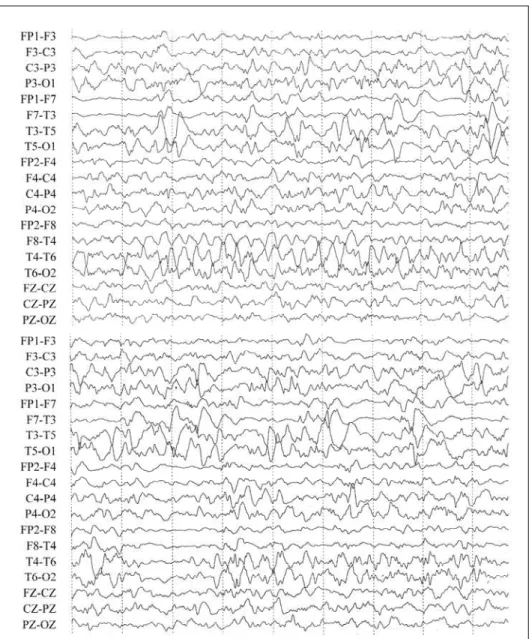
2ABSTRACT -Introduction:X-linked lissencephaly with ambiguous genitalia (XLAG) is a recently described genetic disorder caused by mutation in the aristaless-related homeobox (ARX) gene (Xp22.13). Patients p resent with lissencephaly, agenesis of the corpus callosum, re f r a c t o ry epilepsy of neonatal onset, acquire d m i c rocephaly and male genotype with ambiguous genitalia. Case re p o rt:Second child born to healthy nonconsanguineous parents, presented with seizures within the first hour of life that remained refracto-ry to phenobarbital, phenytoin and midazolam. Examination identified micro c e p h a l y, axial hypotonia, pyramidal signs and ambiguous genitalia. EEG showed disorganized background activity and seizures start-ing at the right midtemporal, central and occipital regions. MRI showed diffuse pachygyria, moderate thickening of the cortex, enlarged ventricles, agenesis of the corpus callosum and septum pellucidum. K a ryotype showed a 46,XY genotype. Additional findings were hypercalciuria, vesicoureteral reflux, patent ductus arteriosus and chronic diarrhea.
KEY WORDS: corpus callosum, ambiguous genitalia, epilepsy, ARX gene.
Lisencefalia, genitália ambígua e epilepsia refratária: relato de caso da síndrome XLAG
RESUMO - I n t rodução:Lisencefalia com genitália ambígua ligada ao X (XLAG) é doença genética re c e n t e-mente descrita, causada por mutação no genea r i s t a l e s s - related homeobox(ARX) (Xp22.13). Os pacientes a p resentam lisencefalia, agenesia de corpo caloso, epilepsia refratária com início no período neonatal, m i c rocefalia adquirida e genótipo masculino com genitália ambígua. Relato de caso:Segundo filho de pais não-consangüíneos, apresentou crises na primeira hora de vida que permaneceram refratárias a feno-barbital, fenitoína e midazolam. Apresentava microcefalia, hipotonia axial, sinais de liberação piramidal e genitália ambígua. EEG demonstrou atividade de base desorganizada, crises convulsivas com início nas regiões temporal-média, central e occipital direitas. RNM demonstrou paquigiria difusa, moderado espes-samento do córtex, ventrículos aumentados, agenesia de corpo caloso e septo pelúcido. Cariótipo eviden-ciou genótipo 46,XY. Achados adicionais foram: hipercalciúria, refluxo vésico-ureteral, ducto arterioso per-sistente e diarréia crônica.
PALAVRAS-CHAVE: corpo caloso, genitália ambígua, epilepsia, gene ARX.
In 1999, Dobyns et al.1described 5 cases of geno-typic males with lissencephaly of posterior predom-inance, agenesis of the corpus callosum and ambigu-ous genitalia. In one family affected, the authors ob-s e rved a pattern of inheritance compatible with an X-linked disord e r. However, since the 5 patients clin-ically diff e red from the previously described X-linked isolated lissencephaly, that was known to be linked to mutations in the doublecortin gene (Xq22.3-q23), the authors postulated that the cases re p o rted be-longed to a yet unknown syndrome, and re f e rred to
1024 Arq Neuropsiquiatr 2006;64(4)
their ARX gene analyzed and all three cases were found to be heterozygous with respect to their son’s mutation. In 2003, Uyanik et al.7sequenced the ARX gene in 2 patients and their mothers, confirming Kita-m u r a ’s findings. Mutations in the ARX gene can be e x p ressed phenotypically as XLAG, X-linked infantile spasms (West syndro m e )8, X-linked myoclonic epilep-sy with spasticity and mental re t a rd a t i o n9, X-linked mental re t a rd a t i o n1 0, Partington syndrome (mental re t a rdation, dystonic movements of the hands and d y s a rt h r i a )1 1, Proud syndrome (acquired micro c e p h a l y, mental re t a rdation, agenesis of the corpus callosum and characteristic facies)12or hydranencephaly with ambiguous genitalia1 3. All cases can be associated with autistic features14.
This case re p o rt was approved by the ethics com-mittee of Pequeno Príncipe Hospital and pare n t a l
written informed consent was obtained for publica-tion.
CASE
Second child born to healthy nonconsanguineous par-ents, adequate pre-natal medical care, vaginal term deliv-e ry without complications. Sdeliv-eizurdeliv-es startdeliv-ed within thdeliv-e first hour of life and remained re f r a c t o ry to treatment with phe-nobarbital 40 mg/kg/day, phenytoin 15 mg/kg/day and con-tinuous infusion of midazolam 12 mcg/kg/min. Seizure s w e re characterized by clonic jerks of the right hemiface and arm, re c u rred many times a day and frequently evolved into status epilepticus. The mother had had two pre v i o u s p regnancies, which resulted in a healthy boy and a miscar-riage in the first trimester. Family history revealed a mater-nal aunt who had two seizures in late childhood.
Clinical and neurological examination identified micro-cephaly, lack of visual contact, axial hypotonia, pyramidal
Arq Neuropsiquiatr 2006;64(4) 1025
signs and ambiguous genitalia (impalpable gonads, phal-lus of 1.2 cm, single medial urogenital meatus and unfused l a b i o s c rotal folds with normal skin pigmentation). A series of 3 EEG tracings (24 days, 2 and 3 months of age) demon-strated disorganized background activity. In all 3 exams e l e c t roclinical and/or electrographical seizures starting at the midtemporal, central and occipital regions of the right c e rebral hemisphere were detected (Fig 1). MRI showed d i ffuse pachygyria, moderate thickening of the cere b r a l c o rtex, enlarged ventricles, agenesis of the corpus callosum and septum pellucidum (Fig 2). Karyotype showed a 46,XY genotype.
Additional findings were hypercalciuria, grade II vesi-c o u reteral reflux, small patent duvesi-ctus arteriosus and vesi-chro n-ic diarrhea that responded well to a semi-elementary for-mula. Further investigation excluded megacolon, hyper-phosphaturia, mid left lung hypoplasia, exocrine pancre-atic deficiency and other cardiac malformations. Deficient temperature control was not observed.
DISCUSSION
General features of the XLAG syndrome are lissen-c e p h a l y, agenesis of the lissen-corpus lissen-callosum, intralissen-ctable epilepsy of neonatal onset, acquired micro c e p h a l y and male genotype with ambiguous genitalia1.
S e i z u res occur pre c o c i o u s l y. A case of marked fetal movements suggestive of prenatal seizures was described by Uyanik et al.7. Tonic, multifocal myo-clonic and generalized tonic-myo-clonic seizures have been re p o rt e d3 , 7. No description of the electro e n c e p h a l o-graphic pattern was found.
Key MRI findings consist of lissencephaly with a moderately thickened cerebral cortex and agenesis of the corpus callosum. Dobyns et al.1, in the first description of the syndrome, re p o rted a lissencephaly with a posterior-to-anterior gradient, i.e. a posteri-or agyria and anteriposteri-or pachygyria. This finding was c o n f i rmed by some authors3 , 7and refuted by others4. The spectrum of neurological phenotypes determ i n e d
by mutations in the ARX gene, summoned by Kato et al.1 3, suggests that variations in the degree of cere-bral malformation should not be viewed with surpri-se. Basal ganglia have been described as small7a n d d y s p l a s i c3. Small subependymal cystic lesions were observed in one patient7.
Many authors described hypothalamic dysfunc-tion with deficient control of body temperature1 , 2 , 5 - 7, which was not observed in our patient. Chronic diar-rhea is also a common finding1 - 3 , 5. Two of the thre e cases reported by Bonneau et al.3had micrognathia and prominent forehead. One case of “minor facial a b n o rmalities” was described by Uyanik et al.7O u r patient did not possess any distinctive facial feature s . Additional systemic features include mid left lung hypoplasia, ventricular septal defect, patent ductus a rteriosus and megacolon2; exocrine pancreatic defi-ciency and renal phosphate wasting5; patent ductus a rteriosus and foramen ovale7. The association of h y p e rcalciuria, vesicoureteral reflux and patent duc-tus arteriosus has not been previously reported.
M a t e rnal history of miscarriage, as observed in our case, had been documented by Ogata et al.2. In his study, the patient’s mother had two pre g n a n c i e s that spontaneously terminated at 32 and 18 weeks of gestation. Both were male fetuses whose ultra-sound showed a hydrocephalic appearance. Even though none of the fetuses had been genetically exa-mined to confirm the presence of the ARX mutation, it was postulated that the miscarriages represented s e v e rely malformed fetuses. Some asymptomatic mothers, heterozygous carriers of the ARX mutation, w e re found to have either total or partial agenesis of the corpus3 , 1 3and in one case partial posterior age-nesis of the corpus callosum associated with enlarg e d v e n t r i c l e s7. Bonneau et al. described that female car-riers may present with epilepsy or mental re t a rd
tion. This observation was suggested to support a semi dominant X-linked inheritance mode3.
XLAG syndrome has a poor prognosis. All cases w e reassociated with intractable epilepsy and lacked psychomotor development. Maximum survival re p o rt-ed was 4 years7. Most patients die before the age of 18 months2,4,5.
REFERENCES
1. Dobyns WB, Berry-Kravis E, Havernick NJ, Holden KR, Viskochil D. X-linked lissencephaly with absent corpus callosum and ambiguous genitalia. Am J Med Genet 1999;86:331-337.
2. Ogata T, Matsuo N, Hiraoka N, Hata J. X-linked lissencephaly with ambiguous genitalia: delineation of further case. Am J Med Genet 2000; 94:174-176.
3. Bonneau D, Toutain A, Laquerriere A, et al. X-linked lissencephaly with absent corpus callosum and ambiguous genitalia (XLAG): clinical, mag-netic resonance imaging, and neuropathological findings. Ann Neuro l 2002;51:340-349.
4. Hartmann H, Uyanik G, Gross C, et al. Agenesis of the corpus callo-sum, abnormal genitalia and intractable epilepsy due to a novel famil-ial mutation in the A r i s t a l e s s - related homeobox gene. Neuro p e d i a t r i c s 2004;35:157-160.
5. Hahn A, Gross C, Uyanik G, et al. X-linked lissencephaly with abnor-mal genitalia associated with renal phosphate wasting. Neuro p e d i a t r i c s 2004;35:202-205.
6. Kitamura K, Yanazawa M, Sugiyama N, et al. Mutation of ARX caus-es abnormal development of forebrain and tcaus-estcaus-es in mice and X-linked lissencephaly with abnormal genitalia in humans. Nature Genet 2002; 32:359-369.
7. Uyanik G, Aigner L, Martin P, et al. ARX mutations in X-linked lissen-cephaly with abnormal genitalia. Neurology 2003;61:232-235. 8. B ru y e re H, Lewis S, Wood S, MacLeod PJ, Langlois S. Confirmation of
linkage in X-linked infantile spasms (West syndrome) and re f i n e m e n t of the disease locus to Xp21.3-Xp22.1. Clin Genet 1999;55:173-181. 9. Scheffer IE, Wallace RH, Phillips FL, et al. X-linked myoclonic
epilep-sy with spasticity and intellectual disability: mutation in the homeobox gene ARX. Neurology 2002;59:348-356.
10. S t romme P, Mangelsdorf ME, Shaw MA, et al. Mutations in the human ortholog of Aristaless cause X-linked mental re t a rdation and epilepsy. Nat Genet 2002;30:441-445.
11. Partington MW, Mulley JC, Sutherland GR, Hockey A, Thode A, Tu r n e r G. X-linked mental re t a rdation with dystonic movements of the hands. Am J Med Genet 1988:251-262.
12. P roud VK, Levine C, Carpenter NJ. New X-linked syndrome with s e i z u res, acquired micre n c e p h a l y, and agenesis of the corpus callosum. Am J Med Genet 1992;43:458-466.
13. Kato M, Das S, Petras K, et al. Mutations of ARX are associated with striking pleiotropy and consistent genotype-phenotype corre l a t i o n . Hum Mutat 2004;23:147-159.
14. A r t i g a s - P a l l a res J, Gabau-Vila E, Guitart-Feliubadalo M. Syndro m i c autism: II. Genetic syndromes associated with autism. Rev Neurol 2005; 40:S151-S162.