RECIIS – R. Eletr. de Com. Inf. Inov. Saúde. Rio de Janeiro, v.6, n.3, Set., 2012 [www.reciis.icict.fiocruz.br] e-ISSN 1981-6278
* Original Article
Multi-user equipment, core-facilities and technological
platforms: the evolution of organizational strategies for
translational health research
Renata Almeida de Souza
Fiocruz/CDTS. Possui Bacharelado em Ciências Biológicas pela Universidade do Estado do Rio de Janeiro (1996), mestrado em Biologia (Biociências Nucleares) pela Universidade do Estado do Rio de Janeiro (2001) e doutorado em Biologia Parasitária pela Fundação Oswaldo Cruz (2006). Atualmente é servidora do Instituto Nacional de Metrologia, Qualidade e Tecnologia (INMETRO) trabalhando na Diretoria da Qualidade. Também é Consultora de Laboratório para Management Sciences of Health (MSH).
Daniel Savignon Marinho
Fiocruz/CDTS. Possui graduação em Farmácia pela Universidade Federal do Rio de Janeiro (2000), Habilitação em Farmácia Industrial pela Universidade Federal do Rio de Janeiro (2002) e mestrado em Vigilância Sanitária pela Fundação Oswaldo Cruz (2005). Atualmente é analista C&T da Fundação Oswaldo Cruz Pesquisador do INCT- Inovação em doenças Negligenciadas. [email protected]
Ana Paula Oliveira Brum
Fiocruz/CDTS. Possui graduação em Desenho Industrial pela Universidade do Estado do Rio de Janeiro (1989), Mestrado (1993) e Doutorado (1997) em Engenharia de Produção pela Coordenação dos Programas de Pós-Graduação em Engenharia - COPPE - da Universidade Federal do Rio de Janeiro. Atualmente é Coordenadora de Gestão em Desenvolvimento e Inovação do Centro de Desenvolvimento Tecnológico em Saúde - CDTS - da Fundação Oswaldo Cruz.
Carlos Medicis Morel
Fiocruz/CDTS. Membro titular da Academia Brasileira de Ciências, é médico pela Faculdade de Medicina da Universidade Federal de Pernambuco (UFPE) e doutor em ciências (Biofísica / Biologia Molecular ) pelo Instituto de Biofísica Carlos Chagas Filho da Universidade Federal do Rio de Janeiro (UFRJ), defendendo tese realizada no "Institut Suisse de Recherches Expérimentales sur le Cancer" ISREC) em Lausanne, Suíça. Foi professor da Faculdade de Medicina e do Instituto de Ciências Biológicas da Universidade de Brasília (UnB). Pesquisador da Fundação Oswaldo Cruz (Fiocruz), criou o Departamento de Bioquímica e Biologia Molecular do Instituto Oswaldo Cruz (IOC) reunindo uma equipe que se destacou mundialmente pelos trabalhos no campo da parasitologia molecular e biotecnologia.
DOI: 10.3395/reciis.v6i3.600en
Abstract
practical applications (‘translational research’). We have focused our analysis on universities and biomedical institutions that have created dedicated facilities to optimize this type of activity either working in isolation or in partnership with the industrial sector. We have detected three main types of infrastructure arrangements: multi-user equipment, core-facilities and technological platforms. Although most of the institutions share a common vision and definition for the first two categories, we have identified different perceptions on the nature, role and mission of existing, self denominated ‘technological platforms’. A review of these structures has led us to propose a unifying categorization and nomenclature system of these critical components of health innovation systems. Based on this conceptual framework we have analyzed the evolution of organizational R&D structures and initiatives of Fiocruz and developed a web-based system for the strategic planning, implementation and management of its network of translational research facilities located in several cities in Brazil. This approach may prove useful for organizations facing similar transitions and challenges.
Keywords: Developing countries, Health innovation, Science-Technology integration, Laboratory management, Translational research
1. Introduction
Science, technology and production are critical factors required for social and economic development which are especially interwoven in the industrialized countries’ economies but weakly linked in the developing ones (SAGASTI, 2004). Using the numbers of papers and patents as proxies for scientific and technological production, Bernardes and Albuquerque (2003) classified countries into three groups: I, the least developed countries where the connections between science and technology are immature; II, the developing countries where an initial interaction between these sectors has already contributed to development; and III, the industrialized countries. This classification reflects the emergence of fast growing developing economies such as the “BRICs” (O’NEILL et al., 2005) and of the Innovative Developing Countries, IDCs, (MOREL et al., 2005), those countries with rapidly growing capabilities for undertaking health innovation. This phenomenon challenges the traditional vision of a bipolar world composed of rich countries (the “North)” and the underdeveloped world (the “South”) (MOREL, 2003; REUVENY; THOMPSON, 2008) and opens up a rich research agenda to address the characteristics, organization, strategy and evolution of systems of innovation and development (LUNDVALL, 1992; NELSON, 1993; LASTRES; CASSIOLATO; ARROIO, 2005; ETZKOWITZ, 2008). Morel et al. (2005) and Mahoney et al. (2007) proposed six components, or determinants, of health innovation, which are: (1) R&D i.e. laboratory and clinical studies; (2) regulations for ensuring safety and efficacy; (3) manufacturing capabilities to meet international quality standards; (4) authoritative IP management and licensing; (5) delivery of immunization services by national public and private sectors; and (6) international procurement and trade. In addition there are two other essential elements for success - dynamic linkage and partnerships. Those countries wishing to improve their innovation capabilities must make coordinated, dynamic progress in all six determinants.
discoveries into practical riches from which humanity can benefit (ANONYMOUS, 2008). In other words, facing the Sisyphus Challenge of the 21st Century (SAGASTI, 2004) can be as difficult as crossing the ‘Valley of Death’ (BUTLER, 2007, 2008). This raises the interesting possibility that similar strategies and mechanisms could be designed to serve both developing and industrialized countries in addressing their needs in expertise, infrastructure and incentives (TO THWART…, 2008). They would need to address similar hurdles and obstacles at least four levels: (i) different cultures and motivations of “star” scientists doing basic research (Mode I of knowledge production) as compared to “pasteur” scientists carrying out strategic or applied research or to experts working on technological development including clinical trials, regulation and production (Mode II of knowledge production) (STOKES, 1997; GIBBONS et al., 1994; BABA; SHICHIJO; SEDITA, 2009); (ii) differences in infrastructure, policies and governance required for basic research as compared to technological development and production (PAOLI, 2009); (iii) the changing nature of scientific enterprise in which advances require an ever-increasing number of contributors (BARABASI, 2005; GUIMERA et al., 2005); (iv)financing issues in translational health research, due to the fundamental role of the public sector in health innovation (ALBUQUERQUE; CASSIOLATO, 2002), the high costs of taking a discovery to its first clinical trials and then all the way on to drug or vaccine development and manufacturing (DI MASI; HANSEN; GRABOWSKI, 2003).
This paper addresses the organizational infrastructure needed for stimulating innovation and technological development, two critical components of translational health research. This issue has been studied from five different angles e.g.: (1) spacial and environmental factors like geographic proximity and concentration of various industrial, educational and technological assets on innovation outcomes and economic development (CASTELLS; HALL, 1994; PORTER; STERN, 2001; ROBINSON; RIP; MANGEMATIN, 2007); (2) spacial factors operating at a micro analysis level such as workspace (TOKER; GRAY, 2008); (3) organizational aspects of laboratories and publication performance (CARAYOL; MATT, 2004); (4) the role played by scientific instrumentation on the shaping and management of scientific and technological spaces (PEERBAYE, 2004; PEERBAYE; MANGEMATIN, 2005); and (5) the role of shared institutional resources on translational cancer research (PAOLI, 2009).
Our analysis focused on how leading academic institutions have organized their scientific and technological ‘spaces’ to cope with the challenges of translational research: how they have structured their research laboratories and facilities, how these structures operate internally and how they interact with external partners such as the industrial sector to improve the exploitation of research results and foster economic development. Three basic, increasingly complex prototypes of infrastructure/organizational arrangements could be identified: multi-user equipments, core-facilities and technological platforms. These are the building blocks of higher level arrangements such as technological agglomerations and innovation networks. Finally we used this lens to analyze the recent evolution and strategic development plans of a leading Latin American public health institution, the Oswaldo Cruz Foundation (Fiocruz, http://www.fiocruz.br), an organization closely linked to Brazil’s Ministry of Health and that played a key role during “The Beginnings of Brazilian Science” (STEPAN, 1976).
adopted to analyse their translational research facilities and our main findings. In the fourth section the conceptual framework derived from this analysis is described. The fifth section describes the evolution of translational research at Fiocruz and how this framework shaped the present institutional strategy in health innovation and stimulated the development of a web-based system for the management of its network of technological platforms. The sixth section is the conclusion.
2. Science, technology and health innovation
2.1 Introduction
The economic impact of science and the importance of supporting academic research has been recognized since the end of World War II (BUSH, 1945; NARIN; HAMILTON; OLIVASTRO, 1997) and seems to be particularly important in the chemical and pharmaceutical industries (PAVITT, 1991) and the health sector (NELSON, 1995; GELIJNS; ROSENBERG, 1995). The reciprocal interaction and the mutual dependence between science and technology was investigated by Chaves and Moro for both the national system of innovation and the health innovation system (CHAVES; MORO, 2007). Their analysis shows that science stimulates technology and technology also influences scientific development in both class II and class III countries of the previously mentioned classification (BERNARDES; ALBUQUERQUE, 2003), although with different intensities: While in developed, class III countries 30 scientific papers generated one patent, in class II developing countries it took 120 papers to generate one (CHAVES; MORO, 2007).
2.2 What is health innovation?
Innovation dynamics in the health sector have various distinctive characteristics, especially in regard to the key importance of universities and academic research in biomedical innovations (ALBUQUERQUE; CASSIOLATO, 2002) and of service providers, patients and policy makers for health service innovation (WINDRUM; GARCÍA-GOÑI, 2008). The importance of technological and social innovation for global health was pointed out by (GARDNER; ACHARYA; YACH, 2007) and the need to incorporate innovation from the political, social, economic, and scientific realms was stressed by (JASSAL; BISHAI, 2009) in order to control diseases such as drug-resistant tuberculosis.
We have adopted two basic concepts in this paper: (i) the Health Economic-Industrial Complex (HEIC) of Gadelha that puts health questions within the context of national development and industrial policy (GADELHA, 2006) and (ii) the Global Health Innovation System (GHIS) framework of Mahoney and Morel that shows how countries at different stages of development can address the three types of health “failures” - science failures, market failures and public health failures (MAHONEY; MOREL, 2006b, 2006a). Using these lenses we focus on biomedical innovations and organizational strategies for translational health research.
2.3 Health innovation and developing country needs
WORKING GROUP, 2001). This classification represents an evolution in the term “tropical diseases”, since it considers the political, economic, and social development contexts. It extends beyond a colonialistic view of geographic determinism in disease causality. It also signals that the struggle against these diseases, which particularly afflict marginalized populations, is essential for achieving the United Nations Millennium Development Goals (MDGs) (MOREL, 2006). For recent discussions on the definition and terminology of neglected tropical diseases see (LIESE; ROSENBERG; SCHRATZ, 2010; HOTEZ; PECOUL, 2010).
When the traditional view of a bipolar, “North”/“South” world prevailed, it was generally accepted that research, development and deployment of health interventions to cope with the diseases of poor countries was mainly a responsibility of the “North”. This framework works for Type I / global diseases due to market forces but fails when dealing with Types II-III / neglected-most neglected diseases (TROUILLER et al., 2002; VANDERELST; SPEYBROECK, 2010). Several approaches and mechanisms have been proposed, or are in operation, to address the need for innovation and new tools to control diseases that affect poor populations (HECHT; WILSON; PALRIWALA, 2009): “Push” mechanisms, which pay for R&D up front and act directly on the different stages of the R&D process, such as, for example, grants from governments and foundations to small and medium-size companies or to multilateral organizations, such as the UNICEF/UNDP/World Bank/WHO Special Programme on Research and Training in Tropical Diseases, TDR, created in 1975 (http://www.who.int/tdr). Another of the “push” type is public-private collaboration (GODAL, 1994) which includes the nonprofit product development partnerships (PDPs), a class of public-private partnerships that focus on pharmaceutical product development for diseases of the developing world (CHATAWAY et al., 2010) (for an analysis of their investments on neglected diseases R&D see (MORAN et al., 2009) and in addition there are health innovation networks with strong participation from developing countries (MOREL et al., 2005).
There are also “pull” mechanisms, which act indirectly, offering the prospect of a financial reward or straight acquisition once the product has been developed, and thus encourage private investment in R&D such as in: multimillion-dollar prizes for a new drug for a neglected disease; advance market commitments (AMCs); Food and Drug Administration priority review vouchers (RIDLEY; GRABOWSKI; MOE, 2006; KESSELHEIM, 2009) and international financing institution that invest in the acquisition and distribution of health interventions such as the Global Fund to Fight AIDS, Tuberculosis and Malaria and GAVI, The Global Alliance for Vaccines and Immunization.
3. Analytical work and main findings
3.1 Selection of institutions and characterization of their translational
re-search facilities
We studied the top 200 world universities ranked in 2009 by The Times Higher Education World University, one of the most prominent world university rankings (http://www.timeshighereducation.co.uk/hybrid.asp?typeCode=438). Their translational facilities infrastructure and management characteristics were analyzed through information on the web site analyzing the following parameters: (i) nomenclature adopted; (ii) policy on cost recovery / service charges; (iii) facilities for the exclusive use of internal clients or also available to external partners; (iv) provision for training of new users or facilities exclusively run by internal, dedicated staff.
3.2 Results
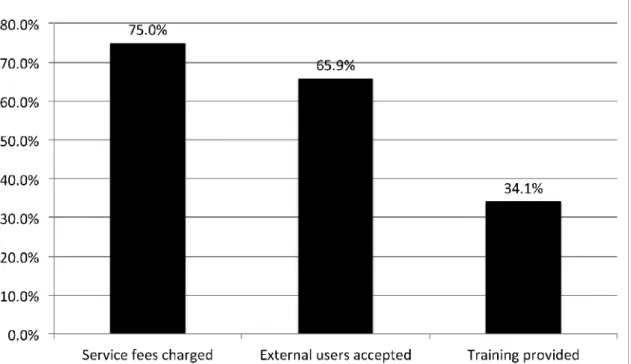
Relevant information on the above parameters could be found in 164 of the 200 ranked universities (Appendix A). The preferred nomenclature is “Facility” or “Core Facility”, used by 82% of the 164 institutions, but other terms are adopted by a few institutions (Figure 1). The majority of universities charge for the services provided and allow or stimulate external users, but only a third offer training to new users (Figure 2).
Figure 2: How universities run their translational research facilities. The characterization of the translational facilities of the top 200 universities ranked by The Times Higher Education World University was performed by analyzing the information provided by their web sites. Relevant information on the characteristics of their management system was collected from the 164 institutions listed in the Appendix.
4. Classification of translational research facilities
4.1 A conceptual and evolutionary framework for the classification of
translational research facilities
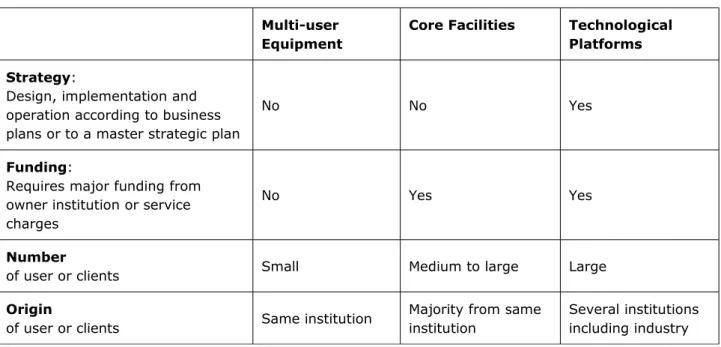
with a purpose”. It is a component of, and participates in a master strategic plan, achieving clear objectives and goals. It provides services to multiple institutions, industry participation being the norm rather than an exception.
Table I: summarizes our proposal:
Multi-user Equipment
Core Facilities Technological Platforms
Strategy:
Design, implementation and operation according to business plans or to a master strategic plan
No No Yes
Funding:
Requires major funding from owner institution or service charges
No Yes Yes
Number
of user or clients Small Medium to large Large
Origin
of user or clients Same institution
Majority from same institution
Several institutions including industry
Our analysis shows that multi-user equipment and core facilities are natural arrangements in academic institutions as their primary goal is to provide support to all ongoing research and development activities carried out by their different laboratories or departments. The nomenclatures ‘platform’ and ‘research platform’, however, are adopted by only a minority of universities (8 out of 164; 6 institutions used ‘platform’ and 2 adopted ‘research platform’) when referring to their service facilities. We found that this term was used as a synonym of core facility by five institutions while the other three applied this label to designate infrastructure arrangements that are present in technological parks where industry has a strong presence and the priorities are business based goals or on major strategic goals of the parks themselves. The University of Barcelona (UB) represents an interesting case as it runs typical core facilities at its Scientific-Technical Services (http://www.sct.ub.es) but in 1977 also created the Barcelona Science Park, structured on technology platforms that actively participate in research and development projects in collaboration with over 60 companies based at the Park (Parc Científic Barcelona; http://www.pcb.ub.es).
5. Case study: Fiocruz
5.1 Introduction
Today the institution has over 10,000 employees and health professionals and is responsible for a range of activities which include research and development; hospital and ambulatory care services; production of vaccines, drugs, reagents, and diagnostic kits; education and training of human resources; information and communication in the area of health, science and technology; quality control of products and services, and the implementation of social programs.
Fiocruz headquarters are located at the 80 hectare Manguinhos campus in the northern part of the city of Rio de Janeiro. Spread around the three historical buildings of the old Federal Serotherapy Institute - the Moorish Pavilion, the Clock Pavilion and the Mews -, are located ten of Fiocruz’s thirteen technical-scientific units and all the technical and administrative sup-port units. Other units are located around the city of Rio de Janeiro and in the cities of Belo Horizonte, Brasilia, Curitiba, Manaus, Recife and Salvador. An International Office was recently inaugurated in Maputo, Mozambique and new Units are being implemented in the States of Ceará, Mato Grosso do Sul, Piauí and Rondônia. Apart from these fixed units, Fiocruz is present all over Brazil through its support to the Brazilian Unified Health System (SUS), in its proposals on public health policy-making, its research activities, its scientific expeditions, and in the reach of its health services and products.
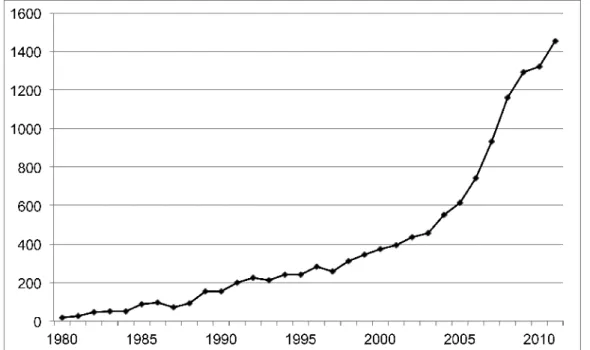
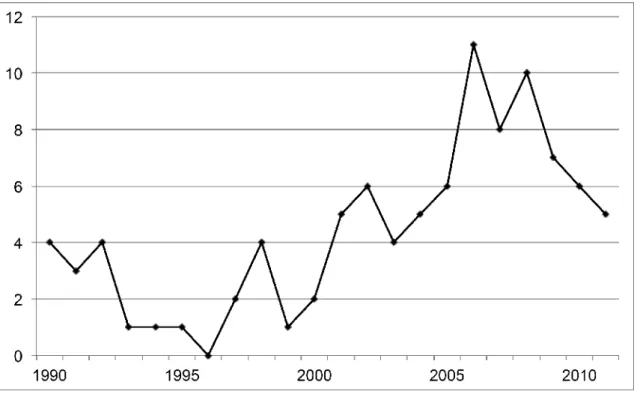
Figures 3 and 4 display the evolution of scientific and technological productivity of Fiocruz. For this purpose we used the “Portal de Periódicos Capes” (http://www.periodicos.capes. gov.br) to retrieve Fiocruz articles and patents from the ISI Web of Knowledge and Derwent Innovations Index, respectively. The dissociation between these two indicators is evident, the present research output of over 1,200 publications per year contrasting with the total of just 88 patents in 15 areas (Figure 5) listed in the Derwent database since its inception in 1963. This situation is a characteristic of developing countries that has already been appointed out by several authors (BERNARDES; ALBUQUERQUE, 2003; MOREL et al., 2007) leading to what (SAGASTI, 2004) has called the Sisyphus Challenge of the 21st Century.
retrieved the articles published by scientists working respectively at the Fiocruz Aggeu Magalhães Research Institute in Recife, and the Fiocruz Leonidas and Maria Deane Research Center in Manaus): (AD=(FIOCRUZ OR (Fundacao Oswaldo Cruz) OR (Oswaldo Cruz Foundation) OR (Fdn Oswaldo Cruz) OR INCQS OR (Inst Nacl Controle Qualidade Saude) OR (Aggeu Magalhaes) OR (Goncalo Moniz) OR (Rene Rachou) OR (Leonidas & Maria Deane) OR (Instituto Oswaldo Cruz) OR (Inst Oswaldo Cruz) OR (Oswaldo Cruz Institute) OR (Inst Pesquisas Evandro Chagas) OR (Fernandes Figueira) OR Biomanguinhos OR Bio-manguinhos OR Farmanguinhos OR Far-manguinhos) OR OG=(Deane)) AND CU=(Brazil OR Brasil).
Figure 5: Subject areas covered by Fiocruz patents. The 91 patents of Fig. 4 were retrieved from the Derwent Innovations Index and processed by the site’s “Analyze Results” module taking into account all subject areas covered by each patent.
5.2 Evolution of Fiocruz organizational strategies
The evolution of the R&D infrastructure of Fiocruz in the last three decades has been remarkable, allowing the institution to become one of the top performing Brazilian institutions in scientific productivity as well as production of public health goods such as vaccines, pharmaceuticals and diagnostic kits (http://www.fiocruz.br). The transition from the classical infrastructure arrangements of the 80s’, based on individual research laboratories, to its present day facilities where multi-user equipments, core-facilities, technological platforms and networks are the norm, started as a slow process triggered by the acquisition of a few costly pieces of equipment such as electron microscopes (FLEISCHER, 2000) and flow cytometers (COUTINHO, 2000).
The creation of peer-reviewed, internal granting programs to strengthen Fiocruz R&D capability in the 90s’ (PAPES, Programme to Support Strategic Health Research) and to stimulate innovation and technological development in the early 2000s’ (PDTIS, Programme to Support Technological Development of Public Goods for Health; PDTSP, Programme to Support Technological Development for Public Health) represented a qualitative increase in investments to address growing public health demands due to emerging and re-emerging diseases such as HIV/AIDS and dengue: in the last five years PAPES has invested 7 million US dollars and PDTIS 22 million US dollars. The research laboratories funded by these programs acquired several pieces of high cost, multi-user equipment and as the need came to share them with other research groups some of these laboratories were transformed into full-blown core-facilities providing reliable services to multiple users both inside and outside the institution.
core-facilities into a structured network with the mission of providing strategic support to health innovation and the development of new vaccines, pharmaceuticals and diagnostic kits. As of today (September 2012) 47 core facilities located in 5 States (BA, MG, PE, PR, RJ) integrate the 12 technological platforms of Fiocruz (analytical methods, bio prospecting, bioassays, bioinformatics, confocal microscopy, flow cytometry, genomics, laboratory animals, monoclonal antibodies, nanotechnology and microarrays, peptide synthesis, proteomics, real-time PCR).
The need to ensure quality management, hire and train technical staff, carry on real-time management of this geographically dispersed collection of facilities, facilitate user access and interaction with industry, has led us to develop a web-based management system to address Fiocruz actions in translational health research (http://plataformas.cdts.fiocruz.br). This management system, developed by our team in partnership with NetMaker Ltd allows: (i) registered users to reserve day and time to use equipment and facilities; get information on standard procedures and methodology adopted by the different Platforms; receive online the results of the analyses of submitted samples; (ii) facility and platforms team to post results of analytical work conducted on user samples; submit regular reports on work carried out; issue occasional alerts on equipment maintenance; inform on training courses or opportunities; (iii) Managers to supervise the whole system in real time; evaluate reports and user satisfaction surveys; (iv) policy-makers to decide on investment needs and requests; discuss strategic plans, objectives and goals; (v) external partners to access general information on Fiocruz facilities and services (SOUZA, 2012).
In 2004 the Brazilian Innovation Law was approved by Congress and promulgated by President Luiz Inácio Lula da Silva. This law, possibly the first in Latin America to be national in scope and to cover a range of scientific fields (MASSARANI, 2006), provides the legal framework to allow and stimulate interactions and collaborations between the public and private sectors. This key legal instrument, compared by many to the Bayh-Dole Act in the US, was followed by a number of policies and regulations put in place to strengthen Brazil’s science and innovation potential, particularly by linking up actors in the innovation system and stimulating private sector investment (BOUND, 2008): The Good Law (2005), the Programme of Accelerated Growth in Science, Technology and Innovation (“PAC da Ciência”) (November 2007) and the Productive Development Policy (PDP) (May 2008). This radical change in the legal framework of the country allowed Fiocruz to launch one of its most ambitious challenges: the construction
Table II: summarizes the major steps taken by Fiocruz to build up and manage its facilities for translational health research.:
Arrangement Major steps at Fiocruz
Multi-user Equipments
1970’s: Electron microscopes installed at the Manguinhos campus in collaboration with the Bernhard Nocht Institute in Hamburg (FLEISCHER, 2000) and used by several researchers of the institution
Core Facilities
1980’s: Fiocruz acquires and installs the first flow cytometer in Latin America to be used by its own researchers and also by collaborators or users from the Federal University of Rio de Janeiro (UFRJ) and other institutions (COUTINHO, 2000) 1990’s: Fiocruz launches the Program to Support Strategic Health Research (PAPES); several laboratories acquire multi-user equipments and transform themselves into core-facilities
Technological Platforms
2000’s: In order to speed up the development of vaccines, pharmaceuticals and diagnostic kits Fiocruz launches the Programme to Support Technological Development of Public Goods for Health (PDTSP) and the Program for the Technological Development of Health Products (PDTIS). Forty core facilities are supported and strengthened and are the beginning of a network of 12 technological platforms spread along several States of Brazil
Technological Agglomeration
2010’s: In order to profit from Brazil’s Innovation Law of 2004 and complementary policies and regulations put in place to strengthen Brazil’s science and innovation potential and foster collaboration with the industrial sector (BOUND, 2008), Fiocruz launches its 20,000 m2 Center for Technological Development in Health (CDTS) in Rio de Janeiro which will work in close collaboration with industry and the network of technological platforms of the PDTIS/PDTSP Programmes. The facilities and platforms of this technological agglomeration are managed on line by a web-based system located at the CDTS server
6 Discussion
“The world would no doubt be a nicer place if the North-South gap disappeared. But it appears unlikely to go away anytime soon.” (REUVENY; THOMPSON, 2008). Sharing research facilities is commonplace in several areas of science and technology and became an important issue in the biological and biomedical sciences with the advent of modern biotechnology. As noted by (PEERBAYE; MANGEMATIN, 2005), since the development of genomics and tools for ‘mass gene and protein exploration’, instrumentation has become more and more resource consuming, making sharing research facilities a growing issue and a means to transfer technology.
Our analysis on how the best universities organize, share and manage their research facilities, and our study on the evolution of these arrangements during the last decades in a leading Brazilian biomedical institution, allowed us to propose a typology of increasingly complex, prototype R&D organizational structures: Multi-user equipments, core-facilities and technological platforms.
strategic management. Transforming a piece of multi-user equipment into a core-facility, for example, requires hiring and training new technical staff in quality management; moving from core-facilities to technological platforms requires profound cultural changes, as it means moving from “first-in, first-out” user attendance to deciding who, or which project, has strategic priority or rights to be served by the platforms. Incomplete or wrong perception about the nature and mission of each type of shared infrastructure arrangement can lead to the implementation of inadequate facilities, user dissatisfaction and institutional conflicts. This is particularly relevant in those sciences or institutions where shared facilities or purpose-driven technological platforms are a relatively new phenomenon and researchers have been educated in more classical ways of operation and are used to work in traditional research laboratories.
The Fiocruz case study illustrates well these issues. Brazil’s new legal framework inaugurated by the 2004 Innovation Law and followed by complementary policies and regulations (BOUND, 2008) stimulated Fiocruz to discuss, define and build a network of bona-fide techno-logical platforms to support the PDTIS and PDTSP programmes, particularly in their interactions with external users including industry. This decision represented an immense management challenge: It required organizing core facilities and upgrading selected ones to technological platforms in several cities in Brazil; adopting new policies for user access; continuously monitoring operations in order to ensure quality; training staff in complex technologies, good laboratory practices (GLP guidelines), management of contracts, business plans and intellectual property. This process has required a strategically planned, profound, and still ongoing, change in the R&D and innovation culture of Fiocruz, a “path finder” organization according to the criteria of Salles-Filho and Bonacelli (2010) and therefore used to promote organizational changes and provide effective response to both internal and external challenges. The web-based system we developed and implemented to manage Fiocruz core facilities and technological platforms represented a key step and a turning point in this process, as it allowed continuous, interactive contact among all interested parties - decision-makers, managers, technical staff, clients and end users.
Partnerships between public institutions and the industrial sector are a critical component of modern biotechnology as they require innovative management and substantial investments in human resources, laboratory facilities and infrastructure. The typology proposed in this article is both a product and a driver of the long-term strategy of Fiocruz on translational health research. Transitioning from its infrastructure of the 1970s’, which was based on multi-user equipments, all the way to the technological agglomeration of the 2010s’ (Table II) was a long process that required critical strategic decisions and profound managerial and cultural changes. The proposed typology and this experience of a developing country institution may prove useful for organizations facing similar transitions and challenges in other countries and regions.
Acknowledgements
Estado" to CMM) and the Oswaldo Cruz Foundation (Fiocruz). R. A. Souza was supported by a post-doctoral fellowship from CAPES. The funders had no role in study design, data collection and analysis, decision to publish, or preparation of the manuscript.
References
ALBUQUERQUE, E. M.; CASSIOLATO, J. E. As especificidades do sistema de inovação do setor saúde. Revista de Economia Política, v. 22, n. 4, p. 134–151, Oct.-Dec. 2002.
ATKINSON, R.; BLANPIED, W. Research universities: core of the US science and technology system. Technology in Society, v. 30, n. 1, p. 30–48, Jan. 2008. Available at: <http://dx.doi.org/10.1016/j.techsoc.2007.10.004>. Accessed on: 24 May 2012.
BABA, Y.; SHICHIJO, N.; SEDITA, S. R. How do collaborations with universities affect firms’ innovative performance? The role of “Pasteur scientists” in the advanced materials field. Research Policy, v. 38, n. 5, p. 756–764, June 2009. Available at:
<http://www.sciencedirect.com/science/article/B6V77-4VRWNFM-1/2/f2d0ec0ec188d103fbfc577f8e017e23>. Accessed on: 24 May 2012.
BARABASI, A. Network theory the emergence of the creative enterprise. Science, v. 308, n. 5722, p. 639–641, Apr. 2005. Available at: <http://www.sciencemag.org>. Accessed on: 24 May 2012.
BERNARDES, A. T.; ALBUQUERQUE, E. D. Crossover, thresholds, and interactions, between science and technology: lessons for less-developed countries. Research Policy, v. 32, n. 5, p. 865–885, May 2003. Available at: <http://dx.doi.org/doi%3A10.1016%2FS0048-7333%2802%2900089-6%20>. Accessed on: 24 May 2012.
BOUND, K. Brazil: the natural knowledge economy. London: Demos, 2008. Available at: <http://www.demos.co.uk/publications/brazil>. Accessed on: 24 May 2012.
BUSH, V. Science, the Endless Frontier: a report to the President. Washington, DC: U.S. Government Printing Office, 1945. Available at:<http://www.nsf.gov/od/lpa/nsf50/vbush1945.htm>. Accessed on: 24 May 2012.
BUTLER, D. Lost in translation. Nature Publishing Group, v. 449, n. 7159, p. 158–159, Sept. 2007. Available at: <http://dx.doi.org/10.1038%2F449158a>. Accessed on: 24 May 2012.
BUTLER, D. Translational research: crossing the valley of death. Nature, v. 453, n. 7197, p. 840–842, June 2008. Available at: <http://dx.doi.org/10.1038/453840a>. Accessed on: 24 May 2012.
BUTLER, M.; WILLIAMS, H. P. Fairness versus efficiency in charging for the use of common facilities. Journal of the Operational Research Society, v. 53, n. 12, p. 1324–1329, 2002. Available at: <http://www.palgrave-journals.com/jors/journal/v53/n12/abs/2601456a.html>. Accessed on: 24 May 2012.
CASTELLS, M; HALL, P. Technopoles of the World: the making of 21th. Century industrial complexes. London: Routledge, 1994.
CHAGAS, C. R. J. Nova tripanozomiaze humana: estudos sobre a morfolojia e o ciclo evolutivo do Schizotrypanum cruzi n. gen., n. sp., ajente etiolojico de nova entidade morbida do homem. Memorias do Instituto Oswaldo Cruz, v. 1, n. 2, p. 159–218, 1909.
CHATAWAY, J. et al. Global health social technologies: Reflections on evolving theories and landscapes. Research Policy, v. 39, n. 10, p. 1277–1288, Dec. 2010. Available
at:<http://www.sciencedirect.com/science/article/B6V77-50T947H-1/2/355627791caaf39a2f3ce78018c072c0>. Accessed on: 24 May 2012.
CHAVES, C. V.; MORO, S. Investigating the interaction and mutual dependence between science and technology. Research Policy, v. 36, n. 8, p. 1204–1220, Oct. 2007. Available at:<http://dx.doi.org/10.1016%2Fj.respol.2007.04.007>. Accessed on: 24 May 2012.
COSTA, E. A.; MOREL, C. M.; BUSS, P. M. Centro de Desenvolvimento Tecnológico em Saúde (CDTS): um instrumento da Fiocruz para avanço tecnológico do Brasil. In: BUSS, P. M.; TEMPORÃO, J. G.; CARVALHEIRO, J. R. (Ed.). Vacinas, soros e imunizações no Brasil. Rio de Janeiro: Editora Fiocruz, 2005. p. 305–322.
COUTINHO, S. G. The beginning and expansion of flow cytometry in brazil. Memórias do Instituto Oswaldo Cruz, v. 95, n. 3, p. 435–436, June 2000. Available at:<http://www.ncbi.nlm.nih.gov/pubmed/10970201>. Accessed on: 24 May 2012.
DI MASI, J. A.; HANSEN, R. W.; GRABOWSKI, H. G. The price of innovation: new estimates of drug development costs. Journal of Health Economics, v. 22, n. 2, p. 151–185, Mar. 2003. Available at:<http://www.ncbi.nlm.nih.gov/pubmed/12606142>. Accessed on: 24 May 2012.
ETZKOWITZ, H. The Triple Helix: industry, university, and government in innovation. [S.l.]: Routledge, 2008.
FLEISCHER, B. The Bernhard Nocht institute: 100 years of tropical medicine in Hamburg. Memórias do Instituto Oswaldo Cruz, v. 95, p. 17–23, 2000.
GADELHA, C. A. G. Development, health-industrial complex and industrial policy. Revista de Saúde Pública, v. 40 (Special issue), p. 11–23, 2006.
GARDNER, C. A.; ACHARYA, T.; YACH, D. Technological and social innovation: a unifying new paradigm for global health. Health Affairs, v. 26, n. 4, p. 1052–1061, July 2007. Available at:<http://dx.doi.org/10.1377%2Fhlthaff.26.4.1052>. Accessed on: 24 May 2012.
GELIJNS, A.; ROSENBERG, N. The changing nature of medical technology development In: GELIJNS, A. C.; ROSENBERG, N.; DAWKINS, H. Sources of medical technology: universities and industry. P. 3-14. (Medical Innovation at the Crossroads, v.5).
GUIMERA, R. et al. Team assembly mechanisms determine collaboration network structure and team performance. Science, v. 308, n. 5722, p. 697–702, April 2005. Available at:<http://dx.doi.org/10.1126%2Fscience.1106340>. Accessed on: 24 May 2012.
HECHT, R.; WILSON, P.; PALRIWALA, A. Improving health R&D financing for developing countries: A menu of innovative policy options. Health Affairs, v. 28, n. 4, p. 974–985, July 2009. Available at: <http://content.healthaffairs.org/cgi/content/abstract/28/4/974>.
HOTEZ, P. J.; PECOUL, B. “Manifesto” for advancing the control and elimination of neglected tropical diseases. PLoS Neglected Tropical Diseases, v. 4, n. 5, p. e718, 2010. Available at :< http://www.ncbi.nlm.nih.gov/pubmed/20520793>. Accessed on: 24 May 2012.
JASSAL, M.; BISHAI, W. R. Extensively drug-resistant tuberculosis. The Lancet Infectious
Diseases, v. 9, n. 1, p. 19–30, 2009. Available at:
<http://www.ncbi.nlm.nih.gov/pubmed/18990610>. Accessed on: 24 May 2012.
KAITIN, K. I. Deconstructing the drug development process: the new face of innovation. Clinical Pharmacology and Therapeutics, v. 87, p. 356–361, Mar. 2010. Available at: <http://dx.doi.org/10.1038/clpt.2009.293>. Accessed on: 24 May 2012.
KESSELHEIM, A. Priority review vouchers: An inefficient and dangerous way to promote Neglected-Disease drug development. Clinical Pharmacology and Therapeutics, v. 85, n. 6, p. 573–575, May 2009. Available at:<http://dx.doi.org/10.1038/clpt.2009.50>.
LASTRES H. M.; CASSIOLATO, J. E.; ARROIO, A. Conhecimento, sistemas de inovação e desenvolvimento. Rio de Janeiro: Editora UFRJ/Contraponto, 2005. (Coleção Economia e Sociedade).
LIESE, B.; ROSENBERG, M.; SCHRATZ, A. Programmes, partnerships, and governance for elimination and control of neglected tropical diseases. Lancet, v. 375, n. 9708, p. 67–76, 2010. Available at:<http://www.ncbi.nlm.nih.gov/pubmed/20109865>. Accessed on: 24 May 2012.
LUNDVALL, B-A. (Ed.). National systems of innovation: towards a theory of innovation and interactive learning. London: Pinter, 1992.
MAHONEY, R. T. et al. The introduction of new vaccines into developing countries IV: Global access strategies. Vaccine, v. 25, n. 20, p. 4003–4011, May 2007. Available at: <http://dx.doi.org/10.1016%2Fj.vaccine.2007.02.047>. Accessed on: 24 May 2012.
MAHONEY, R. T.; MOREL, C. M. A global health innovation system (GHIS).In: GLOBAL FORUM UPDATE ON RESEARCH FOR HEALTH. Combating disease and promoting health: v.3. London: Pro-Brook Publishing, 2006. p. 149–156.
MAHONEY, R. T.; MOREL, C. M. A global health innovation system (GHIS). Innovation Strategy Today, v. 2, n. 1, p. 1–12, 2006.
MASSARANI, L. Brazil’s innovation law: lessons for Latin America. Aug. 2006. Available
MAYER, L. Laboratory core service and support facilities. In: MAYER, L.; MAYER, J. E. Design and planning of research and clinical laboratory facilities. New York: John Wiley and Sons, 1995. p. 187–197.
MÉDECINS SANS FRONTIÈRES ACCESS TO ESSENTIAL MEDICINES CAMPAIGN AND THE DRUGS FOR NEGLECTED DISEASES WORKING GROUP. Fatal Imbalance: the Crisis in research and development for drugs for neglected diseases. MSF Access to Essential Medicines Campaign. Geneva, 2001.
MORAN, M. et al. Neglected disease research and development: how much are we really spending? PLoS Medicine, v. 6, n. 2, p. e1000030, Fev. 2009.
MOREL, C. et al. Health innovation in developing countries to address diseases of the poor. Innovation Strategy Today, v. 1, p. 1–15, 2005. Available at: <http://www.biodevelopments.org/innovation/ist1.pdf>. Accessed on: 24 May 2012.
MOREL, C. M. Neglected diseases: under-funded research and inadequate health interventions. Can we change this reality? EMBO Reports, v. 4 (Spec No), p. S35–S38, June 2003. Available at: <http://dx.doi.org/10.1038%2Fsj.embor.embor851>. Accessed on: 24 May 2012.
MOREL, C. M. Innovation in health and neglected diseases. Cadernos de Saúde Pública, v.
22, n. 8, p. 1522–1523, Aug. 2006. Available at:
<http://view.ncbi.nlm.nih.gov/pubmed/16832524>. Accessed on: 24 May 2012.
MOREL, C. M. et al. Health innovation networks to help developing countries address neglected diseases. Science, v. 309, n. 5733, p. 401–404, July 2005. Available at: <http://dx.doi.org/10.1126%2Fscience.1115538>. Accessed on: 24 May 2012.
MOREL, C. M. et al. The road to recovery. Nature Publishing Group, v. 449, n. 7159, p.
180–182, Sept. 2007. ISSN 0028-0836. Available at:
<http://dx.doi.org/10.1038%2F449180a>. Accessed on: 24 May 2012.
NARIN, F.; HAMILTON, K. S.; OLIVASTRO, D. The increasing linkage between U.S. technology and public science. Research Policy, v. 26, p. 317–330, 1997.
NELSON, R. R. National Innovation Systems: a comparative analysis.Oxford: Oxford University Press, 1993. Available at:<http://www.amazon.ca/exec/obidos/redirect? tag=citeulike09-20&path=ASIN/0195076176>. Accessed on: 24 May 2012.
NELSON, R. R. The intertwining of public and proprietary in medical technology. In: ROSENBERG, N;. GELIJNS, A. C.; DAWKINS, H. Sources of medical technology: universities and industry. Washington, D.C: National Academies Press, 1995. p. 219–222.
(Medical innovation at the crossroads, 4). Available at:<http://www.nap.edu/openbook.php? record_id=4819&page=R1>. Accessed on: 24 May 2012.
PAOLI, P. D. Institutional shared resources and translational cancer research. Journal of Translational Medicine, v. 7, n. 1, p. 54, 2009. Available at:<http://www.translational-medicine.com/content/7/1/54>. Accessed on: 24 May 2012.
PAVITT, K. What makes basic research economically useful? Research Policy, v. 20, p. 109– 119, 1991.
PEERBAYE, A. La Construction de l’espace génomique en France: la place des dispositifs instrumentaux. 2004. Thèse (doctorat en sociologie) — École Normale Supérieure de Cachan, Groupe d’Analyse des Politiques Publiques, Cachan Cedex (France), 2004.
PEERBAYE, A.; MANGEMATIN, V. Sharing research facilities: towards a new mode of technology transfer? Innovation: management, policy & practice, v. 7, p. 23–38, June 2005. Available at: <http://www.atypon-link.com/EMP/doi/abs/10.5555/impp.2005.7.1.23>. Accessed on: 24 May 2012.
PORTER, M. E.; STERN, S. Innovation: Location matters. MIT Sloan Management Review, v. 42, p. 28–36, 2001.
REUVENY, R.; THOMPSON, W. R. Uneven economic growth and the world economy’s North-South stratification. International Studies Quarterly, v. 52, n. 3, p. 579–605, 2008. Available at: <http://dx.doi.org/10.1111/j.1468-2478.2008.00516.x>. Accessed on: 24 May 2012.
RIDLEY, D. B.; GRABOWSKI, H. G.; MOE, J. L. Developing drugs for developing countries. Health Affairs, v. 25, n. 2, p. 313–324, Mar. 2006. Available at: <http://content.healthaffairs.org/cgi/content/abstract/25/2/313>. Accessed on: 24 May 2012.
ROBINSON, D. K.; RIP, A.; MANGEMATIN, V. Technological agglomeration and the emergence of clusters and networks in nanotechnology. Research Policy, v. 36, n. 6, p. 871–879, July 2007.Available at: <http://www.sciencedirect.com/science/article/B6V77-4N977F3-2/2/6425ce3765eacc6f3980e55c0b95e25b>. Accessed on: 24 May 2012.
SAGASTI, F. Knowledge and Innovation for Development: the Sisyphus Challenge of the 21st Century. Chiltenham, U.K.: Edward Elgar Publishers, 2004. Available at:
<http://www.amazon.ca/exec/obidos/redirect?tag=citeulike09-20&path=ASIN/1843766531>. Accessed on: 24 May 2012.
SALLES-FILHO, S.; BONACELLI, M. B. M. Trends in the organization of public research organizations: lessons from the Brazilian case. Science and Public Policy, v. 37, n. 3, p. 193–204, 2010.
SOUZA R.A., DOCENA, C., SILVA, P. S., SILVA, A. B. M., BRUM, A. P. O. Implementation of Good Laboratory Practices (NIT-DICLA-035, Inmetro) in a technological platforms network: the Fiocruz experience. Accredittation and Quality Assurance, v. 17 (3), p.331-339, Jun 2012.
STEPAN, N. Beginnings of Brazilian Science. New York: Science History Publications, 1976.
TOKER, U.; GRAY, D. O. Innovation spaces: Workspace planning and innovation in U.S. university research centers. Research Policy, v. 37, p. 309–329, Mar. 2008. Available at:
<http://www.sciencedirect.com/science/article/B6V77-4RFD67R-1/2/a00871439cd1a378ab9542200be79881>. Accessed on: 24 May 2012.
TO THWART disease, apply now (editorial). Nature, v. 453, p. 823, jun. 2008. Available at: <http://dx.doi.org/10.1038/453823a>. Accessed on: 24 May 2012.
TROUILLER, P. et al. Drug development for neglected diseases: a deficient market and a public-health policy failure. Lancet, v. 359, n. 9324, p. 2188–2194, June 2002. Available at: <http://view.ncbi.nlm.nih.gov/pubmed/12090998>. Accessed on: 24 May 2012.
VANDERELST, D.; SPEYBROECK, N. Quantifying the lack of scientific interest in neglected tropical diseases. PLoS Neglected Tropical Diseases, v. 4, n. 1, p. e576, 2010. Available at:<http://dx.doi.org/10.1371/journal.pntd.0000576>. Accessed on: 24 May 2012.
WHO COMMISSION ON MACROECONOMICS AND HEALTH. Macroeconomics and health: investing in health for economic development. Report of the Commission on Macroeconomics
and Health. Geneva: WHO, 2001. Available at:
<http://whqlibdoc.who.int/publications/2001/924154550x.pdf>. Accessed on: 24 May 2012.
WINDRUM, P.; GARCÍA-GOÑI, M. A neo-Schumpeterian model of health services innovation. Research Policy, v. 37, n. 4, p. 649–672, May 2008. Available
at:<http://www.sciencedirect.com/science/article/B6V77-4S1BWX6-1/2/79a6e0827320d716f29b9166bfa96533>. Accessed on: 24 May 2012.
YOUTIE, J.; SHAPIRA, P. Building an innovation hub: a case study of the transformation of university roles in regional technological and economic development. Research Policy, v. 37,
n. 8, p. 1188–1204, Sept. 2008. Available at:
<http://www.sciencedirect.com/science/article/B6V77-4SNPPXK-2/2/80cd839a824ff594e197641028769d56>. Accessed on: 24 May 2012.