147
WITH EXTRACORPOREAL URETERO-URETERAL ANASTOMOSIS FOR TREATING International Braz J Urol
Official Journal of the Brazilian Society of Urology
Vol. 31 (2): 147-150, March - April, 2005
RETROPERITONEOSCOPIC SURGERY WITH EXTRACORPOREAL
URETERO-URETERAL ANASTOMOSIS FOR TREATING RETROCAVAL
URETER
M. TOBIAS-MACHADO, MARCO T. LASMAR, ERIC R. WROCLAWSKI
Department of Urology, ABC Medical School, Santo André, Sao Paulo, Brazil
ABSTRACT
We present a case of retrocaval ureter featuring laparoscopic technique treatment using extraperitoneal access and extracorporeal suture of the ureteral stumps. Surgical time was 130 min-utes, and the anastomosis was performed in 40 minutes. There were no intra- or postoperative compli-cations, and the patient was discharged from hospital on the second postoperative day. The medium-term outcome featured similar results to pure laparoscopic technique.
We conclude that this technical variation for treatment of retrocaval ureter makes the proce-dure easier and provides a drastic reduction in surgical time, without compromising the minimally invasive aspect of this kind of approach.
Key words: ureter; urogenital abnormalities; vena cava, inferior; laparoscopy Int Braz J Urol. 2005; 31: 147-50
INTRODUCTION
Retrocaval ureter is a rare congenital entity that ultimately results in a developmental abnormal-ity of the vena cava inferior, located postero-laterally to the ureter.
Though it is a congenital pathology, symp-toms usually arise during the 3rd or 4th decade of life and result from the compressive effect exerted by the vena cava on the ureter with consequent proximal uretero-hydronephrosis. Diagnosis can be suggested through excretory urography and confirmed through helical computerized tomography.
The treatment is surgical and is always sug-gested in symptomatic cases and/or when signs of renal obstruction are verified. Currently, laparoscopic surgery has been employed as the minimally inva-sive therapeutic option. Our objective was to present a new technical approach that uses laparoscopic sur-gery with extraperitoneal suture as a strategy for re-ducing surgical time.
CASE REPORT – SURGICAL TECHNIQUE
A 24-year old woman complained on recur-ring lumbar colic pain associated with repeated epi-sodes of acute pyelonephritis on the same side. Labo-ratory tests showed preserved renal function.
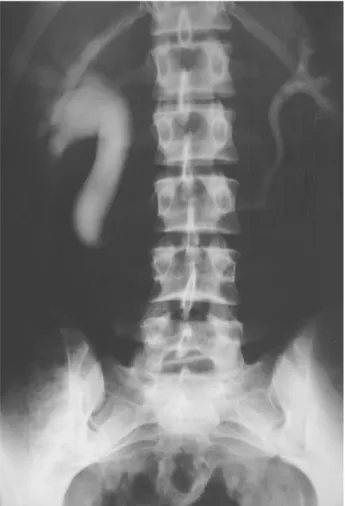
The ultrasound revealed moderate dilation of the pyelocaliceal system in the right kidney. The ex-cretory urography showed a J-shaped proximal ure-ter, suggesting retrocaval ureter (Figure-1). Helical tomography confirmed this diagnosis.
Due to the clinical picture and findings of complimentary tests, we decided for surgical treat-ment. We used the standard extraperitoneal laparoscopic access through 3 ports (Figure-2).
We dissected the entire proximal ureter and released the lower renal pole, and then dissected the distal ureter up to the point of maximum visualiza-tion in the interaortocaval posivisualiza-tion, while preserving the periureteral fat. The ureter was identified and brought to the extremity of the trocar positioned at
148
WITH EXTRACORPOREAL URETERO-URETERAL ANASTOMOSIS FOR TREATING
the extremity of the 12th rib, while observing which would be the point with the least tension for exterior-ization. The ureter was sectioned at this site. The ure-teral stumps were exteriorized through the incision of the 12-mm port after enlarging the skin incision to 20 mm. The proximal and distal ureteral margins were resected and a good vascularization was observed. We performed a continuous spatulate suture on the posterior aspect of the ureter using monocryl 4-0. A double-J catheter was then inserted. The anterior ure-ter was sutured like the posure-terior aspect. The ureure-ter was repositioned at its usual location (Figure-3) and a Penrose was inserted for drainage. Total surgical time was 130 minutes, 40 minutes of which were employed for the anastomosis. Estimated bleeding was 50 mL and there were no intraoperative compli-cations. The patient was discharged from hospital on
the 2nd postoperative day with no intercurrence. The double-J catheter was maintained for 6 weeks, and the patient remained asymptomatic following re-moval. A control urography performed 3 months af-ter surgery showed good drainage of the ureaf-ter with correction of the anatomic abnormality (Figure-4).
COMMENTS
The classical treatment for retrocaval ureter consists of separating the ureter, re-anastomosing its stumps and replacing the ureter in its usual position while maintaining its irrigation.
Figure 1 – Excretory urography showing proximal
uretero-hy-dronephrosis and typical “J” configuration of retrocaval ureter.
Figure 2 – Configuration of ports used during surgery. A first
149
WITH EXTRACORPOREAL URETERO-URETERAL ANASTOMOSIS FOR TREATING
The transperitoneal laparoscopic surgical re-pair for retrocaval ureter was first described by Baba et al. in 1994 (1). Comparisons between previous work using a laparoscopic approach and historical reports on open surgery for treatment of retrocaval have shown the advantages of minimally invasive access, specifically a shorter hospital stay, reduced postop-erative pain, early return to daily activities and a re-markably superior esthetic effect while maintaining efficacy (2,3).
The main limiting factor for laparoscopic treatment of this pathology has been the intracorporeal anastomosis of the ureter, which considerably in-creases surgical time (1-3), Table-1.
The majority of reports have used a transperitoneal access. In 1999, Salomon et al. de-scribed the feasibility of the surgical repair of
retro-Figure 3 – Retroperitoneoscopic aspect of the re-anastomosed
ureter (between yellow lines) (U - ureter; PM – psoas muscle).
Figure 4 – Excretory urography performed after reconstruction
showing good drainage of the ureter (thick arrow = pre-anasto-mosis; thin arrow = post-anastomosis).
caval ureter through laparoscopic access using the retroperitoneal approach (3).
150
WITH EXTRACORPOREAL URETERO-URETERAL ANASTOMOSIS FOR TREATING
Table 1 – Case reports in the literature using laparoscopic technique for surgical repair of retrocaval ureter.
Author
Baba, 1994 Matsuda, 1996 Polascik, 1998 Salomon, 1999 Ameda, 2001
Present study, 2004
N. of Cases
1 1 1 1 2
1
Access
Transperitoneal Transperitoneal Transperitoneal Retroperitoneal Transperitoneal Retroperitoneal
Retroperitoneal
Ports
5 5 3 4 4 4
3
Surgical Time
9h 20 m 7h 30 m 3h 45 m 4h 30 m 7h 30 m 6h 40 m
2h 10 m
Anastomosis Time
2h 30 m
-40 m
success using this technical variation. The long-term postoperative result shows an effectiveness that is similar to the pure laparoscopic technique. Surgical time was the lowest posted in the literature so far.
The authors acknowledge Dr. Pedro Forseto Jr. and Dr. Marcelo M. Gava for patient assistance and cooperation in the conduction of this project.
REFERENCES
1. Baba S, Oya M, Miyahara M, Deguchi N, Tazaki H: Laparoscopic surgical correction of circumcaval ure-ter. Urology. 1994; 44: 122-6.
2. Matsuda T, Yasumoto R, Tsujino T: Laparoscopic treat-ment of a retrocaval ureter. Eur Urol. 1996; 29: 115-8. 3. Salomon L, Hoznek A, Balian C, Gasman D, Chopin DK, Abbou CC: Retroperitoneal laparoscopy of a ret-rocaval ureter. BJU Int. 1999; 84: 181-2.
Received: September 17, 2004 Accepted after revision: February 4, 2005
Correspondence address: Dr. Marcos Tobias-Machado Rua Graúna, 104 / 131
São Paulo, 04514-000, SP, Brazil Phone: + 55 11 288-1003