EXTRACORPOREAL SHOCK WAVE LITHOTRIPSY IN THE TREATMENT
OF RENAL PELVICALYCEAL STONES IN MORBIDLY OBESE PATIENTS
V. A. MEZENTSEV
Department of Urology, Moscow Regional Scientific Research Clinical Institute, Moscow, Russia
ABSTRACT
Introduction: Management of urolithiasis in morbidly obese patients is usually associated with higher morbidity and mortality compared to non-obese patients. In morbidly obese patients, since the kidney and stone are at a considerable distance from the skin (compared to non-obese pa-tients) difficulty may be found in positioning the patient so that the stone is situated at the focal point of the lithotripter.
Objective:To evaluate the outcomes and cost-efficiency of extracorporeal shock wave lithot-ripsy (ESWL) in the treatment of renal pelvicalyceal stones sized between 6 and 20 mm in morbidly obese patients.
Materials and Methods: Using various aids, such as mobile overtable module, extended shock pathway and abdominal compression 37 patients with body mass index more than 40 kg/m2 were treated using the Siemens Lithostar-plus third generation lithotripter. The size of renal pelvicalyceal stones was between 6 and 20 mm. Treatment costs for shock wave lithotripsy were calculated.
Results: The overall stone free rate at 3 months of 73% was achieved. The mean number of treatments per patient was 2.1. The post-lithotripsy secondary procedures rate was 5.4%. No complica-tions, such as subcapsular haematoma or acute pyelonephritis were recorded. The most effective (87% success rate) and cost-efficient treatment was in the patients with pelvic stones. The treatment of the patients with low caliceal stones was effective in 60% only. The cost of the treatment of the patients with low calyceal stones was in 1.8 times higher than in the patients with pelvic stones.
Conclusion:We conclude that ESWL with the Siemens Lithostar-plus is the most effective and cost-efficient in morbidly obese patients with pelvic stones sized between 6 and 20 mm. 87% success rate was achieved. The increased distance from the skin surface to the stone in those patients does not decrease the success rate provided the stone is positioned in the focal point or within 3 cm of it on the extended shock pathway. ESWL should not be considered as the first line of treatment in the morbidly obese patients with low caliceal stones where the stone was positioned more than 1 cm from the focal point on the extended shock pathway.
Key words: high-energy shock waves; lithotripsy; kidney calculi; obesity, morbid
Int Braz J Urol. 2005; 31: 105-10
INTRODUCTION
An improvement in the social and economic conditions in the most European countries over the last few decades and the adoption of a more sedentary lifestyle have resulted in an accompanying increase in the number of obese individuals (1). The
prevalence of stone disease is also increasing and the combination of these two factors means that more obese and morbidly obese patients are presenting to urologists for the treatment of renal stones (2).
available including ESWL (3), percutaneous neph-rolithotomy (PCNL) (2), retrograde intrarenal surgery (RIRS) (4), and in rare cases, open or laparoscopic stone surgery. ESWL has revolutionized the treatment of kidney stone disease and the majority of “simple” renal calculi (about 80 - 85%) can be treated satisfac-torily with ESWL (5).
However, several unique issues arise in the surgical arena with morbidly obese patients: these patients may exceed the weight limits of standard surgical tables and may have skin-to-organ distances that exceed the focal length of the lithotripter or length of standard endoscopic equipment.
The purpose of the study was to evaluate the outcomes and cost-efficiency of ESWL in the treat-ment of renal pelvicalyceal stones sized between 6 and 20 mm in morbidly obese patients.
MATERIALS AND METHODS
We reviewed the clinical records of all pa-tients with morbid obesity that were treated with the Siemens Lithostar Plus, third generation lithotripter by one urologist at the Moscow Regional Scientific Research Clinical Institute between 1995 and 2002. According to the World Health Organization classifi-cation patients with body mass index (BMI) more than 40 kg/m2 were classified as morbidly obese. During the study period we identified 37 cases, aged 18 - 72 years (mean age 45 years). Twenty were male and 17 were female. Patient weights ranged from 123 to 179 kg (mean 143 kg).
Renal colic was the most frequent symptom in 24 patients (64.9%). 12 patients (32.4%) complained of vague abdominal pain. 14 patients (37.8%) presented with hematuria and 4 patients (10.8%) presented with slight fever. Urinalysis and urine culture were performed in 36 patients (97.3%). 34 (91.9%) patients had intravenous urography (IVU) and all 37 had ultrasonography.
Two patients had renal surgery 4 and 7 years before ESWL. 3 patients were treated by PCNL pre-viously and ESWL was used for treatment of residual fragments. All these 3 patients had nephrostomy at the time of ESWL.
None of our patients had bilateral stones. Pelvic stones were found in 15 patients and 22 pa-tients had caliceal stones, including 11 with low cal-iceal stones. The stone size was between 6 and 20 mm ( mean 16 mm).
Coexisting medical conditions included hy-pertension, chronic obstructive airway disease/ asthma, diabetes mellitus and previous deep venous thrombosis.
Criteria for ESWL were symptomatic stone size between 6 mm and 20 mm without evidence of active urinary tract infection (UTI). Good renal func-tion was essential.
All the patients underwent ESWL with the Siemens Lithostar Plus, third generation lithotripter. All patients were treated while at the side position using an overtable module. The table was lowered (the z-axis) to its limit and was covered with the pro-tected plastic cover to ensure that the table was se-cure. The level of energy was between 5 and 7 (mean 6). The number of shock waves delivered per session were between 2800 and 3500 (mean 3300). Stones were localized by ultrasound. Seventy-eight sessions of ESWL were performed. The mean number of treat-ments per patient was 2.1.
The mobility of the overtable module helped in positioning the stone in the focal point or within 3 cm of it on the extended shock pathway. In 24 (64.9%) patients we used an abdominal compression strap to facilitate positioning of the stone within the extended shock pathway. Using the overtable ultrasound mod-ule is operator dependant. In our patients it took be-tween 3 and 15 min to locate the stones on the ex-tended shock pathway.
ESWL was performed without analgesics in 11 patients. Fifteen required non-steroidal anti-inflam-matory drugs (NSAID) and 11 had NSAID with fen-tanyl. The interval between treatment sessions was at least 5 days to allow the passage of fragmented de-bris before the next session.
used are much lower than in Western countries and hardly contribute in overall treatment expenses. The Siemens Lithostar Plus was bought in 1990. For 12 years 8244 sessions have been done. The costs of the Siemens Lithostar Plus and its maintenance was 2,700.000 DM. Taking into account the aforemen-tioned figures, the average treatment cost for the shock wave lithotripsy session was 327.5 DM or US$ 218.3.
RESULTS
All patients were treated on an outpatient basis, and 2 (5.4%) required hospitalization for post-ESWL pain. Treatment time was between 35 and 57 min. (mean 45 min).
The immediate follow-up after ESWL was by ultrasonography in all patients, followed by a plain abdominal film for patients who had radio-opaque calculi, from which the size of the residual fragments
was determined. The treatment was considered suc-cessful at 3 months of follow-up if there was no ra-diological evidence of stones on both ultrasonogra-phy and the plain film.
Patients were stratified into 3 groups accord-ing to the position of the stone in relation with the focus of shock wave, namely, within 1 cm, between 1 and 2 cm and between 2 - 3 cm. All 37 patients were available for follow-up for 3 months.
Table-1 shows the outcome of ESWL in the treatment of pelvicalyceal stones according to the stone location and the position of the stone in rela-tion to the focus of the shock wave. Tables-2 and 3 respectively show the summary of the outcome and cost of ESWL according to the position of the stone in relation to the focus of the shock waves and loca-tion of the stone in the pelvicalyceal system.
The treatment was considered successful in 27 patients (73%). The success rate was lower in
Pelvic stones Number of ESWL Success rates Low caliceal stones Number of ESWL Success rates
Upper and middle caliceal stones Number of ESWL
Success rates
3 3 3 (100%) 2 7 2 (100%) 4 6 3 (75%)
07 (00.0%)
10 (00.0%)
6 (85.7%) 4 (00.0%)
10 (00.0%)
2 (50.0%) 3 (00.0%)
8 (00.0%)
2 (75.0%)
05 (00%)
11(00%) 04 (80%) 4 (00%)
12 (00%) 02 (50%) 5 (00%)
11 (00%) 03 (60%)
Table 1 – The outcome of ESWL in the treatment of renal pelvicalyceal stones sized between 6 and 20 mm in morbidly obese patients.
Blast Path < 1 cm Blast Path 1 - 2 cm Blast Path 2 - 3 cm
Table 2 – The summary of the outcome and cost of ESWL in the treatment of pelvicalyceal stones sized between 6 - 20 mm in morbidly obese patients according to the position of the stone in relation to the focus of the shock waves (blast path).
Number of stones Number of ESWL
Number of ESWL per stone Success rates
Cost of treatment (average)
Blast Path < 1 cm Blast Path 1 - 2 cm Blast Path 2 - 3 cm
14.0 (64.3%)
34.0 (64.3%)
2.4 (64.3%)
9.0 (64.3%) US$ 524000
14 (71.4%)
28 (71.4%)
2 (71.4%)
10 (71.4%) US$ 43700
9.0 (89%)
16.0 (89%)
1.8 (89%)
8.0(89%).
the patients treated with the blast path between 2 and 3 cm than in the patients treated with the blast path less than 1 cm, 64.3% and 89% respectively (p <0.01).
The most effective (87% success rate) and cost-efficient treatment was in the patients with pel-vic stones. The treatment of the patients with low caliceal stones was effective in 60% only. The lowest success rate of the treatment (50%) was in the pa-tients with low caliceal stones where the stone was positioned more than 1 cm from the focal point on the extended shock pathway. The cost of the treat-ment of the patients with low calyceal stones was in 1.8 times higher than in the patients with pelvic stones, US$ 643 and US$ 349 respectively.
Two patients (5.4%) underwent cystoscopic stent placement for obstruction 3 and 5 days after ESWL. No complications, such as acute pyelonephri-tis, perirenal or subcapsular haematoma were recorded.
COMMENTS
Obesity and morbid obesity confer an in-creased risk of morbidity because of their associa-tion with diabetes, cardiovascular and respiratory dis-ease. These impairments will tend to increase during and after surgery, and place the patient at risk of myo-cardial ischemia and hypoxemia. Surgery in the mor-bidly obese is more likely to be complicated by thrombo-embolism, wound infection and dehiscence, and respiratory problems (6). Anesthesia and surgery may present a considerable risk for obese patients and should not be undertaken without a full understand-ing of the potential problems.
Morbidly obese patients carry a physical and psychological burden (7). Surgeons will often send obese patients away to lose weight before they will consider an operation. This is a blow to the obese patient’s self-esteem and serves to further erode the relationship between patient and surgeon. In morbidly obese patients attempts at dieting and weight reduc-tion are largely unsuccessful without inpatient treat-ment, and merely serve to compound their problems by delaying treatment for symptomatic stone disease. Morbidly obese patients with stones may not present with classic frank pain, but may present with vague complains due to ill-defined body landmarks. 12 patients in our study presented with vague abdomi-nal pain. The response to anti-inflammatory drugs for the relief of renal colic is similar in obese and non-obese patients.
Morbid obesity poses a problem to the suc-cessful treatment of kidney stones. The most signifi-cant problems in using PCNL for treatment kidney stones in obese patients is the increased risk of nephrostomy tube lose or its displacement (8). The ESWL table may not be able to support the weight of the patient and the increased distance from the skin surface to the stone may render positioning of the stone at the focus of the shock wave impossible (Table-4).
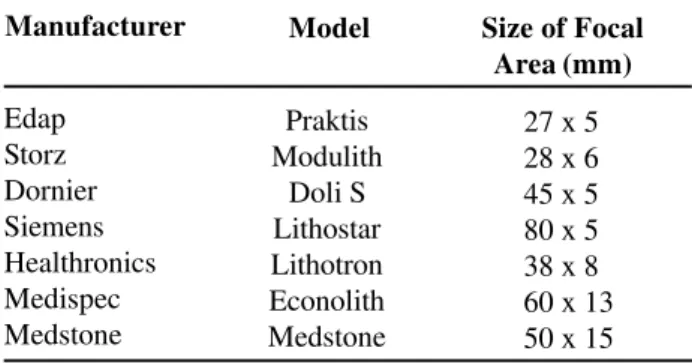
Utilization of the “blast path” (9) is neces-sary to overcome this problem. The distribution of pressure and the size of focal area of a lithotripter are essential for implementing “blast path” technique (10). The focal area is usually an ellipse. The Table-5 represents the size of focal area for different lithotripters (11).
Table 3 – The outcome and cost of ESWL in the treatment of pelvicalyceal stones sized between 6 and 20 mm in morbidly obese patients according to the position of the stone in pelvicalyceal system (summary).
Number of stones Number of ESWL
Number of ESWL per stone Success rates
Cost of treatment (average)
Pelvic Stones Low Caliceal Stones Upper and Middle Caliceal Stones
15 24
001.6
000013.(87%) US$ 34900
10.0 (00%)
29.0 (00%)
2.9 (00%)
6.0 (60%) US$ 63300
0012. 0025
As we can see from the table-5 the maximum length of focal area of the Siemens Lithostar-plus is 80 mm. This enables an operator to use “blast path” technique when a stone is located a few cm from the center of focal area. The mobility of the overtable module helped in positioning the stone in the focal point or within 3 cm of it on the extended shock path-way. We found using the overtable module more flex-ible in positioning the stone compared to the fluoro-scopic module. An operator enables to use different angles between the module and skin to localize the stone at the nearest to the focal area point. In the fluo-roscopic module the angle is fixed and, therefore, positioning of the stone is limited to the one direc-tion only.
Successful ESWL treatment in obese patients (weight range 135 - 181 kg) was reported with an overall stone free rate at 3 months of 68% (3) com-pared to 80 - 85% in non-obese patients (5). In the aforementioned study (3) higher energy settings were implemented to achieve successful stone fragmenta-tion in morbidly obese patients but no serious com-plications were recorded.
In our study the overall stone free rate of 73% was achieved. Continuous ultrasound monitoring during lithotripsy gives the accurate information of fragmentation of all types of kidney stones. That to-gether with accurate location of the stone into the nearest to the focal area point using the overtable module eliminate the importance of using higher en-ergy setting. As a result we had no complication such as subcapsular haematoma or acute pyelonephritis. Furthermore, increasing the number of treatment ses-sions allows to perform “gentle” fragmentation of stones with stone fragments 1-2 mm. The mean num-ber of treatments per patient in our study was 2.1. As a consequence only 2 (5.4%) of our patients required hospitalization for post-ESWL pain.
Using the overtable module increases secu-rity of the table. The table was lowered (the z-axis) to its limit and was covered with the protected plastic cover to ensure that the table was secure. The latter was technically impossible with the fluoroscopic module.
A higher radiation dose was previously re-ported with the markedly obese patients (43 versus 12 rad) due to radiographic technique (increased kilo voltage and milliampers per second) required to pen-etrate the larger body to obtain satisfactory radio-graphs (12). In our study we only applied ultrasound location, which eliminated the risk of radiation.
The lowest success rate was found in the pa-tients treated with the blast path between 2 and 3 cm. Nine out of 14 patients (64.3%) were treated success-fully with the aforementioned technique.
The management of stone disease is of great economic importance. In the US the cost to the tax-payer for the evaluation and management of urinary tract stone disease in 1993 was US$ 1.23 billion and a further US$ 139 million of wages were lost as a result of the disease (13). The most cost-efficient treat-ment in our study was in the patients with pelvic stones. The cost of treatment of the patients with pel-vic stones was US$ 349 compared to US$ 633 for treatment of the patients with low caliceal stones.
The success rate of the treatment of the pa-tients with low caliceal stones where the stone was positioned more than 1 cm from the focal point on the extended shock pathway was only 50%.
Table 4 – Lithotripter specification.
Table 5 – Lithotripter focal areas.
Manufacturer Model Size of Focal
Area (mm)
27 x 5 28 x 6 45 x 5 80 x 5 38 x 8 60 x 13 50 x 15 Praktis
Modulith Doli S Lithostar Lithotron Econolith Medstone Edap
Storz Dornier Siemens Healthronics Medispec Medstone
Manufacturer Model Focal Length (mm)
150 150 153 155 165 DoLiS
Lithotron STS Lithostar Modulith Dornier
CONCLUSION
We conclude that ESWL with the Siemens Lithostar-plus is the most effective and cost-efficient in obese patients with pelvic stones sized between 6 and 20 mm. 87% success rate was achieved The in-creased distance from the skin surface to the stone in those patients do not decrease the success rate pro-vided the stone is positioned in the focal point or within 3 cm of it on the extended shock pathway. ESWL should not be considered as the first line of treatment in the patients with low caliceal stones where the stone was positioned more than 1 cm from the focal point on the extended shock pathway.
REFERENCES
1. Word Health Organization. Obesity. Preventing and Managing the Global Epidemic. Geneva. World Health Organization. 1997.
2. Koo BC, Burtt G, Burgess NA: Percutaneous stone surgery in the obese: outcome stratified according to body mass index. BJU Int. 2004; 93: 1296-9. 3. Thomas R, Cass AS: Extracorporeal shock wave
lithot-ripsy in morbidly obese patients. J Urol. 1993; 150: 30-2.
4. Troy AJ, Anagnostou T, Tolley DA: Flexible upper tract endoscopy. BJU Int. 2004; 93: 671-9.
5. Peterson RF., Lifshitz DA, Kuo RL., Siqueira TM Jr, Lingeman JE: Shock wave lithotripsy monotherapy for renal calculi. Int Braz J Urol. 2002; 28: 291-301. 6. Choban PS, Flancbaum L: The impact of obesity on
surgical outcomes: a review. J Am Coll Surg. 1997; 185: 593-603.
7. Kaminsky J, Gadaleta D: A study of discrimination within the medical community as viewed by obese patients. Obes Surg. 2002; 12: 14-8.
8. Carson CC 3rd, Danneberger JE, Weinerth JL: Percu-taneous lithotripsy in morbid obesity. J Urol. 1988; 139: 243-5.
9. Whelan JP, Finlayson B, Welch J, Newman RC: The blast path: theoretical basis, experimental data and clinical application. J Urol. 1988; 140: 401-4. 10. Folberth W, Kohler G, Rohwedder A, Matura E:
Pres-sure distribution and energy flow in the focal region of two different electromagnetic shock wave sources. J Stone Dis. 1992; 4: 1-4.
11. Loske AM, Prieto FE, Gutierrez J, Zendejas H, Saita A, Velez Gomez E: Evaluation of a bifocal reflector on a clinical lithotripter. J Endourol. 2004; 18: 7-15; discussion 15-6.
12. Cass AS: Equivalence of mobile and fixed lithotriptors for upper tract stones. J Urol. 1991; 146: 290-3. 13. May DJ, Chandhoke PS: Efficacy and
cost-effective-ness of extracorporeal shock wave lithotripsy for soli-tary lower pole renal calculi. J Urol. 1998; 159: 24-7.
Received: October 18, 2004 Accepted after revision: December 5, 2004
Correspondence address:
Dr. V. A. Mezentsev 19 Old Mill View Dewsbury West Yorkshire, WF12 9QJ, UK Phone: + 44 1924 451342