Abst ract
Submitted: April 27, 2017 0RGL¿FDWLRQ-XQH Accepted: June 30, 2017
Associat ion of single nucleot ide
polym orphism s in AXI N2, BMP4,
and I RF6 w it h Non- Syndrom ic Cleft
Lip w it h or w it hout Cleft Palat e in
a sam ple of t he sout heast I ranian
populat ion
Non- syndrom ic cleft lip w it h or w it hout palat e ( NSCL/ P) is a com m on congenit al m alfor m at ion w or ldw ide, w it h com plex et iology. I t has been proposed t hat int eract ion of genes and environm ent al fact ors play a role in t he predisposit ion t o t his disease. Obj ect ives: The aim of t his st udy was t o exam ine t he associat ion bet ween AXI N2 ( axis inhibit ion prot ein 2) rs7224837, BMP4 ( bon e m or ph ogen et ic pr ot ein 4 ) r s1 7 5 6 3 , an d I RF6 ( in t er f er on regulat ory fact or 6) rs861019 and 2235371 polym orphism s and NSCL/ P in an I ranian populat ion. Mat erial and Met hods: This case- cont rol st udy was carried out on 132 unrelat ed NSCL/ P pat ient s and 156 healt hy subj ect s. The variant s w ere genot yped using polym erase chain react ion- rest rict ion IUDJPHQWOHQJWKSRO\PRUSKLVP3&55)/35HVXOWV7KH¿QGLQJVVXJJHVWWKDW %03UVSRO\PRUSKLVPVLJQL¿FDQWO\GHFUHDVHGWKHULVNRI16&/3LQ codom inant ( OR= 0.36, 95% CI = 0.17- 0.79, p= 0.012, CT vs CC and OR= 0.11, 95% CI = 0.01- 0.88, p= 0.019, TT vs CC) , dom inant ( OR= 0.30, 95% CI = 0.15-0.62, p= 0.0007, CT+ TT vs CC) , recessive ( OR= 0.12, 95% CI = 0.02- 0.99, p= 0 . 0 2 3 , TT v s CC+ CT) , ov er dom in an t ( OR= 0 . 3 9 , 9 5 % CI = 0 . 1 8 - 0 . 8 4 , p= 0.021, CT vs CC+ TT) , and allele ( OR= 0.28, 95% CI = 0.15- 0.55, p< 0.0001, 7 YV & LQKHULWDQFH PRGHOV 2XU ¿QGLQJV GLG QRW VXSSRUW DQ DVVRFLDWLRQ bet w een AXI N2 r s7224837 and I RF6 r s861019 poly m or phism and r isk / prot ect ion of NSCL/ P. The I RF6 2235371 variant was not polym orphic in our populat ion. Conclusion: The result s indicat e t hat t he BMP4 rs17563 variant is likely t o confer a prot ect ive effect against t he occurrence of NSCL/ P in a sam ple of t he sout heast I ranian populat ion.
Ke yw or ds: AXI N2. BMP4. I RF6. Non- syndrom ic cleft lip w it h or w it hout cleft palat e. NSCL/ P. Polym orphism .
Houshang RAFIGHDOOST1,2
Mohammad HASHEMI3
Hiva DANESH3
Fatemeh BIZHANI3
Gholamreza BAHARI3
Mohsen TAHERI4
http://dx.doi.org/10.1590/1678-7757-2017-0191
1Zahedan University of Medical Sciences, Cellular and Molecular Research Center, Zahedan, Iran. 2Zahedan University of Medical Sciences, School of Medicine, Department of Anatomy, Zahedan, Iran. 3Zahedan University of Medical Sciences, School of Medicine, Department of Clinical Biochemistry,
Zahedan, Iran.
4Genetic of Non-Communicable Disease Research Center, Zahedan University of Medical Sciences,
Zahedan, Iran.
I nt roduct ion
Nonsyndrom ic cleft lip w it h or w it hout cleft palat e
( NSCL/ P) is on e of t h e m ost com m on con gen it al
m alf or m at ion s am on g liv e bir t h s w or ldw ide5. Th e
prevalence of NSCL/ P is about 1.7 per 1000 live birt hs,
alt hough t his rat e is different in t erm s of geographical
p osit ion an d et h n icit y1 8, w it h h ig h er occu r r en ce
in Asian and Nat iv e Am er ican populat ions t han in
African populat ions. Alt hough t he exact et iology of
NSCL/ P is unknow n, it is proposed t hat bot h genet ic
and environm ent al fact ors play a role in t he disease’s
pat hogenesis5.
Wn t s ar e a f am ily of sign alin g m olecu les t h at
play cr it ical r oles in diver se aspect s of craniofacial
developm ent . The AXI N2 ( axis inhibit ion prot ein 2)
act s as a t um or suppressor gene in num erous cancers
m apped at hum an chrom osom e 17q23- q246. AXI N2
serves as a scaffolding com ponent of t he m ult iprot ein FRPSOH[ DQG QHJDWLYHO\ UHJXODWHV :QWǃFDWHQLQ signaling dow nst r eam pat hw ay v ia degradat ion of ǃFDWHQLQ2. I t h as b een sh ow n t h at m em b er s of
t he Wnt s gene fam ily ar e associat ed w it h cleft s in
h u m an s an d m ice1 1. Mu t at ion s or poly m or ph ism s
in AXI N2 hav e been show n t o be associat ed w it h
increased suscept ibilit y t o cancer9,10 and fam ilial t oot h
agenesis10,16.
Bone m orphogenet ic prot eins ( BMPs) are secret ed
signaling m olecules t hat belong t o t he t ransform ing
g r o w t h f a ct o r - b ( TGF- b ) su p er f a m i l y o f g r o w t h
fact ors. The bone m orphogenet ic prot ein 4 ( BMP4)
gene is locat ed at chrom osom e 14q22- 23, cont ains
four exons, and encodes t he BMP4 prot ein28, w hich
play crit ical roles in em bryonic developm ent . Anim al
m o d e l s i n d i ca t e d t h a t t h e BMP4 i s a p o t e n t i a l
can didat e gen e f or NSCL/ P1 4. Liu , et al.1 3 ( 2 0 0 5 )
r epor t ed t hat all em br y os of BMP4 k nock out in a
m ouse m odel had bilat eral CL at t he 12t h em bryonic
day, dem onst rat ing t hat t he BMP signal pat hway is
cr it ical for cell pr oliferat ion and fusion of oral and
m ax illof acial con st r u ct ion . Th e r s1 7 5 6 3 ( 5 3 8 T/ C)
funct ional polym orphism of t he BMP4 gene is show n
t o be associat ed w it h risk of NSCL/ P developm ent 7.
The int erferon regulat ory fact or 6 ( I RF6) gene is
locat ed on chrom osom e 1q32.2. I t has been show n
t hat variant s of t he I RF6 gene increased t he risk of
NSCL/ P as w ell as t oot h agenesis20,22,26.
Genet ic risk fact ors for NSCL/ P m ay be at t ribut ed
t o et h n i c an d en v i r on m en t al d i f f er en ces am on g
various populat ions. Accordingly, repeat ing previously
described genet ic associat ions in different populat ions LVUHTXLUHGWRGH¿QHWKHDVVRFLDWLRQVRIWKHJHQHWLF risk in each populat ion. Therefore, t his st udy aim ed
t o evaluat e t he possible associat ion am ong AXI N2
rs7224837, BMP4 rs17563, and I RF6 rs861019 and
2235371 polym orphism s and NSCL/ P risk in a sam ple
of t he sout heast I ranian populat ion.
Mat erials and Met hods
A t ot al of 2 8 8 subj ect s, including 1 3 2 NSCL/ P
and 1 5 6 healt hy subj ect s, w er e r ecr uit ed for t his
case- cont rol st udy. The crit eria for part icipant s w it h
NSCL/ P an d h ealt h y in d iv id u als w er e p r ev iou sly
d escr ib ed2 2 - 2 4. Th e local Et h ics Com m it t ee of t h e
Zahedan Universit y of Medical Sciences approved t he
pr oj ect ( I R. Z AUMS. Rec. 1 3 9 3 . 6 9 2 3 ) an d in f or m ed
consent form s w ere collect ed from all part icipant s ( or
t heir legal guardians) . Blood sam ples w ere collect ed
in EDTA cont aining t ubes from pat ient s and cont rols,
and t hen st ored at - 20° C. Genom ic DNA was ext ract ed
by salt ing- out m et hod.
Genot yping
Genot y ping of AXI N2, BMP4 and I RF6 var iant s
was carried out using t he polym erase chain react
ion-rest rict ion fragm ent lengt h polym orphism ( PCR- RFLP)
m et hod. The prim ers sequences and am plicon sizes
ar e sh ow n in Table 1 . PCR w as per f or m ed u sin g
com m ercially available Prim e Taq prem ix ( Genet bio,
So u t h Ko r e a ) a cco r d i n g t o t h e m a n u f a ct u r e r ’s
r eco m m en d ed p r o t o co l . I n t o each 0 . 2 0 m l PCR UHDFWLRQ WXEH NjO RI JHQRPLF '1$ a QJPO NjORIHDFKSULPHUNj0NjORI;3ULPH7DT 3UHPL[DQGNjORIGG+2ZHUHDGGHG3&5F\FOLQJ condit ions w ere init ial denat urat ion at 95° C for 5 m in
follow ed by 30 cycles for 30 s at 95° C, and annealing
t em perat ure ( Table 1) for 30 s, ext ension at 72° C for VZLWKD¿QDOH[WHQVLRQRI&IRUPLQ7KH 3&5 SURGXFWV NjO ZHUH GLJHVWHG E\ DSSURSULDWH r est r i ct i o n en zy m es ( Tab l e 1 ) an d t h e d i g est ed
product s w ere elect rophoresed on 2.5% agarose gel FRQWDLQLQJNjJP/HWKLGLXPEURPLGHDQGYLVXDOL]HG on a UV t ransillum inat or ( Figure 1) .
St at ist ical analysis
t he SPSS 22.0 soft ware. The associat ions bet w een
alleles or genot ypes and NS- CL/ P w ere assessed by FRPSXWLQJWKHRGGVUDWLR25DQGFRQ¿GHQFH i n t e r v a l s ( 9 5 % CI ) f r o m u n c o n d i t i o n a l l o g i s t i c
r egr ession analy ses. P- values less t han 0.05 w er e
FRQVLGHUHGVWDWLVWLFDOO\VLJQL¿FDQW
Polymorphism NSCL/P Control Patients OR (95%CI) P-value
n (%) n (%)
$;,1UV$!* Codominant
AA 103 (78.0) 125 (80.1) 1
-AG 25 (19.0) 26 (16.7) 1.17 (0.63-2.14) 0.643
GG 4 (3.0) 5 (3.2) 0.97 (0.25-3.71) 0.973
Dominant
AA 103 (78.0) 125 (80.1) 1
-AG+GG 29 (22.0) 31 (19.9) 1.14 (0.64-2.01) 0.665
Reccessive
AA+AG 128 (97.0) 151 (96.8) 1
GG 4 (3.0) 5 (3.2) 0.94 (0.25-3.59) 0.944
Overdominant
AA+GG 107 (81.0) 130 (83.3) 1
-AG 25 (19.0) 26 (16.7) 1.17 (0.64-2.14) 0.644
Allele
A 231 (87.5) 276 (88.4) 1
-G 33 (12.5) 36 (11.6) 1.09 (0.66-1.81) 0.797
BMP4 rs17563 Codominant
CC 121 (91.7) 120 (76.9) 1
-CT 10 (7.6) 27 (17.3) 0.36 (0.17-0.79) 0.012
TT 1 (0.7) 9 (5.8) 0.11 (0.01-0.88) 0.019
Dominant
CC 121 (91.7) 120 (76.9) 1
-CT+TT 11 (8.3) 36 (23.1) 0.30 (0.15-0.62) 0.0007
Recessive
CC+CT 131 (99.3) 147 (94.2) 1
-TT 1 (0.7) 9 (5.8) 0.12 (0.02-0.99) 0.023
Overdominant
CC+TT 122 (92.4) 129 (82.7) 1
-CT 10 (7.6) 27 (17.3) 0.39 (0.18-0.84) 0.021
Allele
C 252 (95.4) 267 (85.6) 1
-T 12 (4.6) 45 (14.4) 0.28 (0.15-0.55)
,5)UV*!$ Codominant
GG 54 (40.9) 50 (32.1) 1
-GA 63 (47.7) 86 (55.1) 0.68 (0.41-1.12) 0.157
AA 15 (11.4) 20 (12.8) 0.69 (0.32-1.50) 0.435
Dominant
GG 54 (40.9) 50 (32.1) 1
-GA+AA 78 (59.1) 106 (67.9) 0.68 (0.42-1.01) 0.139
Recessive
GG+GA 117 (88.6) 136 (87.2) 1
-AA 15 (11.4) 20 (12.8) 0.87 (0.43-1.78) 0.722
Overdominant
GG+AA 69 (52.3) 70 (44.9) 1
-GA 63 (47.7) 86 (55.1) 0.74 (0.47-1.83) 0.237
Allele
G 171 (64.8) 186 (59.6) 1
-A 93 (35.2) 126 (40.4) 0.80 (0.57-1.27) 0.228
Result s
This st udy consist ed of 132 NSCL/ P ( 78 m ales, 54
fem ales, age: 12.13± 11.68 years) and 156 healt hy
individuals ( 94 m ales, 62 fem ales, age: 11.35± 11.81
years) . Of t he 132 pat ient s, 52 had CL, 44 had CL wit h
CP ( CLP) , and 36 had CP. There w ere no st at ist ically VLJQL¿FDQWGLIIHUHQFHVEHWZHHQWKHJURXSVUHJDUGLQJ sex and age ( p= 0.904 and p= 0.575, respect ively) .
Genot ypic and allelic frequencies of AXI N2, BMP4 and
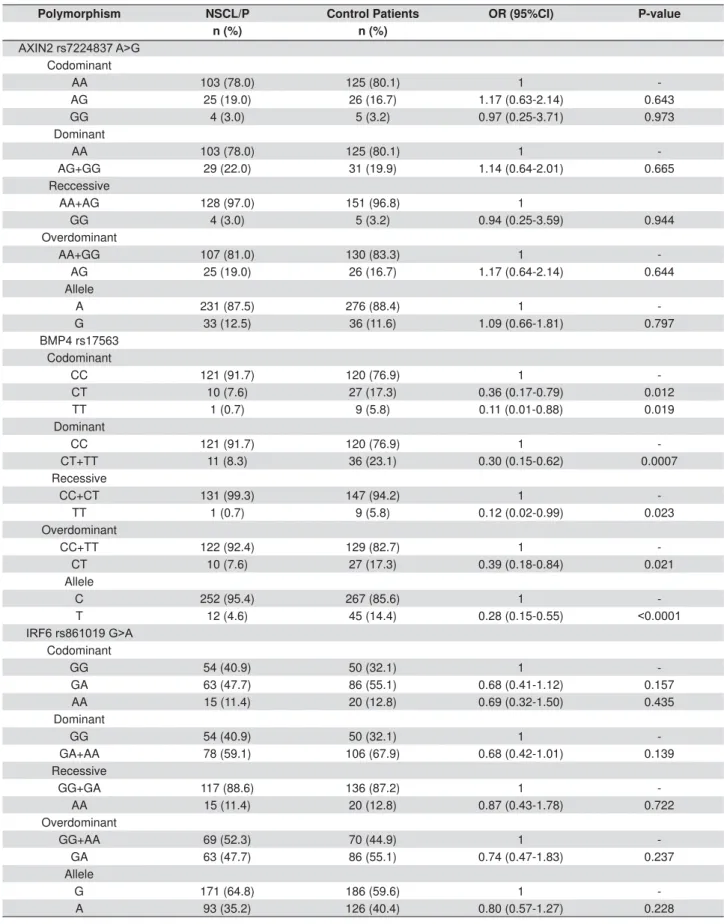
I RF6polym orphism s are show n in Table 2.
Th e f i n d i n g s r e v e a l e d t h a t B M P4 r s 1 7 5 6 3
p oly m or p h ism sig n if ican t ly d ecr eased t h e r isk of
NSCL/ P in codom inant ( OR= 0.36, 95% CI = 0.17- 0.79,
p= 0 . 0 1 2 , CT v s CC an d OR= 0 . 1 1 , 9 5 % CI = 0 . 0 1
-0 . 8 8 , p = -0 . -0 1 9 , TT v s CC) , d om in an t ( OR= -0 . 3 -0 ,
95% CI = 0.15- 0.62, p= 0.0007, CT+ TT vs CC) , recessive
( OR= 0 . 1 2 , 9 5 % CI = 0 . 0 2 - 0 . 9 9 , p = 0 . 0 2 3 , TT v s
CC+ CT) , and overdom inant ( OR= 0.39, 95% CI =
0.18-0.84, p= 0.021, CT v s CC+ TT) inher it ance m odels. 7KH7DOOHOHVLJQL¿FDQWO\GHFUHDVHGWKHULVNRI16&/3 ( OR= 0.28, 95% CI = 0.15- 0.55, p< 0.0001) , com pared
t o t he C allele.
2XU¿QGLQJVGLGQRWVXSSRUWDQDVVRFLDWLRQEHWZHHQ AXI N2 rs7224837 and I RF6 rs861019 polym orphism s
and risk/ prot ect ion of CL/ P in any inherit ance m odel
t est ed ( Table 1) . I n addit ion, The I RF6 r s2235371
variant was not polym orphic and all cases ( including
cont rols) w ere CC genot ype.
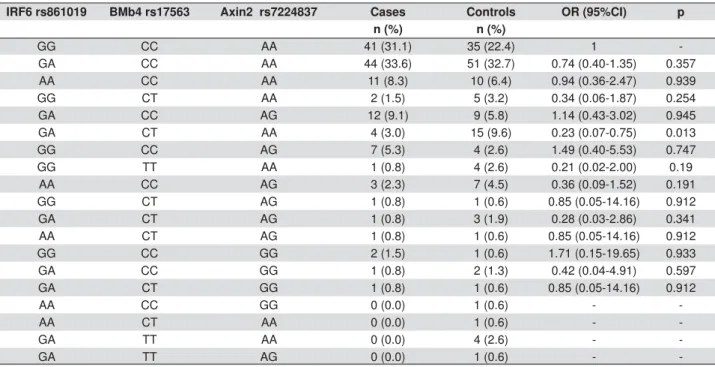
We also analyzed gene- gene int eract ion ( Table 2) .
I n com parison t o t he reference I RF6 rs861019 GG,
BMP4 r s17563 CC, AXI N2 r s7224837 CC, and t he *$&7$$JHQRW\SHVLJQL¿FDQWO\GHFUHDVHGWKHULVN of NSCL/ P ( OR= 0.23, 95% CI = 0.07- 0.75, p= 0.013) .
:HDOVRVWUDWL¿HGWKHSDWLHQWVLQWRFOHIWOLS&/ cleft lip w it h cleft palat e ( CLP) , and cleft palat e ( CP)
and assessed t he im pact of t he polym orphism s and
IRF6 rs861019 BMb4 rs17563 Axin2 rs7224837 Cases Controls OR (95%CI) p n (%) n (%)
GG CC AA 41 (31.1) 35 (22.4) 1
-GA CC AA 44 (33.6) 51 (32.7) 0.74 (0.40-1.35) 0.357
AA CC AA 11 (8.3) 10 (6.4) 0.94 (0.36-2.47) 0.939
GG CT AA 2 (1.5) 5 (3.2) 0.34 (0.06-1.87) 0.254
GA CC AG 12 (9.1) 9 (5.8) 1.14 (0.43-3.02) 0.945
GA CT AA 4 (3.0) 15 (9.6) 0.23 (0.07-0.75) 0.013
GG CC AG 7 (5.3) 4 (2.6) 1.49 (0.40-5.53) 0.747
GG TT AA 1 (0.8) 4 (2.6) 0.21 (0.02-2.00) 0.19
AA CC AG 3 (2.3) 7 (4.5) 0.36 (0.09-1.52) 0.191
GG CT AG 1 (0.8) 1 (0.6) 0.85 (0.05-14.16) 0.912
GA CT AG 1 (0.8) 3 (1.9) 0.28 (0.03-2.86) 0.341
AA CT AG 1 (0.8) 1 (0.6) 0.85 (0.05-14.16) 0.912
GG CC GG 2 (1.5) 1 (0.6) 1.71 (0.15-19.65) 0.933
GA CC GG 1 (0.8) 2 (1.3) 0.42 (0.04-4.91) 0.597
GA CT GG 1 (0.8) 1 (0.6) 0.85 (0.05-14.16) 0.912
AA CC GG 0 (0.0) 1 (0.6) -
-AA CT AA 0 (0.0) 1 (0.6) -
-GA TT AA 0 (0.0) 4 (2.6) -
-GA TT AG 0 (0.0) 1 (0.6) -
-Table 2 - Frequency distribution of genotypes combinations for the IRF6 rs861019, and BMP4 rs17563, and AXIN2 rs7224837polymorphisms between patients with nonsyndromic cleft lip and/or cleft palate (NSCL/P) and control subjects
t he risk of t he disease by com paring w it h t he cont rols 7DEOH7KH¿QGLQJVVKRZHGWKDWWKH%03UV YDULDQW ZDV VLJQL¿FDQWO\ DVVRFLDWHG ZLWK GHFUHDVH risk of CL, CLP, and CP. AXI N2 rs7224837 and I RF6
r s861019 w er e not associat ed w it h t he r isk of CL,
CLP, or CP.
Discussion
Th e d o cu m en t at i o n o f r i sk f act o r s acco r d i n g
t o et hnicit y and geographic or igin is im por t ant for
underst anding t he m aj or causes of NSCL/ P.
We have previously show n an associat ion bet w een
FGF1 r s34010, CDH1 r s16260, MSX1 r s12532 and
D H FR 1 9 - b p i n se r t i o n / d e l e t i o n p o l y m o r p h i sm s
and NSCL/ P in a sam ple of t he sout heast I ranian
populat ion22- 24. I n t his st udy, w e exam ined t he im pact
Polymorphism Controls CL OR (95%CI), p CLP OR (95%CI), p2 CP OR (95%CI), p3
(n) (n) (n) (n)
Axin2 rs7224837
AA 125 41 1 35 1 27 1
AG 26 9 1.06 (0.46-2.44), 0.953 7 0.96 (0.38-2/40), 0.911 9 1.60 (0.67-3.81), 0.341
GG 5 2 1.22 (0.23-6.53), 0.917 2 1.43 (0.27-7.68), 0.651 0
-A 276 91 1 77 1 63 1
C 36 13 1.09 (0.56-2.16), 0.861 11 1.09 (0.53-2.25), 0.851 9 1.09 (0.50-2.39), 0.839
BMP4 rs17563
CC 120 48 1 39 1 34 1
CT 27 3 0.28 (0.08-0.96), 0.040 5 0.57 (0.21-1.58), 0.360 2 0.26 (0.06-1.16), 0.074
TT 9 1 0.28 (0.03-2.54), 0.288 0 3.05 (0.06-156.4), 0.983 0 0.18 (0.01-3.24), 0.206
C 267 99 1 83 1 70 1
T 45 5 0.30 (0.12-0.78), 0.008 5 0.36 (0.14-0.93), 0.028 2 0.17 (0.04-0.72), 0.005
IRF6 rs861019
GG 50 22 1 14 1 18 1
GA 86 25 0.66 (0.34-1.29), 0.231 25 1.04 (0.49-2.18), 0.912 13 0.42 (0.19-0.93), 0.042
AA 20 5 0.57 (0.19-1.71), 0.438 5 0.89 (0.28-2.81), 0.927 5 0.69 (0.23-2.13), 0.598
G 186 69 1 53 1 49 1
A 126 35 0.75 (0.47-1.19), 0.246 35 0.98 (0.60-1.58), 0.965 23 0.69 (0.40-1.19), 0.227
Table 3- Genotype and allele frequencies of AXIN2 rs7224837, BMP4 rs17563, and IRF6 rs861019 gene polymorphisms in subjects with cleft lip (CL), cleft lip with cleft palate (CLP), and cleft palate (CP)
of AXI N2, BMP4 and I RF6polym orphism s on t he risk
of NSCL/ P. The result s suggest ed t hat BMP4 rs17563
p oly m or p h ism sig n if ican t ly d ecr eased t h e r isk of
NSCL/ P in codom in an t , dom in an t , r ecessiv e, an d DOOHOHLQKHULWDQFHPRGHOV1RVLJQL¿FDQWDVVRFLDWLRQ w as f ou n d b et w een AXI N2 r s7 2 2 4 8 3 7 an d I RF6
rs861019 variant s and risk of NSCL/ P. We observed
t hat rs2235371 polym orphism of t he I RF6 gene was
not polym or phic, and all cases ( including cont r ols)
w ere CC genot ype.
Let ra, et al.12 KDYH VKRZQ D VLJQL¿FDQW
associat ion bet w een AXI N2 r s7224837 var iant and
r isk of NSCL/ P in v ar iou s p op u lat ion s, in clu d in g
Lat in Am erica, Europe, and Asia. Most ow ska, et al.19
( 2012) have found t hat rs3923087 polym orphism was
associat ed w it h decreased risk of NSCL/ P in a Polish SRSXODWLRQ+RZHYHUWKH\GLGQRW¿QGDQDVVRFLDWLRQ b et w een r s4 0 7 4 9 4 7 , r s7 2 2 4 8 3 7 , an d r s2 2 4 0 3 0 8
variant s of AXI N2 and t he risk of t he disease. A m et
a-analysis perform ed by Wang, et al.30 ( 2012) show ed
WKDW UV YDULDQW VLJQL¿FDQWO\ GHFUHDVHG WKH r isk of NSCL/ P. Recent ly, Machado, et al.15 ( 2017)
sh ow ed t h at t h e m in or A allele of r s7 2 1 0 3 5 6 as
an d t h e T- G- G- A- G h aplot y pe f or m ed by r s7 5 9 1 ,
rs7210356, rs4791171, rs11079571, and rs3923087 SRO\PRUSKLVPVLQWKH$;,1JHQHZHUHVLJQL¿FDQWO\ associat ed w it h NSCL/ P in t he Brazilian populat ion.
Mij it i, et al.1 7 ( 2 0 1 5 ) in v est ig at ed t h e im p act
o f sev er al p o l y m o r p h i sm s o f t h e I RF6 g en e o n
NSCL/ P in Xinj iang, China. They observed t hat t he UVYDULDQWVLJQL¿FDQWO\LQFUHDVHGWKHULVNZKLOH rs2235377, rs2235371, 209968684, rs2013162, and
r s861019 var iant s w er e associat ed w it h decr eased
risk of NSCL/ P. The ot her variant s were not associat ed
w it h risk of NSCL/ P.
Several previous st udies have show n t hat BMP4
can be im plicat ed in t he developm ent of CL/ P. A m et
a-analysis perform ed by Hu, et al.7 ( 2015) show ed t hat
t he BMP4 rs17563 variant could play a different role in
NSCL/ P according t o et hnicit y diversit y. I n t he Chinese SRSXODWLRQWKLVYDULDQWVLJQL¿FDQWO\LQFUHDVHGWKHULVN of NSCL/ P w hile it present ed a prot ect ive effect in t he
Brazilian populat ion1,7. On t he ot her hand, Chen, et al.4
( 2012) report ed t hat t his variant was not associat ed
w it h NSCL/ P in an Asian populat ion.
The associat ion of I RF6 rs2235371 polym orphism
and NSCL/ P has been ext ensively invest igat ed, but WKH ¿QGLQJV DUH VWLOO FRQWURYHUVLDO3,8,17,20,21,27,29. Tang,
et al.27 ( 2009) report ed t hat t he T allele of rs2235371
m ay confer an increased risk of developing cleft in
Ch in ese in div idu als. I n con t r ast , an ot h er Ch in ese
st udy has revealed t hat t he rs2235371 variant appears
t o be prot ect ive17. I n t his st udy, w e found t hat t his
variant is not polym orphic in our populat ion. I t has
been report ed t hat 12% of t he genet ic cont ribut ions
t o CL/ P is relat ed t o I RF6 variant s. The rs2235371
variant of I RF6 was est ablished t o increase t he rat e
of r ecur r ence of cleft condit ion t o 9%33. Souza, et
al.26 ( 2016) r epor t ed t hat t he I RF6 G/ A haplot y pe
( r s2 2 3 5 3 7 1 / r s6 4 2 9 6 1 ) in cr eased t h e r isk for or al
clef t in t h e Br azilian popu lat ion . A m et a- an aly sis
perform ed by Wat t anaw ong, et al.31 ( 2016) show ed
t hat t he I RF6 rs2235371 variant decreased t he risk
of NSCL/ P for Asian populat ions but not Caucasian
p o p u l at i o n s. Th ey r ep o r t ed t h at t h e r s2 0 1 3 1 6 2
var iant decr eased t he r isk of NSCL/ P in Caucasian SRXODWLRQVEXWQRWLQ$VLDQ,QDGGLWLRQWKH¿QGLQJ suggest t hat rs642961 and rs987525 variant s of I RF6 VLJQL¿FDQWO\LQFUHDVHWKHULVNRI16&/3LQERWK$VLDQ and Caucasian populat ions31. Xu, et al.32 ( 2016) found
t hat rs2235371 and rs2013162 polym orphism s of I RF6
w ere associat ed w it h NSCP in t he Chinese populat ion.
Recent ly, Salagovic, et al.25 ( 2017) report ed t hat t he
I RF6 UVYDULDQWVLJQL¿FDQWO\LQFUHDVHGWKHULVN of NSCL/ P in t he Slovakian populat ion.
The inconsist ent result s m ay arise from different
et hnic or igins, env ir onm ent al differ ences, and t he
com plex genet ic et iology of t he NSCL/ P disease.
One of t he lim it at ions of t his st udy is it s relat ively
sm all sam ple sizes. An ot h er lim it at ion is t h at w e
evaluat ed lim it ed variant s of t he AXI N2, BMP4, and
I RF6. Ot her genet ic variant s of t hese genes should
also be evaluat ed.
I n conclusion, w e perform ed an associat ion st udy
of AXI N2, BMP4 and I RF6 gene SNPs w it h NSCL/ P LQ DQ ,UDQLDQ SRSXODWLRQ DQG WKH ¿QGLQJV SURSRVHG t hat BMP4 rs17563 polym orphism is associat ed w it h
r edu ced r isk again st NSCL/ P. Fu t u r e st u dies w it h
larger sam ples from different et hnicit ies are needed WRFRQ¿UPRXU¿QGLQJV
Acknow ledgem ent
This st udy w as suppor t ed by a r esear ch grant
( # 6 9 2 3 ) f r om t h e depu t y f or Resear ch , Zah edan
Universit y of Medical Sciences.
'LVFORVXUHRIFRQÀLFWLQJLQWHUHVWV
References
1- Arauj o TK, Secolin R, Felix TM, Souza LT, Font es MI , Monlleo I L, et al.
A m ult icent ric associat ion st udy bet w een 39 genes and nonsyndrom ic
cleft lip and palat e in a Brazilian populat ion. J Craniom axillofac Surg.
2016; 44( 1) : 16- 20.
2- Behr ens J, Jer chow BA, Wur t ele M, Gr im m J, Asbrand C, Wir t z
R, et al. Funct ional int eract ion of an axin hom olog, conduct in, w it h
bet a- cat enin, APC, and GSK3bet a. Science. 1998; 280( 5363) : 596- 9.
3- Bir nbaum S, Ludw ig KU, Reut t er H, Her m s S, Assis NA,
Diaz-Lacava A, et al. I RF6 gene variant s in Cent ral European pat ient s w it h
non- syndrom ic cleft lip w it h or w it hout cleft palat e. Eur J Oral Sci.
2009; 117( 6) : 766- 9.
4- Chen Q, Wang H, Het m anski JB, Zhang T, Ruczinski I , Schw ender H,
et al. BMP4 was associat ed w it h NSCL/ P in an Asian populat ion. PLoS
One. 2012; 7( 4) : e35347.
5- Dixon MJ, Marazit a ML, Beat y TH, Murray JC. Cleft lip and palat e: XQGHUVWDQGLQJJHQHWLFDQGHQYLURQPHQWDOLQÀXHQFHV1DW5HY*HQHW 2011; 12( 3) : 167- 78.
6- Dong X, Seelan RS, Qian C, Mai M, Liu W. Genom ic st r uct ur e,
chrom osom e m apping and expression analysis of t he hum an AXI N2
gene. Cyt ogenet Cell Genet . 2001; 93( 1- 2) : 26- 8.
7- Hu YY, Qin CQ, Deng MH, Niu YM, Long X. Associat ion bet w een
BMP4 rs17563 polym orphism and NSCL/ P risk: a m et a- analysis. Dis
Markers. 2015; 2015: 763090.
8- Jugessur A, Rahim ov F, Lie RT, Wilcox AJ, Gj essing HK, Nilsen RM, et
al. Genet ic variant s in I RF6 and t he risk of facial cleft s: single- m arker
and haplot y pe- based analy ses in a populat ion- based case- cont r ol
st udy of facial cleft s in Norway. Genet Epidem iol. 2008; 32( 5) : 413- 24.
9- Kanzaki H, Ouchida M, Hanafusa H, Yano M, Suzuki H, Aoe M, et
al. Single nucleot ide polym orphism of t he AXI N2 gene is preferent ially
associat ed w it h hum an lung cancer risk in a Japanese populat ion. I nt
J Mol Med. 2006; 18( 2) : 279- 84.
10- Lam m i L, Art e S, Som er M, Jarvinen H, Laherm o P, Thesleff I , et
al. Mut at ions in AXI N2 cause fam ilial t oot h agenesis and predispose t o
colorect al cancer. Am J Hum Genet . 2004; 74( 5) : 1043- 50.
11- Lan Y, Ryan RC, Zhang Z, Bullard SA, Bush JO, Malt by KM, et al.
Expression of Wnt 9b and act ivat ion of canonical Wnt signaling during
m idfacial m orphogenesis in m ice. Dev Dyn. 2006; 235( 5) : 1448- 54.
12- Let ra A, Bj ork B, Cooper ME, Szabo- Rogers H, Deleyiannis FW,
Field LL, et al. Associat ion of AXI N2 w it h non- syndrom ic oral cleft s in
m ult iple populat ions. J Dent Res. 2012; 91( 5) : 473- 8.
13- Liu W, Sun X, Braut A, Mishina Y, Behringer RR, Mina M, et al.
Dist inct funct ions for Bm p signaling in lip and palat e fusion in m ice.
Developm ent . 2005; 132( 6) : 1453- 61.
1 4 - Lu H, Jin Y, Tipoe GL. Alt er at ion in t h e ex pr ession of bon e
m or phogenet ic pr ot ein- 2,3,4,5 m RNA dur ing pat hogenesis of cleft
palat e in BALB/ c m ice. Arch Oral Biol. 2000; 45( 2) : 133- 40.
15- Machado RA, Freit as EM, Aquino SN, Mart elli DR, Sw ert s MS, Reis
SR, et al. Clinical relevance of breast and gast ric cancer- associat ed
polym orphism s as pot ent ial suscept ibilit y m arkers for oral cleft s in t he
Brazilian populat ion. BMC Med Genet . 2017; 18( 1) : 39.
16- Menezes R, Marazit a ML, Goldst ein McHenry T, Cooper ME, Bardi K,
Brandon C, et al. AXI S inhibit ion prot ein 2, orofacial cleft s and a fam ily
hist ory of cancer. J Am Dent Assoc. 2009; 140( 1) : 80- 4.
17- Mij it i A, Ling W, Guli, Mom ing A. Associat ion of single- nucleot ide
polym orphism s in t he I RF6 gene w it h non- syndrom ic cleft lip w it h
or w it hout cleft palat e in t he Xinj iang Uyghur populat ion. Br J Oral
Maxillofac Surg. 2015; 53( 5) : 268- 74.
18- Mossey PA, Lit t le J, Munger RG, Dixon MJ, Shaw WC. Cleft lip and
palat e. Lancet . 2009; 374( 9703) : 1773- 85.
19- Most ow ska A, Hozyasz KK, Woj cicki P, Lasot a A, Dunin- Wilczynska
I , Jagodzinski PP. Associat ion of DVL2 and AXI N2 gene polym orphism s
w it h cleft lip w it h or w it hout cleft palat e in a Polish populat ion. Birt h
Defect s Res A Clin Mol Terat ol. 2012; 94( 11) : 943- 50.
20- Park JW, McI nt osh I , Het m anski JB, Jabs EW, Vander Kolk CA,
Wu- Chou YH, et al. Associat ion bet w een I RF6 and nonsy ndr om ic
cleft lip w it h or w it hout cleft palat e in four populat ions. Genet Med.
2007; 9( 4) : 219- 27.
21- Pegelow M, Peyrard-Janvid M, Zucchelli M, Fransson I , Larson O,
Kere J, et al. Fam ilial non- syndrom ic cleft lip and palat e- - analysis of t he
I RF6 gene and clinical phenot ypes. Eur J Ort hod. 2008; 30( 2) : 169- 75. 5D¿JKGRRVW ) 5D¿JKGRRVW $ 5D¿JKGRRVW + 5LJL/DGH] 0$ Hashem i M, Eskandar i- Nasab E. The 19- bp delet ion polym or phism
of dihydrofolat e reduct ase ( DHFR) and nonsyndrom ic cleft lip w it h or
w it hout cleft palat e: evidence for a prot ect ive role. J Appl Oral Sci.
2015; 23( 3) : 272- 8.
5D¿JKGRRVW++DVKHPL01DURXHL$(VNDQDGUL1DVDE('DVKWL Khadivaki G, Taheri M. Associat ion bet w een CDH1 and MSX1 gene
poly m or phism s and t he r isk of nonsy ndr om ic cleft lip and/ or cleft
palat e in a sout heast I ranian populat ion. Cleft Palat e Craniofac J.
2013; 50( 5) : e98- e104.
5D¿TGRRVW=5D¿TGRRVW$5D¿TGRRVW++DVKHPL0.KD\DW]DGHK J, Esk a n d a r i - Na sa b E. I n v e st i g a t i o n o f FGF1 a n d FGFR g e n e
poly m or phism s in a gr oup of I ranian pat ient s w it h nonsy ndr om ic
cleft lip w it h or w it hout cleft palat e. I nt J Pediat r Ot orhinolaryngol.
2014; 78( 5) : 731- 6.
25- Salagovic J, Klim cakova L, Zabavnikova M, Behunova J, Hudakova
T, Fedeles J, et al. Polym orphism s at 1q32, 8q24, and 17q22 loci are
associat ed w it h nonsyndrom ic cleft lip w it h or w it hout cleft palat e risk
in t he Slovak populat ion. Biom ed Pap Med Fac Univ Palacky Olom ouc
Czech Repub. 2017; 161( 2) : 152- 7.
26- Souza LT, Kowalski TW, Ferrari J, Monlleo I L, Ribeiro EM, Souza J,
et al. St udy of I RF6 and 8q24 region in non- syndrom ic oral cleft s in
t he Brazilian populat ion. Oral Dis. 2016; 22( 3) : 241- 5.
27- Tang W, Du X, Feng F, Long J, Lin Y, Li P, et al. Associat ion analysis
bet w een t he I RF6 G820A polym orphism and nonsyndrom ic cleft lip
and/ or cleft palat e in a Chinese populat ion. Cleft Palat e Craniofac J.
2009; 46( 1) : 89- 92.
28- van den Wij ngaard A, Weghuis DO, Boersm a CJ, van Zoelen EJ,
Geur t s van Kessel A, Olij ve W. Fine m apping of t he hum an bone
m orphogenet ic prot ein- 4 gene ( BMP4) t o chrom osom e 14q22- q23 by
in sit u hybridizat ion. Genom ics. 1995; 27( 3) : 559- 60.
29- Vieira AR, Modest o A, Meira R, Barbosa AR, Lidral AC, Murray -&,QWHUIHURQUHJXODWRU\IDFWRU,5)DQG¿EUREODVWJURZWKIDFWRU recept or 1 ( FGFR1) cont ribut e t o hum an t oot h agenesis. Am J Med
Genet A. 2007; 143A( 6) : 538- 45.
3 0 - Wan g M, Pan Y, Z h an g Z , Wan g L. Th r ee poly m or ph ism s in
I RF6 and 8q24 ar e associat ed w it h nonsy ndr om ic cleft lip w it h or
w it hout cleft palat e: evidence from 20 st udies. Am J Med Genet A.
2012; 158A( 12) : 3080- 6.
31- Wat t anaw ong K, Rat t anasiri S, McEvoy M, At t ia J, Thakkinst ian A.
Associat ion bet ween I RF6 and 8q24 polym orphism s and nonsyndrom ic
cleft lip w it h or w it hout cleft palat e: syst em at ic review and m et
a-analysis. Birt h Defect s Res A Clin Mol Terat ol. 2016; 106( 9) : 773- 88.
32- Xu W, Han WT, Lu YP, Feng WH, Dai M. Associat ion of
single-nucleot ide polym orphism s, rs2235371 and rs2013162, in t he I RF6
gene w it h non- syndrom ic cleft palat e in nort heast China. Genet Mol
Res. 2016; 15( 3) : gm r.15038210.
33- Zucchero TM, Cooper ME, Maher BS, Daack- Hirsch S, Nepom uceno
B, Rib eir o L, et al. I n t er f er on r eg u lat or y f act or 6 ( I RF6 ) g en e
var iant s and t he r isk of isolat ed cleft lip or palat e. N Engl J Med.