___________________________
Corresponding author
:
Yuksel Kaya, Bahri Dagdas International Agricultural Research Institute, Konya, Turkey, e-mail: [email protected]Original scientific paper
BREEDING BARLEY FOR QUALITY IN TURKEY
Yuksel KAYA1*, Ramazan AYRANCI2 1
Bahri Dagdas International Agricultural Research Institute, Konya, Turkey 2Field Crops Department, Agricultural Faculty, Ahi Evran University, Kirsehir, Turkey
Kaya Y. and R. Ayranci (2016):Breeding barley for quality in Turkey.-Genetika, Vol 48, No. 1, 173-186.
We evaluated a total of 411 genotypes, including 334 breeding lines with 77 checks from Barley (Hordeum vulgare L.) Breeding Program of Turkey (BBPT), based upon their grain yield (GY) and quality traits (namely protein content-PC, acid detergent fiber-ADF, thousand kernel weight-TKW, kernel size-KS and test weight-TW), during the 5 consecutive cropping seasons, from 2007-2008 to 2011-2012. Broad-sense heritability (H) values for quality traits were moderate (0.57-0.65), while it was low (0.43) for grain yield. Accordingly, grain physical features (namely TW, KS and TKW) were positively significantly correlated with GY, but negatively significantly correlated with PC. Results of our study showed that selection for GY and quality traits was less efficient than we expected, due to undesirable multi-variate correlations such as GY vs PC and low to moderate H values. Therefore, we tried to put suggestions forward to the BBPT, by following discussing about our ability to select for high GY and acceptable quality in barley.
Key words:Barley, breeding, correlation, heritability, quality
.
INTRODUCTIONThe major portion, around 90 %, of barley grain annually produced in Turkey is used for feed, while its minor portion, only 2-3 %, is reserved for malting industry. For this reason, simultaneous improvement in grain quality for feed and malting is one of main goals of the current BBPT. But, we believe that breeding for feed quality should be prioritized in the BBPT for the next term, considering the present utilization ratios of barley in Turkey and resources allocated to the BBPT. As for breeding barley for malting quality in Turkey, private sector is currently more interested in developing varieties, exclusively for malting industry, and also handling seed production processes than public sector.
In the 1980s in Turkey, it was noticed that specific varieties should be improved for feed and malting quality. The parental crossings in the BBPT were established upon high yielding capacity, acceptable quality, and resistance to diseases. Although some progress was recorded, breeding for quality was not sufficiently realized due to insufficient quality laboratory infrastructure, equipment and personnel. As a result, landrace-derived varieties, such as Tokak, were able to meet the demand, which represented most of consumption in the 1980s. Recently, improved varieties with acceptable quality, specifically for feed, such as Tarm-92, Karatay-94 and Larende, have become available. Today, more than 80 barley varieties, differing in hullness (hulled vs hull-less), row (two vs six rowed), adaptability (irrigated vs rain-fed), growth habit (winter vs spring or facultative) and quality (feed vs malt or food), are present on the registration list of Turkey (http://www.tarim.gov.tr/BUGEM/TTSM). But, we do not have enough information about feed quality facts of the registered varieties of barley in Turkey, even though most of them have been registered for feed. Regarding malting varieties, their quality characteristics have been well documented because of private sector’s interest.
Quality in barley is a complex phenomenon, including several characteristics, and is multi-genic. For instance, the definition of acceptable feed quality is not easy to understand; it depends on its usage aims, including processing techniques (MATTHIES et al., 2014). Barley varieties for feed are specifically developed for good agronomic performance, but also are ones that do not fall into the malting grading standards. They are simply classified as feed varieties, not necessarily possessing desirable feed quality characteristics. Current understanding of true feed quality in barley is somewhat limited. Overall, the feed industry has yet to define quality in any terms that can be used practically for improved breeding selection. Until then, feed varieties will remain second class quality grain (FOX, 2009).
Breeding barley for feed quality has several challenges, including defining what consist of feed quality for the livestock that use barley as feed and being able to efficiently and effectively select for these traits. Another challenge is translating improvements in feed quality into a price premium to the barley producer. While the livestock producer may pay a premium for high TW and KS, he or she may not be getting the best quality product (JUSKIWet al.,2005).
MATERIALS AND METHODS Field trials
A total of 411 genotypes of hulled two-rowed barley (Hordeum vulgare L.), including 334 breeding lines with 77 checks from BBPT, were grown in 14 field trials in Konya, central Turkey, (37°52ˈ N, 32°29ˈ E, 1016 m above sea level), on a hydromorphic alluvial under the conditions of Mediterranean climate, during the 5 consecutive cropping seasons (from 2007-2008 to 2011-2012) (Table 1). Field trials were designed in completely randomized blocks with three (in Barley Yield Trials-BYTs) to four (in Barley Advanced Yield Trials-BAYTs) replicates. They were sown in October and harvested in July for each cropping season. Sowing was done with an experimental drill in 1.2 m × 7 m plots, consisting of 6 rows spaced 20 cm apart. In rain-fed trials (BYT-RF and BAYT-RF), seeding rate was 550 seeds m–2and fertilizer application was 27 kg N ha–1 and 69 kg P2O5 ha–1 at the planting and 43 kg N ha–1 at the stem elongation stage. In supplementary irrigated trials (BYT-SIR and BAYT-SIR), seeding rate was 450 seeds m–2 and fertilizer application was 36 kg N ha–1and 92 kg P2O5ha–1at the planting, 42 kg N ha–1at the stem elongation and 42 kg N ha–1 at the grain filling stages. Harvesting was done with an experimental combine in 1.2 m × 5 m plots.
Field trials received total annual precipitation varying greatly season to season (232-325 mm), with long term annual average of 289 mm (Table 1). In addition, supplementary irrigation of 100 mm in total (i.e. 50 mm at stem elongation and 50 mm at grain filling stages) was applied to irrigated trials (BYT-SIR and BAYT-SIR), during the 2007-2008 and 2008-2009 cropping seasons.
Quality analyses
Kernel samples for each genotype were individually ground to pass through 0.5 mm screen using a Udy-Cyclone Mill (Ft. Collins). The ground samples were then used for analyses of the protein content (PC) (N × 6.25) with elemental analyzer Leco (LECO, St. Joseph, USA). Acid detergent fiber (ADF) content was determined using an ANKOM 200 Fiber Analyzer (ANKOM Technology Crop., Fairport, NY). Thousand kernel weight (TKW) was determined using grain counter Contador (Pfeuffer GmbH, Kitzingen, Germany). For kernel size (KS), sieve fraction above 2.5 mm on the Sortimat screening machine (Pfeuffer GmbH, Kitzingen, Germany) was used. Test weight (TW) was determined using a Dickey-John GAC2100 (FOXet al., 2007, 2008).
Statistical analysis
Analysis of variance (ANOVA) was conducted in order to determine whether genotype effect was significant for all variables studied. Also correlation analysis was performed to measure the strength of the relationships between the variables.
Broad-sense heritability (H) was estimated directly from the expected mean square of ANOVA for each variable in a single trial. H is the ratio of genetic variance ( ) to phenotypic
variance , that is H = , where is error variance (HOLLAND
et al.,2003).
Table 1. Barley yield and advanced yield trials conducted
Cropping
season Trial†
Number of genotype (breeding line
+ check)
Number of replication
Precipitation + supplemental
irrigation
(mm) Trait studied
‡
2007-2008 BYT-RF 36 (30 + 6) 3 274 GY, PC, ADF, TKW
BAYT-RF 25 (20 + 5) 4 274 GY, PC, ADF, TKW
BYT-SIR 36 (30 + 6) 3 274 + 100 GY, PC, ADF, TKW
BAYT-SIR 25 (20 + 5) 4 274 + 100 GY, PC, ADF, TKW
2008-2009 BYT-RF 25 (20 + 5) 3 232 GY, PC, ADF, TKW
BAYT-RF 25 (20 + 5) 4 232 GY, PC, ADF, TKW
BYT-SIR 25 (20 + 5) 3 232 + 100 GY, PC, ADF, TKW
BAYT-SIR 25 (20 + 5) 4 232+ 100 GY, PC, ADF, TKW
2009-2010 BYT-RF 30 (24 + 6) 3 267 GY, PC, ADF,
TKW, KS
BAYT-RF 25 (20 + 5) 4 267 GY, PC, ADF,
TKW, KS, TW
20010-2011 BYT-RF 42 (35 + 7) 3 325 GY, PC, ADF,
TKW, KS
BAYT-RF 25 (20 + 5) 4 325 GY, PC, ADF,
TKW, KS, TW
20011-2012 BYT-RF 42 (35 + 7) 3 258 GY, PC, ADF,
TKW, KS, TW
BAYT-RF 25 (20 + 5) 4 258 GY, PC, ADF,
TKW, KS, TW
Total 14 411 (334 + 77) Mean = 271
†BYT-RF, Rain-fed barley yield trial BAYT-RF, Rain-fed barley advanced yield trial
BYT-SIR, Supplementary irrigated barley yield trial BAYT-SIR, Supplementary irrigated barley advanced yield trial
‡GY, Grain yield (kg ha-1) PC, Protein content (%)
ADF, Acid detergent fiber (g kg-1) TKW, Thousand kernel weight (g)
KS, Kernel size (> 2.5 mm sieve fraction) TW, Test weight (kg hl-1)
RESULTS Environmental conditions
and grain filling stages. The cooler conditions during the grain filling stage were recorded at the 2011-2012 season, and led to the harvest being delayed till the middle of July.
Analysis of variance
The ANOVA for grain yield and quality traits data indicated that significant differences among genotypes tested in all field trials existed during the all cropping seasons (ANOVA results not shown).
Evaluation of field trials based on genotype means
GY values of barley breeding lines selected from the BYTs and BAYTs conducted over the seasons were superior than those of checks used. Meanwhile, GY means of all trials, ranging 3.11 to 6.87 t ha-1, were higher than barley mean yields of Turkey, ranging 2.17 to 2.66 t ha-1, across the seasons (FAOSTAT, 2015). Consequently, these results showed that our barley breeding program was quite useful to select promising breeding lines with high yielding capacity.
For malting barley, PC should be less than 12 %, specifically between 9 and 11 %, to meet malting industry specifications (VERSTEGEN et al.,2014). However, feed industry has not announced yet any specification for PC. According to YANG et al. (2010), for feed barley, PC should be higher than 12.0 %, usually 13-15 %. In our study, PC values were higher than 12 % for the majority of breeding lines studied. For this reason, we understand that our breeding program was suitable to develop feed barley varieties rather than malting ones.
Despite having the high PC, the high fiber (ADF) content of barley like oats decreases its nutrient and commodity values (STRYCHAR, 2011). ADF values of breeding lines tested varied from 5 to 7 g kg-1. Most of the breeding lines showed promise for commercial purposes, altought the range of ADF for our breeding material was narrower than that, 4-8 g kg-1, reported by
BLEIDEREandGAILE(2012).
Heavy kernels are preferred for both feed and malting barley varieties (NEWMAN and
NEWMAN, 2008). TKW values measured from our barley breeding trials varied between 38 g and 49 g. According toNEWMANandNEWMAN(2008), kernels from two-rowed barley varieties were higher TKW values, ranging from 43 g to 50 g with mean of 46 g, than those of six-rowed ones. Although the majority of our barley breeding lines used were hulled two-rowed, their TKW values were slightly lower than those reported byNEWMANandNEWMAN(2008).
Selection for increased KS (> 2.5 mm) can provide a useful strategy in increasing overall KS. Smaller kernel generally has lower starch and higher protein levels, thus reducing the extract/feed potential. Large kernels, conversely, have increased levels of starch and therefore more potential extract. However, KS ratios (> 2.5 mm) measured in our barley breeding lines were substantially lower than the minimum value, 85 %, for two-rowed barley varieties (FOXet al.,2008). This result suggested that our barley breeding lines, considering their KS values (> 2.5 mm), were more suitable for feed than for malting.
breeding lines tested at the 2010-2011 season showed higher TW values than that of the Turkish Grain Board Standard, 64 kg hl-1, (http://www.tmo.gov.tr).
Heritability (H)
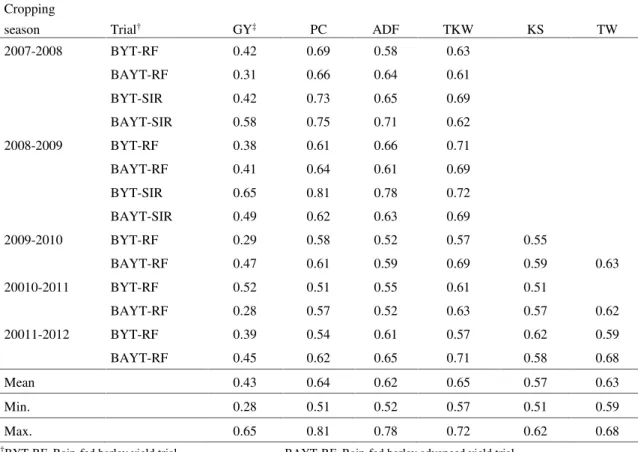
H values indicate a ratio of genetic variance when compared to phenotypic variance (HOLLANDet al., 2003). The range in H values is reported in Table 2. H values showed a broad range for each trait across the cropping seasons. For GY, PC and ADF, H values were very high ranging from 0.28 to 0.65 (low to moderate), 0.51 to 0.81 (moderate to high) and 0.52 to 0.78 (moderate to high), respectively. Accordingly, for TKW, TW and KS, H values were moderate, ranging 0.51 to 0.72. In general, H values estimated on the mean basis were above 0.57, with exception of 0.43 for GY, which indicated that a relatively large genetic component was involved in the determination of the observed trait variation.
Table 2. Heritability estimates for traits studied
Cropping
season Trial† GY‡ PC ADF TKW KS TW
2007-2008 BYT-RF 0.42 0.69 0.58 0.63
BAYT-RF 0.31 0.66 0.64 0.61
BYT-SIR 0.42 0.73 0.65 0.69
BAYT-SIR 0.58 0.75 0.71 0.62
2008-2009 BYT-RF 0.38 0.61 0.66 0.71
BAYT-RF 0.41 0.64 0.61 0.69
BYT-SIR 0.65 0.81 0.78 0.72
BAYT-SIR 0.49 0.62 0.63 0.69
2009-2010 BYT-RF 0.29 0.58 0.52 0.57 0.55
BAYT-RF 0.47 0.61 0.59 0.69 0.59 0.63
20010-2011 BYT-RF 0.52 0.51 0.55 0.61 0.51
BAYT-RF 0.28 0.57 0.52 0.63 0.57 0.62
20011-2012 BYT-RF 0.39 0.54 0.61 0.57 0.62 0.59
BAYT-RF 0.45 0.62 0.65 0.71 0.58 0.68
Mean 0.43 0.64 0.62 0.65 0.57 0.63
Min. 0.28 0.51 0.52 0.57 0.51 0.59
Max. 0.65 0.81 0.78 0.72 0.62 0.68
†BYT-RF, Rain-fed barley yield trial BAYT-RF, Rain-fed barley advanced yield trial
BYT-SIR, Supplementary irrigated barley yield trial
BAYT-SIR, Supplementary irrigated barley advanced yield trial
‡GY, Grain yield (kg ha-1) PC, Protein content (%) ADF, Acid detergent fiber (g kg-1)
H values were relatively more expressed in the irrigated trials conducted at the 2007-2008 and 2007-2008-2009 seasons, comparing with those in rain-fed trials (Table 2). This could be explained by the fact that seasons and/or sites with better growing conditions are likely to lead to either higher genetic variance relative to lower environmental variance or lower environmental variance relative to higher genetic variance (FOXet al.,2008).
Relationships between traits studied
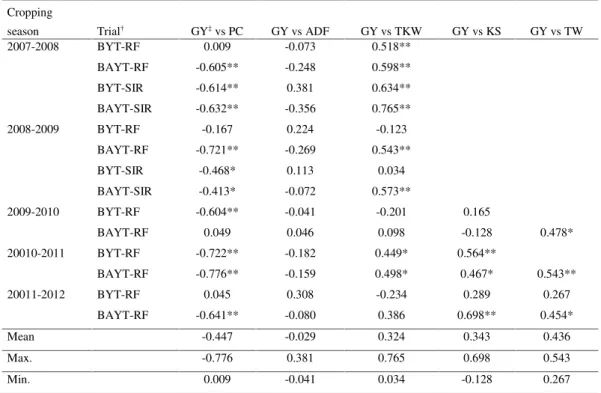
GY and PC were significantly negatively correlated in ten of fourteen barley trials conducted over five cropping seasons (Table 3). The average correlation was -0.447; individual trial values ranged from 0.009 to -0.776. Conversely, correlations of GY with TKW, KS and TW were significantly positive at most of the trials carried out, indicating that relative ranking of the genotypes remained similar under rain-fed (even under severe drought) and irrigated conditions (Tables 1 and 3). Interestingly, heterogenous correlations, but not significant, were observed between GY and ADF in all field trials.
Table 3. Correlations between grain yield and quality traits studied
Cropping
season Trial† GY‡vs PC GY vs ADF GY vs TKW GY vs KS GY vs TW
2007-2008 BYT-RF 0.009 -0.073 0.518**
BAYT-RF -0.605** -0.248 0.598**
BYT-SIR -0.614** 0.381 0.634**
BAYT-SIR -0.632** -0.356 0.765**
2008-2009 BYT-RF -0.167 0.224 -0.123
BAYT-RF -0.721** -0.269 0.543**
BYT-SIR -0.468* 0.113 0.034
BAYT-SIR -0.413* -0.072 0.573**
2009-2010 BYT-RF -0.604** -0.041 -0.201 0.165
BAYT-RF 0.049 0.046 0.098 -0.128 0.478*
20010-2011 BYT-RF -0.722** -0.182 0.449* 0.564**
BAYT-RF -0.776** -0.159 0.498* 0.467* 0.543**
20011-2012 BYT-RF 0.045 0.308 -0.234 0.289 0.267
BAYT-RF -0.641** -0.080 0.386 0.698** 0.454*
Mean -0.447 -0.029 0.324 0.343 0.436
Max. -0.776 0.381 0.765 0.698 0.543
Min. 0.009 -0.041 0.034 -0.128 0.267
*, ** significant at P<0.05 and P<0.01, respectively †BYT-RF, Rain-fed barley yield trial
BAYT-RF, Rain-fed barley advanced yield trial BYT-SIR, Supplementary irrigated barley yield trial
BAYT-SIR, Supplementary irrigated barley advanced yield trial ‡
GY, Grain yield (kg ha-1) PC, Protein content (%) ADF, Acid detergent fiber (g kg-1)
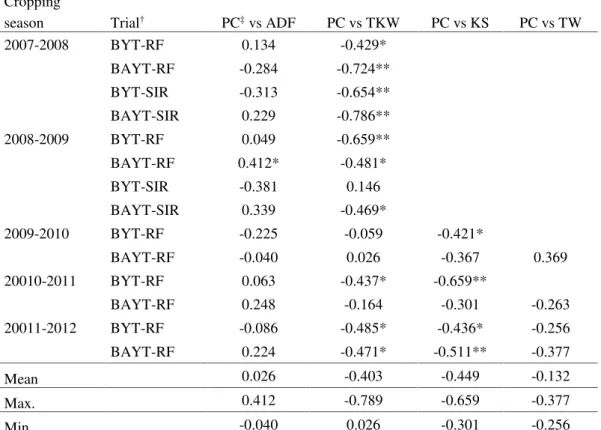
For PC, after starch content, being the predominant form of storage compound in barley, a very strong negative correlation, with average of -0.403, ranging 0.026 to -0.789, was observed with TKW under almost all field trials conducted (Table 4). In addition, this adverse relationship existed between PC and KS. On the other hand, there were no significant correlations among PC, ADF and TW. As a result, in cereals, there are apparent negative correlations of GY and TKW with PC, which was the case for our study (MUNIER-JOLAIN and SALON, 2005; ACRECHE and
SLAFER, 2009;LACAZEet al.,2009;KALLADANet al.,2013). Table 4. Correlations between protein content and quality traits studied
Cropping
season Trial† PC‡vs ADF PC vs TKW PC vs KS PC vs TW
2007-2008 BYT-RF 0.134 -0.429*
BAYT-RF -0.284 -0.724**
BYT-SIR -0.313 -0.654**
BAYT-SIR 0.229 -0.786**
2008-2009 BYT-RF 0.049 -0.659**
BAYT-RF 0.412* -0.481*
BYT-SIR -0.381 0.146
BAYT-SIR 0.339 -0.469*
2009-2010 BYT-RF -0.225 -0.059 -0.421*
BAYT-RF -0.040 0.026 -0.367 0.369
20010-2011 BYT-RF 0.063 -0.437* -0.659**
BAYT-RF 0.248 -0.164 -0.301 -0.263
20011-2012 BYT-RF -0.086 -0.485* -0.436* -0.256
BAYT-RF 0.224 -0.471* -0.511** -0.377
Mean 0.026 -0.403 -0.449 -0.132
Max. 0.412 -0.789 -0.659 -0.377
Min. -0.040 0.026 -0.301 -0.256
*, ** significant at P<0.05 and P<0.01, respectively
†BYT-RF, Rain-fed barley yield trial BAYT-RF, Rain-fed barley advanced yield trial
BYT-SIR, Supplementary irrigated barley yield trial BAYT-SIR, Supplementary irrigated barley advanced yield trial
‡PC, Protein content (%) ADF, Acid detergent fiber (g kg-1)
TKW, Thousand kernel weight (g) KS, Kernel size (> 2.5 mm sieve fraction) TW, Test weight (kg hl-1)
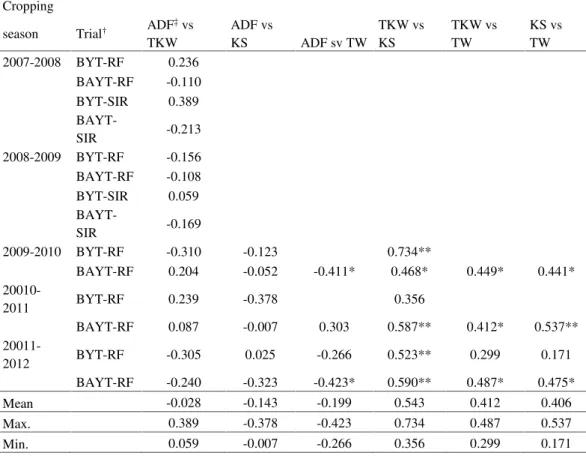
In summary, GY showed only moderate to high correlations with quality traits (except ADF). Grain physical characteristics, namely TKW, KS and TW, showed high correlations with each other. In constrast, relationships between PC and ADF were loose. Meanwhile, the correlations between ADF and quality traits were low, indicating that the genetic determinants of these quality traits were relatively independent (MATTHIESet al.,2014).
Table 5. Correlations between quality traits studied, except protein content
Cropping
season Trial† ADF‡vs
TKW
ADF vs
KS ADF sv TW
TKW vs KS
TKW vs TW
KS vs TW
2007-2008 BYT-RF 0.236
BAYT-RF -0.110
BYT-SIR 0.389
BAYT-SIR -0.213
2008-2009 BYT-RF -0.156
BAYT-RF -0.108
BYT-SIR 0.059
BAYT-SIR -0.169
2009-2010 BYT-RF -0.310 -0.123 0.734**
BAYT-RF 0.204 -0.052 -0.411* 0.468* 0.449* 0.441*
20010-2011 BYT-RF 0.239 -0.378 0.356
BAYT-RF 0.087 -0.007 0.303 0.587** 0.412* 0.537**
20011-2012 BYT-RF -0.305 0.025 -0.266 0.523** 0.299 0.171
BAYT-RF -0.240 -0.323 -0.423* 0.590** 0.487* 0.475*
Mean -0.028 -0.143 -0.199 0.543 0.412 0.406
Max. 0.389 -0.378 -0.423 0.734 0.487 0.537
Min. 0.059 -0.007 -0.266 0.356 0.299 0.171
*, ** significant at P<0.05 and P<0.01, respectively
†BYT-RF, Rain-fed barley yield trial BAYT-RF, Rain-fed barley advanced yield trial
BYT-SIR, Supplementary irrigated barley yield trial BAYT-SIR, Supplementary irrigated barley advanced yield trial
‡ADF, Acid detergent fiber (g kg-1) TKW, Thousand kernel weight (g)
KS, Kernel size (> 2.5 mm sieve fraction) TW, Test weight (kg hl-1)
DISCUSSION
barley varieties in total have been released in Turkey, most of which, 42, have been put into the list of registration (http://www.tarim.gov.tr/BUGEM/TTSM), during the last decade (2006 to 2015), indicating that BBPT, together with private sector, have made a great effort to enhance the barley production of Turkey. However, we believe that even if Turkey allocated more resourses than ever before to the BBPT, decreasing trend in barley production and its cultivated land of Turkey would countinue in the years to come. To be honest, we recognize that there are several reasons why barley facts of Turkey have been trending downward recently. The first reason is related to commodity price of barley grain in domestic market. For instance, barley grain has been sold at $ 250 per ton, comparing with that, $ 330 per ton, of wheat grain (T. aestivum L.) in commodities exchanges of Turkey, during the fourth quarter of 2015 (http://www.ktb.org.tr). The second reason is related to competitiveness or productivity of barley against wheat. For a long time we have experienced that in rain-fed conditions of Turkey, barley can be more competitive against or more productive than wheat, mainly due to its escape mechanism (i.e. earliness) from the terminal drought stress, frequently occurred in the mandate area of our barley breeding program (BLUM, 2009;KALLADAN et al.,2013; AYRANCI et al.,2014; GOUS et al., 2015). The third reason is related to subsidy for cereals. Necessarily, farmers prefer high yielding barley varieties to grow in rain-fed areas. However, they have recently faced the fact that wheat cultivation is economically more subsidized than barley cultivation under both rain-fed and irrigated conditions of Turkey. After all, we understand that drought tolerance mechanism or having high yielding capacity under dryland conditions does not provide any more advantage to barley. Instead, it needs something else rather than high GY potential to be attractive to farmers.
Today, under the irrigated conditions of Turkey, unfortunately, barley is less competitive against or productive than wheat. Obviously, there is no collected data about how much irrigated area is annually cultivated with barley in Turkey. But we are quite sure that a very limited part, less than 1 %, of irrigated agricultural land of Turkey is annually designated for barley cultivation, while its one quarter, 25 %, is occupied by wheat cultivation. In recent years, Turkey has become an importer for quality wheat. Therefore, to meet domestic demand for quality wheat, irrigated wheat cultivation has been specifically subsidied by the government. For the time being, we clearly understand that barley is unlikely to replace the crops, such as wheat, maize and sugar beet, predominantly grown in irrigated land of Turkey. All things considered, at the 2009-2010 season, we took a decision about the BBPT, exclusively for the irrigated barley breeding program, conducted for developing varieties to irrigated land, and then we discontinued it to allocate more resources to the rain-fed barley breeding program. On the other hand, from the breeding perpective of barley, the present study showed that selection for GY under the irrigated conditions would be more successful than that under the rain-fed conditions, because H values estimated for all traits studied under the irrigated conditions were slightly higher than those under the rain-fed conditions.
or undesirable for selecting barley breeding lines with high feed or malting quality in the BBPT. As far as we know, correlations involved usually make the barley breeding cycles more complicated, since most of the agronomic or quality characteristics are undesirably correlated (KAYAandAKCURA, 2014). This was the case for our study. The phenomenon of different traits co-localizing to a QTL, namely correlation, is observed in a variety of crops, including barley. Such co-localization can be due either to tight linkage of genes underlying a particular QTL with nearby genes or to the pleiotropic effect of the gene/genes underlying a QTL. It is crucial to be aware of these relations to understand the tradeoffs implied in the optimization of breeding lines (KALLADANet al.,2013;MATTHIESet al.,2014).
We believe that a simultaneous selection for feed and malting quality is not feasible, although it is included among the objectives of BBPT. According to VERSTEGENet al. (2014) there are many specific requirements for feed and malting barley. For instance, high PC (13-15 %), TKW, TW and KS and low ADF are essential for feed barley, while high TKW, TW and KS and low PC (9-11 %) and ADF are prerequisites for malting barley. At this point only have we mentioned about quality traits studied. But we know that there are also many specific traits expressing feed and malting quality in barley (seeVERSTEGENet al.,2014).
To make BBPT more successful, we suggest that its objectives should be reestablished more specifically. In other words, BBPT should be separated into two programs. The first program could target only to develop feed barley varieties. The second program might specifically focus on breeding barley varieties for malting. For now, we recommend that the first program, based on feed barley breeding, should be commenced, because more than 90 % of barley grain produced annually in Turkey is used for feed. On the other hand, barley usage for malting is very limited, only 2-3 % of the annual production. Since 1998, private sector in Turkey has been conducting a self-sponsored breeding program of barley, specifically for malting quality. Up to now, 29 varieties have been released by private sector, most of which are suitable for malting (http://www.tarim.gov.tr/BUGEM/TTSM). Above all, we believe that private sector resources for financing the malting barley breeding in Turkey are quite sufficient for the time being.
As far as we know, one of the challenges facing our barley breeding program is the lack of quality data of parents using in crossing block. Unfortunatley, we have not yet evaluated the entire set of parents on the basis of quality traits especially for feed. For the development of barley breeding lines, the most important step is to choose promising parents, usually called elite breeding lines, and then cross them in order to find in their progeny such lines that combine the parents’ quality and performance characteristics and ideally surpass the parents’ performance in at least one of the traits of interest (VERSTEGENet al., 2014). Therefore, we urgently need quality data of parents in order to use them for making crossings more efficient.
generations in our barley breeding program. Judging from the results of the barley breeding method currently applied, we understand that advanced generation (F8 and F9) selection for quality possibly results in promoting some barley breeding lines with unacceptable quality, since they are not able to be discarded from the F6 and F7generations, in which quality analysis is not conducted yet. To drop the barley breeding lines with unacceptable quality from advanced generations, we should start to carry out quality analysis at the F6 (i.e. observation nurseries) and F7 (i.e. preliminary yield trials), and continue at further generations, F8 and F9 (BAENZIGERet al., 2001;KAYAandSAHIN, 2015).
Barley grain is graded on the basis of TW, soundness, color, moisture, foreign material, damage and hullness in several countries such as Canada (https://www.grainscanada.gc.ca), Australia (www.graintrade.org.au) and USA (http://www.gipsa.usda.gov). In addition, PC is used as a grade factor for malting barley only in Australia. As for Turkey, the entire mentioned above have been using in barley grading system, since 2010 (https://www.tmo.gov.tr). We believe that barley grading system of Turkey is now effectively used in the purchasing operations of barley grain. On the other hand, the list of quality criteria, only including PC, KS, TKW and TW, currently used in the variety registration procedure for feed barley in Turkey should be updated immediately. For malting barley variety registration procedure, the quality criteria concerned are quite sufficient to determine whether a barley variety or candidate is suitable for malting or not. As for the quality criteria essential for feed barley variety registration, we believe that new criteria should be added into the current list, because present criteria are fully inadequate for determining feed qualiy in barley. Therefore, we suggest that physical (namely kernel hardness, kernel color and hull content), chemical (namely ADF, NDF, beta-glucan, starch, lipids, pentosans and lysine) and animal nutritional quality criteria (namely digestibility and energy) should be added into the list currently used for feed barley variety registration (BOWMANet al.,2001;JUSKIWet al.,2005;
BLEIDERE and GAILE, 2012). Given the quality criteria already suggested, they should also be implemented to the BBPT in order to develop barley varieties better in feed quality.
CONCLUSION
We have taken the messages, given below, from the current study.
1. Barley is more competitive against or more productive than wheat under the rain-fed conditions of Turkey. But, commodity price of barley grain is lower that of wheat in domestic market. Meanwhile, wheat is more subsidized than barley by the Government of Turkey. Therefore, there is little incentive for farmers to grow barley.
2. For selecting barley breeding lines with high feed or malting quality in the BBPT, undesirable correlations between quality traits can be broken or heritability values for quality traits can be increased by means of targeted crossing programs. Therefore, we urgently need quality data of parents in order to use them for making crossings more efficient
3. A simultaneous selection for feed and malting quality is not feasible, because there are many specific requirements for feed and malting barley. Thus, we should divide BBPT into quality oriented programs. The first program could target only to develop feed barley varieties. The second program might specifically focus on breeding barley varieties for malting.
5. For quality traits essential for feed or malting barley variety registration, novel quality traits should be added into the present list, because it is incapable of determining feed or malting quality in barley. Also, the aforementioned quality traits should immediately be used in the BBPT to improve barley varieties better in feed or malting quality.
ACKNOWLEDGEMENTS
This study was supported by the Ministry of Food, Agriculture and Livestock, Republic of Turkey, Project No: TAGEM/ TA/08/07/05/005.
Received January 05st, 2016
Accepted April 02th, 2016
REFERENCES
AYRANCI,R.,B.SADE,S.SOYLU(2014): The response of bread wheat genotypes in different drought types. Grain yield, drought tolerance and grain yield stability. Turk J Field Crops.19 (2):183-188.
BAENZIGER,P.S.,D.R.SHELTON,M.J.SHIPMAN,R.A.GRAYBOSCH(2001): Breeding for end-use quality: Reflections on the Nebraska experience. Euphytica,119: 95-100.
BLEIDERE,M.,Z.GAILE(2012): Grain quality traits important in feed barley. Proceedings of the Latvian Academy of Sciences. Section B 66 (1/2: 676-677): 1-9.
BLUM, A. (2009): Effective use of water (EUW) and not water-use efficiency (WUE) is the target of crop yield improvement under drought stress. Field Crops Res.,112: 119-123.
BOWMAN, J.G.P., T.K. BLAKE, L.M.M. SURBER, D.K. HABERNICHT, H. BOCKELMAN (2001): Feed-quality variation in the barley core collection of the usda national small grains collection. Crop Sci.,41: 863-870.
FOX,G.P. (2009): Chemical composition in barley grains and malt quality. In: Zhang G, Li C, Editors. Genetics and Improvement of Barley Malt Quality. Zhejiang University Press, Hangzhou and Springer-Verlag Berlin Heidelberg, pp: 63-98.
FOX,G.P.,J.BOWMAN,A.KELLY,A.INKERMAN,D.POULSEN,R.HENRY(2008): Assessing for genetic and environmental effects on ruminant feed quality in barley (Hordeum vulgare). Euphytica,163: 249-257.
FOX,G.P.,A.M.KELLY,J.G.P. BOWMAN,P.A.INKERMAN,D.M.E.POULSEN,R.J.HENRY(2009): Is malting barley better feed for cattle than feed barley? J. Inst. Brew.,115: 95-104.
FOX, G.P., J. STUART, A. KELLY (2007): Value of the test weight method in assessing barley quality. 13th Australian Barley Technical Symposium, 26-30 August 2007, Fremantle, Western Australia.
GOUS,P.W.,R.G.GILBERT,G.P.FOX(2015): Drought-proofing barley (Hordeum vulgare) and its impact on grain quality: A review. J. Inst. Brew.,121: 19-27.
HOLLAND, J.B., W.E.NYQUIST,C.T.CERVANTES-MARTINEZ (2003): Estimating and Interpreting Heritability for Plant Breeding: An Update. Plant Breeding Reviews,22: 9-112.
HORSLEY, R.D., J.D. FRANCKOWIAK, P.B. SCHWARZ (2009): Barley. In: Carena MJ, Editor. Cereals. Springer DOI: 10.1007/978-0-387-72297-9, pp. 227-250.
JUSKIW,P.,J.HELM,L.OATWAY,J.NYACHIRO(2005): Breeding for feed barley quality in hulled two-row barley. 12th Australian Barley Technical Symposium.
KALLADAN,R.,S.WORCH,H.ROLLETSCHEK,V.T.HARSHAVARDHAN,L.KUNTZE,C.SEILER,N.SREENIVASULU,M.S.RODER
(2013): Identification of quantitative trait loci contributing to yield and seed quality parameters under terminal drought in barley advanced backcross lines. Mol. Breeding,32: 71-90.
KAYA,Y.,M.SAHIN(2015): Non-parametric stability analyses of protein content in multi-environment trials of wheat (T. aestivum L.). Genetika,47(3): 795-810.
LACAZE,X.,P.M.HAYES,A.KOROL(2009): Genetics of phenotypic plasticity: QTL analysis in barley,Hordeum vulgare. Heredity,102: 163-173.
MARINACCIO, F., A. REYNERI, M. BLANDINO (2015): Enhancing grain yield and quality of winter barley through agronomicstrategies to prolong canopy greenness Field Crops Res.,170: 109-118.
MATTHIES,I.E.,MALOSETTI,M.,RODER,M.S.,VAN EEUWIJK,F. (2014): Genome-wide association mapping for kernel and malting quality traits using historical European barley records. PLoS ONE, 9(11), e110046. doi:10.1371/journal.pone.0110046.
NEWMAN,R.K.,C.W.NEWMAN(2008): Barley for Food and Health: Science, Technology, and Products. John Wiley and Sons, Inc. Publication, New Jersey.
SAS INSTITUTE(2003): SAS/STAT User’s Guide, Version 9.1. SAS Institute, Cary, NC.
SOLOGUBIKA,C.A.,L.A.CAMPANONEC,A.M.PAGANOB,M.C.GELYB(2013): Effect of moisture content on some physical properties of barley. Ind. Crop and Prod.,43: 762-767.
STRYCHAR,R. (2011): World oat production, trade, and usage. In: Webster FH, Wood PJ, Editors. Oats: Chemistry and Technology, 2nd ed. AACC International, Inc. pp. 1-10.
VERSTEGEN,H.,O.KONEKE,V.KORZUN,R.VON BROOCK(2014): The world importance of barley and challenges to futher improvements. In: Kumlehn J, Stein N, Editors. Biotecnological Approaches to Barley Improvement. Springer-Verlag Berlin. Pp. 3-19.
YANG,J.,J.WANG,Q.JIA,J.ZHU(2010): Barley breeding and production in China. He Z, Bonjean APA, Editors. Cereals in China. Mexico, D.F.: CIMMYT, pp. 69-78.
OPLEMENJIVANJE JEČMA NA KVALITET U TURSKOJ
Yuksel KAYA1*, Ramazan AYRANCI2 1
Bahri Dagdas međunarodni poljoprivredno istraživački institut, Konja, Turska 2Odeljenje za oplemenjivanje, Poljoprivredni fakultet, Ahi Evran Univerzitet, Kirsehir, Turska
Izvod
Ispitano je ukupno 411 genotipova ječma (Hordeum vulgareL.), uključujući 334 selekcione linije sa 77 konrole iz oplemenjivačkog programa Turske (BBPT), na osnovu prinosa (GY) i svojstva kvaliteta (sadržaj proteina - PC, kiselih deterđent vlakana - ADF, mase 1000 zrna –TKW, veličine semena – KS, i test težine – TW tokom 5 uzastopnih sezona od 2007-2008 do 2011-2012. Vrednosit za heritabilnost za svojstva kvlaiteta su bile umerene (0.57-0.65), dok su za prinos bile niske (0.43). Fizička svojstva zrna (TW, KS and TKW) su pozitivno značajno korelisana sa prinosom, ali negativno značajno sa sadržajem protiena. Rezultati naših ispitivanja pokazuju da selekcija za prinos zrna i svojstva kvaliteta su bila manje uspešna od očekivanog, usled neželejne multivarijetne korelacije kao prinosa i sadržaja protiena i niske do umerene heritabilnoisti.