Ciência Rural, v.48, n.11, 2018.
Herbicides with natural and synthetic biostimulants in spring wheat
Aplicação de herbicidas com bioestimulantes natural e sintético no trigo primavera Kinga Matysiak1* Wojciech Miziniak1 Sylwia Kaczmarek1 Roman Kierzek1
ISSNe 1678-4596
Received 05.18.18 Approved 10.11.18 Returned by the author 10.29.18
INTRODUCTION
Obtaining stable, high quality yields requires both mitigating the adverse effects of biotic factors (weeds, diseases and insects) and protecting the crops against abiotic factors. During the vegetation season, crop plants are exposed to a number of stress factors resulting from unfavorable soil conditions or herbicides. While mitigating the adverse effects of pests is directly related to the level
of plant protection, it is difficult to minimize the
negative impact of abiotic factors.
The adverse impact of abiotic factors on crop yields can be mitigated by biostimulants,
which improve the biochemical, morphological and physiological processes in crop plants. Among the large group of biostimulants, there are organic substances obtained from plant extracts, synthetic compounds and microelements that improve crop yields. Biostimulants are products that can modify physiological functions of plants, strengthen plant defenses against different biotic and abiotic stresses
and improve nutrition efficiency. Usually they are
known as ‘plant conditioners’ which help plants to adapt to unfavorable conditions. These plant conditioners suppress or eliminate plant growth-limiting factors affecting plant during its life. They protect plants and work differently from other plant 1Institute of Plant Protection, National Research Institute, Władysława Węgorka 20, 60-318, Poznań, Poland. E-mail: [email protected]. *Corresponding author.
ABSTRACT: Although the knowledge on agricultural using of biostimulants increases, there is still little information on their interactions with other chemicals i.e. herbicides. The aim of the study was to assess the influence of popular herbicides (MCPA + dicamba, dicamba + triasulfuron, florasulam+2,4-D) used with and without biostimulants based on seaweed extract (Kelpak) and nitrophenols (Asahi) on weed control efficiency, yield and quality of the crop. Field trial was carried out in the years 2014 and 2015 in the Institute of Plant Protection – National Research Institute in Poznan (Poland). The experiment was established on spring wheat cv.‘Torridon’, in 4 replications, using randomized block design. In the experiment two variants of application were tested. In the first variant preparations (herbicide and biostimulant) were applied as tank mixtures at the crop growth stage BBCH 30 and in the second variant in some combinations herbicide application was followed by biostimulant used alone. Weather conditions had a profound impact on tested preparations activity. Addition of biostimulants to herbicide had not affected weed control efficacy but application of herbicide and biostimulant mixture revealed its influence on yield parameters of wheat. Biostimulants influenced yield quality parameters e.g. by enhancing gluten amount in grains.
Key words: biostimulant, seaweeds, algae extract, herbicides, tank mixtures, wheat.
RESUMO: Embora o conhecimento sobre o uso agrícola de bioestimulantes aumente, ainda há pouca informação sobre suas interações
com outros produtos químicos, como por exemplo, herbicidas. O objetivo desta pesquisa consistiu em avaliar o efeito dos herbicidas MCPA + dicamba, dicamba + triasulfuron + e florasulam + 2,4-D, usados com bioestimulantes a base de extratos de algas marinhas (Klepak) e nitrofenóis (Asahi) sobre a eficiência do controle de plantas daninhas e o rendimento da produção das plantas cultivadas. Os estudos de campo foram realizados nos anos de 2014 e 2015 pelo Instituto de Proteção de Plantas – Instituto Nacional de Pesquisas em Poznań (Polônia). O experimento foi realizado na cultura do trigo, cultivar ‘Torridon’ com quatro repetições. Foram estudadas diferentes opções de mistura de herbicidas versus bioestimulantes que foram aplicados em mistura de tanque ou o bioestimulante foi aplicado três dias após a aplicação do herbicida. As condições climáticas afetaram o desempenho das misturas utilizadas. A adição de bioestimulante ao herbicida não modificou a eficiência do controle de plantas daninhas, mas revelou grande influência nos parâmetros de produtividade do trigo. O uso de bioestimulantes provocou a melhora da qualidade dos grãos, aumentando o teor de glúten.
Palavras-chave: bioestimulante, algas marinhas, herbicidas, aplicação combinada trigo de primavera.
2
protection products. They are also not fertilizers
because their main function is not to deliver nutrients
to the plant (VERKLEIJ, 1992; CALVO et al., 2014; PRZYBYSZ et al., 2014; DU JARDIN, 2015).
Currently, one of the most popular group of biostimulants in agriculture and horticulture are seaweeds. Seaweeds act on soils and plants
by delivery of purified compounds, which include
polisacharides, alginates, micro and macronutrients, sterols and hormones. They can be applied on soils, in
hydroponic solutions or as foliar treatments. (STRIK et al., 2003; KHAN et al., 2009; CRAIGIE, 2011; DU JARDIN, 2015).
Another group of biostimulants are synthetic products based on phenolic compounds. The phenolic compounds can improve plant protection against stress conditions and it can hold sustainable crop yield. Some authors state
that they can significantly stimulate plant growth
and development even in stress less conditions by enhancing IAA activity and increasing in the activity
of nitrate reductase, an important enzyme in nitrogen metabolism (PRZYBYSZ et al., 2010; PRZYBYSZ
et al. 2014).
Generally, an activity of biostimulants in
many different crops is well enough known but they are known mostly as substances applied independently of other plant protection products. There is only few
scientific reports on mix application biostimulants with pesticides; i.e, herbicides. This study evaluates
foliar application of natural (seaweeds) and syntetic (phenols) biostimulants applied separately and as a tank mixtures with popular herbicides in enhancing yield and grain quality of spring wheat.
MATERIALS AND METHODS
Trial conditions
Field experiment was carried out in the
years 2014 and 2015 in the Experimental Station in Toruń (52°12′0″N 17°27′0″E) belonged to the
Institute of Plant Protection – National Research
Institute in Poznan. The experiment was established in randomized block design in 4 replications on
spring wheat cv. Torridon. The surface area of plots
was 12m2 and the width row spacing was of – 11cm.
In both seasons the fore crop was sugar beet. Wheat
sowing was performed on 30th of March 2014 and
6th of April 2015. The experiment was conducted
in grey-brown podzolic soil, of pH 5.6–5.8 and a
content of organic matter of 1.7–1.8 %, depending
on year of research. Mineral fertilization was used: N 140kg∙ha-1, P
2O540kg∙ha -1 and K
2O60kg∙ha
-1. Plant
protection against diseases and pests was used in the whole experiment according to recommendations for the wheat.
Experimental set-up
Experimental treatments included
herbicides: (i) MCPA + dicamba (Chwastox Turbo
340 SL), (ii) dicamba + triasulfuron (Lintur 70WG), (iii) florasulam +2,4-D (Mustang 306 SE) and biostimulants: (i) Kelpak SL (32,26% algae Ecklonia
maxima extract) and (ii) Asahi SL composed of
nitrophenols (sodium ortho nitrophenol, sodium para nitrophenol, sodium 5-nitroguaiacolate).
These preparations were applied according to the following scheme:
1. Control (untreated plots);
2. MCPA + dicamba applied at the dose 600g a.i∙ha-1
+ 80g a.i∙ha-1 at the growth stage BBCH 30;
3. Mixture of MCPA + dicamba+ Kelpak, applied at
the dose 600g a.i∙ha-1 + 80g a.i∙ha-1 + 2dm3∙ha-1 at the
growth stage BBCH 30;
4. MCPA + dicamba applied at the dose 600g a.i∙ha-1
+ 80g a.i∙ha-1at BBCH 30 followed by Kelpak applied
three days later at the dose 2dm3∙ha-1;
5. Mixture of MCPA + dicamba + Asahi
applied at the dose 600g a.i∙ha-1 + 80g a.i∙ha-1
+ 0.6dm3∙ha-1 at the growth stage BBCH 30;
6. MCPA + dicamba applied at the dose 600g a.i∙ha-1
+ 80g a.i∙ha-1 at BBCH 30 followed by Asahi applied
three days later at the dose 0.6dm3∙ha-1;
7. Dicamba + triasulfuron applied at the dose 98.8g
a.i∙ha-1 + 6.15g a.i∙ha-1 at the growth stage BBCH 30;
8. Mixture of dicamba + triasulfuron + Kelpak
applied at the dose 98.8g a.i∙ha-1 + 6.15g a.i∙ha-1 +
2dm3∙ha-1 at the growth stage BBCH 30;
9. Dicamba + triasulfuron applied at the dose 98.8g
a.i∙ha-1 + 6.15g a.i∙ha-1 at BBCH 30 followed by
Kelpak applied three days later at the dose 2dm3∙ha-1;
10. Mixture of dicamba + triasulfuron + Asahi applied
at the dose 98.8g a.i∙ha-1 + 6.15g a.i∙ha-1 + 0.6dm3∙ha-1
at the growth stage BBCH 30;
11. Dicamba + triasulfuron applied at the dose 98.8g
a.i∙ha-1 + 6.15g a.i∙ha-1 at BBCH 30 followed by Asahi
applied three days later at the dose 0.6dm3∙ha-1;
12. Florasulam + 2,4-D applied at the dose 3.75g
a.i∙ha-1 + 180g a.i∙ha-1 at the growth stage BBCH 30;
13. Mixture of florasulam + 2,4-D + Kelpak applied
at the dose 3.75g a.i∙ha-1 + 180g a.i∙ha-1 + 2dm3∙ha-1
at the growth stage BBCH 30;
14. Florasulam + 2,4-D applied at the dose 3.75g
a.i∙ha-1 + 180g a.i∙ha-1 at BBCH 30 followed by
Kelpak applied three days later at a dose 2dm3∙ha-1;
the dose 3.75g a.i∙ha-1 + 180g a.i∙ha-1 + 0.6dm3∙ha-1 at
the growth stage BBCH 30;
16. Florasulam + 2,4-D applied at the dose 3.75g
a.i∙ha-1 + 180g a.i∙ha-1 at BBCH 30 followed by Asahi
applied three days later at the dose 0.6dm3∙ha-1.
Parameters
Treatments were conducted using a bicycle-mounted Victoria sprayer equipped with
TeeJet 110 02 VP sprayers using 200dm3 of spray
liquid per ha, with operating pressure of 0.3MPa. Temperature during the applications varied between
21-23oC depending on term and year of study.
Observations
The herbicide efficacy of the tested chemicals was assessed visually on 5th June 2014 and 15th June
2015, comparing the level of weed infestation with each of the weed species on every plot treated with
the herbicide with the untreated plot. Efficacy against
weeds was presented on a percentage scale, where 100% means complete control and 0% means no herbicide effect.
Systematic, visual assessments of the phytotoxic effect of the applied chemicals and their mixtures on spring wheat were conducted during the vegetation period. The thousand gain weight
was assessed on the basis of five replications of 100
grains. Number of grains per ear was determined
by twenty five ears randomly collected from each plot. Harvest was performed on 8th August 2014
and 16th August 2015 using Wintersteiger Classic
plot combined. Grain yield was determined at 14%
grain moisture and then calculated per surface area
of 1ha. The qualitative grain analysis was conducted
with an InfratecTM 1241 Grain Analyser (FOSS).
The meteorological data got from a
station located at the field experiment site (Falęcin, 53°13′54″ N, 18°32′51″E).
Statistics
The data on herbicide efficacy on the
density, number of grains per ear, grain yield, weight of thousand grains and selected grain quality properties were subject to statistical analysis. The results of the Fisher test were evaluated at 1% and
5% significance level. Upon discovering significant
differences, a detailed comparison of the means using
the Student’s t-distribution test was performed in
order to determine the lowest significant difference at a 5% significance level. It was decided to present
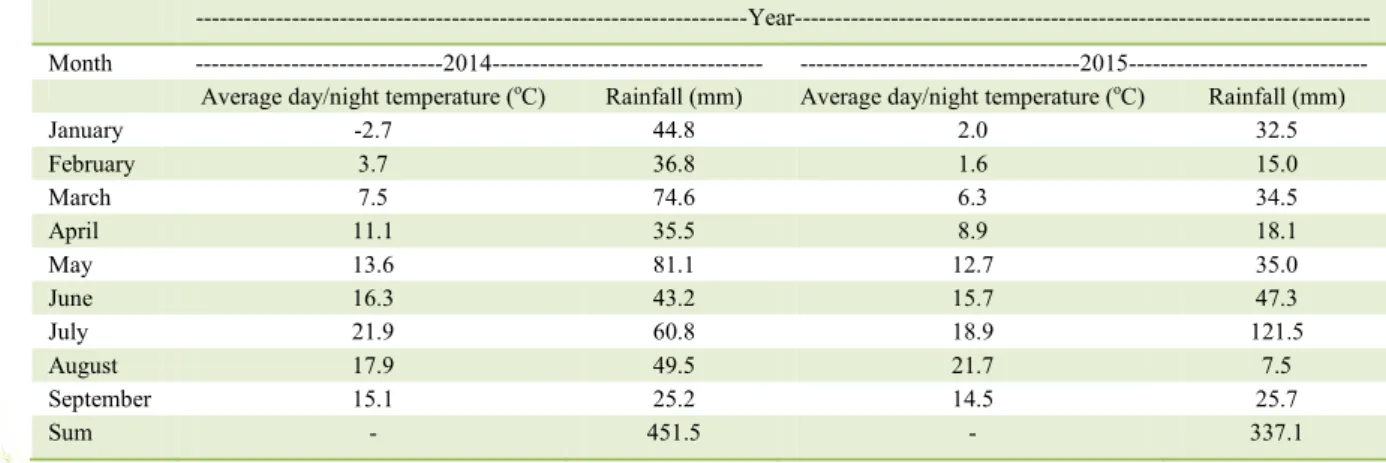
the results separately for each year of the experiment because of completely different weather conditions during the years (Table 1).
RESULTS
Weed control
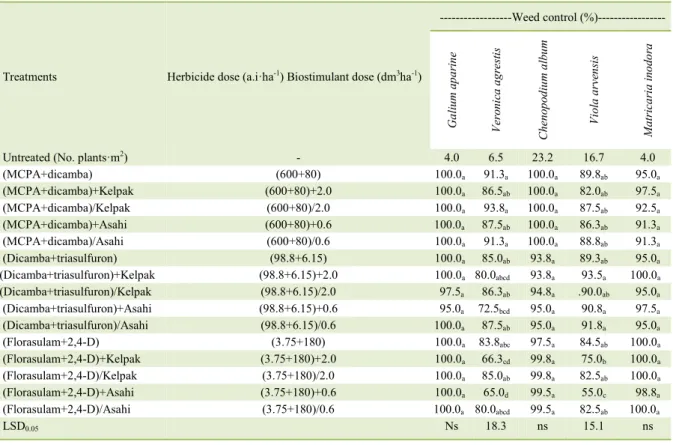
The weed control efficacy in both years
of the study depended on the chemical composition of the tank mixture and the sensitivity of the weed species to the applied herbicide active substances.
Adding Kelpak and Asahi biostimulants to the
liquid containing selected herbicides had no effect
on the biological efficacy against Chenopodium album, Galium aparine and Matricaria indora
(Table 2). Results of the field studies showed a slight decline in the efficacy against Veronica agrestis and
Table 1 - Weather conditions during years of studies.
---Year---
Month ---2014--- ---2015--- Average day/night temperature (oC) Rainfall (mm) Average day/night temperature (oC) Rainfall (mm)
January -2.7 44.8 2.0 32.5
February 3.7 36.8 1.6 15.0
March 7.5 74.6 6.3 34.5
April 11.1 35.5 8.9 18.1
May 13.6 81.1 12.7 35.0
June 16.3 43.2 15.7 47.3
July 21.9 60.8 18.9 121.5
August 17.9 49.5 21.7 7.5
September 15.1 25.2 14.5 25.7
4
Viola arvensis after the application of mixtures of
biostimulants with MCPA + dicamba and dicamba + triasulfuron herbicides. When combined with
florasulam + 2,4-D, the tested biostimulants also caused a significant decline in the efficacy against
these weed species.
Wheat yield
The yield level in both years of the study was related to weather conditions (rainfall) in each year of the study. In 2015, lower rainfall in the spring (March and April) had negative impact on the growth of spring wheat, resulting in a decrease in yielding.
In 2014, regardless of the method of
application of the Kelpak biostimulant, an increase
in the yielding of spring wheat, in comparison with the control, was observed. The analysis of the impact of each of the substances on the discussed parameter showed a slight decrease in the grain weight of spring wheat where MCPA + dicamba was applied, either separately or in a
mixture, in comparison with the plots sprayed with the herbicide only (Table 3). There was a slight increase in the weight of the grains collected from plots sprayed with mixtures of the tested substances
and biostimulant. The studies in 2015 reflected
opposite results. The method of application of a biostimulant was reported to have no effect on the yield level of spring wheat (MCPA + dicamba ) or only slightly reduced the yield (when mixed with dicamba +
triasulfuron or florasulam + 2,4-D) in comparison with
separate application of the substances (Table 4). The Asahi biostimulant, when combined
with herbicides, did not significantly affect the
weight of the grains (Table 3). Despite the lack of
significant differences, a tendency for an increase in
yielding was observed when substances were applied separately in both years. The statistical analyses did
not show any significant differences between the
different methods of biostimulant application. In addition, the studies did not show any
significant correlations between the application Table 2 - Influence of herbicides and biostimulants Kelpak and Asahi on weed control in wheat.
Treatments Herbicide dose (a.i·ha-1) Biostimulant dose (dm3ha-1)
---Weed control (%)---
G
al
iu
m
a
pa
rin
e
V
er
o
n
ic
a
a
g
re
st
is
C
he
no
po
di
um
a
lb
um
Vi
ol
a
ar
ve
ns
is
M
at
ric
ar
ia
in
od
or
a
Untreated (No. plants·m2
) - 4.0 6.5 23.2 16.7 4.0
(MCPA+dicamba) (600+80) 100.0a 91.3a 100.0a 89.8ab 95.0a
(MCPA+dicamba)+Kelpak (600+80)+2.0 100.0a 86.5ab 100.0a 82.0ab 97.5a
(MCPA+dicamba)/Kelpak (600+80)/2.0 100.0a 93.8a 100.0a 87.5ab 92.5a
(MCPA+dicamba)+Asahi (600+80)+0.6 100.0a 87.5ab 100.0a 86.3ab 91.3a
(MCPA+dicamba)/Asahi (600+80)/0.6 100.0a 91.3a 100.0a 88.8ab 91.3a
(Dicamba+triasulfuron) (98.8+6.15) 100.0a 85.0ab 93.8a 89.3ab 95.0a
(Dicamba+triasulfuron)+Kelpak (98.8+6.15)+2.0 100.0a 80.0abcd 93.8a 93.5a 100.0a
(Dicamba+triasulfuron)/Kelpak (98.8+6.15)/2.0 97.5a 86.3ab 94.8a .90.0ab 95.0a
(Dicamba+triasulfuron)+Asahi (98.8+6.15)+0.6 95.0a 72.5bcd 95.0a 90.8a 97.5a
(Dicamba+triasulfuron)/Asahi (98.8+6.15)/0.6 100.0a 87.5ab 95.0a 91.8a 95.0a
(Florasulam+2,4-D) (3.75+180) 100.0a 83.8abc 97.5a 84.5ab 100.0a
(Florasulam+2,4-D)+Kelpak (3.75+180)+2.0 100.0a 66.3cd 99.8a 75.0b 100.0a
(Florasulam+2,4-D)/Kelpak (3.75+180)/2.0 100.0a 85.0ab 99.8a 82.5ab 100.0a
(Florasulam+2,4-D)+Asahi (3.75+180)+0.6 100.0a 65.0d 99.5a 55.0c 98.8a
(Florasulam+2,4-D)/Asahi (3.75+180)/0.6 100.0a 80.0abcd 99.5a 82.5ab 100.0a
LSD0.05 Ns 18.3 ns 15.1 ns
method and the ear-bearing number of spikes, the number of grains per ear and the mass of 1000 grains (Table 4). The evaluation of the number of grains per
ear and the mass of 1000 grains showed insignificant differences between the test objects; however,
tendency to decrease in the number of grains in ears after the application of mixtures and an increase in the mass of 1000 grains after the application of biostimulants was recorded. The correlation analysis
showed a significant impact of the different yield
structure elements, mainly number of spikes, on the yield of spring wheat (Table 5).
Grain quality traits
Among the analyzed study variants in
2014, the wheat grains from the plots treated with
florasulam + 2,4-Dherbicide exhibited the lowest
content of protein (Table 6) and gluten, as well as low Zeleny sedimentation value (Table 7). When the herbicide was applied in combination with the Asahi biostimulant, the quality parameters of the grain improved.
The obtained results show that there
was no significant correlation between the method
of application of the biostimulant and the quality parameters of wheat grains. There was a tendency for a decrease in the quality of the grain (protein, gluten, Zeleny value) after the application of mixtures containing MCPA + dicamba, while there was positive impact in case of dicamba + triasulfuron herbicide. Different results were obtained when the biostimulants were used in combination with
florasulam + 2,4-D (slight decrease in the parameters in the case of Kelpak and an increase in grain quality
in the case of Asahi).
The grains from the 2015 harvest were of better quality than the grains from the 2014 harvest.
Regardless of the year of study, the
analyzed tank mixtures were not reported to have any phytotoxic impact on the KWS Torridon spring wheat
(data not given).
DISCUSSION
The two-year field studies showed that adding both Kelpak and Asahi biostimulants to the
spray liquid containing MCPA + dicamba and dicamba + triasulfuron herbicides had no impact on the weed
Table 3 - Influence of herbicides and biostimulants Kelpak and Asahi on weight of thousand grains and number of grains in ear of wheat.
-Weight of thousand grains (g)-- ---Number of grains in ear---
Treatments Herbicide dose (a.i·ha
-1)
Biostimulant dose (dm3 ·ha-1) ---Experimental year---
2014 2015 2014 2015
Untreated - 37.93ab 41.46bc 28.9abc 33.0a
(MCPA+dicamba) (600+80) 39.29ab 42.24abc 31.1a 34.2a
(MCPA+dicamba)+Kelpak (600+80)+2.0 38.75ab 43.95a 26.0c 33.9a
(MCPA+dicamba)/Kelpak (600+80)/2.0 38.61ab 43.03ab 28.4abc 34.1a
(MCPA+dicamba)+Asahi (600+80)+0.6 38.29ab 41.87abc 26.8bc 34.2a
(MCPA+dicamba)/Asahi (600+80)/0.6 38.03ab 42.83ab 27.3abc 34.8a
(Dicamba+triasulfuron) (98.8+6.15) 39.02ab 42.35abc 27.6abc 32.6a
(Dicamba+triasulfuron)+Kelpak (98.8+6.15)+2.0 39.61a 42.17abc 30.8ab 32.0a
(Dicamba+triasulfuron)/Kelpak (98.8+6.15)/2.0 39.97a 42.44abc 30.9a 32.3a
(Dicamba+triasulfuron)+Asahi (98.8+6.15)+0.6 38.32ab 42.74abc 28.6abc 31.1a
(Dicamba+triasulfuron)/Asahi (98.8+6.15)/0.6 38.90ab 42.12abc 27.3abc 31.4a
(Florasulam+2,4-D) (3.75+180) 38.09ab 40.33c 27.7abc 32.2a
(Florasulam+2,4-D)+Kelpak (3.75+180)+2.0 38.68ab 41.65abc 28.6abc 32.0a
(Florasulam+2,4-D)/Kelpak (3.75+180)/2.0 39.02ab 41.03bc 29.2abc 32.4a
(Florasulam+2,4-D)+Asahi (3.75+180)+0.6 37.42b 41.13bc 28.5abc 32.2a
(Florasulam+2,4-D)/Asahi (3.75+180)/0.6 38.87ab 41.75abc 30.0abc 33.1a
LSD0.05 2.06 2.42 4.1 4.0
6
control efficacy. Similar observations were published by KIERZEK et al. (2013, 2015) on the basis of sugar beet and corn experiments and GOLIAN et al.
(2014) with regard to Asahi or AlfaMax biostimulant
mixes with metribuzin in carrot. According to SOLTANI et al. (2015 a), biostimulant-herbicide
mixes may vary in terms of their impact on the weed
control efficacy against weeds. They showed no
correlation (Crop Booster biostimulant mixed with
bromoxynil or MCPA) and improved efficacy against
Amaranthus retroflexus (a mixture of Crop Booster
or RR SoyBooster biostimulants with a glyphosate
liquid) or a decrease in the efficacy against Setaria
viridis (Crop Booster mixed with glyphosate and
thiencarbazone-methyl). Similary, when florasulam + 2,4-D was applied in combination with Kelpak
and Asahi biostimulants, a decrease in the control of
Veronica agrestis and Veronica arvensis was observed in both years of the study in comparison with separate application or herbicide-only application.
A different view on the subject was
presented by DOMARADZKI et al. (2015) on the Table 4 - Influence of herbicides and biostimulants Kelpak and Asahi on number of spikes per m2 and yield of wheat.
---Number of spikes/m2--- ---Yield (t·ha-1)---
Treatments Herbicide dose (a.i·ha
-1)
Biostimulant dose (dm3 ha-1) ---Experimental year---
2014 2015 2014 2015
Untreated - 564.0b 328.7 ab 6.16cd 4.49abcd
(MCPA+dicamba) (600+80) 598.7ab 322.7ab 7.27ab 4.65abcd
(MCPA+dicamba)+Kelpak (600+80)+2.0 652.0ab 338.7ab 6.54bcd 5.03a
(MCPA+dicamba)/Kelpak (600+80)/2.0 564.0b 337.3ab 6.15cd 4.95ab
(MCPA+dicamba)+Asahi (600+80)+0.6 580.0ab 304.7b 5.95d 4.37bcd
(MCPA+dicamba)/Asahi (600+80)/0.6 646.7ab 328.0ab 6.69abcd 4.89abc
(Dicamba+triasulfuron) (98.8+6.15) 648.0ab 319.3ab 6.98abc 4.39abcd
(Dicamba+triasulfuron)+Kelpak (98.8+6.15)+2.0 617.3ab 335.3ab 7.54a 4.53abcd
(Dicamba+triasulfuron)/Kelpak (98.8+6.15)/2.0 589.3ab 345.3ab 7.23ab 4.74abcd
(Dicamba+triasulfuron)+Asahi (98.8+6.15)+0.6 564.0b 318.7ab 6.17cd 4.23d
(Dicamba+triasulfuron)/Asahi (98.8+6.15)/0.6 673.3a 340.0ab 7.13abc 4.48abcd
(Florasulam+2,4-D) (3.75+180) 641.3ab 330.0ab 6.74abcd 4.27cd
(Florasulam+2,4-D)+Kelpak (3.75+180)+2.0 649.3ab 319.3ab 7.17ab 4.27cd
(Florasulam+2,4-D)/Kelpak (3.75+180)/2.0 556.0b 364.0a 6.34bcd 4.83abcd
(Florasulam+2,4-D)+Asahi (3.75+180)+0.6 612.0ab 351.3ab 6.49bcd 4.62abcd
(Florasulam+2,4-D)/Asahi (3.75+180)/0.6 646.7ab 342.7ab 7.54a 4.73abcd
LSD0.05 106.6 51.1 0.99 0.65
T1 (+) means application as a tank mixture at BBCH 30 of wheat; T2 (/) means separate application 3 days after T1.
Table 5 - Correlation coefficients between yield forming traits and yield of wheat.
Variable
---Yield---2014--- ---2015---P<0.05 P<0.01 P<0.05 P<0.01 Number of spikes per m2 0.56487* 0.56487** 0.55549* 0.55549**
Weight of thousand grains 0.451895* 0.451895** 0.309823* 0.309823
Number of grains in ear 0.425804* 0.425804** 0.505907* 0.505907**
basis of sugar beet field observations. According to the author, adding Asahi and Kelpak biostimulants
to the spray liquid containing reduced doses of
herbicides does not change herbicide efficacy and,
in some variants of the study, improves the control
of Polygonum aviculare. The authors of the study
showed an efficacy decrease of mixtures against
Amaranthus retroflexus only in the case of a greater
reduction of the herbicide doses.
There has been a number of publications describing the positive impact of biostimulants on
the growth and development of crop plants (KHAN et al., 2011a; KHAN et al., 2011b; MATYSIAK et al., 2012; JANNIN et al., 2013; LASKOWSKA et al., 2013; GUGAŁA et al., 2017). According
to some of the authors, these substances not only
increase the yielding but also neutralize the adverse
impact of weather conditions and plant protection chemicals and reduce the occurrence of diseases
in crop plants (MACIEJEWSKI et al., 2007; -SAWICKA & KROCHMAL-MARCZAK, 2009 BALABANOVA et al., 2016; CONSTANTIN et
al., 2016). Depending on the composition of the
mixture and the year of the field experiments, the
tested substances and their mixtures had varied
effects on the yield of spring wheat. Adding Kelpak
biostimulant in the year with heavier rainfall (2014)
resulted in a statistically insignificant yield increase,
while using the other biostimulant (Asahi) resulted in a slight decrease in the yield. In 2015, regardless
of the type of biostimulant used (Kelpak or Asahi),
mixed applications produced worse results in terms of yield and grain weight than when the substances
were applied separately. There was no significant
correlations between the use of biostimulants and the
yield. Contrarily, SOLTANI et al. (2015 a), KIERZEK et al. (2013 and 2015) and DOMARADZKI et
al. (2015) indicated that herbicide-biostimulant
mixtures had no significant impact on the yield of winter wheat, oats, corn and sugar beet. However, SOLTANI et al. (2015 a) indicated a slight increase
in the yield of winter wheat and corn after the application of such mixtures. A similar opinion
was presented by KOSTADINOWA et al. (2016) on the basis of experiments on sunflower and EL-METWALLY (2016) on the basis of experiments on
Vicia faba var. equina. CONSTANTIN et al. (2016)
presented a different opinion, indicating an increase
Table 6 - Influence of herbicides and biostimulants Kelpak and Asahi on protein and starch content in wheat grains.
---Protein in grains (%)--- ---Starch in grains (%)---
Treatments Herbicide dose (a.i·ha
-1)
Biostimulant dose (dm3 ha-1) ---Experimental year---
2014 2015 2014 2015
Untreated - 10.13abc 12.55abcd 70.82ab 67.97abc
(MCPA+dicamba) (600+80) 10.53abc 12.60abcd 70.90ab 67.78abc
(MCPA+dicamba)+Kelpak (600+80)+2.0 10.60ab 12.13bcd 70.98ab 68.48abc
(MCPA+dicamba)/Kelpak (600+80)/2.0 10.58ab 11.93bcd 70.83ab 68.60abc
(MCPA+dicamba)+Asahi (600+80)+0.6 10.10abc 11.60cd 71.08ab 68.88ab
(MCPA + dicamba)/Asahi (600+80)/0.6 10.30abc 12.50abcd 70.88ab 67.80abc
(Dicamba+triasulfuron) (98.8+6.15) 10.63ab 12.60abcd 70.63ab 68.00abc
(Dicamba+triasulfuron)+Kelpak (98.8+6.15)+2.0 9.90abc 12.70abcd 71.33ab 67.50abc
(Dicamba+triasulfuron)/Kelpak (98.8+6.15)/2.0 10.38abc 12.63abcd 70.83ab 68.33abc
(Dicamba+triasulfuron)+Asahi (98.8+6.15)+0.6 10.73a 13.38abc 70.28b 67.30abc
(Dicamba+triasulfuron)/Asahi (98.8+6.15)/0.6 10.50abc 11.20d 70.60ab 69.83a
(Florasulam+2,4-D) (3.75+180) 9.63bc 14.33a 71.93a 65.93c
(Florasulam+2,4-D)+Kelpak (3.75+180)+2.0 9.68bc 13.53abc 71.10ab 66.73bc
(Florasulam+2,4-D)/Kelpak (3.75+180)/2.0 9.80abc 13.73ab 71.83a 66.50bc
(Florasulam+2,4-D)+Asahi (3.75+180)+0.6 10.23abc 13.50abc 70.78ab 66.58bc
(Florasulam+2,4-D)/Asahi (3.75+180)/0.6 9.53c 13.50abc 71.93a 67.13abc
LSD0.05 1.03 1.97 1.44 2.88
8
in soybean yield resulted from the reduction in yield losses due to herbicide damage. Another argument for the use of herbicide-biostimulant mixtures is the
neutralizing effect of such mixtures on the damages
in crop plants caused by herbicide active substances. The above opinion was published on the basis of
field experiments on soybean (glyphosate used in combination with Fertiactyl PÓS); however, the beneficial effect of the use of mixtures has limited
damage regeneration capabilities. In case of severe symptoms of phytotoxic effects of herbicides on the crop (glyphosate applied in combination with
lactophenol or chlorimuron), the beneficial effects
of the combined use of the substances cannot fully compensate the damage caused by the mixtures used. A different view on the subject was presented
by SOLTANI et al. (2015 b), indicating that the
method of application had no impact on the crops. Our studies did not show any positive effects of the method of application of the tested mixtures due to the lack of herbicide-induced phytotoxic symptoms
on KWS Torridon spring wheat. In case of bread
cereal crops, the grain quality parameters not only affect the yield but also their grind ability. Quality properties of the grain depend on the variety, weather
and agrotechnical conditions. Air temperature has
significant impact on the protein content in cereal
crops. A comparative analysis of the results of the studies conducted in two vegetation seasons with different weather conditions showed that the grains from the 2014 harvest exhibited lower protein and gluten content in comparison with 2015. In 2014, the period between stem formation and heading (May
and June) was marked by higher air temperatures
than in the corresponding period in 2015. Increase in air temperature in the period between stem formation and heading results in the reduction of
protein content in winter wheat grain (EREKUL and KÖHN, 2006). However, MATYSIAK et al. (2012), and KIERZEK et al. (2015) stated that bio
stimulants have no impact on the quality parameters
of the crops (oilseed rape, maize, sugar beet). A
different view on the subject was presented by
DOMARADZKI et al. (2015) on the basis of sugar beet field studies. According to the authors, when
the biostimulants were applied in combination with herbicides, it resulted in an increase in the sugar
content in sugar beet roots (especially Kelpak). A similar thesis was proposed by ZARZECKA et al.
(2017), indicating an increase in the polyphenol
Table 7 - Influence of herbicides and biostimulants Kelpak and Asahi on gluten and Zeleny value in grain of wheat.
---Gluten in grains (%)--- ---Zeleny value---
Treatments Herbicide dose (a.i·ha
-1)
Bostimulant dose (dm3 ha-1) ---Experimental year---
2014 2015 2014 2015
Untreated(No. plants·m2
) - 22.50 ab 30.38 abcd 20.73 abc 37.85 abcd
(MCPA+dicamba) (600+80) 23.73 ab 30.08 abcd 23.30 ab 36.28 abcd
(MCPA+dicamba)+Kelpak (600+80)+2.0 23.98 ab 28.80 bcd 24.03 a 33.58 bcd
(MCPA+dicamba)/Kelpak (600+80)/2.0 23.78 ab 27.98 bcd 23.20 ab 31.63 bcd
(MCPA+dicamba)+Asahi (600+80)+0.6 22.48 ab 26.53 cd 21.38 abc 29.03 cd
(MCPA+dicamba)/Asahi (600+80)/0.6 22.90 ab 29.80 abcd 21.78 abc 36.00 abcd
(Dicamba+triasulfuron) (98.8+6.15) 23.90 ab 30.18 abcd 23.60 ab 36.93 abcd
(Dicamba+triasulfuron)+Kelpak (98.8+6.15)+2.0 21.93 ab 30.90 abcd 20.33 abc 38.58 abcd
(Dicamba+triasulfuron)/Kelpak (98.8+6.15)/2.0 23.00 ab 30.60 abcd 21.90 abc 37.98 abcd
(Dicamba+triasulfuron)+Asahi (98.8+6.15)+0.6 24.08 a 32.90 abc 23.38 ab 42.58 abcd
(Dicamba+triasulfuron)/Asahi (98.8+6.15)/0.6 23.70 ab 25.63 d 23.28 ab 27.90 d
(Florasulam+2,4-D) (3.75+180) 21.23 b 36.30 a 18.58 bc 51.33 a
(Florasulam+2,4-D)+Kelpak (3.75+180)+2.0 21.40 ab 33.70 ab 18.88 bc 45.00 ab
(Florasulam+2,4-D)/Kelpak (3.75+180)/2.0 21.68 ab 34.23 ab 19.90 abc 46.60 ab
(Florasulam+2,4-D)+Asahi (3.75+180)+0.6 22.80 ab 33.63 ab 21.70 abc 44.18 abc
(Florasulam+2,4-D)/Asahi (3.75+180)/0.6 21.23 b 33.68 ab 18.03 c 45.53 ab
LSD0.05 2.77 6.60 5.08 15.86
content in potato tubers after using a biostimulant.
Our studies did not show any significant impact of
the tested substances, whether applied jointly or separately, on selected quality properties of cereal
grains. However, the studies showed that there was
a tendency for an improvement of grain quality after the application of the tested biostimulants in combination with dicamba + triasulfuron herbicide or a decline in grain quality in the case of biostimulant mixtures with MCPA + dicamba. Different grain quality results were obtained when the biostimulants
were used in combination with florasulam + 2,4-D
(a slight improvement of grain quality in the case of Asahi and a decline in grain quality in the case of
Kelpak). In addition to weather conditions and genetic conditions, the quality of cereal grains can be modified
by herbicides applied during the vegetation period.
GIL et al. (2003), confirmed that
propoxycarbazone-sodium and sulfosulfuron have a varying impact on
the flour grindability, resulting, in some years, in a
slight decline in the protein and wet gluten content, as well as the sedimentation index. Our studies also
reflected a significant reduction of the protein and gluten content and Zeleny sedimentation value after
the application of florasulam + 2,4-D, regardless of
the herbicide application method in 2014.
In the present study we demonstrated possibilities of application of herbicides mixed with
biostimulants. Besides of obvious economic benefits of
this manner of application, further advantages can be revealed in enhancement of yield quantity and quality i.e. increasing of grain mass as well as proteins and
gluten content in grains. However, except of these profits
proved in our study, also adverse effects on herbicide
efficacy expressed by poorer control of mid-sensitive
weeds have appeared. The most important abiotic factor
influenced biostimulants and some herbicides in the field
are weather conditions, and for that reason effects of mixtures (herbicide and biostimulant) may slightly vary depending on the year. We concluded that the proper application of herbicides and biostimulants affects the
potential to improve wheat yields. However, further
research on this point should be conducted, providing more precise information.
ACKNOWLEDGEMENTS
This study was the part of the Statutory Research Programme of the Institute of Plant Protection – National Research Institute in Poland. The project ‘Evaluation of biological activity of plant growth regulators and biostimulants in cereals’ (No. HET-08/1.3.3) was supported by the Polish Ministry of Science and Higher Education.
DECLARATION OF CONFLICTING INTERESTS
The authors declare no conflict of interest. The founding sponsors had no role in the design of the study; in the collection, analyses, or interpretation of data; in the writing of the manuscript, and in the decision to publish the results.
AUTHORS’ CONTRIBUTIONS
All authors contributed equally for the conception and writing of the manuscript. All authors critically revised the manuscript and approved of the final version.
REFERENCES
BALABANOVA, D.A. et al. Photosynthetic performance of the imidazolinone resistant sunflower exposed to single and combined treatment by the herbicide imazamox and an amino acid extract.
Frontiers in Plant Science, v.7, p.1559, 2016. Available from: <https://doi.org/10.3389/fpls.2016.01559>. Accessed: Mar. 23, 2018.
CALVO, P. et al. Agricultural uses of plant biostimulants. Plant and Soil, v.383, p.3-41, 2014. Available from: <https://doi. org/10.1007/s11104-014-2131-8>. Accessed: Mar. 23, 2018.
CRAIGIE, J.S. et al. Seaweed extract stimuli in plant science and agriculture. Journal of Applied Phycology, v.23, p.371-393, 2011. Available from: <https://doi.org/10.1007/s10811-010-9560-4>. Accessed: Mar. 23, 2018.
CONSTANTIN, J. et al.Prevention of yield losses caused by glyphosate in soybeans with biostimulant. African Journal of Agricultural Research, v.11, n.18, p.1601-1607, 2016. Available from: <https://doi.org/10.5897/AJAR2016.10809>. Accessed: Mar. 23, 2018.
DOMARADZKI, K. et al. Ocena skuteczności mieszaniny herbicydów i biostymulatorów w uprawie buraka cukrowego. 2015. Przemysł Chemiczny, v.94, n.5, p.787-792, 2015. Available from: <http://dx.doi. org/10.15199%2F62.2015.5.28>. Accessed: Mar. 23, 2018.
DU JARDIN, P. Plant biostimulants: Definition, concept, main categories and regulation. Scientia Horticulturae, v.196, p.3-14, 2015. Available from: <https://doi.org/10.1016/j. scienta.2015.09.021>. Accessed: Mar. 23, 2018.
EL-METWALLY, I. M. Efficiency of some weed control treatments and some bio-stimulants on growth, yield and its components of faba bean and associated weeds. International Journal of PharmTech Research, v. 9, n.12, p. 165–174, 2016. Available from: <http://sphinxsai.com/2016/ph_vol9_no12/1/(165-174) V9N12PT.pdf>. Accessed: Mar. 23, 2018.
EREKUL, O.; KÖHN, W.Effect of weather and soil conditions on yield components and bread making quality of winter wheat
(Triticum aestivum L.) and winter Triticale (Triticosecale Wittm.)
varieties in North East Germany. Journal of Agronomy and Crop Science, v.192, p.452-464, 2006. Available from: <https://doi. org/10.1111/j.1439-037X.2006.00234.x>. Accessed: Mar. 23, 2018.
10
GOLIAN, J. et al. The assessment of herbicides application with biostimulants and adjuvants in carrot (Daucus carota L.) Progress in Plant Protection, v.54, n.2, p.167-173, 2014. Available from: <http:// dx.doi.org/10.14199/ppp-2014-027>. Accessed: Mar. 23, 2018.
GUGAŁA, M. et al. Wpływ herbicydów i biostymulatorów wzrostu na ograniczenia zachwaszczenia i plonowanie ziemniaka jadalnego. Fragmenta Agronomica, v.34, n.4, p.59–66, 2017. Available from: <http://www.up.poznan.pl/pta/pdf/2017/FA%20 34(4)%202017%20Gugala.pdf>. Accessed: Mar. 23, 2018.
JANNIN, L. et al. Brassica napus growth is promoted by
Ascophyllum nodosum (L.) Le Jol. seaweed extract: microarray
analysis and physiological characterization of N, C, and S metabolisms. Journal of Plant Growth Regulation, v.32, p.31– 52, 2013. Available from: <https://doi.org/10.1007/s00344-012-9273-9>. Accessed: Mar. 23, 2018.
KIERZEK, R. et al. Effect of biostimulator Aminoplant mixtures with herbicides on sugar beet yield and quality. Progress in Plant Protection, v.53, n.3, p.621–626, 2013. Available from: <http:// www.progress.plantprotection.pl/?node_id=35&lang=pl&ma_ id=631>. Accessed: Mar. 23, 2018.
KIERZEK, R. 2015. Effect of biostimulator Aminoplant mixtures with terbuthylazine and bromoxynil (Zeagran 340 SE) on herbicidal effect and yield of maize. Progress in Plant Protection, v.55, n.2, p.164-169, 2015. Available from: <https://doi.org/10.14199/ppp-2015-027>. Accessed: Mar. 23, 2018.
KHAN, W.,et al. Seaweed extracts as biostimulants of plant growth and development. Journal of Plant Growth Regulation, v.28, p.386-399, 2009. Available from: <https://doi.org/10.1007/ s00344-009-9103-x>. Accessed: Mar. 23, 2018.
KHAN, W.,et al. Bioassay to detect Ascophyllum nodosum extract-induced cytokinin-like activity in Arabidopsis thaliana. Journal of Applied Phycology, v.23, p.409–414, 2011 a. Available from: <https:// doi.org/10.1007/s10811-010-9583-x>. Accessed: Mar. 23, 2018.
KHAN, W.,et al.Influence of alginate oligosaccharides on growth, yield and alkaloid production of opium poppy (Papaver
somniferum L.). Frontiers in Agriculture in China, v.5, p.122–
127, 2011b. Available from: <https://doi.org/10.1007/s11703-010-1056-0>. Accessed: Mar. 23, 2018.
KOSTADINOWA, S., et al. Sunflower productivity in response to herbicide diflufenican (Pelican 50 SC) and foliar fertilizing.
Agriculture & Food, v.4, p.122–128, 2016. Available from: <https:// www.scientific-publications.net/get/1000020/1465221139539601. pdf>. Accessed: Mar. 23, 2018.
LASKOWSKA, H. et al. The effect of bulb size and applicationmethod of Asahi SL biostimulator on the growth and yield of Alium moly
L. Acta Agrobotanica, v.66, n.1, p. 89-94, 2013. Available from: <https://doi.org/10.5586/aa.2013.010>. Accessed: Mar. 23, 2018.
MACIEJEWSKI, T. et al. Influence of biostymulator Asahi SL i Atonik SL on qualitative tubers of potatoes. Journal of Research and Applications in Agricultural Engineering, v.52, n.3, p.109-112, 2007. Available from: <http://yadda.icm.edu.pl/baztech/ element/bwmeta1.element.baztech-article-BAR0-0031-0059>. Accessed: Mar. 23, 2018.
MATYSIAK, K. et al. Wpływ wyciągu z alg morskich Ecklonia
maxima (Kelpak SL) na rośliny rzepaku ozimego. Oilseed Crops,
v.33, n.1, p.81-88, 2012. Available from: <http://yadda.icm.edu.pl/ yadda/element/bwmeta1.element.agro-46d749cf-b7e0-4ecb-9eb4-c53328f0dbe5>. Accessed: Mar. 23, 2018.
PRZYBYSZ, A. et al. Stimulatory effect of Asahi SL on selected plant species. Acta Scientiarum Polonorum Hortotum Culturus, v.9, p.53-64, 2010. Available from: <https://www. cabdirect.org/cabdirect/abstract/20103213144>. Accessed: Mar. 23, 2018.
PRZYBYSZ, A. et al. Biological mode of action of a nitrophenolates-based biostimulant: case study. Frontiers in Plant Science, v.5, p.713, 2014. Available from: <https://doi. org/10.3389/fpls.2014.00713>. Accessed: Mar. 23, 2018.
SAWICKA, B.; KROCHMAL – MARCZAK, B. Wpływ stosowania nawozu dolistnego Insol 7 i bioregulatora Asahi SL na zdrowotność bulw kilku odmian ziemniaka. Annales Universitis Mariae Curie – Skłodowska Lublin, v.64, n.2, p. 29- 38, 2009. Available from: <http://wydawnictwo.up.lublin.pl/annales/ Agricultura/2009/2/05.pdf>. Accessed: Mar. 23, 2018.
SOLTANI, N. et al. Effect of biostimulants added topostemergence herbicides in corn, oats and winter wheat. Agricultural Sciences
6: 527–534, 2015a. Available from: <http://dx.doi.org/10.4236/ as.2015.65052>. Accessed: Mar. 23, 2018.
SOLTANI, N., et al. Responses of dry bean to biostimulants added to postemergence herbicides. Agricultural Sciences, v.6, p.1023-1032, 2015b. Available from: <http://dx.doi.org/10.4236/ as.2015.69097>. Accessed: Mar. 23, 2018.
STRIK, W.A. et al.Cytokinins in macroalgae. Plant Growth Regulation, v.41, p.13–24, 2003. Available from: <https://doi. org/10.1023/A:1027376507197>. Accessed: Mar. 23, 2018.
VERKLEIJ F.N. Seaweed extracts in agriculture and horticulture: a review. Biological Agriculture & Horticulture, v.8, p.309–324, 1992. Available from: <https://doi.org/10.1080/01448765.1992.97 54608>. Accessed: Mar. 23, 2018.
ZARZECKA, K. et al. The effect of herbicides and biostimulants on polyphenol content of potato (Solanum tuberosum L.) tubers and