Ochratoxigenic fungi associated with green coffee beans (
Coffea arabica
L.)
in conventional and organic cultivation in Brazil
Elisângela de Fátima Rezende
1, Josiane Gonçalves Borges
2, Marcelo Ângelo Cirillo
3,
Guilherme Prado
4, Leandro Carlos Paiva
5, Luís Roberto Batista
11Departamento de Ciência dos Alimentos, Universidade Federal de Lavras, Lavras, MG, Brazil. 2Departamento de Engenharia de Alimentos Faculdade de Zootecnia e Engenharia de Alimentos,
Universidade de São Paulo, Pirassununga, SP, Brazil.
3Departamento de Ciências Exatas, Universidade Federal de Lavras, Lavras, MG, Brazil. 4Núcleo de Micologia e Micotoxinas, Fundação Ezequiel Dias, Belo Horizonte, MG, Brazil. 5Instituto Federal de Educação, Ciência e Tecnologia Sul de Minas Gerais, Campus Machado,
Machado, MG, Brazil.
Submitted: April 20, 2011; Approved: June 5, 2012.
Abstract
The generaAspergilluscomprises species that produce mycotoxins such as aflatoxins, ochratoxins and patulin. These are cosmopolitan species, natural contaminants of agricultural products. In coffee grains, the most importantAspergillusspecies in terms of the risk of presenting mycotoxins belong to the generaAspergillusSectionCircumdatiand SectionNigri. The purpose of this study was to assess the occurrence of isolated ochratoxigenic fungi of coffee grains from organic and conventional culti-vation from the South of Minas Gerais, Brazil, as well as to evaluate which farming system presents higher contamination risk by ochratoxin A (OTA) produced by fungi. Thirty samples of coffee grains (Coffea arabicaL.) were analysed, being 20 of them of conventional coffee grains and 10 of them or-ganic. The microbiological analysis was done with the Direct Plating Technique in a Dichloran Rose Bengal Chloramphenicol Agar (DRBC) media. The identification was done based on the macro and micro morphological characteristics and on the toxigenic potential with the Plug Agar technique. From the 30 samples analysed, 480 filamentous fungi of the generaAspergillusof theCircumdati and Nigri Sections were isolated. The ochratoxigenic species identified were: Aspergillus auricoumus,A. ochraceus,A. ostianus,A. nigerandA. nigerAggregate. The most frequent species which produces ochratoxin A among the isolated ones wasA. ochraceus,corresponding to 89.55%. There was no significant difference regarding the presence of ochratoxigenicA. ochreceusbetween the conventional and organic cultivation systems, which suggests that the contamination risk is simi-lar for both cultivation systems.
Key words:Aspergillus ochraceus, ochratoxin A, arabica coffee.
Introduction
Like other agricultural products, coffee fruits and beans are subject to contamination by microorganisms dur-ing different development stages, from the crop field to storage (Batistaet al., 2009). The presence of fungi in the coffee beans does not only affect quality in terms of flavor and aroma of the beverage, but also presents a safety risk
for the final product, due to the production of toxic second-ary metabolites, the mycotoxins, which can be harmful to consumers at certain concentrations (Bernnett and Klich, 2003, Vilelaet al., 2010).
The contamination by ochratoxigenic fungi and pro-duction of ochratoxin A in the beans only occur in the pres-ence of specific conditions like weather, plant susceptibil-ity, environmental factors (such as temperature, damage
Send correspondence to L.R. Batista. Departamento de Ciências dos Alimentos, Universidade Federal de Lavras, Campus da UFLA, 37200-000, Lavras, MG,Brazil. E-mail: [email protected].
caused by insects, pest attacks, contamination by other gen-era of fungi), chemical composition of beans, product culti-vation and later handling, substrate nutrients, genetics of the microorganisms, and deficient storage (Paterson and Lima, 2010).
The difference between the conventional and organic cultivation for coffee production is mainly based on the products used during coffee growth. The organic coffee is produced without the utilization of high solubility pesti-cides and chemical fertilizers, which are replaced by sub-products originated from recycling plant and animal or-ganic matter, animal dejects, bio-fertilizers, coffee pulp and husks, composting, worm humus, and so on (Theodoro and Guimarães, 2003).
Jestoi et al. (2004), analysing the levels of myco-toxins in cereal grains, have not found a significant differ-ence for the concentration of the toxin between the conven-tional and organic cultivation systems, although the total mean concentration was slightly higher in the organic prod-ucts. Since the organic products do not receive chemical supplies, the fruits and grains are exposed to fungi contami-nation, including potentially toxigenic fungi (Jestoiet al., 2004; Juanet al., 2008). The concentrations of ochratoxin A and ochratoxigenicAspergillus species in grapes culti-vated in the conventional and organic system were ana-lysed by Ponsoneet al.(2007). These authors observed that the presence of these fungi is not influenced by the cultiva-tion system, but by the maturacultiva-tion stage of the fruits. In fact, most studies have concluded that more investigations are needed so that the safety of agriculture products can be assessed (Jestoiet al., 2004).
Several researches have been carried out to analyze the presence of ochratoxigenic fungi in coffee (Noonimet al., 2008; Silvaet al., 2008; Batistaet al., 2009, Vilelaet al., 2010). The main ochratoxin A-producing species for beans coffee belong to the genera Aspergillus Section Circumdatiand SectionNigri(Batistaet al., 2003; Batista et al., 2009, Gil-Sernaet al., 2011). The ochratoxin A-pro-ducing species of the generaAspergillusareA. ochraceus (Taniwakiet al., 2003; Frisvadet al., 2004; Perroneet al., 2007; Batistaet al., 2009; Gil-Sernaet al., 2011;),A. niger (Taniwakiet al., 2003; Samsonet al., 2004; Perroneet al., 2007), A. carbonarius(Taniwakiet al., 2003; Samsonet
al., 2004; Perroneet al., 2007), A. sulphureus(Batistaet al., 2009), A. sclerotiorum (Batista et al., 2009), A. westerdijkiae(Frisvadet al., 2004, Gil-Sernaet al., 2011). A. ochraceusis commonly found in coffee and is an impor-tant ochratoxin A producer (Suarez-Quirozet al., 2004b; Batistaet al., 2009; Vilelaet al., 2011).A. carbonariusis common in grape and in robusta coffee. Its occurrence in coffee beans is not frequent in Brazil, unlike in Thailand, where this species is commonly isolated (Taniwakiet al., 2003; Noonimet al., 2008). Ochratoxin A is possibly carci-nogenic to humans, as well as nephrotoxic, immunotoxic and teratogenic (IARC,1993).
The purpose of this study was to identify toxigenic fungi in organically and conventionally cultivated coffee beans in the South of Minas Gerais, Brazil, as well as to evaluate which farming system presents higher contamina-tion risk by ochratoxin A produced by fungi.
Materials and Methods
Sampling
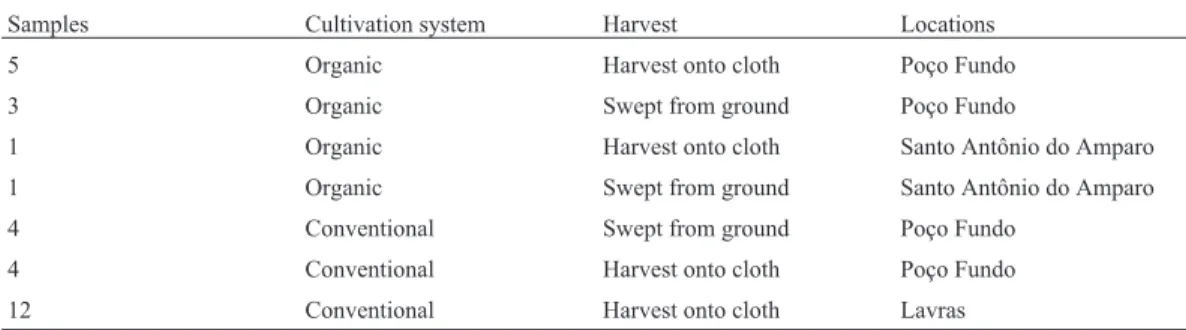
A total of 30 green coffee beans samples (Coffea arabic L.), harvest of the year 2009/2010, divided into 10-bean organic coffee sample and a 20-bean conventional coffee samples (Table 1). The samples were collected from the southern city of Minas Gerais - Brazil, (Poço Fundo: lat-itude -21°46’51”; longlat-itude -45°57’54”; altlat-itude 836 m); (Santo Antônio do Amparo: latitude -20°56’47”; longitude -44°55’08”; altitude 1013 m); (Lavras: latitude -21°14’43”; longitude -44°59’59”; altitude 919 m). These samples were analysed in the Laboratory of Food Microbiology - Mycol-ogy and Mycotoxins - Department of Food Science, Fed-eral University of Lavras (Lavras, MG, Brazil).
Mycological analysis
For isolation of fungi associated with green coffee beans, the direct plating technique was applied in DRBC medium - Dicloran Rose de Bengal Chloramphenicol (glu-cose 10.0 g; peptone 5.0 g; KH2PO41.0 g; MgSO4.7H2H 0.5 g; Agar 15.0 g; bengal rose 25.0 mg; dicloran 2.0 mg; chloramphenicol 100.0 mg; distilled water 1.0 L). A total of 100 coffee beans were plating directly without surface dis-infection and 100 beans were plated with surface
disinfec-Table 1- Studied coffee samples.
Samples Cultivation system Harvest Locations
5 Organic Harvest onto cloth Poço Fundo
3 Organic Swept from ground Poço Fundo
1 Organic Harvest onto cloth Santo Antônio do Amparo
1 Organic Swept from ground Santo Antônio do Amparo
4 Conventional Swept from ground Poço Fundo
4 Conventional Harvest onto cloth Poço Fundo
tion with 70% alcohol and 1% sodium hypochlorite accord-ing to Samsonet al.(2000). The plates were incubated for 5-7 days at 25 °C. The overall percent contamination was expressed as the percentage of particles yielding visible growth of fungi.
Isolation and identification of fungi
The isolated fungi were purified and identified ac-cording to Klich (2002), Frisvadet al.(2004) and Samson et al.(2004).
The isolates were incubated in CYA medium - Cza-pek yeast Agar (K2HPO41.0 g; concentrate Czapek NaNO3 30.0 g; KCl 5.0 g; MgSO4.7H2O 5.0 g; FeSO4.7H2O 0.1 g; ZnSO4.7H2O 0.1 g CuSO4.5H2O 0.05 g; distilled water 100mL) in MEA - Malt Extract Agar (malt extract 20.0 g; peptone 1.0 g; glucose 30.0 g; Agar 20 g; distilled water 1 L) at 25 °C and CYA at 25 °C and 37 °C. After incubation for 7 days, the microscopic and macroscopic characteristics described by Klich (2002b) were observed.
Determination of OTA-producing fungi by the plug agar method
The isolates tested were inoculated in YES medium -Yeast Extract Sucrose Agar (yeast extract 20.0 g; sucrose 150.0 g; Agar 20.0 g; MgSO4.7H2O 0.5 g; distilled water 1 L) with metallic solution 1 mL (ZnSO4.7H2O 1%; CuSO4.5H2O 0.5%) for 7 days at 25 °C, according to Filtenborg and Frisvad (1980). The following was used: ochratoxin A standard (Sigma-Aldrich), thin layer chomatography plates (Merk-Silica Gel 60, 20x20) as mo-bile phase; toluene, ethyl acetate and formic acid 90% (60:30:10 v/v/v). After eluition, the plates were air dried. Mycotoxin production was confirmed by green fluores-cence in ultraviolet light with l = 366 nm in
chroma-tovisor CAMAG (UF-BETRACHTER). The isolates considered as OTA producers presented an RF (refection factor) and a fluorescence spot similar to that of OTA standard.
Statistical analysis
To correlate the levels of OTA contamination with the different coffee samples, simple correspondence analy-sis was used, as described by Greenacre (1993). This tech-nique consists of applying the main components such as the contingency table, in this case, a table displaying the ochra-toxigenic fungi frequency in one line and the coffee sample in columns. The proportion of the coffee sample totals cor-responds to the profile of the variables displayed in the col-umn. Analogously, the profile for the variables lines is produced. For the comparison between the species Aspergillus Section Circumdati and Section Nigri in the two different cultivation systems, a simple descriptive anal-ysis of media was carried out.
Results and Discussion
From the samples analysed, 100% were contaminated by filamentous fungi and approximately 50% contamina-tion with yeasts. The main genera found in this study (Table 2) have also been reported in coffee beans in other researches carried out in Brazil and in other countries (Joostenet al., 2001; Pardo et al., 2004; Bokhari, 2007; Leonget al., 2007; Silvaet al., 2008; Batistaet al., 2009; Vilelaet al., 2010).
Analysing the samples plated without disinfection, the generaAspergillus was found in about 62.3% of the samples. TheAspergillusgenera was found in an incidence of 93% of coffee beans (Pardoet al., 2004), and was pre-dominant in coffee beans in the Saudi Arabia (Bokhari, 2007).
Aspergillus Section Circumdati and Nigri corre-sponded to 56.54% of the total of contaminant fungi of cof-fee beans. This result was similar to the of Batistaet al. (2003), who observed 54.78% for the same sections of the genera in Brazilian coffee beans. These two sections was responsible for 75% of the Vietnamese green coffee beans contamination (Leonget al., 2007). In this work, fungi of the generaAspergillusSectionCircumdaticorresponded to 27.29% and SectionNigri to29.25% of the contaminant fungi of the beans. In a study carried out by Batistaet al.
Table 2- Percentage of fungi found in conventional and organic cultivated system of coffee beans after plating with or without surface disinfection.
Fungi Organic system with
disinfection
Organic system without disinfection
Conventional system with disinfection
Conventional system without disinfection
Aspergillus sp 3.6 49.8 7.6 62.3
Cladosporium sp 0.9 0.08 6.9 5.0
Eurotium sp 0.24 0 0.4 1.8
Fusarium sp 53.1 33.3 28.5 24.1
Mucor sp 0.5 0 0 0.9
Penicillium sp 5.3 11.8 3.9 4.9
Rhizopus sp 0 0.3 0.7 0.2
(2009), 41% of the isolated identified belonged to Section Circumdatiand 25% to SectionNigri. Pardoet al.(2004) found 67.40% of beans, from different origins, infected withAspergillusSectionNigri. In the present study, we ob-served a uniform distribution of filamentous fungi of the generaAspergillusSectionCircumdati and SectionNigri among organic and conventional coffee samples (Figures 1 and 2; Tables 3 and 4). The uniform distribution of the fila-mentous fungi in coffee samples from different regions have also reported for Batistaet al.(2003). The presence of these fungi in coffee beans in Brazil is due to the geograph-ical distribution of this genus, including latitudes 26° - 35° Klich (2002a), as well as environmental conditions and type of coffee processing.
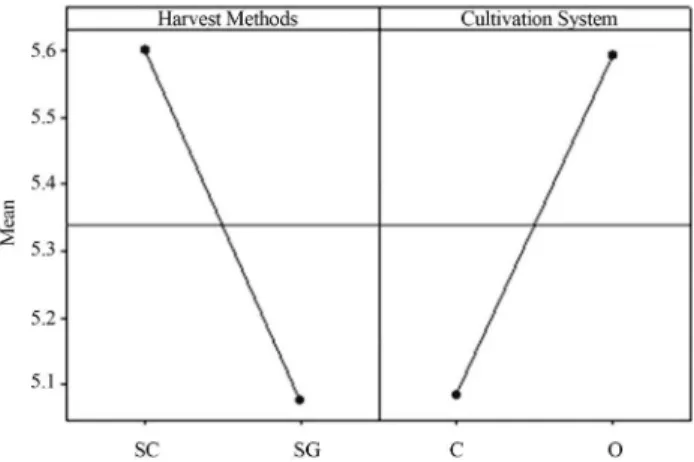
Figures 1 and 2 and Tables 3 and 4 shows the results of contaminations by genera Aspergillus Section Circumdatiand SectionNigriin coffee bean samples re-garding the cultivation system (conventional and organic). It was possible to observe that there were no significant dif-ferences. Regarding the harvesting type, the harvest on
cloth presented a significant difference for fungi of the gen-era Aspergillus SectionNigri. The harvesting system di-rectly affects the incidence of fungi in fruit and coffee beans (Batistaet al., 2009). The coffee berries harvest onto a cloth are fruits that were in the tree, which can be ripe, un-ripe or dried on the tree (Batistaet al., 2009); these fruits are exposed to more insulation.AspergillusSectionNigriare more resistant to UV light due to the spore colors, which confers a larger capacity of competition for the substrate, and can justify the presence of fungi of the genera Aspergillus Section Nigri onto the cloth (Abarca et al., 2003; Romeroet al., 2005; Duarteet al., 2010). The cloth used for harvest could also be contaminated with fungal spores of the genusAspergillusSectionNigri, and favors the contamination of coffee fruits and beans.
Of all the samples analysed, 480 isolates of the genus Aspergilluswere obtained and identified, based on the mor-phological characteristics. Of these isolates, 277 were of the genera Aspergillus Section Nigri and 203 Section Circumdati. Of the SectionCircumdati, the most common species, both for conventional and organic cultivation cof-fee wasA. ochraceus(n = 169) representing 35.20% of the total of isolates, a similar proportion as the ones reported in other studies with coffee fruits and beans (Batistaet al., 2003; Suarez-Quirozet al., 2004b; Silvaet al., 2008). Due to the special relevance of this species for coffee quality and safety, in function of its large distribution and toxigenic
Figure 1- Graphic of the main effects of the harvest method and type of
coffee factors averages for the fungi of genusAspergillusSectionNigri
(data transformed by the square root). SC - harvest onto cloth SG- swept from ground. C - conventional. O - organic.
Figure 2- Graphic of the main effects of type of coffee and harvest
method factors averages for fungi of the genus Aspergillus Section
Circumdati(data transformed by the square root). SC - Harvest onto cloth SG- swept from ground. C - conventional. O - organic.
Table 4- Variance analysis for the calculation of filamentous fungi of the
genusAspergillusSectionCircumdati.
VSa FDb SSc MSd Fe p-valuef
Harvest 1 1.071 1.071 0.19 0.672
Coffee 1 1.016 1.016 0.18 0.680
Coffee harvest* 1 0.007 0.007 0.00 0.973
Error 12 68.377 68.377
Total 15 70.811 70.811
OBS: Data transformed by the square root.aVS - Variation source.bFD
-Freedom degree.cSS - Sum of the squares.dMS - Mean square.eF - Test of
F.fp-value - Significance level.
Table 3- Variance analysis for the calculation of filamentous fungi of the
GenusAspergillusSectionNigri.
VSa FDb SSc MSd Fe p-valuef
Harvest 1 22.342 22.342 4.69 0.049
Coffee 1 4.935 4.935 1.04 0.329
Coffee harvest* 1 0.009 0.009 0.00 0.967
Error 12 57.136 4.761
Total 15 82.191
OBS: Data transformed by the square root.aVS - Variation source.bFD
potential, A. ochraceus has been the target of many re-searches with coffee beans and fruits (Silvaet al., 2000; Batistaet al., 2003; Taniwakiet al., 2003; Suarez-Quirozet al., 2004a; Vilelaet al., 2010).
Considering all the samples analysed, the most com-mon species of the genusAspergillusSectionNigriin the conventional cultivation system wasA. tubingensis with 42.70% of the isolates. In the organic cultivation system, the main species wasA. foetiduswith 35.80%. Noonimet al. (2008) isolated, identified and evaluated the ochrato-xigenic potential ofAspergillusspecies in coffee beans in two regions of Thailand, and they also found the non-ochratoxigenic speciesA. foetidusandA. tubingensisin the beans analysed. However, similar works with green coffee beans, only in the conventional cultivation system, were carried out in Brazil (Taniwakiet al., 2003) and in other countries, like Saudi Arabia (Bokhari, 2007), and Vietnam (Ilicet al., 2007; Leonget al., 2007). In all these studiesA. nigerpredominated.A. nigeris largely distributed in the environment (Urbanoet al., 2001) and is isolated not only from coffee beans, but also from other foods like grape and derivatives (Magnoliet al., 2003; Perroneet al., 2007). The concentration of ochratoxin A and ochratoxigenic Aspergillus species in grapes cultivated in conventional and organic system were analysed by Ponsoneet al.(2007). These authors observed that the presence of these fungi is not influenced by the cultivation system, but by the matura-tion stage of the fruits.
The other species found in this work have also been identified in other coffee researches, such asA. auricomus (19 isolates) andA. sulphureus (8 isolated), which have also been reported by Batistaet al.(2009),A. nigerandA. nigerAggregate reported by Silvaet al.(2008) and Batista et al.(2009).
All the 480 isolated were tested for the capacity of producing ochratoxin A with the Plug Agar technique. Considering the 30 coffee bean samples, the species A. ochraceuswas the main producer of this mycotoxin. Simi-lar results were found by Batistaet al.(2003).
Analysing the eight samples of coffee from the con-ventional cultivation and the eight samples of coffee from the organic cultivation, provenient from the Poço Fundo, it was possible to observe that of the 107 isolates of the genus AspergillusSectionCircumdati, 62.62% (n = 67) produced ochratoxin A (Table 5).
The values obtained in this study were close to the ones obtained by Batista et al. (2003), who identified 74.6% of the Section Circumdati species as ochratoxin A-producing, in conventional coffee beans. Of the ochra-toxin A-producing fungi, the major producer species wasA. ochraceus89.55% (Table 5). In the species ofA. auricomus andA. ostianuswe observed isolates capable of producing mycotoxin (Table 5) these species as potentially ochrato-xigenic also were reported by Batistaet al.(2003, 2009).
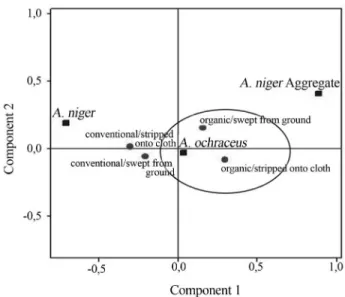
Although the correspondence analysis does not estab-lish the statistical significance of the associations and does not evaluate the independent effect of each characteristic, this analysis combines the advantages of non-linear and multi-dimensional methods, which allows the description of the characteristics that occur simultaneously in the cof-fee culture, and the identification of the different profiles of the ochratoxigenic species found. With the map (Figure 3) generated from the correspondence analysis, it was possi-ble to observe in the coffee samples from the Poço Fundo, thatA. ochraceus was the toxin-producing species found more often in both cultivation systems. The similarity of frequency of this species was notorious in both cultivation systems evaluated, as well as the harvest methods (harvest onto cloth and swept from the ground). Regarding the other species (A. nigerandA. nigerAggregate), we verified that no cultivation system or type of harvesting was character-ized according to the presence of the isolate.
Regarding the ochratoxin A-producing species re-ported by other authors, Batista et al. (2003) found A. ochraceusand A. sulphureusas the main species, while Pardoet al.(2004) found 23.1% of ochratoxin A-producing Aspergillus ochraceus. Urbanoet al.(2001) obtained the
Table 5- Identification of potentially toxigenic species and isolates. Sam-ples from the Poço Fundo.
GenusAspergillus
(number of same)
N. of isolates identified
N. of potentially toxigenicaisolates
Organic coffee (8) SectionCircumdati
A. auricomus 7 4
A. ochraceus 49 32
A.ostianus 1 1
A. sulphureus 2 ND
SectionNigri
A. foetidus 22 ND
A. niger 7 ND
A. nigerAggregate 10 2
A. tubingensis 12 ND
Conventional coffee (8) SectionCircumdati
A. auricomus ND ND
A. ochraceus 45 28
A. ostianus 2 2
A. sulphureus 1 ND
SectionNigri
A. foetidus 20 ND
A. niger 33 4
A. nigerAggregate 15 ND
A. tubingensis 13 ND
same results as the present work, with 88.1% of A. ochraceusproducers of the toxin. Batistaet al.(2009) ana-lysed ochratoxigenic fungi in coffee beans conventionally processed by dry and wet methods; of fungi of the genera AspergillusSectionCircumdati, 92.69% were identified as A. ochraceus and of these, 95% produced ochratoxin A. Taniwakiet al.(2003) found 75% of these species with ca-pacity of producing this toxin.
Besides these species reported as ochratoxin A-pro-ducing, recent studies also show that other species may be potentially producers of mycotoxin in coffee, like A. elegans,A. steyniiandA. westerdijkiae(Batistaet al., 2009; Gil-Sernaet al., 2011;Pradoet al., 2006). Gil-Sernaet al. (2011) stated that the species of A. steynii and A. westerdijkiae can represent a higher risk of producing ochratoxin A, due to their capacity of producing a great amount of it and the diversity of foods that these species may contaminate. However, these authors do not ignore the possibility thatA. elegans and A. ochraceus produce the same toxin.
Comparing the results of the coffee beans samples from the Poço Fundo, of the 132 isolates of the genera AspergillusSectionNigri,4.54% were capable of produc-ing ochratoxin A (Table 5). Pardoet al.(2004) found 7.3% of isolates of the SectionNigrias ochratoxin A producers, while Urbanoet al.(2001) found 11.5% in a similar study. In contrast with these results, Batistaet al.(2003; 2009) have not found any ochratoxigenic isolates of the Section Nigri.
Of the ochratoxin A-producing isolates belonging to SectionNigrianalysed in this work (Table 5), 10% wereA. niger(n = 4) and 8%A. nigerAggregate (n = 2). This result agrees with the one reported by Noonimet al.(2008), who found only 13% of the isolates ofA. nigeras ochratoxin A producers.
This research did not findA. carbonarius, which is described by other researchers as an important ochratoxin A-producing species.A. carbonariusis the species of the genus Aspergillus Section Nigri with the highest ochra-toxin A production potential (Pradoet al., 2004). However, it is not a common species of arabica coffee beans asA. niger(Noonimet al., 2008; Palacios-Cabeiraet al., 2005). This statement was reinforced by the studies of Taniwakiet al.(2003), who found 62.95% ofA. nigerand 6.19% ofA. carbonarius in coffee beans and identified as ochratoxi-genic only 3% of the isolates ofA. nigerwhile in the iso-lates ofA. carbonariusthis proportion was of 77%. That the contamination with A. carbonarius is slightly higher in robusta coffee than in arabica coffee (Pardoet al., 2004; Noonimet al., 2008).
The eventual divergence about ochratoxin A produc-tion by the genusAspergillussuggests that the synthesis of ochratoxin A is dependent on the interaction of several en-vironmental factors (Mühlencoertet al., 2004), more than the simple fact of growth, that is, the inability to produce ochratoxin A in determined conditions does not justify any conclusion about the general ability to produce the myco-toxin (Bakutiset al., 2006). The production of secondary metabolites such as mycotoxins are not essential for the mi-croorganism. The environmental factors will regulate the genes and enzymes involved in the production of ochra-toxin A (Mühlencoertet al., 2004).
Based on the results it was possible to observe that the organic and conventional coffee cultivation systems did not differ in terms of the contamination of beans by species of the genera Aspergillus Section Nigri and Section Circumdati. Likewise, there was no difference in terms of the occurrence ofA. ochraceus,which was the main ochra-toxigenic species found, which allows us to affirm that there is no influence of the cultivation system on the con-tamination by Aspergillus species, neither on the occur-rence of ochratoxigenic species that belong to this genus. Both cultivation systems present the same risks of contami-nation. Not all the isolates of theA. ochraceusspecies were ochratoxin A producers; however, just the presence of this ochratoxigenic species does not imply that the production of the mycotoxin will necessarily occur.
Acknowledgments
To Fundação de Amparo à Pesquisa do Estado de Minas Gerais (FAPEMIG) for the financial support (Pro-ject n. CBB-APQ - 00781-08).
References
Abarca ML, Accensi F, Bragulat MR, Castellá G, Cabañes FJ (2003)Aspergillus carbonariusas the main source of ochra-toxin A contamination in dried vine fruits from the Spanish market. J of Food Prot 66:504-506.
Bakutis B, Baliukoniene V, Lugauskas A (2006) Factos predeter-mining the abundance of fungi and mycotoxins in grain from organic and conventional farms. Ekologija 3:122-127. Batista LR, Chalfoun SM, Prado G, Schwan RF, Whealsa E
(2003) Toxigenic fungi associated with processed (green) coffee beans (Coffea arabica L.). Int J Food Microbiol 85:293-300.
Batista LR, Chalfoun SM, Silva CF, Cirillo M, Varga EA, Schwan RF (2009) Ochratoxin A in coffee beans (Coffea arabicaL.) processed by dry and wet methods. Food Control 20:784-790.
Bernnett JW, Klich M (2003) Mycotoxins. Clin Microbiol Rev 16:497-516.
Bokhari FM (2007) Mycotoxins and toxigenic fungi in arabic cof-fee beans in Saudi Arabia. Adv Biol Res 1:56-66.
Duarte SC, Pena A, Lino CM (2010) A review on ochratoxin A occurrence and effects of processing of cereal and cereal de-rived food products. Food Microbiol 27:187-198.
Filtenborg O, Frisvad JC (1980) A simple screening method for toxigenic molds in pure cultures. LebensWissen Technol 13:128-130.
Frisvad JC, Frank JM, Houbraken JAMP, Kuijpers AFA, Samson RA (2004) New ochratoxin A producing species of AspergillussectionCircumdati. Stud Mycol 50:23-43. Gil-Serna J, Vázquez C, Sardiñas N, González-Jaén MT, Patiño B
(2011) Revision of ochratoxin a production capacity by the main species ofAspergillusSectionCircumdati. Aspergillus steynii revealed as the main risk of OTA contamination. Food Control 22:343-345.
Greenacre M. Correspondence Analysis in Practice (1993) Aca-demic Press, New York.
IARC (1993) Monographs on the evaluation of carcinogenic risks to humans, some naturally occurring substances: Food items and constituents, heterocyclic aromatic amines, and myco-toxins. International Agency for Research on Cancer 56:489-521.
Ilic Z, Bui T, Tran-Dinh N, Dang MHV, Kennedy I, Carter D (2007) Survey of Vietnamese coffee beans for the presence of ochratoxigenic Aspergilli. Mycopathologia 163:177-182.
Jestoi M, Somma MV, Kouva M, Veijalainen P, Rizzo A, Ritieni A, Peltonen K (2004) Levels of mycotoxins and sample cytotoxicity of selected organic and conventional grain-based products purchased from Finnish and Italian markets. Mol Nutr Food Res 48:229-307.
Joosten HMLJ, Goetz J, Pittet A, Schellenberg M, Bucheli P (2001) Production of ochatoxin A by Aspergillus carbonariuson coffee cherries. Int J Food Microbiol 65:39-44.
Juan C, Moltó JC, Lino CM, Mañes J (2008) Determinaton of ochratoxin A in organic and non-organic cereals and cereal products from Spain and Portugal. Food Chem 107:525-530.
Klich MA (2002) Biogeography ofAspergillusspecies in soil and litter. Mycologia 94:21-27.
Klich MA (2002) Identification of CommonAspergillusspecies. Centraalbureau voor Schimmelautures, Netherlands.
Leong SL, Hien LT, An TV, Trang NT, Hocking AD, Scott ES (2007) Ochratoxin A-producing Aspergilli in Vietnamese green coffee beans. Lett Appl Microbiol 45:301-306. Magnoli C, Astoreca A, Ponsone L, Combina M, Palacio G, Rosa
CA, Dalcero AM (2003) Survey of mycoflora and ochra-toxin A in dried vine fruits from Argentina markes. Lett Appl Microbiol 37:179-184.
Mühlencoert E, Mayer I, Zapf MW, Vogel RF, Niessen L (2004) Production of ochratoxin A byAspergillus ochraceus. Eur J Plant Pathol 110:651-659.
Noonim P, Mahakarnchanakul W, Nielsen KF, Frisvad JC, Sam-son RA (2008) Isolation, identification and toxigenic poten-tial of ochratoxin A- producing Aspergillusspecies from coffee beans grown in two regions of Thailand. Int J Food Microbiol 128:197-202.
Palacios-Cabeira H, Taniwaki MH, Hashimoto JM, Menezes HC (2005) Growth of Aspergillus ochraceus, A. carbonarius and A. nigeron culture media at different water activities and temperatures. Braz J Microbiol 36:24-28.
Pardo E, Marín S, Ramos AJ, Sanchis V (2004) Occurrence of ochratoxigenic fungi and ochratoxin A in green coffee from diferent origins. Food Science Technol Int 10:45-50. Pardo E, Sanchis V, Ramos AJ, Marín S (2006) Non-specificity of
nutritional substrate for ochratoxin A production by isolates ofAspergillus ochraceus. Food Microbiol 23:351-358. Paterson RRM, Lima N (2010) How will climate change affect
mycotoxins in food? Food Res Int 43:1902-1914.
Perrone G, Susca A, Cozzi G, Ehrlich J, Varga JC, Frisvad M, Meijer A, Noonim P, Mahakarnchanakul W, Samson RA (2007) Biodiversity ofAspergillusspecies in some impor-tant agricultural products. Stud Mycol 59:53-66.
Ponsone ML, Combina M, Dalcero A, Chulze S (2007) Ochra-toxin A and ochratoxigenicAspergillusspecies in Argentin-ean wine grapes cultivated under organic and non-organic systems. Int J Food Microbiol 114:131-135.
Romero SM, Comerio RM, Larumbe G, Ritieni A, Vaamonde G, Fernández Pinto V (2005) Toxigenic fungi isolated from dried vine fruits in Argentina. Int J Food Microbiol 104:43-49.
Samson RA, Hoekstra ES, Frisvad JC, Filtenborg O (2000) Intro-duction to Food- and Airborne Fungi. Voor Schimmelcul-tures Baarn Delft, Centraalbureau.
Samson RA, Houbraken JAMP, Kuijpers AFA, Frank M, Frisvad JC (2004) New ochratoxin A or sclerotium producing spe-cies inAspergillusSectionNigri. Stud Mycol 50:45-61. Silva CF, Schwan RF, Dias ES, Wheals AE (2000) Microbial
di-versity during maturation and natural producessing of coffee cherries ofCoffea arabicain Brazil. Int J Food Microbiol 60:251-260.
Silva CF, Batista LB, Schwan RF (2008) Incidence and distribu-tion of filamentous fungi during fermentadistribu-tion, drying and storage of coffee (Coffea arabicaL.) beans. Braz J Micro-biol 39:521-526.
Suarez-Quiroz M, Gonzáles-Rios O, Barel M, Guyot B, Schorr-Galindo S, Guiraud, JP (2004 b) Study of ochratoxin A-pro-ducing strains in coffee processing. Int J Food Sci Technol 39:501-507.
Taniwaki MH, Pitt JI, Teixeira AA, Iamanaka BT (2003) The source of ochratoxin A in Brazilian coffee and its formation in relation to processing methods. Int J Food Microbiol 82:173-179.
Theodoro CGC, Guimarães JBC (2003) Avaliação do estado nutricional de agrosistemas de café orgânico no estado de Minas Gerais. Ciênc Agrotec 27:1222-1230.
Urbano GR, Taniwaki MH, Leitão MF, Vicentini MG (2001) Oc-currence of ochratoxin A-production fungi in raw Brazilian coffee. J Food Protect 64:1226-1230.
Vilela DM, Pereira GV, Silva CF, Batista R, Schwan RF (2010) Molecular ecology and polyphasic characterization of the microbiota associated with semi-dry processed coffee (Coffea arabicaL.). Food Microbiol 27:1128-1135.